Links & Quotes

Hey, leaders, let me ask you a simple question: Is your workplace a safe place for people to make mistakes? It should be or else we will be limiting the potential of both our teammates and our whole organization. Greg and I unpack this in greater detail in this episode.

I have a lot of new video content on my YouTube channel every week. Please check it out and subscribe so you don’t miss anything.

“You yearn for a simplified lifestyle, so that your communication with Me can be uninterrupted. But I challenge you to relinquish the fantasy of an uncluttered world. Accept each day just as it comes, and find Me in the midst of it all. … Remember that your ultimate goal is not to control or fix everything around you; it is to keep communing with Me. A successful day is one in which you have stayed in touch with Me, even if many things remain undone at the end of the day. Do not let your to-do list (written or mental) become an idol directing your life. Instead, ask My Spirit to guide you moment by moment.” —Sarah Young, Jesus Calling [1 Thessalonians 5:17; Proverbs 3:6]

“God is God, and since He is God, He is worthy of my worship and my service. I will find rest nowhere else but in His will, and that will is necessarily infinitely, immeasurably, unspeakably beyond my largest notions of what He is up to.” —Elizabeth Elliot 

“If you want to lift yourself up, lift up someone else.” —Booker T. Washington 

As I have mentioned previously, T.M. Moore and I share the conviction that pastors are called by God to shepherd the sheep God has placed under their care. Moore writes, “Jesus indicated six disciplines that shepherds must master in leading His churches.” Check out this post where he outlines these six disciplines.

Pornography adversely effects the viewer’s brain, leading to a growing list of physical and emotional problems. Check out this post from Fight The New Drug, in which they report, “No matter what you believe about porn, ‘what is undeniable is that we’re consuming far more of it than at any point in human history, and the effects of this are yet to fully register.’”

I have always loved the fact of God’s laughter—the perfect joy He has must be expressed in perfect laughter! David Mathis writes about the encouragement in God’s laugh: “One way to enjoy the smile of our fiercely happy Father is to tune your ears to the wonders of His laughter.”

Scientists took a cubic millimeter of a mouse’s brain and mapped out the neurons and connections. The result is astounding! In Nature, they wrote, “A cubic millimetre might not sound like much—roughly the size of a grain of sand—but to neuroscientists, it is enormous. One cubic millimetre of a mammalian brain contains tens of thousands of neurons with hundreds of millions of connections, or synapses, between them.” Can you imagine what the human brain is like?! How amazing is our Creator! 

“Fairy tales do not tell children the dragons exist. Children already know that dragons exist. Fairy tales tell children the dragons can be killed.” —G.K. Chesterton 

Links & Quotes

Having too many items listed as “priorities” on your To Do list can actually paralyze you. You have keep your list manageable to keep your leadership effective. Check out the full conversation Greg and I had on setting goals and making changes. This is also an important aspect of maintaining good mental health.

I have lots of new content every week, which you can check out on my YouTube channel.

According to Leslie T. Lyall, the secret of Hudson Taylor’s life and ministry could be summed up in four simple propositions: “There is a living God. He has spoken in His Word. He means what he says. And He is willing and able to perform what He has promised.”

“Hard times create strong men. Strong men create good times. Good times create weak men. And, weak men create hard times.” —G. Michael Hopf

In lamenting the rise of worldliness in our churches, John Piper said, “About forty years ago, David Wells wrote a book called No Place for Truth, which made the case that in the American church, God rests far too lightly on the people of God. He doesn’t have weight. It was the same heart cry from Dr. Wells as from J.B. Phillips. God is marginal. God has little weight in our worship services and little weight in our lives. He’s taken lightly. He’s simply one among many factors rather than the all-consuming factor, and I have thought that if I were to write a book today with a similar burden, it might have this title: Your Christ Is Too Cheap, Your Heaven Is Too Distant, Your Earth Is Too Big.”

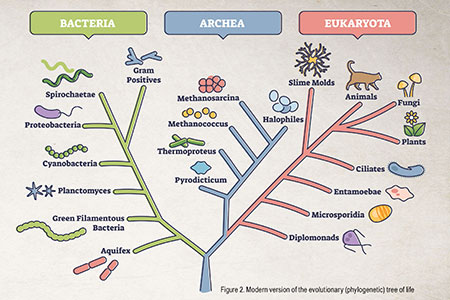
The Institute for Creation Research reported, “In July of 2024, Science magazine confidently reported, ‘The last ancestor shared by all living organisms was a microbe that lived 4.2 billion years ago, had a fairly large genome encoding some 2600 proteins, enjoyed a diet of hydrogen gas and carbon dioxide, and harbored a rudimentary immune system for fighting off viral invaders.’ That’s quite a statement that details an unknown creature living somewhere on this planet 4.2 billion years ago.” Of course, this is an unobservable, unprovable claim, but that’s part and parcel of the evolutionists’ claims. 

Fight The New Drug explains what sextortion is and how to protect yourself and your family from this insidious online threat.

“What we do on some great occasion will probably depend on what we already are; and what we are will be the result of previous years of self-discipline.” —H.P. Liddon, nineteenth-century theologian 

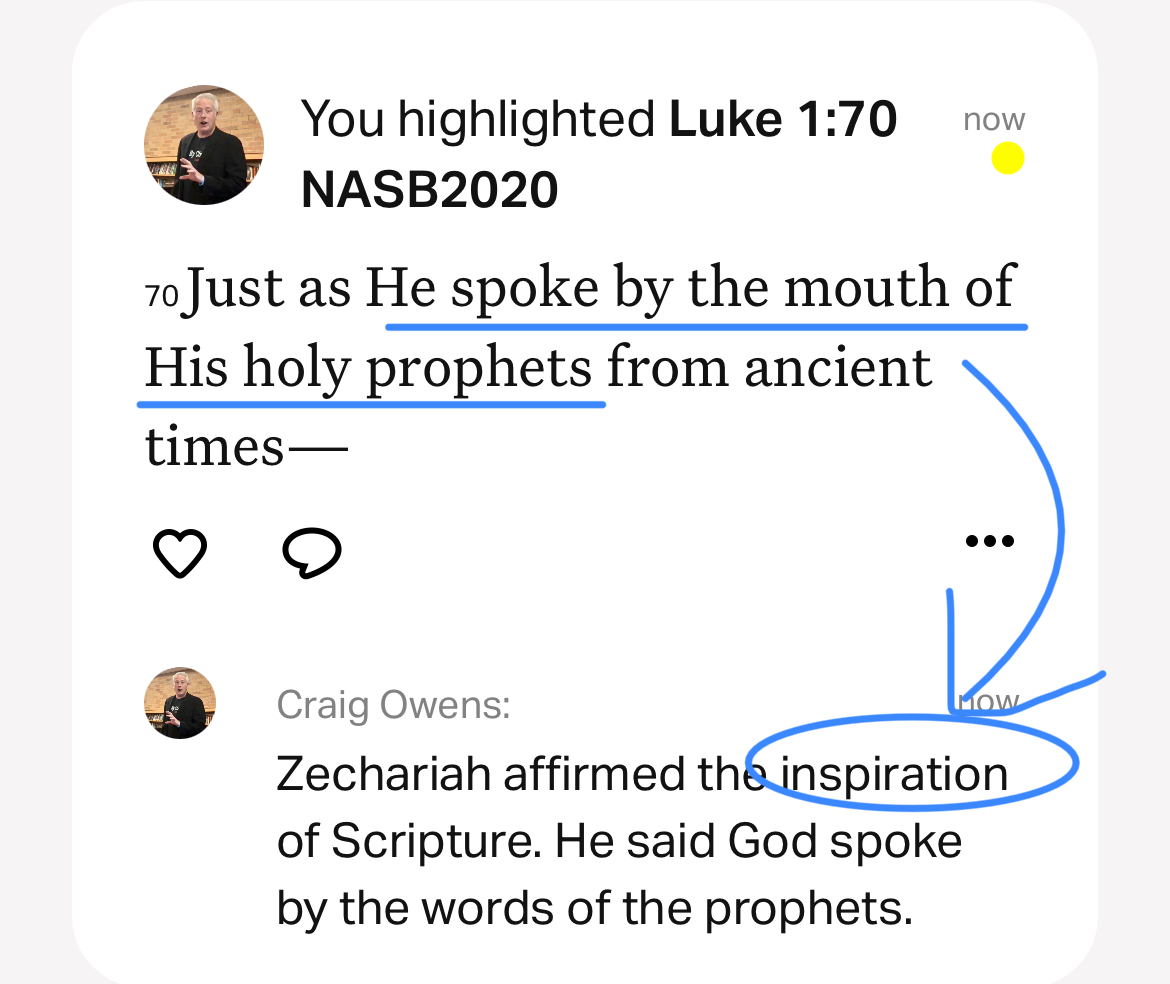
Lenny Esposito has a great podcast for Christian apologists called the Come Let Us Reason podcast. On a recent episode, Lenny used a passage in the Book of Jeremiah to talk about the inspiration of Scripture.

“God will work when He pleases, how He pleases, and by what means He pleases. He is not bound to keep our time, but He will perform His word, honor our faith, and reward them that diligently seek Him.” —Matthew Henry 

As the first Christian church dealt with a serious complaint that could have split the church internally, there are a number of leadership gifts that are in play to provide a wise solution. Most of these leadership gifts get overlooked by the casual observer, but they are all absolutely indispensable. This is new exclusive content I regularly share with my Patreon supporters. Would you prayerfully consider supporting this ministry?

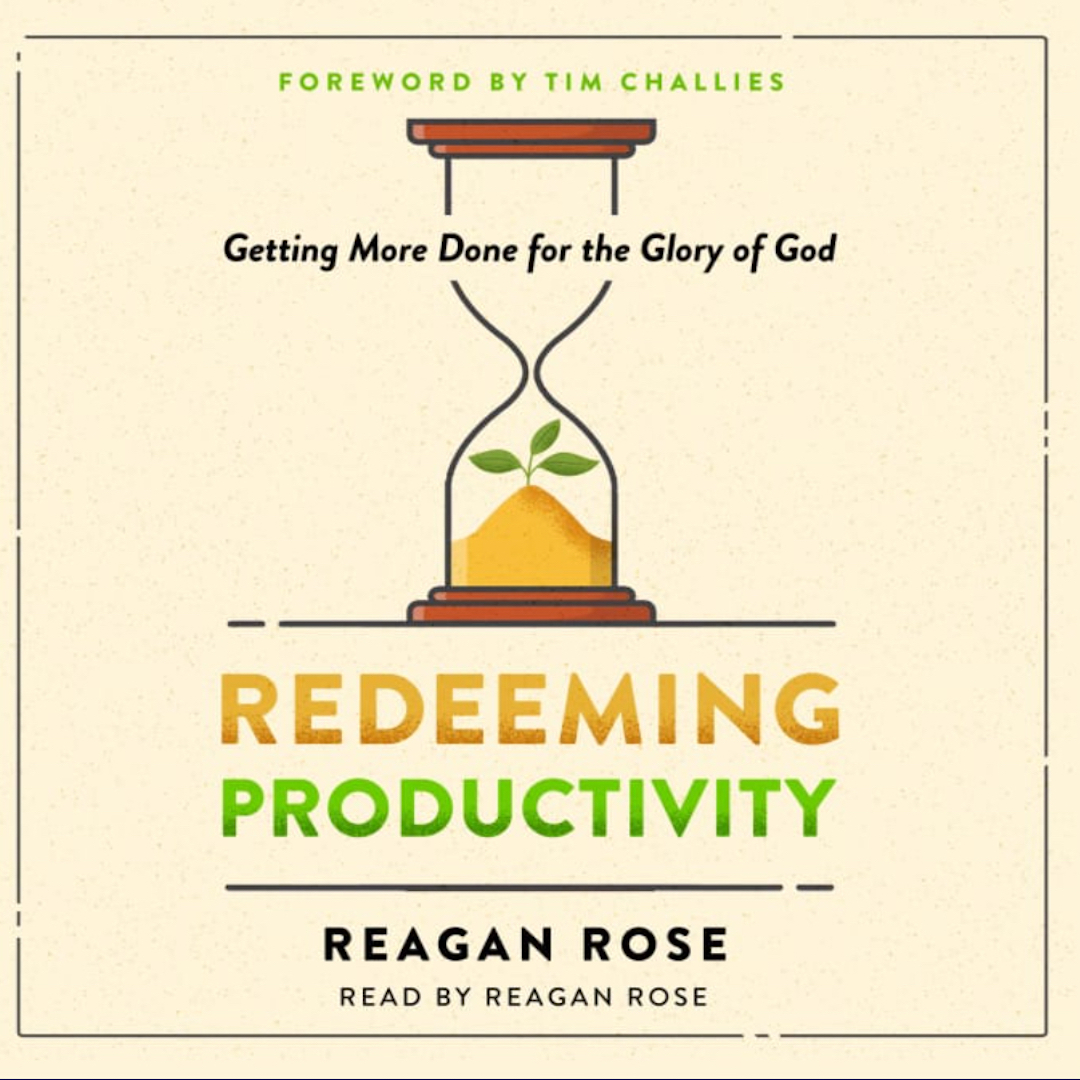
Redeeming Productivity (book review)

Listen to the podcast of this post by clicking on the player below, and you can also subscribe on AppleSpotify, or Audible. 

The other day someone messaged me on LinkedIn to ask about any projects I had in the works. After I got done rattling off several things on which I’m working, he asked, “How did you find the time to get so much done?” I love being productive, and Regan Rose’s book Redeeming Productivity is a huge help. 

I need to start off by stating that getting a lot done is not the same thing as getting the right things done right. My podcast cohost Greg and I recently talked about how too many “To Do” items can negatively impact a leader’s effectiveness. 

Redeeming Productivity is written from a biblical worldview. I really resonated with Reagan’s focus on why Christians should be productive, more so than an emphasis on what things should we be accomplishing. The “what to do” is as important as the “how to do them.” But neither of those are as important as the “why do we do what we do.” 

Reagan unpacks some powerful strategies for effectiveness and efficiency, but what I really appreciated were the principles he shared on why we are to be effective—diving deep into what the Bible say about this important topic. The subtitle of his book is: “Getting more done for the glory of God.” 

So whether you are wanting to make some changes to your productivity, or you desire to improve the current systems you already have in place, I would highly recommend Redeeming Productivity to you. The Bible calls on Christians to work at all we do with excellence, and this book will help you do just that.

(Check out The Craig and Greg Show where we discuss efficient quantity and effective quality.)

►► Would you please prayerfully consider supporting this ministry? My Patreon supporters get behind-the-scenes access to exclusive materials. ◀︎◀︎

Avoiding The Bad Days

Listen to the podcast of this post by clicking on the player below, and you can also subscribe on AppleSpotify, or Audible. 

Would you like to avoid having a bad day? I have the solution for you!

Check out this episode of The Podcast.

Resources mentioned in this video:

►► Would you please prayerfully consider supporting this ministry? My Patreon supporters get behind-the-scenes access to exclusive materials. ◀︎◀︎

How I Learned To Stop Sabotaging My Sabbath

Listen to the podcast of this post by clicking on the player below, and you can also subscribe on AppleSpotify, or Audible. 

We all know that it’s impossible for a leader to be “on” 24 hours a day, seven days per week. Yet many leaders continue to operate as though they are supposed to be “on” all the time. The Bible not only calls for us to take a Sabbath rest, but it is something that God Himself demonstrated for us. 

I enjoyed my time on the Thriving In Ministry podcast with Kyle Willis while his podcast partner Dace Clifton was on sabbatical. Kyle and I didn’t plan this, but he mentioned a passage from Hebrews 4 that the Holy Spirit used years ago to get my attention. 

I would make my plans for a day off, or even a break in the middle of a busy day, only to find myself allowing work to consume that time. I was sabotaging my sabbath time until I saw three life-changing words in Hebrews 4:10. 

It is a very humbling thing to recognize that it is “my own work” that is sabotaging my sabbath rest. God is aware of my need for sabbathing, but I have to submit my plans to His plan. As I mentioned in this interview, and in a previous blog post, writing “ITLW” at the top of my daily To Do list has helped me immensely. It is a reminder to me that God knows what I need to be doing, with whom I need to be speaking, and what ministry needs to be accomplished each day far, far better than I ever could. I must listen to the Holy Spirit and submit “my own work” to God’s will. 

I talk about some other strategies that helped me in this area in my book Shepherd Leadership. It is a part of a 5-chapter section where I discuss how leaders can achieve wholly healthiness—mental, physical, spiritual, and relational health. I hope you will pick up a copy for yourself.

I’ll be sharing more clips from this Thriving In Ministry interview soon, so please stay tuned. Shepherd Leadership: The Metrics That Really Matter is available in print or ebook, and in audiobook through either Audible or Apple. 

►► Would you please prayerfully consider supporting this ministry? My Patreon supporters get behind-the-scenes access to exclusive materials. ◀︎◀︎
The Craig And Greg Show: A Leader’s Top Priority

Listen to the audio-only version of this podcast by clicking on the player below, or scroll down to watch the video.

On this episode of “The Craig And Greg Show” we talk about: 

  • [0:38] What are the origins of the word “priority” and why should priority be singular and not plural? 
  • [0:56] Is it true that multi-tasking increases efficiency? 
  • [2:52] Greg tells a story about shopping with his parents.
  • [3:55] Greg reminds us that the devil uses distraction as a tool.
  • [5:04] I talk about how leaders should set their first priority.
  • [6:32] Why is it so hard to invest in unavailable people?
  • [7:58] I explain how leaders can make time for their “have to” list.
  • [9:58] Greg loves “StrengthFinders” and how it helps leaders learn to work in their strength zone.
  • [10:52] We discuss the book No Is A Beautiful Word.
  • [12:42] How can leaders use the priority vs. priorities paradigm to create margin in their life?
  • [14:36] We throw out the “Not-To-Do List Challenge” for leaders.

Check out this episode and subscribe on YouTube so you can watch all of the upcoming episodes. You can also listen to our podcast on Spotify and Apple.

“These Things”

Listen to the podcast of this post by clicking on the player below, and you can also subscribe on Apple or Spotify.

…whoever does these things will never be shaken (Psalm 15:5). 

David says “these things” are what allow us to come into God’s presence, but we cannot consistently nor completely do “these things” without the help that can only come from being in God’s presence. So I have to already be doing “these things” in order to get into His presence in order to get empowered to do “these things”?! 

That seems like a classic, no-win, Catch-22! 

So… how do I get into God’s presence in the first place?

Simple: I can’t. 

Only Jesus can. 

Thankfully, He made it possible for me to come in: He became the Door! 

Only by Jesus can I come in. Only in Jesus can I be empowered. Only with Jesus can I consistently do “these things.” 

What are “these things” that David listed that both allow me to come into God’s presence and then keep me in God’s presence? David said we must…

  1. …walk blamelessly before God. Or as Jesus said, “Be perfect, therefore, as your heavenly Father is perfect” (Matthew 5:48). I am blameless in God’s sight only when I am in Jesus.  
  2. …speak truthfully: from the heart, no slander on my tongue, no unkind words in my mouth, no gossip on my lips. 
  3. …live courageously: honoring what is good and opposing what is evil. 
  4. …keep my oaths: making my yes mean yes, not making any excuses, helping others to do the same. 

“These things” both glorify God and keep me in God’s presence. And “these things” attract others to His presence too. But I don’t try to do “these things” in my own strength—that would make me God—nor just as a religious To-Do List—that would make me a Pharisee. But I take a cue from the apostle Paul—

But whatever I am now, it is all because God poured out His special favor on me—and not without results. For I have worked harder than any of the other apostles; yet it was not I but God who was working through me by His grace (1 Corinthians 15:10). 

It is grace—a free gift of God—that enables me to do “these things” not in my own strength, but in His strength! 

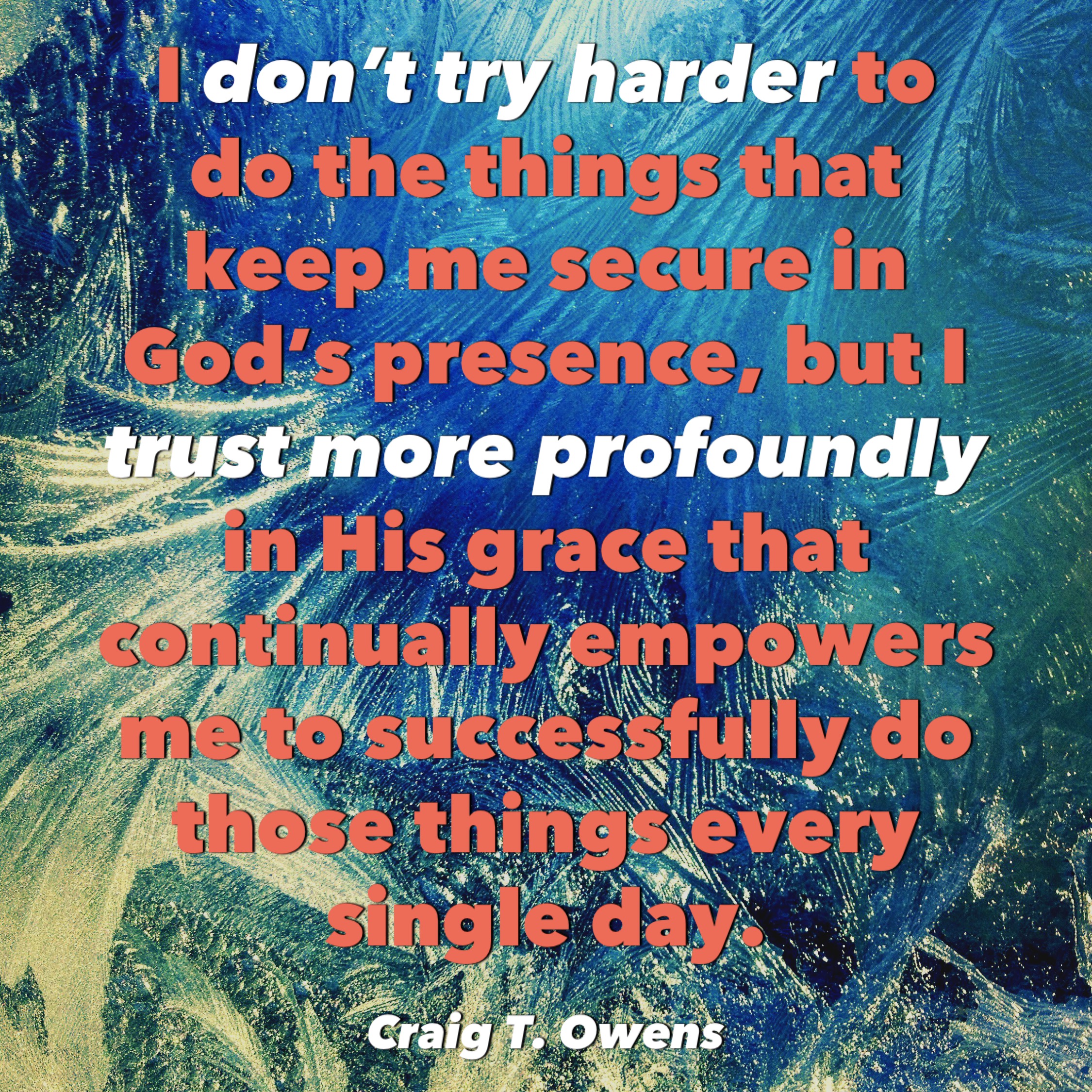
I don’t try harder to do “these things” that keep me secure in God’s presence, but I trust more profoundly in His grace that continually empowers me to successfully do “these things” every single day.

Run To Wait

My wife is a fan of the TV show (and movie) Downton Abbey, which means I have come to appreciate it as well. I think Mr. Carson, the head butler, gives us some great insight into a Christian’s prayer relationship with God. 

Mr. Carson has a lot to oversee with the house, the staff, and the needs of the family members and their guests. Everything needs to be tidy and ready at all times for both important guests and the Grantham family. That means Mr. Carson has to have a schedule and routine for everything. 

He doesn’t get up in the morning and sit around waiting for someone to tell him what to do—he gets up and gets to work. He’s a busy man with a lot of responsibilities. But can you imagine if Lord or Lady Grantham came to him with a request and he responded, “Not now, I’m too busy with my To Do list”? No way! He’s their servant, so he quickly responds, “Yes, my lord.” 

Christians can so busy and hurried with our own “To Do list” that we miss out on what’s really important. As Rick Warren then noted, “Hurry is the death of prayer!” 

The dictionary defines hurry as acting in haste, usually in a state of urgency, or feeling rushed. Notice the word “urgency” in the definition. Far too often we confuse urgent things and important things. It’s not that what we’re busy with are bad things, but perhaps we are busy with things that are keeping us blind to the important things. 

Long before Mr. Carson, there was another notable servant named Abraham (Genesis 18:1-8). God showed up and Abraham wanted to be in His presence. So notice that Abraham had to run to wait to God’s presence—the narrative uses words like hurried, “quick” and ran.  

Abraham was quick to get into God’s presence SO THAT he could linger in God’s presencehe stood near Them under a tree: that’s the posture of a servant-in-waiting. 

In the NIV translation, the text says Abraham hurried, but almost every other translation says he ran to meet Them—this is an important distinction. Hurry speaks to things that are urgent, but run speaks to things that are important. 

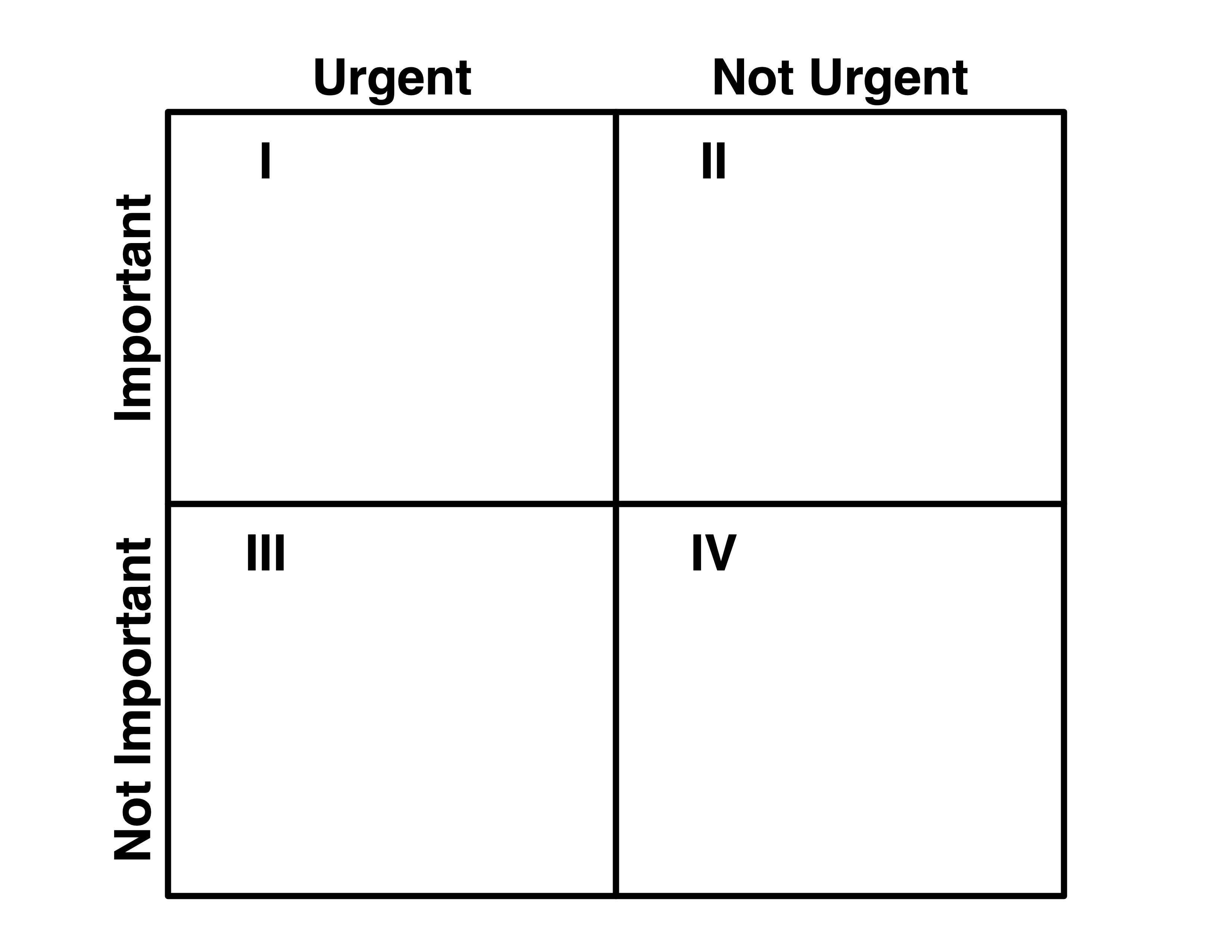
Stephen Covey has a great diagram that helps us identify four important quadrants in our life:

As you place items from your life on this grid, our Prayer Coach—the Holy Spirit—can help us identify the time-wasters. The key is to find time to wait in prayer. The best place to make time for Quadrant II prayer comes from Quadrant IV. As you eliminate those time-wasters, you will be able to spend health-enhancing time in prayer, worship, planning, and self-care in Quadrant II. This will also better equip you to handle the Quadrant I crises as they appear.

Ultimately, like Mr. Carson, we need to be both proactive with our schedule and responsive to the requests of our Lord. A good daily posture for all of us is “If the Lord wills” (James 4:13-17). But we have to not be so distracted with unimportant things that we can hear what God is speaking to our hearts.

Please join me next week as we continue to uncover things that could derail our regular prayer times, and then strategize a plan for dealing with them.  

4 Tips For Making Better Goals

1 Corinthians 10.31I have noticed a lot of similarities between the September back-to-school rush, and New Year’s Day. Except instead of resolutions, in the fall most people set new goals, or try to readjust their schedules to take advantage of a new season.

This is an excellent idea, and the perfect time to do it.

In a psalm written by Moses, he tells us to understand the value of our days, and be as wise as we can with what we do with each day God has given us (Psalm 90:12).

The Apostle Paul echoes these thoughts:

Be very careful, then, how do you live—not as unwise but as wise, making the most of every opportunity, because the days are evil. Therefore do not be foolish, but understand what the Lord’s will is. (Ephesians 5:15-17)

One way for us to make the most of every day is to wisely set some goals. Here are four tips that I’ve discovered to help me.

(1) The fewer the goals, the better.

Craig Groeschel said, “To do more things, do less things better.” I totally agree. I would suggest limiting yourself to just 1-2 goals at a time. Then put these one or two goals on your calendar first. In other words: Don’t prioritize your schedule, but schedule your priorities.

(2) Don’t fall into the sacred/secular trap.

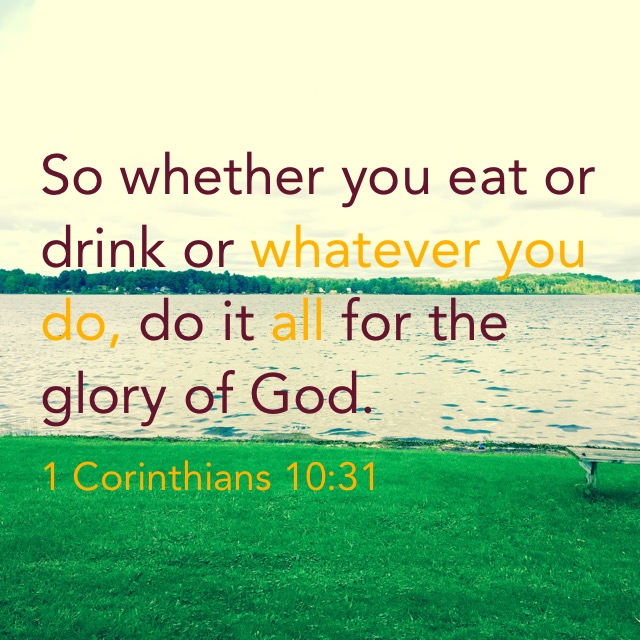
So many people—even Christians—think that there are spiritual goals and non-spiritual goals. But the Bible says, “So whether you eat or drink or whatever you do, do it all for the glory of God” (1 Corinthians 10:31). Every goal you set is a spiritual goal, because every goal should help you live your life wisely, in a way that honors and glorifies God.

(3) Make your goals S.M.A.R.T.

You may have heard these before, but I really like to use them. Make your goals:

  • Specific—not “I want to eat better” but “I want to eat two servings of fruits or vegetables each day.”
  • Measurable—have a way to track your progress toward your goal. How many pages did you read? how many calories did you eat? how many minutes did you work out?
  • Achievable—don’t set a goal to run 5 miles a day if you’ve only been a couch potato. Ramp your goals up little by little in a way that’s achievable for you.
  • Relevant—I like to ask a “so that?” question about each of my goals in make sure it’s moving me forward. “I want to exercise for 20 minute three times per week, so that my blood pressure comes down, so that I can live medicine-free, so that I can….” I think you get the idea. Keep going to make sure your goal is relevant for your life.
  • Time to review—set a date to revisit your goals and see if you need to adjust anything.

(4) Make a “stop doing” list.

You cannot do everything, so focus on the important, not the urgent. And remember not everything can stay on your calendar. For instance, if you want to read more in the evenings, you may have to eliminate some TV time; if you want to exercise in the mornings, you may have to eliminate that second cup of coffee.

Just a couple of verses after Moses challenges us to make the most of every day God has given us, he asks God for His helpMay the favor of the Lord our God rest upon us; establish the work of our hands for usyes, establish the work of our hands.

May God give you wisdom as you make new goals, and may He bless the work of your hands as you implement your new strategies.

Confession: I Struggle With Being An Atheist

ITLWYou see, I love my day to be highly organized. I like to get to all my meetings on time, and then have them run smoothly and efficiently. I like to setup my To Do list, and then methodically check off each item as I go through my day. I like to be in charge of my day.

I am an atheist.

I’m the one calling the shots. I set my agenda. I determine my day. I decide who to see and what project to accept.

There was a guy that Jesus talked about who did the exact same thing. This guy thought to himself and talked to himself all about his plans. Seriously, in just three verses he says me/I/my a dozen times (Luke 12:17-19)!

But God said, “You fool!” The word for fool means without mind. He didn’t mind his mind. He thought the thoughts he wanted to think, without ever consulting anyone else. Not even God.

Jesus made prayer a priority every day (Mark 1:35). What do you think He prayed? Do you think He said, “Here’s what I’m going to do today, and I want You to bless it, Father”? No way!

When Jesus taught us to pray He said, Your kingdom come, Your will be done” (Matthew 6:9-13). Not only did Jesus pray this way, He lived this way too. He didn’t do a single thing unless His Father directed Him to do it (John 6:38), and He didn’t say a single word unless His Father directed Him to say it (John 12:49).

The problem is not going into my prayer closet to meet with God in the morning, the problem is thinking I can leave God in the closet as I go about my day! That is atheism!

The Apostle James gave us this sound counsel: Instead of making my plans all on my own, I should say, “If the Lord wills, this is what I will do today” (James 4:13-17). And wise King Solomon said I shouldn’t lean on my own thoughts when planning my days, but lean onto God, and then watch to see how He will direct my life in the right way (Proverbs 3:5-6).

I’ve begun writing I.T.L.W. on the top of my daily calendar. It’s my reminder to say, “If The Lord Wills” this is what I will do today. And if something else comes up, I quickly acknowledge that God is directing my path where He needs me to go.

Your Kingdom come means my kingdom has to go. Your will be done means my agenda takes a distant second.

If you’re feeling stressed about your schedule, that should be your reminder to pray: “God, what do you want to have done here.” Silence the atheistic thoughts that sound like, “I have to get my list done.” Stop and pray right there on the spot.

Here’s the full video of my message on this topic—

We will be continuing our series called Practical Prayer this Sunday. If you don’t have a home church in Cedar Springs, please come be our guest. Or you can tune into our live broadcast via Periscope.