Links & Quotes

You are more likely to act yourself into good feelings than you are to feel yourself into action. Leaders need to get moving and keep moving! Check out this full conversation from The Craig and Greg Show.

I have lots of new content every week, which you can check out on my YouTube channel.

In news that’s not surprising at all, many recent paleontological discoveries confirm to exactly what would be expected if we take the biblical account of Creation and a global Flood literally.

John Piper was asked to weigh-in on the value of repetitive phrases in worship songs. He said, “The issue’s not repetition per se but whether there is enough substance, enough rich content of truth about God woven into the repetitions to justify them, to warrant them. That’s the issue. There’s a difference between repetitions that are called forth by the repeated crescendo of new, glorious truth, and repetitions that serve as a kind of mantra without sufficient truth that is simply used to sustain or intensify a mood. Moods in worship should be awakened and sustained primarily by truth, assisted by music—not primarily by music with a little truth thrown in to justify the singing.”

Pastor John Piper used Psalm 136 as an example in the post above. T.M. Moore also shared this thought about Psalm 136: “The term most frequently used to describe this everywhere-present-and-always-at-work love of God is translated as ‘lovingkindness’ or, in some versions, ‘steadfast love.’ Especially Psalm 136, with its antiphonal arrangement of verses, insists that the cosmos is upheld, sustained, and pervaded by the lovingkindness of God. … It would improve our learning to pray without ceasing if we simply took some time out during the day to thank the Lord for the many ways His steadfast love surrounds, sustains, and swarms us at every moment!”

“When people refer to a man as a man of the Book, meaning the Bible, he’s generally found to be a man of multitudinous books, which simply isolates the one Book to its proper grandeur. The man who reads only the Bible does not as a rule know it or human life.” —Oswald Chambers

Men’s Health magazine shared an interview with Jeremy Renner, who was nearly killed in a tragic accident. I love his attitude about making today better than yesterday. His words remind me of a poem my grandma used to use to motivate me to keep “besting” what I had already done.

Christopher Ash writes about reading the Psalms through the lens of Jesus. He concludes this way: “I remember seeing on the wall of a church the words of Psalm 20:4: ‘May [the Lord] grant you your heart’s desire and fulfill all your plans!’ How wonderful, you might think. The Bible promises me all that my heart desires. Until you read the psalm and realize that Psalm 20 is a prayer for the king in David’s line. Ultimately, it is a prayer that Jesus will have His heart’s desire granted and that His plans will be fulfilled. And they will! The Psalms are not all about me. If I think they are, I will end up disillusioned. But when I grasp that they are all about Christ, my heart lifts in joy that He is the blessed Man and I belong to Him.”
Gratitude Is A Sword

Listen to the podcast of this post by clicking on the player below, and you can also subscribe on AppleSpotify, or Audible. 

It would be nice if complainers were satisfied just complaining to themselves, but they’re not. Do you know the cliché misery loves company? It’s just as true for complainers: They really want others to join them in their bellyaching! 

I think a good word for what these negative people do is ambush. The dictionary says that means to lie in wait with hostile intent. Jesus told His followers that this ambushing behavior was going to happen. In Luke 6:22, He uses the word “when” not “if”—

Blessed are you when people hate you, when they exclude you and insult you and reject your name as evil, because of the Son of Man. 

We see this vividly portrayed in the life of Daniel. This man had done nothing but helpful things since the moment he arrived in Babylon. He faithfully served foreign kings, never wanted any recognition for himself, saved lives, interpreted dreams, and explained confusing things. He had a great work ethic and impeccable integrity. But the complainers still wanted to ambush him (see Daniel 6:1-5). 

One psalmist described these ambushers in terms of a hunting lion: His mouth is full of lies and threats; trouble and evil are under his tongue. He lies in wait near the villages; from ambush he murders the innocent. His eyes watch in secret for his victims (Psalm 10:7-8). 

Doesn’t this sound like what the devil does too? Be alert and of sober mind. Your enemy the devil prowls around like a roaring lion looking for someone to devour (1 Peter 5:8). 

I already shared with you that gratitude is our shield for defense, but the Bible tells us that gratitude is also our sword for offense! 

Jerusalem was surrounded by three armies that were lying in wait to ambush the Israelites. After God told the people of Jerusalem that He would deliver them, King Jehoshaphat sent out his army with the worshippers at the front of the ranks. Then listen to how worship not only thwarted the ambushers but boomeranged their evil plans back on themselves—

As they began to sing and praise, the Lord set ambushes against the men of Ammon and Moab and Mount Seir who were invading Judah, and they were defeated. The Ammonites and Moabites rose up against the men from Mount Seir to destroy and annihilate them. After they finished slaughtering the men from Seir, they helped to destroy one another. (2 Chronicles 20:22-23) 

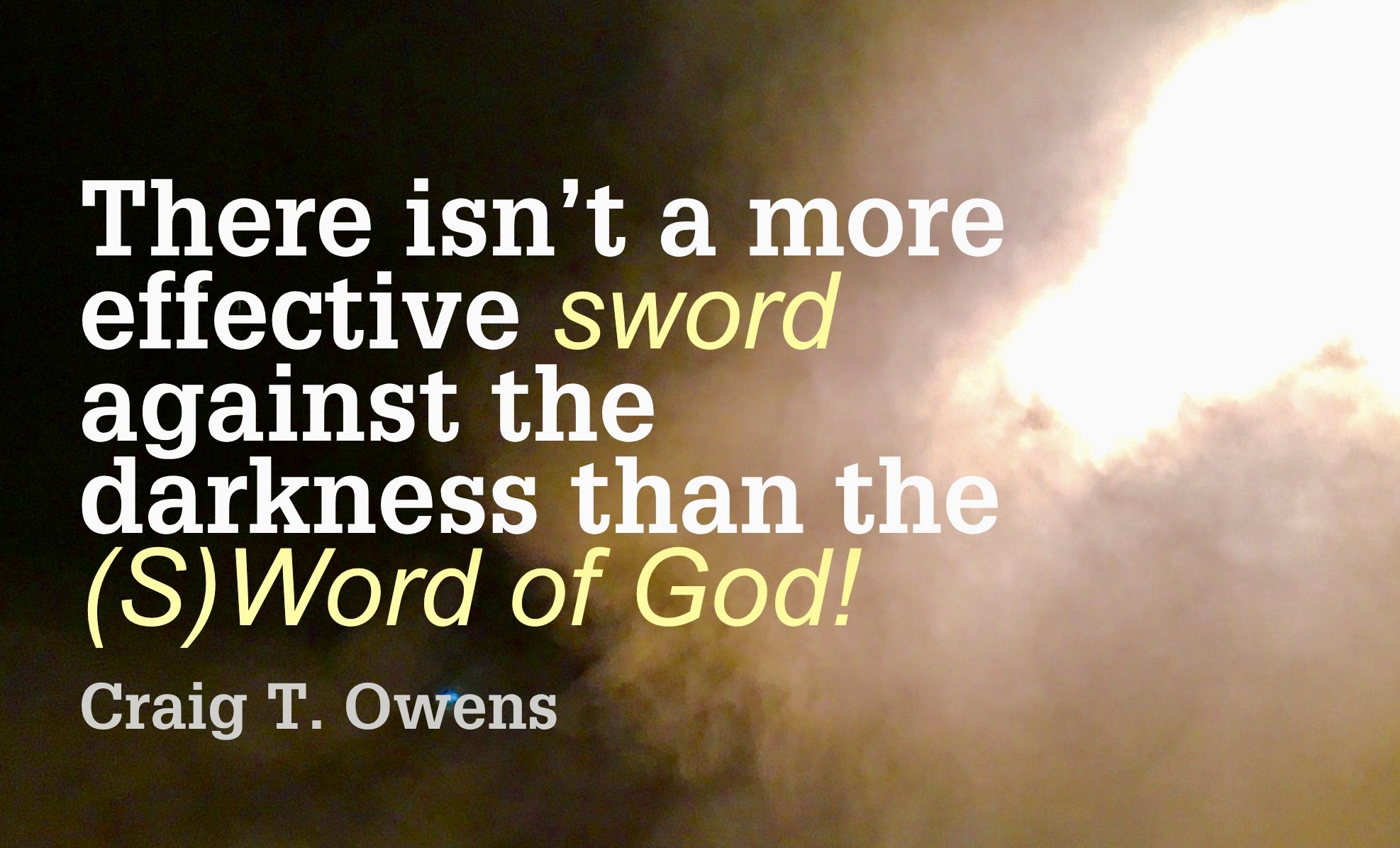
When we worship God and sing our grateful praise to Him, we put the sword of God in our mouths. And there isn’t a more effective sword against the darkness than the (S)Word of God (Hebrews 4:12; Revelation 1:16; Ephesians 6:17)! 

Paul told the church at Colosse that singing our praise to God with other saints was an encouragement to all who heard those worshipful songs (Colossians 3:15-17). 

So when the ambushers are surrounding you, use your thankful songs as a shield, as a sword, and as an encouragement to others! 

If you’ve missed any of the other messages in our series The Great Attitude of Gratitude, you can find them all here.

►► Would you please prayerfully consider supporting this ministry? My Patreon supporters get behind-the-scenes access to exclusive materials. ◀︎◀︎

Our Musical Testimony

Listen to the podcast of this post by clicking on the player below, and you can also subscribe on AppleSpotify, or Audible.  

As these songs of ascent are reminding us, we’re trying to ascend into God’s presence. But it seems like the forces pulling us back downward are so strong! The lyrics in the most popular songs are getting more and more raunchy, the blockbuster movies routinely celebrate sin, TV shows increasingly push a decidedly unbiblical agenda, government leaders are caught in scandals, and church leaders are “de-transitioning” from their Christian testimony. 

It doesn’t seem like there is much to celebrate. 

Just like the Jews who found themselves defeated and living in a foreign land, or fighting opposition to rebuild their way of life, or contending with occupying forces that were hostile to their religion, we, too, find ourselves in a very similar place—even in a country that was supposedly built on godly principles. 

The worldly-minded and irreligious have always tried to pull down the godly. When they do, it makes it hard to even worship God (Psalm 137:1-4). 

I’ve been reminding you that in Hebrew literature we can usually get our perspective from the middle of the story. So before we look at this next song of ascent, let’s look at the middle of the Jewish story—the middle of their time of exile, when things seemed darkest. 

Jeremiah wrote a book of Lamentations which was in the middle of the exile. In the middle of his tears and gall and bitterness he wrote this—

I remember my affliction and my wandering, the bitterness and the gall. I well remember them, and my soul is downcast within me. Yet this I call to mind and therefore I have hope: Because of the Lord’s great love we are not consumed, for His compassions never fail. They are new every morning; great is Your faithfulness. I say to myself, “The Lord is my portion; therefore I will wait for Him.” … I called on Your name, Lord, from the depths of the pit. You heard my plea: “Do not close your ears to my cry for relief.” You came near when I called You, and You said, “Do not fear.” (Lamentations 3:19-24, 55-57) 

Jeremiah said when he called God, He came near. He’s not saying that God had left him, but instead, Jeremiah is saying that he got his eyes off the ever-present God. As soon as he put his eyes back on God, he could feel His nearness. 

Our next song of ascent (Psalm 126) opens with the word “when.” This is a celebration of how God kept His word that the exiles would be released from Babylon and return to Jerusalem. As the Jews praised God for keeping His Word, then the surrounding nations saw and heard the testimony in the songs of joy that were being sung. 

God’s people were both singing for joy for God’s deliverance AND they were singing in joyful anticipation of what was still to come. 

They make a request in prayer for God to “restore our fortunes” (v. 4). This phrase always means that God is going to bring back everything that was taken away and then some. 

We have a promise two times in the next two verses that God will (not might) bring in these restored fortunes. In the midst of darkness or drought, it may seem hopeless to keep sowing seed. God sees your tears, and He will use your tears to water that seed and He will bring a harvest. 

The New Testament assures us of the same promise: “Let us not become weary in doing good, for at the proper time we will reap a harvest if we do not give up” (Galatians 6:9). 

We show our faith in God’s eternal victory by lifting up our voices in song today. That song is a testimony to the nations around us and an encouragement to other saints who may be struggling with weariness (see Ephesians 5:18-20). We keep on singing these songs of joy in anticipation of the final and eternal song we will sing in Heaven. 

God is near. He hears your sighs. He sees your tears. He is watering the seeds you are sowing, and He will bring a harvest. As you sow in tears, sow also with songs of joy! 

If you’ve missed any of the other messages in our Ascending series, you can find them all here. 

►► Would you please prayerfully consider supporting this ministry? My Patreon supporters get behind-the-scenes access to exclusive materials. ◀︎◀︎

The Carols Of Christmas

Carols Of ChristmasI heard the bells on Christmas Day
Their old familiar carols play,
And wild and sweet the words repeat
Of peace on earth, goodwill to men. (Henry Wadsworth Longfellow)

How many “old familiar carols” have you heard Christmas after Christmas until the words have almost lost their meaning? If we’re not careful, any song repeated too often can lose the richness of its original intent.

There are some amazing messages in many of our old familiar Christmas carols because many of those messages are saturated with the old familiar story of Redemption that the Bible tells over and over again.

Please join me this Sunday as we take a new look at the old familiar messages in our Christmas carols. These messages will bring a new appreciation of God’s love that was sung at Christ’s Advent, and reawaken the sweetness of meaning for this Christmas Day.

This has been an ongoing series for us. To take a look at the Christmas carols we’ve already talked about, check them out here, here, here, and here, and here. The Advent songs we looked at this year are:

The Nearness Of God

I think too often we’re in too big of a hurry when we read the Bible. 

Think with me for a moment how much longer it takes to sing the lyrics of a heart-stirring song than it does to just say the words. The psalms were written as songs, and although the melodies that accompanied them have been lost to the pages of history, we would still do well to move more slowly and deliberately and passionately through these inspired songs. 

Let’s slowly consider Psalm 46 from four different perspectives…

First, as a pause from the noise. Selah can be used three different ways: (1) a pause to reflect; (2) a deep breath to crescendo into something bigger; or (3) a contrast between two very different things. There are three selahs in this psalm, and all of them call us to a pause from something noisy. To pause from…

    • natural upheavals—the earth gives way, the mountains fall, the waters roar, the mountains quake
    • political upheavals—nations are in an uproar, kingdoms fall 
    • religious upheavals—God has to serve the judgment of desolation, as He breaks the bow, shatters the spear, burns the shield

Selah/Pause from these upheavals and reflect—God is our refuge … the Lord Almighty is with us.

Second, notice the contrasts. The songwriter takes us to man’s mountains that fall and quake, but reminds us that THE mountain of God is our sure fortress. In the imagery of water, we see man’s attempts at refreshing that are roaring and foaming, but we also see God’s river that brings life and makes people glad. And look at how man’s use of power results in an uproar, but God makes wars to cease. 

Selah/Pause and reflect—aren’t God’s ways better than man’s ways? 

Third, notice the nearness of God. Twice the songwriter reminds us “The Lord Almighty is with us.” And then we hear God Himself speak to our anxiety-prone hearts, “Be still and know that I am God.” Those words “be still” can also mean “let go.” Let go of earthly things, negative voices, fears, trying to control events. If your hands are full of that, how can you grab onto God?! 

Selah/Pause and reflect—God is calling me to go—and stay—near to Him! 

Fourth, see how God’s peace and protection surrounds AND permeates me. In our Western literature, we are used to the climax—or the payoff—being at the end of the story. The story builds and then comes to a conclusion where the hero prevails. But in Hebrew poetry, the climax—or the payoff—is typically in the middle. So when we read Psalm 46, it’s tempting to say, “Hallelujah! Verse 11 says God is my fortress. That’s the climax, the payoff!” But really the payoff—the most important part—is the middle. In this psalm, that is verse 6. Everything else builds to this and radiates out from this. 

Read this psalm for yourself by reading the verses in this order: 6, 5, 7, 4, 8, 3, 9, 2, 10, 1, 11.

Selah/Pause and reflect—God is not only IN me, He also surrounds me. I’m invited to come close to Him because He is already in me. Nations rage, but His voice in my heart silences the upheaval. He is with me. He is the Most High Sovereign God that controls the outcome of all nations. Earth quakes and kingdoms rumble, but I will have no fear; I will be still and know He is God. He is my refuge, my strength, my help, my fortress! 

Don’t rush the reading of the Psalms. Slowly “sing” these inspired lyrics and listen to how the Holy Spirit will whisper to your heart. 

I’ll be continuing our series on the Selahs in the Psalms this Sunday, and I would love to have you join me. 

Poetry Saturday—Against A Thorn


Once I heard a song of sweetness,
As it cleft the morning air,
Sounding in its blest completeness,
Like a tender, pleading prayer;
And I sought to find the singer,
Whence the wondrous song was borne;
And I found a bird, sore wounded,
Pinioned by a cruel thorn.
 
I have seen a soul in sadness,
While its wings with pain were furl’d,
Giving hope, and cheer and gladness
That should bless a weeping world;
And I knew that life of sweetness,
Was of pain and sorrow raw borne,
And a stricken soul was singing,
With its heart against a thorn.
 
Ye are told of One who loved you,
Of a Saviour crucified,
Ye are told of nails that pinioned,
And a spear that pierced His side;
Ye are told of cruel scourging,
Of a Saviour bearing scorn,
And He died for your salvation,
With His brow against a thorn.
 
Ye “are not above the Master.”
Will you breathe a sweet refrain?
And His grace will be sufficient,
When your heart is pierced with pain.
Will you live to bless His loved ones,
Tho’ your life be bruised and torn,
Like the bird that sang so sweetly,
With its heart against a thorn? —Carrie Ellis Breck

The Carols Of Christmas

Carols Of ChristmasI heard the bells on Christmas Day
Their old familiar carols play,
And wild and sweet the words repeat
Of peace on earth, goodwill to men. (Henry Wadsworth Longfellow)

How many “old familiar carols” have you heard Christmas after Christmas until the words have almost lost their meaning? If we’re not careful, any song repeated too often can lose the richness of its original intent.

There are some amazing messages in many of our old familiar Christmas carols because many of those messages are saturated with the old familiar story of Redemption that the Bible tells over and over again.

Please join me this Sunday as we take a new look at the old familiar messages in our Christmas carols. These messages will bring a new appreciation of God’s love that was sung at Christ’s Advent, and reawaken the sweetness of meaning for this Christmas Day.

This has been an ongoing series for us. To take a look at the Christmas carols we’ve already talked about, check them out here, here, here, and here. We have only looked at one Christmas carol this year, but we looked at each stanza:

Saturday In The Psalms—Sing A New Song

Oh, sing to the Lord a new song! (Psalm 96:1).

God is so great—His worth is infinite—that He deserves a new song every time we sing to Him. There is no need to copy or duplicate something done before, but we should continually find new ways to praise Him.

Look at the angels encircling God’s throne. They continually sing out, “Holy! Holy! Holy!” as they perceive new dimensions of God’s grace, love, faithfulness, beauty, and majesty.

“Oh! Did you see that? Holy!” 

“Look at that! Amazing!” 

“Wow, I just saw something else breathtaking” Worthy!”

Our praise of God should follow that example: “Holy! Holy! Holy!” This is what Psalm 96 tells us…

Sing!
Bless His name!
Tell how good He is!
Declare His glory everywhere!
He is great!
He is greatly to be praised!
Look at His majesty!
Stand in awe of His beauty!
Give Him the glory due His name!
Worship! 
Thrill at the beauty of His holiness!
Bow before His majesty!
Rejoice!
Be glad!
Listen to creation praising their Creator!
Join creation in their song!
He is coming soon!
Maranatha!
Oh, sing to the Lord a new song!
Sing it now and forever and ever!

Poetry Saturday—Bells Across The Snow

O Christmas, merry Christmas,
Is it really come again,
With its memories and greetings,
With its joy and with its pain!
There’s a minor in the carol
And a shadow in the light,
And a spray of cypress twining
With the holly wreath tonight.
And the hush is never broken
By laughter light and low,
As we listen in the starlight
To the “bells across the snow.”
O Christmas, merry Christmas,
’Tis not so very long
Since other voices blended
With the carol and the song!
If we could but hear them singing,
As they are singing now,
If we could but see the radiance
Of the crown on each dear brow,
There would be no sigh to smother,
No hidden tear to flow,
As we listen in the starlight
To the “bells across the snow.”
O Christmas, merry Christmas,
This never more can be;
We cannot bring again the days
Of our unshadowed glee,
But Christmas, happy Christmas,
Sweet herald of good will,
With holy songs of glory
Brings holy gladness still.
For peace and hope may brighten,
And patient love may glow,
As we listen in the starlight
To the “bells across the snow.” —Frances Ridley Havergal

5 Blessings You Should Expect From Your Church Experience

Place of peaceKing David loved God, and he loved God’s people. He was passionate about everyone getting as deeply connected with God as he was, so he wrote worship songs, setup worship teams, and organized the temple for worshippers.

The first song of ascent he wrote was one anticipating how good it was going to be when everyone got to the temple in Jerusalem to worship.

In fact, David was so excited about what he was expecting to happen in their worship together that he practically glowed with joy! Really! The word for rejoiced in his song means to be so cheerful and happy that you make others around you bright by your happiness. 😀

What was it that David thought was going to happen? First of all, we need to look at the name Jerusalem. Traditionally this means the City of Peace, but the two words that make up “Jerusalem” are much richer than that. Yes, -salem means “peace.” But the first part of the word (yara-) literally means water flowing through, or an arrow being shot out.

In other words, David anticipated that we are going to a peaceful place to be sent out full of peace, to take that peace to others who don’t have it, but desperately need it.

While we are in our “Jerusalem” (for us in the New Testament, this is our “church,” even if it’s just two or three people getting together), here are five blessings you should expect—

  1. Unity—with all the “tribes” joining together.
  2. Praise—joining together to tell God how great He is!
  3. Learning—we come together to learn God’s statutes.
  4. Judgment—what?! How is judgment a blessing? If you are nervous about being judged, just remember Who does the judging in God’s temple: the Holy Spirit. He judges us in a loving way, and in a way that allows us an opportunity to see our sin, repent from it, and experience unconditional forgiveness. That is exciting!
  5. Peace, security, prosperity—the word shalom is used multiple times in the closing verses of this song. The best definition of shalom is: nothing missing, nothing broken. In other words, when we gather together to worship we should expect that God will heal any dis-ease we have, that He will supply what has fallen short, that He will fill up what’s empty.

With those five blessings in mind, here’s the declaration all Christians can make—

Inside these walls…
we live in unity
we praise the Lord
we learn God’s laws
we judge ourselves by God’s standards
repenting, confessing, forgiving, and being forgiven
we fight for peace
we bless God and one another
We descend back to the valleys
to take this message to valley-dwellers
that they, too, may pilgrimage
with us to Jerusalem
It starts here in God’s family!
It starts with me!


Check out the full video of this message, where I explain each of these ideas more fully. And if you’re in the area, join us on Sunday as we continue our look at the Psalms of Ascent.

If you’ve missed any of the messages in this series, you can access the complete list by clicking here