Servants And Stewards

Listen to the podcast of this post by clicking on the player below, and you can also subscribe on AppleSpotify, or Audible. 

Godly leaders should be secure enough to think of themselves as servants and stewards—nothing more, nothing less. And people in the church should look on their leaders as servants and stewards—nothing more, nothing less.

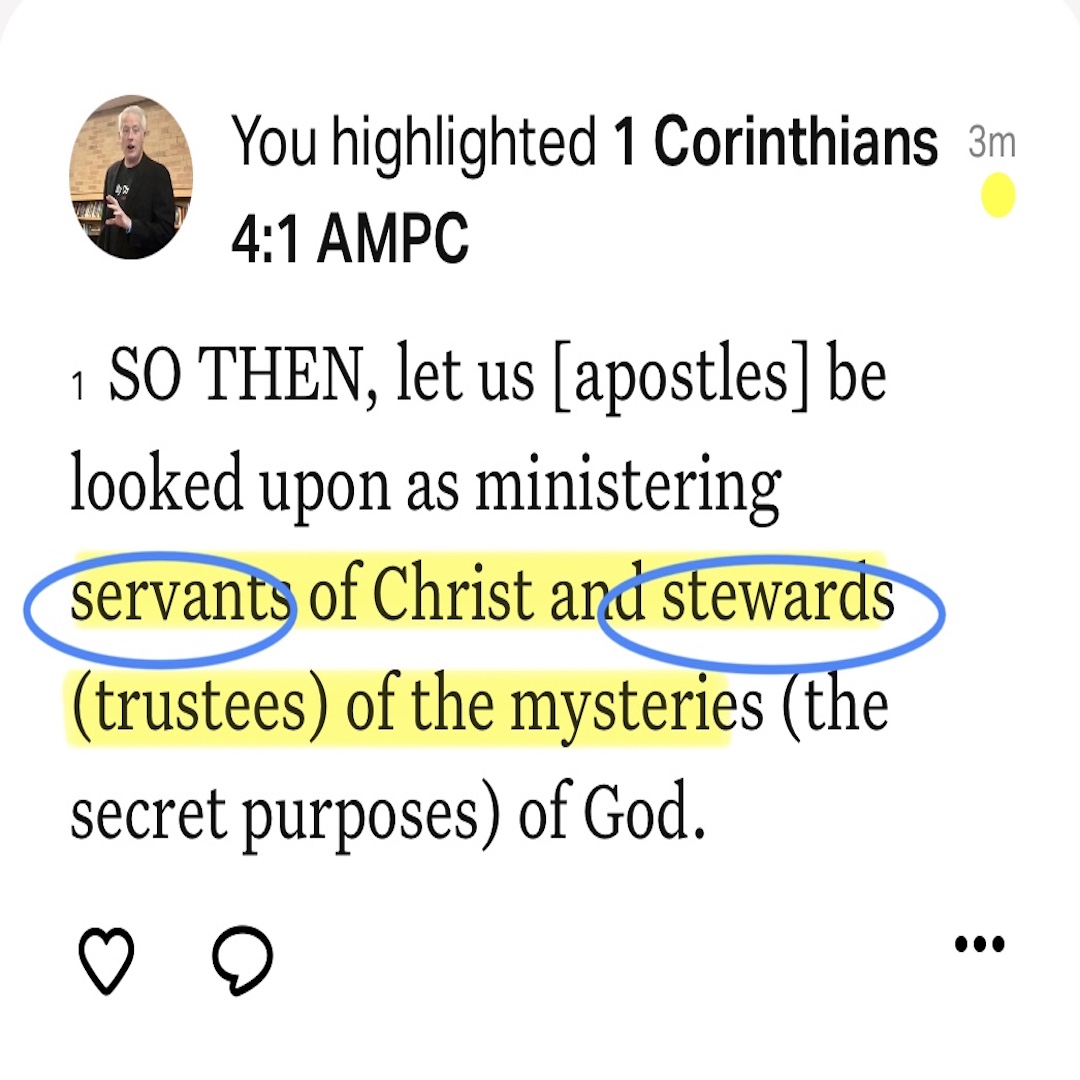
So then, let us apostles be looked upon as ministering servants of Christ and stewards (trustees) of the mysteries (the secret purposes) of God. (1 Corinthians 4:1 AMPC)

Q: How do I know if I am a servant?
A: People treat me like one.

Q: How do I know I have a servant’s attitude?
A: I don’t mind being treated like a servant.

Paul lived this out—Now, brothers and sisters, I have applied these things to myself and Apollos for your benefit, so that you may learn from us the meaning of the saying, “Do not go beyond what is written.” Then you will not be puffed up in being a follower of one of us over against the other (1 Corinthians 4:6).

I closed the chapter ‘Secure to Serve’ in my book Shepherd Leadership like this—

     God wants to use you as a leader. He has called you to great things. Just remember that He does the calling and the equipping so that you can serve and shepherd others. It may be a prominent, noticeable position, or it may be an obscure position unseen by very many. It may be a position God keeps you in until the day He calls you home, or it may be a temporary position. A humbly confident leader doesn’t fight to climb a ladder nor strive to keep a position on a higher rung of the ladder. The shepherd leader is confident to serve where God places him, and humble enough to be moved, or even removed, as God sees best. But most of all, a secure shepherd leader knows that God’s desire for His leader in any position is a heart to serve others. 
Related posts:

►► Would you please prayerfully consider supporting this ministry? My Patreon supporters get behind-the-scenes access to exclusive materials. ◀︎◀︎

Blessing The Blesser

Listen to the podcast of this post by clicking on the player below, and you can also subscribe on AppleSpotify, or Audible. 

We’ve made it to the top step after a long climb. We’ve arrived! But arrived for what? Not for taking it easy, but for serving.  

Jesus was at the top, and consider what He did with that position:

  • He laid aside His prerogatives as God to serve us—Philippians 2:6-8 
  • He demonstrated this by becoming a servant of the servants—John 13:3-5 
  • He said, “For who is greater, the one who is at the table or the one who serves? Is it not the one who is at the table? But I am among you as One who serves.” (Luke 22:27) 

(Check out all of the Scriptures in this post by clicking here.) 

We strive for the top not to be served, but to serve. This is why the final Song of Ascent addresses those at the top as “servants of the Lord” (Psalm 134:1). 

The first duty of the servants is to praise (2x in vv. 1, 2). The KJV actually renders this word “bless,” which I believe is a good way for us to think about this. The word means: 

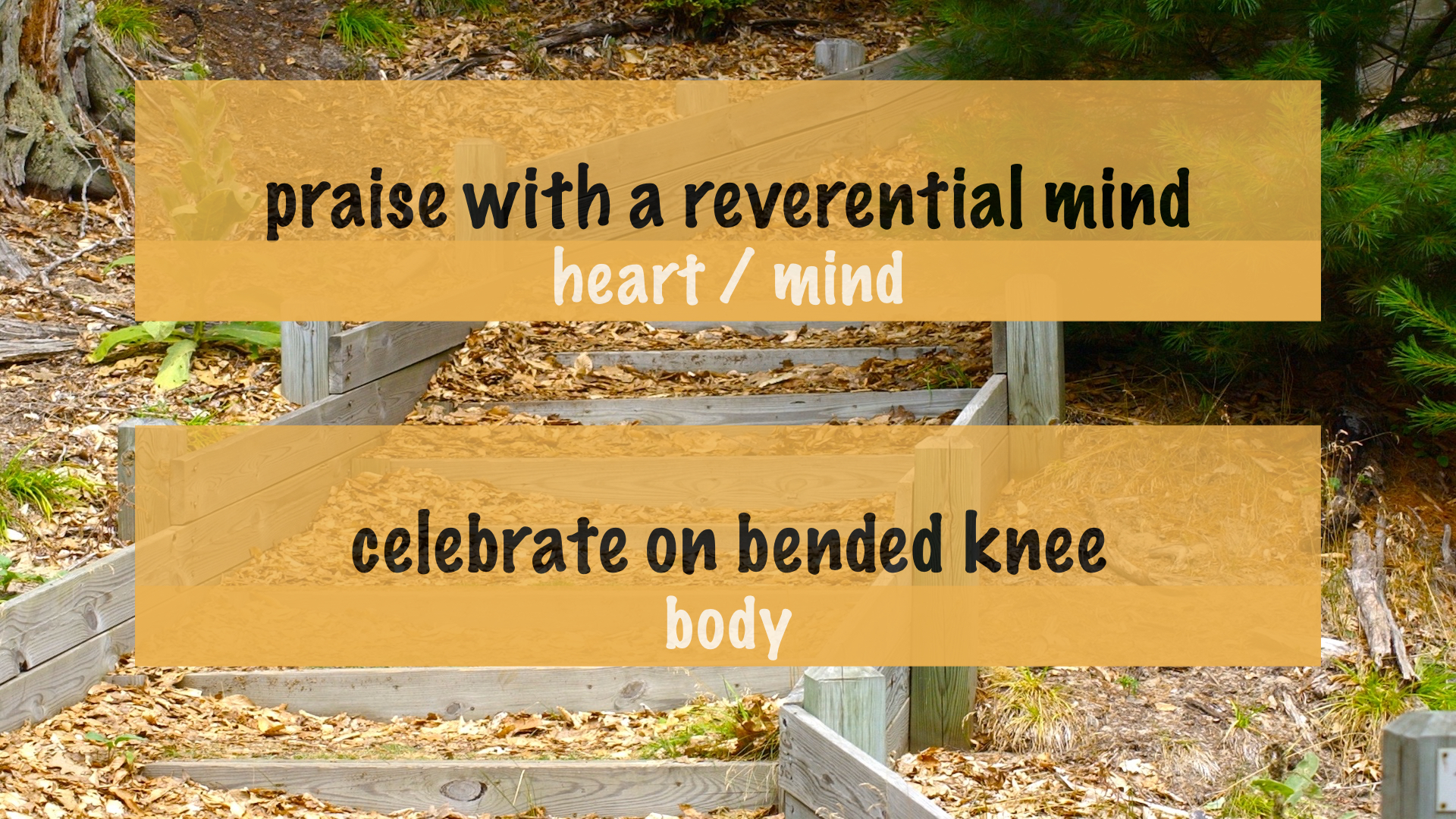
  1. praise God with a reverential mind and 
  2. celebrate God on bended knee 

In other words, both our heart and our body need to be in a posture of a praising servant. In the Septuagint, the word used for praise / bless is eulogeo, which means to say good words. In putting the two parts of the definition together, it mean we aren’t grumbling about our service (like “I have to do this”), but we are thankfully and worshipfully serving (as in “I get to do this!”). 

These servants are called to “minister…in the house of the Lord [and] in the sanctuary” (134:1-2), just as the priests in the tabernacle (1 Chronicles 9:33; Leviticus 6:13; 24:2, 4). 

This blessing and serving is itself a blessing which unlocks even more blessing. The final words of the final Song of Ascent is a prayer request (notice the word “may” in v. 3). 

The word bless in this final is the same word translated praise in vv. 1-2, except here the form of the verb means “to be shown divine favor”! 

We don’t get blessed by God because we have blessed God, but we bless God because He has already blessed us. I don’t command His blessing, but I bless Him in recognition of the blessing that continually flows from Him to me. 

To word minister as in v. 1 means to: 

  • endure all hardships 
  • continue until the task is done 
  • cause or help others to stand too 

God loves to bless people who love to bless people! 

As long as we’re here, keep blessing and serving others as your act of worship to God. Say good words to people about God and say good words to God about people. Lift up your hands, fall on your knees, sing out loud, or worship quietly in your heart. But keep on serving like Jesus. All of this blesses God. 

Your final and eternal reward in the Heavenly Zion is coming and it is beyond compare—

It will be good for those servants whose Master finds them watching when He comes. Truly I tell you, He will dress Himself to serve, will have them recline at the table and will come and wait on them. It will be good for those servants whose Master finds them ready, even if He comes in the middle of the night or toward daybreak. (Luke 12:37-38) 

In blessing others, we are blessing the God who has already blessed us and who longs to bless us for all of eternity! 

If you’ve missed any of the messages looking at the fifteen Songs of Ascent, you can find them all here. 

►► Would you please prayerfully consider supporting this ministry? My Patreon supporters get behind-the-scenes access to exclusive materials. ◀︎◀︎

Ready, Waiting, And Watching

Listen to the podcast of this post by clicking on the player below, and you can also subscribe on AppleSpotify, or Audible. 

Although Jesus spoke these words to His followers 2000 years ago, they are especially important to all of His followers who are awaiting His imminent return—

Be dressed ready for service and keep your lamps burning, like servants waiting for their master to return from a wedding banquet, so that when he comes and knocks they can immediately open the door for him. It will be good for those servants whose master finds them watching when he comes. Truly I tell you, he will dress himself to serve, will have them recline at the table and will come and wait on them. It will be good for those servants whose master finds them ready, even if he comes in the middle of the night or toward daybreak. But understand this: If the owner of the house had known at what hour the thief was coming, he would not have let his house be broken into. You also must be ready, because the Son of Man will come at an hour when you do not expect Him. (Luke 12:35-40) 

There are three words that stand out to me: ready, waiting, and watching. 

Ready is an adjective describing the Christian servant. Its etymology is from the noun meaning “fitness.” So the ready servant has all that he needs at hand. He is prepared for every opportunity, ready to serve and to receive whomever his Master sends him. 

Waiting is a verb that is in the present tense. That means it is something we always have to be doing. The prefix of this Greek word—like the adjective for “ready”—also means that everything that we need to serve is close by and ready to be used, and the root word is to give hospitality. So the waiting servant is waiting with a purpose: always ready to serve at a moment’s notice. 

Watching is also a present tense verb. This word means that we are giving undivided attention to the task that has been given us. 

Jesus was addressing His disciples, but these words are still for you and for me. At every moment we need to be fit to serve, with all that we need close at hand for every opportunity God sends our way.

I want to be occupied in my heavenly service until the very moment Jesus returns to earth or calls me Home. There are no off days. There is no time to waste on frivolous matters, but I need to be solely focused on only doing what matters for eternity. 

Will you join me in serving like this? We lead others to Jesus by serving those Jesus puts in our life. And as we do that, we serve our Master as well.

►► Would you please prayerfully consider supporting this ministry? My Patreon supporters get behind-the-scenes access to exclusive materials. ◀︎◀︎

Last Place

Listen to the podcast of this post by clicking on the player below, and you can also subscribe on AppleSpotify, or Audible. 

I was sitting with a couple of ladies in our school district who were trying to figure out the logistics for a food distribution program. I was offering them a couple of suggestions when one of them asked me, “Have you ever had any experience with something like this?” 

I told her that I had, and then she responded, “But this is going to be pretty big. Probably about 40 families.” 

I smiled and told her that the food distribution program I helped coordinate fed nearly 5000 people. 

She said, “Well, I guess we don’t have to worry anymore!” And from then on, whenever any logistical concerns came up, these ladies confidently handed off the situation to me. Once they knew that I had some relevant experience, they didn’t have any more moments of questioning. 

Unlike Jesus, I didn’t create all of the food from a few loaves and fish. I simply organized the distribution of the food others had donated. I am glad these ladies had confidence in me, but at the same time, I had to guard my heart against the pride that can so easily puff up my ego.

Can you imagine if you were one of the disciples of Jesus, and had seen all of the miraculous things He had done and heard all of the profound things that He had said, and then still had the audacity to ask, “Who is the greatest”?! 

And yet that is exactly what they did (Mark 9:33-35). 

How in the world could they argue about something like this when Jesus was right there with them? Maybe this thought finally sunk in a little because later on they pivoted a bit in their argument to ask who was the greatest after Jesus (Matthew 20:20-28). 

Jesus minced no words and left nothing vague in His answer: “Anyone wants to be first must be the very last, and the servant of all” (Mark 9:34). 

This is exactly what Jesus embodied. He literally lived and died to prove that the highest greatness is measured by the lowest of servanthood. 

…Christ Jesus: Who, being in very nature God, did not consider equality with God something to be used to His own advantage; rather, He made Himself nothing by taking the very nature of a servant, being made in human likeness. And being found in appearance as a man, He humbled Himself by becoming obedient to death—even death on a Cross! (Philippians 2:5-8)

The very last. Jesus made Himself nothing.

Not above some and beneath some, but the servant of all. 

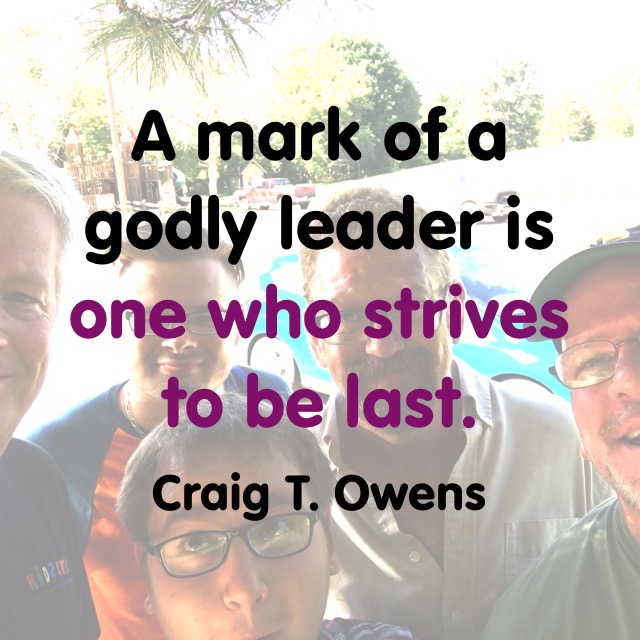
A mark of a godly leader is one who strives to be last.

Not: “I am second.” But: “I am last.” 

This is not just a declaration, but it is a declaration followed by a lifetime of submitting and serving. Not trying to lead others, but trying to out-serve all. 

This is part 74 in my series on godly leadership. You can check out all of my posts in this series by clicking here.

►► Would you please prayerfully consider supporting this ministry? My Patreon supporters get behind-the-scenes access to exclusive materials, like this recent Bible study tip from the Book of Ecclesiastes. ◀︎◀︎

Leaders Serve By Empathizing

Listen to the podcast of this post by clicking on the player below, and you can also subscribe on AppleSpotify, or Audible. 

The gauge of a leader’s level of servant leadership is measured by how that leader interacts with their most difficult teammate. Check out this full conversation from The Craig And Greg Show here.

►► Would you please prayerfully consider supporting this ministry? My Patreon supporters get behind-the-scenes access to exclusive materials. ◀︎◀︎

Elevated To Serve

Listen to the podcast of this post by clicking on the player below, and you can also subscribe on AppleSpotify, or Audible. 

Check out the resources I mention in this video:

  • The story of the 10 disciples being upset with the other two disciples is found in Matthew 20:20-28 
  • The story of Jesus taking on the position of a servant to wash the disciples’ feet is found in John 13:3-5, 14-17 
  • The chapter I quote from in my book is called ‘The Wrong Ladder’
  • Shepherd Leadership: The Metrics That Really Matter is available in print or ebook, and in audiobook through either Audible or Apple

►► Would you please prayerfully consider supporting this ministry? My Patreon supporters get behind-the-scenes access to exclusive materials. ◀︎◀︎

The Craig And Greg Show: What Leaders Can Learn From Veterans

Listen to the audio-only version of this podcast by clicking on the player below, or scroll down to watch the video.

On this episode of “The Craig And Greg Show” we talk about: 

  • [0:36] One thing I have learned about veterans that I have appreciated. 
  • [1:35] Giving a shout-out to our favorite veterans. 
  • [2:35] We wonder how many current leaders would agree to step into tough roles if they weren’t getting paid to do so. 
  • [3:35] What intrigues us about volunteers. 
  • [5:15] What else motivates people beside getting a paycheck?  
  • [6:35] Leaders help their people get involved in a bigger cause—they help them see beyond the organization’s “bottom line” as a way to energize their team. 
  • [8:29] Some leadership examples from our military personnel. 
  • [9:18] What any leader should be able to learn from veterans: respect, understanding of the chain of command, innovation while follow the mission plan. 
  • [11:13] How having veterans on your team can benefit your organization. 
  • [13:41] What we can learn from our veterans about defending our values. 
  • [14:00] Greg shares a great quote on defining true heroes. 
  • [15:20] Find a way to invest in your people and unleash their potential.

Check out this episode and subscribe on YouTube so you can watch all of the upcoming episodes. You can also listen to our podcast on Spotify and Apple.

Shepherd Leaders Serve Others

Listen to the podcast of this post by clicking on the player below, and you can also subscribe on AppleSpotify, or Audible. 

I had a great time on the Ailbe Podcast with Rusty Rabon.

Rusty noted that I used Jesus as the ultimate example of a Shepherd Leader, but then he wondered why I also used a man named Joseph Barnabas. Actually, I used Barnabas as a phenomenal example twice in my book—once in a chapter called “Secure to Serve” and again in a chapter about the importance of having other strong shepherds around us in the chapter “Going Farther.” 

Please check out the Scriptures I mention in this snippet by clicking here.

 I’ll be sharing more clips from this interview soon, so please stay tuned. Shepherd Leadership: The Metrics That Really Matter is now available in print or ebook, and in audiobook through either Audible or Apple. 

►► Would you please prayerfully consider supporting this ministry? ◀︎◀︎

Poetry Saturday—Must I My Brother Keep?

Listen to the podcast of this post by clicking on the player below, and you can also subscribe on Apple or Spotify.

Must I my brother keep,
And share his pain and toil;
And weep for those who weep,
And smile with those who smile;
And act to each a brother’s part,
And feel his sorrows in my heart?

Must I his burden bear,
As though it were my own,
And do as I would care,
Should to myself be done;
And faithful to his interests prove,
And as myself my neighbor love?

Then Jesus at Thy feet
A student let me be,
And learn as it is meet,
My duty, Lord, of Thee;
For Thou didst come on mercy’s plan,
And all Thy life was love to man.

Oh! make me as Thou art;
Thy Spirit, Lord, bestow—
The kind and gentle heart
That feels another’s woe.
May I be thus like Christ my Head,
And in my Savior’s footsteps tread! —Thomas Raffles

Would you please prayerfully consider supporting this ministry? 

12 Quotes From “The Autobiography Of Charles Spurgeon”

Charles Spurgeon lived exactly as he preached. What a delight that is! Check out my full book review of his Autobiography by clicking here. Also, be sure to check out my weekly Thursdays With Spurgeon series, where I share longer passages from this Prince of Preachers. 

“My sole hope for heaven lies in the full atonement made upon Calvary’s Cross for the ungodly. On that I firmly rely. I have not the shadow of a hope anywhere else.” 

“While my brief term on earth shall last, I should be the servant of Him who became the Servant of servants for me.” 

“For I am persuaded there are more delights in Christ, yea, more joy in one glimpse of His face than is to be found in all the praises of this harlot-world, and in all the delights that it can yield to us in its sunniest and brightest days.” 

“I have found, in my own spiritual life, that the more rules I lay down for myself, the more sins I commit. The habit of regular morning and evening prayer is one that is indispensable to a believer’s life, but the prescribing of the length of prayer, and the constrained remembrance of so many persons and subjects, may gender unto bondage and strangle prayer rather than assist it.” 

“There is nothing that more tends to strengthen the faith of the young believer than to hear the veteran Christian, covered with scars from the battle, testifying that the service of his Master is a happy service, and that, if he could have served any other master, he would not have done so, for His service is pleasant and His reward everlasting joy.” 

“I went to my chamber and told my little griefs into the ears of Jesus. They were great griefs to me then, though they are nothing now. When on my knees I just whispered them into the ear of Him who had loved me with an everlasting love, oh, it was so sweet! If I had told them to others, they would have told them again, but He, my blessed Confidant, knows all my secrets, and He never tells again.” 

“That God predestined, and yet that man is responsible, are two facts that few can see clearly. They are believed to be inconsistent and contradictory to each other. If, then, I find taught in one part of the Bible that everything is foreordained, that is true; and if I find, in another Scripture, that man is responsible for all his actions, that is true. And it is only my folly that leads me to imagine that these two truths can ever contradict each other.” 

“It was said of an old Greek philosopher that he wrote over his door, ‘None but the learned may enter here.’ But Christ writes over His door, ‘He who is simple, let him turn in hither.’” 

“I used to think, sometimes, that if they had degrees who deserved them, diplomas would often be transferred and given to those who hold the plow handle or work at the carpenter’s bench; for there is often more divinity in the little finger of a plowman than there is in the whole body of some of our modern divines. ‘Don’t they understand divinity?’ someone asks. Yes, in the letter of it, but as to the spirit and life of it, D.D. often means Doubly Destitute.” 😀

“When I came to New Park Street Chapel, it was but a mere handful of people to whom I first preached; yet I can never forget how earnestly they prayed. Sometimes they seemed to plead as though they could really see the Angel of the covenant present with them, and as if they must have a blessing from Him. More than once, we were all so awestruck with the solemnity of the meeting that we sat silent for some moments while the Lord’s power appeared to overshadow us. All I could do on such occasions was to pronounce the benediction and say, ‘Dear friends, we have had the Spirit of God here very manifestly tonight; let us go home and take care not to lose His gracious influences.’ Then down came the blessing; the house was filled with hearers, and many souls were saved. I always give all the glory to God, but I do not forget that He gave me the privilege of ministering from the first to a praying people.” 

“It is the extremity of unwisdom for a young man, fresh from college or from another charge, to suffer himself to be earwigged by a clique, and to be bribed by kindness and flattery to become a partisan, and so to ruin himself with one half of his people.” 

“It is of no use to rise before an assembly and hope to be inspired upon subjects of which one knows nothing. If anyone is so unwise, the result will be that, as he knows nothing, he will probably say it, and the people will not be edified. But I do not see why a man cannot speak extemporaneously upon a subject that he fully understands. Any tradesman, well versed in his line of business, could explain it without needing to retire for meditation, and surely I ought to be equally familiar with the first principles of our holy faith. I ought not to feel at a loss when called upon to speak upon topics that constitute the daily bread of my soul.”