Have you ever been in the right place at the right time to experience something wonderful? Maybe you got to meet someone important, or you got the job, or you got the money, or you got to ride in that fancy car.
Some will call you “lucky” or say you “caught a break,” but both of those statements imply that something unexpected happened to you.
Is it still “lucky” to be in the right place at the right time if you knew ahead of time that it was coming? For praying Christians, to be in the right place at the right time when we are expecting God to provide is called “an answer to prayer.”
David prayed, “In the morning, Lord, You hear my voice; in the morning I lay my requests before You and wait expectantly” (Psalm 5:3). The Aramaic word for prayer means “to set a trap.” If we pray, and we live in expectation, then it isn’t luck when we’re in the right place at the right time, but it’s a “trap” that caught the answer to our prayer.
Our daily walking can be our daily praying, as long as we’re walking in faith in the direction God pointed us.
One man who—literally!—walked this principle out was Elisha.
Before we look at Elisha’s expectant, prayerful walking, let’s look at his prayer request—
When they reached the other side, Elijah said to Elisha, “What can I do for you before I’m taken from you? Ask anything.” Elisha said, “Your life repeated in my life. I want to be a holy man just like you” (2 Kings 2:9 MSG).
Elisha was essentially asking to be like Elijah’s firstborn son, to be his spiritual heir. This was the original promise God gave when He told Elijah to anoint Elisha as his successor (1 Kings 19:16). From that point onward, Elisha steadily walked in expectation of God answering this prayer.
Elisha wouldn’t stay in a place of military victory, or in a significantly spiritual place, or even in a place surrounded by godly leaders. Elisha wouldn’t be held back by a lucrative family business, or the warning words of friends or his spiritual mentor, or even the seemingly uncrossable Jordan River. He kept on walking (see 2 Kings 2:1-15).
He kept on walking.
He kept on walking until “suddenly” God showed up and answered his prayer.
But was it really “suddenly”? Elisha knew it was coming. He believed what God had promised. He clung to it even when Elijah told him he had asked “a difficult thing.” Elisha kept on walking until he was in the right place at the right time to receive all that God had planned.
If you have prayed in faith, start walking. Settling anywhere else is robbing yourself of a blessing and robbing God of glory.
Just keep walking! And let your walking be your praying.Don’t get discouraged. Don’t settle. Don’t stop eagerly expecting that the next step you took could be the “suddenly” you’ve been waiting for. Just keep walking!
Join me this Sunday as we learn a valuable lesson from another bold pray-er from the Bible.
This past Christmas I was quite surprised to receive a package in the mail. It was something I ordered as a Christmas gift for my wife.
Sort of.
It was actually half of what I thought I ordered. I went back online and discovered some “fine print” that I hadn’t really noticed earlier.
You’ve probably experienced that too—asterisks … fine print … footnotes … hidden fees … “limits and exclusions may apply” are all so frustrating!
Unfortunately, we get so used to these things that we begin to—consciously or subconsciously—plug them into places where they don’t actually belong. So even when Jesus Himself says something that sounds wonderful like, “I tell you the truth, if you have faith as small as a mustard seed, you can say to this mountain, ‘Move from here to there’ and it will move. Nothing will be impossible for you” (Matthew 17:20), we want to insert an asterisk.
Or when He says, “And I will do whatever you ask in My name so that the Son may bring glory to the Father. You may ask Me for anything in My name, and I will do it” (John 14:13-14), we think we’re supposed to ask, “What’s the catch?”
Christians are inserting asterisks where they don’t belong and, as a result, are praying timid prayers.
Why do we pray this way? Perhaps we are…
…fearful of being too bold. But in telling us how to pray, Jesus says God rewards our bold “shameless persistence” in prayer.
I tell you, although he will not get up and supply him anything because he is his friend, yet because of his shameless persistence and insistence he will get up and give him as much as he needs. So I say to you, ask and keep on asking and it shall be given you; seek and keep on seeking and you shall find; knock and keep on knocking and the door shall be opened to you. (Luke 11:8-9 AMP)
…unsure that God hears us, cares for us, or even wants to answer us. But the Bible is quite clear that all of these things are true: He hears us, cares for us, and does want to give us what He has promised (1 John 5:14-15; Romans 8:32; Romans 4:20-21).
…ignorant of what/how to pray. T.M. Moore reminds us, “God has given us three great helps to assist us in our prayers. His Spirit groans for us; His Word guides us; and His Son governs and intercedes for us.”
…not looking for God’s answer. David said that after praying, he expectantly watched for God’s answer (Psalm 5:3). Indeed, the Aramaic word for prayer means “to set a trap.”
“He is the God of limitless resources—the only limit comes from us. Our requests, our thoughts, and our prayers are too small, and our expectations are too low. God is trying to raise our vision to a higher level, call us to have greater expectations, and thereby bring us to greater appropriation. Shall we continue living in a way that mocks His will and denies His Word?” —A.B. Simpson
Why are you hesitating to ask God for even a tiny amount when such vast resources are available? What would happen if you started to pray more boldly? What if you began to make mountain-moving requests? I dare you to try!
Stop looking for the asterisks and start taking God at His word!
Join me next week as we continue our series on Boldly Praying, looking at some bold pray-ers in the Bible.
As a general rule, God would like us to pray much more boldly than we typically do.
Jesus told us that we could pray mountain-moving prayers! But C.S. Lewis rightly observed, “If we consider the unblushing promises of reward and the staggering nature of the rewards promised in the Gospels, it would seem that our Lord finds our desires, not too strong, but too weak.”
This Sunday we begin a new series of messages called Boldly Praying, in which we are going to consider how we can replace our weak prayers with bold prayers. We’ll be looking at the requests of four bold pray-ers that we meet in the pages of Scripture, and each one of them will teach us a new aspect of bold praying.
I have the high privilege of being able to shepherd Calvary Assembly of God. It’s a privilege and responsibility I take as a charge from God, and the Scripture makes it clear that those who have been given such a stewardship must use it in a God-glorifying way.
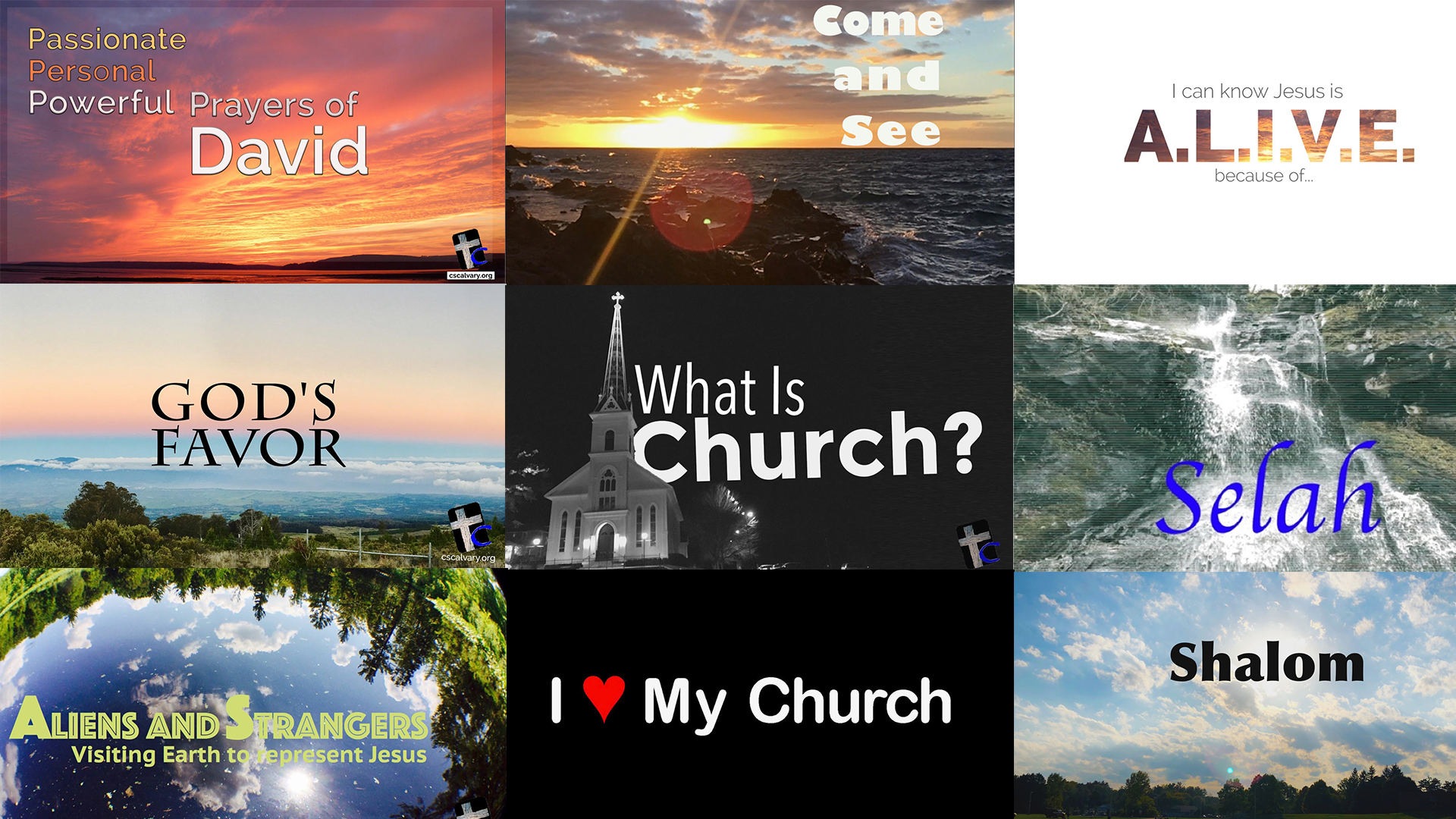
Just one way I can use such stewardship is in the weekly sermons I prepare for our church family. I faithfully study and pray to get God’s mind on the topics that we need to grow in Him. Below is a brief overview of each of the series of messages I shared in 2018, along with links to the weekly recaps I post after delivering each message.
The Prayers Of David—The life of David is an open book for us. One of the unique things about David’s life is that we get to read both the historical narrative of his life, and his diary-like thoughts recorded in his psalms, songs, and prayers in the Book of Psalms. David’s prayers are gut-level honest and full of raw emotion. His prayers are also very helpful for anyone who desires to be as close to God as David was, to be one God describes as “a man after my own heart, who will do everything I want him to do.”
Come And See—Survey after survey, and personal interview after personal interview, all report the same indisputable truth—the #1 reason unchurched people don’t come to church is no one has invited them! Wow! Christians have the life-changing truth of what a personal relationship with Jesus Christ can do, and they are for the most part keeping it to themselves. I want to present a very simple way to invite people to hear about our Risen Savior, and it’s just three simple words: Come and see.
A.L.I.V.E.—It is the foundational claim of Christianity: Christ died on a Cross and was raised back to life. It is also the claim many skeptics of Christianity find so difficult to process. This series explores evidence for for the resurrection of Jesus in each of the five letters of “ALIVE.” These messages are specifically designed for those skeptical of the claims of Christianity. The evidence won’t be a bunch of “churchy” platitudes, but court-room-level evidence that will attempt to make the case for what Christians believe about the death and resurrection of Jesus.
God’s Favor—What if I were to tell you that God is for you? What if I were to tell you that God wants to bless you? What if I were to tell you that God’s favor is constantly pursuing you? Well, here’s me telling you that it’s all true! Why would God do this? Because if you feel distant from Him, how can you glorify Him? If you feel disconnected from His love, how will you draw others to Him? If you feel like your relationship with Him is hanging by a thread, how can you happily abide in His presence? Knowing God’s favor is the key to living the abundant life Jesus purchased for you on the Cross!
What Is Church?—All across the world on Sunday morning, people met for church? But what exactly is church? Is it a place we go to? Is it something that only happens on Sundays? For Jesus, neither the day of the week nor the location determined the way He lived. Peter summed it up this way, “God anointed Jesus of Nazareth with the Holy Spirit and with power. Then Jesus went around doing good and healing all who were oppressed by the devil, for God was with Him” (Acts 10:38).
Selah—The word Selah appears nearly 70 times in the Bible, almost exclusively in the Psalms. Although it is primarily a musical term, it applies beautifully to our new summer series. Throughout the Psalms, Selah appears at the end of a verse, at the end of the psalm, or sometimes even mid-sentence. But each one of them is perfectly placed by the Spirit-inspired authors to get us to take a breath and deeply contemplate what we just read or sang.
Aliens And Strangers—Christians are not citizens of Planet Earth. Our citizenship is in a place called Heaven, and yet we are traveling on Earth during our present lifetime. So the question is: How is a citizen of Heaven supposed to act while visiting Earth? The Apostle Peter was one of the most active disciples of Jesus. During Christ’s first visit to Earth, Peter is recorded as speaking more than all of the other disciples combined. And not surprisingly, Jesus speaks more words directly to Peter than He does to all of the other 11 disciples combined. Peter got a lot of training! With that background, Peter gives us invaluable instructions in his first letter to the church. He calls Christians things like: strangers in the world, chosen people, peculiar people, and aliens and strangers in the world. He tells us travelers not only how to behave while traveling on Earth, but why we should travel in a God-honoring way.
I ♥ My Church—If you lived in the early first century AD—and if the donkey carts had bumper stickers—I’ll bet that you would have seen “IMy Church” bumper stickers on everything the early Christians owned. Both the Bible and historians of that day talked about the positive societal changes that Christians were making in their communities, and how every place they lived and worshipped got better. Why not today? Why not in your community?
Shalom—God makes a promise in Isaiah about His perfect peace being made available to His people. Ahhh, who wouldn’t want God’s perfect peace?! Sadly, many people actually block God’s peace from coming into their hearts. You see, God’s peace is always there, but there are things we humans frequently do that keeps us from experiencing His perfect peace. The Hebrew word for peace is shalom, which is a word packed with rich meaning! There are things God-loving people can do to keep shalom at the center of their lives, and I want to share these things with you.
The Carols Of Christmas—How many “old familiar carols” have you heard Christmas after Christmas until the words have almost lost their meaning? If we’re not careful, any song repeated too often can lose the richness of its original intent. There are some amazing messages in many of our old familiar Christmas carols because many of those messages are saturated with the old familiar story of Redemption that the Bible tells over and over again.
It’s been said that repetition is the mother of all learning. Keep on reminding yourself in refreshing ways again and again, and the lessons will become permanent.
Over the course of a year at Calvary Assembly of God, we cover a lot of ground biblically, crisscrossing the Bible, meeting old friends, learning timeless truths, and discovering how to apply those truths to our everyday lives.
The apostle Peter wanted his friends to keep biblical truths in the forefront of their minds—So I will always remind you of these things, even though you know them and are firmly established in the truth you now have. I think it is right to refresh your memory as long as I live in the tent of this body. … I want you to recall the words spoken in the past by the holy prophets and the command given by our Lord and Savior through your apostles (2 Peter 1:12-13; 3:2).
In the spirit of that constant reminding, I will be presenting a year-end review of all the topics we covered throughout 2018. This will be a great morning to invite your friends, as they will get a quick snapshot of what we’re learning. It will also be a wonderful morning for our regularly-attending church family to be reminded and refreshed.
We live in an amazing time—the First Advent of Jesus has already happened in Bethlehem, and yet we are eagerly anticipating Christ’s Second Advent at any moment!
The fourth stanza of Charles Wesley’s classic Christmas carol Hark! The Herald Angels Sing is a wonderful between-the-Advents look at what happened at the First Advent, and what we have to look forward to in the Second Advent. The key thing to note in this stanza is the verbs: come, fix, rise, bruise, efface, stamp, and reinstate.
COME, Desire of nations—What is the “desire of nations”? It’s the restoration of God’s glory on earth, so it’s not really a what but a Who. The prophet Haggai informs us that our Desire is realized in the Advent of Jesus (2:1-9).
FIX in us Thy humble home—At His First Advent, Jesus came and humbly made His home among us, even dying to pay the penalty for our sins (Hebrews 2:14, 17; Philippians 2:7-8).
RISE, the woman’s conquering seed—Although Jesus was obedient to death—even death on a Cross, He didn’t stay dead but was resurrected (Philippians 2:8-9; Revelation 1:18)!
BRUISE in us the serpent’s head—With His death and resurrection, Jesus took away the sting of death from satan, fulfilling one of God’s first prophesies (Genesis 3:15; 1 Corinthians 15:19-26, 54-57).
Adam’s likeness now EFFACE—That means to wipe out, do away with, expunge. That’s exactly what God does with our forgiven sins (Psalm 103:1-4, 10-12)!
STAMP Thine image in its place—Although our sin has been effaced, God doesn’t leave us as blank slates, but instead He allows the image of His Son Jesus to be stamped onto our lives (2 Corinthians 1:21-22; 2 Corinthians 3:18).
REINSTATE us in Thy love—The relationship we longed for is now reborn in us (1 Corinthians 15:49)!
The Desire of Nations HAS come, and yet He WILL come again! We’re living between the Advents now, so a good question for Christians to ask is: “How are we to live?” I think there are three key things—
In celebration that Jesus came at His First Advent to be our Savior
In anticipation of the Second Advent
In obedience to God’s Word (Revelation 22:7)
To take a look at the other stanzas of this Christmas carol, please click here.
It was for our benefit that God came to Earth in His First Advent, not in thunder, and lightning, and all the brilliance of His heavenly glory, but as a Baby. Otherwise, He would have been unapproachable by sinful man.
But make no mistake about it—although born as a human baby, Jesus was still “Christ by highest heaven adored; Christ the everlasting Lord”!
and give us His everlasting love and everlasting kindness
His everlasting salvation gives us everlasting life, or rejecting it leads to our everlasting punishment
and in His presence is everlasting joy
Charles Wesley captures this fully-God-fully-Man essence in his song Hark! The Herald Angels Sing by calling Jesus the everlasting Lord and then listing His humanness at His First Advent with phrases like offspring of a virgin’s womb, veiled in flesh, incarnate Deity, pleased as Man with men to appear, and Immanuel.
Jesus came to earth as Man not because He was forced to, but because it fulfilled the everlasting covenant that God had planned. The writer of Hebrews explains beautifully how He became like us in all of our humanness so that He could be a merciful help to us (see Hebrews 2:10-18).
When Matthew tells the birth story of Jesus, he includes a line pregnant with meaning: “All this took place to fulfill…” (Matthew 1:22).
What “all this”? Just take a look at Christ’s genealogy in the opening verses of Matthew 1. You see Abraham who tried to “help” God fulfill the covenant by fathering a child with another woman; Jacob who swindled his birthright from Esau; Judah who fathered Perez through his widowed daughter-in-law, whom he thought was a prostitute; Rahab was a prostitute; Ruth was a non-Jewish foreigner; David committed adultery with Bathsheba and then had her husband killed, and from their relationship came Solomon; Solomon’s son split the kingdom in two; from Abijah to Jeconiah the kings became progressively more and more evil; from Jeconiah forward the kings were without a kingdom; and then Joseph was a prince without a throne or even the glimmer of a hope of a throne.
Yet ALL THIS took place to fulfill God’s plan. All of history is His story! Every deed and misdeed was used by God to fulfill His everlasting plan of redemption. Jesus had a very human family tree so that none of us could be outside His merciful reach.
What’s your genealogy like? More good than bad? What about your own history? More mess ups than positives? Nothing in your genealogy—past or present—can ever stop our everlasting Lord from fulfilling His everlasting covenant with YOU (Romans 8:28)!
Christ’s genealogy is proof that your genealogy is no hindrance to His everlasting plan!
It may appear He is late in time, but behold Him comeat just the right time. Accept Him as your everlasting Lord, lean on His everlasting arms, and bask in His everlasting joy.
Jesus—our Immanuel here—came so you could have allof God’s everlastingness!
To take a look at the other stanzas of this Christmas carol, please click here.
The angels are highly visible around the birth of Jesus Christ in Bethlehem, but here’s the amazing thing—we are invited to join the angelic choir singing praise to Jesus!
Nowhere else do we see such a concentration of angels as during Christ’s time on earth, and especially at His birth. In the Old Testament prior to Christ’s birth, and in the New Testament following Christ’s ascension, we don’t see as many angels clustered together on Earth—
Gabriel brings a birth announcement to Zechariah
Gabriel brings a birth announcement to Mary
an angel talks to Joseph in a dream (three times!)
an angel gives instructions to the wise men in a dream
angels minister to Jesus in the wilderness after His battle with the devil
angels are poised for action in case Jesus calls on them prior to His crucifixion
angels are present at Christ’s tomb after His resurrection
and a massive angel choir sings at Christ’s birth (Luke 2:8-14)
Charles Wesley wrote a Christmas carol called Hark! The Herald Angels Sing. In the first stanza, we’re invited to “join the triumph in the skies.” But how can someone sing a song grand enough, majestic enough, or worthy enough to honor Almighty God?! That would be like me being asked to compose a song or play something on the piano to honor Mozart—how could I play anythingworthy of his musical talent?
In a similar way, when the Israelites thought about coming into God’s presence, they were gripped with knee-knocking, gut-churning fear (Exodus 19:16-19; 20:18-19)!
But notice that the angels didn’t sing, “God is born in Bethlehem.” They sang, “Christ is born in Bethlehem.” Christ:the Messiah; the One who sets things right. No wonder this is such good news of great joy that brings peace and God’s favor (Luke 2:10, 14).
The simple fact is that we couldn’t approach God and join in their angelic song. Instead, Jesus approached us as our Messiah, our Deliverer.How could this happen? Wesley’s carol reminds us that Jesus came so that God and sinners are reconciled!
The First Advent is God approaching us. If we allow Jesus to reconcile us to our Holy Heavenly Father, then we have no fear of Christ’s Second Advent. His Second Advent will be attended to by angels just like His First Advent (Matthew 25:31-32; Mark 8:38; Jude 1:14-15). Those who haven’t had their sins forgiven will hear a song that is soul-crushing to them, while those who have accepted the reconciling work of Jesus will join with the angelic host in a victorious song bringing glory to God forever and ever (Revelation 14:9-11; 15:1-4).
We don’t have to wait until we get to Heaven to join the triumph of the skies. We can join the angelic choir right now in singing our praise to God today. And every day!
To take a look at the other stanzas of this Christmas carol, please click here.
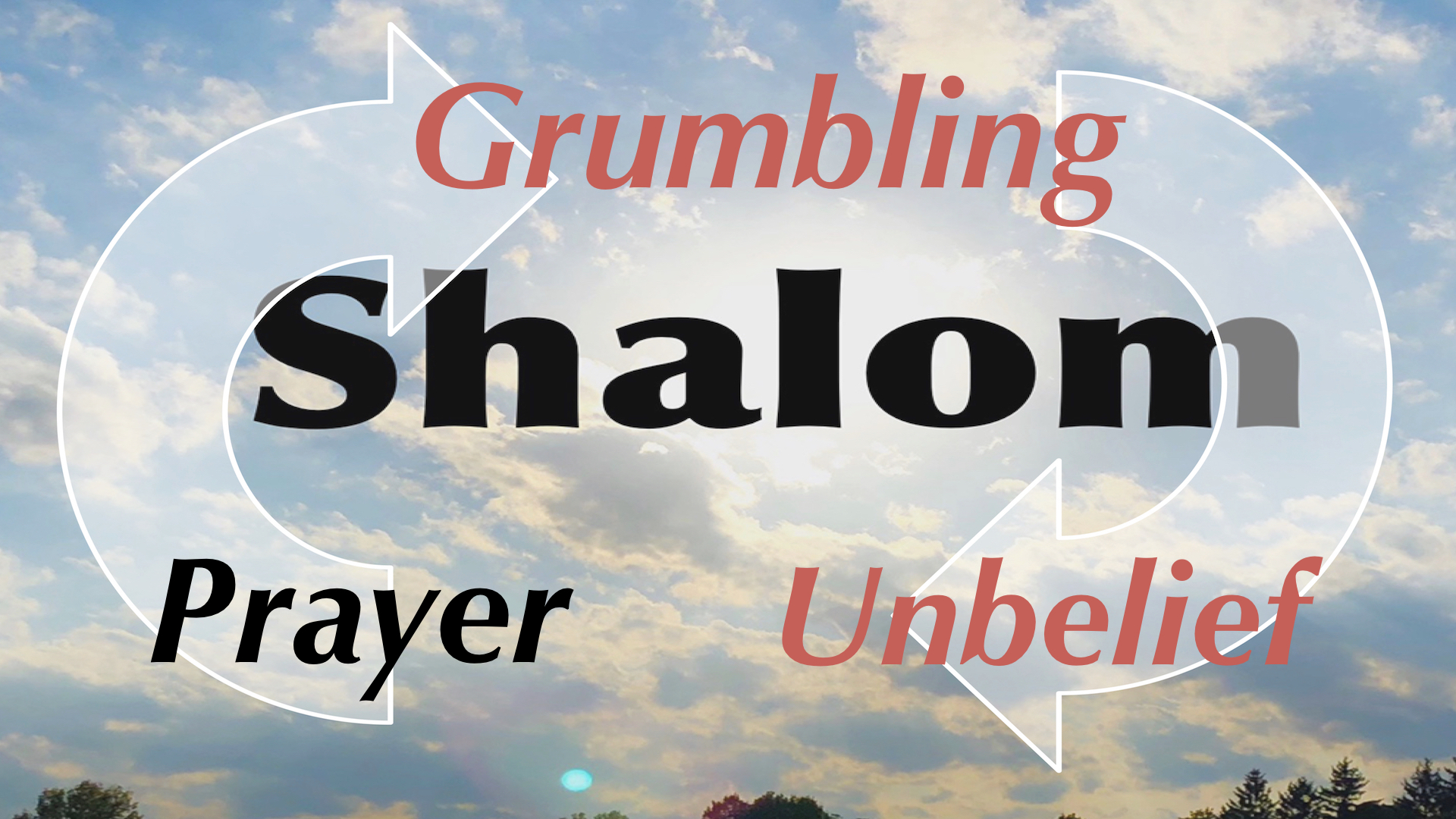
God wants you to live in a place where your heart has unshakable security and tranquility. The Hebrew word is shalom, and the Bible gives us a “Shalom Cycle” that keeps us centered and grounded in God’s peace.
But the Shalom Cycle begins to break down when…
…gratitude is replaced by grumbling
…trust in God’s future grace is replaced by unbelief
…taking our worries to God is replaced by self-reliance
Anxiety causes our mind to race through all sorts of “what if” scenarios. My friend Josh Schram points out, “There are no benefits at all to having anxieties!”
The disciples of Jesus were in an anxiety-producing situation—they were in a boat going through stormy seas. Jesus was in the boat with them, but He was sound asleep. Instead of going to Jesus with their worries, the disciples tried to get themselves out of the situation. As they did, the “what ifs” began to mount.
What if the boat sinks … What if we get smashed on the rocks … What if not everyone can swim … What if (gasp!) Jesus doesn’t make it out alive … What if … What if… WHAT IF?!?
Until finally they screamed at Jesus, “Don’t You even care?!”
Sadly, their last thought was to go to Jesus, instead of making Him their first thought.
But Jesus cared more than they knew. Years later, Peter—who was in this storm-tossed boat—wrote, “Casting all your cares—all your anxieties, all your worries, and all your concerns, once and for all—on Him, for He cares about you with deepest affection, and watches over you very carefully (1 Peter 5:7).
Not—only your big concerns.
Not—most of your concerns.
But—ALL of your concerns; every single thing that robs you of even a moment’s peace.
“Jesus, do You even care?” And Jesus responds with a loving, resounding, “YES! I care about every single thing that causes you anxiety, and worry, and care. Give them all to Me!”
Paul wrote, “Don’t worry about anything; instead, pray about everything. Tell God what you need, and thank Him for all he has done” (Philippians 4:6).
If we allow the Shalom Cycle to break down, the inevitable result in the exact opposite: The Distress Cycle—
The arrows are going the wrong way, and we’re being pulled farther and farther down. We need an about-face, a 180-degree-turn, a new direction. The Bible has a word for this: repentance. Instead of the wrong direction, turn around and go the right direction:
Instead of anxiety—prayer
Instead of worry—worship
Instead of tests—testimonies
“Jesus is more concerned about changing our hearts than about changing our circumstances. He uses our circumstances to change our hearts, IF we will trust Him.” —Josh Schram
Unbelief can shut down the “Shalom Cycle” that God intends for our lives. Even worse, unbelief can put us on a slippery slope that could be disastrous for our future! So it is vital that we understand what unbelief is, how we can recognize it in our own lives, and the steps we can take to recover from unbelief.
First of all, let me remind you of what the Shalom Cycle looks like—
Quite simply, when we are grateful for what God has already done for us it fuels our trust in God’s future grace to meet our needs.
But when we forget to be grateful and gratitude turns to grumbling, unbelief displaces trust.
A good way to remember how unbelief works is thinking of it as an un-complete faith. An un-complete faith is lacking power to trust God because of one of two reasons:
Either we don’t know there is a promise available to us,
Or we know of a promise but don’t think it applies to our circumstance.
J.C. Ryle pointed out that, “Unbelief has a power to rob man of highest blessings.”
Hebrews 3 shows us that left unchecked and uncorrected, unbelief can turn into disbelief. You can remember this word by defining it as a complete disintegration of faith. Notice in Hebrews 3 how quickly the word unbelieving becomes turns away from God, and how closely associated are the words unbelief and disobeyed (Hebrews 3:12, 19-20).
Worrying all the time—God wants you to enter His rest, not wallow in worry (Hebrews 3:11)
Making contingency plans—the Israelites forgot to be grateful and they grumbled instead. The next step (since they didn’t trust that God’s future grace would take them into the Promised Land) was to disobey by concocting a Plan B: “Let’s go back to Egypt.”
An inward focus on self-preservation—we no longer encourage others but think only of ourselves (Hebrews 3:13).
If you detect any of these warning signs, quickly repent (Revelation 3:2-3) and then run to Jesus for help. One of the most honest prayers you can pray—and one of the prayers Jesus answers the quickest—is “Lord, I believe; help me overcome my unbelief!” (Mark 9:22-24).
“Lord, I believe; help me overcome my unbelief!”
Take control of grumbling by gratitude
Take control of unbelief by repentance and running to Jesus for help
Then help others take control of their unbelief by encouraging one another daily
Join me next Sunday for the final message in our 4-part series on God’s Shalom.



 Have you ever been in the right place at the right time to experience something wonderful? Maybe you got to meet someone important, or you got the job, or you got the money, or you got to ride in that fancy car.






 Craig T. Owens