The Essential Confession

Listen to the podcast of this post by clicking on the player below, and you can also subscribe on AppleSpotify, or Audible. 

Last week we talked about biblical beliefs carrying more weight that non-biblical or extra-biblical beliefs. Christians must stand firm on God’s Word to give biblical meaning to everything we say and do, otherwise we lose the true meaning of essential terms like Church and Christian. That means there are words we need to let go, and there is the Word for which we must stand without wavering or backing down. 

Have you heard people make the “They say” claim? “Well, they say you said…,” “They say that Christians are…,” or “They say that Jesus said or did…” It’s always a good idea to get to the source of these statements. 

This is what Jesus did in Matthew 16:13-14. Jesus asked His followers about the “they say” claims they had heard, especially in light of what Jesus had already addressed in Matthew 11:18-19. 

(Check out all of the Scriptures I use in this post by clicking here.) 

Matthew 16:15 is a great question to ask others: What do you think of Jesus? By asking this question and truly listening to the answer, you may just be able to uncover some non-biblical “they say” thinking that you can help correct. 

But this verse is also a great question for us to ask of ourselves! Why? Because there is a huge difference between a verbal confession and a lifestyle confession. Look at vv. 16-23 to see the difference between Peter’s verbal confession in verse 16 and his lifestyle confession in verse 22. 

John may have had this exchange in mind when he wrote 1 John 1:5-10. Notice John’s contrast between the verbal confession (“If we claim”) and our lifestyle confession. Listen: Demons can make a verbal confession (Luke 4:41) but they will be confined in Hell for eternity (Matthew 25:41). In the same way, religious people can make a verbal confession and walk out a completely opposite lifestyle confession (Matthew 7:21-23). 

A lifestyle confession can either amplify or cancel a verbal confession. 

Jesus loved Peter’s verbal confession, but then He gave us a lifestyle confession in Matthew 16:24-28. 

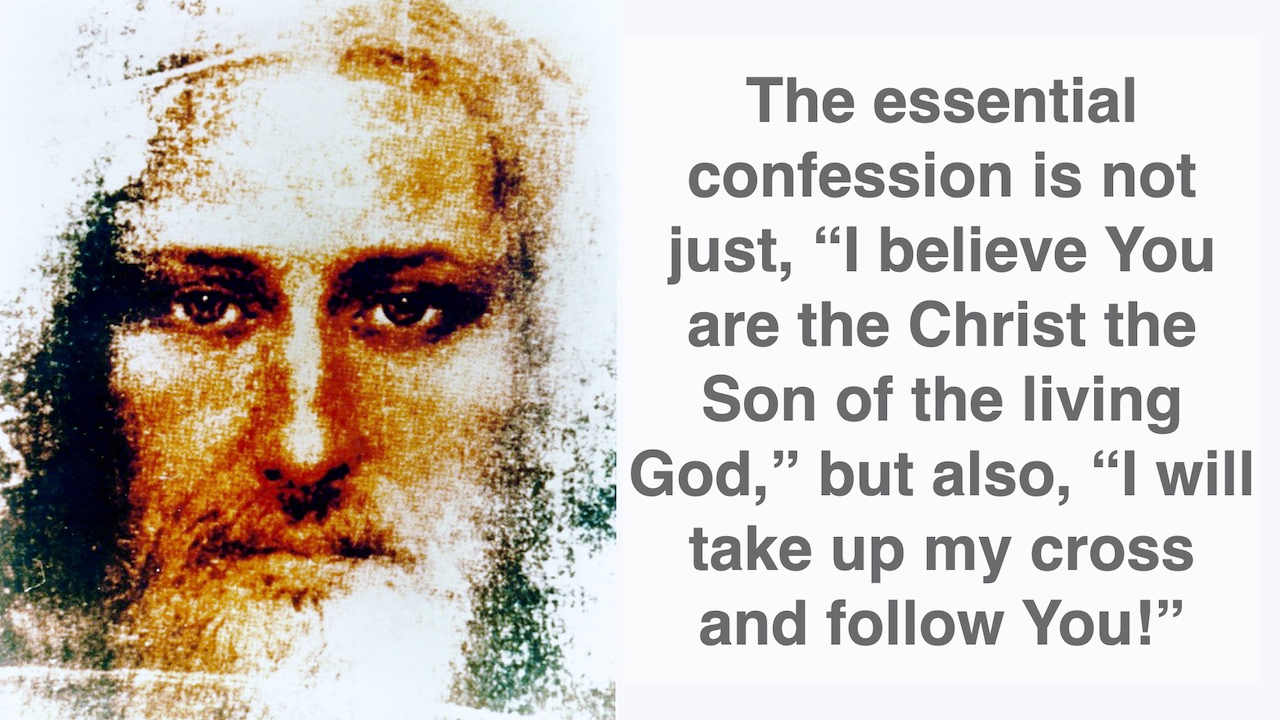
The essential confession is not just, “I believe You are the Christ the Son of the living God,” but also, “I will take up my cross and follow You!” 

We lose our life when we live for Jesus’ words (“I will build My Church”) and not living for “they say” words. As Brennan Manning sad, “The greatest single cause of atheism in the world today is Christians: who acknowledge Jesus with their lips, walk out the door, and deny Him by their lifestyle. That is what an unbelieving world simply finds unbelievable.” 

So let’s ask others, “What do you think of Jesus?” But let’s also ask ourselves that question. Let’s make sure that our verbal confession is being amplified by our lifestyle confession. Ask the Holy Spirit to search your vocabulary and your lifestyle. A great prayer for this is in Psalm 139:23-24. 

If you’ve missed any of the messages in our series “I Will Build My Church”, you can find them all here. 

►► Would you please prayerfully consider supporting this ministry? My Patreon supporters get behind-the-scenes access to exclusive materials. ◀︎◀︎
Why We Do What We Do

Listen to the podcast of this post by clicking on the player below, and you can also subscribe on AppleSpotify, or Audible. 

Charles Spurgeon said, “The resurrection of Christ is the cornerstone of the glorious temple of truth, the keystone of the arch of revelation.” 

What we believe about the resurrection gives meaning and purpose to everything else. The resurrection is the defining Truth. In 2 Timothy 2:19 we read two important truths about this foundation: (1) God knows those who truly know Him, and (2) Those who really know Him must unabashedly stand for the Truth. 

(Check out all of the Scriptures in this post by clicking here.) 

Words are powerful, they are creative. At the very beginning of Time, God said, “Light” and light existed (Genesis 1:1-3). God’s Word is still creating today (Hebrews 4:12). There are words we need to let go, and there is the Word for which we must stand without wavering or backing down. 

In 1 Timothy 1:3-7, Paul essentially says we have two choices: Do we want to promote controversy or do we want to promote God’s work? We have to learn to distinguish what is biblical and what is not. 

  • Biblical things—God’s Word clearly tells us “Yes” (2 Timothy 3:14-17) 
  • Unbiblical things—God’s Word clearly tells us “No” (like: do not murder, do not commit adultery, etc.)  

These two are fairly straightforward. As Dr. Donald Stamps wrote, “The Church has the responsibility to safeguard the true and original apostolic doctrines found in Scripture and commit it to others without compromise or corruption.” 

What is harder to sort out is:

  • Extra-biblical things—something in addition to or outside of God’s Word 
  • Non-biblical things—something not specifically addressed in God’s Word 

Passages like 1 Timothy 4:1-7 and 2 Timothy 2:14-19 help us sort out biblical and non-biblical things. 

Are extra-biblical things wrong? Not necessarily. Paul quoted poets, and even uses an extra-biblical example of Jannes and Jambres [who] opposed Moses (3:8). 

Are non-biblical things wrong? Not necessarily. But both extra-biblical and non-biblical things can become wrong when we give these things biblical status (Mark 7:9). 

“Church” and “Christian” can completely lose their biblical meaning if we allow unbiblical, extra-biblical, or non-biblical ideas to define them. We must stand firm on God’s Word to give biblical meaning to everything we say and do. 

Jesus said, “I will build MY Church.” He’s going to build it His way, not our way. We don’t want to fight the Architect, but neither do we want to fight the erring saint or the scoffing skeptic (2 Timothy 2:22-26). 

Let me give you four applications for this: 

  1. Do get into God’s Word everyday. 
  2. Don’t define the words but let God define His own words. 
  3. Do gently challenge those saints who are getting caught up in non-biblical or extra-biblical things. 
  4. Don’t quarrel with those who are living an unbiblical lifestyle (Colossians 4:5; Jude 1:22). 

You can find all of the other messages in this series called “I will build My Church” by clicking here. 

You may also be interested in these posts and videos: 

►► Would you please prayerfully consider supporting this ministry? My Patreon supporters get behind-the-scenes access to exclusive materials. ◀︎◀︎

“I Will Build My Church”

Church is just a meaningless term, and a church building is merely a clubhouse in which some people occasionally gather, if the resurrection of Jesus is a myth. Even if you accept the resurrection of Jesus as a fact, unless Christ’s resurrection power is the motivating force for your life, you run the risk of living as a hypocrite. 

The resurrection of Jesus is more than just a day to celebrate, it’s paradigm-shaping, life-empowering, culture-changing power for every single day that you are on earth. Unless those who call themselves Christians fully grasp this and live it out, they will be operating far below what the Bible has outlined for them. 

In this series we will allow the Bible to show us what Jesus truly said about His Church and His saints, as opposed to what culture has told us these terms mean. I hope you can join me!

Check out these sermons:

The Authority In Bowing

Listen to the podcast of this post by clicking on the player below, and you can also subscribe on AppleSpotify, or Audible. 

Recognition of the proper chain of command is drilled into every soldier, and knowing and following that chain of command is essential to success. In fact, it’s so important that violating this hierarchy could result in court martial and a dishonorable removal from military service. 

This is just as true in our service in the Lord’s army. 

Pastor Dan Chastain noted how similar the US Army’s Non-commissioned Officer (NCO) creed is to the way Roman centurion’s operated: “I will know my Soldiers and always place their needs above my own. I will communicate consistently with my Soldiers and I will never leave them uniformed. I will be fair and impartial when recommending both rewards and punishment.” 

The centurion we meet in Luke 7:2-10 cared for his servants and understood the chain of command. He recognized the supreme authority that Jesus had, even His authority over death and disease. 

(Check out all of the Scriptures I mention in this post here.)  

Pastor Dan also noted that the backing for an NCO’s authority is fear. There is an understanding of the authority that officer has to both reward and punish. 

The Romans had perfected the torturous act of crucifixion. It struck fear into the hearts of their enemies. In Mark 15:15-38 we see just how well the Romans had developed this gruesome act to keep people living in fear of them. 

They knew just how much to flog their victims to demoralize them for maximum effect—just enough to take the fight out of them, but not too much that they died before being crucified.  

The death of Jesus, however, was probably not what the Roman kill squad expected. It was probably a bit of a letdown for them that Jesus died rather quickly because they were used to their enemies suffering for days. But they also knew they had to ensure that their victims were truly dead (see John 19:31-34). 

Governor Pontius Pilate was also surprised how quickly Joseph of Arimathea showed up to ask for the body of Jesus, so Pilate summoned the centurion who had been in charge of the crucifixions to verify that He was indeed dead (Mark 15:42-45). 

Did you notice that Pilate called “the centurion”? Who is this? He’s the one who oversaw the kill squad that had crucified Jesus and the two other criminals. 

This centurion was a professional soldier. He had obtained his rank by his military skill, his leadership capabilities, his bravery, and his rigidly following the chain of command. His climb through up the ranks would have had him saying over and over again, “Kyrios kaiser,” which means “Caesar is lord.” 

But notice that throughout the time that the Roman soldiers gambled for Jesus’ clothes, hurled insults and Him, and thrust a spear into His side that this centurion remained silent. There was something about this Man that was different. 

When Jesus breathed His last breath, this soldier didn’t say, “Kyrios kaiser,” but something entirely different—“And when the centurion, who stood there in front of Jesus, saw how He died, he said, ‘Surely this Man was the Son of God!’” (Mark 15:39). He changed from “Caesar is lord” to “Jesus is Lord”!  

Just like the Romans terrified their enemies, our enemy wants to do the same thing—to steal, kill, and destroy (John 10:10); to prowl and growl like a lion (1 Peter 5:8). 

We resist him not by our show or force against him, but by our show of submission to the King of kings (Philippians 2:10-11). The devil isn’t afraid of you, and you aren’t strong enough to defeat him (check out what happened in Acts 19:11-16). But satan has been defeated by our King, and when you bow to Christ’s authority, then he must flee from you (James 4:7). 

Our authority comes from bowing, from giving up our way of doing things, from not trying to figure out solutions on our own. When we bow to our King, we have victory! 

If you’ve missed any of the messages in this series on spiritual warfare, check them all out here. 

►► Would you please prayerfully consider supporting this ministry? My Patreon supporters get behind-the-scenes access to exclusive materials. ◀︎◀︎

Delight In Your Duty

Listen to the podcast of this post by clicking on the player below, and you can also subscribe on AppleSpotify, or Audible. 

If anyone is known for attentively doing their duty, it is the members of our military. Duty is drilled into them over and over and over. Civilians could learn a lesson from this. We tend to be reward-motivated, that is to say, if we feel some sort of reward for our effort, we may stick to our commitment. But duty-bound soldiers stick to their commitment regardless of how they feel or what the circumstances are. 

We need to be especially on guard against Christian duties that seem to be thankless, or else we may forget about doing them or do them only reluctantly. 

Some of you might be saying, “‘Christian’ and ‘duty’ doesn’t sound right in the same sentence. Isn’t everything we do for Jesus supposed to be delightful?” Paul said to Timothy, “Join with me in suffering, like a good soldier of Christ Jesus” (2 Timothy 2:3). 

(Check out all of the Scriptures I use in this post by clicking here.)

And listen to these words from Jesus—

     Suppose one of you has a servant plowing or looking after the sheep. Will he say to the servant when he comes in from the field, “Come along now and sit down to eat”? Won’t he rather say, “Prepare my supper, get yourself ready and wait on me while I eat and drink; after that you may eat and drink”? Will he thank the servant because he did what he was told to do? So you also, when you have done everything you were told to do, should say, “We are unworthy servants; we have only done our duty.” (Luke 17:7-10) 

Why does the military drill the idea of duty into every soldier? Because doing your duty is indispensable to success in battle! 

In the New Testament, we meet three Roman soldiers who did their duty. Only one that we know of became a follower of Jesus, yet all three were pivotal for two key leaders in the early Church. These Roman soldiers were important because doing their duty helped Peter and Paul get where God had called them. 

Peter—Jesus called on Peter to be one of the foundational leaders of the Church (Matthew 16:18). But Peter never stepped fully into this role until a Roman centurion named Cornelius did his duty. 

In Acts 10:1-7 we meet Cornelius who followed the command of an angel without question, just as a dutiful soldier would. This dutiful act helped Peter understand what God was calling him to do (10:15-16, 22-28), and then helped him explain what the rest of the Church was supposed to do (11:18; 15:7-11). 

Paul—Lysias was the commander of the Roman garrison in Jerusalem. He saved Paul from literally being torn limb-from-limb by an angry mob, and then he safely transported Paul to Caesarea to avoid the assassins who were laying in wait to ambush Paul (Acts 21-22). 

Then when Paul was being sent to stand trail before Emperor Nero, a centurion named Julius also went to extraordinary lengths to see that Paul made it safely to Rome (Acts 27). 

All three of these Roman soldiers were merely doing their duty—obey orders from their commanding officers—but their dutiful service allowed Peter and Paul to get to the places where God needed them to be. 

Earlier I asked if the Christian life was supposed to be delightful. It may not be delightful here, but doing our duty may be tough at times. Paul said he rejoiced in the difficulties (2 Corinthians 12:10). 

Truly, doing our duty here is noticed by our Commander and King. Allow me to paraphrase Matthew 25:21 for the reward that Jesus gives those saintly soldiers who do their duty—

Our Commander will reply, “Well done, good and dutiful servant! You have been faithful with a few things; I will put you in charge of many things. Come and share your master’s happiness!” 

Do your duty—for your sake, for the benefit of others, and for the glory of our King. 

If you’ve missed any of the other messages in this series called The Lord’s Army, you can find them all here. 

►► Would you please prayerfully consider supporting this ministry? My Patreon supporters get behind-the-scenes access to exclusive materials. ◀︎◀︎
Perfect Tactics

Listen to the podcast of this post by clicking on the player below, and you can also subscribe on AppleSpotify, or Audible. 

In the mid-1930s, a German who fought in World War I as a lieutenant colonel published his book Infantry Attacks. This book recounted his heroic and innovative tactics that earned him battlefield success throughout that war. As World War II loomed, the popularity of this officer and his book compelled Adolf Hitler to appoint him field commander, even though he didn’t come from the prestigious family lines that were typical of other German officers. 

This field commander began adapting the tactics he had used with his infantry in WWI to the tanks that were now under his command in WWII. His success was so swift and noteworthy in northern Africa that he quickly earned the nickname “the Desert Fox.” This is Edwin Rommel. 

In Infantry Attacks, Rommel describes how his shock troops used speed, deception, and deep penetration into enemy territory to surprise and overwhelm. He used innovative tactics like assigning a small team of men to approach enemy lines from the direction in which his enemy expected the attack, which was really just concealing the bulk of his troops who were sneaking to the flanks and rears of the defenders to take them by surprise. These tactics usually intimidated his enemies into surrendering, which helped him avoid unnecessary risks to his supply lines and soldiers. 

But were these tactics truly innovative? If we look back in history we will discover a masterful tactician that used these maneuvers with his troops 3000 years before Rommel did! 

Joshua was the renown field commander of the Israelite army as they moved into the Promised Land. See if some of his tactics sound similar to those Rommel employed. 

  • A fake frontal assault to distract the enemy from the concealed special forces—Joshua 8:1-7, 18-19 
  • An early-morning surprise attack after an all-night march—10:7-10 
  • A divide-and-conquer campaign: the southern campaign was a relentless push (10:29-38, 41-42); the northern campaign relied on a surprise attack (11:1-9) 

(Check out all of the Scriptures in this post by clicking here.) 

Joshua knew God’s voice (Exodus 33:11) and we see it in his tactics. Notice how many times we read about Joshua hearing God’s voice (8:1, 18; 10:8, 10, 42; 11:6, 8). In fact, “The Lord said” appears 15 times in the Book of Joshua! 

The only time Joshua experienced any casualties at all was when he attacked the little town of Ai after their major victory at Jericho without getting God’s tactics first (7:1-12). In this case, Joshua made his tactics based on what “they said.” 

Presumption is so dangerous! We should never think, “This is how God did it last time, so I’ll just copy-and-paste that same prayer and that same tactic in this situation.” After the Israelites repented of their sin, God did give them the precise tactics to defeat Ai, which is what we already saw in Joshua 8. 

The next update we read about Joshua’s troops is, “The whole army then returned safely to Joshua in the camp at Makkedah” (Joshua 10:21). That isn’t miraculous, but it is the expected outcome because all of Joshua’s tactics were from God Himself.

The United States had a general who matched wits with Rommel in WWII. General George Patton wrote this in his diary, “In forty hours I shall be in battle, with little information, and on the spur of the moment will have to make the most momentous decisions. But I believe that one’s spirit enlarges with responsibility and that, with God’s help, I shall make them, and make them right.” 

General Patton was half-right: God will give directions, but we don’t have to wait until we’re in the heat of the battle; God can give us perfect tactics before the battle begins. 

This reminds me of what God said through the prophet—“Whether you turn to the right or to the left, your ears will hear a Voice behind you, saying, ‘This is the way; walk in it’” (Isaiah 30:21). This is foretelling what Jesus said the Holy Spirit would do for us (John 14:26, 16:13). God’s Voice must be the one and only Source of guidance in our spiritual warfare. 

Remember what God told Joshua in Joshua 1:7-8 that he should read and meditate on God’s word at every moment. The writer of Hebrews addresses the same idea about God’s Voice that is heard through His Word, and how this is to be our weapon and Source of strategy as well (Hebrews 4:1-12). 

The perfect tactic for every situation, every conversation, every attack, every opportunity is found in the inspired Word of God. Never presume you know what to do, but let the Holy Spirit illuminate the perfect tactic to you for each unique situation. 

If you have missed any of the messages in our series called The Lord’s Army, please click here. 

►► Would you please prayerfully consider supporting this ministry? My Patreon supporters get behind-the-scenes access to exclusive materials. ◀︎◀︎

Practice For Precision

Listen to the podcast of this post by clicking on the player below, and you can also subscribe on AppleSpotify, or Audible. 

An old Sunday School song had me joyfully singing, “I’m in the Lord’s army!” I loved playing “Army” with my friends and I also loved this song and the idea behind it, but it seems like many seasoned saints today get a little uncomfortable with the idea of a militant Church. But military-like precision was drilled into everything the Church was taught from the days of Moses all through the end of the New Testament. 

Let’s just consider the precision of the movement of the tribes of Israel. For 40 years in the wilderness they were an army on the move, and they moved with precision that was drilled into them. 

  • Numbers 2 lays out the precise encampment arrangements. 
  • Numbers 10:14-36 tells us precisely how they marched out with the vanguard, supporting troops, and rearguard. 

(Check out all of the Scriptures in this post by clicking here.)

Charles T. Crabtree wrote, “As spiritual people we are to understand spiritual warfare. We are to be alert to the devil’s devices. We are not to be obsessed with demonic strategy; we are simply, through God, to understand it and be superior to it.” 

We are in a spiritual battle that requires spiritual armor (Ephesians 6:11-13), and we must practice for precision in which armor and which weapons to use (2 Corinthians 10:4; 2 Timothy 2:3-4). 

My friend Dan Chastain spent more than 20 years serving in the US Army, and he notices several parallels between what the Bible says about military leaders and what he learned in his long military service. He shared four key characteristics of warriors: 

  1. Dedication to honorable service 
  2. Obedience and loyalty to whom and what they serve 
  3. Integrity at all costs
  4. Selfless service 

Dan also shared the US Army’s model of Be, Know, and Do. Which is also vital for Christian warriors today. 

When Joshua—the general of the Israelite army—took over, he was given this directive by God: Meditate on God’s Word so that you can live by it (Joshua 1:6-8), and the New Testament would agree (2 Timothy 3:16-17). So we, too, will learn from the military leaders that Scripture has given us how to practice our precision in the Lord’s Army. 

Let’s make sure we can finish well. As Paul said to Timothy, “Fight the good fight of the faith. … I have fought the good fight, I have finished the race, I have kept the faith” (1 Timothy 6:12; 2 Timothy 4:7). 

You can start today by applying Be, Know, and Do with the Training Manual for the Lord’s Army every single day: 

  • Be in the training Manual every day 
  • Know the Manual 
  • Do what the Manual says 

Follow along with all of the messages in our series on The Lord’s Army. 

►► Would you please prayerfully consider supporting this ministry? My Patreon supporters get behind-the-scenes access to exclusive materials. ◀︎◀︎
The Lord’s Army

An old Sunday School song had kids joyfully singing, “I’m in the Lord’s army!” Children who enjoyed playing “Army” with their friends loved this song and the idea behind it, but it seems like many seasoned saints today get a little uncomfortable with the idea of a militant Church. 

But from God’s well-ordered instructions in the Old Testament of how the tribes of Israel were to move out with military precision, to the New Testament’s directions of how Christians are to wear their spiritual armor to fight their battles, it’s clear that saints are indeed a part of the Lord’s Army. 

On the pages of Scripture, we are introduced to military leaders—some who are among God’s people and some who are outsiders. From each of these leaders we can learn invaluable lessons for our lives. I hope you will join us for this informative and applicable series of messages.

Check out:

Prayer Changes My Maturity

Listen to the podcast of this post by clicking on the player below, and you can also subscribe on AppleSpotify, or Audible. 

Prayer can unleash God’s miracles. Sometimes the most visible miracles are the changes that are seen in us—our attitude, our expectation, our focus, and our maturity.  

Maturity is not stuffy and stodgy. Those folks actually become quite childish when others around them don’t “act right,” according to their standards. The most mature people are the most childlike. 

Do you want proof for that last statement? The most mature Person to ever live on earth was Jesus, and He loved being around kids and having children around Him (Mark 10:13-14). 

(Check out all of the Scriptures in this post by clicking here.) 

His teaching examples were frequently quite simple—farmers, birds, flowers, trees, and even going to the bathroom!. He knew their songs (Luke 7:31-32), and many of His interactions with the overly-mature religious leaders were quite playful and childlike (Mark 11:27-33). 

Jesus wants us to come to our Father like children (Mark 10:15-16). “Like a little child” means childlike, which is the exact opposite of childish. Those who think they are too mature for such simplistic things are actually the ones who are childish. 

Jesus uses the Father-child relationship over and over to teach us about praying to a Father who is desirous of giving us the best things (Matthew 6:7-9; Luke 12:32). 

One of the Psalms of Ascent written by David strikes this childlike note (Psalm 131). Verse 1 describes the childishness he’s giving up, and verse 2 describes the childlikeness he is taking on: 

  • “my heart is not proud”—not focused on me (v. 1a) 
  • “my eyes are not haughty”—overly grown up (v. 1b) 
  • “I don’t concern myself with matters too great or too awesome for me to grasp” (v. 1c NLT) 
  • instead I am stilled, quieted, trustingly at peace (v. 2) 
  • and then David calls all of us to this same childlikeness (v. 3) 

Jesus taught about persistent prayer in Luke 18:1-8 and then used a scenario from the temple to illustrate His point (Luke 18:9-17), contrasting the childish pseudo-maturity of the overly-religious man and the childlike maturity the childlike man. And then, as directed by the Holy Spirit, Luke includes the same exchange Mark used about Jesus taking up children in His arms to bless them.  

Childlike is loving dependent; childish is fiercely independent. 

Childlike is trusting someone wise; childish always knows best. 

Childlike is imaginative; childish is realistic. 

Childlike is persistent; childish is whining. 

I love the Henry Wadsworth Longfellow poem called The Children’s Hour. As you read through this, imagine our Heavenly Father as Longfellow and yourself as his three daughters. 

Between the dark and the daylight,
When the night is beginning to lower,
Comes a pause in the day’s occupations,
That is known as the Children’s Hour.

I hear in the chamber above me
The patter of little feet,
The sound of a door that is opened,
And voices soft and sweet.

From my study I see in the lamplight,
Descending the broad hall stair,
Grave Alice, and laughing Allegra,
And Edith with golden hair.

A whisper, and then a silence:
Yet I know by their merry eyes
They are plotting and planning together
To take me by surprise.

A sudden rush from the stairway,
A sudden raid from the hall!
By three doors left unguarded
They enter my castle wall!

They climb up into my turret
O’er the arms and back of my chair;
If I try to escape, they surround me;
They seem to be everywhere.

They almost devour me with kisses,
Their arms about me entwine,
Till I think of the Bishop of Bingen
In his Mouse-Tower on the Rhine!

Do you think, O blue-eyed banditti,
Because you have scaled the wall,
Such an old mustache as I am
Is not a match for you all!

I have you fast in my fortress,
And will not let you depart,
But put you down into the dungeon
In the round-tower of my heart.

And there will I keep you forever,
Yes, forever and a day,
Till the walls shall crumble to ruin,
And moulder in dust away! —Henry Wadsworth Longfellow

We mature by trading childishness for childlikeness. We mature best by coming to God our Father in prayer as a child comes to his father. 

Let prayer change your maturity! 

If you’ve missed any of the other messages in this series on how prayer changes us, you can find them all here. 

►► Would you please prayerfully consider supporting this ministry? My Patreon supporters get behind-the-scenes access to exclusive materials. ◀︎◀︎
Only The Good Ol’ Days?

Listen to the podcast of this post by clicking on the player below, and you can also subscribe on AppleSpotify, or Audible. 

Sometimes when Christians get anxious about a situation, it appears that they have forgotten that God is just as loving and strong today as He was in the good ol’ days. We need to guard against this misunderstanding. 

This is a clip from the sermon Review Your History, which was a part of our mini-series called “What to do in a crisis.” 

The Scriptures I reference in this clip—Psalm 107; Isaiah 59:1; Hebrews 2:18, 13:8.

Let’s use this prayer to remember that God isn’t just the God of the good ol’ days, but He is still just as loving and powerful today as He has ever been—

“God, You have been faithful—You have rescued me. Now help me to see that You are still Sovereign over this current situation—You are doing something in the midst of this crisis.”

►► Would you please prayerfully consider supporting this ministry? My Patreon supporters get behind-the-scenes access to exclusive materials. ◀︎◀︎