Links & Quotes

link quote

Some interesting reading and watching from today…

An open letter that needs to be read: What’s The Big Deal With Pornography?

All doubts are an attack of the enemy; the Holy Spirit never suggests them, never. He is the Comforter, not the accuser; and He never shows us our need without at the same time revealing the Divine supply.” —Hannah Whitall Smith

“The only way to have a fulfilling life is to stop relying on your own savvy and start relying on God to provide the necessary turn of affairs.” —John Piper


[VIDEO] Speaking of John Piper, I am so excited about his new project called Look At The Book! Check out this preview.

President Obama unleashes another assault on our religious liberties.

Dr. Tim Elmore gives parents and teachers Five Words Every Child Needs To Hear.

The Love & Hate Of God

SamekhI don’t think there’s anyone reading this that hasn’t—at one time or another, or perhaps even right now—struggled with feeling distant from God’s love. Maybe you felt like you blew it, or gave in to temptation, or things aren’t going as you had hoped, and you thought, “Where are You, God? Do You still care about me?” This message is for you!

“God is closer to us than we are to ourselves and that is why we do not notice Him.” —Thomas Merton

The section of the 119th Psalm called samekh (see verses 113-120) is a helpful passage for reminding ourselves just how near God is to us. Some people get nervous thinking about God being close to them, to the point where they want to run away. But you must have this clear in your mind—

God is near me to help and support me, not to harass and condemn me! 

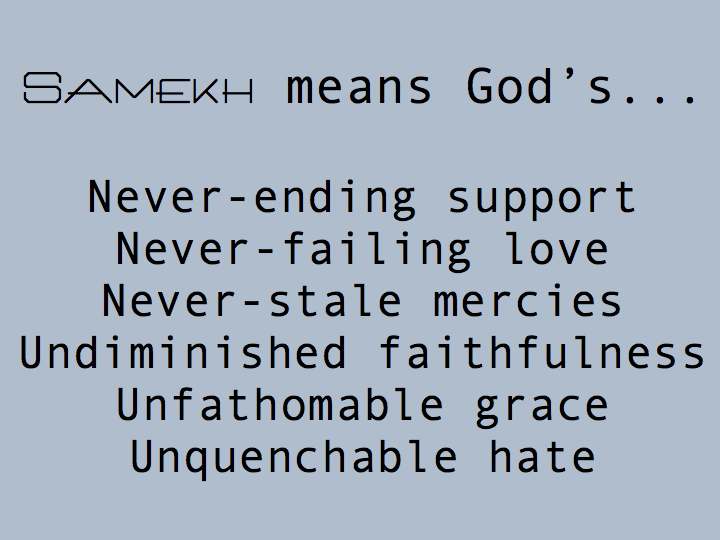
Samekh means...Samekh is the only Hebrew letter which is completely enclosed. And when you look at it, samekh looks like a shield. Indeed the word means more than God’s omnipresence. Samekh means…

  • God’s never-ending support
  • God’s never-failing love
  • God’s never-stale mercies
  • God’s undiminished faithfulness
  • God’s unfathomable grace
  • God’s unquenchable hate

Wait a minute! God’s unquenchable hate?!? Yes! God loves you so much, that He hates anything that would draw you away from Him. So this section of Psalm 119 is filled with words like love, hope, refuge, uphold, and sustain. But it also has words like hate, away from me, reject, and discard.

God wants you to know how close He is to you. God is FOR you and He is AGAINST anything that would pull you away. Read the words in Psalm 91 and see how God protects you and then attacks the enemies of your soul. In the NewTestament, feel God’s closeness as we are told that…

Oh, how God love you! He wants you to feel His closeness, so He loves you and He hates the enemies of your soul! Bask in that today.

If you have missed any of the messages in our P119 series, you can access them all by clicking here.

7 Bible Study Ideas From D.L. Moody

Pleasure & ProfitAs I read D.L. Moody’s book Pleasure & Profit In Bible Study, I made note of several ideas that could stimulate a great Bible study. Check out my review of this book by clicking here, then check out these great study-starters:

“If you are impatient, sit down quietly and commune with Job. If you are strong-headed, read of Moses and Peter. If you are weak-kneed, look at Elijah. If there is no song in your heart, listen to David. If you are a politician, read Daniel. If you are getting sordid, read Isaiah. If you are chilly, read of the beloved disciple. If your faith is low, read Paul. If you are getting lazy, watch James. If you are losing sight of the future, read in Revelation of the promised land.” —Richard Baxter 

“Every chapter [of Mark] but the first, seventh, eighth and fourteenth begins with ‘And,’ as if there was no pause in Christ’s ministry.”

“Matthew begins with Abraham; Mark with Malachi; Luke with John the Baptist; but John with God Himself. Matthew sets forth Christ as the Jew’s Messiah. Mark as the active worker. Luke as a man. John as a personal Savior.”

“[In John’s Gospel] the word repent does not occur once, but the word believe occurs ninety-eight times.”

“Dr. A. T. Pierson says: Let the introduction cover five P’s; place where written; person by whom written; people to whom written; purpose for which written; period at which written.” 

“Some time ago a man wanted to take my Bible home to get a few things out of it, and when it came back I found this noted in it:

  • Justification, a change of state, a new standing before God.
  • Repentance, a change of mind, a new mind about God.
  • Regeneration, a change of nature, a new heart from God.
  • Conversion, a change of life, a new life for God.
  • Adoption, a change of family, new relationship towards God.
  • Sanctification, a change of service, separation unto God.
  • Glorification, a new state, a new condition with God.”

“I was wonderfully blessed by taking the seven ‘Blesseds’ of the Revelation. … Or you may take the eight ‘overcomes’ in Revelation…. I have been greatly blessed by going through the ‘believings’ of John. Every chapter but two speaks of believing. … Take the six ‘precious’ things in Peter’s Epistles. And the seven ‘walks’ of the Epistle to the Ephesians. And the five ‘much mores’ of Romans 5. Or the two ‘receiveds’ of John 1. Or the seven ‘hearts’ in Proverbs 13, and especially an eighth. Or ‘the fear of the Lord’ in Proverbs.” 

“No scripture is exhausted by a single explanation. The flowers of God’s garden bloom, not only double, but seven-fold: they are continually pouring forth fresh fragrance.” —Charles Spurgeon

11 Quotes From “Pleasure & Profit In Bible Study”

Pleasure & ProfitD.L. Moody’s book Pleasure & Profit In Bible Study is a Bible study rejuvenator for both the novice and experienced reader of the Bible. You can read my full book review by clicking here. Below are some of the quotes I especially appreciated in this book.

“The more you love the Scriptures, the firmer will be your faith. There is little backsliding when people love the Scriptures.” 

“I believe we should know better how to pray if we knew our Bibles better. … And if we feed on the Word, it will be so easy then to speak to others; and not only that, but we shall be growing in grace all the while, and others will take notice of our walk and conversation.”

“It is a very interesting fact that of the thirty-nine books of the Old Testament, it is recorded that our Lord made quotations from no less than twenty-two. … About 850 passages in the Old Testament are quoted or alluded to in the New…. In the Gospel by Matthew there are over a hundred quotations from twenty of the books in the Old Testament. In the Gospel of Mark there are fifteen quotations taken from thirteen of the books. In the Gospel of Luke there are thirty-four quotations from thirteen books. In the Gospel of John there are eleven quotations from six books. In the four Gospels alone there are more than 160 quotations from the Old Testament. … In Paul’s letter to the Corinthians there are fifty-three quotations from the Old Testament; sometimes he takes whole paragraphs from it. In Hebrews there are eighty-five quotations, in that one book of thirteen chapters. In Galatians, sixteen quotations. In the book of Revelation alone, there are 245 quotations and allusions.”

“It is very important that every Christian should not only know what the Old Testament teaches, but he should accept its truths, because it is upon this that truth is based. Peter said the Scriptures are not given for any private interpretation, and in speaking of the Scriptures, referred to the Old Testament and not to the New. … If the Old Testament Scriptures are not true, do you think Christ would have so often referred to them, and said the Scriptures must be fulfilled? When told by the tempter that He might call down the angels from heaven to interpose in His behalf, he said: ‘Thus it is written.’ Christ gave Himself up as a sacrifice that the Scriptures might be fulfilled. Was it not said that He was numbered with the transgressors? And when He talked with two of His disciples by the way journeying to Emmaus, after His resurrection, did He not say: ‘Ought not these things to be? am I not to suffer?’ And beginning at Moses He explained unto them in all the Scriptures concerning Himself, for the one theme of the Old Testament is the Messiah. … Christ referred to the Scriptures and their fulfillment in Him, not only after He arose from the dead, but in the book of Revelation He used them in Heaven. He spoke to John of them on the Isle of Patmos, and used the very things in them that men are trying to cast out. He never found fault with or rejected them.”

“Prophecy is history unfulfilled, and history is prophecy fulfilled. … Between 500 and 600 hundred Old Testament prophecies have been remarkably and literally fulfilled, and 200 in regard to Jesus Christ alone. Not a thing happened to Jesus Christ that was not prophesied from 1700 to 400 years before He was born.”

“Someone has said that there are four things necessary in studying the Bible: Admit, submit, commit and transmit. First, admit its truth; second, submit to its teachings; third, commit it to memory; and fourth, transmit it. If the Christian life is a good thing for you, pass it on to some one else.”

“Application to the Word will tend to its growth within and its multiplication without.”

“We learn that Christ prayed when he was baptized, and nearly every great event in His ministry was preceded by prayer. If you want to hear from Heaven you must seek it on your knees.”

“If you want to reach people that do not agree with you, do not take a club to knock them down and then try to pick them up. When Jesus Christ dealt with the erring and the sinners, He was as tender with them as a mother is with her sick child.” 

“Let us go to the Bible and see what that old Book teaches. Let us believe it, and go and act as if we believed it, too.”

“But we can not be ready if we do not study the Bible. So whenever you hear a good thing, just put it down, because if it is good for you it will be good for somebody else; and we should pass the coin of heaven around just as we do the coin of the realm.”

D.L. Moody’s Word To Pastors About The Word

Pleasure & ProfitAs I read D.L. Moody’s book Pleasure & Profit In Bible Study, I noticed several of his comments were directed to pastors.

In my humble opinion, the pastor needs to be the “Bible Student In Chief” of his or her congregation. The pastor’s love for God’s Word will create a hunger in the congregation to study this amazing Book!

You can read my full book review of Pleasure & Profit by clicking here. Below are some of the words to us pastors from this book.

“Oh! let every minister tell the truth, though he preach himself out of his pulpit. … If the Bible only has a chance to speak for itself, it will interest the people.” 

“Give the people the Word of God. Some men only use the Bible as a text book. They get a text and away they go. They go up in a balloon and talk about astronomy, and then go down and give you a little geology, and next Sunday they go on in the same way, and then they wonder why it is people do not read their Bibles.”

“It a good thing for a minister to have the reputation of feeding his people. … People can get along without your theories and opinions, ‘Thus saith the Lord’—that is what we want.”

“Christ did not have a short-hand reporter to go around with Him to write out and print His sermons, and yet the people remembered them. Never mind about finished sentences and rounded periods, but give your attention to making your sermons clear so that they stick. Use bait that your hearers will like.”

“It is a thing to weep over that we have got thousands and thousands of church members who are good for nothing towards extending the Kingdom of God. They understand bazaars, and fairs, and sewing-circles; but when you ask them to sit down and show a man or woman the way into God’s kingdom, they say: ‘Oh, I am not able to do that. Let the deacons do it, or some one else.’ It is all wrong.” 

Pastor, how is your personal Bible study time? Is it invigorating, or humdrum? We’ve got to get immersed in the Word so that we can encourage our congregations to do likewise.

Israel’s Kings & Prophets

click for larger view

click for larger view

click for larger view

I posted earlier that I am reading through my Archeological Study Bible in chronological order. In other words, I’m reading the books of the Bible not in the order they appear, but in order of the historic events they cover.

On the Biblegateway website, Jacob Edson has taken my chart and added even more details and cross-references to related Scriptures for each of the kings on this chart.

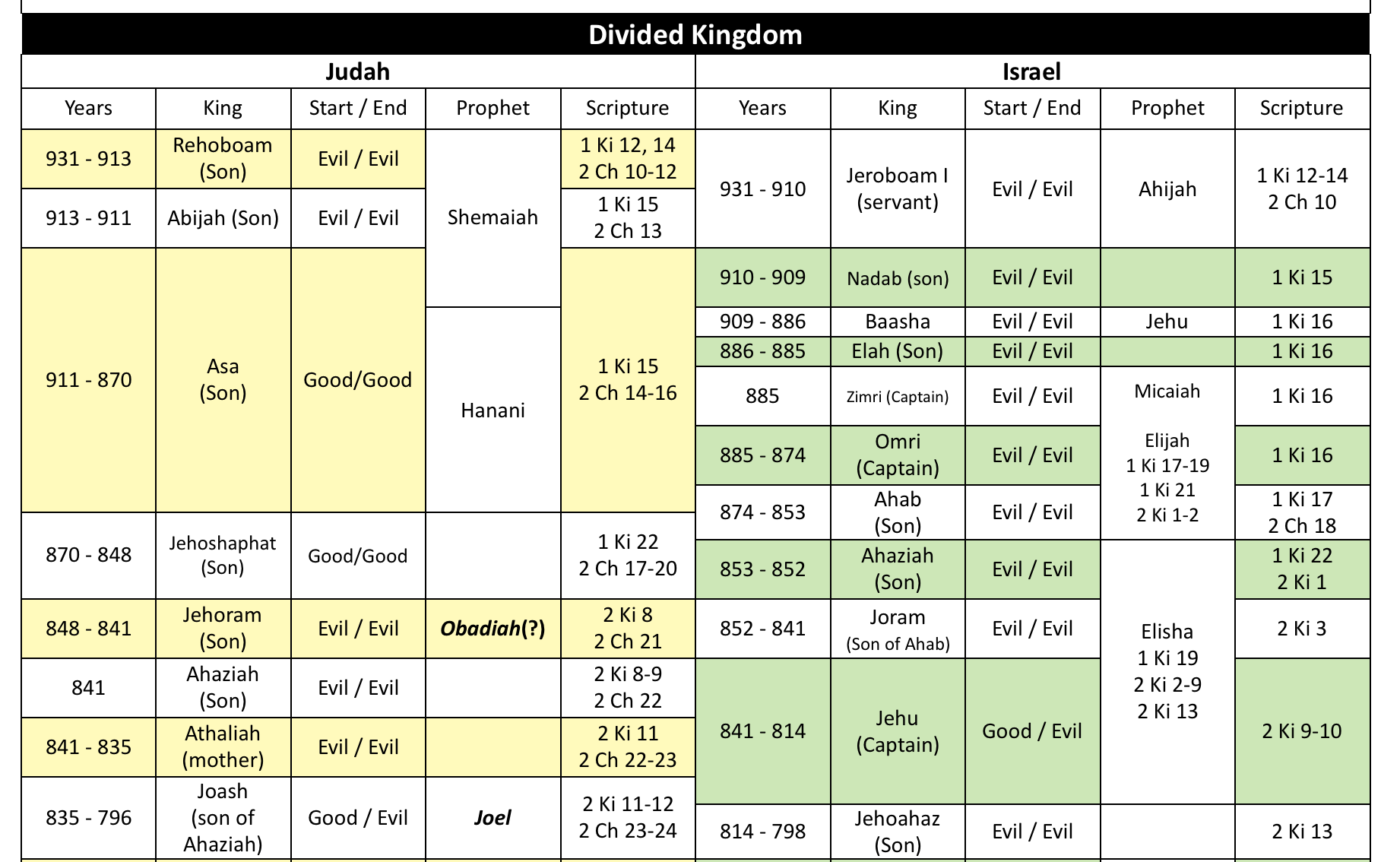
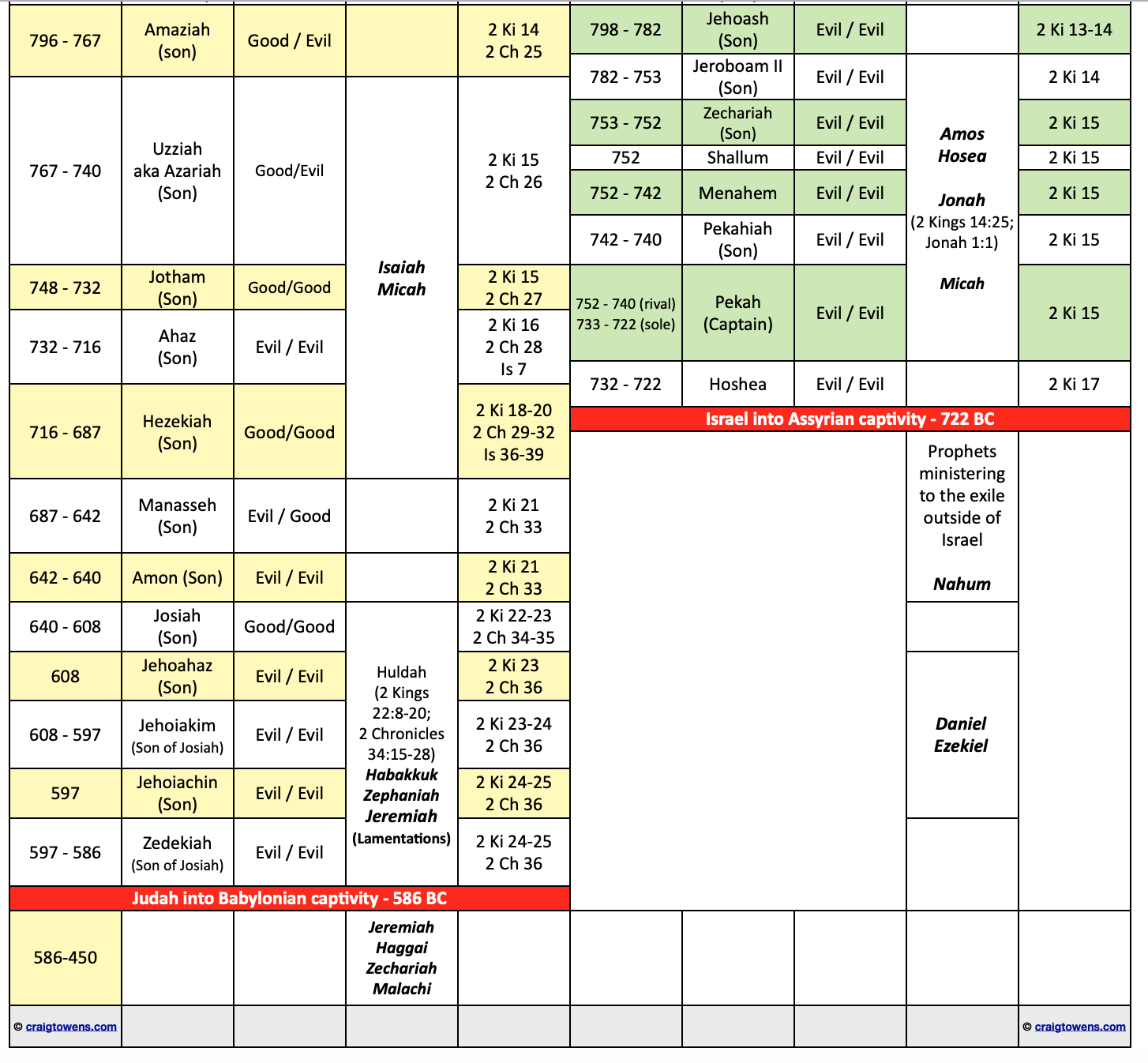
One challenging point in history is the divided kingdoms of Israel (the 10 northern tribes) and Judah (the 2 southern tribes). What makes it challenging when reading straight through the Bible is the history is covered in 1 and 2 Kings and then again in 1 and 2 Chronicles. In the midst of these kingdoms, several prophets are sent by God. Some of these prophets only have their words recorded in Kings or Chronicles, while others have their words recorded elsewhere in the Bible (usually the book name is the prophet’s name).

In trying to keep all of these people and messages clear in my mind, I have put together a list of all the kings and prophets during the period of the divided kingdom (roughly 931-586 BC).

You can click the picture above to get a larger view, or you can download a PDF copy by clicking here → Kings of Israel & Judah ←

I am not a biblical scholar, nor do I have a history degree. This is just a chart I put together to help me in my Bible reading, and I thought it might help someone else too. I would welcome any corrections or clarifications that anyone would offer on this humble work.

Not all of these updates are reflected in the screenshots on this page, but they are all in the PDF version. 

**UPDATE 1: several people pointed out some tweaks I needed to make to this chart, and I am grateful for the input! This is the revised copy as of August 28, 2017.

**UPDATE #2: a few more tweaks … this is the revised version as of July 31, 2014.

**UPDATE #3: I have posted a chart zooming in on the chronology of the Old Testament prophets which I recreated from the Archeological Study Bible. You can read it and download it by clicking here.

A couple of notes:

    • Prophets who also have their words recorded in a book that bears their name are listed in bold italics.
    • The “start / finish” designation for each of the reign of the kings is clearly my subjective opinion.
    • Sometimes you will see dates for two kings’ reigns that overlap. These are where there was a co-regency (that is a father and son ruling simultaneously).
    • The prophets that are listed under the Israel side after Israel had gone into captivity are the prophets that God was using to speak to the Israelites in exile.

**UPDATE #4: I continue to do more research and get feedback from people far wiser than me. The latest version is dated August 28, 2017.

**UPDATE #5: The original chart stopped when Israel and Judah went into captivity. I have now added another line to show the prophets who continued to prophesy to both the exiles in Babylon, as well as to those who returned to Israel later.

**UPDATE #6: Scholars are unsure of the date of Obadiah. We know that it took place after invaders had caused problems in Judah (Obadiah 11)—and Edom responded in a way that angered God. Some scholars place this date after Nebuchadnezzar’s conquest of Judah in 586 BC, but since post-exilic prophets always named Nebuchadnezzar or Babylon, I think it’s more likely to have occurred during the reign of Jehoram around 840 BC (see also 2 Chronicles 21:8-10). Added Huldah as a prophetess during the reign of Judah’s King Josiah.

**UPDATE #7: Thanks to Anthony Wimmer, this chart is now available in French → Rois d’Israel & Juda

**UPDATE 8: I am always appreciative of the interaction with those who have downloaded my chart and are digging into the dates. After a few conversations, I have modified the chart slightly on the lower right quadrant of the last page to show those prophets who were ministering to the Israelites who were in captivity.

Pleasure & Profit In Bible Study (book review)

Pleasure & ProfitNear the beginning of Pleasure & Profit In Bible Study, Dwight Moody states the purpose of his book: “We cannot overestimate the importance of a thorough familiarity with the Bible. I try to lose no opportunity of urging people by every means in my power to the constant study of this wonderful Book. If through the pages that follow, I can reach still others and rouse them to read their Bibles, not at random but with a plan and purpose, I shall be indeed thankful.”

I am thankful that D.L. Moody took the time to pen this book for us. Though over a century old, his words are bringing a renewed excitement to studying my all-time favorite book: The Bible.

Moody devoured God’s Word, and had amazing recall of all he read. He reminds us that anything we are full of will be much easier to recall and apply. He then allows us a glimpse into his personal study time, showing us how he reads his Bible, what he looks for, how he marks certain passages, and other ways to engage Scripture.

If anyone ever felt like their Bible reading or studying was in a rut, this book will be a welcome rejuvenator. Even for those who already appreciate their time studying God’s Word, Pleasure & Profit will bring new insights for your study time.

I highly recommend this book!

Rewards For Faithfulness

NunI unabashedly tell anyone who asks me what my favorite book is … It’s the Bible. I have yet to find such a collection of writings that work every single time they’re applied.

Two summers ago we began a series of messages on the 119th Psalm. It appears that the psalmist shares my passion for God’s Word, as he writes time and time again the difference Scripture makes in his life.

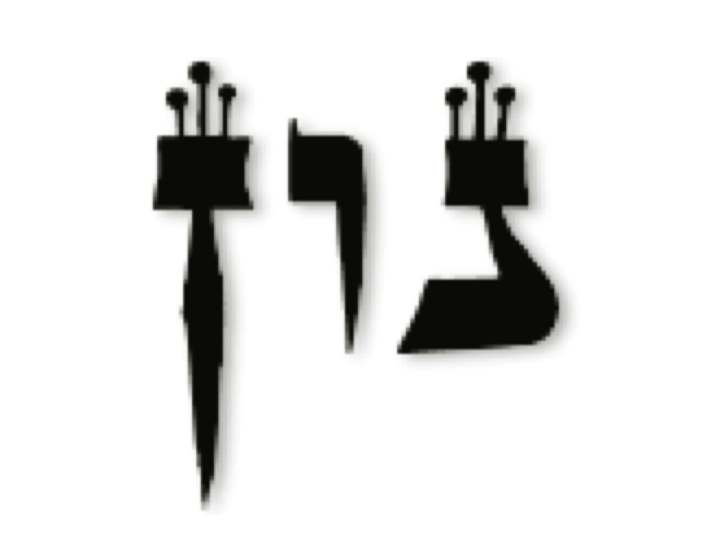
The other thing that makes this psalm so cool to me is the organization of the 176 verses into twenty-two 8-verse segments, with each verse in a segment beginning with the the same Hebrew letter as its title. In the Hebrew language, the letters in the alphabet had their own meaning. In English an “n” is simply spelled “n.” It has no other definition or meaning. But in Hebrew the letter nun has both a spelling and a meaning. Nun is spelled nun-vav-nun (final), and it means both faithfulness and the reward for faithfulness.

Look at the three Hebrew characters that spell nun. Reading right to left it tells a story and gives the meaning of the letter/word—the one who is humbled in faithfulness will be the one who stands in righteousness. The perfect example of this is Jesus, Who humbled Himself when He came to earth and to the Cross, and then was exalted by the Heavenly Father to wear the crown of righteousness (see Philippians 2:5-11 and Revelation 14:14). Paul starts this passage by calling on us to “have the same attitude as that of Jesus” (v. 5), and concludes with the call to stick with it all the way to the end (see vv. 12-13).

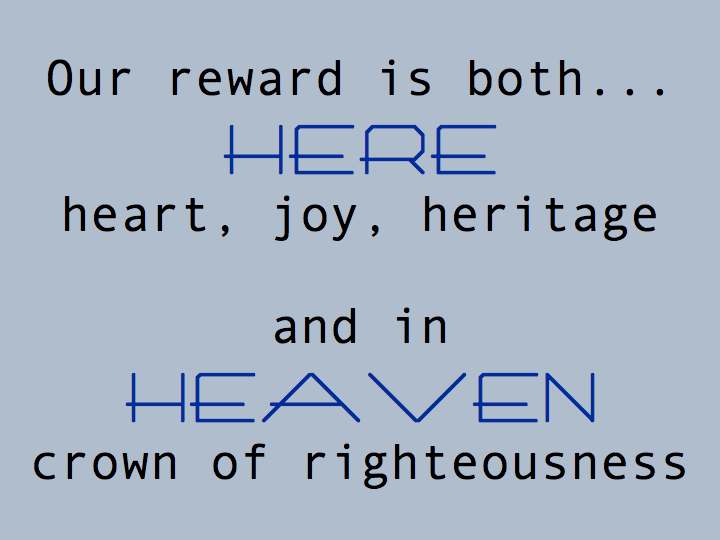
RewardsThe psalmist calls us to this same thing in nun (Psalm 119:105-112). The “bookend” verses say, “Your Word is a lamp for me… so my heart is set on keeping Your Word” (vv. 105 and 112). In between the psalmist commits himself to a life of humbly persevering to God’s ways, and reaps the rewards of a changed heart, the joy of the Lord, and a heritage to pass on to others.

I have fought the good fight, I have finished the race, I have kept the faith. Now there is in store for me the crown of righteousness, which the Lord, the righteous Judge, will award me on that day—and not only to me, but also TO ALL who have longed for His appearing (2 Timothy 4:7-8).

Humble yourself before the Lord, and He will lift you up (James 4:10).

My heart is set on keeping Your decrees to the very end (Psalm 119:112).

Rewards here (new heart, joy, heritage) AND rewards in Heaven (a crown of righteousness). How awesome is that!!

If you have missed any of the messages in our P119 series, you can access them all by clicking here.

12 Quotes From “Tactics

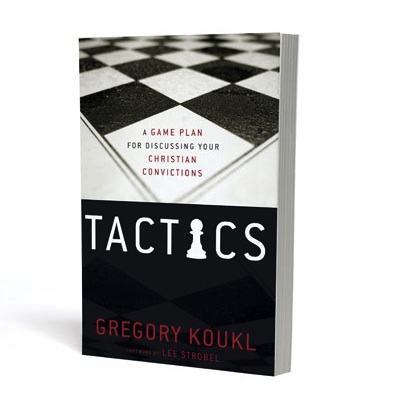
TacticsIn Tactics Greg Koukl gives Christians more how than what/why in defending the Biblical faith. It is an outstanding read that I recommend to all Christians (young or old). You can read my full book review by clicking here. Below are just a few of the quotes I highlighted in this empowering book.

“First, Christ’s ambassadors need the basic knowledge necessary for the task. They must know the central message of God’s kingdom and something about how to respond to the obstacles they’ll encounter on their diplomatic mission. … However, it is not enough for followers of Jesus to have an accurately informed mind. Our knowledge must be tempered with the kind of wisdom that makes our message clear and persuasive. This requires the tools of a diplomat, not the weapons of a warrior, tactical skill rather than brute force. Finally, our character can make or break our mission. Knowledge and wisdom are packaged in a person, so to speak. If that person does not embody the virtues of the kingdom he serves, he will undermine his message and handicap his efforts.” 

“The tactical approach requires as much careful listening as thoughtful response.”

“It is not the Christian life to wound, embarrass, or play one-upmanship with colleagues, friends, or even opponents, but it’s a common vice that anyone can easily fall into.” — Hugh Hewitt 

“Always make it a goal to keep your conversations cordial. Sometimes that will not be possible. If a principled, charitable expression of your ideas makes someone mad, there’s little you can do about it. Jesus’ teaching made some people furious. Just make sure it’s your ideas that offend and not you, that your beliefs cause the dispute and not your behavior.”

“The ability to argue well is vital for clear thinking. That’s why arguments are good things. Arguing is a virtue because it helps us determine what is true and discard what is false. … Paul warns against wrangling about words and quarreling about foolish speculations (2 Timothy 2:14, 23). But he also commands us to be diligent workmen, handling the word of truth accurately (2 Timothy 2:15). And, because some disputes are vitally important, Paul solemnly charges us to reprove, rebuke, and exhort when necessary (2 Timothy 4:112). This cannot be done without some confrontation, but disagreement need not threaten genuine unity.”

“If you want skeptics to believe in the Bible, don’t get into a tug-of-war with them about inspiration. Instead, invite them to listen—to engage Jesus’ words firsthand—then let the Spirit do the heavy lifting for you.”

“You have to know why Jesus is the only way before it is helpful to tell people that He is the only way.” 

“There are three specific things you can do to ‘ready’ yourself to respond. You can anticipate beforehand what might come up. You can reflect afterward on what took place. And in both cases you can practice the responses you think of during these reflective moments so you will be prepared for the next opportunity.”

“Knowing when to step back requires the ability to separate the hogs and the dogs from the lost sheep looking for a shepherd. But how do you know when someone has crossed the line? When do we have an obligation to speak, and when should we save our pearls for another time? Part of the answer can be found in Jesus’ next words in Matthew 7:6: ‘…lest they trample [the pearls] under their feet, and turn and tear you to pieces.’ Be generous with the truth except with someone who shows utter contempt for the precious gift being offered him. He will simply trample it in the mud and then viciously turn on you. … There is an exception to this principle, however. I have learned from my radio show that sometimes my real audience is not the person I’m talking to, but the people who are listening in, eavesdropping on the conversation. … Lee Strobel calls this ‘ricochet evangelism.’” 

“When I face an aggressive challenger, I often give him the last word. Not only is this gracious, it’s also powerful, conveying a deep sense of confidence in one’s own view. Instead of fighting for the final say-so, give it away. Make your concluding point clearly and succinctly, and then say, “I’ll let you have the last word.” But don’t break this promise. Grant him his parting shot, and then let it rest.”

“Know the truth. Know your Bible well enough to give an accurate answer. Tactics are not a substitute for knowledge. Cleverness without truth is manipulation.”

“Culture is most profoundly changed not by the efforts of huge institutions, but by individual people.” —Chuck Colson


9 Requisites For Contented Living

Contented Living

“There are nine requisites for contented living:

  1. Health enough to make work a pleasure [Ecclesiastes 5:19*];
  2. Wealth enough to support your needs [Proverbs 30:8-9];
  3. Strength to battle with the difficulties and overcome them [1 Corinthians 15:57];
  4. Grace enough to confess your sins and forsake them [James 5:16];
  5. Patience enough to toil until some good is accomplished [Romans 5:3-5];
  6. Charity enough to see some good in your neighbor [Luke 10:25-37];
  7. Love enough to move you to be useful and helpful to others [Ephesians 4:2-3];
  8. Faith enough to make real the things of God [Psalm 91];
  9. Hope enough to remove all anxious fears concerning the future [Psalm 33:18].” —Goethe

* The quote is from Wolfgang Goethe, but I added the Scripture references.