Links & Quotes

As I was studying the Book of Jude, I came across this phrase, “Though you already know all this, I want to remind you.” This prompted these three quick thoughts that I want to share with my fellow pastors.

I have a lot of new video content on my YouTube channel every week. Please check it out and subscribe so you don’t miss anything.

Using the words from Isaiah 40:10-11, Sarah Young has Jesus speaking these words to us: “Adverse circumstances become growth opportunities when you affirm your trust in Me no matter what.”

Ken Blanchard has long used a challenge for leaders to catch their teammates doing something right. That phrase has now become the title of a biography about Ken. He says, “Great leaders who want to encourage and motivate their people set up a positive cycle:

  1. A great leader catches someone doing something right and praises them. 
  2. The leader’s praise helps the person feel good about themselves. 
  3. People who feel good about themselves produce good results. 
  4. A great leader notices when people produce good results. 
  5. See #1.”

This is a very encouraging read for men! Scott Hubbard writes, “You may not have ability for preaching and teaching, as Timothy did. But the Holy Spirit does not leave any Christian giftless. … You may have a small vision for your life; God does not.”

An amazing series from T.M. Moore on the law in a Kingdom economy. T.M. writes, “Christians don’t keep the Law to be saved; we keep it because we are saved, because it is the path that Jesus walked (1 John 2:1-6); and we recognize its value for helping us realize more of the life of holy, righteous, and good works for which we have been redeemed (Romans 7:12; Ephesians 2:8-10).” 

Geologists have discovered what Creationists already proposed about plate tectonics related to the Flood described in the Bible. “Flood geologists have predicted that plate motion slowed at the end of the Flood year, and now conventional scientists are finding it to be true.”

The Assemblies of God has always responded to popular religious trends with solid biblical exegesis. The “latter day rain” movement in the 1940s is a good example.

“Mature leaders swallow their egos and recognize God as their power source. They walk confidently in His authority, but never assume credit for it. Faith enables them to stretch, while humility enables them to stoop.” —John Maxwell

What Are You Reading?

Listen to the podcast of this post by clicking on the player below, and you can also subscribe on AppleSpotify, or Audible. 

I would like to ask you a simple question: What are you reading? 

You may have heard the phrase, “Leaders are readers.” Is that true? Is that the best use of your time? If this phrase is true, how do we know what to read? 

Here are some related blog posts I would suggest you peruse: 

The post from Scott Hubbard that I mentioned is called “What Should I Read Next? 

If you are a pastor or ministry leader, I would humbly suggest that my books might be a good addition to your reading list:

►► Would you please prayerfully consider supporting this ministry? My Patreon supporters get behind-the-scenes access to exclusive materials. ◀︎◀︎

Links & Quotes

Some human employers may ask us to do business for them without giving us a good example or enough resources. But when Jesus told us to be about the Father’s business, He gave us an example and the full empowerment of the Holy Spirit! Check out this full sermon.

I have a lot of new video content on my YouTube channel every week. Please check it out and subscribe so you don’t miss anything.

“Compromise is a costly word; non-compromise, even more so.” —Bono 

Shane Morris said, “But as much as AI’s potential can cause harm, blaming it alone misses the point and likely makes these problems worse. Humans are the fallen ones, and that fallenness manifests in all kinds of destructive ways. Machines, strictly speaking, don’t have morals or intentions. They can only reflect ours.” Check out his podcast AI is not the problem, we are.

“I do not believe that a nation dies save by suicide. To the very last every problem is a problem of will; and if we will we can be whole. But it involves facing our failures as well as counting our successes.” —G.K. Chesterton 

I love reading and I have a long list of what I would like to read next. Scott Hubbard addresses this question: “Perhaps the question ‘What should I read or listen to?’ would come into sharper focus if we had a better sense of why we read at all. ‘Why read?’ has more than one right answer. We read to learn, to rest, to deepen friendship with fellow readers, to enjoy the craft of skilled wordsmiths. But alongside these good reasons, consider three others that put our reading into the service of greater loves.” 

“I only hope that we never lose sight of one thing—that it was all started by a mouse.” —Walt Disney 

“The scientific man does not aim at an immediate result. … His duty is to lay the foundation for those who are to come, and point the way.” —Nikola Tesla 

This week marked the 100th anniversary of a court case that was known as “the trial of the century,” perhaps you have heard it called the Scopes Monkey Trial. It was, and has been, more sensation than substance. Check out this post that puts this trial in its proper perspective.

Links & Quotes

Leaders are needed for tough times. “Doing difficult creates natural separation” for your leadership, says Eric Thomas. Check out this full conversation from The Craig and Greg Show.

I have a lot of new video content on my YouTube channel every week. Please check it out and subscribe so you don’t miss anything.

“Busier than a businessman, more sought out than a celebrity, wanted as a mother of many toddlers, and bearing a task as big as the world, Jesus prayed.” Check out Scott Hubbard’s post Never Too Busy To Pray.

“This is certain, that a man that studieth revenge keeps his wounds green, which otherwise would heal and do well.” —Sir Francis Bacon

“Do not have your concert first, and then tune your instrument afterwards. Begin the day with the Word of God and prayer, and get first of all into harmony with Him.” —Hudson Taylor 

There are almost 12,000 species of snakes and lizards, but evolutionists still do not know where they came from. Vertebrate paleontologist Michael Benton stated, “The early history of squamates [snakes, lizards] is patchy,” and the debate of snake origin “is far from resolved.” ICR offers the most straightforward solution to this supposed evolutionary dilemma: “snakes and lizards have been created with the genetic ability to undergo “remarkably varied jaw shapes” that have led to “their extraordinary ecological success” as they move in and fill various niches.”

Seth Porch, in talking about the joy of daily reading the Bible, notes, “By itself, neither habit, shame, nor duty will lead you to open God’s word daily with a heart posture of humble expectation and joy. Such an attitude toward the Bible comes only from the astonished realization that in these pages God actually speaks.” I hope you find the joy in reading God’s Word throughout this new year. I love my YouVersion reading plans that take me through the Bible. You may also like the companion book by Dick Brogden called Missionary God, Missionary Bible. And I shared some Bible studies that may interest you here and here.

Links & Quotes

William Gurnall was right when he noted that joy is the highest testimony of a Christian’s peace. Check out the full sermon from which this clip came.

I have a lot of new video content on my YouTube channel every week. Please check it out and subscribe so you don’t miss anything.

“Your failures are your accomplishments because it makes you prepared for whatever it is that you are going to do next.” —Lee Daniels 

One of my favorite Christmas movies is Miracle on 34th Street, where a well-timed letter to Santa Claus arrives at the courthouse to tip the scales of justice for Kris Kringle. The US Postal Service reports that they still get thousands of letters addressed to Santa each year. Have you ever wondered what happens to them. The Smithsonian has the heart-warming story

“The more we learn from God’s Word about how creation praises and reveals Him, the better able we will be to explain His revelation to others. But we’re not content for people merely so experience some revelation of God from the things He has made. We want them to know Jesus. For that, we’ll have to lead them to the Scriptures. The better we know the Scriptures and are daily immersed in them, the more we will see Jesus there and be made like Him. The more we are made like Him, the more we will see Him in all His works, and the more our hope will grow and be visible to others, some of whom may ask a reason for the hope that is within us.” —T.M. Moore 

“No priest, no theologian stood at the manger of Bethlehem. And yet all Christian theology has its origin in the wonder of all wonders: that God became human. Holy theology arises from knees bent before the mystery of the divine Child in the stable. Without the holy night, there is no theology.” —Dietrich Bonhoeffer

“Early Pentecostals generally viewed the observance of the ‘church calendar’ as remnants of liturgical traditions. Apart from Easter and Christmas, there were few days that Pentecostal churches set aside for special services. One exception was New Year’s Eve, when a ‘Watchnight Service’ would be held, typically starting around 7 p.m. and lasting until after midnight.” Check out the notable history of people “praying in the New Year.”

Scott Hubbard writes, “Spiritual health yesterday does not guarantee spiritual health today. So, at the end of a new year, on the edge of another, let’s stop to take some spiritual vitals. How healthy is your soul?” He then gives us six biblically-based questions to help us assess the healthiness of our soul. 

An amulet discovered under the chin of a man buried in a tomb dating to AD 230–270 shows the spread of Christianity into Germany by the middle of the third century.

Christ’s Advents Bring Hope

Listen to the podcast of this post by clicking on the player below, and you can also subscribe on AppleSpotify, or Audible. 

The word Advent means the appearing—something that bursts onto the scene. At this time of year we are actually thinking about TWO Advents. We look backward in gratitude to celebrate the first Advent of Jesus when He was born in a manger in Bethlehem. And then we look forward in joyful expectation to the second Advent of Jesus when He will return to earth again as King of kings. As we will in this time between the Advents, there are four qualities that we should exemplify—the first is hope. 

When the candle is lit, darkness disappears. 

Darkness is not the opposite of light, it is the absence of light. In the same way, despair or hopelessness is the absence of hope. 

Adam and Eve lived in perfection, but when they tried to do things their way—instead of obeying God’s way—their sin caused them despair. They tried to cover their nakedness, but with a hopeless covering of dying leaves. God came with a promise of full restoration, and illustrated it by covering them with the skin of a sacrificial animal (Genesis 3:7, 15, 21). 

(Check out all of the Scriptures in this post by clicking here.) 

Job knew the hopelessness of self-covering and finality of earthly life, and even David—the man after God’s own heart knew this too (Job 6:11-13, 17:13-16; 1 Chronicles 29:15). 

But Job and David both knew the hope they could have in their Redeemer (Job 19:25; Psalm 16). 

Hope in both the Old and the New Testaments means a patient waiting, anticipating with pleasure, having a confident expectation. It’s a light shining in the darkness that cannot be extinguished—it’s hope that despair cannot darken (Isaiah 9:1-2, 6-7). 

At His first Advent, Jesus appeared in our “clothing” so that He could become our sin and then clothe us in His righteousness (Hebrews 2:17; John 1:14; Romans 4:6-8; Hebrews 6:16-20). For this we look back in gratitude. 

But we don’t live today merely in gratitude for Christ’s first Advent, but we also live in confident hope of Christ’s second Advent (Acts 1:11; John 14:1-3; 2 Corinthians 5:1-8; Revelation 22:7, 12, 20).

He came into this world of sin,
Made flesh and blood His dearest kin;
He died, that He might take us in,
And keep us till He comes again. —Scott Hubbard


How do we live out this confident hope—

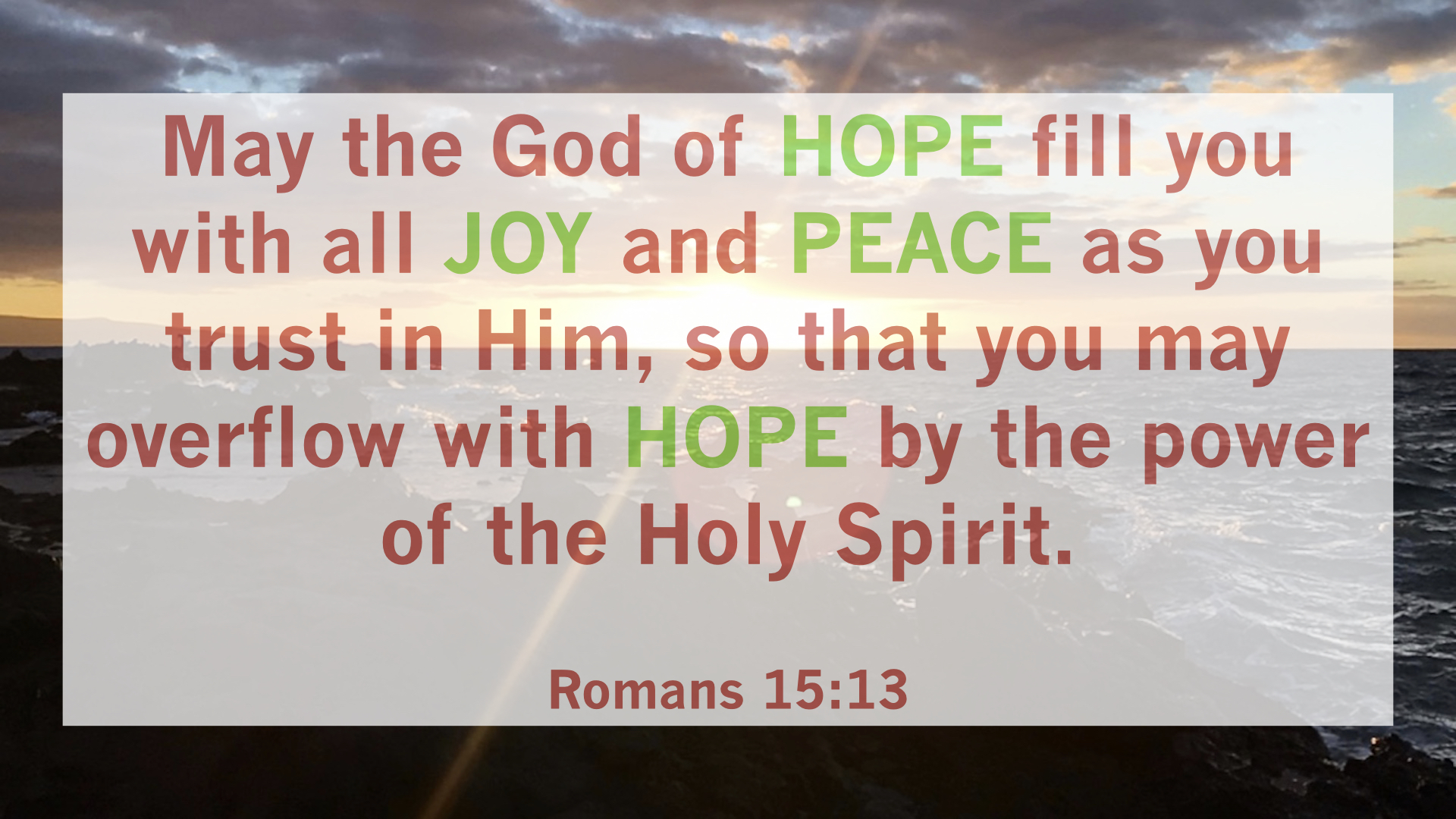
May the God of HOPE fill you with all JOY and PEACE as you trust in Him, so that you may overflow with HOPE by the power of the Holy Spirit. (Romans 15:13) 

Follow along with all four of the Advent attributes by clicking here. 

►► Would you please prayerfully consider supporting this ministry? My Patreon supporters get behind-the-scenes access to exclusive materials. ◀︎◀︎

Links & Quotes

Some of our best lessons are learned in difficult places, so let’s not be too quick to rush in and soften the blow for someone who has taken a tumble. Check out the full conversation I had with my podcast partner Greg. And be sure to check out all of my videos on my YouTube channel.

“A champion is one who gets up when he can’t.” —Jack Dempsey

Once again, archeological finds in Israel confirm the historicity of the biblical accounts of the kings of Judah and Israel. John Stonestreet shares some of the most recent finds. Jewish archeologist Nelson Gluek states, “It may be stated categorically that no archaeological discovery has ever controverted a biblical reference.”

“The reward for work well done is the opportunity to do more.” —Jonas Salk

Scott Hubbard writes, “Stepping into leadership means stepping into mistakes, regrets, and many small but stinging failures. And surviving in leadership, I am learning, means stepping upward on those mistakes—owning them, learning from them, and having the stability in Christ to keep leading after them.” Read more about how leaders can fail well.

J. Warner Wallace addresses the claim that all religions are true or are essentially the same.

“The Scriptures represent the Holy Spirit, not only as moving, and occasionally influencing, the saints, but as dwelling in them as His temple, His proper abode, and everlasting dwelling-place. And He is represented as being there so united to the faculties of the soul, that He becomes there a principle or spring of a new nature and life.” —Jonathan Edwards