How To See A National Revival

Listen to the podcast of this post by clicking on the player below, and you can also subscribe on AppleSpotify, or Audible. 

After making it up to the 11th step—so close to the top now—how could the psalmist be saying, “Out of the depths I cry to You, O LORD”? (Psalm 130:1) 

I think that the more we ascend in God, the more sensitive we should be to any semblance of sin in our lives that would offend Him. The mark of a maturing Christian is one who is constantly closing the gap between sin and confession. 

(You can check out all of the biblical references in this post by clicking here.)

I like the bridge in the song I Keep Falling In Love With Him

When I first fell in love with Jesus,
I gave Him all my heart
And I thought I couldn’t love him more
than I did right at the start.
But now I look back over the mountains,
and the valleys where I’ve been
And It makes me know I love Him so much
more than I did then


Out of the depths—Think how far we’ve come on this climb. In the first Song of Ascent, we were experiencing the woes of being in the valley (Psalm 120:5-7). But now in this song, the feelings of being in the depths are not from someone else’s sinful activity. 

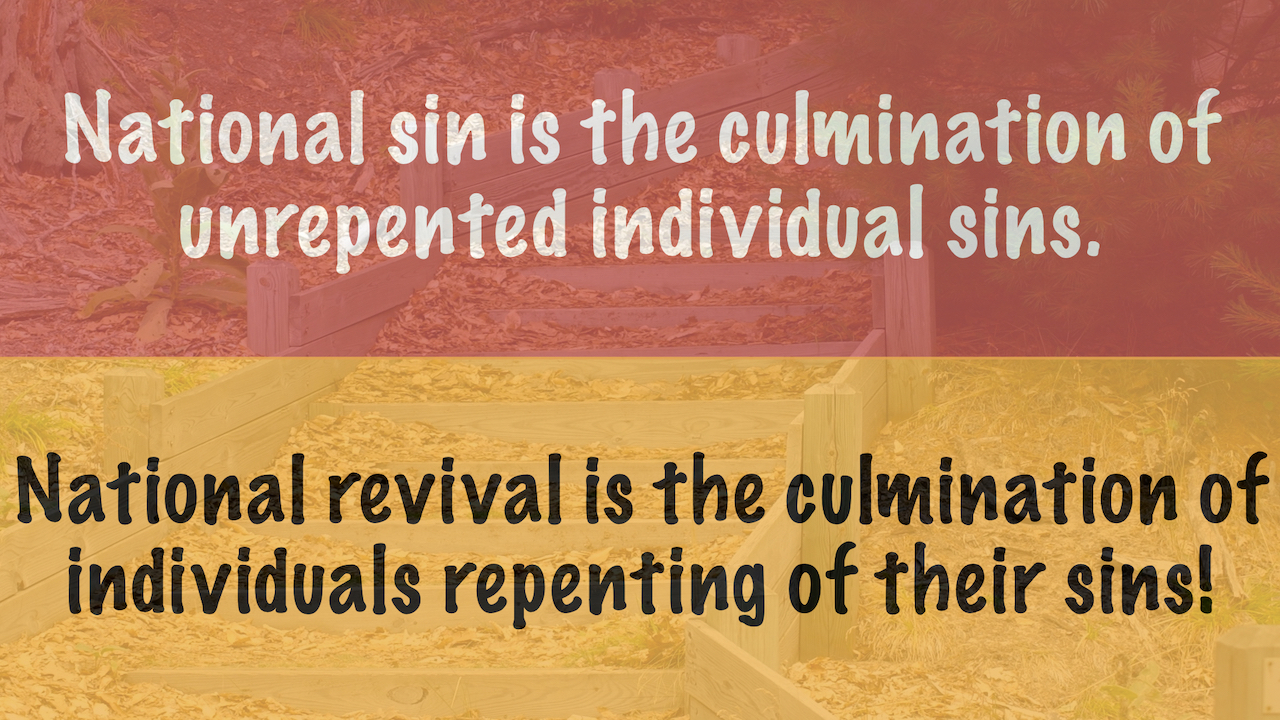
The psalmist is pointing out that national sin is the culmination of unrepented individual sins. God addressed this in Leviticus 20:22—Keep all My decrees and laws and follow them, so that the land where I am bringing you to live may not vomit you out.  

Even in these depths, the psalmist is confident that God will hear—let Your ears be attentive (v. 2). Nehemiah was confident too. Look how he joins his personal sin to the national sin after Israel had be vomited out of the land (Nehemiah 1:1-7). 

Our confidence comes from the rock-solid assurance that God completely forgives our sins and then forgets all that He forgives (vv. 2-3; Psalm 103:10-12). 

The middle verses (vv. 5-6) have the key words wait, watch, and hope. This middle part comes down to: (1) What I’m going to pay attention to, and (2) What God pays attention to. 

God is attentive to our cries for mercy, and He is watchful for our care, not for our punishment! 

We are called to wait and watch in hope because God has proven that He is all in for us. Look at this completeness:  

  • full forgiveness (v. 3) 
  • unfailing love (v. 7a) 
  • full redemption (v. 7b) 
  • all their sins (v. 8) 

Notice in v. 7 the phrase “all THEIR sins” is now corporate (not singular, personal as in the opening verses). 

We’ve gone FROM my voice, my cry TO your hope, O Israel and redemption of their sins. 

If national sin is the culmination of unrepented individual sins, then national revival is the culmination of individuals repenting of their sins! 

National revival starts with you and with me. 

If you’ve missed any of the Songs of Ascent we’ve looked at, you can find them all here. 

►► Would you please prayerfully consider supporting this ministry? My Patreon supporters get behind-the-scenes access to exclusive materials. ◀︎◀︎

Poetry Saturday—Praise To The Redeemer

Listen to the podcast of this post by clicking on the player below, and you can also subscribe on AppleSpotify, or Audible. 

Prepare a thankful song
To the Redeemer’s name
His praises should employ each tongue
And every heart inflame!

He laid His glory by,
And dreadful pains endured;
That rebels, such as you and I,
From wrath might be secured.

Upon the Cross He died,
Our debt of sin to pay;
The blood and water from His side
Wash guilt and filth away.

And now He pleading stands
For us, before the throne;
And answers all the Law’s demands,
With what Himself hath done.

He sees us, willing slaves
To sin, and satan’s pow’r;
But, with an outstretched arm, He saves,
In His appointed hour.

The Holy Ghost He sends.
Our stubborn souls to move;
To make His enemies His friends,
And conquer them by love.

The love of sin departs,
The life of grace takes place,
Soon as His voice invites our hearts
To rise and seek His face.

The world and satan rage,
But He their pow’r controls;
His wisdom, love, and truth, engage
Protection for our souls.

Though pressed, we will not yield,
But shall prevail at length,
For Jesus is our sun and shield,
Our righteousness and strength.

Assured that Christ our King,
Will put our foes to flight;
We, on the field of battle, sing
And triumph, while we fight. —John Newton

►► Would you please prayerfully consider supporting this ministry? ◀︎◀︎

Thursdays With Spurgeon—We Are All Laborers

This is a weekly series with things I’m reading and pondering from Charles Spurgeon. You can read the original seed thought here, or type “Thursdays With Spurgeon” in the search box to read more entries.

Listen to the podcast of this post by clicking on the player below, and you can also subscribe on iTunes or Spotify.

We Are All Laborers

I planted, Apollos watered, but God gave the increase. So then neither he who plants is anything, nor he who waters, but God who gives the increase. Now he who plants and he who waters are one, and each one will receive his own reward according to his own labor. For we are God’s fellow workers; you are God’s field, you are God’s building. (1 Corinthians 3:6-9) 

     Remember that the ablest ministers, the most powerful evangelists, the most profound teachers are, after all, nothing but laborers together with God. Let your mind be set upon the Master and not upon the servants! Do not say, ‘We are for this man because he plants,’ or ‘We are for the other because he waters,’ or ‘We are a third party for nobody at all.’ But let us join in ascribing all honor and praise to God, Who works all our works in us, since every good gift and every perfect gift is from above and comes down from the Father of lights, to Whom be glory world without end! … 

     The church is God’s farm.… In the margin of the Revised Version, we read, ‘You are God’s tilled ground….’ 

    We begin by considering that the church is God’s farm. The Lord has made the church of His sovereign choice to be His own by purchase, having paid an immense price for it. ‘For the Lord’s portion is His people; Jacob is the lot of His inheritance’ (Deuteronomy 32:9). Because the Lord’s portion was under mortgage, therefore the only begotten Son laid down His life as the purchase price and redeemed His people to be the Lord’s portion forever and ever. Henceforth it is said to all believers, ‘You are not your own. For you were bought at a price’ (1 Corinthians 6:19-20). Every acre of God’s farm cost the Savior bloody sweat, yes, the blood of His heart! He loved us and gave Himself for us; that is the price He paid! … 

     The Master’s commission is not ‘sit still and see the Spirit of God convert the nations,’ but ‘Go into all the world and preach the gospel to every creature’ (Mark 16:15). 

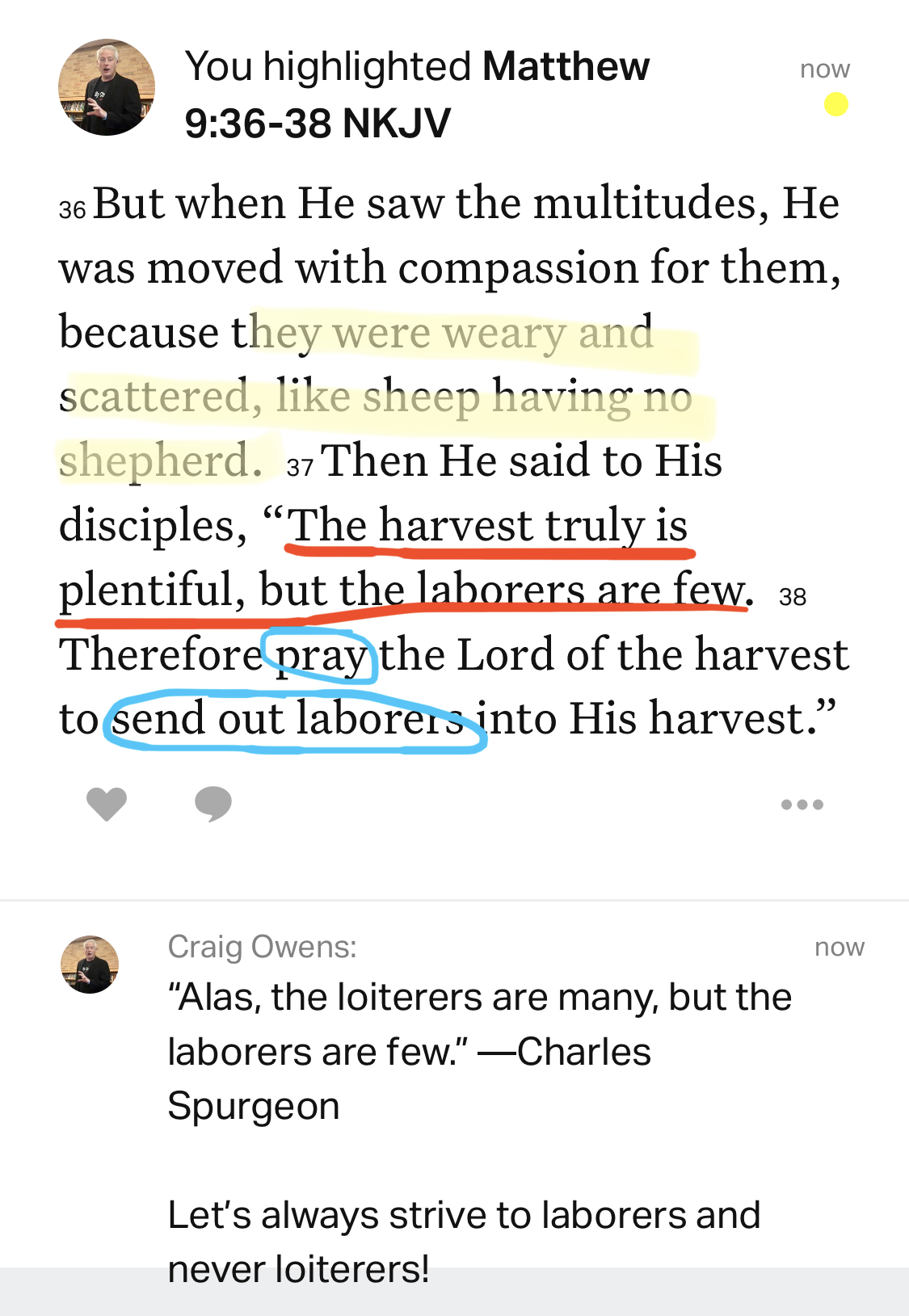
     Alas, the loiterers are many, but the laborers are few.

From Farm Laborers

It’s sad how much time Christians spend on non-essential things. We church shop to find the pastor or the music that suits our tastes; we claim ownership over ministries and only allow others to work under us, but never alongside us; or we attend church and give our tithes and offerings and expect the pastor to do all of the ministry. 

All of this is not only unbiblical but none of this is focused on eternity. And as C.S. Lewis said, “All that is not eternal is eternally useless.” 

Jesus paid too high a price for us to keep the good news to ourselves, or claim that our ministry is superior to someone else’s, or to simply loiter and watch others do the work. All Christians are laborers in God’s field. God made an invaluable investment in the work Jesus did on the Cross, so He wants to see a return on His investment that will last for all eternity. 

It’s time for us to stop squabbling, stop protecting our turf, and stop loitering. We must get to the work because the time is short and the Master is looking for eternal results.

►► Would you please prayerfully consider supporting this ministry? ◀︎◀︎

Ruth + Boaz

This is one of my all-time favorite stories in the Bible! It’s a story of disappointment, death, heartache, hope, redemption, and legacy. 

But mostly it’s a story of unexpected love. It’s a perfect portrayal of God’s redemption, and it’s beautifully lived out by an unlikely heroine and hero: It’s the eternal love story of Ruth + Boaz. 

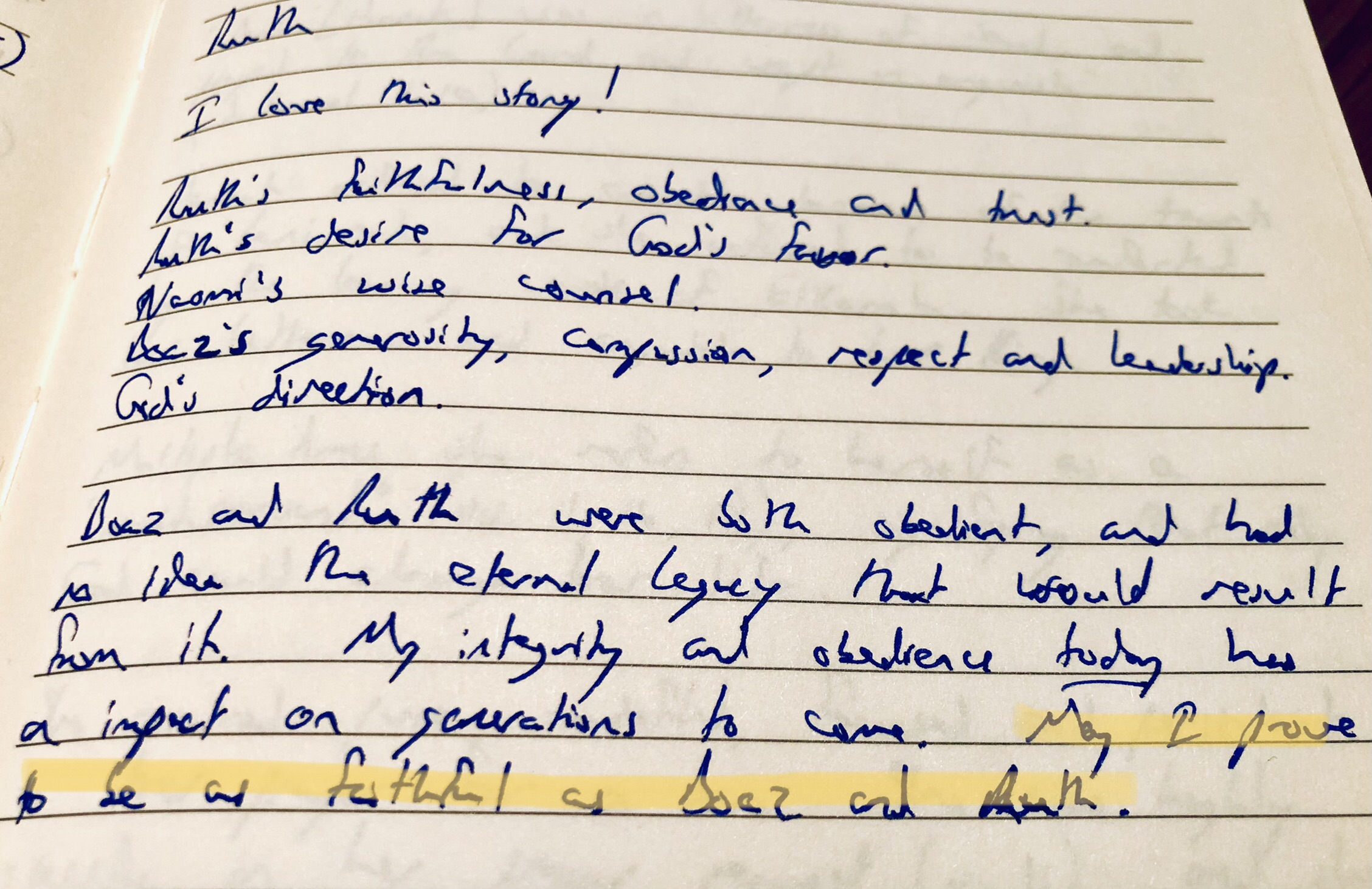
While thinking about this story, I wrote in my journal nearly four years ago, “May I prove to be as faithful as Boaz and Ruth.” Indeed, it’s hard to find better examples! 

This story is still teaching lessons to us today. On Mother’s Day, we looked at this love story through the eyes of Ruth, and on Father’s Day, we saw the lessons Boaz lived out for us. 

  • You can check out the Mother’s Day message about Ruth by clicking here.
  • And the Father’s Day look at Boaz is here.

Thursdays With Spurgeon—Mercy Finds The Loophole

This is a weekly series with things I’m reading and pondering from Charles Spurgeon. You can read the original seed thought here, or type “Thursdays With Spurgeon” in the search box to read more entries.

Listen to the podcast of this post by clicking on the player below, and you can also subscribe on iTunes or Spotify.

Mercy Finds The Loophole

And the Lord smelled a soothing aroma. Then the Lord said in His heart, “I will never again curse the ground for man’s sake, although the imagination of man’s heart is evil from his youth; nor will I again destroy every living thing as I have done.” (Genesis 8:21) 

     To begin, then, with the text, we have here a most painful fact that man’s nature is incurable. ‘The imagination of man’s heart is evil from his youth.’ You will remember, before the flood, in the fifth verse of the sixth chapter, it is written, ‘Then the Lord saw that the wickedness of man was great in the earth, and that every intent of the thoughts of his heart was only evil continually’ (Genesis 6:5). After the flood it was just the same. … 

     You might have hoped that after so terrible a judgment, when only a picked and peculiar few, that is, eight, were saved by water, that man began anew with better stock.… It is not one wit so. The same God who, after looking at men, declared that his imagination was evil before the flood, pronounces the very same verdict upon them afterward. …

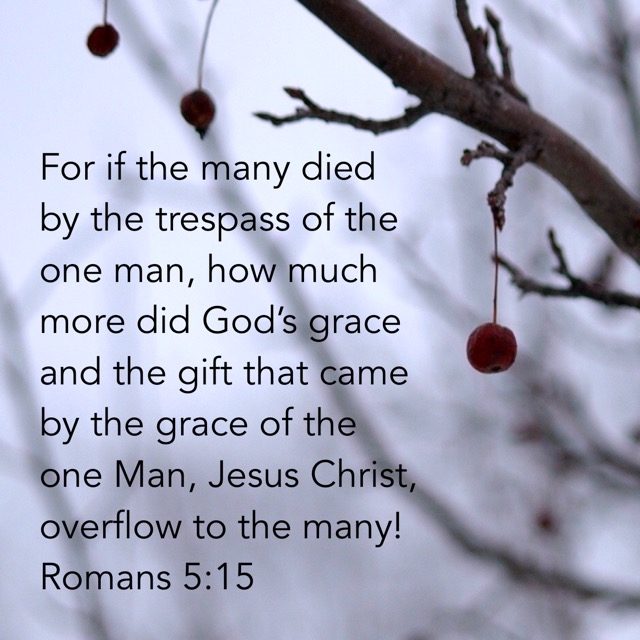
     I believe that God might justly have condemned the whole race of Adam on account of Adam’s sin and their own guilt. But I do think that this was a blessed loophole through which His mercy could, as it were, come fairly to the sons of men. ‘No,’ He says, ‘I made them not distinct individuals but a race. They fell as a race; they will rise as an elect race. “For as in Adam all die, even so in Christ all shall be made alive” (1 Corinthians 15:22). And ‘For as by one man’s disobedience many were made sinners, so also by one Man’s obedience many will be made righteous” (Romans 5:19).’ … 

     I must have more than nature can give me. More than my mother gave me, more than my father gave me, and more than flesh and blood can produce under the most favorable circumstances. I must have the Spirit of God from heaven.

From Human Depravity And Divine Mercy

When Adam and Eve sinned, God wasn’t scrambling to come up with a Plan B. Jesus is described as the Lamb slain from the foundation of the world (Revelation 13:8), meaning that God had His merciful plan of redemption ready before He even created humans! 

The atoning sacrifice Jesus made on the Cross was the “loophole” that God’s mercy used to pardon our sins. We can never earn our salvation because we are still people with evil hearts. But we can put our faith in the One who took our punishment upon Himself so that His righteousness can be our righteousness. 

O what a Savior! O what mercy God has shown! O how great is His love for us! How shall we escape appropriate retribution if we neglect and refuse to pay attention to such a great salvation…? (Hebrews 2:3)

►► Would you please prayerfully consider supporting this ministry? ◀︎◀︎


Poetry Saturday—Sacred Bond

‘Twixt Jesus and the chosen race, 
Subsists a bond of sovereign grace. 
That hell, with its infernal train. 
Shall ne’er dissolve, or rend in twain. 

This sacred bond shall never break, 
Though earth should to her centre shake ; 
Rest, doubting saint, assured of this, 
For God has pledged His holiness. 

He swore but once, the deed was done; 
‘Twas settled by the great Three One; 
Christ was appointed to r’deem 
All that the Father loved in Him. 

Hail sacred union, firm and strong! 
How great the grace, how sweet the song! 
That worms of earth should ever be 
One with incarnate Deity! 

One in the tomb, one when He rose, 
One when He triumph’d o’er His foes. 
One when in heaven He took His seat. 
While seraph’s sung all hell’s defeat. 

This sacred tie forbids their fears, 
For all He is, or has, is theirs; 
With Him their head, they stand or fall, 
Their life, their surety, and their all. —Anonymous

The Church Needs To Foster Community

“Amid the confusion of Christians mistreating people with gender dysphoria to prop up their sense of self-righteousness, and progressives mistreating them to advance their agenda of autonomy, those with real identity struggles are forgotten. Christ alone understands who we are through and through. And because of that each one of us in our fractured states needs to come to Him. …

“The need of the hour is for biblically faithful compassion. The church needs to open its doors and Christians need to open their hearts so that those struggling to find resolution to their dysphoria—and those who are struggling to find clarity amidst other confusions—can find community and, ultimately, their true identity in Christ. In Christ, they can be understood. …

“God’s original intent is for harmony between one’s soul and one’s body. This is why Christians, of all people, should be compassionately concerned with helping people find mind-body congruence. For the Christian, the mind and the body are both important and were meant to work harmoniously. … This biblical perspective defends our integrity as whole human beings in contradistinction to the secular effort to reduce us to our chemistry and jettison any idea that we have an immaterial mind or soul. …

“That is why the invitation of Christ has come in this order: recognition, repentance, redemption, regeneration. When we recognize our need for the Savior (because of our sins in general, not because of our dysphoria), repentance happens and then we are redeemed. But that redemption works itself out in our lives over time. It is the Holy Spirit who lives and works in us to conform us to Jesus’ likeness. It is not an overnight process, which means the church must do a better job of helping that process along. The church needs to foster community.” —Abdu Murray

Thursdays With Oswald—Do You Have The Goods Or Just The Label?

This is a weekly series with things I’m reading and pondering from Oswald Chambers. You can read the original seed thought here, or type “Thursdays With Oswald” in the search box to read more entries.

Do You Have The Goods Or Just The Label? 

     Our Lord makes the test of goodness not only goodness in intention, but the active carrying out of God’s will. Beware of confounding appearance and reality, of judging only by external evidence. …  

     The baptism of the Holy Ghost turns men into the incarnation of what they preach until the appearance and the reality are one and the same. … He does in us what Jesus did for us. … 

     Human nature is fond of labels, but a label may be the counterfeit of confession. It is so easy to be branded with labels, much easier in certain stages to wear a ribbon or a badge than to confess. Jesus never used the word testify; He used a much more searching word—confess. ‘Whosoever therefore shall confess Me before men…’ [Matthew 10:32-33]. The test of goodness is confession by doing the will of God. ‘If you do not confess Me before men,’ says Jesus, ‘neither will your Heavenly Father confess you.’ Immediately we confess, we must have a badge, if we do not put one on, other people will. Our Lord is warning that it is possible to wear the label without having the goods; possible for a man to wear the badge of being His disciple when he is not. Labels are all right, but if we mistake the label for the goods we get confused.

From Studies In The Sermon On The Mount

Some people only wear the labels—they use the name “Christian” without ever surrendering to the lordship of Jesus. Oswald Chambers reminds us that these are the people to whom Jesus will say, “I never knew you” (Matthew 7:21-23). 

Listen to the Holy Spirit. He can make sure that your preaching your living are one and the same. You and I don’t want to just testify that we are disciples of Jesus, but we want to be the living incarnation of all that Jesus did and taught.

Labels are fine (if other people put them there), but just make sure you have the goods! I’ll say it again: Listen to the Holy Spirit and immediately obey what He points out to you.

Thursdays With Oswald—We Must Do The Doing

Oswald ChambersThis is a weekly series with things I’m reading and pondering from Oswald Chambers. You can read the original seed thought here, or type “Thursdays With Oswald” in the search box to read more entries.

We Must Do The Doing

     Our Lord warns that the devout life of a disciple is not a dream, but a decided discipline which calls for the use of all our powers. No amount of determination can give me the new life of God, that is a gift; where the determination comes in is in letting that new life work itself out according to Christ’s standard. 

     We are always in danger of confounding what we can do with what we cannot do. We cannot save ourselves, or sanctify ourselves, or give ourselves the Holy Spirit; only God can do that. Confusion continually occurs when we try to do what God alone can do, and try to persuade ourselves that God will do what we alone can do. We imagine that God is going to make us walk in the light; God will not; it is we who must walk in the light. God gives us the power to do it, but we have to see that we use the power. God puts the power and the life into us and fills us with His Spirit, but we have to work it out. “Work out your own salvation,” says Paul, not, “work for your salvation,” but “work it out”; and as we do, we realize that the noble life of a disciple is gloriously difficult and the difficulty of it rouses us up to overcome, not faint and cave in. It is always necessary to make an effort to be noble. …

     Things that are worth doing are never easy. … It is a noble life and a difficult life. God works in us to do His will, only we must do the doing; and if once we start to do what He commands we find we can do it, because we work on the basis of the noble thing God has done for us in Redemption.

From Studies In The Sermon On The Mount

It’s a simple question that all Christians should ask themselves—“Am I doing the doing?” 

It’s never, “Am I working for my salvation?” but it’s always, “Am I working out my salvation because of all that the Redemption has enabled and empowered me to do?” 

Poetry Saturday—Awake My Soul

Awake, my soul, and with the sun 
Thy daily stage of duty run; 
Shake off dull sloth, and joyful rise, 
To pay thy morning sacrifice. 
Thy precious time misspent, redeem, 
Each present day thy last esteem, 
Improve thy talent with due care; 
For the great day thyself prepare. 
By influence of the Light divine 
Let thy own light to others shine. 
Reflect all Heaven’s propitious ways 
In ardent love, and cheerful praise. 
In conversation be sincere; 
Keep conscience as the noontide clear; 
Think how all seeing God thy ways 
And all thy secret thoughts surveys. —Thomas Ken