God In The Footnotes?

Listen to the podcast of this post by clicking on the player below, and you can also subscribe on AppleSpotify, or Audible. 

Can we trust our Bibles? There are some things that skeptics point to that we need to be able to defend—even in this model prayer that we have been studying. We come to the last verse of this prayer, which many of you probably learned or heard as, “For Yours is the kingdom and the power and the glory forever. Amen.” Yet some Bibles have a footnote here that notes that this doxology is not seen in all biblical manuscripts. 

How are we to handle this observation, and others like it in places like Mark 16:9-20 and John 7:53-8:11? 

Let’s start with how we got the Bibles we have today, because it is very instructive. 

We don’t have the autographs (original writings) but we have manuscripts (copied by a trained scribe from the autograph, and then copied from by yet another reliable scribe, and so forth). The oldest calfskin manuscript we have goes back to 1500 BC, and the oldest papyrus manuscript goes back to 2400 BC. 

The scribes were incredibly talented and disciplined men. They became a recognized group called the Sopherim (scribes) in about 500 BC. By AD 100, the Talmudic scribes eclipsed them, and then the Masoretic scribes—the most stringent scribes of all—dominated from AD 500-900. 

Let’s turn our attention first to the manuscripts that compromise what we call the Old Testament. What did Jesus—and others that lived in His time—call those 39 books of the Old Testament? They were called Scripture. Those books were not in doubt even before Jesus was on earth. 

Dr. Peter Flint notes, “The biblical Dead Sea Scrolls are up to 1,250 years older than the traditional Hebrew Bible, the Masoretic text. We have been using a one-thousand-year-old manuscript to make our Bibles. We’ve now got scrolls going back to 250 BC. … Our conclusion is simply this—the scrolls confirm the accuracy of the biblical text by 99 percent.” 

In the New Testament era, the disciples of Jesus went out in pairs. Their oral transmission of the news of Jesus and the quoting of Scripture was verified by their traveling partners. Even for those who happened to be by themselves (e.g. Philip in Samaria), there was always follow up by other church leaders. 

So the New Testament epistles were written to verify the spoken words—James was the earliest (probably AD 45). The number of manuscripts we have of these New Testament words are simply astounding! 
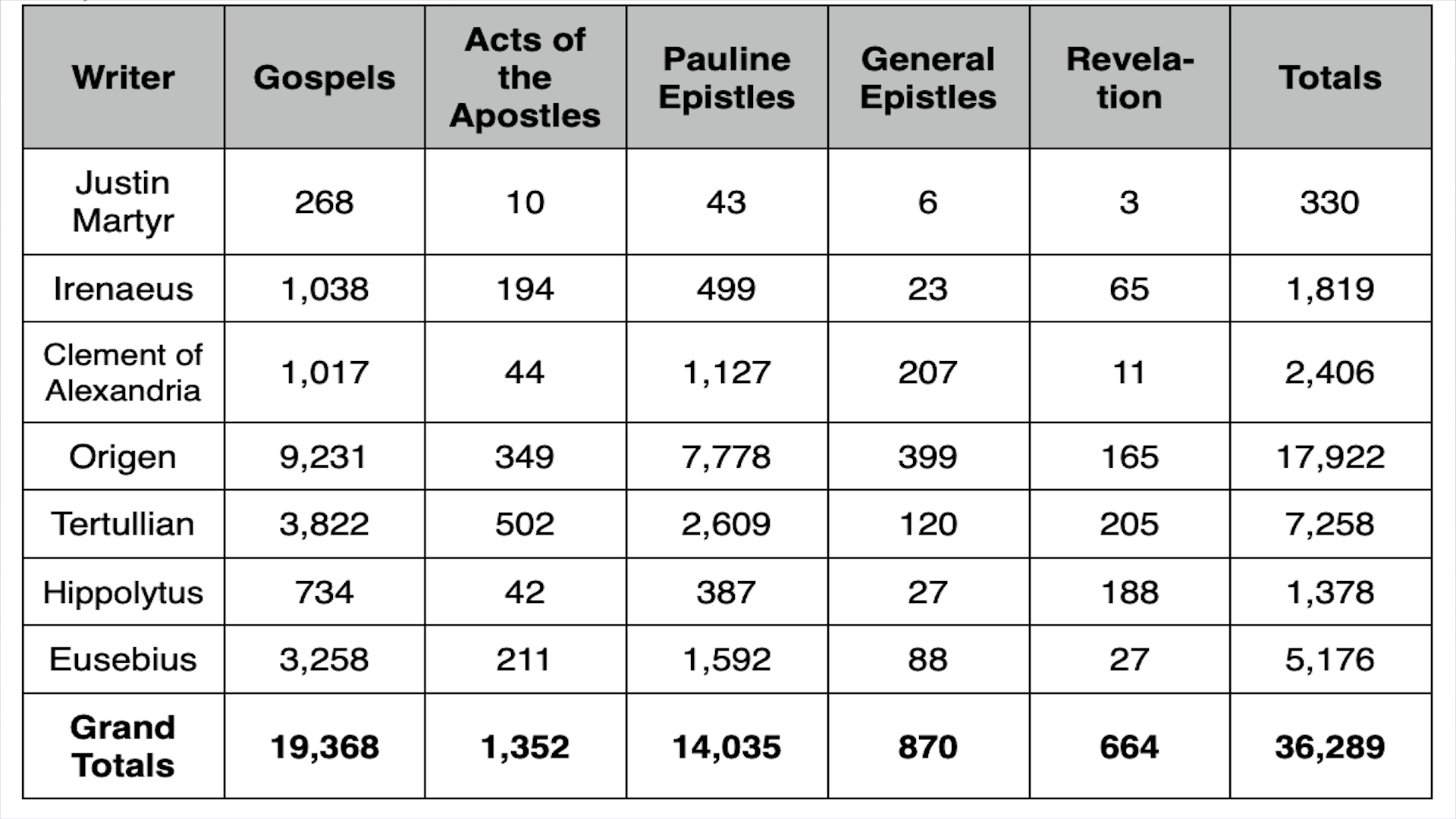
After the canon of the New Testament was completed, the church fathers quoted so much of the New Testament in their letters and books that we could completely reconstruct those 27 books just from their writings. 

With this many manuscripts in existence, is it likely that there would variations in manuscripts? Yes. But none of the variations ever discovered have been fundamental enough to change anything in the meaning. Josh McDowell states, “Compared with other ancient writings, the Bible has more manuscript evidence to support it than the top ten pieces of classical literature combined.” 

So how do we handle these places where scholarly footnotes tell us of a discrepancy in the existing manuscripts? 

  1. Get the context—does this fit with what is happening around it? 
  2. Is there corroboration—can we cross-reference it from elsewhere in the Bible? 

In the conclusion of the powerful model prayer Jesus has given us, the closing words appear to be a doxology. But I think we can trust this because for three main reasons: 

  1. This doxology seems to come full circle with how the prayer begins in: Our Father in heaven, hallowed be Your name, Your kingdom come, Your will be done, on earth as it is in heaven (vv. 9-10). 
  2. These words are found almost verbatim in the words of David: Yours, Lord, is the greatness and the power and the glory and the majesty and the splendor, for everything in heaven and earth is Yours. Yours, Lord, is the kingdom; You are exalted as head over all (1 Chronicles 29:11). 
  3. Finally, these words are similar (if not identical) to the words that John records he heard in Heaven—Revelation 4:11; 5:12-13; 7:12; 11:15-17 

As we have noted throughout this prayer series, the focus of this prayer is two-fold: It is both an acknowledgement of the awesome, praiseworthy glory of our God, and it is a petition for our lives to be empowered to help others see our glorious God and Savior for themselves. 

For these reasons, this doxology, I believe, is an indispensable part of this majestic prayer. 

If you missed any of the other messages in this series, you can check them all out here. 

►► Would you please prayerfully consider supporting this ministry? My Patreon supporters get behind-the-scenes access to exclusive materials. ◀︎◀︎

Links & Quotes

Many of the examples Jesus used to tell us about the Kingdom of God seem like such small things. But those small beginnings have irresistible growth potential! Check out more thoughts in my series of posts called Kingdom Praying. I have lots of new content every week, which you can check out on my YouTube channel.

My wife is a school teacher and I also work quite a bit in our local schools. I think T.M. Moore is spot-on in his analysis of the breakdown in our current educational system: “This commitment to the Law and Word of God as foundational to the education of the young was everywhere practiced throughout the pre-revolutionary period in colonial America. It was unthinkable in the colonies that young people should be submitted to any instruction for any length of time without being taught the commandments and statutes of God, including the Gospel of Jesus Christ. Parents insisted on it, colonial and local statutes required it, and local school boards dutifully saw to it in all their schools.Since the middle of the previous century, assailed by specious invocations of ‘the separation of Church and State,’ educational policy in America has increasingly denied a place to God, His commandments, and His Word in the public-school curriculum. Generations of American children have grown up in a ‘disenchanted’ world (Charles Taylor), a world in which God, spiritual things, and the Law of God are deemed to be irrelevant if not oppressive, or at least a nuisance. The present crisis of morality, culture, and social upheaval is only the most visible consequence of that policy.”

David Mathis shared some thoughts about the healthy pace of ministry Jesus demonstrates for us. He said, “Let’s sit together at the feet of Jesus, and consider the pace and patterns of His life and ministry. He was not idle. Nor was He frenzied. From all we can tell from the Gospels, Jesus’s days were full. I think it would be fair to say He was busy, but He was not frantic. He lived to the full, and yet He did not seem to be in a hurry. In Jesus, we observe a human life with holy habits and patterns: rhythms of retreating from society and then reentering to do the work of ministry. Even as God Himself in human flesh, Jesus prioritized time away with His Father. He chose again and again, in His perfect wisdom and love, to give His first and best moments to seeking His Father’s face.“ These words resonate with me, because they are thoughts that I considered quite extensively for my book Shepherd Leadership.

I love reading stories like these that show how a relationship with Jesus utterly transforms a person’s life! “Opal W. Eubanks joined the Mississippi Highway Patrol during the race riots of 1964. A large, broad-shouldered white man, he relished the opportunity to strike fear in the hearts of African-Americans who were in trouble with the law. By his own admission, he was a foul-mouthed sinner who liked ‘rough stuff.’ A radical conversion to Christ in the early 1970s altered the course of Eubanks’ life, and his hardened heart became tender toward African-Americans in his rural community. He and his wife, Thelma, ultimately pioneered an Assemblies of God congregation consisting mostly of African-Americans, which they pastored for 21 years.”

The Greek word for “teaching” in Mark 9:31 means an ongoing dialogue. It’s an imperfect verb here because it is an activity that is never fully completed. Jesus wants us to abide with Him—to dialogue with Him—to continually learn from Him. The New Living Translation says it this way, ”For He wanted to spend more time with His disciples and teach them.” This is just as true for us today! 

J. Warner Wallace addresses the claims that the Old Testament prophets actually foretold that Jesus would be the Messiah. I love considering the apologetics for the death and resurrection of Jesus Christ, and this video will become an added resource for me in the future.

Links & Quotes

We’ve added things that we think should be in our prayer vocabulary. But kingdom praying should be as natural as talking to the most loving Father you can imagine! Check out more thoughts in my series of posts called Kingdom Praying. I have lots of new content every week, which you can check out on my YouTube channel.

“Obstacles don’t have to stop you. If you run into a wall, don’t turn around and give up. Figure out how to climb it, go through it, or work around it.” —Michael Jordan

In the post-Flood rock layers, fossils are often found of animals that were much larger than are currently observed. This has been called giantism. “Evolutionists claim that adaption occurs as random mutations make some organisms better fitted for their environment, and the less-fit organisms then die off. … This supposed, random, trial-and-error process requires long periods of time waiting for the ‘right’ random mutation to occur. In contrast, ICR gives credit to Jesus. He designed organisms with built-in sensors that enable them to detect changes in their environment. Internal genetic programming then allows these organisms to rapidly adapt to these changes in predictable ways. Such adaptation is often too rapid for natural selection to be the correct explanation. This design-based paradigm of adaptation is called continuous environmental tracking (CET).” This is an excellent article. 

“If the stone falls on the pot, alas, for the pot; if the pot falls on the stone, alas for the pot.” —Jewish proverb, based on Psalm 118:22 and Luke 20:17-18

Godly leaders need…

  • …ears consecrated to hear God’s voice and the voice of the people
  • …hands dedicated to ministering in love and obedience
  • …feet that only walk in God-directed paths

Godly leaders don’t minister to please people, but to lead people to God. So godly leaders are ever aware that in all they do, they must hear God say, “Well done, good and faithful servant.”

5 Quotes From “Unshakable You”

John Opalewski’s short book is highly readable and easily applicable. I recommend this book to both help you get emotionally healthier and then to maintain that emotional health. You can check out my full book review here. 

Here are a few quotes that especially caught my attention—

“Maybe you are reading this book and have no issues currently with depression. Be thankful to God for your health. But understand depression is easier to prevent than it is to cure. Educating yourself while healthy minimizes your future risk.” 

“Emotional health is a choice. If you choose to ignore your emotional health, no one else will pay attention to it for you.” 

“God used words to create the universe. They have the power to create or destroy, heal or wound. … Nobody talks to you more than you talk to yourself. Verbally assaulting yourself damages your emotional health—every time. Being kind to yourself with words enhances your emotional health—every time. … Loving yourself means you gain increasing control of your self-talk.” 

“Learn to be assertive rather than aggressive or passive. Aggression includes foul language, yelling, or getting physical with people. Passivity is another word for repression. Here we stuff our anger and let it boil on the inside. An example of passivity is giving someone the silent treatment. Assertiveness, on the other hand, means standing up for yourself by expressing your needs to others with love and respect.” 

“A depressed person often complains of having no energy to deal with people. Therefore, they tend to isolate themselves, which usually compounds a person’s distress. Depression thrives in isolation. Consequently, it is critical to surround yourself with the right kind of people during your battle with this affliction.” 

I have shared another half-dozen quotes from this book with my Patreon supporters. Please become a supporter and get access to lots of exclusive content—videos, early-releases, study aids, and so much more!

Links & Quotes

Unforgiveness keeps our eyes on our offenders and off our God. Free yourself by forgiving those who have hurt you. You can check out this full sermon hereI have lots of new content every week, which you can check out on my YouTube channel.

“At the moment of truth, there are either reasons or results.” —Chuck Yeager

As I have shared before, I am so impressed with the He Gets Us social media campaign! Some people are still trying to figure out exactly what this campaign is. Sean McDowell and his podcast partner Scott Ray had a great conversation with Ed Stetzer about this. Check out the video!

Some people have been critical of the He Gets Us commercials that aired during the Super Bowl, but I thought they were outstanding! This is a social media outreach designed and funded by some of the most biblically-grounded, evangelistically-minded people I know. It is a social media campaign. It is not designed as a sermon (which is why there are no Bible verses shown in the commercial). The idea is to get past the barriers and misconceptions skeptics have come to believe about Jesus, and then be enticed to go to the hegetsus.com website. It is at this site that the Gospel message is introduced and visitors are given Bible verses and other materials to go deeper.

John Stonestreet wrote, “Before it was the corporate creation of greeting card companies, it was a day to remember third-century Christian martyr Valentinus of Rome.” This post is a good reminder of what Christians really should be remembering on Valentine’s Day, as well as the higher definition of love.

“The important thing is to learn a lesson every time you lose.” —John McEnroe

Links & Quotes

Our anxiety is usually tied to our insecurity about our needs being met. Philippians 4:6-7 counsels us to turn those anxieties into prayer. It’s not what we can provide for ourselves, but trusting what our Heavenly Father has already provided for us. Check out this amazing series on prayer. I have lots of new content every week, which you can check out on my YouTube channel.

A recent post at the Institute for Creation Research says, “despite popular perception, the impact theory of dinosaur extinction has problems and is still a source of contention among even conventional scientists.” In fact, “Despite uniformitarian claims to the contrary, these rocks and fossils are best explained by the Genesis Flood that covered the earth about 4,500 years ago. All the air-breathing, land-dwelling creatures outside the Ark perished. However, the representatives of these animals that God brought on board the Ark, including dinosaurs, survived, reproduced, and spread across the Earth after the Flood. Many ancient peoples wrote about and described what appear to be dinosaurs, even though they called them by other names, e.g., dragons. In the creation Flood model, impacts may have hit the earth during the Flood, but none of them caused the dinosaurs to go extinct.” This article is a good overview of the geological and paleontological evidence that supports the biblical account of the Flood.

“Scripture teaches us that there are two points of view from which we may regard Christ’s death upon the Cross. The one is the redemption of the Cross: Christ dying for us as our complete deliverance from the curse of sin. The other, the fellowship of the Cross: Christ taking us up to die with Him and making us partakers of the fellowship of His death in our own experience. … O Christian, when the world crucified Christ, it crucified you with Him, when Christ overcame the world on the Cross, He made you an overcomer too. He calls you now, at whatever cost of self-denial, to regard the world, in its hostility to God and His kingdom, as a crucified enemy over whom the Cross can ever keep you conqueror. What a different relationship to the pleasures and attractions of the world the Christian has who by the Holy Spirit has learned to say: ‘I have been crucified with Christ;…[the crucified] Christ lives in me!’ (Galatians 2:20).” —Andrew Murray

Sullivan and Addie Chainey were both deaf, but that didn’t stop them from becoming premier missionaries in the Assembly of God fellowship. Their work with other deaf people was amazing! I love this concluding thought in this short biography of their ministry work: “The Chaineys’ story testifies that God can empower those who are marginalized in society to do redemptive work in their own communities and beyond.”

“Earth, I think, will not be found by anyone to be in the end a very distinct place. I think earth, if chosen instead of Heaven, will turn out to have been, all along, only a region in Hell: and earth, if put second to Heaven, to have been from the beginning a part of Heaven itself.” —C.S. Lewis, in The Great Divorce

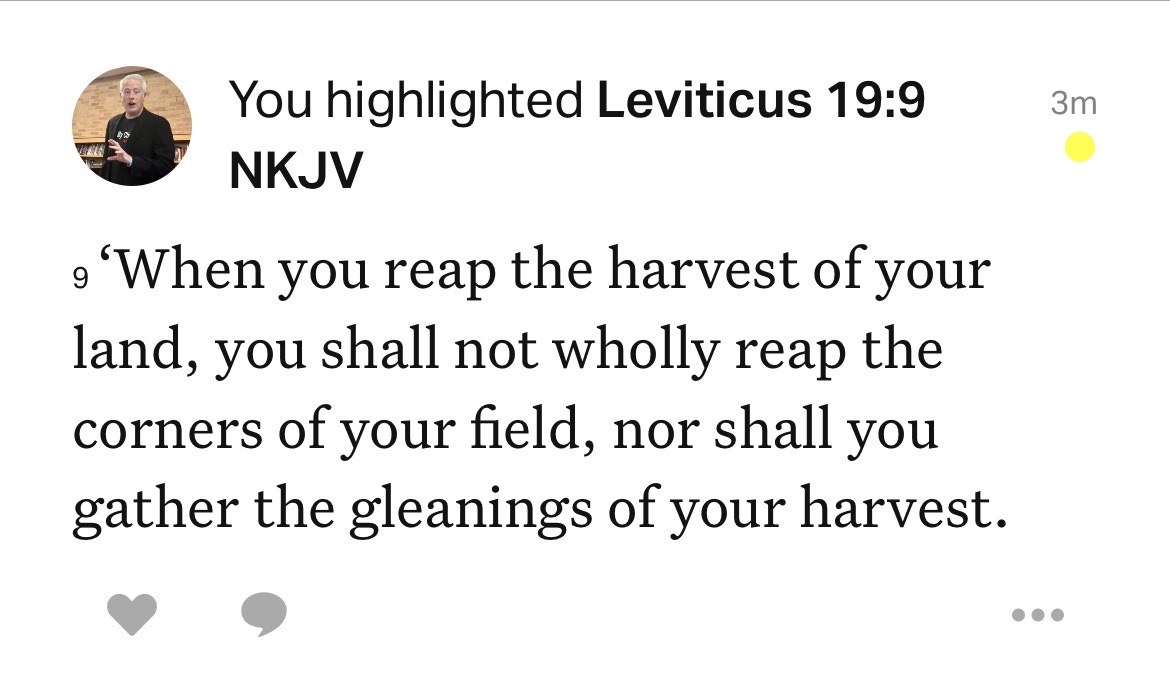
Years later, Boaz was obeying this commandment in Leviticus 19:9. That allowed Ruth to be in his field, which led to a marriage that began the family line of King David, which traces all the way to Jesus! Obedience matters. Just imagine if Boaz had been disobedient in this. The Messiah still would have come, but Boaz and Ruth (and their children and grandchildren) would have missed out on this blessing.

Links & Quotes

Stop praying to yourself! God isn’t impressed with your “powerful” prayer! Jesus tells an interesting story about two men: one thought very highly of his spiritual status and the only could barely lift his eyes. Jesus said that the proud man’s prayer received no help from God, but only the humble man’s prayer was heard. This is a short clip from my series called Kingdom PrayingI have lots of new content every week, which you can check out on my YouTube channel.

“If the fetus gets in the way, ditch it. If the old person gets in the way, ditch it. If you get in the way…” —Francis Schaeffer

“The god of convenience, ruling capriciously in the hearts of men and women, and supported by worshipers of the god of wealth—greedy, self-interested profit-takers in the guise of abortionists and abortion-rights advocates—is the putative lord of life and death where children in the womb are concerned. … Christians must insist that all political candidates seeking their support, at whatever level of government, be firm in their commitment to resist the present abortion regime and expose the lie of the pro-choice agenda by every available means. …The Law of God is holy and righteous and good. Abortion is unholy, unrighteous, and evil. If we want a just and loving society, we will worship God and obey His Law, and we will work to dethrone the god of convenience and to expose the folly and self-interest of all its followers. And we will look to God to explain the nature, meaning, and value of all lives.” —T.M. Moore

Elihu is angry at Job “because he justified himself before God.” Better stated: “Job was more concerned about justifying himself—making himself look good—than he was about making God look good.” Elihu is angry at Job’s three friends because they acted like God and pronounced a guilty verdict against Job. Elihu is righteously provoked. After holding his tongue for 31 chapters, he cannot remain silent any longer!  I conclude that Elihu is righteous in his response because God doesn’t have anything negative to say to or about Elihu (as He does with the three friends) at the end of the Book of Job. 

Long before the term “fake news” made it into our lexicon, Charles E. Robinson wrote an article in 1934 “as a solemn warning to all Christians” about the rising tide of anti-Semitism. He was especially upset about a book that made an erroneous case blaming Jews for global economic and political turmoil. I am thrilled with the strong spiritual and intellectual legacy in the Assembly of God fellowship!

“There’s a lot of blood, sweat and guts between dreams and success.” —Paul Bear Bryant

Dr. Bruce Hindmarsh looks at the rare friendship between one of my favorite authors and a gifted poet whose work I also admire: John Newton and William Cowper.

Links & Quotes

Peter described the ministry of Jesus as “doing good and healing all who were under the power of the devil.” Historical records tell us the first Christians lived this exact same way! This clip is from our current series of sermons on prayerI have lots of new content every week, which you can check out on my YouTube channel.

John Piper has some great advice for finding the main point of a chapter in the Book of Psalms.

Belshazzar was unknown outside the Bible for quite awhile, prompting one biblical skeptic to say, “the whole story [in the Book of Daniel] is disfigured and falsified by the author, who was neither an eye-witness of the occurrences, nor accurately acquainted with the history of them.” Once again, archeology has confirmed the historicity of both Belshazzar and Daniel.

On YouVersion I shared this on Job 1:20-22. The Old English spelling of worship is “worthship.” We worship God because He has infinitely greater worth than any other person or thing. It’s not that Job wasn’t sad about his losses, but He saw Jehovah as the One of greatest worth in spite of his earthly losses.

“Leaders are responsible for building organizations where people continually expand their capabilities to understand complexity, clarify vision, and improve shared mental models—that is, they are responsible for learning.” —Peter M. Senge, in The Fifth Discipline

Never stopping praying for your loved ones. It could be that with their very last breath they will call on Jesus as their Savior!

5 Quotes From “A Shepherd Looks at Psalm 23”

After I wrote the best-selling book Shepherd Leadership, I started naturally gravitating toward anything shepherd related. A Shepherd Looks at Psalm 23 was the perfect fit for me! But I think anyone will enjoy these beautiful insights on Psalm 23. Check out my full book review here. 

Here are some quotes that especially caught my eye—

“Sheep do not ‘just take care of themselves’ as some might suppose. They require, more than any other class of livestock, endless attention and meticulous care. … From early dawn until late at night this utterly selfless Shepherd is alert to the welfare of His flock. … Above all, He is very jealous of His name and high reputation as the Good Shepherd. He is the Owner who delights in His flock. For Him there is no greater reward, no deeper satisfaction, than that of seeing His sheep contented, well fed, safe, and flourishing under His care. This is indeed His very ‘life.’ He gives all He has to it. He literally lays Himself out for those who are His. He will go to no end of trouble and labor to supply them with the finest grazing, the richest pasturage, ample winter feed, and clean water. He will spare Himself no pains to provide shelter from storms, protection from ruthless enemies and the diseases and parasites to which sheep are so susceptible.” 

“A flock that is restless, discontented, always agitated and disturbed never does well. … When one startled sheep runs in fright, a dozen others will bolt with it in blind fear, not waiting to see what frightened them.” 

“In the course of time I came to realize that nothing so quieted and reassured the sheep as to see me in the field. The presence of their master and owner and protector put them at ease as nothing else could do, and this applied day and night. … When my eyes are on my Master they are not on those around me. This is the place of peace.”

“Only those intimately acquainted with sheep and their habits understand the significance of a ‘cast’ sheep or a ‘cast down’ sheep. This is an old English shepherd’s term for a sheep that has turned over on its back and cannot get up again by itself.” 

“Sheep are notorious creatures of habit. If left to themselves, they will follow the same trails until they become ruts; graze the same hills until they turn to desert wastes; pollute their own ground until it is corrupt with disease and parasites. … No other class of livestock requires more careful handling, more detail direction, than do sheep.”

My Patreon supporters had early access to these quotes, plus I have shared many more quotes from this book with these friends.

My newest book When Sheep Bite is releasing soon. You can pre-order a copy for yourself here.

Living In Kingdom Power

Listen to the podcast of this post by clicking on the player below, and you can also subscribe on AppleSpotify, or Audible. 

Last week I shared a quote about this Kingdom Prayer from the YouVersion reading plan The Prayer That Turns The World Upside Down. Let me remind you of one phrase: “This prayer is dangerous, overturning the kingdom of the principalities and powers of this world.” 

We live on Earth but we are citizens of the Kingdom of God. This prayer is a desire for that eternal Kingdom to be seen by Earthlings so that they will also obtain citizenship. So we saw last week that the phrase “Hallowed be Your name” is both an acknowledgement of God’s greatness and a request that we would display His greatness in our lives. The next phrase—Your Kingdom come (Matthew 6:10)—has that same two-part motivation: acknowledgment and request. 

I wrote Shepherd Leadership to address the non-biblical practices in our churches that had taken on biblical weight. I think this is something that invades many Christian’s thinking about what “the Kingdom of God” actually is. 

Here’s two things I know for sure: (1) Kingdom power ≠ political power, and (2) Kingdom power ≠ religious power. 

A.W. Tozer wrote—

“In Christian circles today, the church that can show an impressive quantitative growth is frankly envied and imitated by other ambitious churches. Numbers, size and amounts seem to be very nearly all that matters…. The great goddess, Numbers, is worshiped with fervent devotion, and all things religious are brought before her for examination. Her Old Testament is the financial report, and her New Testament is the membership roll. To these she appeals as the test of spiritual growth and the proof of success or failure in most Christian endeavors. A little acquaintance with the Bible should show this up for the heresy it is.” 

Jesus was clearly focused on His Father’s Kingdom. The phrase “Kingdom of God” is used over 50 times in the Gospels, and Jesus uses words like “Heaven,” “Hell,” and “eternal life” over 120 times. 

In teaching us to pray, Jesus called us to focus on the eternal. We want people to see “Our Father in Heaven”—in all His hallowed majesty and glory—not merely in the ways we attempt to “Christianize” life on Earth. 

Alan Redpath said, “Before we can pray, ‘Lord, Thy Kingdom come,’ we must be willing to pray, ‘My Kingdom go.’” 

Jesus constantly taught like this, “The Kingdom of Heaven is like….” He said, “The coming of the Kingdom of God is not something that can be observed” (Luke 17:20). Or better stated: The Kingdom of God doesn’t arrive because I oversee something and announce it. 

Peter summed up the ministry of Jesus like this, “How God anointed Jesus of Nazareth with the Holy Spirit and power, and how He went around doing good and healing all who were under the power of the devil, because God was with him” (Acts 10:38).

Jesus told us to live the same way—“When Jesus had called the Twelve together, He gave them power and authority to drive out all demons and to cure diseases, and He sent them out to proclaim the kingdom of God and to heal the sick” (Luke 9:2). 

The early Church was known for living differently—cared for the poor, the young, the sick, the elderly; honored marriage; built hospitals. They were not known because they had political clout. 

Our living Kingdom-focused is the answer to our prayer for God’s Kingdom to come. 

For the kingdom of God is not a matter of talk but of power. (1 Corinthians 4:20) 

We hallow God’s name and we make His Kingdom visible when we seek Him as our only priority. Both of these phrases are acknowledgments of His absolute sovereignty and our desire to be empowered to be anointed by the Holy Spirit to go around doing good and delivering all who are under the power of the devil. 

I love this short verse from A.B. Simpson—

Help me to work and pray, 
help me to live each day, 
that all I do may say, 
‘Thy kingdom come.’

Check out the other messages in our series Kingdom Praying by clicking here. 

►► Would you please prayerfully consider supporting this ministry? My Patreon supporters get behind-the-scenes access to exclusive materials—like this recent Bible study insight from the Gospels. ◀︎◀︎