Alien Friendships

As Peter wraps up his letter, he reminds us of his purpose in writing to us aliens and strangers

  • encouraging you = speaking encouraging words to your heart.  
  • testifying that this is the truth = speaking thoughtful words to your head. 

But Peter also says that he wrote this letter “with the help of Silas”—some translations even say “by Silas”—indicating that Peter needed someone to come alongside him with words of encouragement and strength, as much as he needed to deliver those words to fellow Christians. 

Peter mentions three people that were alongside him. These folks are instructive for us too:

  1. Silas 

Peter called Silas a faithful brother. The Greek word he uses for brother is adelphos, a word which usually meant someone who shared the same parents. But Peter modifies this to mean a Christian brother whose heartbeat with the love of Jesus the way his did; someone who shared the same Heavenly Father.  

Silas was a recognized church leader and a companion of Paul (Act 15:22, 30-32, 40). He had quite an extensive and impressive resume, and he also had the full endorsement for such notable people as James, Paul, and Peter. 

  1. She who is in Babylon

Babylon is a code word almost universally agreed to be Rome, but there is some debate as to whom the “she” is. Some think this is the church-in-exile in Rome, and some think this is Peter’s wife (Matthew 8:14; 1 Corinthians 9:5). 

Whether the church or Peter’s wife, they/she are anonymous servants of God, but never for a moment forgotten by God, nor is their reward going to be lacking (Matthew 6:1, 4). 

  1. Mark

Peter calls Mark my son. Again, he takes a word that originally meant “my offspring” and changes it to mean Mark was his protegé. 

Mark had traveled with Paul, then left Paul mid-journey, and was eventually reconciled to Paul (Acts 13:5, 13; 15:36-41; Colossians 4:10; 2 Timothy 4:11). 

Mark listened to and recorded Peter’s accounts of Christ’s earthly ministry and wrote the first Gospel that was produced. His Gospel became one of the main reference documents that Matthew and Luke referred to in writing their Gospels. 

Here’s the point—There are no dispensable people in the Church! 

You may be like Silas with many talents and an impressive resume and references. Or you may be like the “she” who is an anonymous helper to others. Or you may even by like Mark who made mistakes but was given a second chance to make good on your commitment. 

You need a Silas, a she, and a Mark in your life. And you just may need to be one of those to someone else. 

“You can deceive yourself with beautiful thoughts about loving God. You must prove your love to God by your love to your brother; that is the one standard by which God will judge your love to Him. If the love of God is in your heart you will love your brother.” —Andrew Murray 

So let me ask you to consider something vital: Are you remaining faithful to your Christian family? 

If you’ve missed any messages in this series, you may find the complete list by clicking here.

God Is Obsessed With You

“This week, these worries, this world, may leave you feeling a bit depressed,

but you have a God who is obsessed with you.

His love for you is oceanic,

His welcome of you is enthusiastic,

His purpose through you is cosmic,

His commitment to you is astronomic, and

His hope in you is meteoric.”

—Ann Voskamp, in The Way Of Abundance

Don’t Live Beneath Your Capacity

“The most common cause of living beneath our capacity is that we have chosen to walk alone rather than to walk together. You will never sustain greatness or fulfill your God-given calling if you see people as an obstacle to your destiny rather than as essential to fulfilling God’s purpose in your life. … 

“The truth is, there are relationships that will keep you from the life God created you to live. There are people whom you need to extricate from your life because they pull you back to the person you were rather than forward to the person you must become. Yet this must never blind us to the deeper truth. We were not created to do life alone, and if we want people to be for us, then there need to be people whom we are for. …  

“People don’t slow you down; the wrong people slow you down. When you choose the right people, when you find your people, your life begins to come together in a way that it never could when you walk alone. … 

“When you surround yourself with great people, it elevates who you are. If you want to have great character, surround yourself with people of great character. If you want to take great risks, surround yourself with a tribe of risk takers. If you want to live a life of adventure, then choose a tribe that makes life an adventure. You will become who you walk with. So imagine the implications if you decide to walk with Jesus.” —Erwin McManus, in The Last Arrow

You can check out my review of The Last Arrow by clicking here. You can also check out some other quotes I’ve shared from this book here.

Alien Anxiety

“A recent survey of primary care physicians in the United States revealed that at least one-third of office visits were prompted by some form of anxiety.” —Lanny Hunter & Victor Hunter 

The Greek word for anxiety means to be pulled in different directions. In the context of “Aliens and Strangers,” it means being pulled between Earth’s way and Heaven’s way. Other biblical definitions for anxiety that the Amplified Bible brings out include—

  • being perpetually uneasy…about your life (Matthew 6:25) 
  • a troubled mind unsettled, excited, worried, and in suspense (Luke 12:29) 
  • drawn in diverging directions, his interests are divided and he is distracted from his devotion to God (1 Corinthians 7:34) 

Unchecked anxiety can negatively impact our physical, emotional, mental, and even spiritual health, so it’s imperative—if we are going to live differently than Earthlings—that Christians handle their anxiety in an alien way. 

Peter gives us an alien response to our feelings of worry and anxiety—

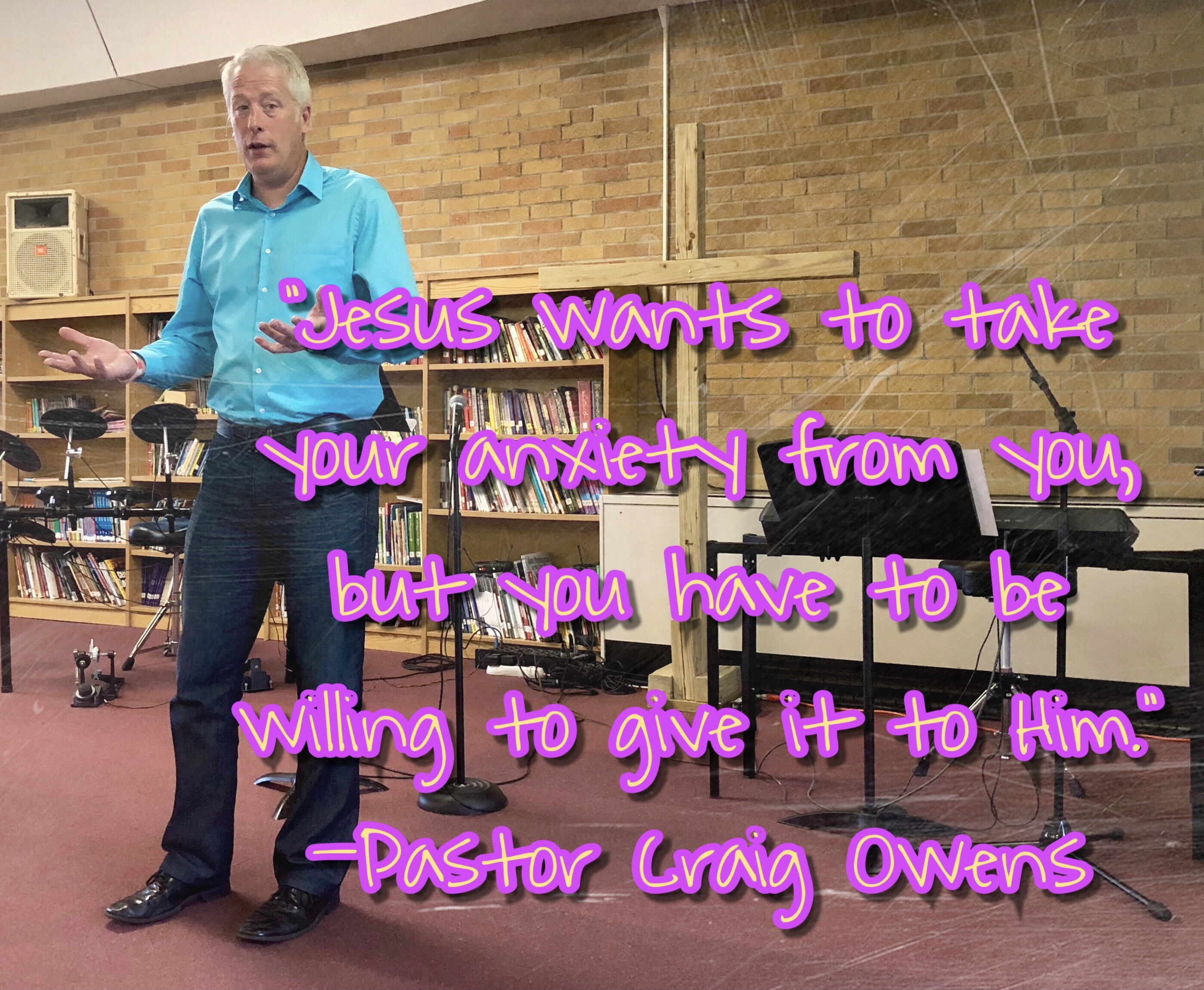
Cast all your anxiety on [Jesus] because He cares for you. (1 Peter 5:7)

Notice that Peter doesn’t say, “Don’t be anxious,” but he does say, “Here’s what to do with your anxiety.” Being anxious is not a sin, but hanging on to your anxiety may cause you to behave in a sinful way. 

So what do we do with our anxiety? In a word cast it off—throw it somewhere else! The verse tense here means it’s something we must keep on doing, so Peter is really saying keep on casting your anxiety on Jesus. 

Why can we keep on casting our anxieties on Jesus? Because He cares for you. Jesus has taken charge of your care; He’s made it His goal that you aren’t missing out on the abundant life He paid for! This verb is in what’s called the indicative mood. That means it is something that has happened in the past, and it is happening now, and it will continue to happen forever and ever! 

Even if you cast an anxiety on Jesus 30 seconds earlier, you can do it again right now because that’s how much He cares for you! 

At the risk of oversimplifying it, here is the prescription for anxiety in four steps: 

  1. Recognize that you are anxious—admit it to yourself and to God. 
  2. Remind yourself that Jesus cares for you. 
  3. Reject your anxieties by counteracting your worry with God’s truth—I like to read something like Psalm 23.
  4. Repeat steps 1-3. 

“Your natural tendency when you’re feeling anxious is to focus on yourself and your problems. The more you do this, the more you forget about Me and all the help I can supply. This worldly focus only increases your anxiety! Let the discomfort you feel at such times alert you to your neglect of Me. Whisper My Name, and invite Me into your difficulties. … A problem-preoccupation makes you anxious. So I urge you to cast all your anxiety on Me—trusting that I care for you. You may have to do this thousands of times daily, but don’t give up! Each time you cast your worries and concerns on Me, you are redirecting your attention from problems to My loving presence.” —Sarah Young, in Jesus Always 

Join me next week as we continue our series called Aliens and Strangers. If you’ve missed any messages in this series, you may find the complete list by clicking here.

Life Is Hard! Now What?

Jesus told Peter, and now Peter tells us—Christians are going to be insulted and persecuted for believing in Jesus. So the fact that life is hard shouldn’t come as a surprise. Peter then goes on to elaborate on how Christians should live in spite of the mistreatment. 

“The more Christians are unlike the world, the more it hates us; the more we are like our Lord, the more the world will persecute us.” —Horatius Bonar

How should Christians respond to insults and persecution? Peter outlines the Christian’s response in 1 Peter 4:12-19

dear friends, do not be surprised (v. 12). I like this verse in the Amplified Bible: Do not be amazed and bewildered at the fiery ordeal which is taking place to test your quality, as though something strange (unusual and alien to you and your position) were befalling you. After all, Jesus told us this was coming (see John 15:18-20). 

but rejoice that you participate in the sufferings of Christ (v. 13a). Notice that this should be the sufferings OF Christ, not of our own making. 

—let suffering lead to Spirit-led reflection (notice the if’s in vv. 14-18, and the if’s in what Jesus said in John 15:18-20). We need to make sure our suffering is because we’re standing for Jesus, not because we’re being jerks! David asked God to check if his actions were the cause of his persecution (Psalm 7:3-4) and we should too. If we discover that we’re the one to blame, quickly apologize, ask for forgiveness, and make things right.  

keep your focus on when His glory is revealed (v. 13b). Time is short, and the rewards are sure so don’t remain focused on the immediate pain, but look up to the longterm gain.  

do not be ashamed to suffer for Jesus (v. 16). Jesus told us not to be ashamed of Him because He is not ashamed of us (Luke 9:26; Hebrews 2:11). 

stay committed to your faithful Creator (v. 19a). Staying committed means getting even closer to God in the hard times.

continue to do good (v. 19b). What does continue to do good look like? Peter lists things like being self-controlled, helping others that are being persecuted, showing proper respect, having a good work ethic, not trading insult for insult, and many other commands. Bottom line: doing good means living like Jesus lived while He was on Earth (see Acts 10:38). 

So, Christian, I’ve got two questions for you—

How are you handling insults and persecution? Are you continuing to do good despite the mistreatment? 

Remember Jesus is coming soon, and His rewards are with Him for how we have lived. “Behold, I am coming soon, and I shall bring My wages and rewards with Me, to repay and render to each one just what his own actions and his own work merit.” —Jesus (Revelation 22:12) 

Join me this Sunday as we continue to learn how Christians are to live as aliens and strangers while we visit Earth. If you’ve missed any messages in this series, you may find the complete list by clicking here. 

Don’t Throw Out The Message

An important reminder—Don’t throw out the message because of the messenger.

“Beware of seeking out inconsistencies in God’s children in order to evade obeying God’s message yourself. If there comes to you a message on personal holiness, beware of the tendency that puts you on the watch to see if that person is consistent; the reason you watch is that you want to evade obeying God’s message. There is an antipathy to the message of holiness which prides itself on being amazingly shrewd, and whenever a man of God is known to fall, there is a sigh of relief—‘Well, that saves me, I have always been suspicious about this holy life,’ and under the affectation of profound sadness there is a glow of relief on the inside. The trick is as old as the Garden of Eden.” —Oswald Chambers

Let’s Put That In Perspective!

How long is your life? If you’re a man living in the United States on average your life is 689,412 hours. But how long is that really? 

Here’s some perspective—if you drew a timeline 50 feet long that represented all of Earth’s recorded history, your life would cover about the breadth of your hand. But that’s only recorded history—what about the eternity that existed before history started and the eternity that will continue after history ends? 

Twice in Psalm 39, David described our brief life like this: each man’s life is but a breath. 

So what do we do with our breath-long life? Fortunately for us, David gives us godly perspective in five areas. 

  1. Perspective on the weight of my words and my silence (vv. 1-3) 

David had a good start: I will keep my tongue from sin, but what happens when sinful words slip out? I would suggest we count those as a gift. Really?! Yes, because those “slips” make us aware of what’s really in our heart (see Matthew 15:19) so that we can confess them. 

David also suggests putting a muzzle on our mouths when we’re around certain people. In other words, don’t get into petty fights with people who aren’t going to receive the wisdom we may have to share with them. 

  1. Perspective on the use of my time (vv. 4-5)

Why do we procrastinate doing good things? Some of our simple cliches reflect this, like TGIF. Why wait until Friday to get happy? Why not say TGIT—thank God it’s today! Do something memorable today… do something life-altering today… do something for God today.

  1. Perspective on my possessions (v. 6) 

David reminds us that we work so hard to accumulate stuff “not knowing who will get it.” Jesus had another word for someone who only wanted to get stuff to make his life easier: fool (see Luke 12:16-21). Use stuff to serve others. 

  1. Perspective on forgiveness (vv. 7-11)

Why oh why, would we spend one minute longer than we have to with unconfessed, unforgiven sin? I blogged last week about the freedom that immediately comes when we receive forgiveness from our confessed sin. Let’s do this quickly! 

  1. Perspective on the purpose of my life (vv. 12-13)

If I only have a breath-long life, I want to make every moment count. I love what C.T. Studd wrote: “Only one life will soon be past. Only what’s done for Christ will last. … Let us not glide through this world and then slip quietly into heaven without having blown the trumpet loud and long for our Redeemer, Jesus Christ. Let us see to it that the devil will hold a thanksgiving service in Hell when he gets the news of our departure from the field of battle.”

Here’s my prayer for all of us—Lord, help me to know how few days I have so I can live every one for Your glory. 

Saturday In The Proverbs—The Blessings Of Integrity (Proverbs 19)

[Each chapter in the Book of Proverbs contains thoughts that fit into a theme; they are not just random thoughts gathered together. In this “Saturday In The Proverbs” series, I will share a theme that I see in each chapter. But the cool thing about God’s Word is that you may see an entirely different theme. That’s great! If you do, I would love for you to share it in the comments below.]

…integrity… (Proverbs 19:1).

Integrity is wholeness—it brings its own blessings because a person of integrity…

  • …is wise (vv. 1, 8, 20, 27)
  • …doesn’t fall into the haste-makes-waste trap (v. 2)
  • …is at peace with God (v. 3)
  • …knows true friendship (vv. 4, 6, 7, 19)
  • …is never punished for lying (vv. 5, 9, 28, 29)
  • …gets promoted to leadership (v. 10)
  • …preserves relationships (vv. 11, 12, 13, 14, 25, 26)
  • …is satisfied with his work (vv. 15, 23, 24)
  • …guards his soul (v. 16)
  • …serves others without an agenda (v. 17)
  • …disciplines only in love (vv. 18, 25)
  • …walks in God’s ways (vv. 21, 23)
  • …is kind to others (v. 22)

“With integrity you can experience freedom. Not only are you less likely to be enslaved by the stress that comes from bad choices, debt, deceptiveness, and other negative character issues, but you are free to influence others and add value to them in an incredible way.” —John Maxwell

How true: Integrity = Freedom to live a satisfying life!

Abundant Bravery

“I am grabbing all you fears by the jugular because I know you are my everyday enemy. You fears are too often my cancer, my addiction, my hidden habit. You’re my jailer, my poison, my daily blade of self-harm. You’ve been my anesthetic, the thing I’ve let come freeze me every day, lock me up, and suck away my life. You’ve snuffed out my soul while you kept on breathing for years. You’re the most common brain tumor, always beginning in our minds.

“You fears may think you can divide us and conquer us and imprison us in small places, in small lives, with high fences that keep out hope and possibility and each other and the lives we really want. But you don’t know how we’re seeing things.

“You may think you can make us cynical about dreams and apathetic about hope and dubious about possibility and people and prospects. But we’re all over you: you aren’t meant to drive our lives; you’re meant to teach us something about life. You’re a chameleon that wears a thousand different masks, and there are ways to see the realest, truest, surest things.

“You can sound loud or you can strut about and rant like pride. You can grow deathly quiet and look like numbness or apathy or indifference or a dream running in the wrong direction.

“But the thing is: When I find my fears, I find my idols. When I find where you lurk, I will look you in the eye until I know your realest name. And I will say your name out loud. …

“So I will go on crushing all of your life-absorbing fears to a fine powder because this is the deal: I want to be better at letting go of you than letting go of joy. I don’t have to worry about what’s up ahead because Christ is the head of everything. And I don’t have to fear what’s around the next corner because Christ is already there too. 

“We don’t have to abide in our fears because we can abide in our Father.

“There’s believing it and then there’s abundantly living it: Fear is a liar, and love hands out keys. Love is infinite and love can’t ever end, and if love doesn’t run out, what is there ever to fear? There will still be love when the worst happens and when the hope doesn’t happen. There will still be love when everything is crumbling, and there will be enough love to rebuild. There will still be enough love to keep breathing, to keep believing, to keep being and being brave.

“For this I know: Fear can be what we feel, but brave is what we do.” —Ann Voskamp, The Way Of Abundance

Check out some other quotes from Ann’s amazing book here, here, and here.

Yea Or Nay

“One of the greatest curses of the modern evangelical movement, in my opinion, is that we are somehow becoming ‘popular.’ Just as soon as you become popular, something goes out of your life, or more accurately, something has gone out of your life before you get popular.

“Historically, the Christian had to be emphatic. He had two words: yea or nay. When God was talking to him, he said yes, and when the devil was talking to him he said no. When God said, ‘Do this,’ he said, ‘Yes, Lord.’ When sinners tempted him to stray, he said an emphatic no.

“The trouble with us now is that we are double-minded. That is why we are weak. Scripture speaks of the double-minded man. He is ‘unstable in all his ways’ (James 1:8). Elijah illustrated this when he said, ‘How long halt ye between two opinions? If the Lord be God, follow Him: but if Baal, then follow him’ (1 Kings 18:21). We need to be on one side or the other. Wholly committed to our high calling in Christ Jesus.” —A.W. Tozer, in The Wisdom Of God