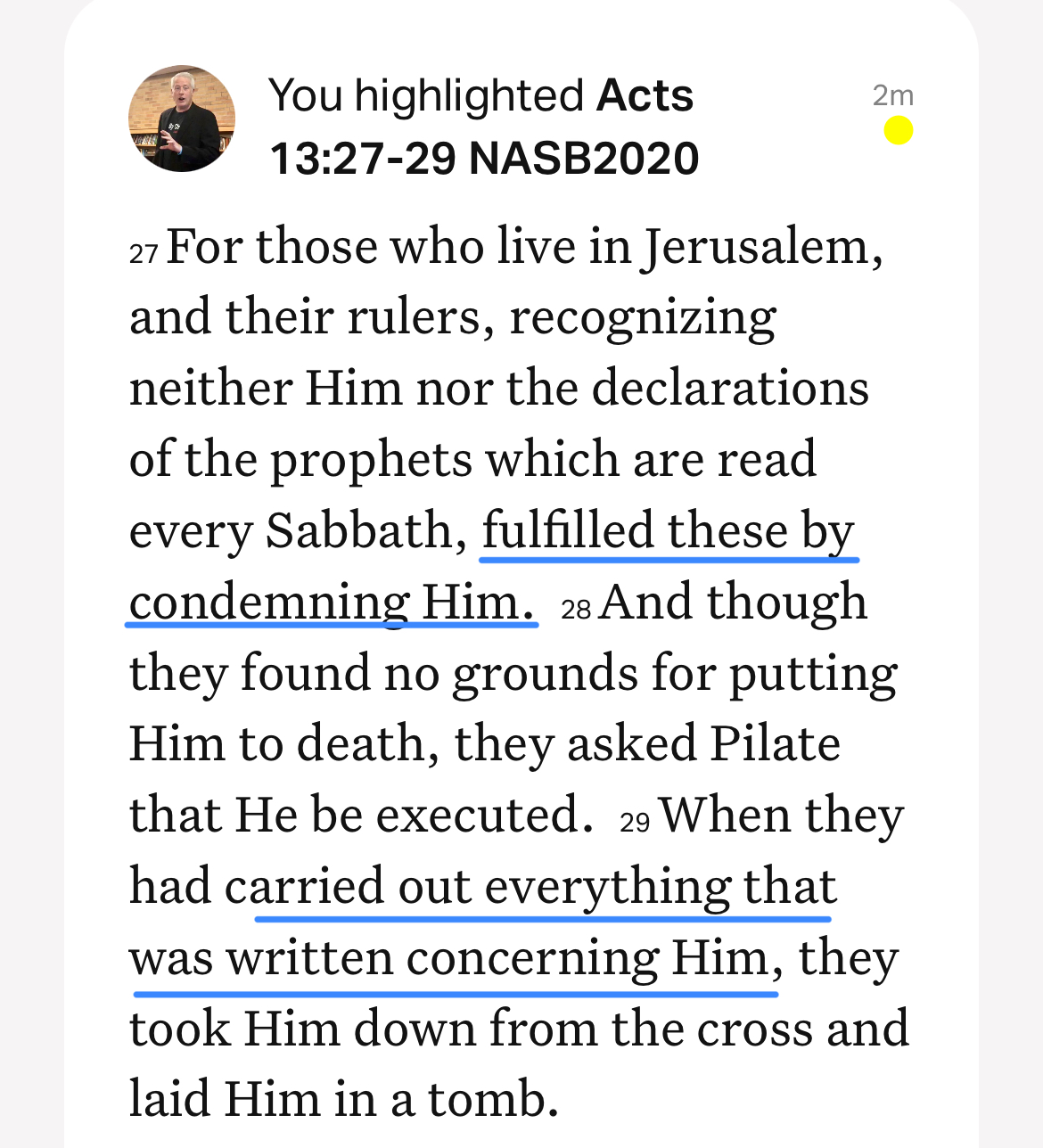
For those who live in Jerusalem, and their rulers, recognizing neither Him [Jesus] nor the declarations of the prophets which are read every Sabbath, fulfilled these by condemning Him. And though they found no grounds for putting Him to death, they asked Pilate that He be executed.When they had carried out everything that was written concerning Him, they took Him down from the Cross and laid Him in a tomb. (Acts 13:27-29)
The prophetic words about Jesus were fulfilled by people who didn’t even realize they were fulfilling God’s pre-ordained plan! It is still true today: Nothing can thwart or delay God’s design, and people are still unwittingly fulfilling that design.
God always gets the final word, the decisive word, and the best word.
Jesus is fulfilling every promise that His Father made, so we can live confidently and joyfully in that assurance. Check out my post Walking Boldly In Dark Places.
Listen to the podcast of this post by clicking on the player below, and you can also subscribe on Apple, Spotify, or Audible.
I want to give you some thoughts to take your Bible studies even deeper. Here are three strategies to make your Bible study time stickier—sticking in your heart and your mind.
Listen to the podcast of this post by clicking on the player below, and you can also subscribe on Apple, Spotify, or Audible.
I’ve noticed over the years that some people get quite nervous—even fearful—with the thought of God coming close to then. Some people have told me, “I can’t go to church—the roof will fall in on me!”
If I’m honest, I had a time in my life when I feared God’s approach. I didn’t want to pray, “God, use me however You want to” because I just knew He was going to send me somewhere I didn’t want to go, or ask me to give up something that was special to me.
But from the the birth of Jesus until His ascension, the consistent message is: Fear not! and Rejoice!
Matthew 21:4 says that Christ’s arrival on a donkey was “to fulfill” another one of the jots and tittles. And John adds, “Jesus found a young donkey and sat upon it, as it is written, ‘Do not be afraid, O Daughter of Zion; see, your King is coming, seated on a donkey’s colt’” (John 12:14-15).
Typically, conquerors came with a show of overwhelming force, not a show of humility. But Jesus came to Jerusalem with the same message repeated at His birth, “Fear not.”
This is elaborated on in the original prophecy found in Zechariah 9:9-14, where the opening word is, “Rejoice!” We rejoice because He is coming to take away the instruments of war that the occupying forces used to keep the citizens in bondage. He is coming to bring freedom He is coming to announce hope and restoration.
With all of these jot-and-tittle prophecies, we have been asking three questions.
(1) What did it mean then? Quite simply, on that first Palm Sunday it meant that this was not the time for judgment.
(2) What does it mean now? Since the final judgment has not taken place, it must mean it still is not a time of judgment, but a time of favor. God is still drawing people to Himself by His kindness (Romans 2:4).
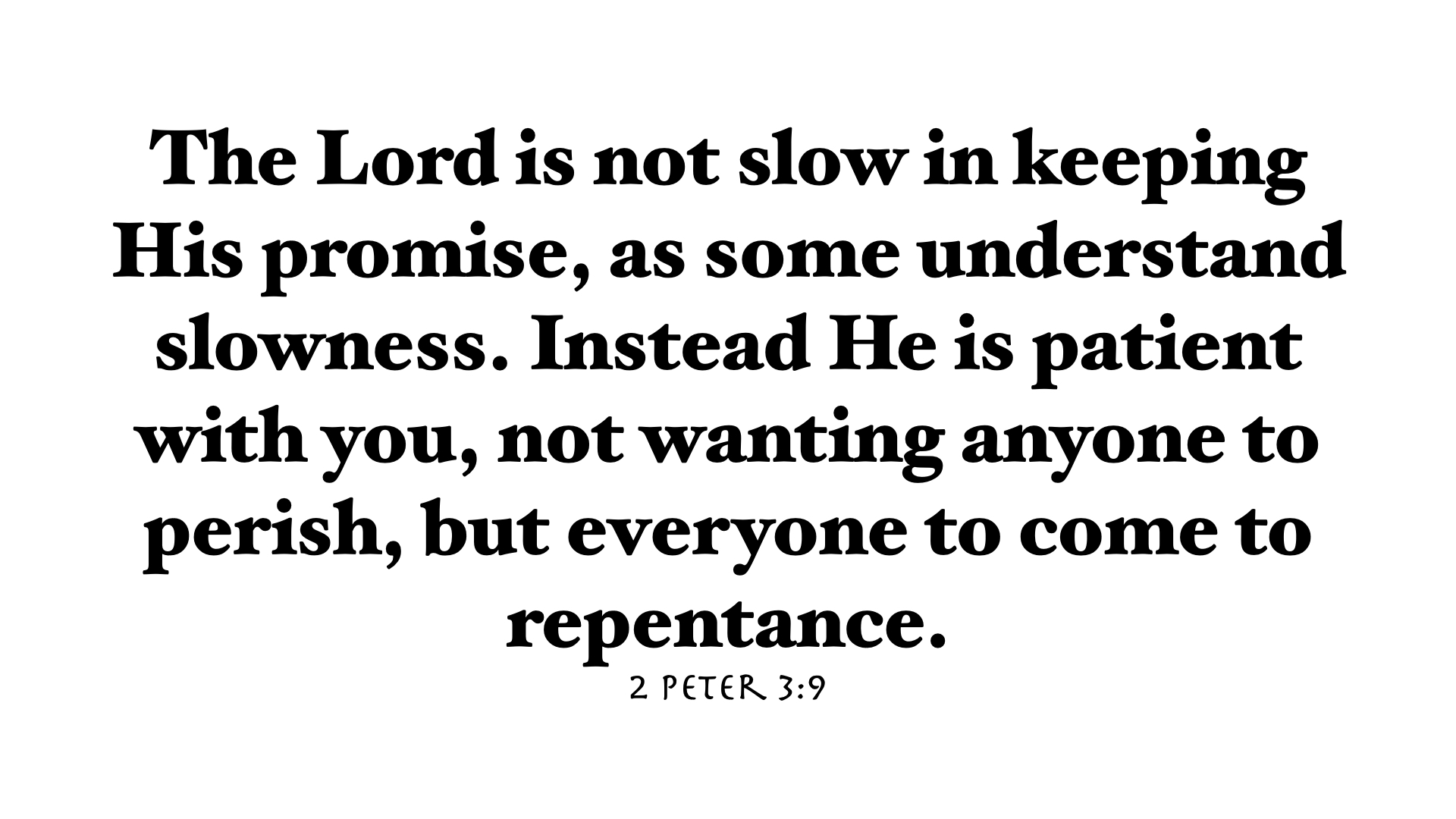
Zechariah 9:14 makes it clear that there will be a day of judgment. And Peter says that God’s not being slow about this, but He is demonstrating His patience so that none will have to perish without Him (2 Peter 3:9-10).
(3) What does it mean for me? It means that I don’t have to fear the approach of God.
First, there is no fear when God calls me to stand before Him because my sins have been forgiven (Romans 8:1).
Second, there is no fear when God asks me to give something to Him because God has equipped me ahead of time to respond obediently. When Jesus sent His disciples ahead of Him to bring back the donkey that He would ride into Jerusalem, Jesus must have already informed the donkey’s owners that this would be coming. The disciples were simply to say, “The Master needs the donkey now.”
God has already prepared me to say, “Yes” to whatever He calls me to do (Psalm 139:16).
Finally, there is no fear when God asks me to give something to Him because I’m only giving back to Him what is already His. You and I are just stewards of what God has given us. When the disciples talked to the steward of the donkey, they assured him, “The Lord needs it and will send it back here shortly” (Mark 3:11). And the prophecy in Zechariah, God says, “Now I announce that I will restore twice as much to you” (Zechariah 9:12). Maybe not here on earth, but the rewards in Heaven will be incalculable for His faithful servants!
Those who know Jesus as their Master can live as fearless stewards.
We don’t fear the requests of our King, but we rejoice to allow Him access. We don’t fear the approach of our Judge, but we rejoice to stand before Him forgiven and rejoicing!
Listen to the podcast of this post by clicking on the player below, and you can also subscribe on Apple, Spotify, or Audible.
I was reading the results of a survey which said one of the top traits for exemplary leaders was: They keep their word.
But don’t we really mean, “They keep their word most of the time”? After all, we do allow those who have a track record of integrity an “out” for unusual or unexpected circumstances. And we would still say that leader had honesty and integrity.
God always keeps His word. He never needs an “out” because nothing is ever unexpected for Him! He is always the Promise Maker and the Promise Fulfiller (Isaiah 42:9, 46:10, 55:10-11; Jeremiah 1:12).
I like the way Jesus sums up these statement from His Father: For assuredly, I say to you, till heaven and earth pass away, one jot or one tittle will by no means pass from the law till all is fulfilled (Matthew 5:18 NKJV).
Ajot is the smallest Hebrew letter (yodh). In Greek the word is iota. This tells us that God is concerned about the smallest of details.
A tittle is the precise difference between Hebrew letters like cheth and he, between daleth and resh, and between beth and kaph.
All of these are fulfilled—brought to their perfect completion (Luke 1:37, 22:37)!
When we see any of God’s promises made and kept, we need to ask ourselves three questions:
What did it mean then?
What does it mean now?
What does it mean for me today?
For example, look at the promise that was made about people living in a very dark place seeing the Light of God. The prophecy is first made in Isaiah 8:19-9:7 that the people of Zebulun and Naphtali would get to see and experience the light of the Messiah.
Matthew 4:11-17 tells us that after Jesus endured the temptation of the devil for 40 days, He went to Capernaum—the region of Zebulun and Naphtali. But before He arrived there, He was first rejected by the folks in His hometown of Nazareth (see Luke 4:14-31).
Our God who knows the end from the beginning never makes a mistake; nothing is ever random or inconsequential. We should develop the habit of praying, “Now that this is happened, what would You have me do?” As Jesus was rejected by the people who should have been so excited to see His ministry flourish, He wasn’t dismayed or discouraged, but He directed His steps toward Capernaum.
In my heart, I may plan a course for my life, but I must trust God to direct my steps. My life has a purpose. Just as the Holy Spirit directed the movements of Jesus, He is directing my steps.
Even when God seems to have directed my steps into a dark place, He has sent me there as His light. I am sent on purpose. I walk a path Jesus has already walked, and a path that He is still walking with me—He guides me in paths of righteousness for His name’s sake. Even though I walk through the valley of the shadow of death, I will fear no evil, for You are with me (Psalm 23:3-4).
I don’t walk into the darkness in my own strength or as a way to fulfill my own plans but instead I trust that “the zeal of the Lord Almighty will accomplish this” (Isaiah 9:7)!
Because Jesus is fulfilling every jot and every tittle, I can live confidently in Him!
If you would like to follow along with all of the messages in this series called Jots and Tittles, you can find them all here.
As we get closer to the death and resurrection of Jesus, there are an increasing number of prophecies that are fulfilled in these events. Jesus appears to have been very attentive to making sure that each and every one of these prophecies were fulfilled to the smallest detail.
Near the beginning of His public ministry, Jesus noted that not one iota—or “one jot or tittle” in the Old English vocabulary—of any of God’s promises would be left unfulfilled (Matthew 5:18). It’s amazing that Jesus so carefully attended to all of these, but it’s also important to ask ourselves what these fulfilled prophecies mean to us today.
This is what we are going to be unpacking in our series Jots and Tittles. I hope you can join us, but if you have missed any of the messages in this series, you will be able to find them all right here—
Many of the examples Jesus used to tell us about the Kingdom of God seem like such small things. But those small beginnings have irresistible growth potential!Check out more thoughts in my series of posts called Kingdom Praying. I have lots of new content every week, which you can check out on my YouTube channel.
My wife is a school teacher and I also work quite a bit in our local schools. I think T.M. Moore is spot-on in his analysis of the breakdown in our current educational system: “This commitment to the Law and Word of God as foundational to the education of the young was everywhere practiced throughout the pre-revolutionary period in colonial America. It was unthinkable in the colonies that young people should be submitted to any instruction for any length of time without being taught the commandments and statutes of God, including the Gospel of Jesus Christ. Parents insisted on it, colonial and local statutes required it, and local school boards dutifully saw to it in all their schools.Since the middle of the previous century, assailed by specious invocations of ‘the separation of Church and State,’ educational policy in America has increasingly denied a place to God, His commandments, and His Word in the public-school curriculum. Generations of American children have grown up in a ‘disenchanted’ world (Charles Taylor), a world in which God, spiritual things, and the Law of God are deemed to be irrelevant if not oppressive, or at least a nuisance. The present crisis of morality, culture, and social upheaval is only the most visible consequence of that policy.”
David Mathis shared some thoughts about the healthy pace of ministry Jesus demonstrates for us. He said, “Let’s sit together at the feet of Jesus, and consider the pace and patterns of His life and ministry. He was not idle. Nor was He frenzied. From all we can tell from the Gospels, Jesus’s days were full. I think it would be fair to say He was busy, but He was not frantic. He lived to the full, and yet He did not seem to be in a hurry. In Jesus, we observe a human life with holy habits and patterns: rhythms of retreating from society and then reentering to do the work of ministry. Even as God Himself in human flesh, Jesus prioritized time away with His Father. He chose again and again, in His perfect wisdom and love, to give His first and best moments to seeking His Father’s face.“ These words resonate with me, because they are thoughts that I considered quite extensively for my book Shepherd Leadership.
I love reading stories like these that show how a relationship with Jesus utterly transforms a person’s life! “Opal W. Eubanks joined the Mississippi Highway Patrol during the race riots of 1964. A large, broad-shouldered white man, he relished the opportunity to strike fear in the hearts of African-Americans who were in trouble with the law. By his own admission, he was a foul-mouthed sinner who liked ‘rough stuff.’ A radical conversion to Christ in the early 1970s altered the course of Eubanks’ life, and his hardened heart became tender toward African-Americans in his rural community. He and his wife, Thelma, ultimately pioneered an Assemblies of God congregation consisting mostly of African-Americans, which they pastored for 21 years.”
The Greek word for “teaching” in Mark 9:31 means an ongoing dialogue. It’s an imperfect verb here because it is an activity that is never fully completed. Jesus wants us to abide with Him—to dialogue with Him—to continually learn from Him. The New Living Translation says it this way, ”For He wanted to spend more time with His disciples and teach them.” This is just as true for us today!
J. Warner Wallace addresses the claims that the Old Testament prophets actually foretold that Jesus would be the Messiah. I love considering the apologetics for the death and resurrection of Jesus Christ, and this video will become an added resource for me in the future.
Listen to the podcast of this post by clicking on the player below, and you can also subscribe on Apple, Spotify, or Audible.
The apostle Peter said he wrote two letters to the church “as reminders to stimulate you to wholesome thinking” (2 Peter 3:1). And Paul reminded his young friend Timothy to “keep reminding [your congregation] of these things” (2 Timothy 2:14).
In the spirit of those great apostles, I have made it a practice to take time at the end of each year to look back on all that we have learned in the previous year, and then to look forward to where God may be leading Calvary Assembly of God in this upcoming year.
Clicking on each series title will take you to a list of all of the sermons in that series.
Intimate Conversation—The dictionary defines the word “intimate” with these phrases: associated in close personal relations, characterized by warm friendship, and closely personal. These words perfectly describe the relationship God wants to have with His children through prayer. Pete Briscoe said, “Prayer is an intimate conversation with the One who passionately loves you and lives in you.” The One who loves you so passionately desires to walk with you and share intimate knowledge with you. Prayer is not something formal, cold, or mechanical, but it is vibrant, warm, engaging, and life-changing.
A Christian’s Mental Health—I don’t think there is any arguing that Jesus was the healthiest individual who ever walked planet Earth. Some may want to push back with, “Of course He was because He didn’t have any problems to deal with!” But the writer of Hebrews tells us that Jesus experienced everything you and I will ever experience (Hebrews 2:17), so His deity didn’t exclude Him from the stressors that His humanity would have to face. And yet, He handled all of these things successfully. Luke the physician observed the growth of Jesus and tells us that it all began with Jesus having a robust mental health. From that foundation, everything else—physical, spiritual, relational—all could develop properly. We must learn from this example and pay careful attention to our own mental health.
Bold Claims—“That’s a pretty bold claim. Are you prepared to back that up?” I’ll bet you have heard something like that said to you, and maybe you have even said that yourself to someone else who made a big, audacious statement. After Jesus is arrested by the religious leaders—an arrest that will ultimately lead to Jesus being crucified on the Cross—there are some incredibly bold claims spoken by key people in this part of the Story. For the most part, these are claims that we don’t read earlier in any of the Gospels, but as this story is heading toward its most crucial moment, we have these audacious statements pronounced. But here’s the most important part: These bold claims weren’t just made, but they were backed up with proof as well.
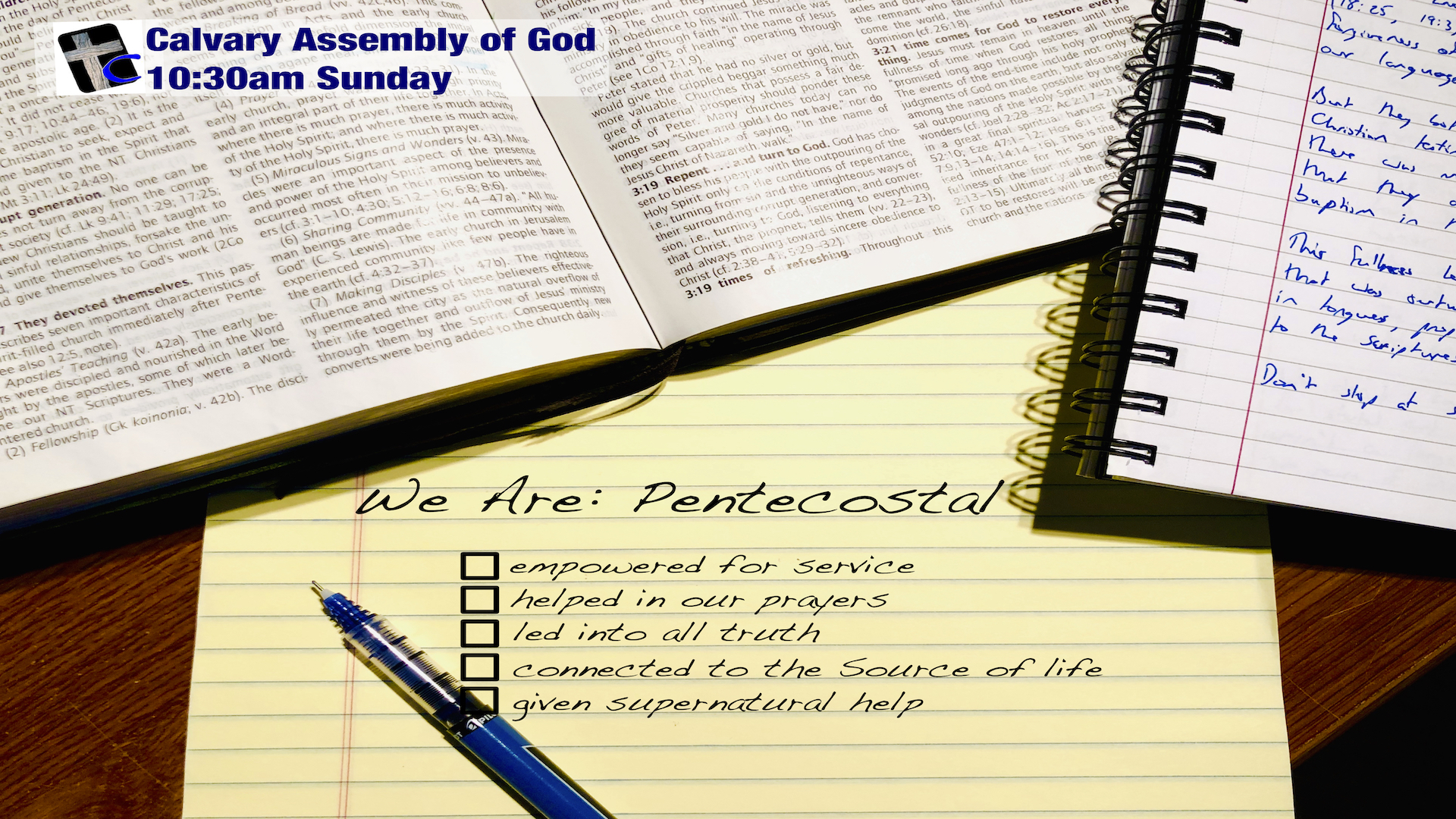
We Are: Pentecostal—Pentecost for over 1500 years was a celebration in Jerusalem that brought in Jews from all over the world. But on the Day of Pentecost that came just ten days after Jesus ascended back into heaven, the meaning of Pentecost was forever changed! Followers of Jesus—now empowered by an infilling of the Holy Spirit—began to take the good news of Jesus all over the world. These Spirit-filled Christians preached the Gospel and won converts to Christ even among hostile crowds, performed miracles and wonders, stood up to pagan priests and persecuting governmental leaders, and established a whole new way of living as Christ-followers. We, too, can be Pentecostal followers of Jesus Christ today.
Ascending—Every year, Jews from around the world made four pilgrimages up to Jerusalem for various feasts and sacrifices. These journeys reminded them of God’s goodness as they went to the Temple to worship, and they helped refocus on God’s ways as they returned to their regular routines. Jerusalem is over 2500 feet above sea level, so the pilgrimage there was a physical workout as well as a spiritual workout. These workouts were beneficial for God’s people, preparing them to minister in their cities in the following months. The Book of Psalms contains 15 songs that these pilgrims would sing to and with each other as they traveled up to Jerusalem. These Psalms of Ascent are still instructive for Christians today.
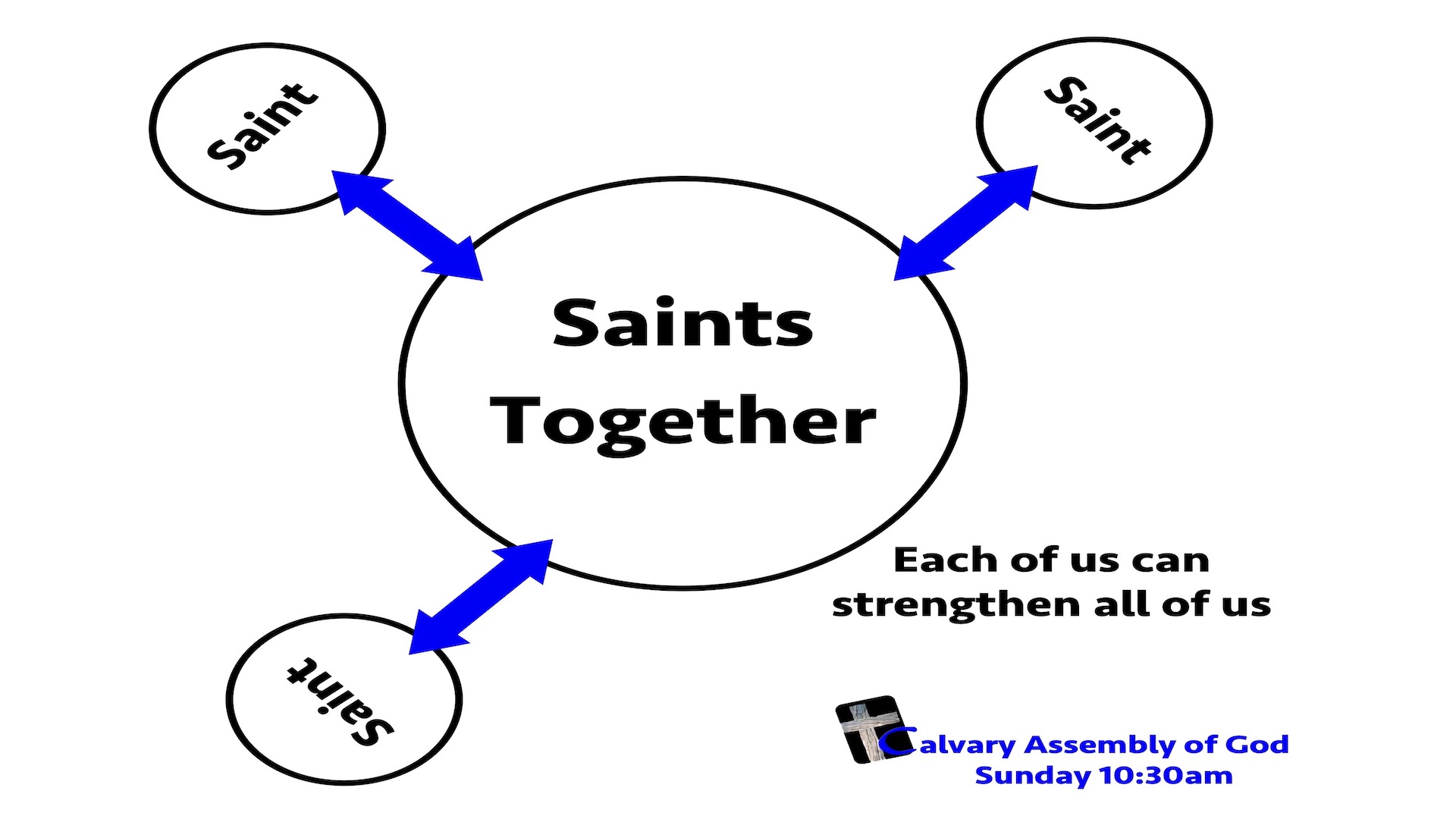
Saints Together—Throughout the New Testament the word “saints” is always in the plural form. This is a clear indication that none of us can develop into the full-fledged Christians we were meant to be on our own. We all need each other. More specifically, we all need the most mature version of each other. A key component of an individual saint’s development is the time spent alone being forged by the discipline of the Holy Spirit. Maturing saints then come together with each other to continue to strengthen and sharpen everyone in the church. Strong individual saints make a strong church, and a strong church makes strong individual saints! Let’s learn about six important spiritual disciplines that each individual saint must put into practice so that they can use their newly developed strengths to help other saints in their own development.
The Great Attitude Of Gratitude—There’s something about gratitude that distinguishes people. Think about it: would you rather hang around with grumblers or grateful people? The gratitude of Paul and Silas certainly made them stand out from the crowd when they were in Philippi. Wrongly accused, beaten, and thrown in prison, but instead of bellyaching, they were praising God. Later on, when Paul wrote his letter to the Christians in Philippi, the theme of gratefulness permeates his letter. The distinguishing mark is actually in the title: The GReat ATTITUDE spells out GRATITUDE!
Long Live The King Of Kings—Throughout human history, whenever a king died, the people would say something like, “The king is dead. Long live the king!” They would say this because the next king ascended to the throne immediately after his predecessor died. Except when a nation had been defeated, the cry, “The king is dead” was unanswered by, “Long live the king!” Israel must have felt like this. After being defeated by Nebuchadnezzar and spending 70 years in exile, it appeared to many that the line of kings was broken. Even after retuning to their homeland, Israel continued to live under the thumb of other powerful nations. And yet, some still clung to the glimmer of the promise God had made about an eternal King sitting on Jerusalem’s throne. The First Advent of Jesus revealed to us in the Gospels reassures us that the promise of an eternal King is true. Jesus came to earth to reveal His majesty to us. The First Advent is so important because it bolsters our faith for the imminent Second Advent when Jesus will return as the King of kings! Christmas is a great time to be reminded that even now we can confidently declare, “Long live the eternal King of kings!”
2024 promises to be an exciting year! If you don’t have a home church in the northern Kent County area, I would love to have you join us!
My friend Douglas Carmel shared this amazing article in one of his recent ministry newsletters. I have reprinted it here with his permission—
Has this ever happened before in the history of the world? That a people should go into exile, be dispersed, and yet survive for 2000 years without a national homeland. And then to come back again—speaking their same language and returning to their same capital city. This alone should make an atheist question their atheism. Why? This is a miraculous, singular event. No country had ever done such a thing before in the history of mankind, except Israel. And yet, this is exactly what was foretold in the Hebrew Scriptures.
The prophet Ezekiel also stated God’s promise: “For I will take you from the nations, gather you from all the lands and bring you into your own land” (Ezekiel 36:24).
Also, in Ezekiel 37, there is an unforgettable vision of a valley of dry bones. The bones come to life in stages: first sinews on the bones, then flesh, then skin, and finally, the breath of life (Ezekiel 37:6–10).
God then explains this vision to Ezekiel: “Son of man, these bones are the whole house of Israel” (Ezekiel 37:11). In other words, this is a prophecy about the Jewish people’s restoration to their Promised Land from all around the world. It is well in keeping with what we see actually occurring during our lifetime. Namely, the regathering of Israel will occur in stages, which it has done and is still doing.
So how did we get to the State of Israel today?
Let’s go back to the first and second centuries, just past the time of Jesus/Yeshua. Deuteronomy 28 contains prophecies regarding this second dispersion. It should be noted that this second dispersion was “…from the one end of the earth even unto the other” (v. 64). This was to be a global dispersion, unlike the first one, which was just to Assyria and Babylon.
Just after the time of Yeshua/Jesus, Israel rebelled against Roman rule. In 70 AD and again in 135 AD, Jewish rebels sought to fight against Rome. In response, the Roman army destroyed Jerusalem and its Temple under Titus in 70 AD, and the Jewish people were either killed or expelled from their land by Roman force. Under the rule of the Roman Emperor Hadrian, the Jews were dispersed all over the world by 135 AD. These facts are well-known in secular history sources as well.
At this time, it was the Romans who changed the name of the land of Israel to Palestine. That was done to rub salt in the wounds of the Jews by changing the name of their beloved homeland to that of their ancient foes, namely, the Philistines (think Goliath’s people).
It is important to note that while the Jewish people as a whole were dispersed by the second century, there always remained a small remnant of Jewish people scattered throughout the land, living in small communities. (Note: There is much more history involved than we can list here in this short article.)
After the Romans, came the Muslims. Except for a short time during the Crusades, the land was continuously ruled by Muslim Empires. That brings us to modern times. The British won the land of “Palestine” from the Ottoman Empire during World War I. About this time, Jewish people began to return in large numbers in the late 1800s. Eventually, the British army pulled out of “Palestine” in 1948 after the UN had given Israel the right to exist (as if they needed that approval). On May 14th, 1948, the State of Israel was reborn, and the name “Palestine” was dropped.
Israel was attacked the very next day by all their neighbors, and guess what? Against all odds, Israel won!
After several more wars that Israel had to fight for their survival, they still exist, and thus you see the headlines today. As you can deduce, this is an extremely short breakdown of Jewish history in the land. There were many more details involved, which we skipped over.
Now, mind you, we are not saying that Israel today is just fine without their Messiah (they are not), nor are we saying that the secular government of Israel is perfect (they are not). But we are saying that, in the big picture of things, Israel being back in her land after 2000 years is something to take note of.
It is indeed a miracle, and those who call for her eviction again “from the land to the sea” are unknowingly fighting against God’s miracle.
Listen to the podcast of this post by clicking on the player below, and you can also subscribe on Apple, Spotify, or Audible.
I once worked with a guy that was the epitome of “all talk and no action.” After a while people just stopped listening to him or believing anything he said. But something worse is someone who says he will do something but doesn’t have the power to finish what he started. In that case, you may have believed him and not taken any steps of your own, so when he finally admits defeat, you are totally unprepared to step in to help finish the task.
I think that comes close to the two attitudes people had prior to the First Advent of Jesus in Bethlehem. Some people thought all of God’s promises had just become “all talk and no action.”
But after Jesus began His public ministry, His skeptics may have originally thought He was also“all talk and no action,” but when they saw how the people responded to Him, they realized He at least had the power to sway a crowd. But they certainty didn’t think He could finish what He started.
The religious elite—the Sanhedrin—had their own plans in the works, and it appeared to them that Jesus was just going to get in the way. So they hatched a plan to have Pontius Pilate, the Roman governor, have Jesus crucified. As Jesus is hanging on the Cross, you can hear the skepticism and derision in the voices of these religious elite—
In the same way the chief priests, the teachers of the law and the elders mocked Him. “He saved others,” they said, “but He can’t save Himself! He’s the King of Israel! Let Him come down now from the Cross, and we will believe in Him. He trusts in God. Let God rescue Him now if He wants Him, for He said, ‘I am the Son of God.’” (Matthew 27:41-43)
After all, they had experienced “messiahs” before (Acts 5:35-37) so they thought this Jesus from Nazareth was just the next in a long line of pretenders. “King of Israel, indeed! Ha!”
But when someone tells you what they are going to do, and then they actually do it, skeptics are turned into believers. We see this happen in people like Nathaniel, a whole village of Samaritans, and one of the thieves that was crucified alongside Jesus (John 1:43-51; John 4:9-42; Luke 23:39-42)
Even though Jesus told His disciples exactly what was going to happen to Him in Jerusalem—and then it did!—they were still skeptical of the claims of His resurrection until they saw it for themselves (Matthew 20:18-19; John 20:3-8).
Skeptics need to see and hear for themselves that Jesus has the power to do what He says He will do. We are the ones that preach this Good News to them by the way we live.
We have to live as good citizens of the King of kings so that people will “come and see” what a good and loving King He is. For those who are skeptical of the claims of Jesus the King, we have to live in a way that makes it real. We have to help them see the King of kings!
Advent isn’t just a long-ago event that we fondly remember. The First Advent is proof that God has the power to keep His word. And just as wehave seen the First Advent, so we will see the Second Advent.
After this genealogy, we read that an angel says to Joseph, “Joseph son of David, do not be afraid to take Mary home as your wife, because what is conceived in her is from the Holy Spirit” (Matthew 1:20). And then notice this commentary from Matthew—
All this took place to fulfill what the Lord had said through the prophet: “The virgin will conceive and give birth to a Son, and they will call Him Immanuel”(which means “God with us”). (Matthew 1:22-23)
Matthew says, “all this took place to fulfill what the Lord had said.” All what? Everything that came before that statement: the genealogy with all its exceptional items, the 70-year exile of the Jewish people, the Immaculate Conception, the fulfillment of a 700-year-old prophecy.
I find this absolutely astounding! And so, apparently, did Joseph!
But remember that Jesus is not only “the son of David” but He is also called a “son of Abraham.” This means that Jesus came to be more than just the King of the Jews.
We have a cliché that says something like, “Don’t miss the forest for the trees.” By this, we mean that sometimes in the moment we only see one large tree or obstacle in front of us and we miss seeing the majesty of the whole forest. Or maybe we only see the obstacle and not the path that would take us where we need to go.
We are living between the Advents now so you would think that we have a good “forest” perspective, but even we sometimes get bogged down in the moment, wondering what God is doing. The story of Abraham should help us to see the whole forest of God’s plan a little better.
In Genesis 12:1-3 we read God’s promise to Abraham that all people on earth would be blessed by his obedience to God’s call. Listen to the opening words of Stephen’s sermon as he looked back on this—
The God of glory appeared to our father Abraham while he was still in Mesopotamia, before he lived in Harran. “Leave your country and your people,” God said, “and go to the land I will show you.” So he left the land of the Chaldeans and settled in Harran. After the death of his father, God sent him to this land where you are now living. (Acts 7:2-4)
Stephen reminds us that God spoke to Abraham while he was still living in Mesopotamia. Abraham must have shared this promise with his father because in Genesis 11:31 we read that Terah takes Abraham, Sarah, and Lot with him to make this journey, but they only traveled as far as Harran.
Why did they stop here? We’re not sure. Perhaps Terah was still grieving the death of his youngest son who had died before they left. Maybe Terah was concerned about his middle son Nahor who chose not to travel with them. Or maybe Terah was paralyzed by the magnitude of the journey still ahead of them. Whatever the reason, Terah allowed a “tree” to obscure his view of the whole “forest” of God’s plan.
Stephen then says that Abraham continued the journey to Canaan “after the death of his father.” But if we do the math, it appears that Terah was still biologically alive when Abraham left (see Genesis 11:26, 32; 16:3, 16).
Abraham had to trust God more than he respected his father, even to the point of considering his father as dead.
Later on, God gave Abraham a similar test with his own son. Abraham passed this test and God repeated His promise about blessing all people through Abraham(see Genesis 22:1-18).
In Romans 4, Paul explains that Abraham’s faith in God’s promise was rewarded, and that through our faith in Jesus we are connected to this same promise.
Just as there was an “all this took place to fulfill what the Lord had said” about Jesus—including the faith-filled obedience of Abraham and David—God has an “all this” for your life too.
God saw you before you were born. He had a plan for your life. He gave you gifts and talents to be used for His glory. There is not a single part—not a single experience—of your life that is accidental (Psalm 139:16; Ephesians 2:10; Romans 8:28).
Just as He used all this for Jesus, He is using all this for your life too. Will you trust Him?
Through David, God fulfilled the promise that Jesus would be King of the Jews. Through Abraham, God fulfilled the promise that Jesus would be King of all nations. Through Jesus, God fulfilled the promise that Jesus would be our Righteousness.
Abraham died without seeing the promise fulfilled. But we have seen the promise fulfilled, and that should fuel our faith to trust God to fulfill the promise He has for each of us. I pray that this assurance will be renewed in your heart as you celebrate Advent this year.