Links & Quotes

When leaders come into a new organization, they need to be aware that they have to overcome the expectations—good or bad—that others have from their former leader.

I have a lot of new video content on my YouTube channel every week. Please check it out and subscribe so you don’t miss anything.

Greg Morse has an intriguing question for preachers: “Lawyers, politicians, celebrities, actors, podcasters, YouTubers all train to improve their voices—why not those who speak the very oracles of God?” But he also concludes, “Yet the aim is to speak like you—not like Chrysostom, Whitefield, Spurgeon, or your favorite preacher, though we learn from them. God made you to sound like you.”

J. Warner Wallace makes the case for why we can trust the “chain of evidence” that speaks to the reliability of the Bible. 

Researchers discovered tree amber where it shouldn’t be: deep within the ocean! “These sedimentary rocks contain more than amber. The researchers found abundant plant debris, including pieces of large tree trunks, some longer than four feet, mixed into the layers. The tree trunks showed no sign of erosion from transport or borings from shallow marine organisms, indicating they moved fast out to the deep water and were quickly buried.” This is more evidence for the worldwide Flood described in the Bible.

Axis’ Culture Translator shared this important note especially for parents: “In his book Achilles in Vietnam, Veterans Affairs psychologist Jonathan Shay unpacks the psychological devastation of war and the causes of PTSD. He makes the argument that PTSD isn’t just caused by witnessing trauma, but by seeing people in authority choose not to act against evil—what he calls a ‘moral injury.’ War correspondent Sebastian Junger takes this research a step further. In his book Tribe, he concludes that being exposed to a traumatic event without any resilience training, and without a strong, cohesive community to help us process violence, are two strong risk factors for PTSD—stronger even than experiencing prolonged, bloody, hand-to-hand conflict. We see evidence for this theory in emerging research about drone operators and intelligence officers, who appear to experience PTSD at higher rates than other veterans. When our kids open their social media feeds, they encounter a war zone, and they haven’t even had basic training. They are looking to those in authority to help them understand what they just saw. But instead, they often get a cacophony of competing voices and no clear answer. They get a moral injury. Our broken society makes cult heroes of deeply disturbed individuals who are controlled by evil forces and motivated by their own pain. But Proverbs 3:31 is absolutely clear that we are never to envy those who do violence, and not to choose any of their ways. His private counsel, His intimacy, His secret—lies with the upright, and we can have it. But only if we dare to make distinctions, refuse to celebrate wrongdoing no matter the circumstances, and unapologetically stand up for human life.”

Integrity And Godly Sincerity

Listen to the podcast of this post by clicking on the player below, and you can also subscribe on AppleSpotify, or Audible. 

The apostle Paul had spent 18 months living and teaching in Corinth, he had likely visited them at least a couple of times, he had written two letters to them, and his associates had visited Corinth on his behalf. Bottom line: The Corinthians knew Paul well. 

With that in mind, Paul boldly states, “Now this is our boast: Our conscience testifies that we have conducted ourselves in the world, and especially in our relations with you, with integrity and godly sincerity” (2 Corinthians 1:12). 

Integrity means “the virtue of one who is free from pretense and hypocrisy.” Some biblical translations use the word holiness here. Indeed, for Christians integrity and holiness should be synonymous. The conclusion of this verse goes on to state that Paul could live this way “not according to worldly wisdom but according to God’s grace.” Paul knew that even more than the Corinthians, God knew Paul’s holy integrity. 

Paul also says that his conduct was with godly sincerity. You might think that the idea of sincerity or mental honesty is implied in the word integrity, but godly sincerity is a pureness that stands up to intense scrutiny. It’s not just a public act, but it is a consistently God-honoring way of living both publicly and privately. 

These two qualities give a godly leader moral authority like nothing else can. It’s authority that is felt as well as seen—it’s the “It Factor” that marks the Holy Spirit’s anointing on a leader. 

Paul is aware that his lifestyle could cause people to think well or to think poorly of the Gospel of Jesus. Just a few verses later, Paul uses the phrase “yes and no” twice (vv. 18-19). 

First, Paul reminds the Corinthians that he doesn’t “in the same breath say both ‘Yes, yes’ and ‘No, no.’” This means he doesn’t want his lifestyle to negate his preaching. 

Second, Paul wants to assure them that all of the promises of God are “‘Yes’ in Christ” (v. 20). He knows that a preacher who lives contrary to his preaching—whose walk doesn’t align with his talk—is not only a hypocrite before God, but a stumbling block to all who have put their faith in Jesus as a result of that preacher’s message. 

Integrity and godly sincerity are absolutely essential for those who proclaim the Gospel. 

Godly leaders must be vigilant. They must be ruthless with themselves so there isn’t even the slightest lapse of integrity. Any infractions in a leader’s integrity and godly sincerity could cause others to doubt that Christ’s “Yes” is truly a trustworthy “Yes.” 

May we all live in such a way that we, like Paul, can stand before those who know us best and assuredly say, “I have lived with all integrity and godly sincerity before both God and you!” 

►► Would you please prayerfully consider supporting this ministry? My Patreon supporters get behind-the-scenes access to exclusive materials. ◀︎◀︎

More Popular Than Jesus?

Listen to the podcast of this post by clicking on the player below, and you can also subscribe on AppleSpotify, or Audible. 

In March 1966, at the height of Beatlemania, John Lennon was quoted—

“Christianity will go. It will vanish and shrink. I needn’t argue about that; I’m right and I will be proved right. We’re more popular than Jesus now; I don’t know which will go first—rock ’n’ roll or Christianity. Jesus was all right but His disciples were thick and ordinary. It’s them twisting it that ruins it for me.” 

Maureen Cleave, the reporter who included this quote in her article about the Beatles, tried to clarify that John was talking specifically about the Church of England, especially when John mentions the disciples of Jesus twisting the words and example of Jesus as it is recorded for us in the New Testament. 

But I wonder if the same argument could be made today about the “stars” in the evangelical movement? Many of those who claim to be preachers of the Gospel have both an online and in-person following that rivals that of the Beatles of the 1960s. Their gatherings are rock concert-esque, with their fans spending lavishly on their books, videos, and seminars. 

But here’s my question: Are these “rock star preachers” making Jesus famous or themselves famous? 

How would John the Baptist’s words sound coming out of the mouths of these mega-stars: “[Jesus] must increase, but I must decrease. He must grow more prominent; I must grow less so” (John 3:30 AMPC)? 

Before John was born, the angel Gabriel told Zechariah that John “will be great in the eyes of the Lord” (Luke 1:15). 

Notice: “Great in the eyes of the Lord” is so infinitely better than “great in the eyes of the world”! 

John’s whole life was one of confident humility (or humble confidence). He spoke God’s Word confidently, but wasn’t seeking the praise of men nor intimidated by the criticism of men. As a result, God’s Spirit remained on him in an unmistakable way. 

God will use anyone in the way that He used John, if they will only have the same attitude John had: “I must decrease and Jesus must increase.”

May I suggest this attitude-adjusting prayer for everyone who has been called by God to herald the Good News about Jesus—

Heavenly Father, as I preach today may all eyes move past me and turn to Jesus. “He must increase, but I must decrease. He must grow more prominent; I must grow less so.” Thank You for this opportunity You have given me today to point people to You. May I only be seen as great in Your eyes, but may the world view me only as Your humble servant. 

►► Would you please prayerfully consider supporting this ministry? My Patreon supporters get behind-the-scenes access to exclusive materials. ◀︎◀︎

Links & Quotes

The sooner we start praying, the sooner we can see God move. Let’s make sure that prayer is not our last resort, but our first response!

I have a lot of new video content on my YouTube channel every week. Please check it out and subscribe so you don’t miss anything.

T.M. Moore has a challenging word for those who are called to preach the Gospel. He writes, “Jesus, like Ezekiel set His face like flint to fulfill His appointed mission. And so must we, for whom the Word is both sweet and bitter (cf. Revelation 10:8-11). We must live and proclaim its sweet and bitter message to an impudent and hard-hearted age, beginning in our churches. It is time for judgment to begin from the house of God (1 Peter 4:17). We must speak to our brethren in the Lord, the household of faith, to teach, warn, direct, and to summon them to revival, renewal, and awakening, for a greater knowledge of the Lord and His love, and a fuller realization of His Kingdom presence, promise, and power.”

Then John Piper shares 10 reasons why Christian preaching is a privilege.

“An essential aspect of creativity is not being afraid to fail.” —Edwin H. Land 

I have written before how significant it is that the New Testament uses the phrase “one another” so many times. T.M. Moore writes about this as well, noting, “The more we love Jesus, the more loving our neighbors will come (super)naturally to us as the Spirit of God works in us to will and do of His good pleasure. So, as in everything we do to take up Jesus’ work of building His Church, loving one another begins with loving Jesus.”

After listing a truckload of verses describing Who the Holy Spirit is, Sinclair Ferguson concludes, “Think about all of that! This Spirit—this one and the same Spirit, and no other—‘dwells within thee.’ He is the very Spirit who dwelled in the Lord Jesus. … There are not multiple Holy Spirits—One in Whose grace and power the Lord Jesus lived, One Who indwells you, One Who indwells me, and a multiplicity of other Holy Spirits indwelling an innumerable company of believers. No! There is only One Holy Spirit; and He who thus indwells me as the Spirit of Christ also indwells every believer I shall ever meet.”

Links & Quotes

High-capacity leaders may need to tap the brakes a bit for the sake of their teammates. Otherwise, their teams may get discouraged and then completely disengage. Check out the full conversation on The Craig and Greg Show.

I have a lot of new video content on my YouTube channel every week. Please check it out and subscribe so you don’t miss anything.

“The important thing is not to stop questioning. Curiosity has its own reason for existing. One cannot help but be in awe when he contemplates the mysteries of eternity, of life, of the marvelous structure of reality. It is enough if one tries merely to comprehend a little of this mystery every day. Never lose a holy curiosity.” —Albert Einstein 

“A steady and balanced diet of God’s Word provides the spiritual energy disciples need for the work of the Lord. … Preachers and teachers must always bear this in mind. Disciples don’t grow into Christlikeness in leaps and bounds, but incrementally, here a little and there a little. We must teach the glory and majesty and scope of the whole counsel of God, but we must teach the disciples how to discern what that requires for every next step in their lives.” —T.M. Moore 

Some skeptics of Christianity try to push their claim that Easter is really a pagan holiday co-opted by Christians. But reading the historical records shows that this is clearly not the case. Check out this helpful article from Michael A.G. Haykin. 

Caiaphas was a key high priest during the New Testament era. The Bible Archeology Report has a really cool archeological biography of this man.

“One step at a time is all it takes to get you there.” —Emily Dickinson 

Links & Quotes

You and I will learn lessons in the hard times that we could learn no other way. Then God will use those lessons so we can help minister to others in their hard times. Check out my sermon about interceding for other saints.

I have a lot of new video content on my YouTube channel every week. Please check it out and subscribe so you don’t miss anything.

Because the Bible is God-breathed, it is as historically accurate as it is applicable to our daily lives. I love these archeological biographies that the Bible Archeology Report presents. This one is about Babylonian king Merodach-Baladan II. 

ICR’s Dr. Randy Guliuzza says, “Convergent evolution is the fabricated conjecture evolutionists invoke to explain very similar characteristics between creatures that could not have been inherited from a common ancestor and that evolutionists will never accept as having been produced by an intelligently designed internal programming that is specified for common purposes.” This particular article is about bats which have always had the ability to fly. Not one fossil record shows any flightless bats because God created them as flying mammals. 

In the early 1900s, Albert Norris was a missionary in India, observing firsthand the spiritual and physical hardships the people faced there. In an article in the Pentecostal Evangel, Norris wrote, “A Christianity that coldly sits down, and goes on its routine of formal work, and allows its fellowmen to starve, or to be obliged to go through all the hard sufferings and exposure connected with famine, without effort to help them, might as well quit its preaching.”

In answering a question about using AI to write a sermon, John Piper answers with an emphatic “no.” I agree! One of the reasons Piper shares: “One of the qualifications for being an elder-pastor-preacher in the Bible is the gift or the ability to teach, didaktikos (1 Timothy 3:2). That means you must have the ability, the gift, to read a passage of Scripture, understand the reality it deals with, feel the emotions it is meant to elicit, be able to explain it to others clearly, illustrate and apply it for their edification. That’s a gift you must have. It’s your number-one job. If you don’t have it, you should not be a pastor.”

“You don’t try to forget the mistake, but you don’t dwell on it. Don’t let it have any of your energy, or any of your time, or any of your space.” —Johnny Cash 

Links & Quotes

God gave us a Book (the Bible) that tells us all we need to know about praying.

I have a lot of new video content on my YouTube channel every week. Please check it out and subscribe so you don’t miss anything.

T.M. is beginning a series on the ministry of the apostle Paul. He writes, “Paul was able to accomplish great things against great odds not because he was such an enthralling preacher (he was not) or had so many resources to invest in his work (he did not), but because he had such great confidence in his message and his Lord.” Check out this series.

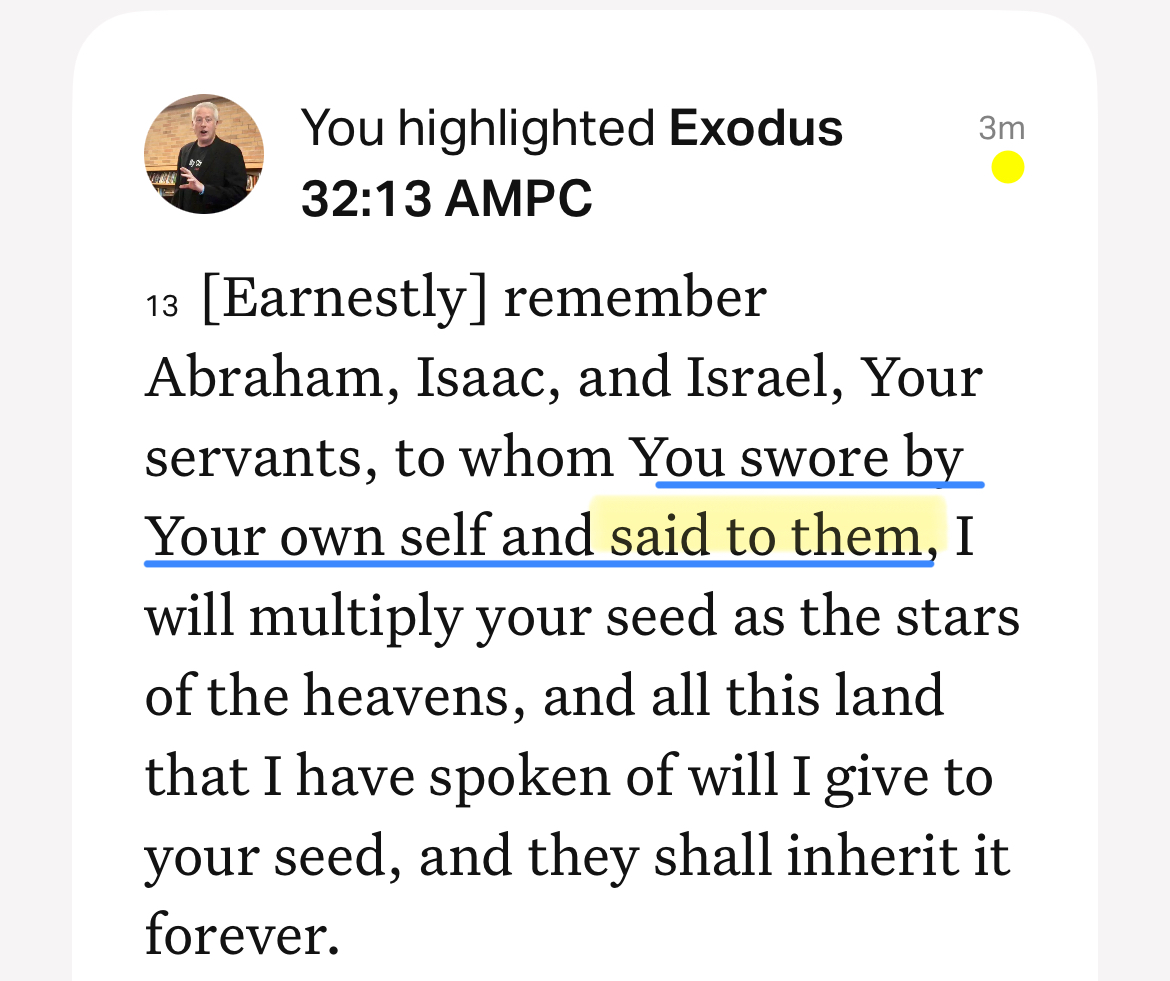
As a father, it always got my attention when my kids would remind me, “Dad, you said….” Not that God ever forgets anything He has promised, but when He hears Moses say, “You swore by Your own self and said to them,” He is pleased because this means that Moses is banking his faith on God’s unchangeable word. Let’s follow this example from Moses and use God’s Word to form our prayers to Him.

The ICR reports, “If the earth is 4.6 billion years old, virtually every square inch of the Earth’s surface would experience a host of erosive events.” But the fact that paleontologists have found so many well preserved foot tracks is a testament to both the Creation and Flood accounts recorded in biblical history.

“When ‘Aunt’ Fanny Lack, a 100-year-old Hoopa Indian woman, accepted Christ and was healed in 1920, she became a local sensation on the Hoopa Indian Reservation in northern California.” This is an amazing story!

“When you hate, the only person that is suffering is you because most of the people you hate don’t know it and the rest don’t care.” —Medgar Evers

AxisCulture Translator reported, “A study from World found that 26% of respondents admitted to flirting with a chatbot or AI, either for fun or unknowingly.” I love Axis’ conclusion: “Although social media was initially pitched as a supplement to real-life social interactions, the slope from supplement to replacement is steep. This Valentine’s Day, remind your teens that although real-life relationships can be difficult, we need both the affirmation and pushback that comes with them.”

Greg Morse shares the very real danger of shepherding God’s flock. He writes, “I enlisted to teach, preach, shepherd, and guide—but also to suffer, defend, and die, if the Lord should choose. As a son with his mother, a husband with his wife, a father with his children, so a pastor with his sheep. I am to defend them against all enemies foreign and domestic—spiritual and physical.” Pastors, I encourage you to read this article.

The Best Sermons

Listen to the podcast of this post by clicking on the player below, and you can also subscribe on AppleSpotify, or Audible. 

This one is for my fellow pastors. I want to give you THE question to ask to help you in crafting the most applicable and memorable sermons. 

It’s a question that Paul asks in Romans 4: “What does the Scripture say?” (v. 3). Preachers must make sure they get their ideas from the text of the Bible, not just from their own good ideas. Look at this amazing example from Paul in just this one chapter of his letter to the saints at Rome. 

He starts off with a question: “What then shall we say?” (v. 1). 

Then he answers his question with another question: “What does the Scripture say?” and he proceeds to give his answer by quoting from the Book of Genesis. 

From this, Paul makes a conclusion in vv. 4-5 that is signaled by the word “Now…”. 

In order to support his conclusion, Paul then quotes from Psalm 32: “David says the same thing” (vv. 6-8).

Next Paul alternates between questions and answers in vv. 9-12, bringing this Q&A to a logical conclusion in vv. 13-16. 

He supports his conclusion with even more Scripture: “As it is written” (v. 17), and “Just as it had been said” (v. 18). 

Finally, Paul wraps up this part of his sermon by both quoting more Scripture (vv. 22-23) and then reminding his audience, “The words ‘it was credited to him’ were written not for him alone, but also for us” (vv. 23-24). This shows that God’s words weren’t just for Abraham, nor just for Paul’s audience, but for anyone reading the Scripture today.

This is a short, masterful, and powerful sermon! Why? Simply because it is totally banked on God’s timeless words. 

The way that preachers can design THE perfect sermon—that is both applicable and memorable—is to start with the same question Paul did: “What does the Scripture say?” 

►► Would you please prayerfully consider supporting this ministry? My Patreon supporters get behind-the-scenes access to exclusive materials. ◀︎◀︎

Links & Quotes

Leaders need to give others confidence to try something new. We need to help people get moving so that we can coach what they are doing. For more great leadership insights, check out The Craig and Greg Show.

I have lots of new content every week, which you can check out on my YouTube channel.

A couple of thought-worthy quotes for pastors. First from David Mathis: “Pastors, observe that in and of itself, mocking is no clear reflection of the faithfulness or fruitfulness of preaching Christ. Wise preachers do not take mocking as an indicator of failure, nor as an indicator of success. Twice in Athens some mock Paul, which may seem like a failure compared to his homiletic triumphs elsewhere. However, others say, ‘We will hear you again.’ And then, in the end: ‘some men joined him and believed’ [Acts 17:32-34]. … How foolish it would be to distract ourselves with the mockers. Or to call special attention to the mocking as some great badge of our own faithfulness. Rather, we have the example of Paul at Mars Hill, who, so far as we can tell, wholly overlooks, with a holy disregard, these mockers and concerns himself instead with those asking honest questions.”

…and then one from John Piper: “Preaching is a happy business. Because even if the text is a hard word that devastates the hearers, the preacher connects the hard word with the gracious word and the hopeful word, and he catches them as they fall. So, in the end, all preaching is a happy business.

“A people that values its privileges above its principles soon loses both.” —Dwight D. Eisenhower

“For condemnation to work, we must say to God what the devil has said to us and believe it. If I want to stand before God with excuses that make what He said to me void, I’ll have to quote the devil to God. Does that sound like a good thing to do? God’s will for me is not to condemn me, but to liberate me from everything that holds me back from being what He created me to be through an ongoing relationship. To accomplish that, I need to do the opposite of what I used to do when I walked in condemnation. Instead of quoting to God what the devil is saying, I quote to the devil what God has said.” —Jim Wiegand, in Recruiting To Releasing 

Thinking about “how Martin Luther, a professor at Wittenberg University, helped to spark the 16th century Protestant Reformation,” J. Calvin Holsinger conceived the idea of preparing missionaries to US colleges and universities—a ministry called Chi Alpha.

Another great story from the “Here We Stand” series of biographies of notable people during the Reformation. “An attendant asked [King Henry VIII] whom he wished to have at his bedside. The king asked for Thomas [Cranmer]. By the time Cranmer arrived, King Henry was unable to speak. Foxe tells the story. ‘Then the archbishop, exhorting him to put his trust in Christ, and to call upon His mercy, desired him though he could not speak, yet to give some token with his eyes or with his hand, that he trusted in the Lord. Then the king, holding him with his hand, did wring his hand in his as hard as he could (Foxe’s Book of Martyrs, 748).’ The scene sweetly punctuates the most important friendship in the English Reformation. Whatever King Henry believed when he squeezed Cranmer’s hand that day, God used the bond between them to break England free from Roman Catholicism and to recover the one true gospel.”

The ICR reports, “Genesis claims that people in the pre-Flood world routinely attained 900-year lifespans. The best-known example is Methuselah, who had the longest recorded lifespan of 969 years (Genesis 5:27). Skeptics dismiss these great ages as fanciful legends, but recent fossil data are providing unexpected, albeit indirect, corroboration of the Bible’s testimony.” Check out this full report.

“In my experience, each failure contains the seeds of your next success—if you are willing to learn from it.” —Paul Allen, cofounder of Microsoft

Links & Quotes

Godly men honor their wives by having eyes only for them. Fellas, if you find your eyes wandering you need to tell yourself, “That’s not mine!” and then quickly put your eyes back where they belong. Check out my full message to men on Father’s Day.

I have lots of new content every week, which you can check out on my YouTube channel.

From a recent article at The Institute for Creation Research: “Astronomers using the James Webb Space Telescope have recently confirmed that two galaxies are extremely distant, with one becoming the new record holder as the most distant galaxy from Earth. … By uniformitarian reckoning, this galaxy existed just 290 million years after the supposed Big Bang, yet it looks too mature for its age. … This new record-breaker is just the latest example of the ‘distant mature galaxy problem’ that has long plagued the Big Bang model.” These galaxies are all the masterpiece of one Creator! Here is another resource from a biblical perspective that outlines what the “in the beginning” moment (Genesis 1:1) may have looked like.

“Give me the preacher who opens the folds of my heart; who accuses me, convicts me, and condemns me before God; who loves my soul too well to suffer me to go on in sin, unreproved, through fear of giving me offence; who draws the line with accuracy, between the delusions of fancy, and the impressions of grace; who pursues me from one hiding place to another, until I am driven from every refuge of lies; who gives me no rest until he sees me, with unfeigned penitence, trembling at the feet of Jesus; and then, and not till then, soothes my anguish, wipes away my tears, and comforts me with the cordials of grace.” —Samuel Pearce

Matthew Emadi writes, “The New Testament quotes Psalm 110 more than any other Old Testament passage. The apostles and the early church loved Psalm 110 for its majestic depiction of the Lord Jesus Christ and His reign over all nations.” Here’s how to read Psalm 110 in light of the words and works of Jesus.

J. Warner Wallace, at a Q&A session, answers questions about why some Bible translators have marked a couple of passages as unreliable, and why some books that claim to be authentic accounts aren’t included in the canon of Scripture. 

I always love when archeological discoveries confirm once again the historicity of the Bible! Here is an archeological biography of Esarhaddon.

“So the writer [of the Book of Hebrews] urges his readers, as part of being faithful to Him Who called them, to consider Jesus, to strive for the glory of Jesus, and to fix their minds on Jesus as the key to knowing daily strength for faithfulness (Hebrews 12:1-2). What does this entail? … The writer of Hebrews admits that he learned to look to Jesus by paying attention to those who had known Him, listening carefully to their words, and laying hold on them with faith (Hebrews 2:1-4). As he heard the apostles and studied the Scriptures of the Old Testament, the picture of Jesus presented there began to become increasingly clear. … The lesson is plain: Jesus is being revealed in the Scriptures of the Old and New Testament. Wherever we read or study in the Scripture, Jesus is present, making Himself known. We can see Jesus throughout the Bible, and consider Him as He is presented to us, in all His majesty, beauty, and power. Our responsibility is to read the Bible in such a way as to recognize what God is revealing about His Apostle and our High Priest, Jesus Christ.” —T.M. Moore