Thursdays With Oswald—What Prayer Does In Us

Oswald ChambersThis is a weekly series with things I’m reading and pondering from Oswald Chambers. You can read the original seed thought here, or type “Thursdays With Oswald” in the search box to read more entries.

What Prayer Does In Us

     Prayer is the point where the reality of God merges with human life. Until we are born from above, prayer with us is honestly nothing more than a mere exercise; but in all our Lord’s teaching and in His own personal life, as well as in the emphasis laid on prayer by the Holy Ghost after He had gone, prayer is regarded as the work (see John 14:11-13). … 

     If prayer is the highest reach of communion possible between Almighty God and the Son of Man, what part ought prayer to play in our lives? … 

     Prayer is not meant to develop us, but to develop the life of God in us after new birth.

From The Psychology Of Redemption

In another lesson, Chambers reminds us that prayer is easy for us because it cost Jesus so much to make it possible for us.

Jesus knew the value of prayer, which is why it was an essential priority all throughout His earthly life. Now we have access to the same Almighty God through the name of Jesus. Yes, Jesus is interceding for us, but we don’t have to stop there—we should never stop there!—because Christ’s death and resurrection makes a way for us to go right into Almighty God’s presence.

Prayer is powerful! Prayer brings the life of God right down into our own souls.

So… what part ought prayer to play in your life?

Lettie Cowman On Prayer

Lettie Cowman“Often it is simply the answers to our prayers that cause many of the difficulties in the Christian life.

“We pray for patience, and our Father sends demanding people our way who test us to the limit, ‘because…suffering produces perseverance’ (Romans 5:3). …

“We pray to be unselfish, and God gives us opportunities to sacrifice by placing other people’s needs first and by laying down our lives for other believers. …

“We pray to the Lord, as His apostles did, saying, ‘Increase our faith!’ (Luke 17:5). Then our money seems to take wings and fly away; our children become critically ill; an employee becomes careless, slow, and wasteful; or some other new trial comes upon us, requiring more faith than we have ever before experienced.

“We pray for a Christlike life that exhibits the humility of a lamb. Then we are asked to perform some lowly task, or we are unjustly accused and given no opportunity to explain….

“We pray for gentleness and quickly face a storm of temptation to be harsh and irritable.

“We pray for quietness, and suddenly every nerve is tested to its limit with tremendous tension so that we may learn that when He sends His peace, no one can disturb it.

“We pray for love for others, and God sends unique suffering by sending people our way who are difficult to love and who say things that get on our nerves and tear at our heart. …

The way to peace and victory is to accept every circumstance and every trial as being straight from the hand of our loving Father.” —Lettie Cowman

Bono & Eugene Peterson Discuss The Psalms

Praying For Your Congregation

I heart my churchPastors often ask for their congregation to pray for them. This is a good thing! But the Apostle Paul gives pastors a model for praying for their congregation.

In his letter to the Church at Philippi, Paul says, “And this is my prayer…” (Philippians 1:9).

First, notice the motivation for Paul’s prayer: thankfulness. He’s not skeptical nor cynical. He doesn’t browbeat them for any shortcomings. He doesn’t think, “Ministry would be great if it weren’t for these people.” No! He was full of thanks that bubbled up in joyful prayer for these precious people (vv. 3, 4).

Paul also had an attitude of confidence for this congregation. He believed they could carry out ministry responsibilities, and that in the process they could continue to mature in Christ (vv. 5, 6).

Paul had affection for this church: he really liked these people! It’s one thing to love someone (after all, Jesus commanded us to do that), but something entirely different when we like being around people. The King James Version says Paul greatly longed after these folks. The Greek is even better—it says he doted on them (v. 8).

With this in mind, look how Paul prayed for these precious folks on whom he doted. He prayed that…

  • …their love might abound
  • …they would increase in knowledge and insight
  • …their level of spiritual discernment would help them always see the best
  • …their purity and blamelessness would remain intact all the days of their life
  • …they would be filled with God’s righteousness
  • …they would bring glory to God

Pastor, this is a great prayer to pray over the precious people on whom you dote!

Mom, Your Prayers ARE Making A Difference

Mother's loveOne day a little girl was sitting and watching her mother do the dishes at the kitchen sink. She suddenly noticed that her mother has several strands of white hair sticking out in contrast on her brunette head. She looked at her mother and inquisitively asked, “Momma, why are some of your hairs white?” Spotting a teachable moment, her mother replied, “Well, every time that you do something wrong and make me cry or unhappy, one of my hairs turns white.” The little girl thought about this revelation for while and then asked, “Momma, how come all of grandma’s hairs are white?”

Mom, you have earned every one of those gray hairs or wrinkles through your loving care for us!

Gray hair is a mark of distinction, the award for a God-loyal life. (Proverbs 16:3)

The glory of the young is their strength; the gray hair of experience is the splendor of the old. (Proverbs 20:29)

Mom, your love for us can be summed up in one verse—Love always protects, always trusts, always hopes, always perseveres. (1 Corinthians 13:7)

And the Apostle Paul’s words to a young preacher are just as true for Moms as they were for Timothy: Keep a close watch on how you live and on your teaching. Stay true to what is right for the sake of your own salvation and the salvation of those who hear you. (1 Timothy 4:16)

Don’t give up, Mom! You need to persevere so that when you have done the will of God, you will receive what He has promised. (Hebrews 10:36)

What has God promised you about your family? Has He said your whole family will call on Jesus as their Savior? Then persevere in that. Has He said that your prodigal child will come home? Then persevere in that. Despite the odds, despite the obstacles, despite the setbacks, keep on loving them and praying for them. It IS making a difference!

Here’s an encouraging biblical example of a little-known Mom’s prayerful influence on a son that is listed in the genealogy of Jesus Christ…

Keep persevering in prayer, Mom. Your prayers ARE making a difference!

We ♥︎ Moms


We Love MomsThis Sunday is Mothers Day, and I cannot wait to celebrate the special ladies in our church. Both the biological Moms and the spiritual Moms have definitely earned my respect and admiration!

I’m going to share a special message about the power that comes when Moms persevere in prayer and a godly example. These prayers with the feminine touch not only change our present, but have a lasting impact for generations to come. In fact, we owe much of our spiritual heritage to those Moms who faithfully prayed.

Please bring Mom with you to Calvary Assembly of God this Sunday!

Thursdays With Oswald—Stretched Like A Bow

Oswald ChambersThis is a weekly series with things I’m reading and pondering from Oswald Chambers. You can read the original seed thought here, or type “Thursdays With Oswald” in the search box to read more entries.

Stretched Like A Bow

     God takes the saints like a bow which He stretches and at a certain point the saint says, “I can’t stand any more,” but God does not heed, He goes on stretching because He is aiming at His mark, not ours, and the patience of the saints is that they “hang in” until God lets the arrow fly. … Remain spiritually tenacious.

From God’s Workmanship 

Endure hardship as discipline; God is treating you as His children. For what children are not disciplined by their father? If you are not disciplined—and everyone undergoes discipline—then you are not legitimate, not true sons and daughters at all. Moreover, we have all had human fathers who disciplined us and we respected them for it. How much more should we submit to the Father of spirits and live! They disciplined us for a little while as they thought best; but God disciplines us for our good, in order that we may share in His holiness. No discipline seems pleasant at the time, but painful. Later on, however, it produces a harvest of righteousness and peace for those who have been trained by it. (Hebrews 12:7-11)

My prayer is that we all remain spiritually tenacious until God lets the arrow of our life fly!

Abundantly Able

Yet Abraham did not waver through unbelief regarding the promise of God, but was strengthened in his faith and gave glory to God, being fully persuaded that God had power to do what He had promised. (Romans 4:20-21)

A.B. Simpson“The literal translation of this passage from the Greek expresses the thought in this way: God is not merely able but abundantly able, bountifully and generously able, with an infinite surplus of resources, and eternally able ‘to do what He had promised.’ He is the God of limitless resources—the only limit comes from us. Our requests, our thoughts, and our prayers are too small, and our expectations are too low. God is trying to raise our vision to a higher level, call us to have greater expectations, and thereby bring us to greater appropriation. Shall we continue living in a way that mocks His will and denies His Word?” —A.B. Simpson

Don’t Try To Change Your Bad Behavior

Thoughts to beahviorsAs I wrote previously, I believe Christians should be the best at getting along with others. First of all, Christians have been empowered by the Holy Spirit with the skills necessary to live at peace with everyone, IF we will only allow the Spirit to do the necessary work in us. And second, the way Christians treat others goes a long way toward either attracting or repelling others from a relationship with Jesus.

But here’s an important thing: If you don’t get along well with others now, don’t try to change your behavior!

Stephen Covey wrote, “To try to change outward behaviors does very little good in the long run if I fail to examine the basic paradigms from which those attitudes and behaviors flow.”

You see, behavior is the fruit. If we want to change the fruit, we need to back up a few steps.

The Apostle Paul used the life of Jesus as an example for Christians on how we can get along with others. But notice this: most of what Paul discusses is the “inside stuff.”

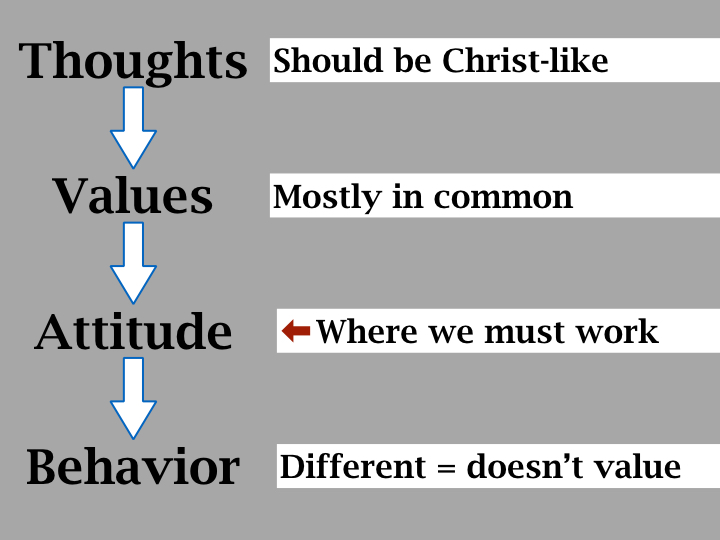
The progression goes like this (see Philippians 2:1-13)—

Thoughts → Values → Attitudes → Behaviors

(1) Thoughts—These need to be humble thoughts about God’s love toward us (v. 1).

(2) Values—Paul tells us to be “one in spirit and purpose” with others (v. 2). The definition of the Greek words here mean valuing the well-being of everyone. Paul then explains how our humility can lead to these win-win relationships (vv. 3, 4).

(3) Attitudes—“Your attitude should be the same as Christ Jesus” (v. 5). Jesus showed us what it was to have an attitude related toward obedience to God’s will.

(4) Behavior—If our thoughts, values and attitudes are rightly aligned to God, then our behavior will naturally be Christ-like as well. We see the example of Jesus in verses 6-8, and God’s reward for that behavior in verses 9-11. Then Paul calls on Christians to follow that pattern in our own lives (vv. 12, 13).

Most decent, reasonably-thinking human beings share the same values. Harry Truman said, “When we understand the other fellow’s viewpoint—understand what he is trying to do—nine times out of ten he is trying to do right.”

The problem is this: When the other person behaves differently from me, my natural tendency is to assume he doesn’t value what I value. In other words, I’m judging his value system on the way I normally behave.

The break-down is in my attitude. That’s the area I need to address. That’s the attribute of Jesus that Paul told us to copy.

So if I want to get along better with others, I shouldn’t try to change my behavior, but my attitude. My prayer should be: “I want this same attitude to be in me which was also in Christ Jesus. He served God and others, so I too want to follow His example of obedience, and I want to demonstrate my appreciation for all that Jesus has done for me by working hard to better get along with others. Help me change my attitude!”

Check out this video of the full message…

I hope you can join us next Sunday as we continue learning how to get along with others. Please join us in person or on Periscope.

You Are An Empowered Peacemaker

My new attitude“The whole world—with one minor exception—is made up of others,” says John Maxwell. The ‘one minor exception’ is that person who’s looking back at you from the mirror every morning, so if you want to be successful in life, you better learn to get along with ‘the others.’

I believe this is especially important for those who call themselves Christians. Here are three reasons why—

  1. Our interaction with other Christians is a testimony to outsiders—John 13:34-35.
  2. Our positive interaction with outsiders can draw others to Christ—Colossians 4:5.
  3. Our negative interaction with outsiders can repel others from Christ—1 Peter 2:12.

So although it can be very (sometimes very, very!) challenging, we are called to find ways to get along with others. The Apostle Paul said:

Be careful to do what is right in the eyes of everybody. If it is possible, as far as it depends on you, live at peace with everyone (Romans 12:17-18, emphasis added).

When you see the phrase “if it is possible” you may think that Paul has given us an “out.” We could say, “I tried really hard to get along with that guy, but it just hasn’t worked, so I’m off the hook!”

But consider how another translation of the Bible states this phrase: Do all that you can to live in peace with everyone.

Jesus was asked to do something that had never been done before: heal two men born blind. Jesus asked these men, “Do you believe I am able to do this?” (Matthew 9:28). The men answered an emphatic, “Yes!” On another occasion a father asked Jesus to heal his son by saying, “If You can, please help us.” Jesus said, “‘If I can? All things are possible to those who believe.” The father immediately replied, “I do believe; please help my unbelief” (Mark 9:22-24).

If you are Christian, the Spirit of Jesus lives in you. So the question Jesus asks us about our difficult relationships is, “Do you believe I am able to help you?” Or perhaps more accurately He asks us, “Will you let Me help you?”

So the part of the verse which says, “if it is possible, as far at it depends on you” is really saying, “If you really believe Jesus is stronger than this strained relationship, will you let Him do something in you to bring about peace?”

We aren’t asking Jesus to change the other person; we’re asking Him to change us. We aren’t asking someone else to get on our page, or to see the world from our perspective; we’re asking the Holy Spirit to help us get on their page, to help us see the world they way they see it.

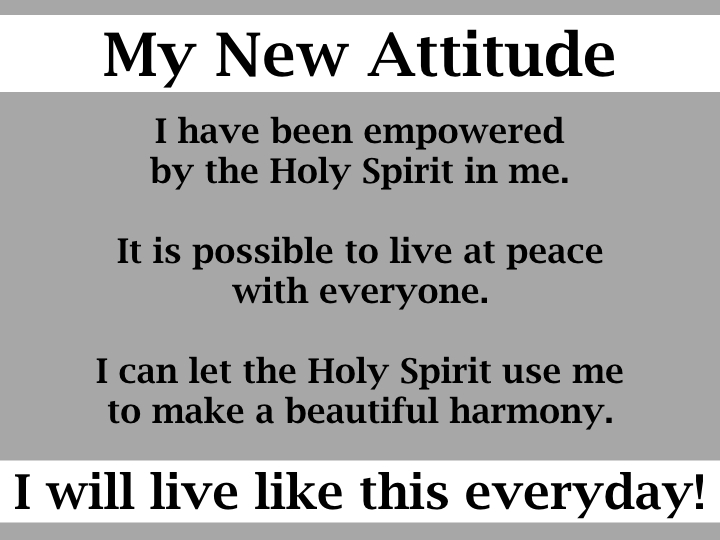
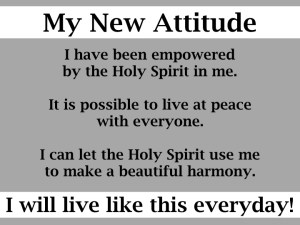
We need to have a new attitude. And I believe that attitude comes from a prayer like this—

I have been empowered by the Spirit of Christ in me. 
It is now possible for me to live at peace with everyone. 
I can let the Holy Spirit use to me make a beautiful harmony. 
I will keep on living like this every day.

Next Sunday we will be looking at some practical techniques and more biblical insights to help us excel in getting along with all ‘the others’ that make up the world. Please join us in person or on Periscope.