Pastors can only fulfill their calling as shepherd leaders with the vitalizing power of prayer, and must pray for themselves first. A healthy, prayer-full pastor is an effective pastor. My newest book is to help pastors in this vital discipline of prayer.
Amen Indeed fuels growth by providing more than 100 prayers for pastors to pray for their own mental, physical, spiritual, and relational growth. Each is sourced from Scripture and rings with the “Amen” that Jesus promised to add (2 Corinthians 1:20).
“There is one assured way for our prayers to be answered: It is to pray the will of God.
“There is one assured way to pray the will of God: It is to pray Scripture.
“As ministers of the Gospel we would be wise then to primarily pray Scripture, for ‘the word of our God stands forever’ (Isaiah 40:8).” —Dick Brogden, Founder of the Live Dead Movement
“When it comes to prayer, we need some help. And in Amen Indeed, help is at hand. Whatever is keeping us from prayer, Craig Owens can help us push through to a more consistent and more consistently joyful and fruitful life of prayer.” —T.M. Moore, Principal of The Fellowship of Ailbe
Listen to the podcast of this post by clicking on the player below, and you can also subscribe on Apple, Spotify, or Audible.
Imagine you just preached a sermon that was so Holy Spirit-anointed that crowds of people turned to Jesus. This kind of activity made a big stir in town, and some supposedly religious people became quite jealous of the fruit of your ministry. In their jealousy, they begin slandering you to others in town, causing a huge backlash against your ministry.
How would you respond? Would you give those jealous slanderers a piece of your mind? Would you give them some of their own medicine? Would you leave town?
The scenario I described isn’t make believe; it actually happened to Paul and Barnabas in the city of Iconium (Acts 14:1-2). In the very next verse, Luke describes Paul and Barnabas’ response: some biblical translations use the word “so” and some use the word “therefore” to indicate the natural connection—
“So Paul and Barnabas stayed on there for a long time, speaking freely and fearlessly and boldly in the Lord” (v. 3).
They didn’t fight their slanderers nor did they flee from Iconium; they remained faithful to the task to which God had called them!
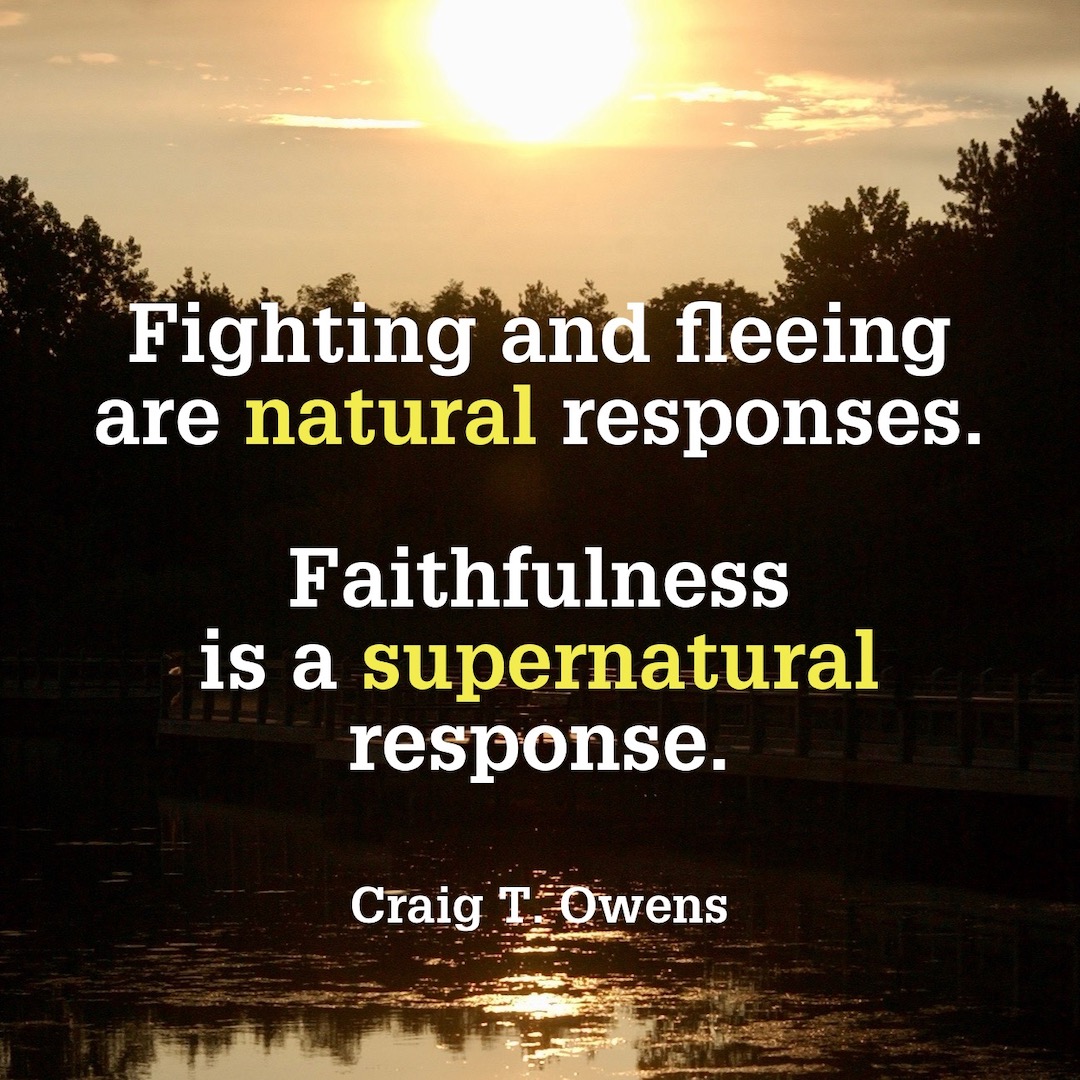
Fighting and fleeing are natural responses.
Faithfulness, however, is a supernatural response.
God honored the faithfulness of Paul and Barnabas by demonstrating His own supernatural power through them: “[God] continued to bear testimony to the Word of His grace, granting signs and wonders to be performed by their hands” (v. 3b).
The scenario I described isn’t just something from long ago history, but it was a scene from my personal history too. In the Introduction of my book When Sheep Bite I wrote—
I cannot pinpoint exactly what triggered their outburst or when their attacks started, but it seemed like almost overnight their teeth were bared. I was completely taken aback! I had assumed that seeing the new life and vitality in this pasture would be celebrated. When the exact opposite happened, I must admit that my knee-jerk reactions probably weren’t very Christlike. …
This was something I never imagined. I never saw anything like this in my home, nor had I experienced anything like this in my associate pastor’s role. In fact, even in the business world I had never seen people behave this egregiously.
In the final chapter of my book I shared this thought, “Yes, fight-or-flight is our natural response, but with the empowerment of the Holy Spirit, we can respond in supernatural faithfulness. We don’t have to sit unmoving and unfeeling, but we can continue to serve even biting sheep until God removes us or them.”
This whole idea of supernatural faithfulness to God’s calling versus giving in to the natural reactions of fight-or-flight is why I wrote this book. Once again, let me take you back to an excerpt from the Introduction—
Would I ever want to relive this experience? No way! But there were lessons I learned during this walk through hell that I could have learned in no other way. It is those lessons that I hope to be able to unpack for you, my shepherding friends, in this book. … I would say to you something that C.S. Lewis wrote, “Think of me as a fellow-patient in the same hospital who, having been admitted a little earlier, could give some advice.”
When you are under attack, I know it seems like you are alone, but you are not. Don’t give in to fight-or-flight, but ask God to supernaturally empower you to remain faithful. I believe When Sheep Bite can be a huge assistance to you as well. Please pick up a copy and reach out to me if I can be of assistance to you.
You and I will learn lessons in the hard times that we could learn no other way. Then God will use those lessons so we can help minister to others in their hard times. Check out my sermon about interceding for other saints.
ICR’s Dr. Randy Guliuzza says, “Convergent evolution is the fabricated conjecture evolutionists invoke to explain very similar characteristics between creatures that could not have been inherited from a common ancestor and that evolutionists will never accept as having been produced by an intelligently designed internal programming that is specified for common purposes.” This particular article is about bats which have always had the ability to fly. Not one fossil record shows any flightless bats because God created them as flying mammals.
In the early 1900s, Albert Norris was a missionary in India, observing firsthand the spiritual and physical hardships the people faced there. In an article in the Pentecostal Evangel, Norris wrote, “A Christianity that coldly sits down, and goes on its routine of formal work, and allows its fellowmen to starve, or to be obliged to go through all the hard sufferings and exposure connected with famine, without effort to help them, might as well quit its preaching.”
In answering a question about using AI to write a sermon, John Piper answers with an emphatic “no.” I agree! One of the reasons Piper shares: “One of the qualifications for being an elder-pastor-preacher in the Bible is the gift or the ability to teach, didaktikos (1 Timothy 3:2). That means you must have the ability, the gift, to read a passage of Scripture, understand the reality it deals with, feel the emotions it is meant to elicit, be able to explain it to others clearly, illustrate and apply it for their edification. That’s a gift you must have. It’s your number-one job. If you don’t have it, you should not be a pastor.”
“You don’t try to forget the mistake, but you don’t dwell on it. Don’t let it have any of your energy, or any of your time, or any of your space.” —Johnny Cash
Godly men honor their wives by having eyes only for them. Fellas, if you find your eyes wandering you need to tell yourself, “That’s not mine!” and then quickly put your eyes back where they belong. Check out my full message to men on Father’s Day.
I have lots of new content every week, which you can check out on my YouTube channel.
From a recent article at The Institute for Creation Research: “Astronomers using the James Webb Space Telescope have recently confirmed that two galaxies are extremely distant, with one becoming the new record holder as the most distant galaxy from Earth. … By uniformitarian reckoning, this galaxy existed just 290 million years after the supposed Big Bang, yet it looks too mature for its age. … This new record-breaker is just the latest example of the ‘distant mature galaxy problem’ that has long plagued the Big Bang model.” These galaxies are all the masterpiece of one Creator! Here is another resource from a biblical perspective that outlines what the “in the beginning” moment (Genesis 1:1) may have looked like.
“Give me the preacher who opens the folds of my heart; who accuses me, convicts me, and condemns me before God; who loves my soul too well to suffer me to go on in sin, unreproved, through fear of giving me offence; who draws the line with accuracy, between the delusions of fancy, and the impressions of grace; who pursues me from one hiding place to another, until I am driven from every refuge of lies; who gives me no rest until he sees me, with unfeigned penitence, trembling at the feet of Jesus; and then, and not till then, soothes my anguish, wipes away my tears, and comforts me with the cordials of grace.” —Samuel Pearce
Matthew Emadi writes, “The New Testament quotes Psalm 110 more than any other Old Testament passage. The apostles and the early church loved Psalm 110 for its majestic depiction of the Lord Jesus Christ and His reign over all nations.” Here’s how to read Psalm 110 in light of the words and works of Jesus.
J. Warner Wallace, at a Q&A session, answers questions about why some Bible translators have marked a couple of passages as unreliable, and why some books that claim to be authentic accounts aren’t included in the canon of Scripture.
“So the writer [of the Book of Hebrews] urges his readers, as part of being faithful to Him Who called them, to consider Jesus, to strive for the glory of Jesus, and to fix their minds on Jesus as the key to knowing daily strength for faithfulness (Hebrews 12:1-2). What does this entail? … The writer of Hebrews admits that he learned to look to Jesus by paying attention to those who had known Him, listening carefully to their words, and laying hold on them with faith (Hebrews 2:1-4). As he heard the apostles and studied the Scriptures of the Old Testament, the picture of Jesus presented there began to become increasingly clear. … The lesson is plain: Jesus is being revealed in the Scriptures of the Old and New Testament. Wherever we read or study in the Scripture, Jesus is present, making Himself known. We can see Jesus throughout the Bible, and consider Him as He is presented to us, in all His majesty, beauty, and power. Our responsibility is to read the Bible in such a way as to recognize what God is revealing about His Apostle and our High Priest, Jesus Christ.” —T.M. Moore
Listen to the podcast of this post by clicking on the player below, and you can also subscribe on Apple, Spotify, or Audible.
Without a doubt, a leader plagued by feelings of guilt is a leader that is operating well-below his or her full potential.
One of the best ways to avoid these feelings of limiting guilt is for the leader to admit that he or she isn’t an expert in every aspect of their organization.
In this short clip, Karl Vaters and I are specifically addressing pastoral leaders, but the principles can be applied to leaders of any organization.
You can check out more clips from this interview by clicking here.
The two related blog posts I made reference to in this video are:
“When the Lord chose His twelve disciples, it was ‘that they might be with Him and that He might send them out to preach’ (Mark 3:14). A life in fellowship with Him prepared them for the work of preaching. …
“The law of their first calling remained unchanged: their unbroken fellowship with Him was the secret of their power to preach and to testify of Him. …
“The same principle stands for all His servants, for all time: without the experience of His presence with us, our preaching has no power. The secret of our strength is the living testimony that Jesus Christ is every moment with us, inspiring, directing and strengthening us. …
“But remember that this power is never meant to be experienced as if it were our own. It is only as Jesus Christ as a living Person dwells and works with His divine energy in our own hearts and lives that there can be power in our preaching as a personal testimony. …
“For it’s only when His servants show in their lives that they obey Him in all His commands can they expect the fullness of His power and His presence to be with them. Only when they themselves are living witnesses to the reality of His power to save and to keep from sin can they expect to experience His abiding presence, and the power to train others to the life of obedience that He asks.
“The living experience of the presence of Jesus is an essential element in preaching the gospel. If this becomes clouded, work becomes a human effort, without the freshness and power of the heavenly life. Nothing can bring back the power and blessing but a return to the Master’s feet so that He may breathe into the heart, in divine power, His blessed word, ‘I am with you always!’” —Andrew Murray
Listen to the podcast of this post by clicking on the player below, and you can also subscribe on Apple, Spotify, or Audible.
Jesus began to speak to them in parables… (Mark 12:1).
What Jesus relates here in the 12th chapter of Mark’s Gospel is only the fourth parable that Mark records, and as the final parable that Jesus shares, it brings His public ministry to a close.
Jesus concludes this parable by quoting from Psalm 118. This Psalm is the last of the “Hallel Psalms” that were sung at the conclusion of the Passover celebration. This song specifically looks eagerly forward to the arrival of the Messiah. It contains the words that the crowd used on Palm Sunday: “Lord, save us! Lord, grant us success! Blessed is He who comes in the name of the Lord” (Psalm 118:25-26). By quoting from the same Psalm—that was perhaps hundreds of years old, but had just been sung and shouted by the crowd—Jesus was claiming to be the Messiah longed for in that Hallel Psalm.
As you may recall, these shouts from the crowd and the activities of Jesus as He cleansed the temple got the religious leaders riled up! They, in essence, asked Jesus, “Who do You think You are?!” His answer is contained in this parable of Mark 12.
At the conclusion of this parable, the religious leaders “knew He had spoken this parable against them” (Mark 12:12).
Pastors, if you want to deliver soul-shaking, life-transforming, eye-opening, heart-melting sermons, you must follow this example of Jesus: Stick with the Scripture!
We don’t need to try to be clever or witty or even memorable. We just need to speak the Word of God that is inspired by the Holy Spirit, and then allow the Holy Spirit to illuminate that inspired Word to each person’s needs. As Randy Pope noted, “Preaching is not talking to people about the Bible; it is talking to people about themselves from the Bible.”
I don’t want to try to make my voice impress people, but I am desperate for God’s voice to impact people. Nearly every week as I prepare a sermon, I’ll pray this prayer from Oswald Chambers: “In my preaching, cause Thy glorious voice to be heard, Thy lovely face to be seen, Thy pervasive Spirit felt.” My dear pastor, I would encourage you to make this your prayer as well.
Listen to the podcast of this post by clicking on the player below, and you can also subscribe on Apple, Spotify, or Audible.
In my book Shepherd Leadership, I take five chapters to unpack the lessons we can learn from the health of Jesus. Yes, Jesus was mentally, physically, spiritually, and relationally healthy.
On the 200churches podcast with Jeff Keady we talked about a chapter in my book called “The Pinnacle of a Shepherd’s Health.” In that chapter I wrote—
The phrase Dr. Luke uses about Christ’s growth is, “Jesus grew in favor with men” [Luke 2:52]. People liked having Jesus around. The word Luke uses for favor is from the same root word that is also translated “grace.” Jesus was a graceful Man. Or we could say that He was a Man so full of grace that when He was jostled, only grace spilled out of Him.
What does it mean when someone is graceful? It means they are pleasant to be around. It means you feel safe around them, knowing they will never belittle you or put you down. It means that their focus is on your agenda, not their own agenda. It means they are a “there you are!” person, not a “here I am!” person. The bottom line: grace-full people are full of grace for others.
Let’s return to our perfect example in Jesus. He was treated rudely and spoken to condescendingly, even by people who should have been His allies. Then there were those on a constant mission to try to trip Him up or get Him to say or do something that would have undermined His credibility. Yet Jesus never spoke inappropriately nor acted childishly. Jesus never had to say, “My bad, I misspoke there,” or “Sorry, I shouldn’t have done that.”
We can make all of our plans to behave in loving ways toward the sheep under our care, but what happens when the sheep ignore us, bite us, or leave us? As boxer Mike Tyson noted, “Everyone has a plan until they get punched in the mouth.” Surely the best indication of our overall healthiness and servant-like attitude is not so much our actions but our reactions.
If your reactions are less than what you would like them to be, I believe you will find a lot of excellent content in my book that can help you.
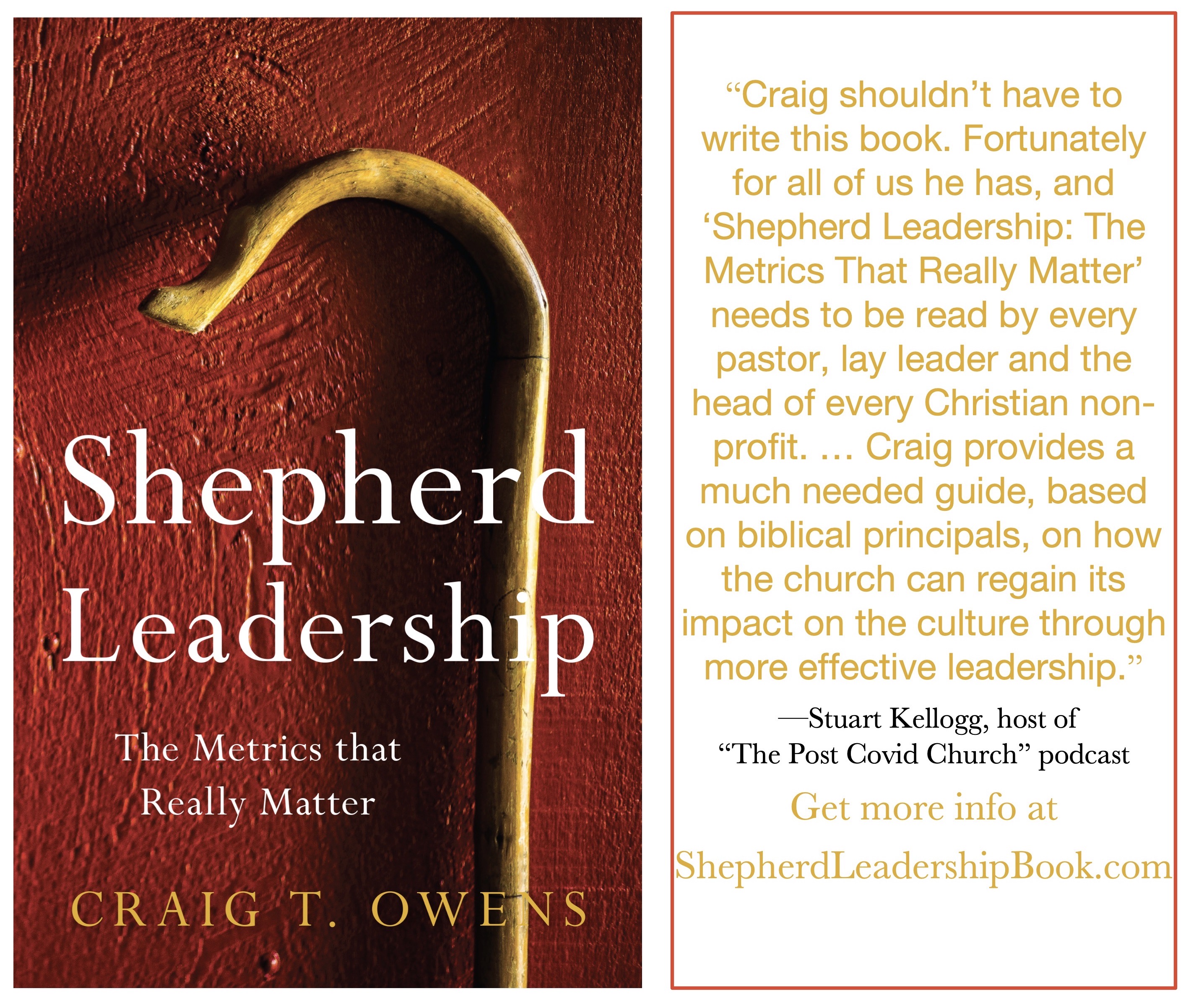
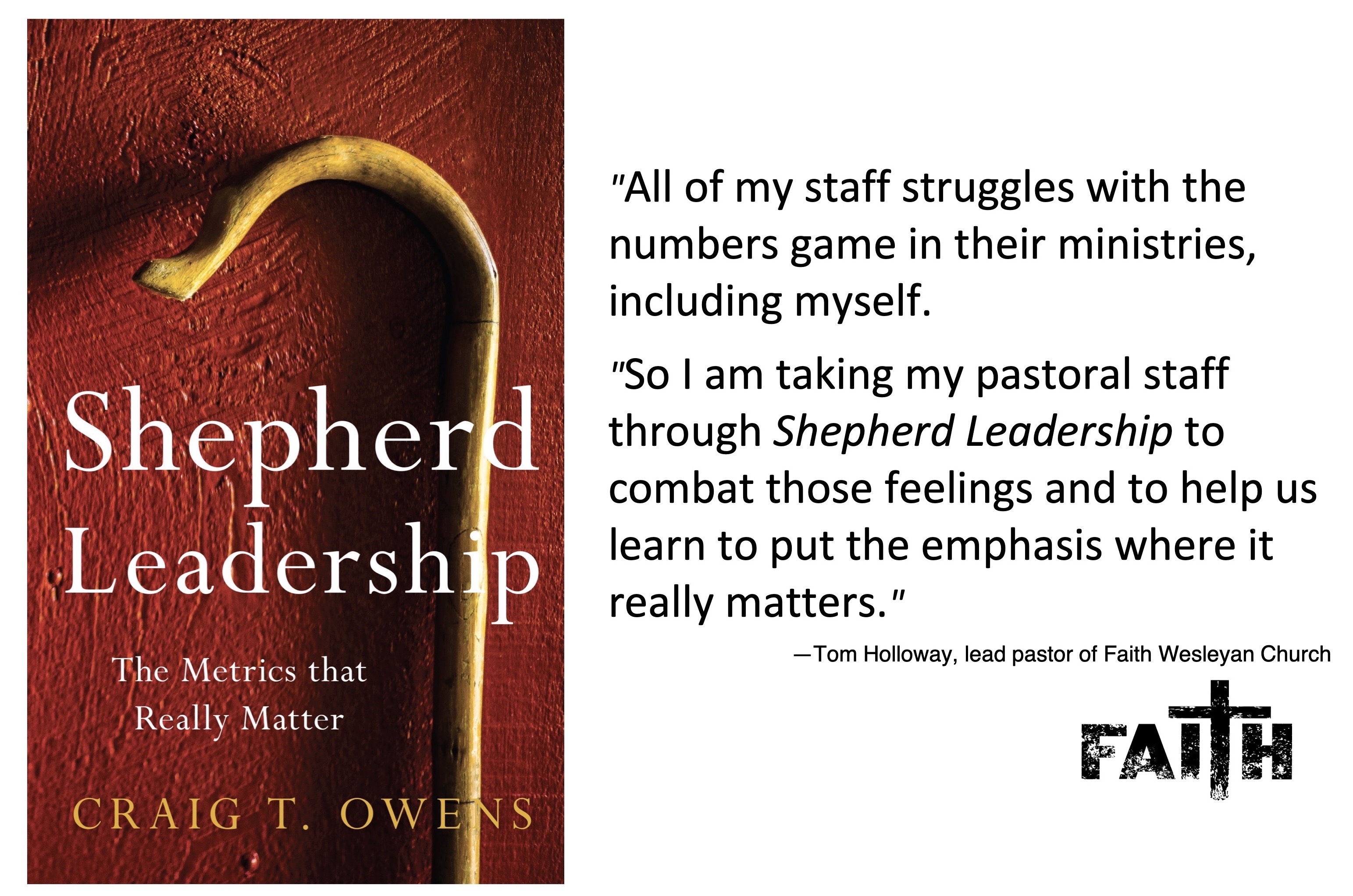
If you want to catch up on some of the other clips I’ve already shared from this interview, you can find them here, and I’ll be sharing more clips from this 200churches interview soon, so please stay tuned. Shepherd Leadership: The Metrics That Really Matter is available in print or ebook, and in audiobook through either Audible or Apple.
Listen to the podcast of this post by clicking on the player below, and you can also subscribe on Apple, Spotify, or Audible.
I’ve discussed quite a bit the two ways that organizations—especially churches and non-profit ministries—can measure success: By quantity or by quality. And I think a good case can be made for both of these metrics from the Bible.
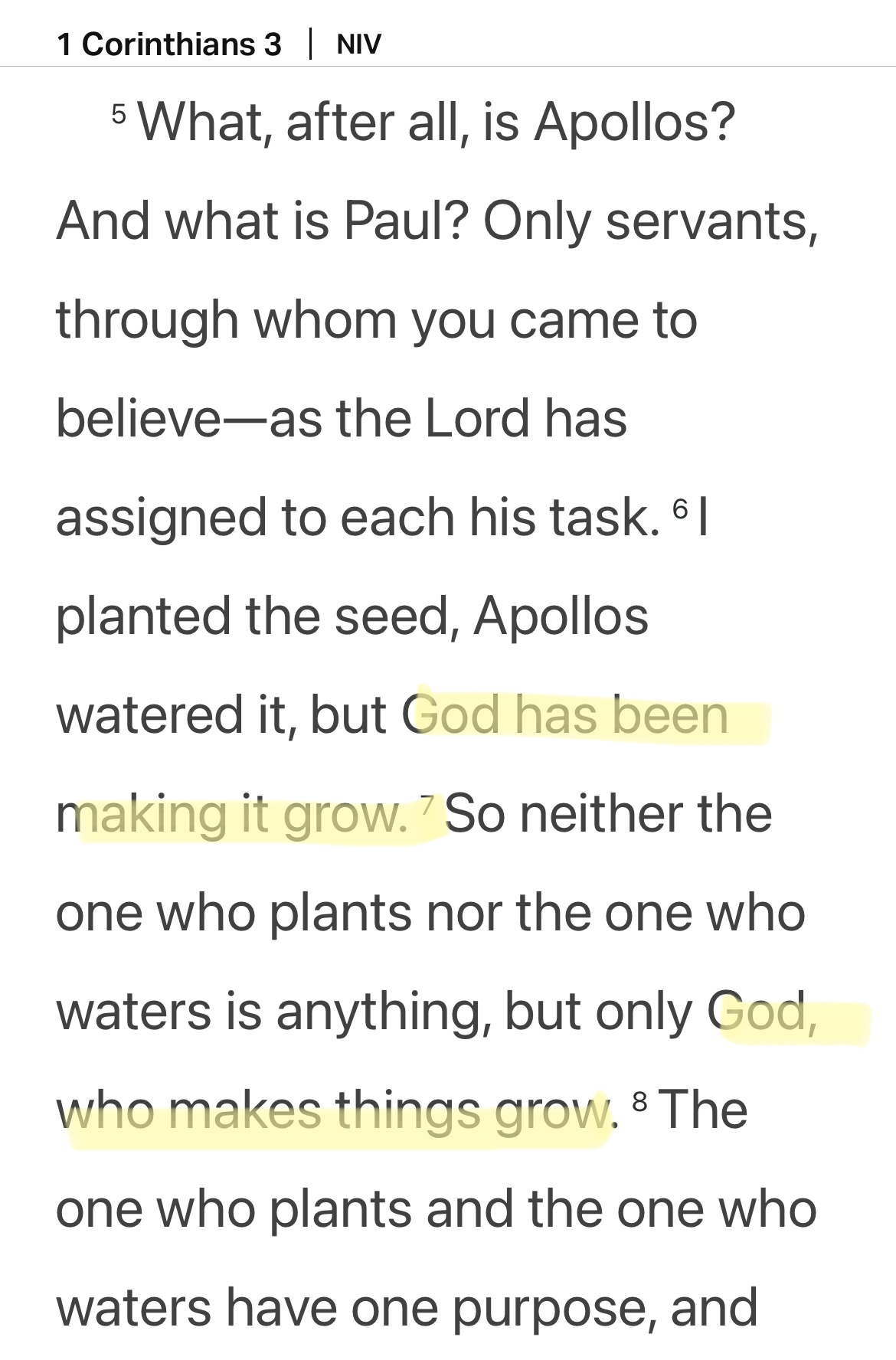
My bigger concern is when we try to use bigger numbers as the sole gauge of success. In a training time I had with some ministry interns, we took a deep dive into the reasons why the metric of bigger and ever-increasing numbers became the sole measurement for success in our churches. During this training time, I took these interns to Paul’s teaching in 1 Corinthians and two Old Testament examples where people got this wrong. Take a listen…










 Craig T. Owens