Money & Hammers

Money checklistHammers are very similar to money. Don’t believe me? Just take a look at some of the things they have in common. They both…

  1. …are tools.
  2. …can be used to build up or destroy.
  3. …are amoral.
  4. …don’t have any power until they’re in a person’s hand.

I realize in church circles it can make people uncomfortable to talk about money, but it shouldn’t be that way. The Bible is very clear in saying wealth comes from God, as well as how to use that wealth, so why should that be uncomfortable? Here are some of the things the Bible says about wealth:

  • If we honor God, He blesses our work (Proverbs 3:9-10).
  • If we take the glory for our success, God calls us “foolish” (Luke 12:16-21).
  • Money can be used to build God’s kingdom (Acts 4:34-37) or to build our own reputations (Acts 5:1-11).
  • Making the pursuit of money our priority becomes an idol (Luke 16:10-13).
  • The anxiety over money can choke our spiritual life (Matthew 13:22).
  • God gives us the ability to work, to make money, and to enjoy both the work and the rewards of work (Ecclesiastes 5:19).
  • God alone judges our attitude toward money (Luke 16:15).

It’s not money that is immoral, but our pursuit of Money (with a capital “M” or what the Bible calls Mammon) that is immoral.

It’s not money that will ruin us, but our trust in money that will ruin us.

It’s not money that gives us a secure future, but God Who richly provides us with everything for our enjoyment (1 Timothy 6:17).

Don’t envy people with more money than you. Don’t look down on people with less money than you. Don’t—as Jesus said to the Pharisees—justify your opinions and attitudes about money.

Only an honest listening to the Holy Spirit about your attitude and lifestyle concerning money is what can keep us from letting money rob us of God’s blessing.


Links & Quotes

link quote

Some great reading I came across today.

I am so blessed to work at the En Gedi Youth Center every day. Here’s a great article on the youth center in Mlive.

[INFOGRAPHIC] Where Did Your Tax Money Go?

“Are you becoming more sweet-spirited, more like Jesus? Are you looking soberly in the mirror each day and praying, ‘Lord, I want to conform to Your image in every area of my life’? Or has your bitterness taken root, turning into rebellion and hardness of heart? Have you learned to shield yourself from the convicting voice of God’s Spirit?” —David Wilkerson

“Prayer at its holiest moment is the entering into God to a place of such blessed union as makes miracles seem tame and remarkable answers to prayer appear something very far short of wonderful by comparison.” —A.W. Tozer

“I find that when I think I am asking God to forgive me I am often in reality (unless I watch myself very carefully) asking Him to do something quite different. I am asking Him not to forgive me but to excuse me. But there is all the difference in the world between forgiving and excusing.” —C.S. Lewis

Correcting The Pantheist

C.S. Lewis at his deskI recently re-read C.S. Lewis’ book Miracles (you can read my full book review by clicking here). As you may have noticed, after reading and reviewing books on this blog, I also like to share some quotes that caught my attention. Doing this with Lewis is difficult, because in order to get the context of a particular quote, I think I would have to cite almost a full page or more. So over the next few weeks I plan to share some quotes from Miracles that require not as much context, or I will provide a bit of background to set the stage.

Democritus was a Greek philosopher who proposed the universe was made up of invisible atoms and empty space. The atoms perpetually bounced around and sometimes connected with other atoms to form our tangible universe. Erwin Schrödinger put a ‘concreteness’ or ‘definiteness’ to the atomic theories previous held. In other words, Democritus saw an almost pantheistic, indescribable vagueness about Nature, whereas Schrödinger gave it definition. Lewis says that Christians need to put Monotheistic definitions on Nature and Supernature. 

“At every point Christianity has to correct the natural expectations of the Pantheist and offer something more difficult, just as Schrödinger has to correct Democritus. At every moment he has to multiply distinctions and rule out false analogies. He has to substitute the mappings of something that has a positive, concrete, and highly articulated character for the formless generalities in which Pantheism is at home.” 

 “If God is the ultimate source of all concrete, individual things and events, then God Himself must be concrete, and individual in the highest degree. Unless the origin of all other things were itself concrete and individual, nothing else could be so; for there is no conceivable means whereby what is abstract or general could itself produce concrete reality. Bookkeeping, continued to all eternity, could never produce one farthing. Metre, of itself, could never produce a poem. Bookkeeping needs something else (namely, real money put into the account) and metre needs something else (real words, fed into it by a poet) before any income or any poem can exist. If anything is to exist at all, then the Original Thing must be, not a principal nor a generality, much less an ‘ideal’ or a ‘value,’ but an utterly concrete fact.”

For more quotes from this book, check out Miracle Or “Cheating”? and Miracles And Nature.

Book Reviews From 2013

BookshelfHere are the books I read and reviewed in 2013. Click a title to read the review…

10 People Every Christian Should Know

A Harmony Of The Gospels

Alive To Wonder

All In

Alone

Altar Ego

Andrew Murray Daily Reader

Dear Abba

Decision Points

Did The Resurrection Happen … Really?

Draw The Circle

Fight

Firsthand

Francis

God’s Favorite Place On Earth

God’s Workmanship

Habitudes

He Shall Glorify Me

I Never Thought I’d See The Day

If Thou Wilt Be Perfect

If Ye Shall Ask

It Is Finished

Jesus Is _____.

Jesus: A Theography

Knocking At God’s Door

Love To The Uttermost

One Year Book Of Personal Prayer

Outliers

Plastic Donuts

Pouring Holy Water On Strange Fire

Promotion

Raising Your Child To Love God

Seven Men

Smith Wigglesworth On Healing

Sometimes You Win, Sometimes You Learn

Stopping Words That Hurt

The 13th Resolution

The Baptism With The Holy Spirit

The Bare Facts

The Five Levels Of Leadership

The Highest Good

The Hobbit

The Man Who Knew Too Much

The Purpose Of Christmas

The Ragamuffin Gospel

The Reagan Diaries

The Secrets Of Intercessory Prayer

Things We Couldn’t Say

Understanding Sexting

Unfinished

Unstoppable

Visioneering

Who Do You Think You Are?

You Don’t Need A Title To Be A Leader

For my book reviews of 2011 click here, and for 2012’s list click here.

Money And The Church

Unfortunately, far too many financial scandals have tainted the church, and therefore any pastor who mentions tithes or offerings or missions support is usually viewed skeptically.

So sad! Especially because it should NEVER be this way!

The Apostle Paul gives an excellent teaching on financial gifts for church ministry in 2 Corinthians 8-9. I love this example he gives about the Christians in the impoverished area of Macedonia—

Out of the most severe trial, their overflowing joy and their extreme poverty welled up in rich generosity. (2 Corinthians 8:3)

Severe trial … extreme poverty rich generosity…. Want to see this in a modern-day setting? Check out this video:

Wow!! If the homeless can give like that, why can’t we?

Here are some principles Paul lists about giving:

  • Give because God compels you, not because a man compels you (2 Corinthians 8:3-4)
  • Give yourself to God before you give your income (8:5)
  • Give excellently (8:7)
  • Give sincerely (8:8)
  • Give like Jesus gave (8:9)
  • Give what you say you’re going to give, and do it quickly (8:10-15)
  • Give where there is proper accountability and proven credibility (8:16-24)
  • Give generously (9:1-6)
  • Give cheerfully (9:7)
  • Give where God is glorified (9:8-15)

Giving according to these principles removes the taint of anything shady, and puts the focus on God.

The Treasure Principle (book review)

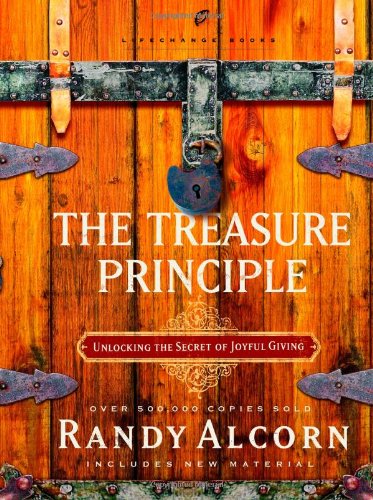
One of the knocks I often hear about the church is that we talk too much about money. I don’t feel that’s an accurate assessment, especially considering that Jesus talked about money and possessions more than He did about Heaven and Hell. In The Treasure Principle: Unlocking The Secret Of Joyful Giving, Randy Alcorn shares the keys that Jesus taught about this important topic.

In just the first few pages, Randy sets the stage for this book by stating:

“Why did Jesus put such an emphasis on money and possessions? Because there’s a fundamental connection between our spiritual lives and how we think about and handle money. We may try to divorce our faith and our finances, but God sees them as inseparable.”

The Treasure Principle mixes biblical instruction on handling our money, Randy’s insights into those scriptures, as well as Randy’s own personal experiences with finances. These are all used to support six treasure principle keys.

One of my favorite parts of the book comes at the very end. Randy shares “31 Radical, Liberating Questions To Ask God About Your Giving.” This is where the rubber meets the road (or the principles meet the pocketbook!). This is setup for you to read one question daily for a month, to really allow God to speak to you through His Word and through this book about your financial perspectives and practices. I thoroughly enjoyed the book, and I’m looking forward to continuing my month-long journey through these radical questions.

I am a Multnomah book reviewer.

Mammon

It’s a funny-sounding word, but it has deadly consequences!

Jesus said we cannot serve both God and mammon (Luke 16:13 KJV). That word mammon had no direct translation in the English language, so the translators of the King James Version of the Bible simply did a transliteration: they took the Greek word and carried the same word into English. The translators of the New International Version did something different with this word: they made it Money, with a capital M.

The idea behind this word is placing our trust or reliance in anything except God. For us, the means of our security and basic living needs seems to be money, so Money (with a capital M) seems like an appropriate way to translate mammon.

Jesus recommended giving an offering—above and beyond our tithe—as a way to defeat the Mammon Monster. Giving our tithe is simply obedience to God’s commands. But giving our offering shows our trust in God’s provision.

Giving an offering to God is counterintuitive.

After all, less money is less than more money! If I receive money, I tend to hang on to it. I tell myself, “This might come in handy if the economy nosedives, or if something unexpected comes up.” When I start thinking this way, I start to make money Mammon, because I see money as my provider, instead of God.

What an appropriate way to wrap up our Live Dead series yesterday, as we made faith promises to God. We said, “God, I believe You will provide the amount of money I should give as an offering. And when You do provide, I promise to give it.” Placing my trust in God not only helps me to live dead to the pull of Mammon, but also Jesus promised—

Give, and it will be given to you. A good measure, pressed down, shaken together and running over, will be poured into your lap. For with the measure you use, it will be measured to you. (Luke 6:38)

I don’t give to get. I give because I trust God to provide.

P.S. By the way, all of the offerings that come in as a result of these faith promises will be going directly to missions. Calvary Assembly of God will not be keeping one cent of these faith promise offerings.

If you’ve missed any messages in our series called Live Dead, you can find them all by clicking here.

Even Before You Ask

A couple of weeks ago a lady in our church asked me to pray for a need in her life. She is a single Mom, as well as a caregiver for her bed-bound grandmother, which means money is tight.

She knew her car needed some repairs, so she took the car to the mechanic on Thursday afternoon. His initial estimate was $400. On Sunday we prayed about this, and joined our faith that God would either provide the funds, or provide another way for her car to be repaired.

Here’s a powerful verse of Scripture—

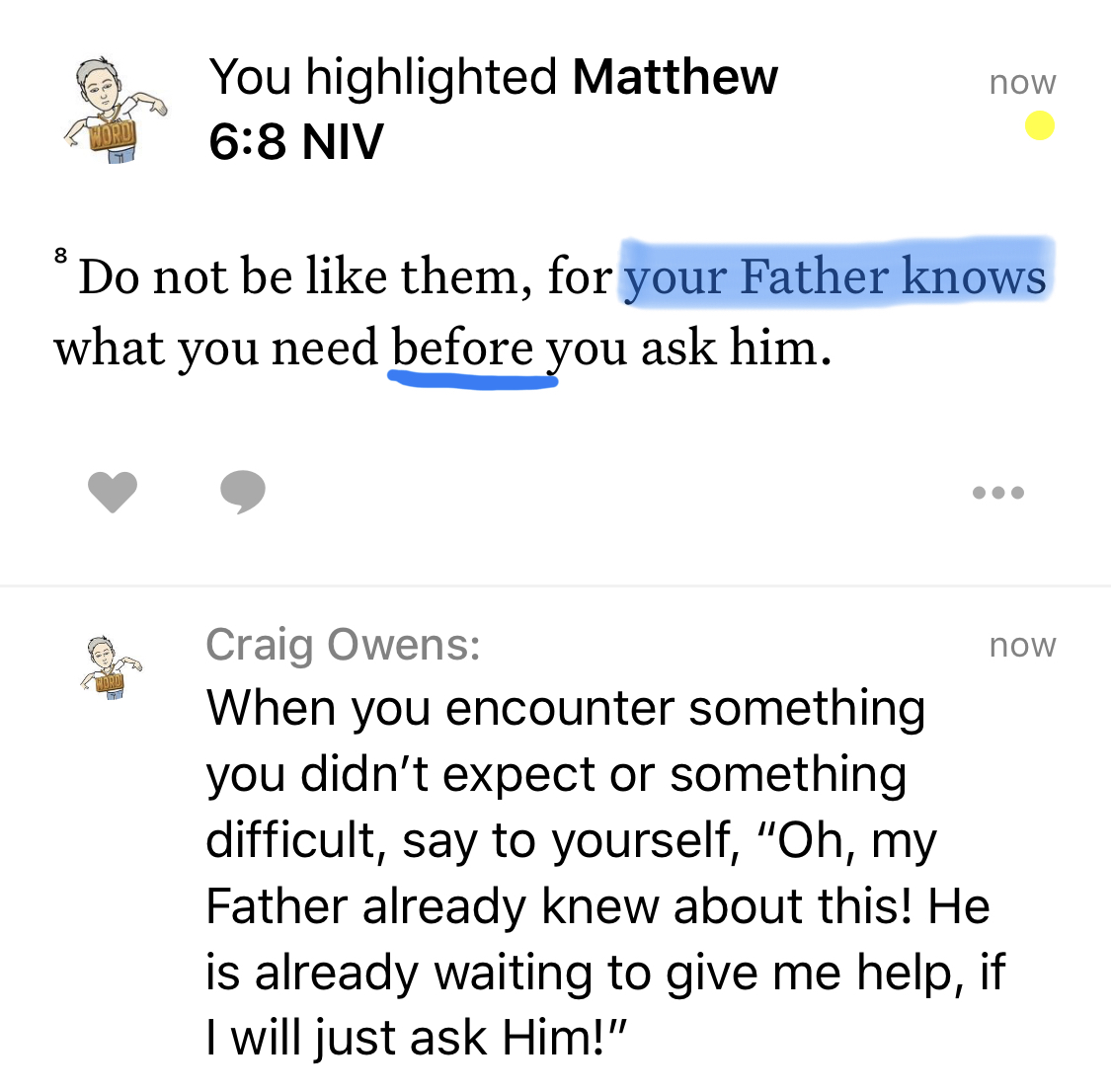
…Your Father knows exactly what you need even before you ask Him! (Matthew 6:8)

This lady returned to her mechanic the next day, and he told her the repairs had been completed. But the repairs were not as extensive as he originally thought, so the bill was only $105.

Now, here’s the best part—on Thursday, this lady had looked at her financial situation and had set aside all the money she could afford for this repair: $125!

So not only did God provide for her even before she asked, but she even gave the mechanic a $20 tip!

I love the fact that God knows what we need even before we ask Him!

What God Do You Tru$t?

Listen to the podcast of this post by clicking on the player below, and you can also subscribe on AppleSpotify, or Audible.

Things seem to be going very, very well for Israel! Check out what Isaiah wrote:

Their land is full of silver and gold; there is no end to their treasures. Their land is full of horses; there is no end to their chariots.

Sounds like a success story to me!

But wait: the next verse sounds a bit ominous:

Their land is full of idols; the people worship things they have made with their own hands.

Money? Yes.

Influence? Lots.

Prosperity? For everyone.

Idolatry? Widespread.

They were no longer looking to God, but they were looking to what they had made with their own hands. In other words, they made Money their god.

Money can save us!

Money can fix all our problems!

Without Money we are lost!

Only those with Money can be saved!

Sadly, I believe what was said of Israel 2500 years ago could be said of the United States of America today. In God We Trust is printed on all our currency, but it really has become In Money We Trust. We have made Money our god.

Don’t believe me? How do you think most people would answer these fill-in-the-blanks:

  • I need _____________ to get clothes.
  • Without _____________ I cannot feed my family.
  • If I lost _____________ today I would be devastated.
  • I frequently think about how more _____________ in my life would make my life better.

But check out what Jesus says about clothes, food, and our means of survival.

What should go in the blank: Money or God? Again, let’s let Jesus have the final word: “No one can serve two masters. Either you will hate the one and love the other, or you will be devoted to the one and despise the other. You cannot serve both God and money” (Luke 16:13).

►► Would you please prayerfully consider supporting this ministry? ◀︎◀︎

Is Your Integrity Worth $12 Million

My wife alerted me to this almost unbelievable story this morning. Gil Meche, a pitcher for the Kansas City Royals baseball team, is walking away from the final year of his contract with the team.

He’s walking away from $12 million.

Why? Because Gil Meche is a man of integrity. He signed a contract to pitch for the Royals, but due to his injuries, he doesn’t think he can live up to his end of the bargain. I especially liked this part of the article:

“A lot of people might think I’m crazy for not trying to play and make this amount of money,” he said, “[but] I don’t think I’m going to regret it.”

This would have been the final season under the five-year, $55 million contract he signed with the Royals prior to the 2007 season. Health issues, with his back and then with his shoulder, plagued him the last two seasons.

I didn’t want to go try it again for another season and be the guy making $12 million and doing absolutely nothing to help this team,” he said.

There is no settlement, no nothing for Meche as he walks away from the guaranteed money.

“I think it really reaffirms and validates why we signed Gil Meche—the integrity and the class and the respect that he’s displaying,” Royals general manager Dayton Moore said.

What price can you put on integrity?

Or as Jesus asked, “And what do you benefit if you gain the whole world but lose your own soul?”

Thanks, Gil, for showing the world that integrity is worth even more than $12 million.