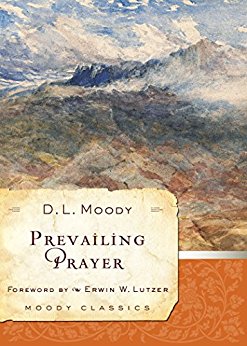
13 Quotes From “Prevailing Prayer”

prevailing-prayerD.L. Moody challenges all Christians to stick with prayer a little longer. Far too many of us give up too soon, and miss out on the miracle God wants to do. Check out my review of Prevailing Prayer by clicking here.

“The two first and essential means of grace are the Word of God and Prayer. … If we read the Word and do not pray, we may become puffed up with knowledge, without the love that buildeth up. If we pray without reading the Word, we shall be ignorant of the mind and will of God, and become mystical and fanatical, and liable to be blown about by every wind of doctrine.”

“The reason we so often fail in moving our fellowmen is that we try to win them without first getting power with God. Jesus was in communion with His Father, and so He could be assured that His prayers were heard.”

“It is not by eloquent sermons that perishing souls are going to be reached; we need the power of God in order that the blessing may come down.”

“Our Master’s prayers were short when offered in public; when He was alone with God that was a different thing, and He could spend the whole night in communion with His Father. My experience is that those who pray most in their closets generally make short prayers in public.”

“In Proverbs 28:9 we read, ‘He that turneth away his ear from hearing the law, even his prayer shall be abomination.’ Think of that! It may shock some of us to think that our prayers are an abomination to God, yet if any are living in known sin, this is what God’s Word says about them.” 

“There is a great deal more said in the Bible about praise than prayer; yet how few praise-meetings there are! David, in his Psalms, always mixes praise with prayer. Solomon prevailed much with God in prayer at the dedication of the temple; but it was the voice of praise which brought down the glory that filled the house. … However great our difficulties, or deep even our sorrows, there is room for thankfulness.”

“Even if nothing else called for thankfulness, it would always be an ample cause for it that Jesus Christ loved us, and gave Himself for us.”

“When the church, the pulpit, and the pew get united, and God’s people are all of one mind, Christianity is like a red-hot ball rolling over the earth, and all the hosts of death and hell cannot stand before it.”

“We are not told that Jesus ever taught His disciples how to preach, but He taught them how to pray. He wanted them to have power with God; then He knew they would have power with man.” 

“It is not the most beautiful or the most eloquent language that brings down the answer; it is the cry that goes up from a burdened heart.”

“Some people think God does not like to be troubled with our constant coming and asking. The only way to trouble God is not to come at all. He encourages us to come to Him repeatedly, and press our claims.”

“The Lord delights in hearing His children make their requests known unto Him—telling their troubles all out to Him; and then we should wait for His time.”

“Let our prayer be that God may advance His work, not for our glory—not for our sake—but for the sake of His beloved Son whom He hath sent.”
Little Is Not Insignificant

gods-promise-to-youPastor Phillips Brooks visited Israel in the mid-1800s. While there he visited a small church just outside of Bethlehem. Listening to the worshipful songs being sung in that quiet countryside, he was inspired to pen the words to O Little Town Of Bethlehem.

Because of that quiet setting, notice how Rev. Brooks notices things we often miss—

  • little town on Bethlehem
  • in thy dark streets
  • while mortals sleep
  • no ear may hear His coming

But little does not mean insignificant. And just because we can’t see or hear something doesn’t mean it doesn’t exist or it isn’t important.

Sometimes we’ve looked and listened and waited and searched for so long that we have given up and we begin to drift off to sleep. We continue to live in our own “little town” surrounded by silence. And we are in danger of missing a miracle right in our midst!

We know today that Jesus was born in Bethlehem. But did you know that this little town was still so obscure in Christ’s day that many people in Israel were unaware of what went on there? (See John 7:41-43). Even after King Herod had gruesomely killed all the baby boys in Bethlehem, scarcely anyone outside of that town knew about it or cared about it.

But God cared. And He knew exactly what He was doing.

But when the proper time had fully come, God sent His Son (Galatians 4:4)—the exact right moment—to be born in Bethlehem—the exact right place (Micah 5:2). Notice even Micah says of Bethlehem though you are small among the clans of Judah, giving birth to the title of Rev. Brooks’ poem.

How small was it? Look at the description of the territory for the tribe of Judah (in Joshua 15), and you can easily glossed over the names of all of the towns. But look more closely and you will see something you didn’t read in that list of towns. Take a close look at all 38 cities: it’s still missing.

There are a couple of very notable figures that dominate the Old and New Testaments, and they have something in common—King David and Jesus both come from the tribe of Judah. And both of them were born in Bethlehem. But in the list of towns in Judah’s territory, there is absolutely no mention of Bethlehem.

This town either didn’t exist, or it was so “insignificant” that Joshua didn’t even think to mention it. It would be almost another 500 years before David would be born in Bethlehem, and then another 900 years after that before Jesus would be born in this little town of Bethlehem.

God had in mind for the greatest earthly king in Israel’s history and the King of all kings to come from such humble origins… from a village that didn’t even make the list. Bethlehem was ready for these kings at just the right moment!

Jesus said heaven and earth will pass away, but His words will never pass away. What promise in His Word do you need to cling to? 

Just as those awaiting the Messiah clung to Micah’s promise until it came to pass, you must find God’s promise for you in His Word, cling to it, and don’t let go until it comes to pass in your little town.

If you’ve missed any of the messages in our series The Carols Of Christmas, you can find the full list here.

5 Key Parts To A Synergy Relationship

img_1970King David of Israel was a stud! Outstanding song writer, professional shepherd, bear killer, lion killer, giant killer, decorated army general, and ultimately king of Israel.

Near the end of his life we read an extensive list of Mighty Men that supported David. Some of these guys were also giant killers. One guy singlehandedly defeated 300 enemies, another guy defeated 800 bad guys, one guy killed a lion, and on and on the list goes.

I believe it is clear that David wouldn’t have become king without the support of his Mighty Men, and these guys probably wouldn’t have been recognized as “Mighty Men” without David’s support.

This is a classic definition of synergy. Synergy is when the outcome is so much greater than just the addition of the parts. Sort of like 1 + 1 = 5.

All of us can be a part of synergistic relationships, if we will include these five key parts.

[1] Humility

Without humility, you will never let anyone else into your life, and it’s doubtful they will let you in. Humility says, “I don’t have all the answers. I need some help in fulfilling my God-given dream. I have some areas of weakness where you are strong.”

[2] Confidence

Just like humility, without confidence it’s doubtful others would allow you access to their lives. Confidence says, “I have some something I am willing to offer you. I have a God-given strength in an area where you may be struggling.” The Apostle Paul said, all of us have strengths that God has given us that are to be used to help others (1 Corinthians 12:7; Ephesians 4:7).

[3] Collaboration

Quite simply, in order for synergy to work, the people in the relationship have to be willing to labor together. Paul used the example of one person planting the seed and another person watering the seed. Both laborers are necessary if there is going to be a harvest.

[4] Patience

The journey with others may be slower and messier than traveling solo, but it’s so much more rewarding (see Ecclesiastes 4:9-12).

[5] Investment

Synergy is really about there being a return on investment. But if you’re not willing to invest your time, your learning, your love, can you really expect there to be a synergistic return?

I just wrapped up a year-long investment with a group of guys from my church. What an amazing time! I am definitely better for having been involved with this synergy group, and I believe all of the other guys would tell you the same thing. You, too, can experience this same joy by investing in a synergy group of your own!

#MOWT

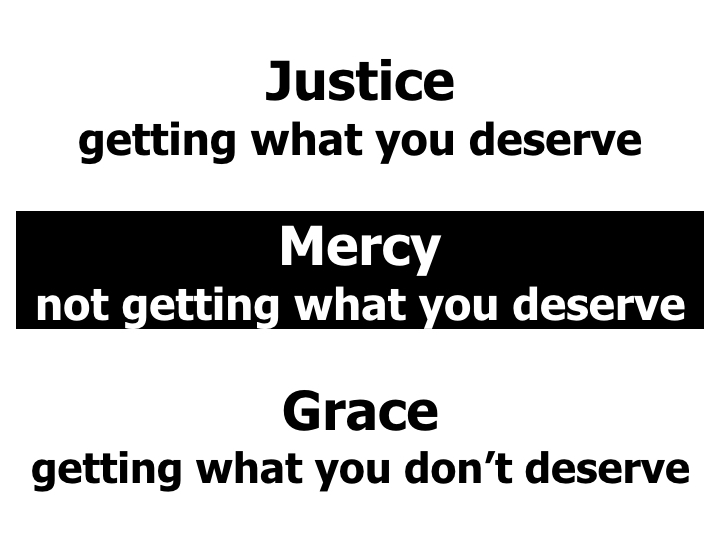
justice-mercy-graceLast week I blogged about justice, mercy, and grace. Justice is getting the penalty we deserve, mercy is not getting the penalty we deserve, and grace is getting blessings we don’t deserve.

If we are truly grace-full people, then we should be thank-full people as well. As we approach Thanksgiving Day, people are naturally thinking about things for which they can give thanks during this past year. But Christians should be the most full-of-thanks people on the planet, because we have been showered with so much grace! 

I’d like us to think about a word that I believe will increase our level of thankfulness: Appreciation. Appreciation goes beyond merely being thankful for blessings, as it sees the high value in those blessings, and then continually looks for ways to express even more gratitude for them. In other words, appreciation can begin a cycle of gratitude that grows and grows and GROWS!

Check out three parts to the definition of appreciation

[1] Gratitude; thankful recognition. Did you know that being grateful is actually good for you? Research has shown that increasing your gratitude levels increases your:

  • Physical health. “A state of gratitude, according to research by the Institute of HeartMath, also improves the heart’s rhythmic functioning, which helps us to reduce stress, think more clearly under pressure and heal physically. It’s actually physiologically impossible to be stressed and thankful at the same time” —Jon Gordon
  • Emotional health. Dr. Robert Emmons says gratitude decreases envy, resentment, and feelings of retaliation; and increases empathy, emotional resilience, and self-esteem.
  • Spiritual health. Notice how ingratitude is included in the list of a whole lot of ugliness (2 Timothy 3:1-4), but spiritual health is restored simply by being thankful (Ephesians 5:3-4).

[2] Estimating qualities and giving them their proper value. In order to determine value, we must have a standard of comparison. What’s your standard? Is it what your neighbor has? Is it what you don’t have? Or is it thankfulness for what God has given you? 

Max Lucado said, “To reflect on your blessings is to rehearse God’s accomplishments. To rehearse His accomplishments is to discover His heart. Gratitude always leaves us looking at God and away from dread.”

[3] Assessing the true worth of our blessings. Assessing leads to appreciation, and appreciation begins to give us a return on investment. I like how Jeff Anderson says it: “If you want to grow your faith, grow your gratitude. To grow your gratitude, take time to count your blessings.”

Remember: gratitude isn’t gratitude if it isn’t expressed. David made his gratitude known, and other afflicted people around him began to join with him in thanking God for His blessings (see Psalm 34:1-3). In other words, David’s thanksgiving went viral!

mowtHere’s how we can make our gratitude go viral: #MOWT. Let’s count our blessings every day, and let’s appreciate what God has done for us. Then let’s share our gratitude not only with God, but with others as well. Post it on Facebook or Twitter or Instagram with #MOWT: my one word thanks. Maybe include a photo and “family” #MOWT, or “protection” #MOWT, or even “paycheck” #MOWT.

Let’s give God so much glory for His grace gifts, that we tell the world about our appreciation!

12 More Quotes From “Chase The Lion”

chase-the-lionI loved Chase The Lion by Mark Batterson! If this book doesn’t inspire you to do great things for God, I’m not sure what will. Be sure to check out my review of this book by clicking here, and then enjoy some more quotes from this amazing book.

“You may doubt yourself because of your lack of education or lack of experience. But if God has called you, you aren’t really doubting yourself. You’re doubting God. God doesn’t call the qualified. God qualifies the called.”

“An opportunity isn’t an opportunity if you have to compromise your integrity. It’s the decisions when no one is looking that will dictate your destiny. In fact, your integrity is your destiny! Killing Goliath was an epic act of bravery. Not killing Saul was an epic act of integrity.”

“One of the most important decisions you make every single day is what time you set your alarm to go off.”

“God doesn’t promise us happily ever after. He promises so much more than that—happily forever after.”

“In God’s kingdom the outcome isn’t the issue. Success isn’t winning or losing; it’s obeying. … In God’s book success is spelled stewardship. It’s making the most of the time, talent, and treasure God has given you. It’s doing the best you can with what you have, where you are.”

“Just as courage is not the absence of fear, success is not the absence of failure. Failure is a necessary step in every dream journey.”

“Fighters don’t walk away when the going gets tough; they fight to the finish for their convictions. Fighters don’t give up when everyone is against them; they fight against the status quo. And fighters don’t shrink back when the odds are against them; they fight for what they believe in.”

“It’s okay to talk to God about your problems, but at some point you have to flip the script. You need to talk to your problems about God.”

“Valor is less an action and more a reaction. If you judge a person by his or her actions, you’re judging a book by its cover. Reactions are far more revealing than actions. How you react in difficult circumstances is the litmus test of character. And you never really know how you’ll react until you’re the one who crosses paths with a lion. Valor is running toward trouble when everyone else is running away. Valor is going above and beyond the call of duty. Valor is putting yourself in the line of fire for someone else.”

“You know why some of us have never killed the giant, chased the lion, or walked on water? We’re afraid of looking foolish. But it’s the fear of looking foolish that is foolish!”

“Sometimes the circumstances we’re trying to change are the very circumstances God is using to change us. … Instead of expending all your energy trying to get out of them, get something out of them.”

“Don’t be in such a hurry to begin the next chapter of your life that you fail to ace the lessons the current chapter is trying to teach you.”

You can check out the first set of quotes I shared from Chase The Lion by clicking here. And be sure to follow me on Tumblr and Twitter, where I daily share quotes from all sorts of inspirational authors.

Chase The Lion (book review)

chase-the-lionThere is always something about a Mark Batterson book that motivates me to do even bigger things. But Chase The Lion took that to a whole new level!

Chase The Lion is sort of the sequel to In A Pit With A Lion On A Snowy Day. In the first book, Batterson looked at the life of Benaiah, who was a lion killer. In Chase The Lion, we go deeper into Benaiah’s motivation. What motivates a man to run toward the roar? Is he a unique individual, or can others do what he did?

Pastor Batterson then broadens his circles by looking at the other Mighty Men who, along with Benaiah, were attracted to King David. What brought these courageous warriors together? What kept them together? What were they fighting for?

Then skillfully Mark weaves together his own lion-chasing journey, with other historic characters, as well as those mighty men surrounding King David. Time and time again Mark challenged me to be disenchanted with the status quo, to dream bigger dreams, to try more courageous things, to see that my life is not just lived for me. The life I live is made possible by other lion-chasers who came before me, and the way I live my life will make it possible for still more lion-chasers to follow my example.

Before getting to chapter one I read “The Lion Chaser’s Manifesto” and I was already fired up to read and learn more. The rest of the book was chapter after chapter of new inspiration and encouragement.

What an amazing book! I can’t recommend Chase The Lion enough to anyone who wants to do great things, and leave a legacy of greatness for generations to come.

I am a Multnomah book reviewer.

How To Escape Your Fears

Jesus is ChampionFear is crippling. Fear robs us of seizing opportunities. Fear cuts short the abundant life God desires for us to have. One definition of fear captures it well: F.E.A.R is False Evidence Appearing Real.

Oversized fears can turn into what psychologists call phobias. One website actually lists 543 unique phobias!

Where does this fear come from? Why are so many plagued by fears?

I believe the answer is found in this: fearful people aren’t looking far enough ahead. They are looking at their fears, and not the Champion of their fears.

King David knew what it was to have assassins stalking him, to be on the run for his life, to not know if someone was a friend or foe, to not even know where he was going to sleep at night. So he begins his second song of ascent with this thought: “If the Lord had not been on our side, here’s a list of really bad things that would have happened to us.”

Notice the “if” statements. David is not saying “if there were no God,” of “if God didn’t care for us.” In other words, David is clearly saying that God exists, and that God is for us!

I like this—Oh, blessed be God! He didn’t go off and leave us. He didn’t abandon us defenseless, helpless as a rabbit in a pack of snarling dogs (v. 6, in The Message).

David is not telling us how to escape our fears, but to begin celebrating that we have already been freed from our fears! 

We seem to think that satan and Jesus are still duking it out, that the outcome of the struggle is still up for grabs. I’ve got fantastic news: Jesus already won! He is already the Champion!!

We’ve flown free from their fangs, free of their traps, free as a bird. Their grip is broken; we’re free as a bird in flight (v. 7, The Message).

Speaking of birds flying free, J.B. Figgis wrote, “Do you find yourself asking, ‘But am I to step out onto nothing?’ That is exactly what the bird is seemingly asked to do, yet we know that the air is there and that the air is not nearly as insubstantial as it seems. And you know that the promises of God are there, and they certainly are not insubstantial at all” (emphasis added).

What fears plague you? Jesus has already set you free from that. The battle has already been won. You just need to find the promise of God in the Bible that tells you how He has canceled that fear.

Now begin to swing that promise like a sword at your fear every time it raises its ugly head! Stop being crippled by your fear, and lift your eyes up to the Maker of heaven and earth who has set you free!

Check out my full message on this song of ascent:

If you’ve missed any of the messages in this series, you can access the complete list by clicking here

5 Blessings You Should Expect From Your Church Experience

Place of peaceKing David loved God, and he loved God’s people. He was passionate about everyone getting as deeply connected with God as he was, so he wrote worship songs, setup worship teams, and organized the temple for worshippers.

The first song of ascent he wrote was one anticipating how good it was going to be when everyone got to the temple in Jerusalem to worship.

In fact, David was so excited about what he was expecting to happen in their worship together that he practically glowed with joy! Really! The word for rejoiced in his song means to be so cheerful and happy that you make others around you bright by your happiness. 😀

What was it that David thought was going to happen? First of all, we need to look at the name Jerusalem. Traditionally this means the City of Peace, but the two words that make up “Jerusalem” are much richer than that. Yes, -salem means “peace.” But the first part of the word (yara-) literally means water flowing through, or an arrow being shot out.

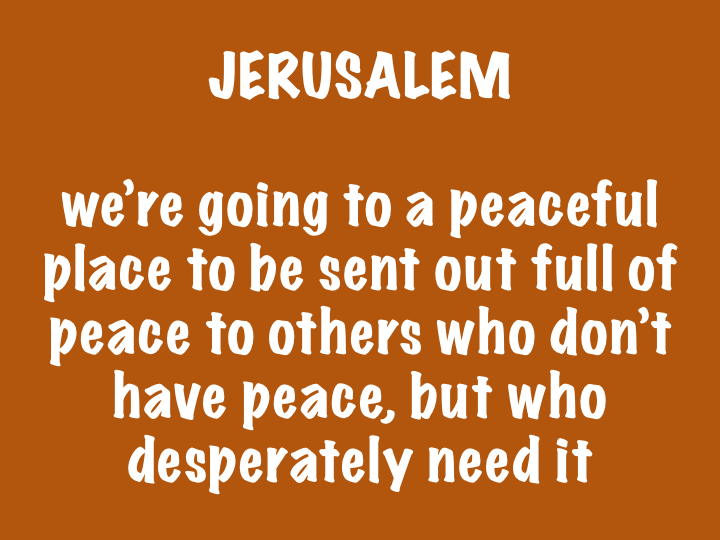
In other words, David anticipated that we are going to a peaceful place to be sent out full of peace, to take that peace to others who don’t have it, but desperately need it.

While we are in our “Jerusalem” (for us in the New Testament, this is our “church,” even if it’s just two or three people getting together), here are five blessings you should expect—

  1. Unity—with all the “tribes” joining together.
  2. Praise—joining together to tell God how great He is!
  3. Learning—we come together to learn God’s statutes.
  4. Judgment—what?! How is judgment a blessing? If you are nervous about being judged, just remember Who does the judging in God’s temple: the Holy Spirit. He judges us in a loving way, and in a way that allows us an opportunity to see our sin, repent from it, and experience unconditional forgiveness. That is exciting!
  5. Peace, security, prosperity—the word shalom is used multiple times in the closing verses of this song. The best definition of shalom is: nothing missing, nothing broken. In other words, when we gather together to worship we should expect that God will heal any dis-ease we have, that He will supply what has fallen short, that He will fill up what’s empty.

With those five blessings in mind, here’s the declaration all Christians can make—

Inside these walls…
we live in unity
we praise the Lord
we learn God’s laws
we judge ourselves by God’s standards
repenting, confessing, forgiving, and being forgiven
we fight for peace
we bless God and one another
We descend back to the valleys
to take this message to valley-dwellers
that they, too, may pilgrimage
with us to Jerusalem
It starts here in God’s family!
It starts with me!


Check out the full video of this message, where I explain each of these ideas more fully. And if you’re in the area, join us on Sunday as we continue our look at the Psalms of Ascent.

If you’ve missed any of the messages in this series, you can access the complete list by clicking here

6 Quotes On Mourning From “The Blessing Of Humility”

The Blessing Of HumilityAs I stated in my review of Jerry Bridges’ book The Blessing Of Humility, reading through these thoughts slowly—Beatitude by Beatitude—would bring about the most life-changing impact. In that spirit, I will be sharing some noteworthy quotes one Beatitude at a time. Here are some quotes on blessed are those who mourn (Matthew 5:4)…

“The word that Jesus used in this Beatitude is the strongest word in the Greek language for mourning. It is the word for Jacob’s morning over what he thought was the death of Joseph (Genesis 37:35). … Jesus uses this word to show the intensity of mourning He blesses here. He is, however, actually talking about mourning not over death but over our sin.”

“To be ‘poor in spirit’ is to be convicted of one’s sin, whereas to ‘mourn’ is to be contrite for it.” —John Blanchard

“King David committed two sins: first adultery, and then (essentially) murder to try to cover up his adultery. God sent the prophet Nathan to confront him, and in his skillful accusation of David, Nathan twice used the word despised (2 Samuel 12:7-11). First, David despised the Word of the Lord—that is, he despised the law of God (verse 9). In so doing, he also despised the Person of God (verse 10). Why is this true? Despising the law of God is not only an expression of rebellion. It is also a despising of His very character, since His law is a reflection of His character. This is true not only of such heinous sins as adultery and murder, but also of our more refined sins: pride, selfishness, gossip, and the like. So let us pray that God will indeed allow us to see our sin as rebellion against the rule of God—a despising of God’s law and even of His character.”

“Failure to see our sin as primarily against God is, I believe, the reason we experience so little heartfelt grief over it. … But be it ever so small in our own eyes, whenever we sin we also break God’s law. And Scripture says, ‘Whoever keeps the whole law but fails in one point has become accountable for all of it’ (James 2:10). God’s law is seamless, one complete whole. So when we break any of it, we break the whole law.”

“Is mourning over sin just for those first coming to Christ? No, Jesus’ words are in the present active tense. We could literally translate them as ‘blessed are those who continue to mourn.’ He is pronouncing a blessing on those whose attitude toward their sin is characterized by mourning. One mark of a growing Christian, then, is a growing sense of his or her sin, and an attitude of mourning over it.”

“So mourning over our sin is truly a display of humility in action. We cannot be proud and mourn over sin at the same time. We cannot be judgmental toward other believers, or even toward unbelievers, if we are truly contrite and brokenhearted over our own sin.”

I just shared quotes on blessed are the poor in spirit. Quotes on the next Beatitude will be posted soon. Stay tuned…

Links & Quotes

link quote

“Foretastes are good. Unless they become substitutes. O, don’t let all the sweet things of this season become substitutes of the final great, all-satisfying Sweetness. Let every loss and every delight send your hearts a-homing after heaven.” —John Piper

“Are you in a season of winter?  A lost job… A doctor’s report… A broken marriage? Maybe you feel stuck in winter, like Christmas may never come. As scripture says, God rewards those who diligently seek Him. So just like the wise men of the Christmas story…search for the Lord. Look for Him in the midst of your darkest nights and coldest winters. Hope may seem as distant as a star, but if the Christmas story tells us anything…God is still present. God is still working. And in this very moment, God is near.” —Max Lucado

“If there had been no prophet like Nathan—no piercing, prophetic word—David could have ended up like Saul: spiritually dead, with no Holy Ghost guidance, having lost all intimacy with God. … If you are being probed by God’s Word—if His Spirit isn’t letting you sit comfortably in your sin—then you are being shown mercy. It is the deep love of God at work, wooing you out of death and into life.” —David Wilkerson

“If regrets about yesterday’s decisions and actions help you do better work today, then they’ve served a useful purpose. … Most of the time, though, we use regrets to keep us from moving forward. They paralyze us in the face of possibility. We don’t want to do something if it reminds us of that black hole we have in our past. It’s useful if you can forgive yourself, because the regrets you’re carrying around are keeping you from holding onto the possibility that you can contribute even more tomorrow.” —Seth Godin

Live Action shares an important post: Abortion and the church—what can we do?

Nature shares some science myths that won’t die.

Ty Cobb is my all-time favorite Detroit Tiger. Here is a cool timeline of his life.

[VIDEO] Excellent word from Bobby Conway: How should a Christian vote?—