For God is not a mere man, as I am, that I should answer Him, that we should come together in court. There is no umpire between us, who might lay his hand upon us both—would that there were! That He might take His rod away from threatening me, and that the fear of Him might not terrify me. Then would I speak and not fear Him, but I am not so in myself to make me afraid, were only a fair trial given me. (Job 9:32-35 AMPC)
The “umpire” or mediator for whom Job was longing is Jesus.
Both Paul (Galatians 3:19-20; 1 Timothy 2:5) and the writer of Hebrews (8:6, 9:15, 12:24) make it clear that what Job said was true: Man cannot come before God on his own, let alone attempt to argue his case.
Listen to the podcast of this post by clicking on the player below, and you can also subscribe on Apple, Spotify, or Audible.
Last week we saw that if we make prayer our priority, we can expect that our eyes will be opened to the answers that God has for us. Hagar and Eliezer seemed to get pretty quick answers. Nehemiah had to wait four months for the answer to his prayer.
We saw in Psalm 5 that David laid his requests before God first thing in the morning, and then he went out of his prayer closet in expectation of an answer (Psalm 5:1-3). But how long did he wait?
Psalm 6 may not happen historically right after Psalm 5, but listen to David’s heart, “Have mercy on me, LORD, for I am faint; heal me, LORD, for my bones are in agony. My soul is in deep anguish. How long, LORD, how long? (Psalm 6:2-3). And then again in Psalm 13:1-3, David asks, “How long?” four times in the first two verses!
When we read the training Jesus gave His disciples about prayer in Luke 11:9-10, we see how He implores them (and us) to keep on praying. It becomes even more emphatic in the Amplified Bible—
So I say to you, ask and keep on asking and it shall be given you; seek and keep on seeking and you shall find; knock and keep on knocking and the door shall be opened to you. For everyone who asks and keeps on asking receives; and he who seeks and keeps on seeking finds; and to him who knocks and keeps on knocking, the door shall be opened.
But once again we have to ask: how long are we to continue asking, seeking, and knocking? This is what Job asked in the middle of his trial (Job 6:8, 11-13).
Charles Spurgeon said, “God has measured the crosses of all His children: Israel in Egypt, 430 years; Joseph in prison, 3 years; Judah in Babylon, 70 years.” That means that God knows what He is doing, God knows His timing for answering, and that our part is to simply to continue to ask, seek, and knock as we throw our total trust on Him!
I remember my affliction and my wandering, the bitterness and the gall.I well remember them, and my soul is downcast within me.Yet this I call to mind and therefore I have hope.Because of the LORD’s great love we are not consumed, for His compassions never fail.They are new every morning; great is Your faithfulness.I say to myself, “The LORD is my portion; therefore I will wait for Him.” (Lamentations 3:19-24)
During these times of waiting, we need to keep recalling what we know:
God’s love is unfathomable—Romans 5:5, 8:38-39
God’s timing is perfect—Deuteronomy 32:4
God’s method is flawless—Romans 8:28
God’s gifts are good—Luke 11:11-13, 12:32
In Psalms 6 & 13, David doesn’t record any answers from God, but listen to this assurance from Jesus, “Blessed are those who mourn, for they will be comforted” (Matthew 5:4).
Jesus doesn’t tell us how or when God will bring us comfort, but He does assure us that we will be comforted!
In a couple of the examples from David, you can see this assurance as he continues his prayers (Psalm 6:2-4, 8-10; 13:1-6). Paul also experienced this confidence (2 Corinthians 12:7-10), and so did Jesus (Matthew 26:38-39, 50-54).
The writer of Hebrews assures us that Jesus was heard in His, “How long?” cries, and therefore He knows exactly how to intercede for us today as we lift up the same cry (Hebrews 5:7-8; 2:10, 14, 17-18)!
How long? Quite simply stated: Until God answers or until He lifts our burden.
In the meantime, the examples in Scripture and the assurance of Christ’s intercession for us us encourages us to…
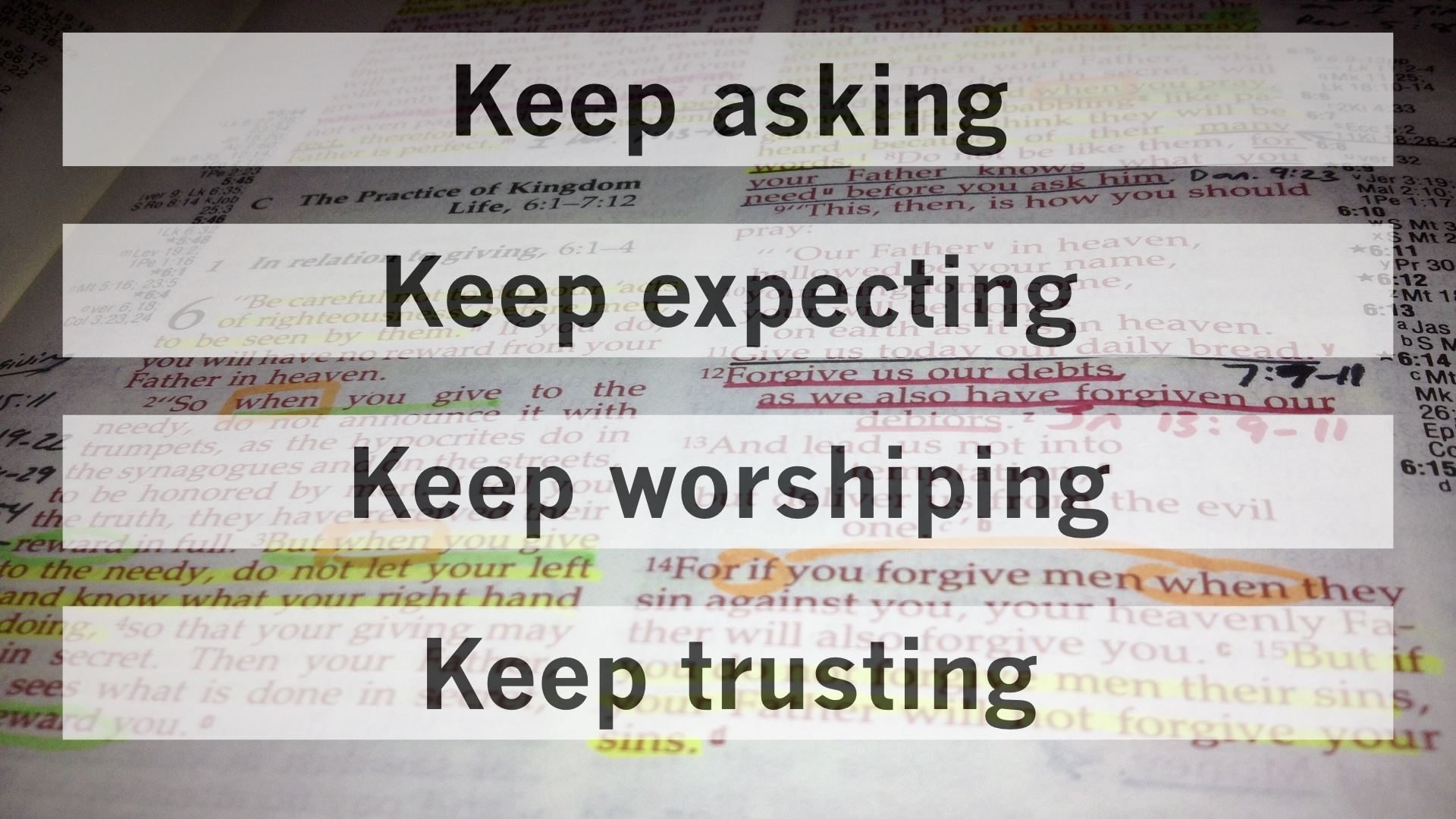
Keep asking with full confidence that God hears you
Keep expecting an answer
Keep worshiping God for Who He is
Keep trusting that your Heavenly Father wants to give you the very best!
I shared this video last week with my Patreon supporters. When we’re unclear about all that God has asked us to do, the first step is to obey the part that is clear to us. Check out my blog post Clearing up the Confusion for more insight on how Peter handled this.
I have lots of new content every week, which you can check out on my YouTube channel.
T.M. Moore calls on Christians to recognize the God-given authority our leaders have. Not just recognize, but submit to that authority: “We show that we believe the Lord and trust in His Word, and we demonstrate the evidence of that faith when we submit to our church leaders as unto the Lord (Colossians 3:23-24). Submitting to proper authorities is an integral component of full faith. If we want to gain the benefit God intends for us from those appointed to lead, we’re going to have to learn to submit.”
“Talent is never enough. With few exceptions the best players are the hardest workers.” —Earvin Magic Johnson
“Take your job seriously, but don’t take yourself too seriously.” —Alex Trebek
The American Bible Society reports that Gen Z is engaged with Scripture less than any other generation. But here is a sad outcome: “Scripture Engagement is associated with significantly lower anxiety levels among all Americans, but especially among Generation Z. The anxiety score for Bible Engaged Gen Z respondents (3.4) is less than half that of the anxiety score for Bible Disengaged Gen Z respondents (7.1).”
What if the qualifications in Acts 6:3 were the only qualifications we used for selecting folks for ministry assignments: (a) good reputation, (b) full of the Holy Spirit, and (c) full of wisdom?
Listen to the podcast of this post by clicking on the player below, and you can also subscribe on Apple, Spotify, or Audible.
Jesus sent us and the Holy Spirit empowers us to take the Good News to all nations—all the streets (Luke 24:47-49; Acts 1:8). As we move away from Jerusalem and into Judea, we should expect to see more differences with our audience. And then as we move into Samaria, there will probably be more differences than similarities. Regardless of how little we may have in common with those on other streets, the Holy Spirit still empowers us to witness there.
When we don’t live on someone else’s street, we tend to make some pretty big assumptions about them. For example, until I married a school teacher, I thought, “How nice it must be to be done with work by 3:00 every afternoon and have three months off in the summer!”
Mistakenly, we think we can so easily fix the problems people on other streets have—we think we can show them how simple it is to correct anything out of balance on their street. These are natural thought patterns when so little of our circles overlap.
If you live on Main Street, two streets which are quite different from you are Easy Street and Skid Row. When it comes to finances, there tends to be extremes in our thoughts about the Samaritans that live on those streets—
Those on Easy Street only cares about themselves
Those on Skid Row should work harder
Those on Easy Street have too much—it’s not fair!
Those on Skip Row don’t have enough—it’s not fair!
But here’s the thing: It’s really not about the money but it’s about our attitude about the money.
In Luke 21:1-6, Jesus saw both rich people from Easy Street placing their tithe in the temple treasury, and a poor widow from Skid Row doing the same. Jesus said this widow put in more than anyone else. He was talking in terms of quality, not quantity.
While they were still in the temple, the disciples pointed out how beautifully embellished the temple was. These decorations came from the money those on Easy Street had contributed. Jesus told them not to focus on the temporal temple but on the eternal Kingdom of God.
As I said, Jesus doesn’t have a problem with money, but He does warn us about our ungodly attitude toward money (Luke 8:1-3; Matthew 27:57; Acts 4:32-5:4; Exodus 20:17; Luke 12:13-22).
Even though Easy Street and Skid Row seem to be at opposite ends of the spectrum, I think we are effective witnesses for Jesus on these streets in exactly the same way.
(1) Guard your attitude about money. Remember that Gad often provides for us by giving us a skill, and then making a job available that can use our skill. So let’s be thankful for our God-given jobs. Then we guard our attitude about money by tithing regularly, and making sure that when we bless others financially, we do it without expecting any fanfare (Colossians 3:23; Malachi 3:10; Matthew 6:2-3).
(2) Let God be unique as unique with these folks on Easy Street and Skid Row as He is with you on Main Street. Don’t try to be someone else, and don’t expect others to be you—simply obey what God has spoken to your heart, just as you allow others to obey what God has spoken to their hearts.
(3) Don’t tell, but show how you use the resources God has given to you. It’s not our place to “preach” to others about how they should or shouldn’t be handling their finances, but simply live out the biblical principles outlined above, and let your life show your godly attitude.
(4) Always turn the focus to the eternal. Just as Jesus did with His disciples in the temple, He always reminded people that this world with its perks or tragedies is only temporary. What ultimately matters is where we will spend eternity (Luke 13:1-5).
Money is always a touchy subject with people, so let’s make sure we have our own attitude aligned with Scripture before we try to bring the subject up with others.
If you’ve missed any of the other messages in our Takin’ Him To The Street series, you can find them all here.
Listen to the podcast of this post by clicking on the player below, and you can also subscribe on Apple, Spotify, or Audible.
No one likes to be around a complainer!
Complainers, ironically, find things wrong everywhere else but with themselves. Complainers know how everyone else should raise their kids, run their businesses, operate their government, lead their sports teams to victory, but they seldom apply their so-called wisdom to their own lives. Complainers find the one thing that’s wrong in an otherwise perfect situation.
Complaining is easy because it comes so naturally. What do I mean by that? Take a look at the magazine covers at your grocery store—do they have good news or complaints? Take a look at the lead news stories—are they celebrations or complaints? Those magazines want to sell copies. Those news stations want viewers. Those websites want clicks. They wouldn’t promote the complaints if they didn’t get them the attention (and the advertising revenue) they desire!
Let me see a show of hands on this: How many of you want to be around complainers?
I noticed no one raised their hand, so I need to ask a follow-up question: Why do you complain? If you don’t like to be around a complainer, why do you do what others obviously don’t like either?
I think we complain because we think our situation is unique—no one has experienced anything quite like what we’re going through. We often make a list to “prove” to everyone that we have earned the right to complain. This is what Job did. Check out his list in Job 7:1-11, and then notice his conclusion where he says, “Therefore I will not keep silent; I will speak out in the anguish of my spirit, I will complain in the bitterness of my soul.”
But we need to be careful because the Bible makes it clear that complainers make God angry (see Numbers 11:1; 1 Corinthians 10:10-11). Why? I think there are two reasons.
First, I think God gets angry about complaints because of how quickly they spread to everyone around them—like cancer cells they destroy the whole body.
Second, complainers take everyone’s eyes off God and point their attention to the lousy situation about which they are complaining.
On the other hand, grateful people stand out because they can find the one thing worthwhile in an otherwise lousy situation. Being a grateful person takes discipline to overcome the downward pull of everyone else’s complaints.
Paul wrote a letter to the church at Philippi that is bursting with thankfulness! We only have to get three verses in when he says, “I thank my God every time I remember you” (Philippians 1:3).
Paul stood out because of his great attitude of gratitude. Consider what happened the very first time he visited the city of Philippi. He and Silas were wrongly accused, beaten, and locked in prison. Paul didn’t start a petition, he didn’t give the jailer a bad review on Yelp, he didn’t organize a rally, he didn’t call the Roman governor. Instead, Paul and Silas were praying and singing hymns to God while the other prisoners listened in (Acts 16:16-25).
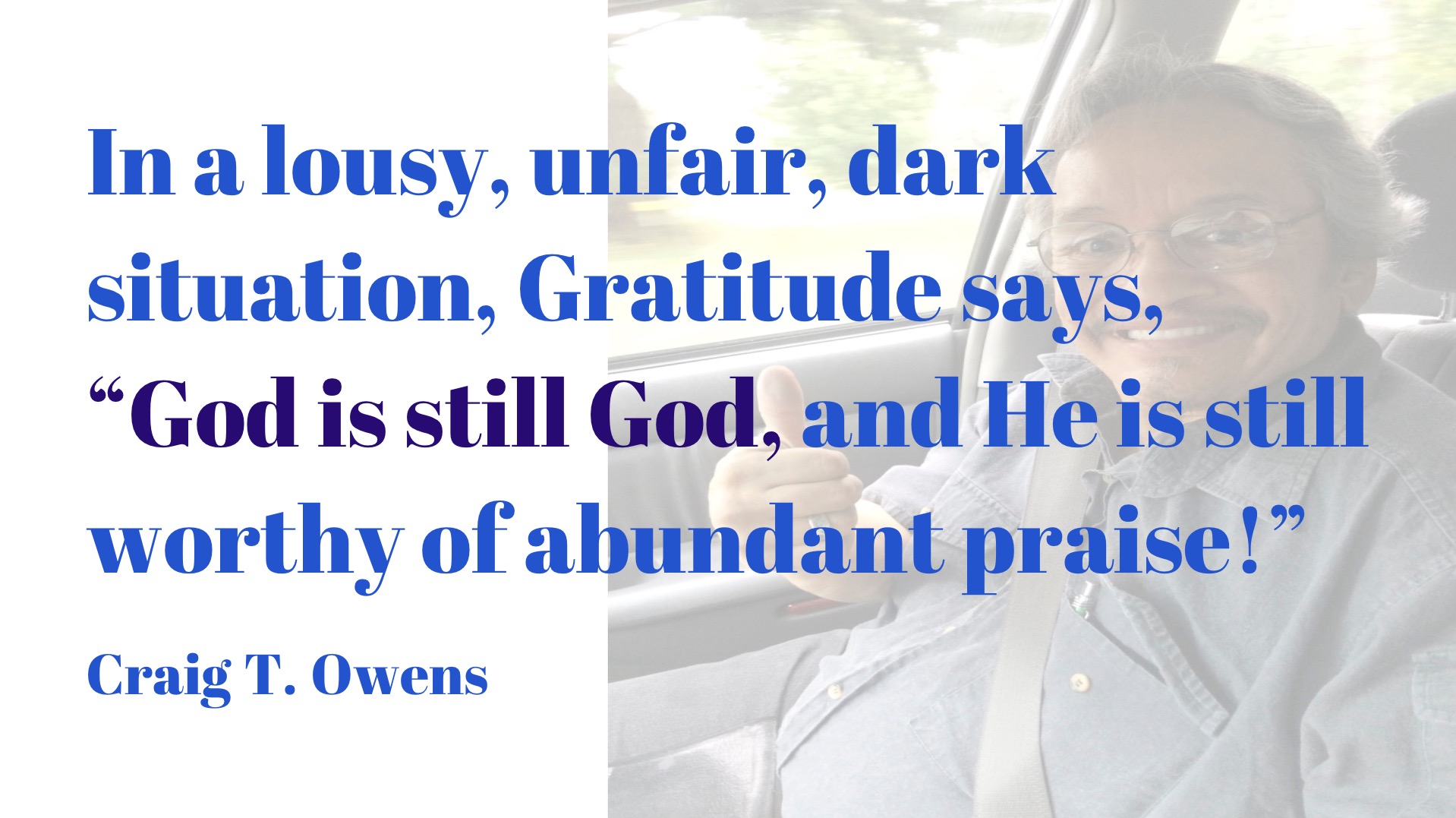
In a lousy, unfair, dark situation, Gratitude says, “God is still God, and He is still worthy of abundant praise!”
So in the middle of his letter to the Philippians, Paul instructs these Christians to: Do all things without murmurings and disputings (Philippians 2:14 KJV). Murmurings are the vocalizing of the faults we have found.Disputings, though, are internal. In the Greek, this word almost always refers to complaining and grumbling thoughts, and many times it’s translated as “evil thoughts.”
When the complaining comes out of our mouths, that is just the ugly weed. The root of that complaint is in our hearts. We don’t need a vocabulary change, we need a heart change.
When we praise God, we magnify Him. That doesn’t make God bigger because He is infinite. But it does put a “telescope” on Him. Telescopes bypass everything that is close by and focus on something majestic. Our praise—like Paul and Silas’ song from prison—invites others to look through our telescope to see the God we are magnifying.
Gratitude can start with one person, and then it can spread. Gratitude can counteract the cancerous complaints. Will you be that one grateful person at this Thanksgiving season and beyond? Will you be the one that says, “No matter what, God is still God, and He is still worthy of abundant praise”? Will you be that one that sings praise at the exact moment everyone else expects complaints? If you do, your gratitude will entice others to want to worship this all-good God too!
Follow along with all of the messages in our series called The Great Attitude Of Gratitude by clicking here.
Listen to the podcast of this post by clicking on the player below, and you can also subscribe on Apple, Spotify, or Audible.
A couple of weeks ago I asked a question about a fictitious job. Which job would you rather have: a job that’s (a) boring, not utilizing your skills, where you’re treated as a cog in the wheel, or (b) energizing, calling out your best talents, a place where you are making a difference?
As a follow up I asked, “Which of those jobs are you more likely to be happy to go to? Which job is going to inspire you to give your best work ethic?”
We all want that ideal job, but the reality is that in this fallen world there are no perfect jobs, so it’s very likely that we’re going to have the challenging jobs. Even when we have that kind of job, Christians are called to work with excellence and to find joy in that work (Colossians 3:23).
Work originated with God. At the conclusion of every day of Creation, God looked at His magnificent handiwork and pronounced it good. When God placed Adam and Eve in the Garden of Eden, He gave them instructions to work, and even after their sin, He repeated the call to work (Genesis 2:15, 3:17-19).
Whether we are called to be gardeners or evangelists, plumbers or salespeople, teachers or doctors, we are to work well. William Tyndale wrote, “There is no work better than to please God; to pour water, to wash dishes, to be a cobbler, or an apostle, all are one; to wash dishes and to preach are all one, as touching the deed, to please God.”
Let me give you two examples of good workers.
The first is Joseph whom we meet in the first book of the Bible. Out of their jealousy of their father’s preferential treatment of Joseph, his brothers sold him into slavery. Joseph ended up in Egypt working for a man named Potiphar. I don’t think anyone would have blamed Joseph for grumbling about his condition and giving the least effort possible, but instead, Joseph so excelled in his work that Potiphar promoted him over all his household.
After being framed for a crime he didn’t commit, Joseph found himself in prison. Once again, this innocent man could have sulked and complained and shirked his work responsibility. But once again, Joseph did such excellent work that the warden promoted him to a trustee position over all the other prisoners.
Eventually, Joseph was promoted to second in command in all of Egypt, where he continued to do excellent and innovative work. Joseph’s good attitude and impeccable work ethic allowed God to place him in a position where he could save his people from starvation (see Genesis 39-50).
What about the example of Jesus? He was fully God, yet He gave up His divine prerogatives to work as a carpenter and to eventually perform the most important work of all: the willing sacrifice for the sins of all humankind. Paul describes the servanthood and willing attitude of Jesus in Philippians 2, adding an important “therefore” when he tells us that the excellent work of Jesus allowed God to place Him in a position where He could save His people from eternal separation from God (Philippians 2:6-11).
But Paul also has an important word for us in the verse preceding this passage: “Let this same attitude and purpose and humble mind be in you which was in Christ Jesus” (v. 5 AMP).
I may not be able to choose my job, but I can always choose to have a God-glorifying attitude about my job. When I choose this attitude and live it out with an excellent work ethic, God is pleased.
So allow me to give you four attitude-checking questions about your own work ethic:
Do I feel like I have to go to work? I should so crave God’s glory and God’s rewards that I have a get to attitude about my work.
Am I living for T.G.I.F.? We shouldn’t be focused on just getting things done, but we should make the most of every day of work that we have been given. We should be living out T.G.I.T.—Thank God It’s Today (Psalm 90:12, 17)!
Let me repeat an important principle: I may not be able to choose my job, but I can always choose to have a God-glorifying attitude about my job. When you have this kind of attitude, you will experience the joy of a fulfilled craving that God has put in all of us—the desire to do meaningful and God-honoring work. This is the attitude and work ethic God delights to reward.
Listen to the podcast of this post by clicking on the player below, and you can also subscribe on Apple, Spotify, or Audible.
I’ve noticed that when people want to sound super-spiritual that they like to use King James Version phrases. Sometimes I hear people speaking in normal, everyday English until they begin praying and then I hear, “Thy servant … Thou O Most High … we beseech Thee … Thou knowest Thine children….”
Statement #6 in our series “Is that in the Bible” also sounds more powerful when people quote it in King James English—Shun the very appearance of evil or sometimes Wherefore come out from among them, and be ye separate, saith the Lord. Are those in the Bible? Yes, they are!
We don’t use the word “shun” very often today, but in what was probably the first written book of the Bible we read that not only did Job shun evil, but God commended him for shunning evil too. And wise King Solomon advocated for his readers to shun evil (Job 1:1, 8; 2:3; Proverbs 3:7, 14:16).
Yes, those phrases that I quoted earlier come right from the King James Version of the Bible in 1 Thessalonians 5:22 and 2 Corinthians 6:17, but does this mean that we are to stay away from anything that is “unChristian”? Does it mean that we are to shun sinners?
There is a story that is told in the synoptic Gospels, but I especially like it in Matthew’s Gospel for one specific reason (which I’ll share with you in a moment). Jesus has just called Matthew to be His disciple, and several of Matthew’s coworkers appear to be having a going-away dinner for him which Jesus attended.
Then comes the “911” call from the Pharisees (this statement is in Matthew 9:11): “Gasp! Jesus is eating with sinners! He’s not shunning them! Call in the sin police!” The New Living Translation is even more harsh, with the Pharisees asking, “Why does your Teacher eat with such scum?” (v. 13 NLT).
In Luke’s Gospel we read another story where Jesus eating with “such scum” turned another tax collector’s life around. In Luke 19:1-10, we read of Zaccheus experiencing a complete life change because of His encounter with Jesus.
Listen to Christ’s words in both Matthew and Luke: “It is not the healthy who need a doctor, but the sick. … I have not come to call the righteous, but sinners. … The Son of Man came to seek and to save what was lost” (Matthew 9:12-13; Luke 19:10).
This doesn’t sound like Jesus shunned sinners.
Likewise, Jesus called us to be His salt and light in the world (Matthew 5:13-14). No matter how beneficial the salt of my life is, it doesn’t help anyone if it stays in the saltshaker, shunning the food. No matter how bright the lantern of my life is, it doesn’t help anyone in a closed closet, shunning the darkness.
Notice what Jesus didn’t do. He didn’t go to Matthew’s house or Zaccheus’ house for a good time, or for a good meal, or for a time of entertainment. He was on mission. So too for Christians: We go into dark places not for our pleasure or entertainment, but because we’re on a rescue mission!
In both the Old Testament Hebrew and the New Testament Greek, the words for “shun” point at our own hearts. The words mean: You walk away from things that will pull you down, or you hold yourself back from the places and things that will lead you to sin.
So look at the phrase “Shun the very appearance of evil” in its context: “Do not quench the Spirit. Do not treat prophecies with contempt but test them all; hold on to what is good, reject [or shun] every kind of evil” (1 Thessalonians 5:19-22).
Paul is calling us to shun the things that drown out the voice of the Holy Spirit. Listen to two of those verses in another translation: “But test and prove all things until you can recognize what is good; to that hold fast. Abstain from evil” (vv. 21-22 AMP).
In 2 Corinthians 6 the phrase “Be ye separate” is in the context about being “unequally yoked” with unbelievers. This is what happened to King Solomon when he married women who were idolaters, and they pulled his heart away from God.
“Shun” means to keep away from those things that would pull you down. How do I know if a certain environment or activity or person is pulling me down? I need to check my thoughts, attitudes, and actions. If I find they are becoming un-Christlike, then that is an indication of a place or person that I need to limit my exposure.
As long as my thoughts, attitudes, and actions remain Christlike, I should keep on seasoning and shining in dark places so that I can draw others to Jesus. “Do everything without complaining and arguing, so that no one can criticize you. Live clean, innocent lives as children of God, shining like bright lights in a world full of crooked and perverse people” (Philippians 2:14-15 NLT).
Don’t shun people that Jesus dearly loves, but don’t put yourself in a position where your devotion to God is compromised either. Listen to the voice of the Holy Spirit giving you the wisdom you need to be both on-mission for Jesus and shining a bright, innocent light!
Listen to the podcast of this post by clicking on the player below, and you can also subscribe on Apple, Spotify, or Audible.
This is part 4 in our series “Is that in the Bible?”
Statement #4—Name it and claim it. Is that in the Bible? No!
But in fairness, even the proponents of this belief don’t usually say it this way. Instead they quote words from Jesus like: “I will do whatever you ask in My name” (John 14:13) or “Ask whatever you wish, and it will be given you” (John 15:7).
They really want this to be true, I think, because in their minds happy, prosperous Christians make God look good. On the other hand, struggling Christians make God look bad. There is a whole branch of theology called theodicy which literally means: “a defense of God’s goodness and omnipotence in view of the existence of evil.”
This is nothing new. Religious people have always tried to have pat answers. In the oldest book of the Bible, Job’s friends were convinced that suffering results from sin and blessing results from righteousness. And yet according to God, Job was a righteous man (Job 1:1, 8, 20-21).
At the advent of Jesus, the chief priests and scribes want the Messiah to be heroic so they modified a prophecy to make Bethlehem sound more impressive (compare Micah 5:2 with Matthew 2:6).
So it follows that this name-it-claim-it group wants God to look good because His people look good, dress well, drive nice cars, live in big homes, fly private jets, and never get sick.
But Jesus Himself told His followers to, “Sell your possessions and give to the poor” (Luke 12:33). And He said,“Blessed are you when people insult you, persecute you and falsely say all kinds of evil against you because of Me” (Matthew 5:11). And Jesus also said, “In this world you will have trouble” (John 16:33).
This is not to say that God opposes wealth: He gave wealth to His leaders, Job was doubly-wealthy after his trial, and wealthy people funded the ministry of Jesus and the early church. But this isn’t the same as pursuing—or even demanding—wealth, or of making the erroneous connection that poor people are somehow out of favor with God.
How do we avoid these errors? Here are three thoughts:
The word “eisegesis” means to read something into the Word. But that is like creating your own beliefs and then going to the Bible to find phrases that support what you already believe. On the other hand “exegesis” is to read the Bible and have it speak to us by the Holy Spirit.
Two of the phrases from Jesus that the name-it-and-claim-it folks use (John 14:13 and John 15:7) turn out to mean something entirely different than, “God will give me all of the things I demand from Him” when they are read within the context of the things Jesus was teaching at that time (see John 14:9-14 and 15:1-8).
(3) Understand your terms.
If something is biblical, that is something the Bible says yes to. Unbiblical things the Bible says no to. But non-biblical are those the Bible doesn’t explicitly address. We have to be very careful of trying to make non-biblical things sound biblical or it may lead to some unbiblical attitudes and actions.
This is exactly what the Pharisees did by giving their non-biblical traditions the weight of biblical statements, and then looking down on others in a very unbiblical way.
God is sovereign. We do not tell Him what to do. We do not demand Him to respond to our needs. We trust Him and and we abide in Him. Then in the abiding, asking and understanding and fruitfulness are as natural as a flower sprouting from a branch that is attached to the vine. We don’t name things and claim things for our personal comfort, but we desire solely for God’s glory to be seen—whether in wealth or poverty, health or sickness, peaceful times or tribulation.
Evaluating all biblical sounding statements by those three items—studying the whole counsel of God’s Word, understanding the context, and knowing our terms—will guide us from going astray.
Listen to the podcast of this post by clicking on the player below, and you can also subscribe on Apple, Spotify, or Audible.
We saw that our beautiful Jesus became grotesque—taking our ugly sin on Himself so that He could clothe us with His perfectly righteous robe. In so doing, He became even more resplendent. His friend John saw Him in such radiant beauty that he crumbled to his knees at the sight of His majesty (Revelation 1:12-16)!
Just like John and others in the Bible, when we see ourselves in contrast to His awesome beauty, we often feel shabby and unworthy to be in His presence. Job expressed his desire to somehow get away from this Perfection (Job 7:11-21). Ultimately, in his desperation, Job utters something prophetic—
God is not a mere mortal like me that I might answer Him, that we might confront each other in court.If only there were someone to mediate between us, someone to bring us together,someone to remove God’s rod from me, so that His terror would frighten me no more.Then I would speak up without fear of Him, but as it now stands with me, I cannot.(Job 9:32-35)
When we are confronted with the perfection of God, we all want “someone to arbitrate”—someone who will fairly represent both sides. We need someone both God and man. Since man cannot become God, only God can become man. Isaiah prophesied it this way, “God saw that there was no one, He was appalled that there was no one to intervene; so His own arm achieved salvation for Him” (Isaiah 59:16).
Christ or Messiah means “anointed by God” and is His divine title. Often His title is used with the definite article “the” to signify that Jesus is the One and Only Messiah (Luke 2:26-27; John 1:41; Matthew 16:16; Acts 10:38).
William Barclay commented on this: “Peter states [that Jesus was a human descendent of David] in the first recorded sermon of the Christian Church (Acts 2:29-36). Paul speaks of Jesus Christ descended from David according to the flesh (Romans 1:3). The writer of the Pastoral Epistles urges men to remember that Jesus Christ, descended from David, was raised from the dead (2 Timothy 2:8). The writer of the Revelation hears the Risen Christ say: ‘I am the root and the offspring of David’ (Revelation 22:16).”
Many times this human name and divine title are linked together. In Hebrews, the name Jesus is used more times than any other title (19x), and Christ is the second-most used title (15x).
Hebrews makes it perfectly clear how important it is that Jesus was made fully human just like us. We read phrases like…
“made a little lower than the angels,” which was David’s way of talking about humans (see Psalm 8:4-6)
“made perfect through suffering”—only humans can suffer
“flesh and blood”
“made like His brothers in every way”
“His life on earth”
Remember that I said the most-used titles in Hebrews were Jesus and Christ. The third-most used title in Hebrews is high priest (14x). Only the Human Jesus and the Divine Jesus could be the perfect High Priest and Mediator that Job longed for, and that you and I have to have!
This post is a part of a bigger series on prayer with the subtitle: “Learning to pray in the awesome name of Jesus.” So what does it mean that we can pray in the human name of Jesus?
It means we don’t have to pray majestic prayers in order for God to take notice. We can pray very human prayers, we can groan with real human pain, we can growl with real human anger. Our totally human Jesus understands us, and the totally divine Christ runs to help us!
Don’t try to sanitize your prayers to make them sound acceptable. Jesus didn’t! How awesome it is to have a High Priest who is both fully human and fully divine!



 For God is not a mere man, as I am, that I should answer Him, that we should come together in court. There is no umpire between us, who might lay his hand upon us both—would that there were! That He might take His rod away from threatening me, and that the fear of Him might not terrify me. Then would I speak and not fear Him, but I am not so in myself to make me afraid, were only a fair trial given me. (Job 9:32-35 AMPC)












 Craig T. Owens