Check Your Inputs

Listen to the podcast of this post by clicking on the player below, and you can also subscribe on AppleSpotify, or Audible.

Jesus was the healthiest Person to ever walk planet Earth. When Luke, a physician, tells us about the growth of Jesus, he says first that “Jesus grew in wisdom.” (Luke 2:52). That is our indication that a healthy mind is at the foundation for every other aspect of health. 

But mental health doesn’t stay in your mind—it affects every other part of your life. Likewise, all of the other parts of your life can enhance or drain your mental health. We are created as interconnected beings. For instance, it’s hard to think correctly when you’re physically tired, spiritually drained, or involved in an unhealthy relationship. It’s also true that it’s hard to make good decisions about your physical health, stay focused on God, or handle your relationships successfully if you aren’t thinking correctly. 

We see the apostles writing about our wholly healthiness

Dear friend, I pray that you may enjoy good health and that all may go well with you, even as your soul is getting along well. (3 John 2) 

Now may the God of peace make you holy in every way, and may your whole spirit and soul and body be kept blameless until our Lord Jesus Christ comes again. (1 Thessalonians 5:23 NLT) 

When my laptop is disconnected from the monitors I use at our church building, the message on the screen tells me to “check your inputs.” That’s not just for inanimate technology, but for us too: To maintain good overall health, we need to check our physical, spiritual, mental, and emotional inputs. 

Let’s start with the physical inputs. When we are active during the day our bodies release a stress hormone called cortisol. Stress is not a bad thing—it’s a normal thing. A body that isn’t stressed will atrophy and become susceptible to disease. Balanced, healthy stress is called eustress, and unbalanced, unhealthy stress is called distress. 

Cortisol is naturally flushed from the body in two ways: exercise and sleep. Exercise is important to keep our bodies moving effectively, and sleep helps us recover and helps our brains catalogue our memories (see 1 Timothy 4:8; Psalm 3:5). To fuel our exercise and our sleep requires the energy which we get from a healthy diet. 

So if you’re not thinking healthy thoughts, check your physical inputs: Am I getting the proper amount of sleep? Am I exercising regularly? Am I eating properly? Do I see a doctor for a checkup? 

How about spiritual inputs? Somewhat surprisingly, our spirits are kept healthy very much along the same lines as our physical bodies—proper food, appropriate exercise, and a time of rest. Our spiritual food is God’s Word, our exercise is working out what we’ve studied in the Bible, and our rest is called sabbathing (Jeremiah 15:16; Matthew 7:24-27; James 2:17). Jesus demonstrated all of these in His life and we, too, should follow His example. 

If you’re not thinking healthy thoughts, check your spiritual inputs: Am I reading the Bible regularly? Am I putting what I learn into practice? Am I sabbathing properly?  

Then there our emotional inputs, or the relationships that build us and relationships that drain us. You are always going to encounter people in need, and ministering to those needs is draining (Luke 8:45-46). We also need to be alert to those antagonistic people who purposely drain us (2 Timothy 4:14-15). We can make decisions to place people in our lives who build us up and be cautious of those who drain us (Proverbs 27:3, 5-6, 9, 17). 

Once again, if you’re not thinking healthy thoughts, check your emotional inputs: Do I have healthy people investing in my life? Am I sharpening the iron of others? 

Finally, let’s not forget the mental inputs. Computer programmers are well aware of the acronym GIGO: garbage in, garbage out. If you don’t like the results that are coming out, check what is going in. The apostle Paul gives us an outstanding checklist in Philippians 4:8. 

If your mental health isn’t as healthy as you would like it to be, perhaps you need to talk to your doctor about your physical health, or a mature spiritual friend about your spiritual health, or a Christian counselor about your emotional health. As you consult with these wise people, continue to pray for God’s help. As your Creator, He knows you better than anyone else could and He can give you the wisdom you need as you check your inputs. 

This is part 5 in our series on a Christian’s mental health. If you’ve missed any of the other messages I’ve shared, you can find them all by clicking here. 

►► Would you please prayerfully consider supporting this ministry? My Patreon supporters get behind-the-scenes access to exclusive materials. ◀︎◀︎

Links & Quotes

The Holy Spirit can speak to us through other people. Be sure to check out all of my videos on my YouTube channel.

“A time will come when instead of shepherds feeding the sheep, the church will have clowns entertaining the goats.” —Charles Spurgeon

“Every word from God comes with the power to make that word happen.” —Kevin Berry

“The question is not, ‘Should we pray for the lost people of our community?’ The question is, ‘Will we?’ Will we pray for our neighbors, our community, our nation, and our world? Will we seek the peace of the world and the wellbeing of all our fellow humans before the Lord in prayer? [Jeremiah 29:7]
“If we will not, then we must face up to the fact that we are disobeying a divine mandate, abandoning our neighbors to their folly, and stoking the fires of indifference—if not outright scorn—for the unbelieving world around. But if we will pray, who knows what God might be willing to do?
“Those prayers may be prayers of anguish and anger at times; but they must also be prayers for God to work in the hard hearts of our unsaved neighbors, just as He has worked in ours, to bring new life, forgiveness, and hope to those who now live apart from God in a world full of rebellion and sin.” —T.M. Moore

Axis is a great resource to help parents communicate effectively with their pre-teen and teenage children. In the wake of the school shooting in Nashville, Axis posted this: “We have created resources to help parents and caring adults have conversations about violence and school shootings. Consider our Conversation Kit on Violence, our Parent’s Guide to School Shootings, our Parent’s Guide to Talking About Violence, and our Parent’s Guide to Anxiety, for starters.”

This is an excellent post from Fight The New Drug on how to spot online sexual predators.

“Failure is a part of success. There is no such thing as a bed of roses all your life. But failure will never stand in the way of success if you learn from it.” —Hank Aaron

Come To God And Keep Walking With Him

Listen to the podcast of this post by clicking on the player below, and you can also subscribe on AppleSpotify, or Audible. 

I have been so grateful for the insights of Dr. Gary Chapman in his book The Five Love Languages. I have found this book to be of immense value in helping couple prepares for marriage, and in helping married couples get beyond a place where intimacy has become stuck. 

In short, the five love languages are words of affirmation, quality time, gifts, acts of service, and physical touch. The goal of learning the other person’s love language—and learning to speak it consistently and fluently—is an increased level of intimacy. In the book of Amos, God asks, “Can two people walk together without agreeing on the direction?” (Amos 3:3 NLT), and speaking the right love language definitely helps people agree! 

The whole reason we come to God in prayer as a Father, as a Brother, and as a Counselor is so that we can hear Him speaking our love language and we can continue to walk in deeper intimacy with Him. 

When my then-girlfriend Betsy and I first met, we spent hours and hours getting to know each other. We would ask questions, share stories, and tell things we did and didn’t enjoy. This is the epitome of intimate conversation: getting to know the other person’s heart as you open up your heart to them as well.

I’ve shared this analogy before, but intimacy grows stale and can eventually disappear altogether if those in a relationship are no longer walking together. It doesn’t work if I say, “Betsy, I’m looking forward to spending an hour with you each week,” or even if I say, “I’ll give you 15 minutes each morning.” Instead, our relationship needs to be one of continual walking. 

It’s the same thing for us as Christians: we cannot only give God an hour at a church service on Sunday mornings, nor is intimacy going to increase if I only walk and talk with my Savior for a few minutes in my morning devotions. 

Walking closely with Him is what God has desired right from the beginning. He walked with Adam and Eve each evening. This phrase “walking with God” is used consistently throughout the Bible of those who had an intimate relationship with their Father, Brother, and Counselor—Noah, Abraham, Isaac, the people of Israel (Genesis 3:8, 6:9, 17:1, 48:15; Leviticus 26:12). And even as the New Testament era dawns, we read, “And they [Zechariah and Elizabeth] were both righteous before God, walking in all the commandments and ordinances of the Lord blameless” (Luke 1:6 NKJV). 

But I’m especially intrigued by the story of Enoch in Genesis 5:21-24. Twice in four short verses, we read “Enoch walked with God.” Remember that verse in Amos—“Can two people walk together without agreeing on the direction?”—so Enoch and God had to be in agreement. In fact, that’s exactly what we read about Enoch in the Book of Hebrews: 

By faith Enoch was taken from this life, so that he did not experience death: “He could not be found, because God had taken him away.” For before he was taken, he was commended as one who pleased God. And without faith it is impossible to please God, because anyone who comes to Him must believe that He exists and that He rewards those who earnestly seek Him. (Hebrews 11:5-6)

If you’ve taken Dr. Chapman’s love language assessment, you probably found that you were pretty lopsided: maybe you scored very highly in one love language and then barely registered in another. We may be lopsided in our love language skill, but God speaks every language perfectly! 

  • Words of affirmation—Hosea 2:14; Isaiah 40:2 
  • Quality time—Deuteronomy 31:6; Psalm 23:3-4
  • Gifts—James 1:17; 2 Peter 1:3
  • Acts of service—Philippians 2:13; Romans 8:28
  • Physical touch—Psalm 139:13-15; Luke 24:39 

(Click here to check out all of those verses.) 

Dr. Chapman noted that when our love language is being spoken to us sincerely and consistently, our love tank is filled, and all of the love languages begin to become more meaningful. 

Just as God walked with Enoch until the day He brought him Home, so He wants to walk with us. 

  • Walk in obedience to all that the Lord your God has commanded you, so that you may live and prosper. (Deuteronomy 5:33) 
  • The Lord will establish you as His holy people, as He promised you on oath, if you keep the commands of the Lord your God and walk in obedience to Him. (Deuteronomy 28:9) 
  • May He turn our hearts to Him, to walk in obedience to Him and keep the commands. (1 Kings 8:58) 
  • Blessed are all who fear the Lord, who walk in obedience to Him. (Psalm 128:1) 
  • And this is love: that we walk in obedience to His commands. As you have heard from the beginning, His command is that you walk in love. (2 John 6) 

When we walk in loving intimacy with Him, our intimacy grows deeper and more mature. Sometimes they will say of couples who have been married for a long time and walk in increasingly deeper intimacy with each other, “They seem to know each other’s thoughts.” That’s because they know each other’s hearts—and that’s what God wants to do with us. He did it with Enoch, and He will do that with us too (Jude 14; Jeremiah 33:3; Habakkuk 3:19). 

Enoch walked intimately with God for 365 years. Let us walk intimately with God for 365 days a year, for as many years as He gives us until God takes us away with Him forever! 

If you’ve missed any of the messages in our prayer series called Intimate Conversation, you can find all of the messages by clicking here. 

►► Would you please prayerfully consider supporting this ministry? My Patreon supporters get behind-the-scenes access to exclusive materials. ◀︎◀︎

God Is Infinitely Logical

Listen to the podcast of this post by clicking on the player below, and you can also subscribe on AppleSpotify, or Audible. 

Plato said, “Arguments, like men, are often pretenders.” This is both true and a logical syllogism. It is true because men often pretend, and they design their arguments to support their pretenses. 

One of my favorite classes in college was “Introduction to Logic.” In fact, it is one of my few college textbooks that is still in my personal library today. It always struck me that God created logic. That means He is infinitely logical.

So we can restate Plato’s quote like this, “God’s arguments, like God Himself, are always authentic, logical, and valid.” 

In my Bible study time, I often highlight the words that denote premisses and conclusions. In just Ezekiel 36 alone I find: 

  • therefore (6x)
  • because (2x) 
  • then (6x)
  • for (1x) 
  • so that (1x) 

We can argue against God’s logic, and we can even try to invalidate His arguments. But to do so makes me illogical. God not only gives the premisses and the conclusion, but He makes them both logical and valid. God told Jeremiah, “I am watching to see that My word is fulfilled” (Jeremiah 1:12).

So any of my attempts to redefine or re-order or invalidate what God has logically presented ultimately brings disorder, collapse, and frustration. It is far better for me to simply follow the premisses and trust God to bring about His promised—and logical—conclusion. 

I encourage you to look for these logic statements as you read the Bible yourself. Here is a Bible study from Proverbs 2 that can help get you started.

►► Would you please prayerfully consider supporting this ministry? My Patreon supporters get behind-the-scenes access to exclusive materials. ◀︎◀︎

There’s Still Time, America

Listen to the podcast of this post by clicking on the player below, and you can also subscribe on AppleSpotify, or Audible. 

This is what the Lord Almighty says: “Cut down the trees and build siege ramps against Jerusalem. This city must be punished…” (Jeremiah 6:6). 

When I read these 2500-year-old words it makes me shudder. Why? Because if we changed “Jerusalem” to “Washington, D.C.” and “Judah” to “America,” the sins of the people sound eerily the same: 

  • arrogantly closed ears refusing to listen to God’s Word 
  • people calling the loving message of the Bible “offensive” 
  • the predominance of greed 
  • deceptive “prosperity” preachers who are only in it for their own personal gain 
  • shameless, detestable lifestyles 
  • open rebellion against God’s laws 
  • constant slandering of God and of people created in God’s image (vv. 10-28)

God says, “This city must be punished.” 

But still, a hope remains. God also says, “Take warning, Jerusalem [or America], or I will turn away from you” (v. 8). 

There is still time for repentance! There is still time to take heed of this loving warning and turn away from sin. That’s what repentance truly means—seeing our sins as disgusting in God’s sight, asking for forgiveness, and turning away from those sins. 

Repentance means an about-face, so that instead of the catalog of sins that I just listed, we instead see:

  • a humility that hears and obeys God’s Word 
  • living in contentment with God’s blessings and not lusting for anything more 
  • listening to preachers who faithfully, lovingly, and boldly speak exactly what God has spoken to their hearts 
  • being ashamed of our former sinful lifestyle, and gratefully receiving the forgiveness that Jesus purchased for us
  • and having a passion to help everyone live in this God-glorifying way

Repent, America! There is still time before God’s judgment falls on us. The historical record is there for all to read: Unrepented sin received God’s righteous judgment. But in His mercy, God is still giving us time to repent today. Don’t miss this golden opportunity! 

►► Would you please prayerfully consider supporting this ministry? My Patreon supporters get behind-the-scenes access to exclusive materials. ◀︎◀︎

Eternally Satisfied

Listen to the podcast of this post by clicking on the player below, and you can also subscribe on AppleSpotify, or Audible. 

We see a pattern throughout the history of the Israelites in the Old Testament: They wanted to have all their bases covered, so they kept up the pretense of worshiping Jehovah, but they also added the idolatrous practices of the nations around them. It got pretty vile (see Jeremiah 2:23-25 as an example). 

These cravings for more than God had provided led to their punishment. As we quoted last week from Isaiah, they lost their “matchless, unbroken companionship” with God (Isaiah 30:18 AMP).

Craving for our self-created idols creates anxiety in our hearts that shows up in three nagging questions. 

(1) What will others think of me if they have things I don’t have?

Worrying about what others think of us has always been a trap. We play games, posture, and frequently hide the truth so that we “look right” to others. But this dishonesty only hurts us in the long run.

Dr. Tony Evans noted, “satan uses our legitimate need for acceptance in an illegitimate way that can result in us living under a false identity.” Jesus warned us not to show off to try to get others to think well of us (Matthew 6:1) and He lived this out in His own life. He said, “I receive not glory from men—I crave no human honor, I look for no mortal fame” (John 5:41 AMP). 

To avoid this trap remember: Recognition from God > Recognition from men. We should be living to hear Jesus say, “Well done, good and faithful servant!” (Matthew 25:21, 23). 

(2) Will I have enough to survive?

Because the things of this earth pass away, it is natural to think that our supply may just <poof!> be gone in an instant. So we can crave the security of having our shelves fully stocked for the future. 

Jesus twice tells us that our Heavenly Father knows what we need (Matthew 6:8, 32). Then over a span of ten verses, Jesus tells us four times, “Do not worry” (Matthew 6:25-34). He can assure us of this because of this rock-solid reality: Heaven’s provisions > Earth’s provisions. 

(3) Will God accept me?

Just as satan tried to get Jesus to doubt that He was the Son of God, the devil will also try to get you to doubt whether or not you measure up in God’s sight. But in the Sermon on the Mount, Jesus emphasizes the Fatherhood of God thirteen times—usually calling Him “your Father.” 

This tells me that we can cling to this: Being accepted by your Father > Being accepted by anyone else. Paul uses a wonderful description in Ephesians when he tells us we are “accepted in the Beloved” (Ephesians 1:6 NKJV). 

Isaiah told us that God longs to be gracious to us, and Jesus emphasizes that idea when He says, “Only aim at and strive for and seek His kingdom, and all these things shall be supplied to you also. Do not be seized with alarm and struck with fear, little flock, for it is your Father’s good pleasure to give you the kingdom!” (Luke 12:31-32 AMP) 

Just as God craves to bless you, so you are to crave your fulfillment in what He alone can supply. You must crave the only One Who can eternally satisfy you, Who longs to reward you, and Who delights to give you the inestimable rewards of His kingdom! 

If you’ve missed any of the messages in our Craving series, check them out by clicking here. 

►► Would you please prayerfully consider supporting this ministry? My Patreon supporters get behind-the-scenes access to exclusive materials. ◀︎◀︎

Growing The Wrong Thing

Listen to the podcast of this post by clicking on the player below, and you can also subscribe on AppleSpotify, or Audible. 

In a recent teaching time with some ministry interns, I discussed the two main metrics that we can use to measure growth: quantity and quality. Sadly, too many churches and ministries have gotten so caught up in the “numbers game” of more-more-more being the only metric of success, that they’ve forgotten about quality. Or maybe they do focus on quality, but only as a means to the end of more-more-more. 

This is never a metric of success that is discussed in the Bible. Check this out…

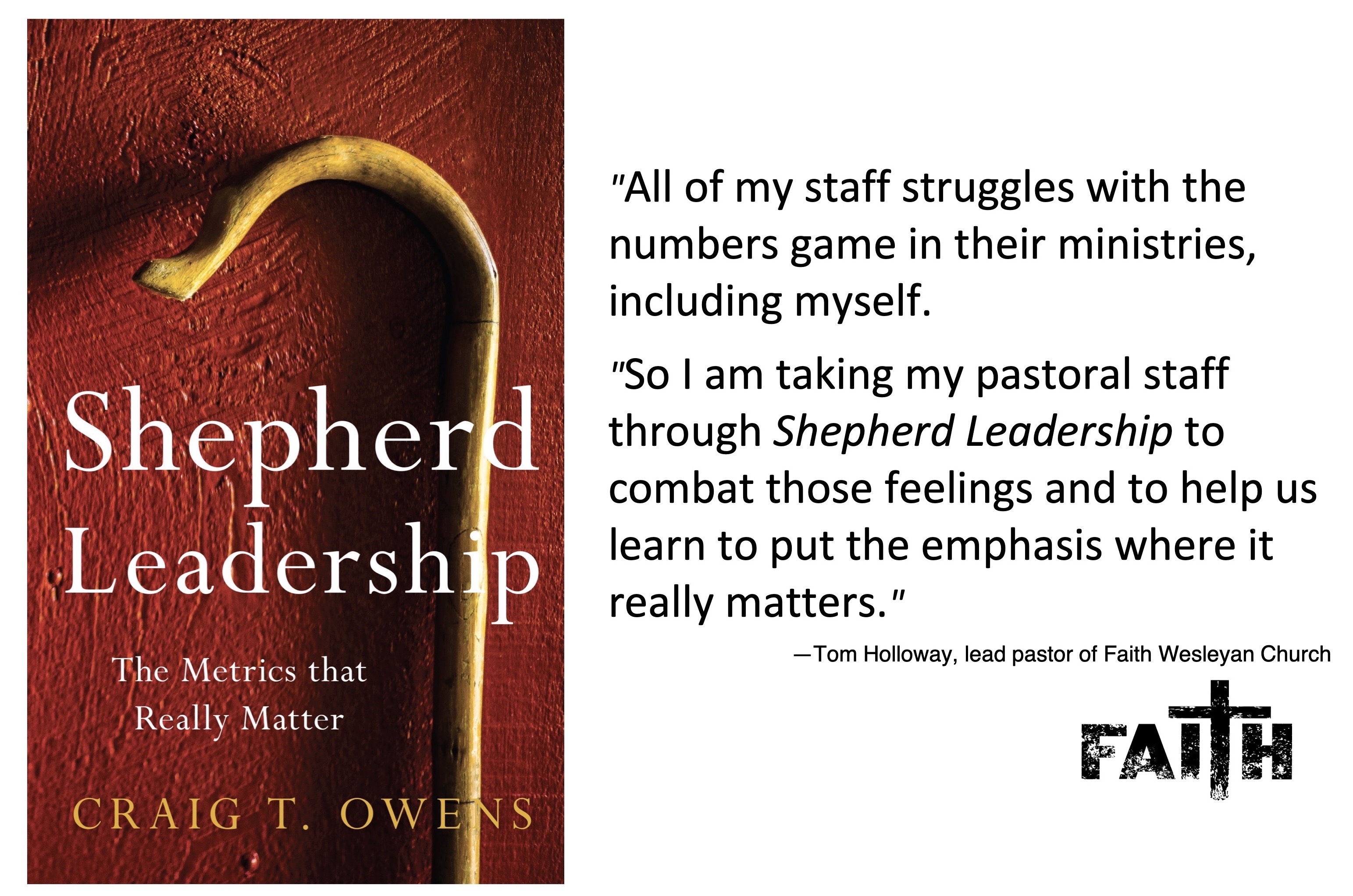
In the chapter entitled ‘Don’t Try to Grow Your Ministry’ in my book Shepherd Leadership: The Metrics That Really Matter I wrote this—

Businesses think in terms of quantitative gains—things they can count—but churches and nonprofits should be thinking in terms of qualitative gains—a quality improvement that isn’t as easily counted. I think we all know this, and yet we still persist in wanting to define success in a church or a nonprofit by those quantitative standards such as attendance growth, donations, and the like. When we think qualitative over quantitative, suddenly what seemed “small” is so significant and so valuable that it cannot be calculated! What if one of those babies that weren’t aborted discovers a cure for cancer, or deciphers a dialect to take the Gospel to an unreached people group, or becomes the loving next-door neighbor that leads your son or daughter to a relationship with Jesus? 

Just as you cannot put a price tag on a life, you cannot put a price tag on a sheep. Make no mistake about it, God views His sheep—every single one of them—as invaluable. Because His valuation is so high, we can understand why He gets so angry at those who are more concerned about their success than they are about the health of the sheep. When God uses the word “Woe!” we should definitely take that seriously. He uses that very word to warn shepherd leaders who were shirking their responsibility when He said, “Woe to those shepherds who only take care of themselves” (Ezekiel 34:2). 

When we map out our plan for success, or when we try to define success solely by quantitative measurements, we ultimately become more committed to our plans than to God’s sheep. God pulls no punches when He calls leaders with this attitude evil, mere hired hands, or even thieves (Jeremiah 23:3; John 10:8, 12). And most sobering of all, God says, “I will hold them accountable” (Ezekiel 34:10). 

Friends, let’s make sure we are focused on the metrics that really matter. Recently, a pastor shared honestly with me about his frustration with the “numbers game,” and purchased five copies of my book to use as a discussion starter with his church staff. I hope you will consider using Shepherd Leadership in a similar way. If I can be of assistance, please let me know. 

Shepherd Leadership is available in print or ebook, and in audiobook through either Audible or Apple. 

►► Would you please prayerfully consider supporting this ministry? My Patreon supporters get behind-the-scenes access to exclusive materials. ◀︎◀︎
Thursdays With Spurgeon—Encouragement For Preachers

This is a weekly series with things I’m reading and pondering from Charles Spurgeon. You can read the original seed thought here, or type “Thursdays With Spurgeon” in the search box to read more entries.

Listen to the podcast of this post by clicking on the player below, and you can also subscribe on AppleSpotify, or Audible. 

Encouragement For Preachers

…For the mouth of the Lord has spoken (Isaiah 1:20).

     We preach because ‘the mouth of the Lord has spoken.’ It would not be worth our while to speak what Isaiah had spoken if in it there was nothing more than Isaiah’s thought—neither should we care to meditate hour after hour upon the writings of Paul, if there was nothing more than Paul in them. … The true preacher, the man whom God has commissioned, delivers his message with awe and trembling because ‘the mouth of the Lord has spoken.’ … 

     Woe unto us if we dare to speak the Word of the Lord with less than our whole heart and soul and strength! Woe unto us if we handle the Word as if it were an occasion for display! If it were our own word, we might be studious of the graces of oratory. But if it is God’s Word, we cannot afford to think of ourselves. … Because the mouth of the Lord has spoken the truth of God, we therefore endeavor to preach it with absolute fidelity. …  

     Believing that ‘the mouth of the Lord has spoken,’ it is my duty to repeat God’s Word to you as correctly as I can after having heard it and felt it in my own soul. It is not mine to amend or adapt the gospel. …  Again, dear friends, as ‘the mouth of the Lord has spoken,’ we speak the divine truth with courage and full assurance. Modesty is a virtue, but hesitancy when we are speaking for the Lord is a great fault. …  

     We preach not the gospel by your leave. We do not ask tolerance nor court applause. We preach Christ crucified, and we preach boldly as we ought to speak because it is God’s Word not our own. … We cannot use ‘ifs’ and ‘buts,’ for we are dealing with God’s ‘shalls’ and ‘wills.’ If He says it is so, it is so. And there is the end of it. Controversy ceases when Jehovah speaks [Jeremiah 1:17-19].

From The Infallibility Of Scripture

Preaching God’s Word is not for the faint of heart. It takes one who is confidently humbled—confident that God has spoken and humbled that He would choose someone like me to speak His Word to His people. 

In my book Shepherd Leadership: The Metrics That Really Matter I wrote: 

Check this out: “Now Moses was a very humble man, more humble than anyone else on the face of the earth” (Numbers 12:3). Who wrote the book of Numbers? If you answered “Moses,” you are correct. Doesn’t that sound a bit brash to declare that you are more humble than anyone else on the earth? Yet, God allowed Moses to pen those words, making that a Holy Spirit-inspired statement of fact. Humility is a double-edged sword: it can serve a leader well when it is balanced with appropriate confidence, but it is a detriment to an organization’s health if it is self-de-basing humility that undercuts a leader’s credibility. 

The God-honoring preacher gets his message from the mouth of the Lord, and then confidently endeavors “to preach it with absolute fidelity.” Whether others praise of criticize, the humble leader says, “I am only God’s servant speaking God’s Word.” 

Preachers, let’s make sure that everything we confidently and humbly share from our pulpits is the whole counsel of what has been spoken by the mouth of the Lord.

►► Would you please prayerfully consider supporting this ministry? My Patreon supporters get behind-the-scenes access to exclusive materials. ◀︎◀︎

I Can’t, God Can

Listen to the podcast of this post by clicking on the player below, and you can also subscribe on AppleSpotify, or Audible. 

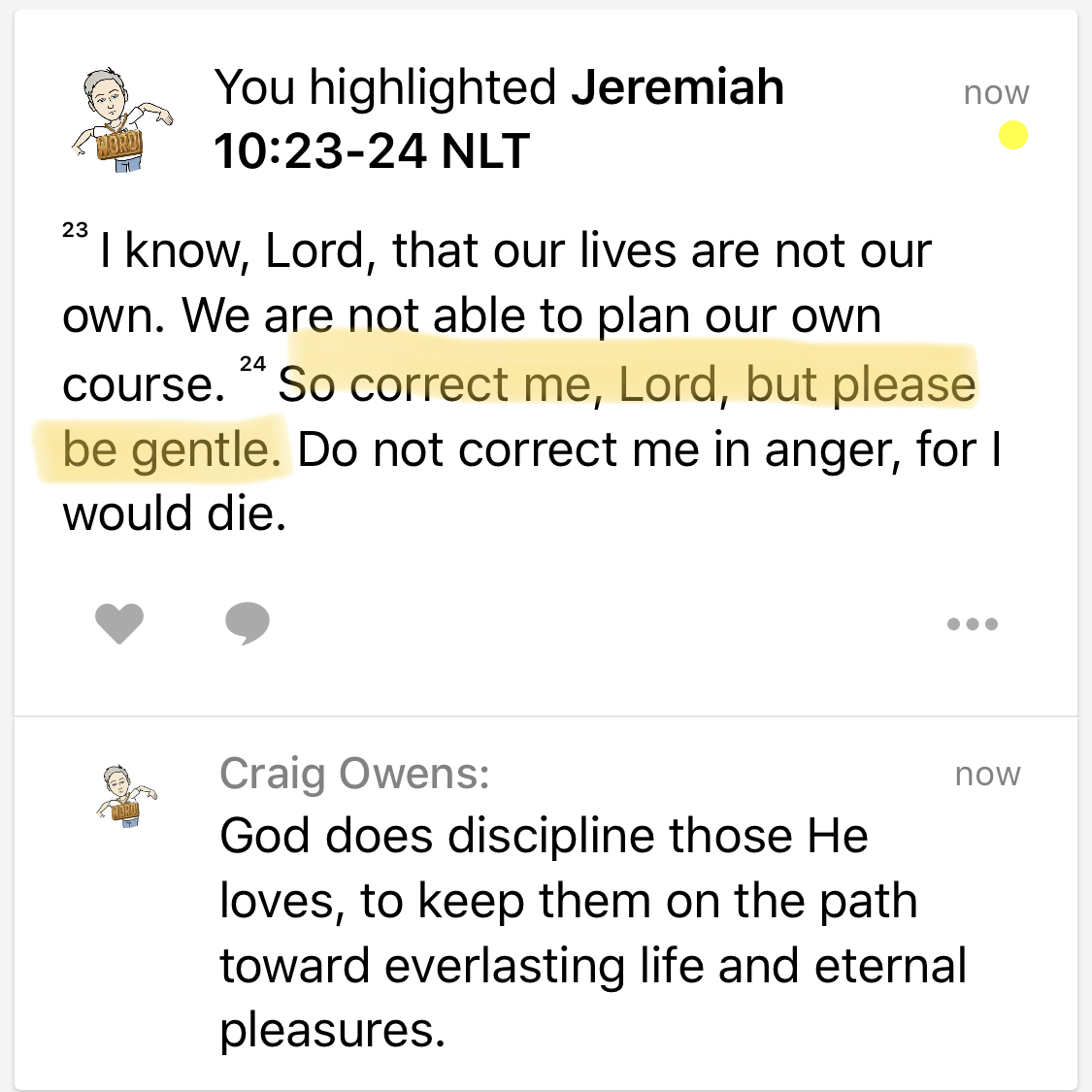
Lord, I know that people’s lives are not their own; it is not for them to direct their steps (Jeremiah 10:23 NIV).

I didn’t create my life—You did!

So “people do not control their own destiny” (NET)—You do!

“Mere mortals can’t run their own lives” (MSG)—You can!

“The way of man is not in himself” (NKJV)—it’s in You!

Discipline me, Lord, but only in due measure—not in Your anger, or You will reduce me to nothing (Jeremiah 10:24 NIV).

You can correct me “with justice” (NKJV)—I can’t!

You know how to “be gentle” (NLT)—I don’t!

God, You correct “as You see best” (MSG)—I can’t!

I’d say it’s pretty clear that there is only One who can lead me in the way I should go. So my prayer should always be: Heavenly Father, You are Sovereign, You are Love, and I trust You completely to guide me into paths of righteousness for Your name’s sake, as only You know how. Holy Spirit, help me to trust You in this journey. In Jesus’ name, amen.

I used only two verses to write this post, but I read them in multiple translations. This is another great Bible study tool that any of us can use. If you would like to read more about the various translations of the Bible and how to access them, please check out this post. 

►► Would you please prayerfully consider supporting this ministry? My Patreon supporters get behind-the-scenes access to exclusive materials. ◀︎◀︎

Thursdays With Spurgeon—Three Keys To Effective Prayer

This is a weekly series with things I’m reading and pondering from Charles Spurgeon. You can read the original seed thought here, or type “Thursdays With Spurgeon” in the search box to read more entries.

Listen to the podcast of this post by clicking on the player below, and you can also subscribe on AppleSpotify, or Audible. 

Three Keys To Effective Prayer 

     Why is this extraordinary power of prayer given to those who abide in Christ? May what I have to say encourage you to make the glorious attempt to win this pearl of great price! Why is it, that by abiding in Christ and having His words abide in us, we get to this liberty and prevalence in prayer? … 

     I answer, first, because of the fullness of Christ. … I see clearly enough why the branch gets all it wants while it abides in the stem, since all it wants is already in the stem and is placed there for the sake of the branch. What does the branch want more than the stem can give it? If it did want more, it could not get it. For it has no other means of living but by sucking its life out of the stem. O my precious Lord, if I want anything that is not in You, I desire always to be without it. I desire to be denied a wish that wanders outside of You. But if the supply of my desire is already in You for me, why should I go elsewhere? You are my all, where else should I look? … 

     The next reason for this is the richness of the Word of God. … The best praying man is the man who is most believingly familiar with the promises of God. After all, prayer is nothing but taking God’s promises to Him and saying to Him, ‘Do as You have said.’ … If the Word of God abides in you, you are the man who can pray because you meet the great God with His own words…. 

     A man will succeed in prayer when his faith is strong. And this is the case with those who abide in Jesus. It is faith that prevails in prayer. The real eloquence of prayer is a believing desire. ‘All things are possible to him who believes’ (Mark 9:23). A man abiding in Christ, with Christ’s words abiding in him, is eminently a believer and consequently eminently successful in prayer.

 From The Secret Of Power In Prayer

God Himself has told us, “Call to Me and I will answer you and tell you great and unsearchable things you do not know” (Jeremiah 33:3). Not “I might answer you,” but “I will answer you.” 

God also tells us how to receive what we ask in prayer:

  1. Abide in Jesus. Desire nothing else but to know His heart more intimately. 
  2. Know God’s Word. The Bible isn’t just a Book to be read through, but it’s a Book to be prayed through. 
  3. Stretch your faith. A desperate father said to Jesus, “If You can, please help us.” Jesus admonished that father—and all of us too—to believe that Jesus is able to accomplish what we ask of Him. And then comes this great exclamation from that same desperate father: “I do believe; help me overcome my unbelief!” The God that wants us to have faith in Him for answered prayers is the same God Who imparts that faith to us. How? By abiding in Jesus and taking God at His Word. 

Don’t give up, my friend. Keep praying. There is no other way to learn to pray more effectively than to keep on abiding in Jesus, keep on claiming the biblical promises, and keep on stretching your faith to present your prayer request to Him again.

►► Would you please prayerfully consider supporting this ministry? My Patreon supporters get behind-the-scenes access to exclusive materials. ◀︎◀︎