No one wants what the gloomy person has. Joy is a Christian’s testimony—it’s what attracts others to Jesus! Check out this full message from my series on the Songs of Ascent.
I have lots of new content every week, which you can check out on my YouTube channel.
“At first glance, people may not see how these different forms of sexual violence connect to each other. But, in fact, experts are increasingly recognizing that they may all stem from one common source—sexual objectification. Sexual objectification occurs when people perceive others as sex objects rather than complex human beings deserving of dignity and respect.” Pornography is a major contributor to the sexual objectification which leads to sexual violence.
Dr. Brian Thomas describes why fossils are found where they are and why land animals may even be found near marine animals: “This fossil discovery [a bone from a South American megaraptor found near Cape Otway, Australia] fits well with a biblical history, which goes something like this: Around 2348 BC, a worldwide flood crushed and reshaped the earth’s surface, breaking up a single landmass (Pangaea) into continents and fossilizing countless living things. Prior to the Flood megaraptors roamed Pangaea, during the Flood they were fossilized, and in the late Flood stages the boundaries of new continents (along with their fossils) were roughly shaped. Unlike the standard story, the outlines of this history have been testified to by reliable eyewitnesses, and this testimony has been faithfully preserved in Genesis.”
“The more we let God take over us, the more truly ourselves we become—because He made us.” —C.S. Lewis
J. Warner Wallace shares two trends in American society that are contributing to the decline of religious adherence in America.
“There is no way around hard work. Embrace it.” —Roger Federer
Shame on my thoughts, how they stray from me!
During the Psalms, they wander on a path that is not right; they run, they distract…
One moment they follow the ways of loveliness, and the next the ways of riotous shame…
Swiftly they leap in one bound from earth to heaven…
O beloved Christ… may the grace of the sevenfold Spirit come to keep them in check!
Rule this heart of mine, O swift God of the elements, that You may be my love, and I may do Your will! —Anonymous, On the Flightiness of Thought, Irish, 8th-9th century
Why has this people, Jerusalem, turned away in continual apostasy? They hold on to deceit, they refuse to return. I have listened and heard, they have spoken what is not right; no one repented of his wickedness, saying, “What have I done?” Everyone turned to his own course, like a horse charging into the battle. (Jeremiah 8:5-6)
“Everyone turned to his own course” is the description of our culture today.
Listen to the podcast of this post by clicking on the player below, and you can also subscribe on Apple, Spotify, or Audible.
The religious leaders who should have known God’s Word the best were the ones who wanted Jeremiah killed for speaking God’s Word boldly.
The priests and the prophets and all the people heard Jeremiah speaking these words in the house of the Lord. Yet when Jeremiah finished speaking everything that the Lord had commanded him to speak to all the people, then the priests and the prophets and all the people seized him, saying, “You must die!” … Then the priests and the prophets spoke to the officials and to all the people, saying, “A death sentence for this man! For he has prophesied against this city, just as you have heard with your own ears!” (Jeremiah 26:7-8, 11)
They did this to Jesus. The religious leaders shouted louder and louder, “Crucify Him!”
They will do this to me. Jesus said, “Blessed are you when people insult you, persecute you and falsely say all kinds of evil against you because of Me. Rejoice and be glad, because great is your reward in heaven, for in the same way they persecuted the prophets who were before you” (Matthew 5:11-12). And He said, “Be on your guard; you will be handed over to the local councils and be flogged in the synagogues. On My account you will be brought before governors and kings as witnesses to them and to the Gentiles” (Matthew 10:17-18).
Holy Spirit, help me to speak only what You tell me to speak and do only what You tell me to do (Matthew 10:19-20). Help me to respond quickly to any wrong thinking, speaking, or action that You point out so that I may just as quickly repent of that. I want my life to point others to Jesus, even as I face persecution.
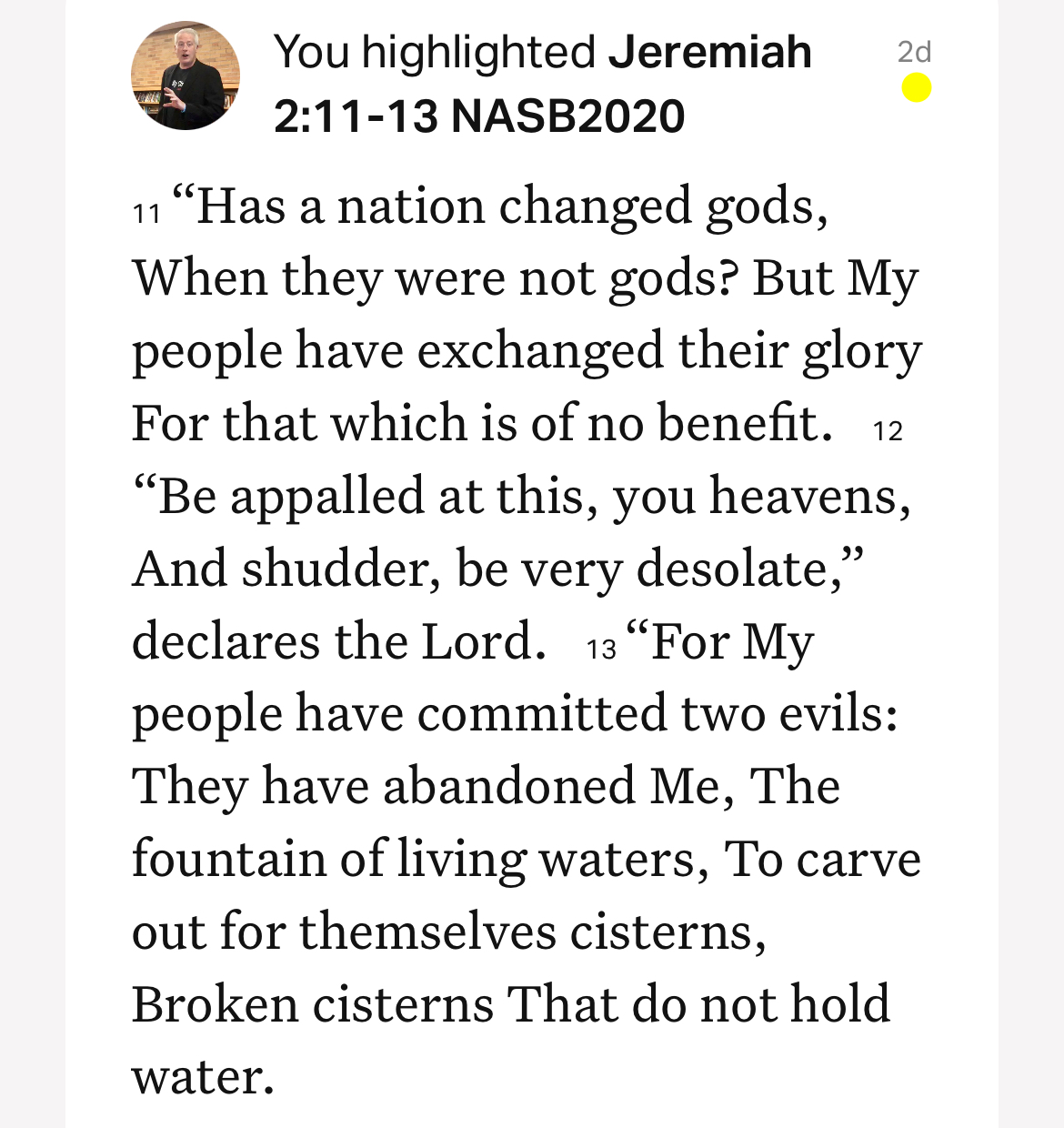
“Has a nation changed gods, when they were not gods? But My people have exchanged their glory for that which is of no benefit.Be appalled at this, you heavens, and shudder, be very desolate,” declares the Lord.“For My people have committed two evils: They have abandoned Me, the fountain of living waters, to carve out for themselves cisterns, broken cisterns that do not hold water. … Your own wickedness will correct you, and your apostasies will punish you; know therefore and see that it is evil and bitter for you to abandon the Lord your God, and the fear of Me is not in you,” declares the Lord God of armies. (Jeremiah 2:11-13, 19)
This was true of Judah, and it’s just as true today in nations that used to regard the Word of God as their righteous standard. We have abandoned God and we have attempted to satisfy ourselves with things that are transient at best.
God goes on to outline the results that we are already seeing in our homes, government, and cultures: “‘Your own wickedness will correct you, and your apostasies will punish you; know therefore and see that it is evil and bitter for you to abandon the Lord your God, and the fear of Me is not in you,’ declares the Lord God of armies” (Jeremiah 2:19).
There’s no secret formula to fruitfulness as a Christian. We just stay connected to Jesus and the fruit will grow. This clip is from this sermon.
I have lots of new content every week, which you can check out on my YouTube channel.
The “Ten Commandments” are not explicitly listed or reiterated in the New Testament. Does that mean they are obsolete? No, says David Mathis, it means they are fulfilled. “Jesus Himself says He did not come to destroy the Law and Prophets, but to do something even more striking: fulfill them (Matthew 5:17). That is, fulfill like prophecy. Not simply keep the Ten in place, or remain under them, or leave them untouched, but fulfill them—first in His own person, and then by His Spirit in His church. He came not to cast off Moses, but to fulfill Jeremiah, and in doing so, He accomplished what is even more radical: establishing Himself as the supreme authority, putting God’s law within His people (rather than on tablets), writing it on their hearts (rather than stone), and making all His people to know Him (Jeremiah 31:31–34).” Check out my post The 10 Commandments in the New Testament.
More archeological evidence supporting to the historicity of the Bible. You can check out the full article, but this paragraph is a good summation: “One of the surprising findings was that, according to the results of their tests, the Broad Wall in Jerusalem, also known as Hezekiah’s Wall, was likely built during the reign of Uzziah, who Scripture says built fortifications in Jerusalem (2 Chronicles 26:9). Another finding was that Jerusalem was much more heavily populated and urbanized in the 12th through 10th centuries BC than some scholars previously thought. This would align with the biblical description of Jerusalem, particularly during the days of David and Solomon.”
“There is much of beauty, goodness, and truth to be discovered in the city of man, as Augustine pointed out toward the end of his great treatise, City of God. But all the culture and best intentions of men turn to corruption apart from the power of God to redeem and renew them. We who live also in the heavenly city now possess the mind of Christ (1 Corinthians 2:16); we are able to see the ways that culture can be ‘taken captive’ from the clutches of sin and unbelief and made to serve the purposes of Christ in all things. Thus, for the honor and glory of God, we commit ourselves daily to using all our time, activities, relationships, roles, responsibilities, and culture to furthering His rule on earth as it is in heaven.” —T.M. Moore
“Have movies and most conventional paleontologists got it all wrong? T. rex and other theropod dinosaurs (the meat-eaters) are often portrayed as intelligent predators that can outmuscle and outsmart their opponents. But is that really supported by science?” A very interesting compilation of research can be found here. The conclusion is exactly right: “God designed dinosaur brains that were perfectly suited for their lifestyles and body size when He created dinosaurs on Day 6 of the creation week (Genesis 1:25).”
Listen to the podcast of this post by clicking on the player below, and you can also subscribe on Apple, Spotify, or Audible.
Jesus hung on the Cross for about 6 hours. He was mostly silent during this time—His seven statements from the Cross would have taken less than a minute to say them all back-to-back.
He hung silently and thoughtfully. I know He was thoughtful because John records, “Later, knowing that all was now completed, and so that the Scriptures would be fulfilled, Jesus said, ‘I am thirsty’” (John 19:28).
Movie directors will often show a flashback scene where their character looks back to remember what came before. I think during this silent time on the Cross, Jesus reviewed His public ministry. He reviewed every jot and tittle of every promise His Father had made, and He knew that each and every one had been completed.
This culminating event on the Cross was the fulfillment of the big picture that God had been painting all along. The system of sacrifices centered in the tabernacle or the temple had been trying to show us something.
There were daily sacrifices and annual sacrifices; there were sacrifices for willful sins and sacrifices for unintentional sins; there were sacrifices for priests and for laypeople. Day after day, week after week, month after month, year after year, decade after decade, century after century these sacrifices continued, never feeling like the work was finished.
These practices were only a shadow, but a shadow that foretells the Reality—
The law is only a shadow of the good things that are coming—not the realities themselves. For this reason it can never, by the same sacrifices repeated endlessly year after year, make perfect those who draw near to worship. … The reality, however, is found in Christ. (Hebrews 10:1; Colossians 2:17)
Jesus knew that He had come as the Reality (John 13:1), but before this final event on the Cross that would fully reveal the Reality, Jesus had one last thing to do: He wanted to share a final meal with His friends (Luke 22:7-15).
Jesus said that eagerly desired to eat the Passover meal with them. This Passover remembrance looked backwards to the deliverance from Egypt and was celebrated year after year, decade after decade, century after century.
The events were so long ago that they may have seemed like fading shadows to those who were celebrating this meal over a millennia after the fact. Jesus brought Reality.
Jesus knew He was the most powerful Person on earth, but He also knew that He had come to serve (Mark 10:45; John 13:3-5). To demonstrate His servanthood…
He washed the feet of His betrayer
He washed the feet that would run away from Him in terror
He prepared them for what was coming
Peter boldly declared that he would never run away, and Matthew and Mark record that all of the other disciples declared the same thing—(Luke 22:33; Matthew 26:35; Mark 14:31). But Jesus knew the prophecy that said, “I will strike the Shepherd, and the sheep of the flock will be scattered (Matthew 26:31).
So Jesus prepared them by praying for them, and He prepared them by showing them the Reality of all those daily, weekly, monthly, annual, and Passover sacrifices (Luke 22:17-20, 31-32).
Jesus was the completion of this sacrifices (Hebrews 7:26-28, 9:11-14)!
The prophecy God gave in Jeremiah was completed in Christ’s broken body and spilled blood on the Cross—“For I will forgive their wickedness and will remember their sins no more” (Jeremiah 31:31-34; Hebrews 8:12).
The purpose of this Last Supper—this meal that completes so many jots and tittles—is to remember. The devil wants you to remember what YOU did. Jesus wants you to remember what HE did.
Good Friday and the celebration of Communion helps us remember correctly that Jesus paid in-full the penalty for our sins, so now our forgiven sins are forgotten sins. The moment we sin, there is already the remedy for our sins that has been paid for. We repent, ask forgiveness, and receive His immediate cleaning.
Such amazing love!
If you have missed any of the messages in this series looking at some of the jots and tittles of prophecy that are fulfilled in Jesus, you can check them all out by clicking here.
Listen to the podcast of this post by clicking on the player below, and you can also subscribe on Apple, Spotify, or Audible.
I was reading the results of a survey which said one of the top traits for exemplary leaders was: They keep their word.
But don’t we really mean, “They keep their word most of the time”? After all, we do allow those who have a track record of integrity an “out” for unusual or unexpected circumstances. And we would still say that leader had honesty and integrity.
God always keeps His word. He never needs an “out” because nothing is ever unexpected for Him! He is always the Promise Maker and the Promise Fulfiller (Isaiah 42:9, 46:10, 55:10-11; Jeremiah 1:12).
I like the way Jesus sums up these statement from His Father: For assuredly, I say to you, till heaven and earth pass away, one jot or one tittle will by no means pass from the law till all is fulfilled (Matthew 5:18 NKJV).
Ajot is the smallest Hebrew letter (yodh). In Greek the word is iota. This tells us that God is concerned about the smallest of details.
A tittle is the precise difference between Hebrew letters like cheth and he, between daleth and resh, and between beth and kaph.
All of these are fulfilled—brought to their perfect completion (Luke 1:37, 22:37)!
When we see any of God’s promises made and kept, we need to ask ourselves three questions:
What did it mean then?
What does it mean now?
What does it mean for me today?
For example, look at the promise that was made about people living in a very dark place seeing the Light of God. The prophecy is first made in Isaiah 8:19-9:7 that the people of Zebulun and Naphtali would get to see and experience the light of the Messiah.
Matthew 4:11-17 tells us that after Jesus endured the temptation of the devil for 40 days, He went to Capernaum—the region of Zebulun and Naphtali. But before He arrived there, He was first rejected by the folks in His hometown of Nazareth (see Luke 4:14-31).
Our God who knows the end from the beginning never makes a mistake; nothing is ever random or inconsequential. We should develop the habit of praying, “Now that this is happened, what would You have me do?” As Jesus was rejected by the people who should have been so excited to see His ministry flourish, He wasn’t dismayed or discouraged, but He directed His steps toward Capernaum.
In my heart, I may plan a course for my life, but I must trust God to direct my steps. My life has a purpose. Just as the Holy Spirit directed the movements of Jesus, He is directing my steps.
Even when God seems to have directed my steps into a dark place, He has sent me there as His light. I am sent on purpose. I walk a path Jesus has already walked, and a path that He is still walking with me—He guides me in paths of righteousness for His name’s sake. Even though I walk through the valley of the shadow of death, I will fear no evil, for You are with me (Psalm 23:3-4).
I don’t walk into the darkness in my own strength or as a way to fulfill my own plans but instead I trust that “the zeal of the Lord Almighty will accomplish this” (Isaiah 9:7)!
Because Jesus is fulfilling every jot and every tittle, I can live confidently in Him!
If you would like to follow along with all of the messages in this series called Jots and Tittles, you can find them all here.
Listen to the podcast of this post by clicking on the player below, and you can also subscribe on Apple, Spotify, or Audible.
You may have heard it said that Christians are supposed to pray for those who are in governmental leadership positions over them. Is that really true? And if it is, what exactly are we supposed to pray for them?
►► Would you please prayerfully consider supporting this ministry? My Patreon supporters get behind-the-scenes access to exclusive materials. Become a supporter today and get access to all of my previous posts plus have instant access to all of the new materials that are being posted weekly. ◀︎◀︎
Listen to the podcast of this post by clicking on the player below, and you can also subscribe on Apple, Spotify, or Audible.
When Luke says first that “Jesus grew in wisdom,” that is our indication that a healthy mind is at the foundation for every other aspect of health (Luke 2:52). We don’t see Jesus anxious or worried, we don’t see Him confused in His thinking, or even indecisive of what to say or do. So by studying the life of Jesus—and the Scriptures on which He relied—we, too, can improve our mental health.
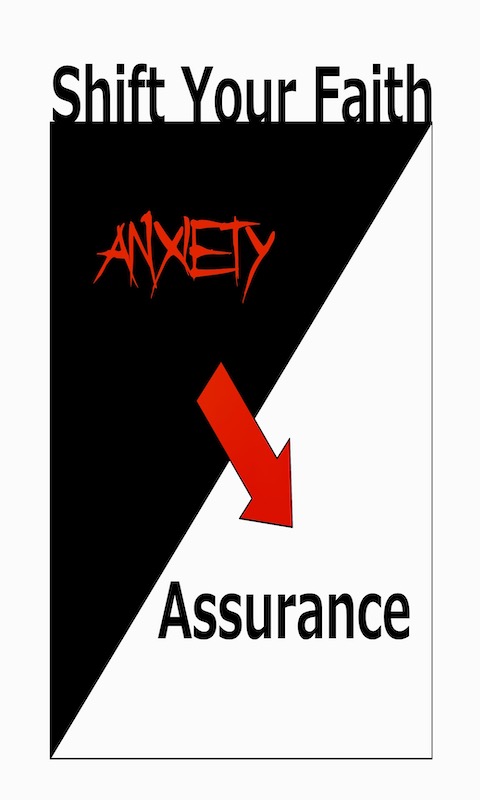
This may sound unbelievable when you first read this, but I believe that at their foundation, anxiety and assurance are remarkably similar. The similarity is that they both have faith.
The dictionary defines faith as a strong or unshakeable belief in something. The biblical definition of faith is remarkably similar: “Faith is confidence in what we hope for and assurance about what we do not see” (Hebrews 11:1).
Using those definitions of faith, let me point out the similarity and the difference between the anxious mind and the assured mind:
Anxiety is faith or expectation that something bad is going to happen.
Assurance is faith or expectation that something good is going to happen.
But the biggest difference of all is seen in the mental health of the one worried and anxious about the bad things that are coming versus the one who is confidently assured of the good things that are coming.
If we are going to be mentally healthy people, we need to shift our faith from anxiety to assurance every single time we feel the worry building in our hearts. This isn’t just changing our mindset but knowing what we believe and why we believe it.
Assurance and anxiety both believe in the unseen. The assured person believes in God’s promises to provide all that we need, while the anxious person doubts their own abilities and resources will be able to sustain them.
As a result, the assured person has an abundance mindset, while the anxious person has a scarcity mindset.
These feelings can be traced back to our faith about the origins of the universe. The assured person believes that God transcends this universe—that He existed before time began and spoke all created things into existence (Hebrews 11:3). But the anxious person is still trying to find answers in constantly-changing theories about the universe’s beginning.
Finally, the person who sees the universe and their own life as accidental becomes quite anxious and uneasy when they think about death, and what may or may not come on the other side. But the one who trusts God as their Creator is confident that God is their eternal reward (Hebrews 11:6).
Hebrews 11 is filled with the accounts of assured people who shifted their faith away from anxiety—believing something bad was going to happen—to the assurance that God was bringing about something incredibly good! Hebrews 12 then invites Christians today to remember that cloud of witnesses and keep our eyes on Jesus, who is described as the Author and Perfecter of our faith, so that we don’t lose hope (Hebrews 12:1-3).
I’ve previously shared seven strategies for a Christian to maintain a strong mental health. Our eighth strategy is a constant shifting of our faith away from anxiety to assurance. Every single time an anxious thought tempts us to believe something bad is coming, we need to make a shift toward the assurance of God’s goodness.
Really quickly, here is how we can use the first seven strategies to help us make that shift:
Pray for the Holy Spirit to help you make a new path.
Notice your fearful or anxious words and pull them out by the root.
Confront the thought patterns that are causing fear or anxiety.
Talk back to those fearful thoughts with the truth from God’s Word.
Check the inputs that may be causing fear (poor diet, not taking time for solitude, anxious friends, etc.).
Focus on today—I like the words of the song “strength for today and bright hope for tomorrow!”
Don’t look to escape, but take time to de-escalate.
Listen to the podcast of this post by clicking on the player below, and you can also subscribe on Apple, Spotify, or Audible.
The Bible is not only the inspired Word of God but it is rooted in history too. Every prayer was prayed by a real person in distress, and every song of praise was lifted up by someone who personally experienced God’s deliverance.
The reason why this is so important is that it makes God’s Word relatable and applicable to us. If the Bible merely contained moral stories set in some make-believe world, we may have a hard time seeing how to apply the principles to our daily lives. But, thankfully, this isn’t the case. We can read the real-life experiences of real historical people and then we can allow the Holy Spirit to help us apply this inspired Word to our lives.
There is a collection of 15 songs in the Book of Psalms called “The Songs of Ascent.” Even these songs have an important historical background.
Second Chronicles ends with this proclamation from King Cyrus: “The Lord, the God of heaven, has given me all the kingdoms of the earth and He has appointed me to build a temple for Him at Jerusalem in Judah. Anyone of His people among you—may the Lord his God be with him, and let him go up” (2 Chronicles 26:23).
The phrase “let him go up” is both literal (since Jerusalem is 2500 feet above sea level) and spiritual. Listen to these words from King Solomon, “The way of life winds upward for the wise, that he may turn away from hell below” (Proverbs 15:24 NKJV).
The Songs of Ascent were a rallying cry—an encouragement to all pilgrims to keep climbing up.
In Hebrew literature, the main point is usually found in the middle of the poem or story, unlike our Western literature which puts the payoff at the end. In the first Song of Ascent, the middle is verse 4. But the second half of Psalm 120 seems out of place for people ascending up to Jerusalem to worship God. Verse 5 begins with the words, “Woe to me.”
The psalmist is expressing his pain in living among the people of Meshech and Kedar. The people of Meshech were vicious people who traded human lives for money and who conducted themselves as terrorists (Ezekiel 27:13; 32:26). Their name literally means “drawing away.” The people of Kedar were nomadic sons of Ishmael. Being nomadic means they were never at rest. Their name literally means “dark place.” Very noteworthy is that there is no mention of God in verses 5-7.
The middle verse of this song (v. 4) turns the people of Meshech and Kedar over to God. It is a reminder that we are not the ones to dispense justice. If God knew how to overthrow the powerful kingdoms of Judah, Babylon, and the Medes, if He knew to call Cyrus by name at just the right moment, He also knows how to deal with these sinners.
This Song of Ascent shows the stark contrast between keeping our eyes on the dark culture around us versus keeping our eyes on the God who is never weighed down by the darkness. As we go higher up, we focus more on God; as His saints focus on Him, His light shines on them; as His light shines on them, they point sinners living in dark valleys to the God of light and love.
Staying down is easy. Getting up requires intentional effort. Going up requires us to overcome the pull of sin and the frustration of watching for judgment to fall on sinners.
Continually going up glorifies God, has eternal rewards for saints, and creates a compelling testimony for sinners.
Going up is a lot of effort, but the rewards are so worth it! As the apostle Paul reminded his friends in Rome, “I consider that our present sufferings are not worth comparing with the glory that will be revealed in us” (Romans 8:18). Let’s keep climbing up and let’s keep lifting our eyes to the only One who has the eternal light.




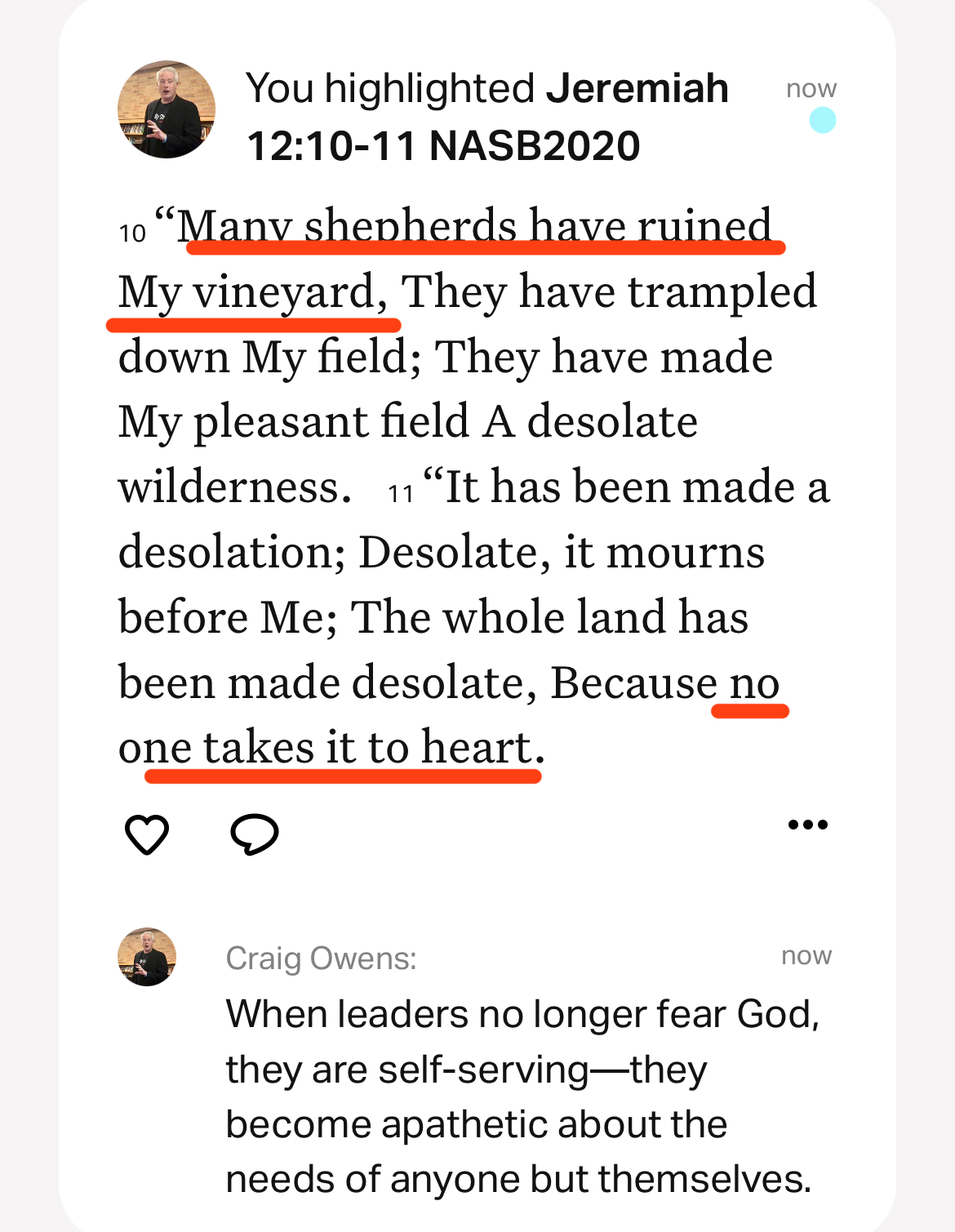 Ungodly leaders become more and more selfish, while shepherd leaders become more and more God-fearing and more and more attentive to the needs of others (Jeremiah 12:10-11). Check out my series of posts for godly leaders and my book Shepherd Leadership.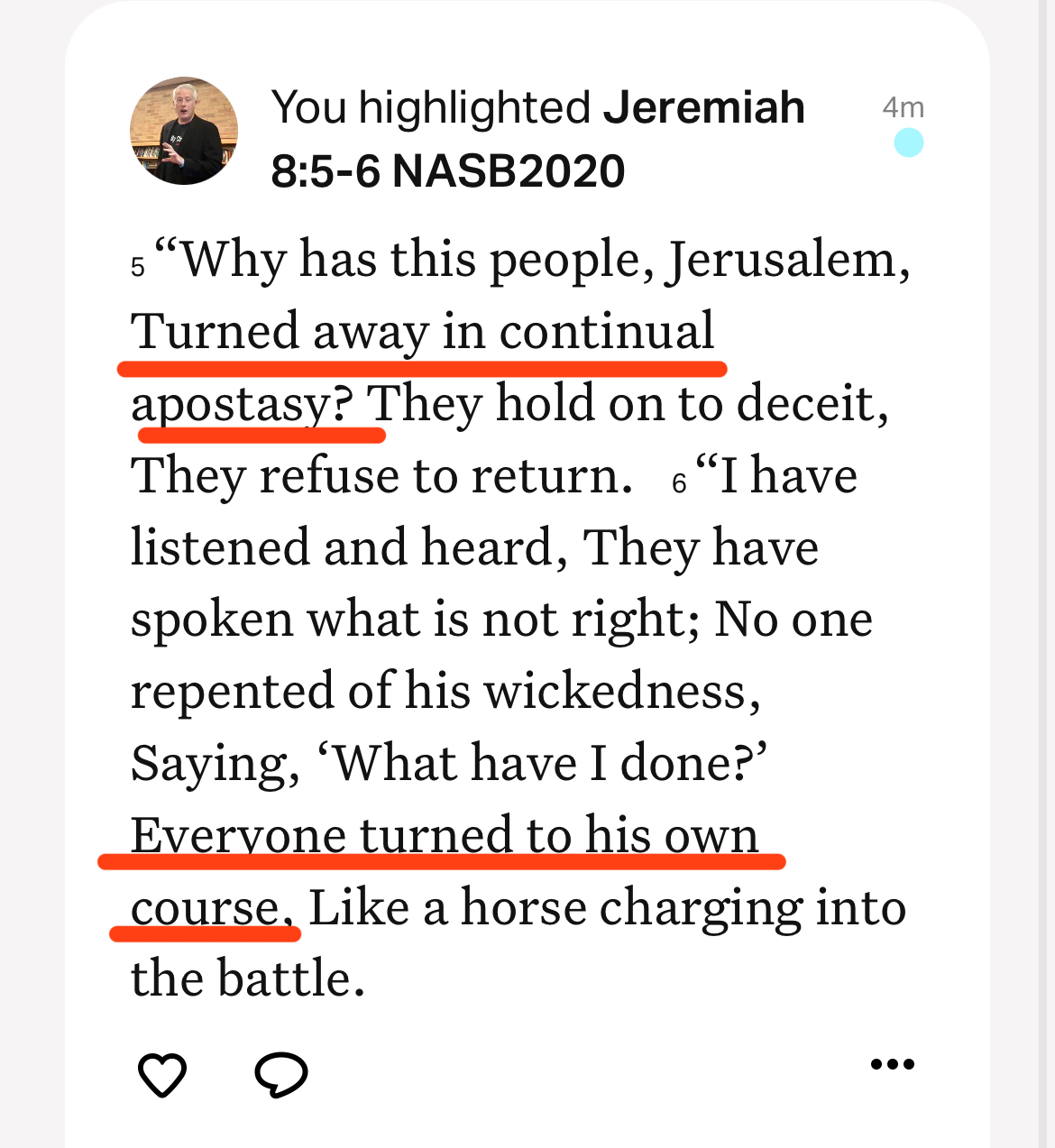





 Craig T. Owens