Listen to the podcast of this post by clicking on the player below, and you can also subscribe on iTunes or Spotify.
C.S. Lewis gives us fantastic insight into the temptations the devil tries to use against Christians. You can read my full book review here. Just as a reminder: When Screwtape talks about “the Enemy” he is referring to God and when he says “our Father” he is talking about satan.
“Prosperity knits a man to the World. He feels that he is ‘finding his place in it,’ while really it is finding its place in him.”
“Music and silence—how I detest them both! How thankful we should be that ever since our Father entered Hell—though longer ago than humans, reckoning in light years, could express—no square inch of infernal space and no moment of infernal time has been surrendered to either of those abominable forces, but all has been occupied by Noise—Noise, the grand dynamism, the audible expression of all that is exultant, ruthless, and virile—Noise which alone defends us from silly qualms, despairing scruples, and impossible desires. We will make the whole universe a noise in the end.”
“Let his inner resolve be to bear whatever comes to him, but to bear it ‘for a reasonable period’—and let the reasonable period be shorter than the trial is likely to last. It need not be much shorter…. The fun is to make the man yield just when (had he but known it) relief was almost in sight.”
“Surely you know that if a man can’t be cured of churchgoing, the next best thing is to send him all over the neighborhood looking for the church that ‘suits’ him until he becomes a taster or connoisseur of churches.”
“Our Enemy is a hedonist at heart. All those fasts and vigils and stakes and crosses are only a facade. Or only like foam on the seashore. Out at sea, out in His sea, there is pleasure, and more pleasure. He makes no secret of it; at His right hand are ‘pleasures forevermore.’ Ugh! … He has filled His world full of pleasures. There are things for humans to do all day long without His minding in the least—sleeping, washing, eating, drinking, making love, playing, praying, working. Everything has to be twisted before it’s any use to us.”
“You will say that these are very small sins; and doubtless, like all young tempters, you are anxious to be able to report spectacular wickedness. But do remember, the only thing that matters is the extent to which you separate the man from the Enemy. It does not matter how small the sins are provided that their cumulative effect is to edge the man away from the Light and out into the Nothing. Murder is no better than cards if cards can do the trick. Indeed the safest road to Hell is the gradual one—the gentle slope, soft underfoot, without sudden turnings, without milestones, without signposts.”
“Your patient has become humble; have you drawn his attention to the fact? All virtues are less formidable to us once the man is aware that he has them, but this is specially true of humility. Catch him at the moment when he is really poor in spirit and smuggle into his mind the gratifying reflection, ‘By Jove! I’m being humble,’ and almost immediately pride—pride at his own humility—will appear. If he awakes to the danger and tries to smother this new form of pride, make him proud of his attempt. … You must therefore conceal from the patient the true end of Humility. Let him think of it not as self-forgetfulness but as a certain kind of opinion (namely, a low opinion) of his own talents and character.”
“There are two equal and opposite errors into which our race can fall about the devils. One it to disbelieve in their existence. The other is to believe, and to feel an excessive and unhealthy interest in them.”
“Even of his sins the Enemy does not want him to think too much: once they are repented, the sooner the man turns his attention outward, the better the Enemy is pleased.”
“Whenever they are attending to the Enemy Himself we are defeated, but there are ways of preventing them from doing so. The simplest is to turn their gaze away from Him towards themselves. Keep them watching their own minds and trying to produce feelings there by the action of their own wills. When they meant to ask Him for charity, let them, instead, start trying to manufacture charitable feelings for themselves and not notice that this is what they are doing. When they meant to pray for courage, let them really be trying to feel brave. When they say they are praying for forgiveness, let them be trying to feel forgiven. Teach them to estimate the value of each prayer by their success in producing the desired feeling; and never let them suspect how much success or failure of that kind depends on whether they are well or ill, fresh or tired, at the moment.”
Listen to the podcast of this post by clicking on the player below, and you can also subscribe on Apple, Spotify, or Audible.
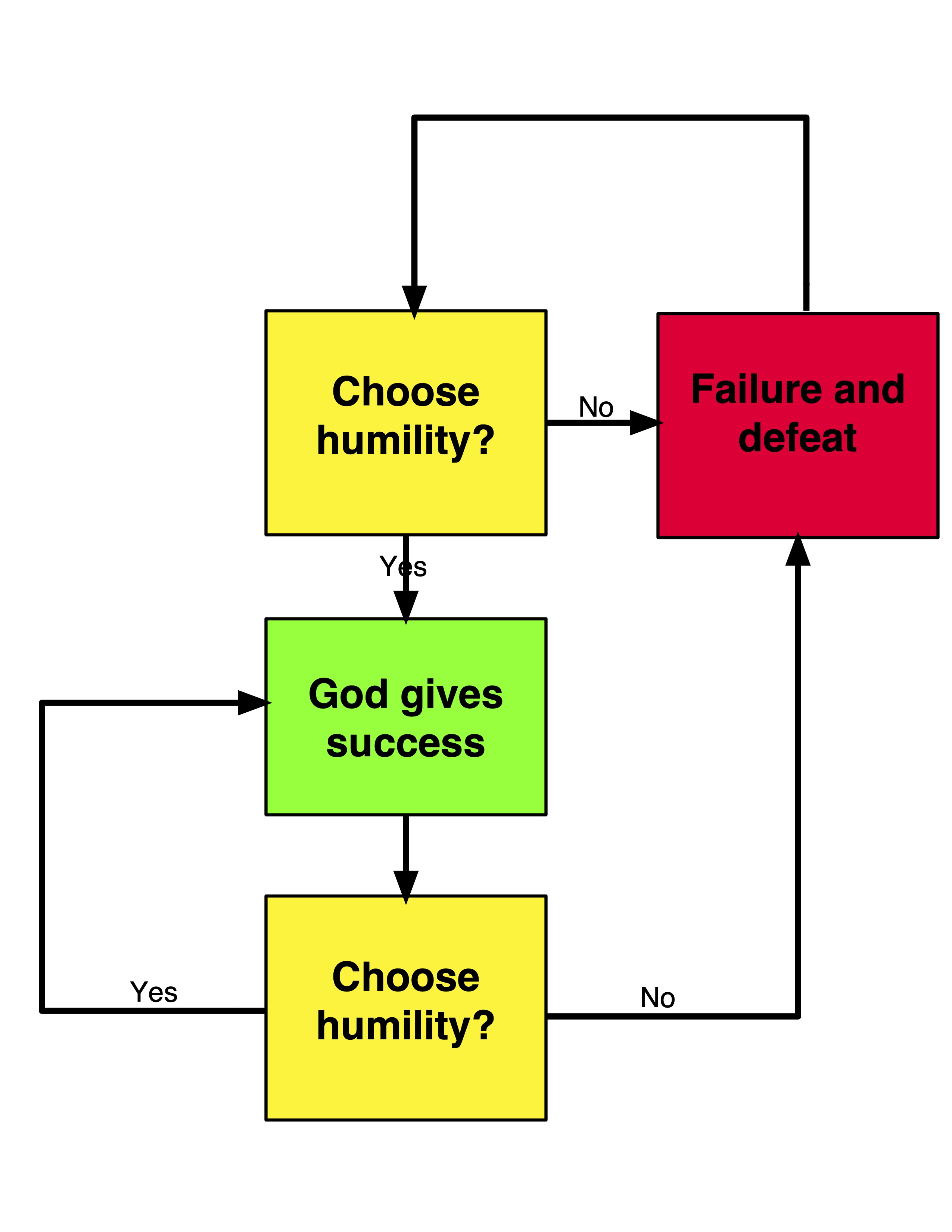
…As long as Uzziah sought the Lord, God gave him success. … But after Uzziah became powerful, his pride led to his downfall… (2 Chronicles 26:5, 16).
Success makes me more vulnerable to pride. Success can distract from the very One who gave me success. I am in danger of losing God’s blessings in the very moment I am enjoying God’s blessings.
Humility has to be an ongoing choice. That choice becomes harder as the successes become bigger or more frequent. But choosing pride in “my accomplishments” will undo all the previous successes.
The only way to keep these blessings is two words: IF ONLY. If only I will continue to remain humble before God and obedient to Him.
Uzziah, sadly, didn’t make that choice. His pride in God’s success led to his downfall.
His son Jotham learned this lesson. Jotham grew powerful because he walked steadfastly before the Lord his God (27:6).
I like the KJV of this verse that says, “Jotham grew powerful because he prepared his ways before the Lord his God.”
Jotham was keenly aware that everything he did was seen by God. He was determined that everything he did would be pleasing in God’s sight. The word “before” in verse 6 means “in front” of or even “before the face.” Jotham didn’t live as though he might face God at the end of his life, but as though he was facing God at every moment of his life.
Notice two phrases in this sentence—grew powerful and walked steadfastly. They are directly tied to each other: Jotham became powerful only because he was determined to live righteously and humbly in God’s sight. The more powerful he became, the more he increased his commitment to live humbly before God’s face.
He did what was right in the eyes of the Lord, just as his father Uzziah had done, BUT unlike him he did not enter the temple of the Lord (v. 2).
Jotham humbly prepared his ways before the Lord, and when God made him powerful Jotham re-committed to stay humble. Great choice!
I’ll say it again: The only way to keep God’s blessings on my initial humble choice is to continue to choose humility at every moment of success.
►► Would you please prayerfully consider supporting this ministry? My Patreon supporters get behind-the-scenes access to exclusive materials. ◀︎◀︎
“…the heavens, even the highest heavens, cannot contain You. How much less this temple I have built! Yet, Lord by God, give attention to Your servant’s prayer…” (2 Chronicles 6:18, 19).
It’s amazing to think that the Limitless God of the Universe condescends to listen to frail human prayers!
The key is my humility to approach God. Not as one afraid to approach, but as one who is humbly confident that He wants me to come to Him (see Matthew 6:8).
Solomon repeatedly asked God to “hear” and respond (vv. 19, 20, 21, 23, 25, 27, 30, 33, 35, 39). And God says, “I have heard you and I will continue to hear and respond” (7:12, 14)!
If God wants to hear from me, why do I try to handle things on my own?!
On this episode of “The Craig And Greg Show” we talk about:
Check out this episode and subscribe on YouTube so you can watch all of the upcoming episodes. You can also listen to our podcast on Spotify and iTunes.
Get more information at Maximize Leadership.
Micah the prophet’s name means who is like God, or more literally: “who but God?” The implied answer, of course, is no one!
Micah opens his letter by telling us his name, and then he closes his prophetic words with a play on his name when he says, “Who is a God like You?” (7:18-20). Who else but God could…
NO ONE!
In light of this, how should we respond to this amazing God? Micah asks a series of rhetorical questions about what sort of religious practices would somehow “balance the scales” for God’s amazing gifts to us. But here’s the deal: there is no way for us to balance the scales! Instead, Micah tells us this, “God has showed you what is good. What does the Lord require of you? To act justly, to love mercy, and to walk humbly with your God.”
In other words, our response to God’s invaluable gifts must transition from a have to lifestyle to a get to lifestyle! Micah makes it clear that God’s Spirit empowers us to live this way (Micah 3:8).
It is the Holy Spirit who empowers Christians to act justly, love mercy, and walk humbly with our God.
The apostle Paul agrees with Micah, even echoing some of Micah’s own phrases—God’s great love, His rich mercy, His unearned grace, His forgiveness of sin, His kindness, and His salvation (Ephesians 2:4-10). Why did God do all of this? So that we could “do good works”—like acting justly, loving mercy, and walking humbly—“which God prepared in advance for us to do”!
I am saved by grace SO THAT I am free to do grace-filled, Spirit-empowered, good things.
All of this prompts me to ask myself three introspective questions:
Who but God could call us, forgive us, and forget our sins? NO ONE!
Who but God could empower us to live in such a way that others see His greatness too? NO ONE!
Let’s never, ever become self-reliant or works-dependent (that’s have to living), but let’s stay so Spirit-reliant that we cannot help be get to people!
If you’ve missed any of the other messages in our series about major lessons from the minor prophets, you can find the full list by clicking here.

King David was a unifier. He took people that were territorial and possessive of their own tribes and unified them into the strong nation of Israel.
The way he responded to the murders of Saul, Abner, and Ish-Boseth prompted this response: “All the people took note and were pleased; indeed, everything that the king did pleased them. So on that day all the people there and all Israel knew that the king had no part in the murder of Abner son of Ner” (2 Samuel 3:36-37).
The leaders of Israel’s various tribes then followed the lead of Abner—“All the tribes of Israel came to David at Hebron” and “all the elders of Israel” joined with David (5:1, 3).
David accepted all of this in confident humility. He knew that it wasn’t his doing but God’s. He made sure to stay reliant on God (5:19, 23), keeping in mind that he was leading to win victories for all Israel: “Then David knew that the Lord had established him as king over [all] Israel and had exalted his kingdom for the sake of His people Israel” (5:12).
Result: “[David] became more and more powerful, because the Lord God Almighty was with him” (v. 10).
God delights to empower leaders who have a humble heart to unify God’s people. God will let self-made leaders struggle in their own ability, but He will unleash all His resources to help the humble, God-dependent leader.
These God-empowered leaders are the only ones who can bring lasting unity.
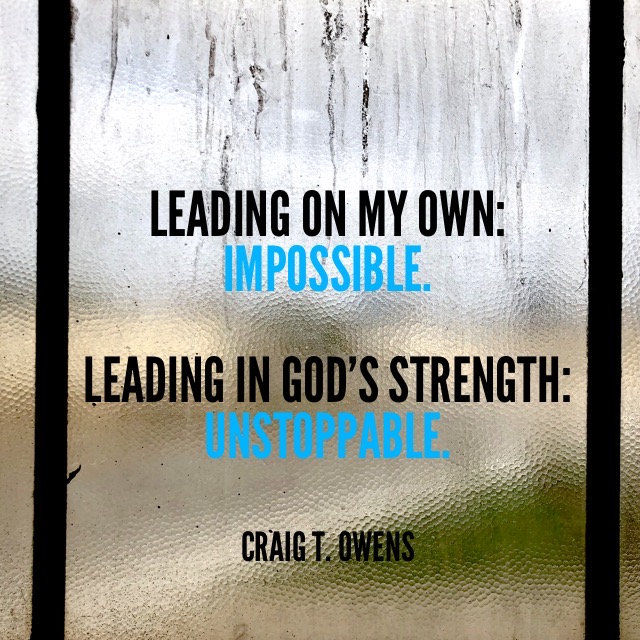
Leading on my own strength: Impossible.
Leading in God’s strength: Unstoppable!
[read all of these passage in the Bible for yourself by clicking here]
My dear friends Josh and Judy are moving. They feel like God has been calling them to Nebraska, and I affirm that God is directing them into this new chapter for their lives. I will miss them dearly, but I know God has indeed called them.
During times like this many people will often ask, “How do I know that God is directing me?”
In the Bible we see God speaking to people in several ways:
But most often God speaks through the inner voice of the Holy Spirit.
The Holy Spirit is a Person. He is described as having a mind, a will, and emotions. Although He doesn’t have a physical body, He is still a Person. Just like any person you could get to know, you can get to know the Holy Spirit more and more personally, becoming increasingly more acquainted with His voice.
All of us are unique individuals. God has never, ever duplicated a person. Your combination of genes, talents, personality, and personal experiences make you a one-of-a-kind in all of human history. That means that God speaks uniquely to each of us.
Even though the exact manner God will speak to us will be unique, there are some clear principles that we can know from the Bible.
1. Humbly listen for God’s voice.
Solomon wrote, “Trust in the Lord with all your heart and lean not on your own understanding; in all your ways acknowledge Him, and He will make your paths straight” (Proverbs 3:5-6). Let me unpack three key phrases:
2. Consult with godly friends.
In Acts 16, the apostle Paul and his companions are attempting to go into new territories to share the good news about Jesus but Luke records twice that the Holy Spirit wouldn’t allow them. Perhaps they felt out-of-sync with the Spirit when they attempted to make their plans. Ultimately, God did open a door for them to move forward and Luke writes, “Concluding that God had called us.” Notice that word “us.” Paul shared his heart with his godly friends and they affirmed God’s voice, much as I affirmed the call on Josh and Judy’s lives in their move.
3. Don’t be overly concerned about making a mistake.
In Romans 8, Paul reminds us that God is working all things together for your good and for His glory. “All things” means even your mistakes—like not noticing that the Spirit was prompting you to move, or perhaps temporarily heading down a wrong path. The Holy Spirit can help you look back and see how these experiences have prepared you for your present moment. Even those missteps can be used for God’s glory. But most importantly, those missteps have never diminished God’s love for you!
Your journey will be unique from everyone else’s journey, but these three principles are applicable to everyone who wants to walk in the paths God has set for them.
These are the last words of David: “The inspired utterance of David son of Jesse, the utterance of the man exalted by the Most High, the man anointed by the God of Jacob, the hero of Israel’s songs. The Spirit of the Lord spoke through me; His word was on my tongue. The God of Israel spoke, the Rock of Israel said to me: ‘When one rules over people in righteousness, when he rules in the fear of God, he is like the light of morning at sunrise on a cloudless morning, like the brightness after rain that brings grass from the earth.’” (2 Samuel 23:1-4)
Look how David describes himself:
This statement by David reminds me of the words Moses spoke about himself: “Moses was a very humble man, more humble than anyone else on the face of the earth” (Numbers 12:3)!
David also said that he was the hero of Israel’s songs. The King James Version says he was “the sweet psalmist of Israel.” However he is described, these are his last words. Literally, that means that his words loitered. They hung around. They continued to impact people’s lives long after he was gone.
Look how long his words loitered. When the Church prayed in Acts 4, they quote David’s prophetic words, stating that they were spoken through the Holy Spirit. David said that’s exactly how he was speaking—“the Spirit of the Lord spoke through me; His word was on my tongue” (v. 2), and God Himself is recorded as speaking through David in verse 3.
David was both confident of this and humbled by this.
God is still looking for people through whom He may speak loitering words.
May our prayer be—God, You are still looking for men and women through whom You can impart loitering words. You want to put Your words in the mouth of those who are righteous in Your sight and who walk in reverent fear of Your holiness, those who acknowledge Your love and Your sovereignty. O God, make me that person! I don’t want to speak idle words, but life-changing, God-glorifying, Spirit-empowered words that will loiter, and impart truth, and bring people to Jesus. Show me what I need to change to be the one through whom You will speak Your loitering words.