9 Quotes From “Your Joy Will Turn To Sorrow”

Your Sorrow Will Turn To JoyAlthough Your Joy Will Turn To Sorrow is intended to be read each morning and evening of Holy Week (check out my book review here), the content is so good that it will benefit you anytime you decide to read it! Here are some quotes that especially caught my attention.

“The only Savior who truly saves, only saves through suffering. The Cross was the only means of making us sinners right before a holy God. Our salvation was purchased with suffering, and it will be sealed and preserved with suffering (James 1:2-4), not comfort. We are promised comfort in the Christian life (2 Corinthians 1:4), but not the cheap, temporal imitation we’ve grown accustomed to in our modern world.” —Marshall Segal

“Jesus did not come to purchase the approval of others. No, He ‘was despised and rejected by men; a Man of sorrows, and acquainted with grief; and as One from whom men hide their faces He was despised’ (Isaiah 53:3). Why? Because it is God’s approval we desperately need. And God’s approval doesn’t come by popular opinion, but by divine intervention—the substitution of His own Son in our place.” —Marshall Segal

“The irony of Mark 14 is that Judas could see the value of the ointment rolling down Jesus’ head, but he couldn’t see the value of Jesus. He was a pawnbroker with cataracts. That’s why he took such offense at the woman. The woman, on the other hand, could see both the value of the ointment and the value of Jesus. That’s why she broke the flask.” —Jonathan Bowers

“No one understands better than God how difficult it can be for a human to embrace the will of God. And no human has suffered more in embracing the will of God the Father than God the Son. When Jesus calls us to follow Him, whatever the cost, He is not calling us to do something He is either unwilling to do or is never done Himself.” —Jon Bloom

“So, now, we say with an entirely different meaning, let His blood be on us, not defiantly as the crowds that crucified Him, but desperately—with gratitude and hope and adoration—as those who depend wholly on His sacrifice. Jesus, let Your blood be on us. Let it cover us. Let the blood that flows from Your head, Your hands, Your feet wash over us and cleanse us from all our iniquity. We proclaim Jesus’ death. We rejoice in his death, not because we believe He was a fraud or a lunatic, but because it is by His death, by His wounds, by His blood that we are healed.” —Marshall Segal

“Jesus spoke of this joy as He faced the torture of Good Friday. He faced denial, faced betrayal, faced beatings, faced splinters and nails and spears—He could not stop talking about joy! Only joy would keep Him going. Joy was on His mind, joy was on His tongue, and joy was drawing Him, not away from suffering, but into it (Hebrews 12:2). Jesus went to the Cross for joy: to buy joy, create joy, and offer joy. As the world celebrated the savage killing of God, out of this sea of foaming rebel hostility emerged a blood-bought, inextinguishable joy.

“If the killing of the Author of life could not extinguish this joy Jesus speaks about, nothing can—and nothing ever will. No opposition from the world, no opposition to the gospel, and no cultural despising of Christ will overcome the resurrection joy of Jesus.” —Tony Reinke

“If Christ is still dead, death reigns, and all our joys our vain. So hoard every plastic Easter egg you find, because whatever you find inside is all the joy you have to grab. Or, as Paul says, ‘If the dead are not raised, let us eat and drink, for tomorrow we die’ (1 Corinthians 15:32). But if death is dead, and if the dead are raised—if Christ is risen from the dead!—brothers and sisters, let us feast and celebrate, for the daunting light of our inextinguishable and inexhaustible eternal pleasures have broken into the darkness, offering us a life of joy in Christ that cannot fade or rust or be stolen away!” —Tony Reinke

“Easter has now become our annual dress rehearsal for that great coming Day. When our perishable bodies will put on the imperishable. When the mortal finally puts on immortality. When we join in the triumph song with the prophets and the apostles, ‘O death, where is your victory? O death, where is your sting?’ (Hosea 13:14; 1 Corinthians 15:55).” —David Mathis

“Indeed, even agony will turn to glory, but Easter doesn’t suppress our pain. It doesn’t minimize our loss. It bids our burdens stand as they are, in all their weight, with all their threats. And this risen Christ, with the brilliance of the indestructible life in His eyes, says, ‘These too I will claim in the victory. These too will serve your joy. These too, even these, I can make an occasion for rejoicing. I have overcome, and you will more than conquer.’ 

“Easter is not an occasion to repress whatever ails you and put on a happy face. Rather, the joy of Easter speaks tenderly to the pains that plague you. Whatever loss you lament, whatever burden weighs you down, Easter says, ‘It will not always be this way for you. The new age has begun. Jesus has risen, and the Kingdom of the Messiah is here. He has conquered death and sin and hell. He is alive and on His throne. And He is putting your enemies, all your enemies, under His feet.’” —David Mathis
Your Sorrow Will Turn To Joy (book review)

Your Sorrow Will Turn To JoyHoly Week is always a good time to slow down to take a closer look at the events leading up to Christ’s crucifixion and resurrection. I never want to “go through the motions” and miss out on some new revelation of all that Jesus did for us. An excellent companion for this journey is Your Sorrow Will Turn To Joy by the writers at Desiring God.

This book covers the eight days of Holy Week, from Palm Sunday to Resurrection Sunday. Each day has an insightful reading selection for both the morning and evening. The authors pulled together the accounts from all four of the Gospels, to offer unique insights and observations on each step of Christ’s journey to the Cross, the grave, and the empty tomb. As I read, I marveled again at the amazing love God showered on us!

The good folks at Desiring God have made this book available free of charge in its ebook format. Otherwise, the paperback can be purchased at a nominal cost.

Pick up a copy and read through it on the next Holy Week, and I promise you will see something fresh about the joy that Christ’s finished work on Calvary brings to those who will believe in Him!

Did Jesus Rise From The Dead?

Good Friday—It Is Finished

Your Sorrow Will Turn To JoyThis is from a chapter in Your Sorrow Will Turn To Joy, and is probably one of the best depictions of Good Friday I have read. Jon Bloom writes—

It is Friday, April 3, A.D. 33. It is the darkest day in human history, though most humans have no clue of this. In Rome, Tiberius attends to the demanding business of the empire. Throughout the inhabited world, babies are born, people eat and drink, marry and are given in marriage, barter in marketplaces, sail merchant ships, and fight battles. Children play, old women gossip, young men lust, and people die. 

But today, one death, one brutal, gruesome death, the worst and best of all human deaths, will leave upon the canvas of human history the darkest brushstroke. In Jerusalem, God the Son, the Creator of all that is (John 1:3), will be executed. 

The Garden 

The Jewish day dawns with night, and never has it been more fitting, since today the hour has come and the power of darkness (Luke 22:53). Jesus is in Gethsemane, where He has prayed with loud cries and tears, being heard by His Father (Heb. 5:7) whose will will be done. Jesus hears noises and looks up. Torches and hushed voices signal the arrest party’s arrival. 

Jesus wakes His sleepy friends who are jarred alert at the sight of their brother, Judas, betraying his Rabbi with a kiss. Soldiers and servants encircle Jesus. Peter, flushed with anger, pulls out his sword and lunges at those nearest Jesus. Malchus flinches, but not enough. Blinding pain and blood surge where his ear had been. Voices speak, but Malchus only hears the screaming wound, which he’s grabbed with both hands. He feels a hand touch his hands and the pain vanishes. Under his hands is an ear. Stunned, he looks at Jesus, already being led away. Disciples are scattering. Malchus looks down at his bloody hands. 

The Sanhedrin 

Jesus is led brusquely into the house of Annas, a former High Priest, who questions Him about His teaching. Jesus knows this informal interrogation is meant to catch Him disoriented and unguarded. He is neither, and gives this manipulative leader nothing. Rather, He refers Annas to his hearers and is struck with irony by a Jewish officer for showing disrespect. Frustrated, Annas sends Jesus on to his son-in-law Caiaphas, the current High Priest. 

At Caiaphas’s house the trial gets underway quickly. Morning will come fast. The Council needs a damning verdict by daybreak. The examination proceeds as bleary-eyed Sanhedrin members continue to file in. 

The trial has been assembled hastily and witnesses haven’t been screened well. Testimonies don’t line up. Council members look disconcerted. Jesus is silent as a lamb. Irritated and impatient, Caiaphas cuts to the quick: “I adjure You by the living God, tell us if you are the Christ, the Son of God” (Matt. 26:63). The hour has come. Charged in the name of His Father to answer, Jesus speaks the words that seal the doom for which He had come to endure (John 12:27): “You have said so. But I tell you, from now on you will see the Son of Man seated at the right hand of Power and coming on the clouds of heaven” (Matt. 26:64). 

In a moment of law-breaking (Lev. 21:10) politically religious theater, Caiaphas tears his robes in feigned outrage and thinly concealed relief over Jesus’s blasphemy. He declares the trial’s end with, “What further testimony do we need? We have heard it ourselves from His own lips” (Luke 22:71). 

As the sun breaks over Jerusalem’s eastern ridge, Judas swings from his own belt, Peter writhes in the grief of his failure, and Jesus’s face is streaked with dried blood and saliva from the pre-dawn sport of the temple police. The Council’s verdict: guilty of blasphemy. Their sentence: death. But it’s a sentence they cannot carry out. Rome refuses to delegate capital punishment. 

The Governor 

Pilate’s mood, already sour over the Sanhedrin’s sudden insistent intrusion so early in the morning, worsens as he grasps the situation. They want him to execute a Galilean “prophet.” His seasoned instincts tell him something isn’t right. He questions Jesus and then tells the Council, “I find no guilt in this Man” (Luke 23:4). 

A game of political chess ensues between Pilate and the Sanhedrin, neither realizing that they are pawns, not kings. Pilate makes a move. As a Galilean, Jesus falls under Herod Antipas’s jurisdiction. Let Herod judge. Herod initially receives Jesus happily, hoping to see a miracle. But Jesus refuses to entertain or even respond. Antipas, disappointed, blocks the move by returning Jesus to Pilate. 

Pilate makes another move. He offers to release Jesus as this year’s annual Passover pardoned prisoner. The Council blocks the move. “Not this man, but Barabbas!” they cry (John 18:40). Pilate is astounded. The Sanhedrin prefers a thief and murderer to this peasant prophet? 

Pilate tries another move. He has Jesus severely flogged and humiliated, hoping to curb the Council’s blood thirst. Again the move is blocked when the Council insists that Jesus must be crucified because “He has made Himself the Son of God” (John 19:7). Check. Pilate’s fear grows. Jesus’s divine claim could threaten Rome. Worse, it could be true. Roman deities supposedly could take on human form. His further questioning of Jesus unnerves him. 

One last move. Pilate tries to persuade the Sanhedrin to release Jesus. One last block and trap. “If you release this Man, you are not Caesar’s friend. Everyone who makes himself a king opposes Caesar” (John 19:12). The Council has Pilate where they want him: cornered. Checkmate. 

And the triune God has the Council, Pilate, and satan where He wants them. They would have no authority over the Son at all unless it had been given them from above (John 19:11). Fallen Jews, Gentiles, and spiritual powers unwittingly collaborate in executing the only innocent death that could possibly grant the guilty life. Checkmate. 

The Cross 

Morning wanes as Jesus stumbles out of the Praetorium, horribly beaten and bleeding profusely. The Roman soldiers had been brutal in their creative cruelty. Thorns have ripped Jesus’s scalp and His back is one grotesque, oozing wound. Golgotha is barely a third of a mile through the Garden Gate, but Jesus has no strength to manage the forty-pound crossbar. Simon of Cyrene is drafted from the crowd. 

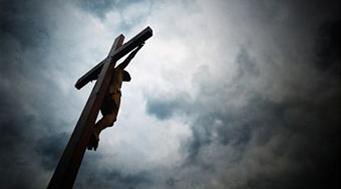
Twenty-five minutes later, Jesus is hanging in sheer agony on one of the cruelest instruments of torture ever devised. Nails have been driven through His wrists (which we only know about because of the doubt Thomas will express in a couple days—see John 20:25). A sign above Jesus declares in Greek, Latin, and Aramaic who He is: the King of the Jews. 

The King is flanked on either side by thieves and around Him are gawkers and mockers. “Let Him save Himself, if He is the Christ of God, His Chosen One!” some yell (Luke 23:35). One dying thief even joins in the derision. They do not understand that if the King saves Himself, their only hope for salvation is lost. Jesus asks His Father to forgive them. The other crucified thief sees a Messiah in the mutilated man beside him, and he asks the Messiah to remember him. Jesus’s prayer is beginning to be answered. Hundreds of millions will follow. 

It is mid-afternoon now and the eerie darkness that has fallen has everyone on edge. But for Jesus, the darkness is a horror He has never known. This, more than the nails and thorns and lashings, is what made Him sweat blood in the garden. The Father’s wrath is hitting Him in full force. He is in that moment no longer the Blessed, but the Cursed (Gal. 3:13). He has become sin (2 Cor. 5:21). In terrifying isolation, cut off from His Father and all humans, He screams, “Eli, Eli, lema sabachthani,” Aramaic for “My God, My God, why have You forsaken Me?” (Matt. 27:46; Ps. 22:1). No greater love (John 15:13), humility (Phil. 2:8), or obedience (Heb. 5:8) has ever or will ever be displayed. 

Shortly after 3:00 P.M., Jesus whispers hoarsely for a drink. In love, He has drained the cup of His Father’s wrath to the dregs. He has born our full curse. There is no debt left to pay and He has nothing left to give. The wine moistens His mouth just enough to say one final word: “It is finished” (John 19:30). And God the Son dies. 

It is the worst and best of all human deaths. For on this tree He bears our sins in His body (1 Pet. 2:24), “the righteous for the unrighteous, that He might bring us to God” (1 Pet. 3:18). And now it is finished.

The Emblem Of Suffering And Shame

Listen to the podcast of this post by clicking on the player below, and you can also subscribe on AppleSpotify, or Audible.

Tomorrow we celebrate Good Friday—the day Jesus died a horrific death on Calvary for my sins and your sins. The apostle Paul said Christ’s crucifixion was a stumbling block to many, because it was unimaginable that anyone—especially the perfect Son of God—could be subject to the torturous death reserved for the worst of offenders. But when Jesus became sin for us, that’s just what He was in that moment: the worst of offenders in Holy God’s eyes.

Christ on the Cross    “In the ancient world crucifixion was seen as a particularly disgraceful and grievous form of execution. Assyrian battle reliefs depict a precursor to crucifixion—impaling victims on poles outside the walls of conquered cities. The Persians made wide spread use of crucifixion, although sometimes the crucifixion took place only after the victim had been executed by other means (Herodotus, Histories, 3.125.2-3). There are also reports that crucifixion was used by peoples as varied as the Assyrians, Scythians, Celts, Germans, Britons and inhabitants of India, although the reliability of some of these accounts is questionable. Common to most of these cultures was the perspective that crucifixion was a form of execution reserved for the worst offenders, as well as for slaves.

     “The practice of crucifixion became widespread under Alexander the Great (356-323 B.C.). It became the common form of execution for traitors, defeated armies and rebellious slaves. Later, under the Roman Empire, only non-citizens, lower-class Romans and violent offenders could be crucified. The only possible exceptions were in cases of high treason or desertion during wartime. Slaves were particularly vulnerable to the imposition of crucifixion. Latin literature reflects the dread slaves felt at the prospect of this fate. It was officially accepted as the most painful and disgraceful form of capital punishment, more so than decapitation, being thrown to wild animals or even being burned alive. For these reasons this heinous penalty was often imposed upon foreigners who were seen as threats to Roman rule.

     “There are also accounts of crucifixion being practiced among Jews. Josephus wrote that the Sadducees and high priest Alexander Janneus (in the office from 103 to 76 B.C.) committed the following atrocity against his enemies, the Pharisees: ‘While dining in a conspicuous place with his concubines, he commanded that about 800 of them be crucified, and while they were still alive before their eyes he had the throats of their children and wives cut’ (Josephus, Antiquities, 13.14.2).

     “Victims were often scourged or otherwise tortured prior to crucifixion. Crucifixions were carried out on either a single vertical stake or on a vertical stake with a crossbeam near or on its top. Sometimes blocks were attached to the stake as a seat, footrest or both. Depending upon the presence of these blocks, the victim might linger, alive, for up to three days. The blocks allowed a victim to rest some of his weight, increasing the chance of breathing and proper circulation. Without the blocks a victim’s weight would rest totally upon his arms, which were attached to the crosspiece by ropes, nails or both. This would prohibit breathing and circulation and lead to both brain and heart failure. To end the torture, a victim’s legs could be broken, after which death would quickly follow. Oftentimes the charge against the guilty party would be written out and nailed to the cross above his head. As a deterrent to would-be rebels and criminals, crucifixions were usually carried out in highly visible locations.

     “During Jesus’ lifetime crucifixion was used by the Romans to exercise and gruesomely display their authority over others. This torturous execution was viewed by the Jews as a cursed form of death. Deuteronomy 21:23 states that ‘anyone who is hung on a tree is under God’s curse.’ Documents discovered at Qumran reveal that many Jews of Jesus’ time applied this text to Roman crucifixion. This perspective of crucifixion demonstrates why the apostle Paul wrote that the Cross of Christ was ‘a stumbling block to Jews and foolishness to Gentiles’ (1 Corinthians 1:23). Who would have imagined that the Holy One of God would voluntarily take upon Himself the curse that should have been ours? This emblem of shame has thus become the symbol of our salvation.” —Archaeological Study Bible, “Crucifixion” (page 1757)

As you remember what Jesus did for you on the Cross atop of Golgotha, may you be overwhelmed by the love which held Him fast to such a horrific instrument of death. He endured the suffering and shame of the Cross because He loves you and wants you to be with Him forever.

May we cherish that old rugged Cross and the Savior who suffered and died for us. As we place our faith in His death and resurrection three days later, may we be able to live each day in celebration of the victory Jesus won over hell, death, and the grave!

►► Would you please prayerfully consider supporting this ministry? My Patreon supporters get behind-the-scenes access to exclusive materials. ◀︎◀︎

Why The Cross?

Why The CrossCrucifixion seems so extreme (click here to read The Horrors of Crucifixion)! Why would God allow His Son to go through this?

But perhaps we should back up a step or two. Before asking why the Cross maybe there are some other questions we should explore. Questions like…

  • Did Jesus actually die?
  • Is the account true that Jesus came back to life?
  • How can we know for sure?
  • Is this just too fantastic to believe? Or is the evidence reasonable?

These are questions we must all wrestle with, especially those who call themselves Christians. After all, Christian means a follower of Jesus Christ who believes that Jesus in fact died on a Cross and was raised back to life three days later.

Join me this Sunday was we explore the reliability of the evidence. Then on Easter Sunday morning we will consider the claims that Jesus died and came back to life, as well as the claims that this is all make-believe stuff.

You won’t want to miss this! Click here to find a map to our meeting place. If you cannot join us in person, we will be broadcasting live on Periscope (click here to find the account to follow to be notified when the broadcast begins).

Links & Quotes

link quote

Some great reading (and watching) from the past couple of days.

“This generation has yet to prove all that prayer can do for believing men and women.” —A.W. Tozer

Come, my heart, be calm and hopeful today. Clouds together, but the Lord can blow them away. Since God will not fail me, my faith shall not fail; and as He will not forsake me, neither will I forsake Him.” —Charles Spurgeon

[VIDEO] This is priceless! Watch as a young man with Down Syndrome reads a special letter.

John Piper shares The Greatest Prayer In The World.

Tim Elmore discussing Generation Y: The Inverse Relationship Between Empathy And Narcissism.

This is why I love loving on our missionaries: Home Without A Home.

Some powerful Good Friday quotes compiled by Chilly Chilton in his post Cross Walk.

“Right now you may feel abused and unloved. The devil would have you believe that God has left you to your own devices—that you deserve to suffer, that it’s all over for you, that there is no hope. Beloved, those are lies from hell. God wants more than anything else to rid you of your perverted concept of Him.” —David Wilkerson

5 Quotes From “Love To The Uttermost”

Love To The UttermostI suggested last week that John Piper’s book Love To The Uttermost is an excellent resource to help guide you through the Holy Week with some fresh insights (you can read my review of this book by clicking here). Here are a few of the fresh insights that stood out to me.

“Luke 12:32 is a verse about the nature of God. It’s a verse about what kind of heart God has. It’s a verse about what makes God glad—not merely about what God will do or what He has to do, but what He delights to do, what He loves to do, and what He takes pleasure in doing. ‘Fear not, little flock, for it is your Father’s good pleasure to give you the kingdom.’ … This is what the word means: God’s joy, His desire, His want and wish and hope and pleasure and gladness and delight, is to give the kingdom to His flock.”

“Jesus was not accidentally entangled in a web of injustice. The saving benefits of His death for sinners were not an afterthought. God planned it all out of infinite love to sinners like us, and He appointed a time. Jesus, who was the very embodiment of His Father’s love for sinners, saw that the time had come and set His face to fulfill His mission: to die in Jerusalem for our sake. ‘No one takes my life from Me,’ Jesus said, ‘I lay it down of my own accord’ (John 10:18).”

“First, we know the depth of someone’s love for us by what it costs him. Second, we know the depth of someone’s love for us by how little we deserve it. Third, we know the depth of someone’s love for us by the greatness of the benefits we receive in being loved. Fourth, we know the depth of someone’s love for us by the freedom with which they love us.”

“[God] does not need us. If we stay away He is not impoverished. He does not need us in order to be happy in the fellowship of the Trinity. But He magnifies His mercy by giving us free access through His Son, in spite of our sin, to the one Reality that can satisfy us completely and forever, namely, Himself.”

“The resurrection of Jesus is given to us as the confirmation or evidence that He was indeed free in laying down His life. And so the resurrection is Christ’s testimony to the freedom of His love. … Of all the great things that Easter means, it also means this: it is a mighty ‘I meant it!’ behind Christ’s death. I meant it! I was free. You see how free I am? You see how much power and authority I have? I was able to avoid it. I have power to take up My life out of the grave. And could I not, then, have devastated My enemies and escaped the Cross? My resurrection is a shout over My love for My sheep: It was free! It was free! I chose it. I embraced it. I was not caught. I was not cornered. Nothing can constrain Me to do what I do not choose to do. I had power to take My life from death. And I have taken My life from death. How much more, then, could I have kept My life from death! I am alive to show you that I really loved you. I freely loved you. Nobody forced Me to it. And I am now alive to spend eternity loving you with omnipotent resurrection love forever and ever. Come to Me, all you sinners who need a Savior. And I will forgive you and accept you and love you with all My heart forevermore.”

Thursdays With Oswald—Redemption

This is a weekly series with things I’m reading and pondering from Oswald Chambers. You can read the original seed thought here, or type “Thursdays With Oswald” in the search box to read more entries.

Redemption

   Redemption is easy to experience because it cost God everything, and if I am going to be regenerated it is going to cost me something. I have to give up my right to myself. I have deliberately to accept into myself something that will fight for all it is worth, something that will war against the desires of the flesh, and that will ask me to go into identification with the death of Jesus Christ, and these things produce a struggle in me. …

   The result of the Redemption in my life must be that I justify God in forgiving me. …In what way are you different in your life? does the reality of the Redemption at work in you justify God in having forgiven you?

From Baffled To Fight Better and Biblical Ethics

I like to think of the death and resurrection of Jesus this way: It cost Him so much, and He wants everything He paid for.

Jesus didn’t coast through, He wasn’t wishy-washy about His decision to go to the Cross, neither was He forced into such a horrific death by crucifixion.

Jesus willingly and lovingly went “all in” to pay the redemption price for our sins. So I’m challenged by Oswald Chambers’ question: Does the reality of the Redemption at work in you justify God in having forgiven you? Does my life show how grateful I am for the price Jesus paid?

Such Wondrous Love

CrossAs I am preparing both a Good Friday message and an Easter message, I am immersed in the details of Christ’s passion for us. There are so many thoughts swirling through my head about the amazing, unequaled, undeserved, overflowing love that Jesus has for us.

See from His head, His hands, His feet / Sorrow and love flow mingled down! / Did e’er such love and sorrow meet, / Or thorns compose so rich a crown? (Isaac Watts, When I Survey The Wondrous Cross)

You see, at just the right time, when we were still powerless, Christ died for the ungodly. Very rarely will anyone die for a righteous person, though for a good person someone might possibly dare to die. But God demonstrates His own love for us in this: While we were still sinners, Christ died for us. (Romans 5:6-8)

That Christ should join so freely in the scheme / Although it meant His death on Calvary / Did ever human tongue find nobler theme / Than love divine that ransomed me?

Such love, such wondrous love / Such love, such wondrous love / That God should love a sinner such as I / How wonderful is love like this!

That for a willful outcast such as I / The Father planned, the Savior bled and died / Redemption for a worthless slave to buy / Who long had law and grace defied (C.Bishop, Such Love)

Because of the joy awaiting Him, Jesus endured the Cross, disregarding its shame. Now He is seated in the place of honor beside God’s throne. (Hebrews 12:2)

I hope this week you will reflect on God’s amazing grace, Christ’s great love, and the Holy Spirit’s persistent drawing of your heart. Jesus died for us so that we could be brought into a loving relationship with our Heavenly Father!

If you are in the Cedar Springs area, please join me in celebrating with our churches our combined Good Friday service, or our Easter morning breakfast drama called Conspiracy!