Good Friday—It Is Finished

Your Sorrow Will Turn To JoyThis is from a chapter in Your Sorrow Will Turn To Joy, and is probably one of the best depictions of Good Friday I have read. Jon Bloom writes—

It is Friday, April 3, A.D. 33. It is the darkest day in human history, though most humans have no clue of this. In Rome, Tiberius attends to the demanding business of the empire. Throughout the inhabited world, babies are born, people eat and drink, marry and are given in marriage, barter in marketplaces, sail merchant ships, and fight battles. Children play, old women gossip, young men lust, and people die. 

But today, one death, one brutal, gruesome death, the worst and best of all human deaths, will leave upon the canvas of human history the darkest brushstroke. In Jerusalem, God the Son, the Creator of all that is (John 1:3), will be executed. 

The Garden 

The Jewish day dawns with night, and never has it been more fitting, since today the hour has come and the power of darkness (Luke 22:53). Jesus is in Gethsemane, where He has prayed with loud cries and tears, being heard by His Father (Heb. 5:7) whose will will be done. Jesus hears noises and looks up. Torches and hushed voices signal the arrest party’s arrival. 

Jesus wakes His sleepy friends who are jarred alert at the sight of their brother, Judas, betraying his Rabbi with a kiss. Soldiers and servants encircle Jesus. Peter, flushed with anger, pulls out his sword and lunges at those nearest Jesus. Malchus flinches, but not enough. Blinding pain and blood surge where his ear had been. Voices speak, but Malchus only hears the screaming wound, which he’s grabbed with both hands. He feels a hand touch his hands and the pain vanishes. Under his hands is an ear. Stunned, he looks at Jesus, already being led away. Disciples are scattering. Malchus looks down at his bloody hands. 

The Sanhedrin 

Jesus is led brusquely into the house of Annas, a former High Priest, who questions Him about His teaching. Jesus knows this informal interrogation is meant to catch Him disoriented and unguarded. He is neither, and gives this manipulative leader nothing. Rather, He refers Annas to his hearers and is struck with irony by a Jewish officer for showing disrespect. Frustrated, Annas sends Jesus on to his son-in-law Caiaphas, the current High Priest. 

At Caiaphas’s house the trial gets underway quickly. Morning will come fast. The Council needs a damning verdict by daybreak. The examination proceeds as bleary-eyed Sanhedrin members continue to file in. 

The trial has been assembled hastily and witnesses haven’t been screened well. Testimonies don’t line up. Council members look disconcerted. Jesus is silent as a lamb. Irritated and impatient, Caiaphas cuts to the quick: “I adjure You by the living God, tell us if you are the Christ, the Son of God” (Matt. 26:63). The hour has come. Charged in the name of His Father to answer, Jesus speaks the words that seal the doom for which He had come to endure (John 12:27): “You have said so. But I tell you, from now on you will see the Son of Man seated at the right hand of Power and coming on the clouds of heaven” (Matt. 26:64). 

In a moment of law-breaking (Lev. 21:10) politically religious theater, Caiaphas tears his robes in feigned outrage and thinly concealed relief over Jesus’s blasphemy. He declares the trial’s end with, “What further testimony do we need? We have heard it ourselves from His own lips” (Luke 22:71). 

As the sun breaks over Jerusalem’s eastern ridge, Judas swings from his own belt, Peter writhes in the grief of his failure, and Jesus’s face is streaked with dried blood and saliva from the pre-dawn sport of the temple police. The Council’s verdict: guilty of blasphemy. Their sentence: death. But it’s a sentence they cannot carry out. Rome refuses to delegate capital punishment. 

The Governor 

Pilate’s mood, already sour over the Sanhedrin’s sudden insistent intrusion so early in the morning, worsens as he grasps the situation. They want him to execute a Galilean “prophet.” His seasoned instincts tell him something isn’t right. He questions Jesus and then tells the Council, “I find no guilt in this Man” (Luke 23:4). 

A game of political chess ensues between Pilate and the Sanhedrin, neither realizing that they are pawns, not kings. Pilate makes a move. As a Galilean, Jesus falls under Herod Antipas’s jurisdiction. Let Herod judge. Herod initially receives Jesus happily, hoping to see a miracle. But Jesus refuses to entertain or even respond. Antipas, disappointed, blocks the move by returning Jesus to Pilate. 

Pilate makes another move. He offers to release Jesus as this year’s annual Passover pardoned prisoner. The Council blocks the move. “Not this man, but Barabbas!” they cry (John 18:40). Pilate is astounded. The Sanhedrin prefers a thief and murderer to this peasant prophet? 

Pilate tries another move. He has Jesus severely flogged and humiliated, hoping to curb the Council’s blood thirst. Again the move is blocked when the Council insists that Jesus must be crucified because “He has made Himself the Son of God” (John 19:7). Check. Pilate’s fear grows. Jesus’s divine claim could threaten Rome. Worse, it could be true. Roman deities supposedly could take on human form. His further questioning of Jesus unnerves him. 

One last move. Pilate tries to persuade the Sanhedrin to release Jesus. One last block and trap. “If you release this Man, you are not Caesar’s friend. Everyone who makes himself a king opposes Caesar” (John 19:12). The Council has Pilate where they want him: cornered. Checkmate. 

And the triune God has the Council, Pilate, and satan where He wants them. They would have no authority over the Son at all unless it had been given them from above (John 19:11). Fallen Jews, Gentiles, and spiritual powers unwittingly collaborate in executing the only innocent death that could possibly grant the guilty life. Checkmate. 

The Cross 

Morning wanes as Jesus stumbles out of the Praetorium, horribly beaten and bleeding profusely. The Roman soldiers had been brutal in their creative cruelty. Thorns have ripped Jesus’s scalp and His back is one grotesque, oozing wound. Golgotha is barely a third of a mile through the Garden Gate, but Jesus has no strength to manage the forty-pound crossbar. Simon of Cyrene is drafted from the crowd. 

Twenty-five minutes later, Jesus is hanging in sheer agony on one of the cruelest instruments of torture ever devised. Nails have been driven through His wrists (which we only know about because of the doubt Thomas will express in a couple days—see John 20:25). A sign above Jesus declares in Greek, Latin, and Aramaic who He is: the King of the Jews. 

The King is flanked on either side by thieves and around Him are gawkers and mockers. “Let Him save Himself, if He is the Christ of God, His Chosen One!” some yell (Luke 23:35). One dying thief even joins in the derision. They do not understand that if the King saves Himself, their only hope for salvation is lost. Jesus asks His Father to forgive them. The other crucified thief sees a Messiah in the mutilated man beside him, and he asks the Messiah to remember him. Jesus’s prayer is beginning to be answered. Hundreds of millions will follow. 

It is mid-afternoon now and the eerie darkness that has fallen has everyone on edge. But for Jesus, the darkness is a horror He has never known. This, more than the nails and thorns and lashings, is what made Him sweat blood in the garden. The Father’s wrath is hitting Him in full force. He is in that moment no longer the Blessed, but the Cursed (Gal. 3:13). He has become sin (2 Cor. 5:21). In terrifying isolation, cut off from His Father and all humans, He screams, “Eli, Eli, lema sabachthani,” Aramaic for “My God, My God, why have You forsaken Me?” (Matt. 27:46; Ps. 22:1). No greater love (John 15:13), humility (Phil. 2:8), or obedience (Heb. 5:8) has ever or will ever be displayed. 

Shortly after 3:00 P.M., Jesus whispers hoarsely for a drink. In love, He has drained the cup of His Father’s wrath to the dregs. He has born our full curse. There is no debt left to pay and He has nothing left to give. The wine moistens His mouth just enough to say one final word: “It is finished” (John 19:30). And God the Son dies. 

It is the worst and best of all human deaths. For on this tree He bears our sins in His body (1 Pet. 2:24), “the righteous for the unrighteous, that He might bring us to God” (1 Pet. 3:18). And now it is finished.
The Emblem Of Suffering And Shame

Listen to the podcast of this post by clicking on the player below, and you can also subscribe on AppleSpotify, or Audible.

Tomorrow we celebrate Good Friday—the day Jesus died a horrific death on Calvary for my sins and your sins. The apostle Paul said Christ’s crucifixion was a stumbling block to many, because it was unimaginable that anyone—especially the perfect Son of God—could be subject to the torturous death reserved for the worst of offenders. But when Jesus became sin for us, that’s just what He was in that moment: the worst of offenders in Holy God’s eyes.

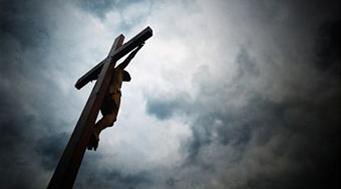
Christ on the Cross    “In the ancient world crucifixion was seen as a particularly disgraceful and grievous form of execution. Assyrian battle reliefs depict a precursor to crucifixion—impaling victims on poles outside the walls of conquered cities. The Persians made wide spread use of crucifixion, although sometimes the crucifixion took place only after the victim had been executed by other means (Herodotus, Histories, 3.125.2-3). There are also reports that crucifixion was used by peoples as varied as the Assyrians, Scythians, Celts, Germans, Britons and inhabitants of India, although the reliability of some of these accounts is questionable. Common to most of these cultures was the perspective that crucifixion was a form of execution reserved for the worst offenders, as well as for slaves.

     “The practice of crucifixion became widespread under Alexander the Great (356-323 B.C.). It became the common form of execution for traitors, defeated armies and rebellious slaves. Later, under the Roman Empire, only non-citizens, lower-class Romans and violent offenders could be crucified. The only possible exceptions were in cases of high treason or desertion during wartime. Slaves were particularly vulnerable to the imposition of crucifixion. Latin literature reflects the dread slaves felt at the prospect of this fate. It was officially accepted as the most painful and disgraceful form of capital punishment, more so than decapitation, being thrown to wild animals or even being burned alive. For these reasons this heinous penalty was often imposed upon foreigners who were seen as threats to Roman rule.

     “There are also accounts of crucifixion being practiced among Jews. Josephus wrote that the Sadducees and high priest Alexander Janneus (in the office from 103 to 76 B.C.) committed the following atrocity against his enemies, the Pharisees: ‘While dining in a conspicuous place with his concubines, he commanded that about 800 of them be crucified, and while they were still alive before their eyes he had the throats of their children and wives cut’ (Josephus, Antiquities, 13.14.2).

     “Victims were often scourged or otherwise tortured prior to crucifixion. Crucifixions were carried out on either a single vertical stake or on a vertical stake with a crossbeam near or on its top. Sometimes blocks were attached to the stake as a seat, footrest or both. Depending upon the presence of these blocks, the victim might linger, alive, for up to three days. The blocks allowed a victim to rest some of his weight, increasing the chance of breathing and proper circulation. Without the blocks a victim’s weight would rest totally upon his arms, which were attached to the crosspiece by ropes, nails or both. This would prohibit breathing and circulation and lead to both brain and heart failure. To end the torture, a victim’s legs could be broken, after which death would quickly follow. Oftentimes the charge against the guilty party would be written out and nailed to the cross above his head. As a deterrent to would-be rebels and criminals, crucifixions were usually carried out in highly visible locations.

     “During Jesus’ lifetime crucifixion was used by the Romans to exercise and gruesomely display their authority over others. This torturous execution was viewed by the Jews as a cursed form of death. Deuteronomy 21:23 states that ‘anyone who is hung on a tree is under God’s curse.’ Documents discovered at Qumran reveal that many Jews of Jesus’ time applied this text to Roman crucifixion. This perspective of crucifixion demonstrates why the apostle Paul wrote that the Cross of Christ was ‘a stumbling block to Jews and foolishness to Gentiles’ (1 Corinthians 1:23). Who would have imagined that the Holy One of God would voluntarily take upon Himself the curse that should have been ours? This emblem of shame has thus become the symbol of our salvation.” —Archaeological Study Bible, “Crucifixion” (page 1757)

As you remember what Jesus did for you on the Cross atop of Golgotha, may you be overwhelmed by the love which held Him fast to such a horrific instrument of death. He endured the suffering and shame of the Cross because He loves you and wants you to be with Him forever.

May we cherish that old rugged Cross and the Savior who suffered and died for us. As we place our faith in His death and resurrection three days later, may we be able to live each day in celebration of the victory Jesus won over hell, death, and the grave!

►► Would you please prayerfully consider supporting this ministry? My Patreon supporters get behind-the-scenes access to exclusive materials. ◀︎◀︎

4 Ways To Evaluate Biblical Evidence

Reliability of the GospelsTo be honest, if someone hasn’t heard the biblical account of the life of Jesus Christ before, it can sound quite fantastic! Jesus was born of a virgin, lived a sinless life, performed miracles no one had seen before, died a horrific martyr’s death, was raised back to life three days later, and then ascended back into heaven until He returns to Earth again.

But as fantastic as this sounds, there is still enough evidence to reasonably believe it’s all true. An unreasonable faith believes in something in spite of the evidence; a blind faith believes in something without any evidence; and reasonable faith believes in something because of the evidence.

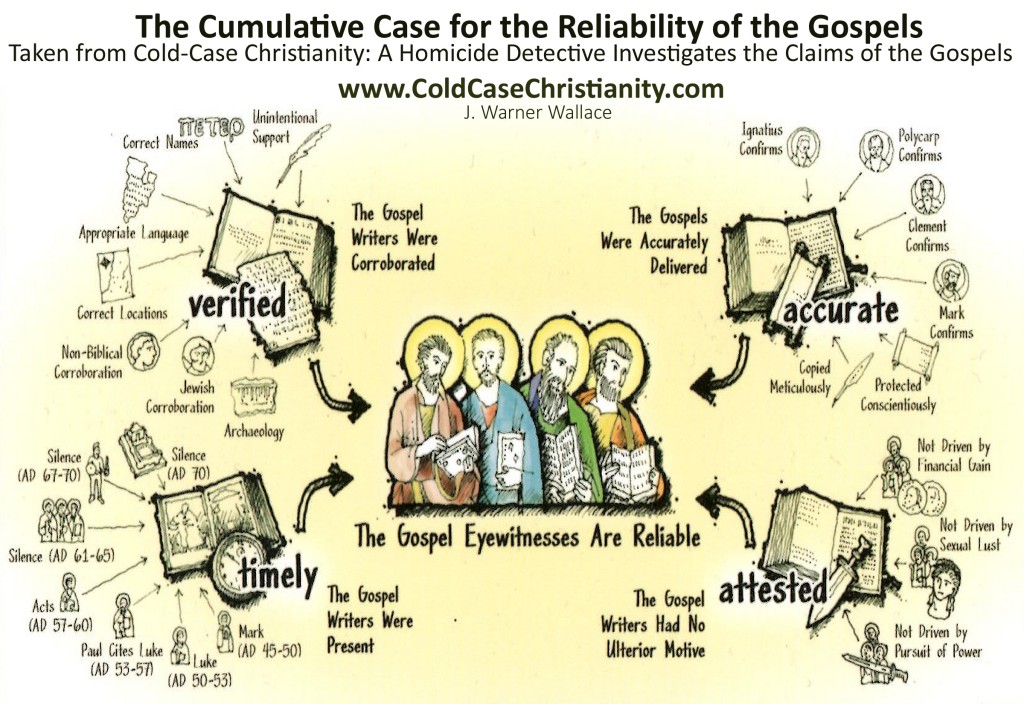
The Bible gives us eyewitness testimony about the life of Jesus which we can matter-of-factly evaluate. 

In a modern-day court of law, eyewitness testimony is evaluated on…

  • …the determination that the witnesses were actually present.
  • …the ability to corroborate their testimony.
  • …the consistency of their testimony over time.
  • …any biases they have that would cause them to exaggerate or misrepresent their testimony.

Let’s consider the testimony of the four Gospel writers: Matthew, Mark, Luke and John.

(1) Were The Eyewitnesses Present?

  • Luke is considered a credible historian, even by modern standards. He wrote the book of Acts following the ascension of Jesus into Heaven. Because he did not mention three major events in Jewish history (the Jewish uprising, the Roman siege of Jerusalem in response to that uprising, and the Roman destruction of the temple), we can determine that Acts was written before 61 AD.
  • Luke wrote the Gospel that bears his name before he wrote Acts. The Apostle Paul referenced portions of Luke’s Gospel in letters we can date by Paul’s Roman imprisonment, which means Luke was written prior to 53-57 AD.
  • Luke uses the Gospel of Mark as one of his references, which means Mark was probably written in 45-50 AD, just 10-15 years after the events of Christ’s life.
  • Mark was closely associated with the Apostle Peter, who was most assuredly Mark’s “source” in writing his Gospel, and Peter was one of the original twelve apostles called by Jesus.
  • Matthew and John were both apostles of Jesus, living and working closely with Jesus for over three years.

(2) Is Their Testimony Corroborated?

  • Archeological finds continually demonstrate the accuracy of the people, titles, places and details the Gospel writers mention.
  • Outside—or extra-biblical—sources like Josephus (a Jewish historian who wanted to preserve the purity of Judaism), Tacitus (a Roman historian), and Mara Bar-Serapion (a Syrian historian)—all who wrote between 40-70 AD—affirm things like where Jesus lived, the miracles He performed, the manner of His death, His resurrection, and the changed lives of people who believed in Jesus Christ.
  • In addition, Paul wrote of the “five hundred of the brothers” who were also eyewitnesses to the resurrected Christ (1 Corinthians 15:3-8).

(3) Has Their Testimony Remain Unchanged Over Time?

  • The history and accuracy of the scribes had already been demonstrated in the preservation and transmission of the Old Testament over a period of 1400 years.
  • These same scribal techniques were not only used in the transmission of the New Testament, but in subsequent years the Masoretic scribes became even more meticulous in the techniques they used.
  • The “chain of custody” of evidence can be absolutely traced from the Gospel authors, to their students, and to the writings of the Church Fathers.
  • In fact into the third-century AD, the writings of the Church Fathers contain so many direct quotations from the New Testament, that we can almost completely reconstruct the New Testament from their writings.

(4) Is Their Testimony Unbiased?

  • These eyewitnesses didn’t gain anything financially by their testimony. In fact, many of them lost or gave up all their possessions to tell others about Jesus.
  • They didn’t gain political power or influence that could save their own lives. All of the original apostles (except John) died a gruesome martyrs’ death.
  • In short, they had nothing to gain by making up and reporting a false story about Jesus.

All of these points make it reasonable to believe the evidence presented in the Bible about Jesus Christ is true. Check out this video where I elaborate a little more on each of these points—

If you live in the Cedar Springs area and don’t have a home church, I would love for you to visit with us Easter Sunday morning at 10:30am. We’ll be examining the evidence for Christ’s resurrection from the dead. Click here to get more details.

Are You Expecting The Lord?

Horatius Bonar“Are you expecting the Lord? Are you living in this expectation? Is it a deep-seated, abiding, cherished hope? Is it a hope that tells upon your character, your life, your daily actings in public or private, your opinions, your whole man? Does it quicken you? Does it purify you? Does it keep you separate from the world? Does it keep you calm in the midst of earth’s most exciting events, or most untoward changes? Does it give you a new view of history as well as prophecy? …

“Let your expectation of the Lord’s coming be a calm and healthy one; not one that excites, but one that tranquilizes; not one that unfits for duty, but one that nerves you more firmly for it; not one that paralyzes exertion, but one that invigorates you for it; not one that makes you indifferent to present duty, but one that makes you doubly in earnest about everything that your hand findeth to do; not one that stops liberality, and prayer, and work, but one that increases all these a hundred fold; not one that dwells exclusively on the future’s dark side—the judgments that are at hand—but one that realizes the glory and the joy of Messiah’s approaching victory and triumphant reign.” —Horatius Bonar

Links & Quotes

link quote

“Here’s an Advent illustration for kids—and those of us who used to be kids and remember what it was like. Suppose you and your mom get separated in the grocery store, and you start to get scared and panic and don’t know which way to go, and you run to the end of an aisle, and just before you start to cry, you see a shadow on the floor at the end of the aisle that looks just like your mom. It makes you really happy and you feel hope. But which is better? The happiness of seeing the shadow, or having your mom step around the corner and it’s really her? That’s the way it is when Jesus comes to be our High Priest. That’s what Christmas is. Christmas is the replacement of shadows with the real thing.” —John Piper (check out Hebrews 10:1-10)

“God desires to be remembered by man. He has taken unspeakable pains to keep Himself before His creatures, so as to make forgetfulness on their part the greatest of all impossibilities. In everything that God has set before our eyes or ears, He says, Remember Me. In every star, every flower, every mountain, every stream—in every joy, every comfort, every blessing of daily life—God says, Remember Me.” —Horatius Bonar

“God gives us a new revelation of His kindness in the valley of the shadow.” —Oswald Chambers

“Allow yourself one excess: be excessively obedient.” —Francois Fenelon

“satan’s ultimate weapon against us is our own sin. If the death of Jesus takes it away, the chief weapon of the devil is taken out of his hand. He cannot make a case for our death penalty, because the Judge has acquitted us by the death of His Son!” —John Piper

“Without Jesus, we’re trapped in the expectations of others. We’re trapped in living for the approval of our peers. We’re trapped in addictions. We’ve tried to change over and over again, but we don’t have the power needed to escape. Jesus came to give us that power.” —Rick Warren

“Holidays are about history, and if we fail to remember that history or to remind our contemporaries of it, then we will only be confirming their narrow and narcissistic view of ‘history’ as ‘my-story’ and my supposed right to make of my life whatever I will.” —T.M. Moore

John Stonestreet points out the power of hype in our modern culture—Ronda Rousey, Reality TV and Jesus.

Calvary Assembly of God helping the Cedar Springs community see the true meaning of Advent.

Is it really that big of a deal for a Christian to date a non-Christian?

Detroit Tigers fans and New York Yankees fans will enjoy this comparison of Ty Cobb and Babe Ruth.

Links & Quotes

link quote

“There are two kinds of people in life when it comes to truth: speculators and seekers. Speculators make guesses about the truth. Speculators think they know what God is like. … On the other hand, God loves those who take the time to find the truth. Seekers do four things: (1) They ask questions; (2) They study; (3) They watch what is happening around them; and (4) They do whatever it takes to find answers. They seek after Jesus with all they have.” —Rick Warren

“Often, Jesus gets shut out during Christmas. Imagine I planned a party for you and invited many people. Everyone brings lots of gifts, and the invitees trade presents with one another—and you get nothing. That’s Christmas. We give gifts to everyone but Jesus.” —Rick Warren

“When we’re thinking preserve the body, God is thinking save the soul. When we dream of a pay raise God dreams of raising the dead. We avoid pain and seek peace while God uses pain to bring peace. I’m going to live before I die, we resolve. But God instructs, Die so you can live. We love what rusts but God loves what endures. We rejoice at our successes but God rejoices at our confessions. We show our children the Nike star with the million-dollar smile and say, ‘Be like him!’ God points to the crucified Carpenter with bloody lips and a torn side and says, ‘Be like Christ!’” —Max Lucado

“Discipline is not an end in itself. It is a future-oriented activity.” —T.M. Moore

Craig Gross and Shaunti Feldhahn share 5 things women shouldn’t say if they catch their husbands looking at pornography.

Kirk Cousins tells us how he started caring about justice for oppressed people around the world, and why we should too.

Maria Gerber, a missionary in the early 1900s, was called “the angel of mercy” for the help she provided during the Armenian genocide in Turkey.

Links & Quotes

link quote

“That which astonishes, astonishes once; but whatever is admirable become more and more admired.” —Joseph Joubert

“Adoption is an act of God’s free grace, whereby we are received into the number, and have a right to all the privileges of the sons of God.” —Westminster Confession

“Adversity is the first path to trust.” —Lord Byron

“Adversity makes men, and prosperity makes monsters.” —Victor Hugo

“God’s corrections are our instructions; His lashes our lessons, and His scourges our schoolmasters.” —John H. Aughey

“Am I getting nobler, better, more helpful, more humble, as I get older? Am I exhibiting the life that men take knowledge of as having been with Jesus, or am I getting more self-assertive, more deliberately determined to have my own way? It is a great thing to tell yourself the truth.” —Oswald Chambers

“Press into God’s promises. When fears surface, respond with this thought: But God said … And when doubts arise, but God said… And when guilt overwhelms you, but God said…  Search the Scriptures like a miner digging for gold and trust the promises you find.” —Max Lucado

John Hendryx points out several similarities between Islamic and secular fundamentalism.

Josh McDowell reminds us that just teaching someone biblical truth is not enough.

If you would like to check out some devotional readings for Advent, click here.

The importance of belief in God for Issac Newton’s scientific discoveries.

[VIDEO] One of the most beautiful arrangements of Amazing Grace I’ve heard—

The Tweetable Billy Graham

BillyGrahamAlthough The Quotable Billy Graham was compiled nearly 50 years ago, all of this godly man’s wisdom still rings true today. Here are some of his quotes that fit nicely into Twitter—15 tweetable quotes from Billy Graham…

“Our faith grows by expression. If we want to keep our faith, we must share it. We must act.”

“The neglect of older people is becoming an increasing sin in America.”

“The ethical and moral concepts of Christianity are found all the way through the Declaration of Independence.”

“Anxiety is the natural result when our hopes are centered in anything short of God and His will for us.”

“The world has never seen such a manifestation of selfless love as was demonstrated upon Calvary.”

“We have not practiced applied Christianity. We have restricted it to a Sunday affair.”

“Many persons today insist on coming into the church head first rather than heart first.”

“Hot heads and cold hearts never solved anything.”

“Those who stand by the Cross are those who changed the course of history.”

“Salvation is free, but discipleship costs everything we have.”

“The further we get from the fact of the Resurrection, the closer we get to the reality of distraction.”

“It is very strange that the world accepts enthusiasm in every realm but the spiritual.”

“Faith is not anti-intellectual. It is an act of man that reaches beyond the limits of our five senses.”

“Once man denies the existence of God, he can stoop to anything.”

“If you gossip in front of your children, they are going to grow up to be gossipers.”

Previously I shared some of Billy Graham’s quotes on faith and on the church.

If you would like to check out my review of The Quotable Billy Graham, please click here.

Thursdays With Oswald—My Personal History With Jesus

Oswald ChambersThis is a periodic series with things I’m reading and pondering from Oswald Chambers. You can read the original seed thought here, or type “Thursdays With Oswald” in the search box to read more entries.

My Personal History With Jesus

Beware of the people who tell you life is simple. Life is such a mass of complications that no man is safe apart from God. Coming to Jesus does not simplify life, it simplifies my relationship to God.

God’s idea is that individual Christians should become identified with His purpose for the world. When Christianity becomes over-organized and denominational it is incapable of fulfilling our Lord’s commission; it doesn’t “feed His sheep,” it can’t (see John 21:15-17). 

If my religion is not based on a personal history with Jesus it becomes something I suffer from, not a joyous thing, but something that keeps me from doing what I want to do.

From Disciples Indeed

These three quotes from one chapter in this book have a common theme: What makes life a joy is a personal relationship with Jesus Christ as my Lord and Savior.

Doctrine can’t do it. Easy answers won’t work. Religion can’t do it. My church denomination won’t.

Only knowing Jesus intimately, personally—only having a “personal history” with Him will bring me lasting joy! I pray that you can know this joy!

(If you would like to read more quotes from Disciples Indeed, please click here.)

Links & Quotes

link quote

“I have learned now that while those who speak about one’s miseries usually hurt, those who keep silence hurt more.” —C.S. Lewis

“Jesus spilled His blood for you. You can spill your heart before God.” —Max Lucado

“Too often, when issues of sexual abuse come up, the Church simply stays silent. But a Gospel-centered response to sexual violation of anyone at any age begins with understanding that silence is not an option.” Read more in The Scandal Of Silence.

An abortion clinic in Michigan was shut down for numerous health and safety violations, but now it appears it may re-open.

[VIDEO] Here’s the truth of what abortion providers do—

Eric Metaxas shares the really cool story behind the Navy Hymn.

“You can be saved, Spirit-filled, and walking holy before God, yet still be guilty of unbelief. You may think, ‘I don’t have any unbelief.’ But do you get upset when things go wrong? Are you fearful of failing God? Are you restless, afraid of the future? The believer who has unconditional faith in God’s promise enjoys complete rest. What characterizes this rest? A full, complete confidence in God’s Word, and a total dependence on His faithfulness to that Word. Indeed, rest is the evidence of faith.” —David Wilkerson

Seth Godin discusses what starts to happen when our expectations slip.