
Graceful Christians

Listen to the podcast of this post by clicking on the player below, and you can also subscribe on Apple, Spotify, or Audible. 
Our Advent series this year has been called “People Will Talk,” but we have one more person to learn from who says nothing. We have none of her words inside quotation marks, and yet Luke was inspired by the Holy Spirit to share her story with us. Her wordless message speaks volumes, if we’re willing to listen. 

Anna, like Simeon, was one of the “Quiet in the Land.” Luke describes her as “very old.” The Greek phrase can either mean that she was a widow for 84 years after seven years of marriage, or simply that she was 84 years old. In either case, we don’t see her sitting withdrawn and inactive because of her old age, but we see her taking the initiative. She is the one who comes up to Joseph, Mary, and Jesus. 

Luke also calls her a “prophetess.” Not someone bitter about her widowhood, but someone who truthfully and lovingly spoke God’s Words. Throughout the Bible, we see that a prophet or prophetess is less foretelling the future than they are forth-telling the promises of God. Of course the “-ess” at then end of “prophet” reminds us that Anna is a woman. As a woman she was excluded from certain parts of the temple, but instead of picketing or making a scene Luke says she spends her time worshipping, fasting, praying, and waiting for the fulfillment of God’s promised Messiah.

I imagine that her mere presence must have changed the atmosphere wherever she went! 

I’m not sure if Charles Dickens had Anna in mind when he wrote A Christmas Carol, but the way the Ghost of Christmas Present added his blessing to busy people is what I imagine Anna’s role being in the temple—

“But soon the steeples called good people all, to church and chapel, and away they came, flocking through the streets in their best clothes, and with their gayest faces. And at the same time there emerged from scores of bye-streets, lanes, and nameless turnings, innumerable people, carrying their dinners to the bakers’ shops. The sight of these poor revelers appeared to interest the Spirit very much, for he stood with Scrooge beside him in a baker’s doorway, and taking off the covers as their bearers passed, sprinkled incense on their dinners from his torch. And it was a very uncommon kind of torch, for once or twice when there were angry words between some dinner-carriers who had jostled each other, he shed a few drops of water on them from it, and their good humor was restored directly. For they said, it was a shame to quarrel upon Christmas Day. And so it was! God love it, so it was!” 

Both Anna in the New Testament and Hannah in the Old Testament mean graceful. Or as I like to remember that word: someone full of grace. When she approaches Joseph, Mary, and Jesus, Luke says she “gave thanks.” This comes from a unique Greek word in the New Testament. The root word is usually translated confession, which means saying the same words as others. But the prefix Luke adds means “in place of.” This means that Anna was speaking thankful words in place of the other words being spoken around her. 

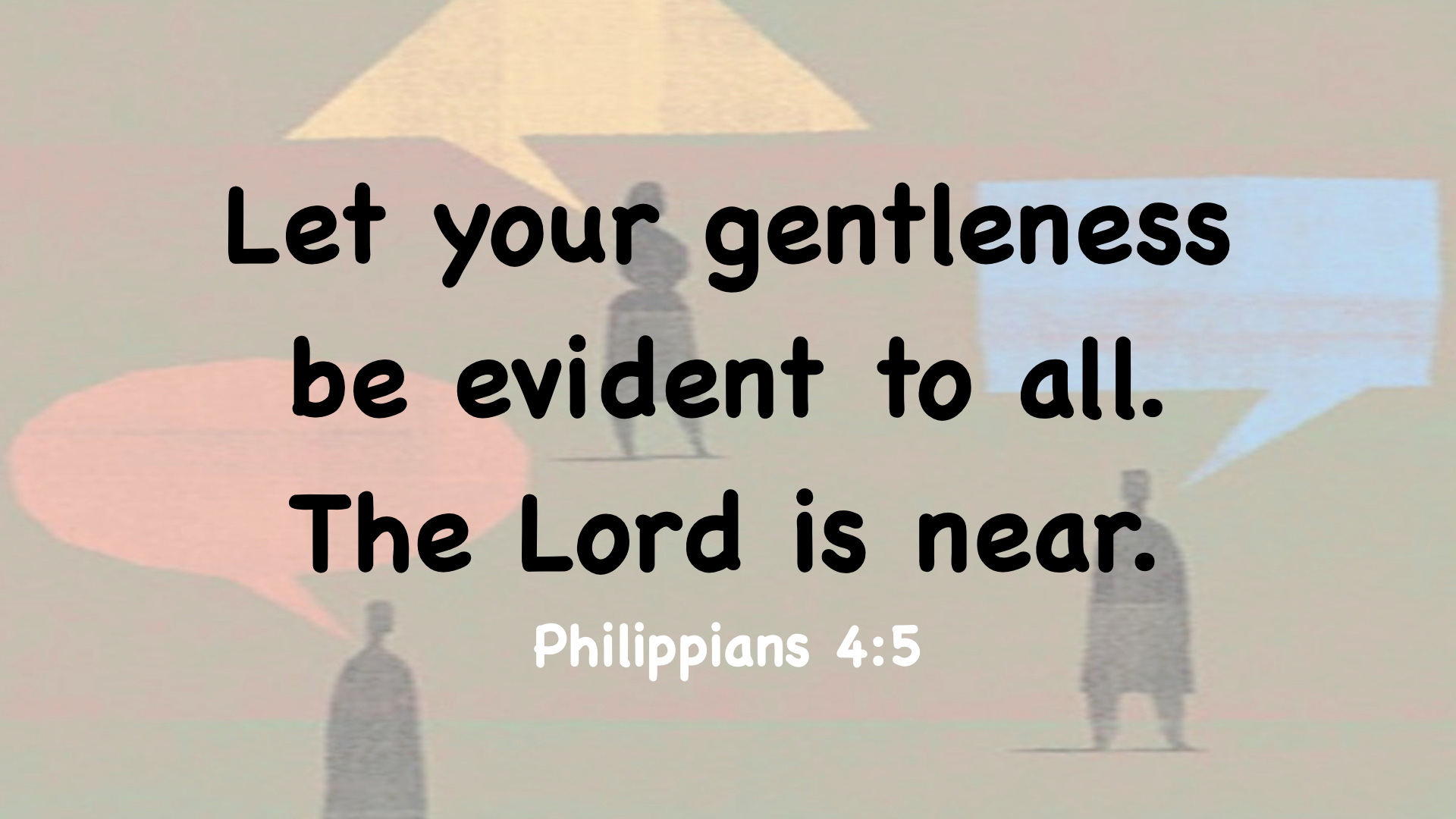
Anna spoke counter-culturally. Instead of being a cultural thermometer, she was serving as a thermostat to change the culture around her. This is the same kind of lifestyle that Jesus calls us to live. And it’s a lifestyle that Paul sums up in one succinct verse: “Let your gentleness [or we could say ‘grace-fullness’] be evident to all. The Lord is near” (Philippians 4:5). 

After Ebenezer Scrooge’s encounter with the three spirits, his life was transformed—

“Scrooge was better than his word. He did it all, and infinitely more.… He became as good a friend, as good a master, and as good a man, as the good old city knew, or any other good old city, town, or borough, in the good old world. 

“Some people laughed to see the alteration in him, but he let them laugh, and little heeded them; for he was wise enough to know that nothing ever happened on this globe, for good, at which some people did not have their fill of laughter in the outset; and knowing that such as these would be blind anyway, he thought it quite as well that they should wrinkle up their eyes in grins, as have the malady in less attractive forms. His own heart laughed: and that was quite enough for him. 

“…And it was always said of him, that he knew how to keep Christmas well, if any man alive possessed the knowledge. May that be truly said of us, and all of us! And so, as Tiny Tim observed, God bless Us, Every One!” 

As Christians, may both our actions and our reactions be so grace-filled, and may our gentleness be so evident to everyone all year long, and may we live so counter-culturally that people cannot help but see that we are grace-filled by the Spirit of Jesus Christ! 

If you’ve missed any of the messages in this Advent series, you can find the full list of messages by clicking here. 

►► Would you please prayerfully consider supporting this ministry? ◀︎◀︎

Poetry Saturday—Will Ye Also Go Away?

Listen to the podcast of this post by clicking on the player below, and you can also subscribe on Apple, Spotify, or Audible.

When any turn from Zion’s way,
(As numbers often do,)
Methinks I hear my Saviour say,
“Wilt thou forsake Me too?”

Ah, Lord! with such a heart as mine,
Unless Thou hold me fast,
My faith will fail, I shall decline,
And prove like them at last.

‘Tis Thou alone hast power and grace,
To save a wretch like me;
To whom then shall I turn my face,
If I depart from Thee.

Beyond a doubt I rest assur’d
Thou art the Christ of God;
Who hast eternal life secur’d,
By promise and by blood.

The help of men and angels join’d,
Could never reach my case!
Nor can I hope relief to find,
But in Thy boundless grace.

No voice but Thine can give me rest,
And bid my fears depart;
No love but Thine can make me blest,
And satisfy my heart. —John Newton

►► Would you please prayerfully consider supporting this ministry? ◀︎◀︎

Thursdays With Spurgeon—It’s Not About Me

This is a weekly series with things I’m reading and pondering from Charles Spurgeon. You can read the original seed thought here, or type “Thursdays With Spurgeon” in the search box to read more entries.

Listen to the podcast of this post by clicking on the player below, and you can also subscribe on iTunes or Spotify.

It’s Not About Me

Look to Me, and be saved, all you ends of the earth! For I am God, and there is no other. (Isaiah 45:22 NKJV)

     To whom does God tell us to look for salvation? Oh, does it not lower the pride of man when we hear the Lord say, ‘Look to Me, and be saved, all you ends of the earth’? … How frequently you who are coming to Christ look to yourselves. ‘Oh!’ you say, ‘I do not repent enough.’ That is looking to yourself. ‘I do not believe enough.’ That is looking to yourself. ‘I am not worthy.’ That is looking to yourself. 

     ‘I cannot discover,’ says another, ‘that I have any righteousness.’ It is quite right to say that you have not any righteousness. But it is quite wrong to look for any. It is ‘Look to Me.’ God will have you turn your eye off yourself and look to Him. The hardest thing in the world is to turn a man’s eye off himself. As long as he lives, he always has a predilection to turn his eye inside and look at himself, whereas God says, ‘Look to Me.’ … 

     It is not a consideration of what you are but a consideration of what God is and what Christ is that can save you.

     For God has committed them all to disobedience, that He might have mercy on all (Romans 11:32). He has passed a sentence of condemnation on all so that the free grace of God might come upon many to salvation. ‘Look! Look! Look!’ This is the simple method of salvation. ‘Look to Me, and be saved, all you ends of the earth!’

From Sovereignty And Salvation

One of the greatest—and most effective—lies that satan keeps whispering is that you have to do something to be saved. Or you have to do something to stay in God’s favor. Or your salvation is hanging by a flimsy thread. 

No, no, no! A thousand times no! 

When Jesus said, “It is finished,” He meant just that: everything is done. Salvation is a free gift of God’s grace extended to you through faith in Jesus alone. Jesus paid it all, so there is absolutely nothing you or I can add to it. For it is by grace you have been saved, through faith—and this is not from yourselves, it is the gift of God—not by works, so that no one can boast (Ephesians 2:8-9). 

Tell the devil he is a liar. Then, as Spurgeon said, look away from yourself and what you think you have to do and look only to the completed work of Calvary. True freedom and eternal joy come to the heart that looks away from itself and keeps its gaze on its Savior! When Jesus said, “It is finished,” He meant it! It is no longer what I must do, but what Jesus already did!

►► Would you please prayerfully consider supporting this ministry? ◀︎◀︎

Thursdays With Spurgeon—Never Give Up On Grace And Mercy

This is a weekly series with things I’m reading and pondering from Charles Spurgeon. You can read the original seed thought here, or type “Thursdays With Spurgeon” in the search box to read more entries.

Listen to the podcast of this post by clicking on the player below, and you can also subscribe on iTunes or Spotify.

Never Give Up On Grace And Mercy

Therefore He is also able to save to the uttermost those who come to God through Him, since He always lives to make intercession for them. (Hebrews 7:25) 

     My friends, it is one thing to go to church or chapel. It is quite another thing to go to God. …

Coming to God is not what some of you suppose, that is, now and then sincerely performing an act of devotion but giving to the world the greater part of your life. You think that if sometimes you are sincere, if now and then you put up an earnest cry to heaven, God will accept you. And though your life may be still worldly and your desires still carnal, you suppose that for the sake of this occasional devotion God will be pleased, in His infinite mercy, to blot out your sins. I tell you, sinners, there is no such thing as bringing half of yourselves to God and leaving the other half away. …  

     If I should see a sinner staggering on his progress to hell, I would not give him up, even when he had advanced to the last stage of iniquity. Though his foot hung trembling over the very edge of perdition, I would not cease to pray for him. And though he should in his poor drunken wickedness go staggering on till one foot was over hell and he was ready to perish, I would not despair of him. Till the pit had shut its mouth upon him I would believe it is possible that divine grace might save him. See there! He is just upon the edge of the pit, ready to fall. But before he falls, free grace bids, ‘Stop that man!’ Down mercy comes, catches him on her broad wings, and he is saved—a trophy of redeeming love. 

From Salvation To The Uttermost 

My friend, if you don’t have a personal relationship with God through the forgiving work that Jesus accomplished on the Cross, I implore you to come to Him before another minute passes. When Jesus said from this Cross, “It is finished,” He told you that He paid in full your debt that would have kept you separated from God forever. 

Now you just need to come to Him in faith. Simply pray something like this: “God, I acknowledge that I am a sinner separated from You. But I believe that Jesus paid the penalty for all of my sins when He died on the Cross. Because of that payment, I am asking You to forgive me and bring me into a full relationship with You. I pray this in the name of Jesus. Amen.” 

And let me speak to you, my Christian brother or sister who has been praying earnestly for the salvation of someone dear to you. Let me encourage you to not give up! God’s mercy and God’s grace are so swift that even with the last breath they can swoop in to save. Never cease to pray for them and know that Jesus is interceding for them before God’s throne too!

►► Would you please prayerfully consider supporting this ministry? ◀︎◀︎

 

Poetry Saturday—Eternal Spirit

Listen to the podcast of this post by clicking on the player below, and you can also subscribe on Apple or Spotify.

Eternal Spirit, we confess
And sing the wonders of Your grace!
Your power conveys our blessings down
From God the Father and the Son.
Enlightened by Your heavenly ray,
Our shades and darkness turn to day.
Your inward teachings make us know
Our danger and our refuge, too.
Your power and glory work within,
And break the chains of reigning sin,
Does our imperious lusts subdue,
And forms our wretched hearts anew.
The troubled conscience knows Your voice,
Your cheering words awake our joys;
Your words allay the stormy wind,
And calm the surges of the mind.

*Spurgeon used this poem as a conclusion to his sermon entitled Human Depravity and Divine Mercy. I was unable to find this poem attributed to anyone else, so I am assuming it was written by Spurgeon himself. 

►► Would you please prayerfully consider supporting this ministry? ◀︎◀︎

The Craig And Greg Show: Leaders And Laughter

On this episode of “The Craig And Greg Show” we talk about: 

  • sometimes leaders and laughter don’t together, but sometimes humor can bring about the ice breaker that teams need
  • leaders need to practice laughter  
  • how Greg used to prepare himself for meetings while he was on the road
  • I share that leaders need to lighten up even before in-office meetings
  • people want to follow leaders not just to win, but to have fun along the way too
  • how do leaders find the appropriate use of humor? Greg shares two important words to keep in mind
  • leaders need to get on the same page with their teammates, and the best way to do this is to laugh at ourselves
  • in a previous episode, we talked about love languages, which is also key in the appropriate use of humor 
  • laughing is good for your health—both physical health and emotional health
  • we wonder about the statute of limitations on some pranks with which we may have been involved
  • laughter triggers endorphins in us but also triggers the mirror neurons in others
  • we announce a really fun contest!

Check out this episode and subscribe on YouTube so you can watch all of the upcoming episodes. You can also listen to our podcast on Spotify and Apple.

Thursdays With Spurgeon—Never Beyond God’s Love

This is a weekly series with things I’m reading and pondering from Charles Spurgeon. You can read the original seed thought here, or type “Thursdays With Spurgeon” in the search box to read more entries.

Listen to the podcast of this post by clicking on the player below, and you can also subscribe on iTunes or Spotify.

Never Beyond God’s Love

Lost, perishing sinners, hear the voice of God, for it speaks to you. 

“Where art thou? for I am come to seek thee.” 

“Lord, I am in such a place that I cannot do anything for myself.” 

“Then I am come to seek thee and do all for thee.” 

“Lord, I am in such a place that the law threatens me and justice frowns upon me.” 

“I am come to answer the threatenings of the law, and to bear all the wrath of justice.” 

“But, Lord, I am in such a place that I cannot repent as I would.” 

“I am come to seek thee, and I am exalted on high to give repentance and remission of sins.” 

“But, Lord, I cannot believe in Thee, I cannot believe as I would.” 

“A bruised reed I will not break, and a smoking flax will I not quench; I am come to give thee faith.” 

“But, Lord, I am in such a state that my prayers can never be acceptable.” 

“I am come to pray for thee, and then to grant thee thy desires.” 

“But, Lord, Thou dost not know what a wretch I am.” 

“Yes, I know thee. Though I asked thee the question, ‘Where art thou?’ it was that thou mightest know where thou art, for I know well enough.” 

“But, Lord, I have been the chief of sinners; none can have so aggravated their guilt as I have.” 

“But wherever thou mayest be, I have come to save thee.” 

“But I am an outcast from society.” 

“But I am come to gather together the outcasts of Israel.” 

“O but I have sinned beyond all hope.” 

“Yes, but I have come to give hope to hopeless sinners.” 

“But, then I deserve to be lost.” 

“Yes, but I have come to magnify the law and make it honorable, and so to give thee thy deserts in the person of Christ, and then to give thee My mercy because of His merits.” —Charles Spurgeon

My friend, there isn’t anything you can do to make God love you any less or any more—God IS Love. You are never beyond His love! 

There is never a hole so deep, or a burden so heavy that God cannot rescue you—God IS All-mighty. You are never beyond His rescue! 

You cannot escape the powerful love of your Heavenly Father. Jesus purchased your salvation with His blood, and the Holy Spirit is calling to your heart today. Will you come to Him in faith? O, please, my friend, receive God’s love today! 

►► Would you please prayerfully consider supporting this ministry? ◀︎◀︎

 

Poetry Saturday—Depth Of Mercy

Listen to the podcast of this post by clicking on the player below, and you can also subscribe on Apple or Spotify.

Depth of mercy! can there be
Mercy still reserved for me?
Can my God His wrath forbear,
Me, the chief of sinners, spare?

I have long withstood His grace,
Long provoked Him to His face,
Would not hearken to His calls,
Grieved Him by a thousand falls.

Kindled His relentings are:
Me He now delights to spare;
Cries, “How shall I give thee up?”
Lets the lifted thunder drop.

There for me the Savior stands,
Shows His wounds and spreads His hands.
God is Love; I know, I feel;
Jesus weeps, but loves me still. ―Charles Wesley

►► Would you please prayerfully consider supporting this ministry? ◀︎◀︎

Poetry Saturday—Arise, My Soul, Arise

Listen to the podcast of this post by clicking on the player below, and you can also subscribe on Apple or Spotify.

Arise, my soul, arise,
shake off your guilty fears;
The bleeding sacrifice,
in my behalf appears;
Before the throne my Surety stands,
My name is written on His hands.

He ever lives above,
for me to intercede;
His all redeeming love,
His precious blood, to plead;
His blood atoned for every race,
And sprinkles now the throne of grace.

Five bleeding wounds He bears;
received on Calvary;
They pour effectual prayers;
they strongly plead for me:
“Forgive him, O forgive,” they cry,
“Nor let that ransomed sinner die!”

The Father hears Him pray,
His dear anointed One;
He cannot turn away
the presence of His Son;
The Spirit answers to the blood,
The Spirit answers to the blood
And tells me I am born of God.

My God is reconciled;
His pardoning voice I hear;
He owns me for His child;
I can no longer fear
With confidence I now draw nigh,
And “Father, Abba, Father,” cry. —Charles Wesley

►► Would you please prayerfully consider supporting this ministry? ◀︎◀︎
Biblical Mindfulness

Listen to the podcast of this post by clicking on the player below, and you can also subscribe on Apple or Spotify.

I have always been mindful of Your unfailing love…. (Psalm 26:3).

The dictionary defines “mindful” as simply being aware. Unfortunately, many psychologists today have constricted this term to mean simply being aware of the present moment, especially one’s own emotions in the present moment. 

In the New Living Translation, this verse has David saying to God, “I am always aware of Your unfailing love.” God’s unfailing love is an eternal attribute of God, and David says he is perpetually contemplating this attribute. But notice how David applies mindfulness not just to his present moment, but to his past and future as well. In fact, David invites God to examine his heart and mind to verify that David is always properly mindful of God’s love.

Notice the past, present, and future tenses David uses—

Past (v. 1):

  • I have led a blameless life 
  • I have trusted in the Lord without wavering 

Present (vv. 3, 7, 11):

  • Your love is ever before me 
  • I walk continually in Your truth
  • I proclaim aloud your praise
  • I lead a blameless life

Future (v. 12):

  • In the great assembly I will praise the Lord

Notice that between David’s claim that he has led a blameless life and that he is still leading a blameless life, we read his request for God to, “Test me, O Lord, and try me, examine my heart and my mind.” David was perpetually mindful of God’s awareness of both his thoughts and his lifestyle.

Being mindful of God’s love means looking back in gratitude to recall God’s past provision, looking around in worship to see God’s ongoing involvement, and looking ahead in hope to anticipate God’s unending grace. 

Unlike modern-day psychology which tells us mindfulness is a narrowing of our thoughts, biblical mindfulness is an expanding of our thoughts. Biblical mindfulness sees God’s past work and His future grace, and brings those to bear on our present circumstances.