This is a weekly series with things I’m reading and pondering from Oswald Chambers. You can read the original seed thought here, or type “Thursdays With Oswald” in the search box to read more entries.
Overcoming Temptation
In the silent years Our Lord learned how to be; at His Baptism He had revealed to Him what He had to do; in the Temptation what to avoid.
…The word “temptation” is built on a Latin word meaning “to stretch.” … Temptation is the test by an alien power of the possession held by a personality.
…Every temptation of satan is perfectly wise. The wisest, shrewdest, subtlest things are said by satan, and they are accepted by everybody as the acme of human philosophy; but when the Spirit of God is at work in a man, instantly the hollow mockery at the heart of what satan is trying to do, is seen. When we understand the inwardness of the temptation we see how satan’s strategy is turned into confusion by the Spirit of God.
We, just like Jesus, can be victorious over these temptations by doing what Jesus did. (1) He was fully submitted to His Heavenly Father, (2) He was sensitive to go where the Holy Spirit led Him, and (3) He uncovered the shrewd and subtle arguments of satan by using the Word of God.
The One who overcame satan’s temptations wants to help you overcome as well—
For because He Himself [in His humanity] has suffered in being tempted (tested and tried), He is able [immediately] to run to the cry of (assist, relieve) those who are being tempted and tested and tried [and who therefore are being exposed to suffering].(Hebrews 2:18, Amplified Bible)
Listen to the podcast of this post by clicking on the player below, and you can also subscribe on Apple, Spotify, or Audible.
John opens the book of Revelation with this greeting: Grace and peace to you from Him who is, and who was, AND WHO IS TO COME… (Revelation 1:4). This is so significant because of the other descriptive phrases John uses for Jesus:
Jesus was pre-existent before creation (John 1:1).
John was witness to everything Jesus did during His public ministry, including all of the claims Jesus made about Himself (1 John 1:1).
And now John says not only has Jesus existed before time existed, not only is He alive now, but He is coming back again!
This is what makes the resurrection of Jesus so important. Jesus Himself told us exactly what was going to happen with His death by crucifixion and His resurrection three days later. The fact that these statements all turned out to be true gives us greater assurance that His promise that He is coming back is also true.
In His very first sermon, Jesus quoted from Isaiah about how He would conduct His earthly ministry (see Isaiah 61:1-2 and Luke 4:18-19). But when He quotes the passage from Isaiah, He leaves off a phrase “and a day of vengeance of our God.” God’s wrath against sin is being held back for now, but the day of judgment is coming.
John says Jesus is the One Who is to come, and records later on how Jesus will come—
I saw Heaven standing open and there before me was a white horse, whose rider is called Faithful and True. With justice He judges and wages war. His eyes are like blazing fire, and on His head are many crowns. He has a name written on Him that no one knows but He Himself. He is dressed in a robe dipped in blood, and His name is the Word of God. The armies of Heaven were following Him, riding on white horses and dressed in fine linen, white and clean. Coming out of His mouth is a sharp sword with which to strike down the nations. “He will rule them with an iron scepter.”He treads the winepress of the fury of the wrath of God Almighty. (Revelation 19:11-15)
God made Jesus to be sin for us. He suffered and died to pay the penalty for our sins, and those who are still found in their sins—unforgiven, without placing their faith in Jesus Christ’s sacrificial death and resurrection—must face the wrath of God.
Jesus is not only our Risen Savior, but He is the soon-returning King and Judge.
Three times the last book of the Bible records Jesus Himself saying, “I am coming soon!” This isn’t a scare tactic, it’s real. As certainly as Jesus rose from the grave, He is returning soon.
Are you ready for His return? Are you telling others that Jesus is our soon-returning King? I hope you know what it means to have Jesus as your Lord and Savior, and I hope you are telling as many other people as you can about our soon coming King!
Listen to the podcast of this post by clicking on the player below, and you can also subscribe on Apple, Spotify, or Audible.
Could it really be this simple? Could it be that Jesus died and rose again just like the Bible says? Or does it need to be more complicated than that? Are there other theories that seem to fit the facts?
At the feast of Pentecost where Jewish people from all over the world convened in Jerusalem just 50 days after the resurrection of Jesus, Peter stood up to address them:
He began, “Fellow Jews and all of you who live in Jerusalem…” (Acts 2:14). He addressed both local residents and guests from faraway lands.
Peter began by saying, “Jesus of Nazareth was a Man accredited by God to you by miracles, wonders and signs, which God did among you, as you yourselves know” (v. 22). No one shouted Peter down or disputed this claim. Quite possibly because there were those in this audience who had personally seen or experienced one of Jesus’ miracles.
The he announced, “God has raised this Jesus to life, and we are all witnesses of the fact” (v. 32). Anyone could have easily refuted this claim because the tomb of Jesus was within walking distance of where they were standing, and yet no one disputed this claim.
A short time later, after healing a lame man outside of the temple, Peter and John were hauled before the Sanhedrin (the rulers and elders of the people [Acts 4:8]). This was the very group who had convinced the Roman governor Pontius Pilate to have Jesus crucified.
They addresses this group by saying, “It is by the name of Jesus Christ of Nazareth, Whom you crucified but Whom God raised from the dead, that this man stands before you healed” (v. 10). Once again, they didn’t dispute this, but they just told them to stop preaching in this name of Jesus (v. 17).
Paul was a devout member of this Jewish religious leadership until he had a personal encounter with Jesus. It became awfully difficult for Paul to argue that Jesus was dead, when he had personally seen Him and talked with Him!
Paul’s former colleagues had him arrested to stand trial before the Romans. The Roman governor Festus noted that the claims of the Jews against Paul were “about a dead man named Jesus Who Paul claimed was alive” (Acts 25:19). This is nearly 30 years after the resurrection of Jesus occurred. King Agrippa didn’t scoff this off. In fact, Paul said he was glad to talk to the king since “the king is familiar with these things…. I am convinced that none of this has escaped his notice, because it was not done in a corner” (Acts 26:26). Again, Agrippa didn’t dispute the claim of Jesus’ resurrection, but simply accused Paul of trying to convert him to Christianity.
There is something in our hearts that wants the resurrection to be true.
We don’t want to work all our lives for nothing.
We don’t want to invest in a relationship, only to have that end when the other person dies.
We want there to be something more. We want there to be something that makes sense of the world.
Only the resurrection of Jesus the Christ helps us make sense of life. Only His resurrection gives us lasting hope.
An old song by the band Kansas says:
Deep within the hardest heart
There is something there that knows
There’s a hunger life can never fill
Til you face the One Who rose
There were two followers of Jesus who were out for a walk on the evening of the day of the resurrection. They, too, were trying to figure out if the news reports they heard about Jesus’ resurrection was fact or fiction. Jesus met them on the road (although they didn’t recognize Him) and He walked and talked with them. He explained how all of the things in the Bible pointed to these facts: a Savior would come, a Savior would die, and a Savior would be raised to life again. As Jesus sat down to eat with them, they recognized Who He was, and then He disappeared from their sight. As they hurried back to tell the other disciples, they said, “Didn’t our hearts burn within us as He talked” (Luke 24:32).
Does it take faith to believe the biblical resurrection story? Yes!
Does it take faith to believe the conspiracy theories? Yes!
But I believe that not only is the resurrection account more plausible, but it’s more satisfying too. The resurrection of Jesus rings true because IT IS TRUE, and because you were created by God to believe this truth so you could be in a relationship with Him forever.
I suggested last week that John Piper’s book Love To The Uttermost is an excellent resource to help guide you through the Holy Week with some fresh insights (you can read my review of this book by clicking here). Here are a few of the fresh insights that stood out to me.
“Luke 12:32 is a verse about the nature of God. It’s a verse about what kind of heart God has. It’s a verse about what makes God glad—not merely about what God will do or what He has to do, but what He delights to do, what He loves to do, and what He takes pleasure in doing. ‘Fear not, little flock, for it is your Father’s good pleasure to give you the kingdom.’ … This is what the word means: God’s joy, His desire, His want and wish and hope and pleasure and gladness and delight, is to give the kingdom to His flock.”
“Jesus was not accidentally entangled in a web of injustice. The saving benefits of His death for sinners were not an afterthought. God planned it all out of infinite love to sinners like us, and He appointed a time. Jesus, who was the very embodiment of His Father’s love for sinners, saw that the time had come and set His face to fulfill His mission: to die in Jerusalem for our sake. ‘No one takes my life from Me,’ Jesus said, ‘I lay it down of my own accord’ (John 10:18).”
“First, we know the depth of someone’s love for us by what it costs him. Second, we know the depth of someone’s love for us by how little we deserve it. Third, we know the depth of someone’s love for us by the greatness of the benefits we receive in being loved. Fourth, we know the depth of someone’s love for us by the freedom with which they love us.”
“[God] does not need us. If we stay away He is not impoverished. He does not need us in order to be happy in the fellowship of the Trinity. But He magnifies His mercy by giving us free access through His Son, in spite of our sin, to the one Reality that can satisfy us completely and forever, namely, Himself.”
“The resurrection of Jesus is given to us as the confirmation or evidence that He was indeed free in laying down His life. And so the resurrection is Christ’s testimony to the freedom of His love. … Of all the great things that Easter means, it also means this: it is a mighty ‘I meant it!’ behind Christ’s death. I meant it! I was free. You see how free I am? You see how much power and authority I have? I was able to avoid it. I have power to take up My life out of the grave. And could I not, then, have devastated My enemies and escaped the Cross? My resurrection is a shout over My love for My sheep: It was free! It was free! I chose it. I embraced it. I was not caught. I was not cornered. Nothing can constrain Me to do what I do not choose to do. I had power to take My life from death. And I have taken My life from death. How much more, then, could I have kept My life from death! I am alive to show you that I really loved you. I freely loved you. Nobody forced Me to it. And I am now alive to spend eternity loving you with omnipotent resurrection love forever and ever. Come to Me, all you sinners who need a Savior. And I will forgive you and accept you and love you with all My heart forevermore.”
Listen to the podcast of this post by clicking on the player below, and you can also subscribe on Apple, Spotify, or Audible.
Have you ever experienced this? You are certain that God has spoken to you. You’ve launched out in obedience, things are sailing along smoothly, and then <wham!> a storm threatens to swamp you. And you begin to second-guess what you thought God said to you. You begin to wonder if perhaps you misunderstood the directions God spoke: “Did God send me into this?!”
Ever been there?
The disciples of Jesus must have felt that way. Jesus says, “Let’s get into the boat and head over to the other side of the lake.” The disciples obeyed Jesus only to have a huge storm come crashing down on them, to the point that their boat was about to be swamped (see Luke 8:22-25).
What were they thinking then? What would you have been thinking? Perhaps you might have thought, “Did I miss something God said?”
I love this thought from Oswald Chambers—
You say, “If I had not obeyed Jesus I should not have got into this complication.” Exactly. The problems in our walk with God are to be accounted for along this line, and the temptation is to say, “God could have never told me to go there, if He had done so this would not have happened.” We discover then whether we are going to trust God’s integrity or listen to our own expressed skepticism.
God knows what He’s doing. He knows what He needs to accomplish.
Too many times I get focused on the destination, while God is focusing on the process. I often will learn more about my faith, and about the power and faithfulness and love of my God, during these storms than I will in an incident-free journey.
If you are on a journey on which God sent you and your boat’s rocking, don’t second-guess what God said. Keep your eyes on Jesus, and watch to see what He’s developing in you during your stormy trip.
It’s extremely rare that a 19th-century pastor, Jesus Christ, and a noted atheist would all agree on something. But as we wrapped up our series on love today, I had to share these quotes (the added emphasis in the quotes is mine)—
“Never offer men a thimbleful of gospel. Do not offer them merely joy, or merely peace, or merely rest, or merely safety; tell them how Christ came to give men a more abundant life than they have, a life abundant in love, and therefore abundant in salvation for themselves, and large in enterprise for the alleviation and redemption of the world. … Only this fuller love can compete with the love of the world.” —Henry Drummond
“If you love only those who love you, why should you get credit for that? Even sinners love those who love them! And if you do good only to those who do good to you, why should you get credit? Even sinners do that much! … By this all men will know that you are My disciples, if you truly love one another.” —Jesus (Luke 6:32-33; John 13:35)
“Nothing can penetrate the loneliness of the human heart except the highest intensity of the sort of love the religious teachers have preached.” —Bertrand Russell
Listen to the podcast of this post by clicking on the player below, and you can also subscribe on Apple, Spotify, or Audible.
Love is not always flowery and sweet, where everyone gets along, and no one is ever mean or even unkind. Actually that’s not love; that’s selfishness. You’re saying, “I will love you because it makes me feel good. I get something special out of this when I am kind and loving to you.”
The ancient Greeks had different words for love. Whereas we use love for food (“I love my pasta”), and the same word for special people (“I love my wife”). But we all know that I’m not really saying my wife and a plate of spaghetti are on the same level.
So the Greeks had a word for love for the inanimate (like food and music), and a word for this-makes-me-feel-so-good (like sex and alcohol), and a word for treating someone humanely or kindly (sometimes called brotherly love). These are well-known loves, but they are very fragile. The law of diminishing returns says that each time I experience one of these loves, its ability to please me the next time is slightly reduced, until at one point this thing/person no longer satisfy me at all. In fact, they may even cause my stomach to churn in nausea.
But there was one more word the Greeks used for love, that the biblical writers used almost exclusively. This word (agape) is not tuxedos and dancing gowns and chandeliers. This love shows up in work clothes, with callouses on its hands and knees, because it’s determined to serve someone else no matter what!
This is the kind of love God exhibited toward us—God shows and clearly proves His own love for us by the fact that while we were still sinners, Christ died for us (Romans 5:8).
And this is the kind of love Jesus commanded us to exhibit toward others… even toward those we think are unloveable—By this all men will know that you are My disciples, if you love one another. … If you love those who love you, what credit is that to you? Even “sinners” love those who love them. And if you do good to those who are good to you, what credit is that to you? Even “sinners” do that (John 13:35; Luke 6:32-33).
This is the kind of full love that those apart from Jesus Christ do not know, but they can see it and be drawn to it if Christians will demonstrate it. Henry Drummond said this—
“Never offer men a thimbleful of gospel. Do not offer them merely joy, or merely peace, or merely rest, or merely safety; tell them how Christ came to give men a more abundant life than they have, a life abundant in love. … Then only can the gospel take hold of the whole of a man, body, soul and spirit. … Only a fuller love can compete with the love of the world.”
Let’s show the world a fuller love, and in so doing we will show them Jesus!
Have you ever had a really good scare that turned your life around? For some people, they need to be scared half to death in order for them to make changes in their lives.
I think this is what happened to the shepherds outside Bethlehem the night Jesus was born (Luke 2:8-20). The Bible says that when the glory of the Lord shone around them they were terrified (the King James Version is very picturesque when it says they were sore afraid). The Greek word for fear is phobeo, but the phrase Luke uses here for “terrified” is megas phobeo phobos. Get the picture? They were scared half to death!!
But now, what to do what that fear? The angel gave them the first step—Go find Jesus. He didn’t tell them to get themselves cleaned up, or start going to church, or even to stop acting a certain way. Simply go find Jesus.
The shepherds obeyed and went to meet Jesus, and then something amazing happens.
Their fear is turned to praise—the shepherds returned, glorifying and praising God.
Their silence is turned to testimony—they spread the word concerning what had been told them.
Jesus was born as a Man to experience all our fears and sorrows and pains. But He took these upon Himself as He became the perfect, once-for-all sacrifice. Now there are no fears that can keep us from God’s presence. Jesus conquered all that kept us from God!
There was nothing beautiful or majestic about His appearance, nothing to attract us to Him.He was despised and rejected—a Man of sorrows, acquainted with deepest grief. We turned our backs on Him and looked the other way. He was despised, and we did not care. Yet it was our weaknesses He carried;it was our sorrows that weighed Him down. And we thought His troubles were a punishment from God, a punishment for His own sins! But He was pierced for our rebellion,crushed for our sins. He was beaten so we could be whole. He was whipped so we could be healed.
All praise to God, the Father of our Lord Jesus Christ, who has blessed us with every spiritual blessing in the heavenly realms because we are united with Christ. Even before He made the world, God loved us and chose us in Christ to be holy and without fault in His eyes. (Isaiah 53:2-5; Ephesians 1:3-4)
Listen to the podcast of this post by clicking on the player below, and you can also subscribe on Apple, Spotify, or Audible.
Today some call her “the holy mother” and revere her as a saint. But 2000 years ago, Mary saw herself as only an ordinary, faceless, fame-less, Israelite girl.
She came from Nazareth (a town of which people said, “Can anything good come from Nazareth?!”)
Nazareth was in the region of Galilee (an area of which people said, “No one special has ever come from Galilee”)
She was pledged to be married (probably a marriage that she had no say in)
And she was a young teenager
What did Mary think of herself? We can infer her self-image from what went on her mind when God’s angel greeted her with the words, “Greetings, you who are highly favored! The Lord is with you.”
She was greatly troubled and wondered what kind of greeting this might be. Psychologists today would describe Mary’s response as inner dissonance—the feeling that something is not quite right, but she couldn’t put her finger on exactly what was wrong. The phrase greatly troubled is a single Greek word which means agitated and perplexed by doubts.
In short: the way the angel greeted Mary didn’t jive with the way Mary saw herself (see Luke 1:26-38).
Mary, like many of us still today, didn’t think she was worthy of God’s attention, let alone His special blessings.
But the word the angel used when he said she was highly favored is a wonderful word! It’s root word is grace, and it only appears twice in the New Testament. This word means God’s grace which is constantly reaching out to us, even when we’re unaware of it. Look at the other passage where this word is used—
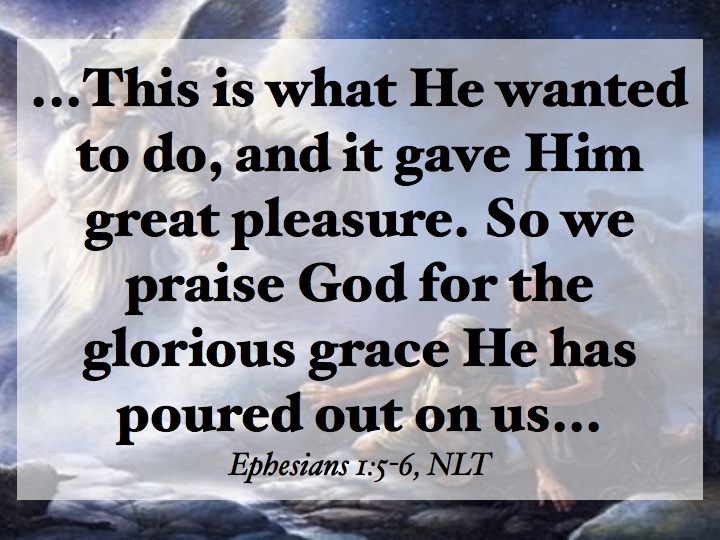
God decided in advance to adopt us into His own family by bringing us to Himself through Jesus Christ. This is what He wanted to do, and it gave Him great pleasure. So we praise God for the glorious grace He has poured out on us who belong to His dear Son. (Ephesians 1:5-6 NLT)
How amazing! God wants to adopt you! It’s something that brings Him great pleasure, so He constantly pours out the blessing of His grace on us!
Are you worthy of God’s favor? YES!! Not because you did anything to earn it, but because Jesus paid the price for you on the Cross.
Now you need to respond the way Mary did. The angel told Mary to “Fear not!” The verb tense implies that Mary needed to stop fretting about her (un)worthiness, and simply accept the grace that God was extending to her. In other words, she needed to see herself as God saw her.
Mary’s response should be our response: “I am the Lord’s servant. May it be to me as you have said.”
Listen to the podcast of this post by clicking on the player below, and you can also subscribe on Apple, Spotify, or Audible.
One fear that can haunt us is the fear that we’ve missed an opportunity. The fear becomes even more acute when the opportunity we fear we’ve missed is an opportunity that we believe God has promised us.
That’s the fear that plagued Zechariah (Luke 1:5-13). He and his wife Elizabeth were both PKs (priest’s kids), they were godly people who were upright in God’s estimation. Zechariah was even chosen by God to offer the incense in the Holy Place of the temple. Yet one fear haunted Zechariah: He and Elizabeth were childless.
The Bible says they were well along in years; or as the King James Version more poetically says it, they were stricken with years. This literally means they had moved on—they weren’t in their prime childbearing years any longer.
Zechariah had almost pushed this out of his mind, thinking that he had missed his window of opportunity, when the angel showed up with God’s message to him—
Do not be afraid, Zechariah; your prayer has been heard. Your wife Elizabeth will bear you a son…. (Luke 1:13)
Did you notice this phrase: your prayer HAS BEEN heard? The verb tense really makes it say: “The thing you used to pray for—the child you used to believe for, the pregnancy you used to try for—has been heard. But you stopped praying, you stopped believing, you stopped trying to get pregnant.”
Zechariah let his fears speak louder than God’s voice. That’s why the angel called him by name. Zechariah means Jehovah doesn’t forget!
What has God promised you? Are you still praying for it? Still believing for it? Are you still doing what you need to do to see it happen? Zechariah needed to sleep with his wife. What do you need to do? Do you need to go back to school? Make a phone call? Set up an appointment?
If God spoke it to you, He has not forgotten you! Don’t believe the lie that the window of opportunity has closed!
If it seems slow in coming, wait patiently, for it will surely take place. It will not be delayed. (Habakkuk 2:3)



 Overcoming Temptation







 Craig T. Owens