The Gift Unmistakably Seen

Listen to the podcast of this post by clicking on the player below, and you can also subscribe on AppleSpotify, or Audible. 

We saw last week that John 3:16 tells us of God’s greatest Gift—Jesus! 

This Gift was not an after-thought. God didn’t say, “I’ve tried everything else and nothing has worked so I guess I have to send My Son.” NO! The Gift was foretold right from the very moment Adam and Eve sinned (Genesis 3:15, 21). In fact, we can even say it was planned before the beginning of Time, as John describes Jesus as “the Lamb who was slaughtered before the world was made” (Revelation 13:8). 

John also writes for us one of the most beautiful and succinct statements of God: God IS Love (1 John 4:8). 

Paul wrote an inspired definition of love. Check out what happens when we put “God” in place of “love” in 1 Corinthians 13:4-8

God is patient, God is kind. God does not envy, God does not boast, God is not proud. God does not dishonor others, God is not self-seeking, God is not easily angered, God keeps no record of wrongs. God does not delight in evil but rejoices with the truth. God always protects, God always trusts, God always hopes, God always perseveres. God’s love never fails. 

This description of God means that He wasn’t forced to send Jesus as the ransom for our sins, but rather that His love foreknew the perfect moment to send this Gift for us. 

Neither did Jesus feel trapped by this plan His Father made. Calvary didn’t happen to Jesus, but Jesus came to make Calvary happen (John 17:24; Hebrews 12:2; John 10:17-18). 

Jesus made His Gift unmistakable:

  • He predicted the unmistakable events leading up to Calvary—Matthew 20:17-19, 26:2; Mark 10:32-34; Luke 18:31-33; John 13:19 
  • He predicted the unmistakable way He would die—John 3:14, 12:32-33 
  • And His Father unmistakably confirmed all of this—John 12:27-28

(check out all of the above verses by clicking here) 

Just before His crucifixion, Jesus gave His followers an unmistakable example of love to follow. He said that His love radiating out of His followers would show the world an unmistakable picture of His love (see John 13:3-5, 12-17, 34-35). 

I may say, “Thank you so much” when I open someone’s gift, but my true gratitude is seen in what I do with their gift after that. Do I put it on a shelf and forget about it? Or do I cherish it, use it, and tell others all about the one who gave the gift to me? This is just as true with how I treat the Love Gift that I was given in Jesus. 

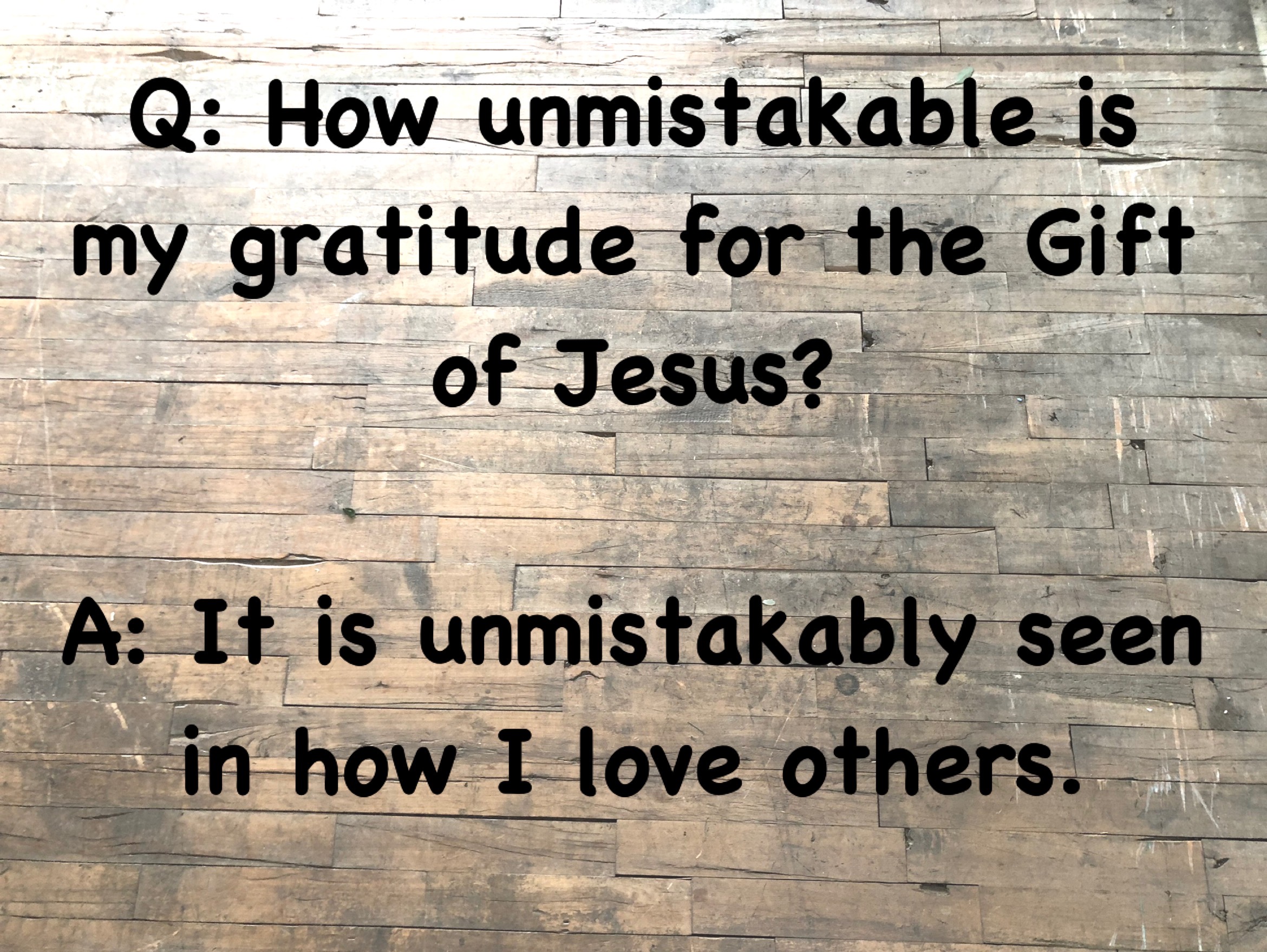
Q: How unmistakable is my gratitude for the Gift of Jesus? 

A: It is unmistakably seen in how I love others. 

Here’s the test: Can I put my name in 1 Corinthians 13:4-8—

Craig is patient, Craig is kind. Craig does not envy, Craig does not boast, Craig is not proud. Craig does not dishonor others, Craig is not self-seeking, Craig is not easily angered, Craig keeps no record of wrongs. Craig does not delight in evil but rejoices with the truth. Craig always protects, Craig always trusts, Craig always hopes, Craig always perseveres. Craig’s love never fails.

The Holy Spirit wants all Christians to be able to truthfully insert their names in that statement. He wants to help us make necessary changes that will allow the amazing Gift of Jesus to be unmistakably seen by everyone. 

God’s plan is unmistakable. The death of Jesus is unmistakable proof of God’s love. Now, let’s make sure that our love is also empowered by the love of God shining unmistakably out of everything we say and do. 

If you’ve missed any of the messages in our series Christmas Unwrapped At Easter, you can find the complete list by clicking here. 

►► Would you please prayerfully consider supporting this ministry? My Patreon supporters get behind-the-scenes access to exclusive materials. ◀︎◀︎

Crucifixion Events

Listen to the podcast of this post by clicking on the player below, and you can also subscribe on AppleSpotify, or Audible. 

The death of Jesus may be the most attested execution in all of history. It’s certainly the most meaningful execution, as the death of Jesus brought a fulfillment to prophecy that was made in the immediate aftermath of humanity’s first sin. 

I have frequently written about the historicity of the Bible. The crucifixion of Jesus is not a “once upon a time” or “in the make-believe land of Israel” story, but an actual event, which involved actual people, at an actual moment in history. Even the way the four Gospel writers record the crucifixion of Jesus attests to the historicity of this event.

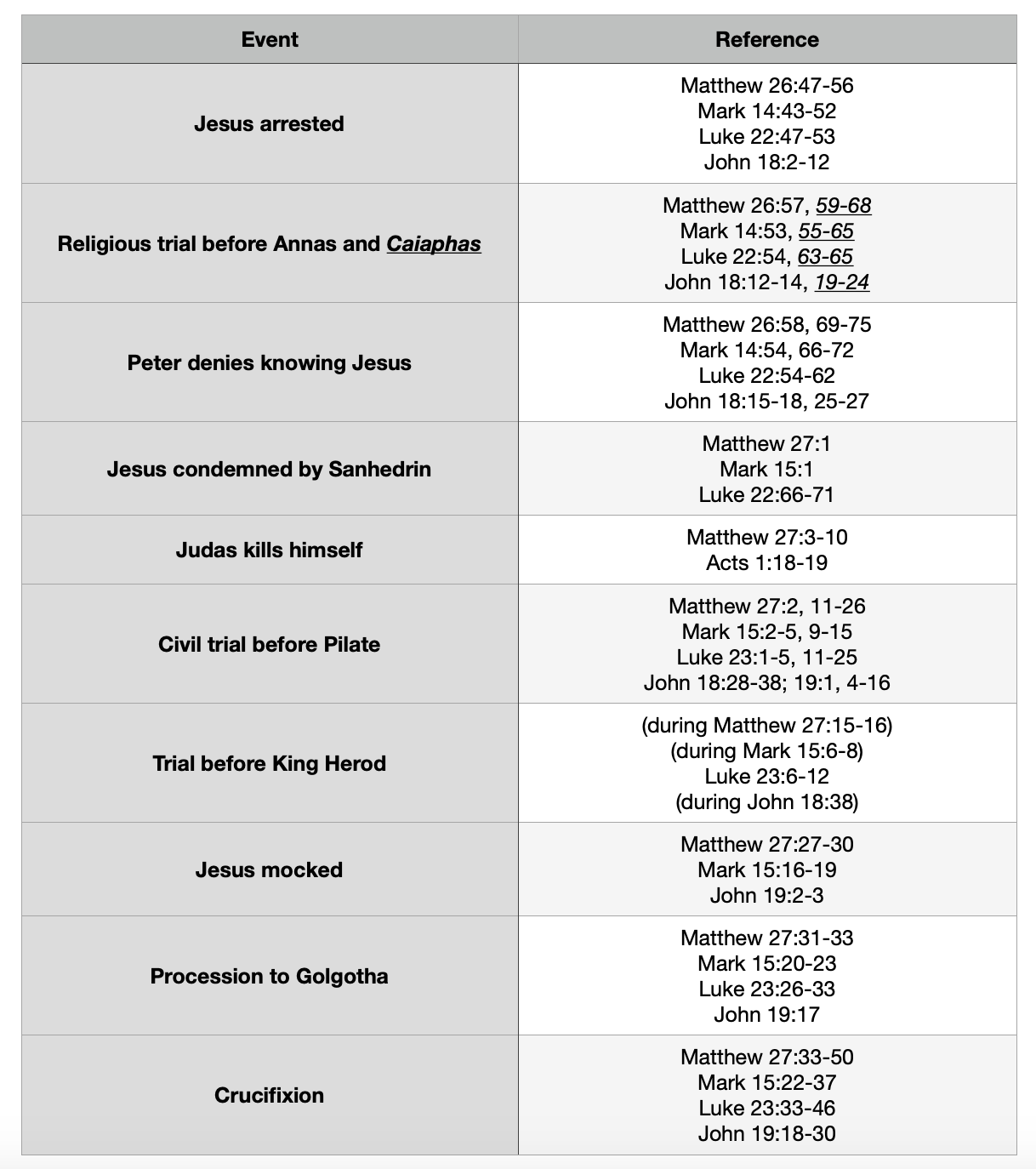
Check out this chart of the events that show how Matthew, Mark, Luke, and John record this historical moment. 

When did this moment in history occur? Consider this scholarly insight from The Archeological Study Bible

“In what year was Jesus born, and when was He crucified? These are long-standing historical questions. The seemingly obvious answer to the first—that He was born in A.D. 1 (there is no year 0)—is incorrect, however, since the calculations on which our modern calendar is based were faulty. …

“The chronology of Jesus’ life, though clear in outline, cannot be fixed with absolute precision. Matthew and Luke both inform us that Jesus was born before the death of Herod (4 B.C.), though it would appear that His birth occurred toward the final years of Herod’s reign, suggesting an approximate date of 6-4 B.C. The next chronological marker comes from Luke 3:1, where we learn that John the Baptist’s ministry began during the fifteenth year of the reign of the emperor Tiberius. Since A.D. 14 is the generally accepted date for Tiberius’ accession to the throne, John’s ministry would have commenced between August A.D. 28 and December of 29. Jesus began His own ministry shortly after John had embarked on his, at some point in A.D. 28 or 29, making Jesus about 32 or 33 years old at the time. This fits well with Luke’s statement that Jesus was ‘about 30 years old’ (Luke 3:23).

“The duration of Jesus’ public ministry was approximately three years. While the exact chronology of this period is difficult to ascertain, the final phase of His ministry allows for closer scrutiny. It is clear that Jesus was crucified under Pontius Pilate, who governed Judea from A.D. 26-36. …

“Taking Friday, Nisan 14, as the day of the crucifixion, astronomical data informs us that the only years from A.D. 29-36 that could have seen Nisan 14 on a Friday are A.D. 30, 33 and 36. A.D. 36 is easily dismissed as too late, while A.D. 30 seems too early (although some who begin Jesus’ ministry in A.D. 28 and shorten His public ministry find it acceptable). This leaves A.D. 33 as the most likely date for the year of Jesus’ death and resurrection.” 

As you celebrate the victory over sin and death that Jesus won by His sacrificial death on the Cross, rejoice also that this is an actual historical event that bought your freedom from your sin. It is indeed miraculous, but it is also historic. Let’s never lose sight of either of those facets. 

►► Would you please prayerfully consider supporting this ministry? My Patreon supporters get behind-the-scenes access to exclusive materials. ◀︎◀︎

The Gift Promised

Listen to the podcast of this post by clicking on the player below, and you can also subscribe on AppleSpotify, or Audible.

Have you ever seen kids tearing into a Christmas present and then being disappointed that what they got wasn’t what they wanted? They may say something like, “This isn’t what I put on my wish list!” 

From the response of the religious leaders in the Gospels, it appears that the gift of Jesus on that original “Christmas morning” was very similar. It’s almost like they were saying, “This isn’t the type of Messiah we wanted!” They wanted someone to give them freedom from the Romans, but their Heavenly Father wanted them to have something far bigger and greater: Eternal freedom from the penalty of sin. 

The first humans had the joy of being innocent in God’s presence, where they had everything they needed. But satan got Adam and Eve to focus on something they wanted, and that sin of disobedience brought an immediate separation. They now feared the nearness of God. 

There were immediate and painful consequences for their sin, but God wanted the heaviest of penalties to fall on Himself. To foreshadow this, God sacrificed an innocent animal to cover their nakedness, showing us what the gift of Jesus would do for us (Genesis 3:1-21). 

In The Holy War, John Bunyan tells the story of the town of Mansoul enslaved to Diabolus. The crafty serpent plays on their fears by reminding them how terrible it would be if they allowed Holy God to come near them while they were in their sinful state: 

“‘Gentlemen,’ quoth he, ‘and my faithful subjects, if it is true that this summoner hath said concerning the greatness of their King, by His terror you will always be kept in bondage, and so be made to sneak. Yea, how can you now, though He is at a distance, endure to think of such a Mighty One? And if not to think of Him while at a distance, how can you endure to be in His presence?’” 

Diabolus even tried to make their slavery to sin look like freedom: “I, your prince, am familiar with you, and you may play with me as you would with a grasshopper. Consider, therefore, what is for your profit, and remember the immunities that I have granted you.’”  

As John Piper reminds us, “Christmas is for freedom.” Indeed, that’s just what we see on the first “Christmas morning” in words like salvation, no fear, and great joy (Matthew 1:21; Luke 2:10-11). 

Turning again to The Holy War, here’s what the Father said to His Son: “Wherefore the King called to Him Emmanuel, His Son, who said, ‘Here am I, My Father.’ Then said the King, ‘Thou knowest, as I do Myself, the condition of the town of Mansoul, and what We have purposed, and what Thou hast done to redeem it. Come now, therefore, My Son, and prepare Thyself.’”  

Immanuel (or the Romanized spelling Emmanuel) is the One who removes the separation caused by our sin, and rejoins us to God. That prefix “im” means with, and the suffix “El” means God. The root word means God’s kinsmen. Immanuel comes to repair what was severed by taking sin’s penalty on Himself, and allowing us to once again enjoy the closeness of kinship with our Heavenly Father (Matthew 1:22-23; Galatians 4:4-7). 

When the people saw this Gift on Christmas morning, they said, “This isn’t what we wanted! We wanted a rich, powerful, conquering King. One who would send the Romans running in fear!” As a result, very few unwrapped this Heavenly Gift. But God reminded them, “That may be what you wanted, but I have given what you need. I want you to have not just temporary freedom from the Romans, but eternal freedom from your sin so that you can be forever in My presence!” 

This is what Jesus rejoiced to do for us with the Gift of His life, death, and resurrection. One more passage from The Holy War tells us, “Then said the King’s Son, ‘Thy law is within My heart: I delight to do Thy will. This is the day that I have longed for, and the work that I have waited for all this while. … I will go and will deliver from Diabolus, and from his power, Thy perishing town of Mansoul. My heart has been often pained within Me for the miserable town of Mansoul; but now it is rejoiced, but now it is glad.’” (The timing for the Incarnation of Jesus and even these words of Immanuel Himself are found in Hebrews 2:14-15; 10:5-7). 

God’s love is too great to be limited to just meeting our wants because in our immaturity and sinfulness we don’t know what we really need—but He does. So His love sent Immanuel to us. 

The Gift was given to us at Christmas, but in our immaturity and shortsightedness, we didn’t realize the full impact of this Gift until Jesus rose victoriously from the grave! Now by placing our faith in His completed work, we can be rejoined to God and live in unshakable hope of an eternity with Him! 

If you would like to follow along with all of the messages in this series called Christmas Unwrapped At Easter, please check out the links I’ve shared here.

►► Would you please prayerfully consider supporting this ministry? My Patreon supporters get behind-the-scenes access to exclusive materials. ◀︎◀︎
Shine In The Darkness

Listen to the podcast of this post by clicking on the player below, and you can also subscribe on AppleSpotify, or Audible. 

I’ve noticed that when people want to sound super-spiritual that they like to use King James Version phrases. Sometimes I hear people speaking in normal, everyday English until they begin praying and then I hear, “Thy servant … Thou O Most High … we beseech Thee … Thou knowest Thine children….” 

Statement #6 in our series “Is that in the Bible” also sounds more powerful when people quote it in King James English—Shun the very appearance of evil or sometimes Wherefore come out from among them, and be ye separate, saith the Lord. Are those in the Bible? Yes, they are! 

We don’t use the word “shun” very often today, but in what was probably the first written book of the Bible we read that not only did Job shun evil, but God commended him for shunning evil too. And wise King Solomon advocated for his readers to shun evil (Job 1:1, 8; 2:3; Proverbs 3:7, 14:16). 

Yes, those phrases that I quoted earlier come right from the King James Version of the Bible in 1 Thessalonians 5:22 and 2 Corinthians 6:17, but does this mean that we are to stay away from anything that is “unChristian”? Does it mean that we are to shun sinners? 

There is a story that is told in the synoptic Gospels, but I especially like it in Matthew’s Gospel for one specific reason (which I’ll share with you in a moment). Jesus has just called Matthew to be His disciple, and several of Matthew’s coworkers appear to be having a going-away dinner for him which Jesus attended. 

Then comes the “911” call from the Pharisees (this statement is in Matthew 9:11): “Gasp! Jesus is eating with sinners! He’s not shunning them! Call in the sin police!” The New Living Translation is even more harsh, with the Pharisees asking, “Why does your Teacher eat with such scum?” (v. 13 NLT). 

In Luke’s Gospel we read another story where Jesus eating with “such scum” turned another tax collector’s life around. In Luke 19:1-10, we read of Zaccheus experiencing a complete life change because of His encounter with Jesus. 

Listen to Christ’s words in both Matthew and Luke: “It is not the healthy who need a doctor, but the sick. … I have not come to call the righteous, but sinners. … The Son of Man came to seek and to save what was lost” (Matthew 9:12-13; Luke 19:10). 

This doesn’t sound like Jesus shunned sinners.

Likewise, Jesus called us to be His salt and light in the world (Matthew 5:13-14). No matter how beneficial the salt of my life is, it doesn’t help anyone if it stays in the saltshaker, shunning the food. No matter how bright the lantern of my life is, it doesn’t help anyone in a closed closet, shunning the darkness. 

Notice what Jesus didn’t do. He didn’t go to Matthew’s house or Zaccheus’ house for a good time, or for a good meal, or for a time of entertainment. He was on mission. So too for Christians: We go into dark places not for our pleasure or entertainment, but because we’re on a rescue mission! 

In both the Old Testament Hebrew and the New Testament Greek, the words for “shun” point at our own hearts. The words mean: You walk away from things that will pull you down, or you hold yourself back from the places and things that will lead you to sin. 

So look at the phrase “Shun the very appearance of evil” in its context: “Do not quench the Spirit. Do not treat prophecies with contempt but test them all; hold on to what is good, reject [or shun] every kind of evil” (1 Thessalonians 5:19-22). 

Paul is calling us to shun the things that drown out the voice of the Holy Spirit. Listen to two of those verses in another translation: “But test and prove all things until you can recognize what is good; to that hold fast. Abstain from evil” (vv. 21-22 AMP). 

In 2 Corinthians 6 the phrase “Be ye separate” is in the context about being “unequally yoked” with unbelievers. This is what happened to King Solomon when he married women who were idolaters, and they pulled his heart away from God. 

Shun” means to keep away from those things that would pull you down. How do I know if a certain environment or activity or person is pulling me down? I need to check my thoughts, attitudes, and actions. If I find they are becoming un-Christlike, then that is an indication of a place or person that I need to limit my exposure. 

As long as my thoughts, attitudes, and actions remain Christlike, I should keep on seasoning and shining in dark places so that I can draw others to Jesus. “Do everything without complaining and arguing, so that no one can criticize you. Live clean, innocent lives as children of God, shining like bright lights in a world full of crooked and perverse people” (Philippians 2:14-15 NLT). 

Don’t shun people that Jesus dearly loves, but don’t put yourself in a position where your devotion to God is compromised either. Listen to the voice of the Holy Spirit giving you the wisdom you need to be both on-mission for Jesus and shining a bright, innocent light! 

If you’ve missed any of the other lessons in this series, you can find the full list by clicking here. 

►► Would you please prayerfully consider supporting this ministry? My Patreon supporters get behind-the-scenes access to exclusive materials. ◀︎◀︎

Letting Go To Hold On

Listen to the podcast of this post by clicking on the player below, and you can also subscribe on AppleSpotify, or Audible.

In Stephen’s sermon, he notes something interesting about Abraham: “The God of glory appeared to our father Abraham while he was still living in Mesopotamia, before he lived in Haran. ‘Leave your country and your people,’ God said, ‘and go to the land I will show you’” (Acts 7:2-3). 

That word “before” especially caught my attention—“before he lived in Haran.” 

In Genesis 11:31, we read that Terah (who is Abraham’s father) is the one who takes Abraham and Lot to set out for Canaan, but that they only made it as far as Haran. Could it be that God did speak to Abraham in the land of Ur, and that his influence on his father was so deep that Terah decided to answer the call too? Yet God called Abraham—not Terah—so Terah apparently was not as committed to obey God’s call. 

Terah’s youngest son Haran died before they began the journey. Terah didn’t get very far into their journey toward Canaan until in grief over his dead son, he stopped and he settled. 

Was Terah angry at God? Was he fearful about what may happen to the rest of his family on the long journey? Was he so wrapped up in his grief over his youngest son that he couldn’t move forward? 

Whatever the case, not only did Terah stop, but so did Abraham. 

But God, in His incredible graciousness, spoke to Abraham again, renewing the call to follow Him. 

Stephen said that Abraham left Haran “after the death of his father” (Acts 7:4). But let’s do the math: Terah was 70 years old when Abraham was born and lived to be 205 years old (Genesis 11:26), but Abraham arrived in Canaan when he was 76 years old (Genesis 16:3, 16). That means that Terah was still physically alive when Abraham left him. 

In other words, Abraham had to love God more than his grief-stricken, grief-paralyzed father, to the point that he had to consider his father as dead. He had to do this in order to follow God. 

Jesus says something similar to those who would be His followers today: “If anyone comes to Me and does not hate his father… he cannot be My disciple” (Luke 14:26). 

That’s a sobering word! We have to value obedience to God above all else. We have to believe that God is our supreme reward, and that absolutely nothing on this earth compares to the surpassing greatness of knowing Him. 

Jesus gave us this promise—

Jesus said to them, “Truly I tell you, at the renewal of all things, when the Son of Man sits on His glorious throne, you who have followed Me will also sit on twelve thrones, judging the twelve tribes of Israel. And everyone who has left houses or brothers or sisters or father or mother or wife or children or fields for My sake will receive a hundred times as much and will inherit eternal life. (Matthew 19:28-29)

Abraham shows us the principle that we should all realize: Following the call of God is so worth it! Letting go of this world so that you can hold on to your Savior is the best decision you could ever make! 

►► Would you please prayerfully consider supporting this ministry? My Patreon supporters get behind-the-scenes access to exclusive materials. ◀︎◀︎

Name-It-Claim-It?

Listen to the podcast of this post by clicking on the player below, and you can also subscribe on AppleSpotify, or Audible.

This is part 4 in our series “Is that in the Bible?” 

Statement #4—Name it and claim it. Is that in the Bible? No! 

But in fairness, even the proponents of this belief don’t usually say it this way. Instead they quote words from Jesus like: “I will do whatever you ask in My name” (John 14:13) or “Ask whatever you wish, and it will be given you” (John 15:7). 

They really want this to be true, I think, because in their minds happy, prosperous Christians make God look good. On the other hand, struggling Christians make God look bad. There is a whole branch of theology called theodicy which literally means: “a defense of God’s goodness and omnipotence in view of the existence of evil.” 

This is nothing new. Religious people have always tried to have pat answers. In the oldest book of the Bible, Job’s friends were convinced that suffering results from sin and blessing results from righteousness. And yet according to God, Job was a righteous man (Job 1:1, 8, 20-21). 

At the advent of Jesus, the chief priests and scribes want the Messiah to be heroic so they modified a prophecy to make Bethlehem sound more impressive (compare Micah 5:2 with Matthew 2:6). 

So it follows that this name-it-claim-it group wants God to look good because His people look good, dress well, drive nice cars, live in big homes, fly private jets, and never get sick.

But Jesus Himself told His followers to, “Sell your possessions and give to the poor” (Luke 12:33). And He said, “Blessed are you when people insult you, persecute you and falsely say all kinds of evil against you because of Me” (Matthew 5:11). And Jesus also said, “In this world you will have trouble” (John 16:33). 

This is not to say that God opposes wealth: He gave wealth to His leaders, Job was doubly-wealthy after his trial, and wealthy people funded the ministry of Jesus and the early church. But this isn’t the same as pursuing—or even demanding—wealth, or of making the erroneous connection that poor people are somehow out of favor with God. 

How do we avoid these errors? Here are three thoughts: 

(1) Study the whole counsel of God’s Word.  

Don’t just read your favorite passages, or the ones that make you feel good, but read all of the Bible. Jesus frequently had to correct the religious leaders’ beliefs by sending them back to the Scripture (Matthew 21:15-16; Mark 12:18-27; Luke 6:3). Jesus called the Holy Spirit the Spirit of truth (John 16:12-15). The Holy Spirit that inspired the Bible is the same Holy Spirit in a Christian that can illuminate the Bible as you read it.  

(2) Remember that context is king.  

The word “eisegesis” means to read something into the Word. But that is like creating your own beliefs and then going to the Bible to find phrases that support what you already believe. On the other hand “exegesis” is to read the Bible and have it speak to us by the Holy Spirit. 

Two of the phrases from Jesus that the name-it-and-claim-it folks use (John 14:13 and John 15:7) turn out to mean something entirely different than, “God will give me all of the things I demand from Him” when they are read within the context of the things Jesus was teaching at that time (see John 14:9-14 and 15:1-8). 

(3) Understand your terms.

If something is biblical, that is something the Bible says yes to. Unbiblical things the Bible says no to. But non-biblical are those the Bible doesn’t explicitly address. We have to be very careful of trying to make non-biblical things sound biblical or it may lead to some unbiblical attitudes and actions. 

This is exactly what the Pharisees did by giving their non-biblical traditions the weight of biblical statements, and then looking down on others in a very unbiblical way. 

God is sovereign. We do not tell Him what to do. We do not demand Him to respond to our needs. We trust Him and and we abide in Him. Then in the abiding, asking and understanding and fruitfulness are as natural as a flower sprouting from a branch that is attached to the vine. We don’t name things and claim things for our personal comfort, but we desire solely for God’s glory to be seen—whether in wealth or poverty, health or sickness, peaceful times or tribulation. 

Evaluating all biblical sounding statements by those three items—studying the whole counsel of God’s Word, understanding the context, and knowing our terms—will guide us from going astray. 

If you’ve missed any of the messages in our series Is That In The Bible?, you can get a list of all of the messages by clicking here.

►► Would you please prayerfully consider supporting this ministry? My Patreon supporters get behind-the-scenes access to exclusive materials. ◀︎◀︎

Links & Quotes

T.M. Moore wrote, “It’s not likely John the Baptist would be welcomed in many pulpits today. Even though Edwards used him as a model of ‘The True Excellency of a Gospel Minister,’ few and far between are the shepherds today who would even think of adopting his example.

“Edwards wrote, ‘He also shone bright in his conversation, and his eminent mortification and renunciation of the enjoyments of the world; his great diligence and laboriousness in his work, his impartiality in it, declaring the mind and will of God to all sorts without distinction; his great humility, rejoicing in the increase of the honour of Christ, though his honour was diminished, as the brightness of the star diminishes as the light of the sun increases; and in his faithfulness and courage, though it cost him his own life.’

“These days many pastors secure their ‘honor’ in subtle but significant ways. They go by ‘Reverend’ or ‘Doctor.’ Have reserved parking places and their name on the church sign. Adopt fashionable garb and speech. Try hard to be friends with all the right people. Such shepherds want to advance their honor; John worked to have his honor diminished, that the honor of Christ might increase.”

I share T.M.’s passion for shepherd in the Church, which is why he graciously wrote an endorsement for my book Shepherd Leadership: The Metrics That Really Matter.

Vaughn Shoemaker (1902-1991) was an American editorial cartoonist. He won the 1938 and 1947 Pulitzer Prizes for Editorial Cartooning for his work with the Chicago Daily News. He was the creator of the character, John Q. Public, and a faithful Assemblies of God layman. I am a fourth-generational Pentecostal in the Assembly of God fellowship, so I love studying more about the men and women who have made this such a robust missions-minded fellowship! Read more of this amazing man here.

Dan Reiland has an important list for leaders: 11 Leadership Mistakes To Avoid At All Costs.

This is a radical call for us to look hard at our present lives to see if they are shaped by the hope of the resurrection. Do we make decisions on the basis of gain in this world or gain in the next? Do we take risks for love’s sake that can only be explained as wise if there is a resurrection?” —John Piper

“Jesus will do the things we ask for if they make God’s greatness known. So how do we ask this way? We must ask from right relationships (Mark 11:24-25, 1 Peter 3:7), with right motives (James 4:3, Proverbs 16:2), through right living (James 5:16, Proverbs 15:29), in good faith (James 1:6-7), according to His will (1 John 5:14-15). In short, if you think Jesus would put His name on it, and it will make His Father famous, then ask and believe! But remember, we’re here for Him—He’s not here for us.” —Craig Groeschel, in Twisted 

For parents and anyone else who works with students, this is a segment from the Axis ministry’s Culture Translator newsletter:

In his book Man’s Search for Meaning, Viktor Frankl writes that “success, like happiness, cannot be pursued; it must ensue, and it only does so as the unintended side-effect of one’s personal dedication to a cause greater than oneself… Happiness must happen, and the same holds for success: you have to let it happen by not caring about it.”

An idea like that would likely seem counterintuitive to many of the students in Professor Santos’ classes—students who have been raised from young ages to pay careful and constant attention to their academic viability. Students like these grow up with a hope and an expectation that achieving perfection (whether academic, relational, spiritual, or other) will finally yield the happiness, satisfaction, and recognition they’ve been looking for. But after achieving perfection, the next source of anxiety is maintainingperfection. As Christopher Fry once put it, “What, after all is a halo? It’s only one more thing to keep clean.”

Jesus concludes Matthew 5 by saying to his hearers, “Be perfect, therefore, as your heavenly Father is perfect.” It’s a verse most Christians may not want to touch, and one that anxious overachievers might point to as justification for their continual striving. But as C.S. Lewis points out in Mere Christianity, Jesus’ words presuppose our dependence on Him. He writes, “The command Be ye perfect is not idealistic gas. Nor is it a command to do the impossible. He is going to make us into creatures that can obey that command… The process will be long and in parts very painful, but that is what we are in for. Nothing less. He meant what He said.”

In other words, our betterment is in partnership with our Creator, and happiness is merely a by-product of our total surrender. Whoever has ears, let them hear.

The Approachable Jesus

Listen to the podcast of this post by clicking on the player below, and you can also subscribe on AppleSpotify, or Audible. 

A friend of mine who was in a position of leadership in the Assemblies of God used to joke with people, “Since you’re bowing and walking backwards out of my office, would you like to kiss my ring too?” There are some people that we feel are in a special class so that we have to approach them differently. 

If we feel that way about certain people, what might we be thinking when we consider approaching the supreme, awesome, preeminent, incomparable Jesus?! It’s very likely that we could feel Him to be unapproachable, as though we aren’t worthy of His attention. 

But when Jesus Himself told us, “When [not ‘if’] you pray,” He is assuming that we will pray. And then He adds this amazing thought: “And I will do whatever you ask in My name, so that the Father may be glorified in the Son” (John 14:13)! 

Jesus loves to help us. He died a cruel death on the Cross so that He could help us! Jesus ties our trusting prayer with His willingness to serve us (Luke 12:22-37). Note this last line from our approachable Savior: 

It will be good for those servants whose Master finds them watching when He comes. Truly I tell you, He will dress Himself to serve, will have them recline at the table and will come and wait on them. (v. 37) 

Jesus serves us?! What an amazing thought! But does this make Jesus somehow less majestic? I like what John Piper has to say about this: “Does this belittle the risen Christ—to say that He was and is and will ever be the servant of His people? It would, if ‘servant’ meant ‘one who takes orders,’ or if we thought we were His masters. Yes, that would dishonor Him. But it does not dishonor Him to say that we are weak and need His help.” 

How do we not treat Jesus as an order-taking servant? First, we have to remember that approachable doesn’t mean something we do casually. I think this is discovered in our attitude—it’s the difference between being childlike and being childish. 

The childlike attitude is one of wonder and trust. One that calls God, “Daddy.” One that is lovingly dependent on Him. One that says, “I don’t understand what I’m going through right now, but I trust Your wisdom.” 

The childish attitude is one who treats majestic things flippantly. Perhaps the childish one talks about God as “the Big Guy upstairs.” Or one who remains selfishly independent, or who says, “Do it my way—now!”

The childlike attitude glorifies Jesus as our approachable Servant Savior. 

The childlike attitude also recognizes that there are more dimensions of the majesty of God to be discovered in an abiding relationship with Jesus. Our approachable Savior wants us to come to Him, to call to Him for help, and to know Him more intimately (Jeremiah 29:13-14; Matthew 11:28-30; Hebrews 4:16; 10:19, 22). 

Prayer not only unlocks deeper, proper intimacy with Jesus, but it conforms our heart more and more to His heart. As we are conformed to Him, we reflect His approachable glory to others (2 Corinthians 4:6, 3:18). 

We approach the awesome Jesus reverently in childlike faith. It’s in God’s presence that the Holy Spirit matures our faith so that we become glory-reflectors that point others to Jesus. 

If you’ve missed any of the eight messages in our series Awesome: Learning to pray in the awesome name of Jesus, you can find the list of all of the messages by clicking here. 

►► Would you please prayerfully consider supporting this ministry? My Patreon supporters get behind-the-scenes access to exclusive materials. ◀︎◀︎

A Leader’s Health

Listen to the podcast of this post by clicking on the player below, and you can also subscribe on AppleSpotify, or Audible. 

I had a great time on the Ailbe Podcast with Rusty Rabon.

Rusty noted how I had used the description of the early life of Jesus from Luke’s Gospel—And Jesus grew in wisdom and stature, and in favor with God and man (Luke 2:52)—and then how I created a pyramid of health for shepherd leaders to follow. 

I think that Dr. Luke, under the inspiration of the Holy Spirit, listed those four items in a very specific order. It begins with the growth of our mind, which helps us make healthy choices for our physical body, which allows us to concentrate on our spiritual growth. But ultimately the real proof of our God-honoring healthiness is seem in how we interact and react with other people. 

In my book Shepherd Leadership: The Metrics That Really Matter I take five chapters to unpack the various aspects of a leader’s health, and I offer some practical first steps for anyone to address areas where their health is not at its best. 

I’ll be sharing more clips from this interview soon, so please stay tuned. Shepherd Leadership: The Metrics That Really Matter is now available in print or ebook, and in audiobook through either Audible or Apple. 

►► Would you please prayerfully consider supporting this ministry? ◀︎◀︎

The Human Jesus

Listen to the podcast of this post by clicking on the player below, and you can also subscribe on AppleSpotify, or Audible. 

We saw that our beautiful Jesus became grotesque—taking our ugly sin on Himself so that He could clothe us with His perfectly righteous robe. In so doing, He became even more resplendent. His friend John saw Him in such radiant beauty that he crumbled to his knees at the sight of His majesty (Revelation 1:12-16)! 

Just like John and others in the Bible, when we see ourselves in contrast to His awesome beauty, we often feel shabby and unworthy to be in His presence. Job expressed his desire to somehow get away from this Perfection (Job 7:11-21). Ultimately, in his desperation, Job utters something prophetic—

God is not a mere mortal like me that I might answer Him, that we might confront each other in court. If only there were someone to mediate between us, someone to bring us together, someone to remove God’s rod from me, so that His terror would frighten me no more. Then I would speak up without fear of Him, but as it now stands with me, I cannot. (Job 9:32-35) 

When we are confronted with the perfection of God, we all want “someone to arbitrate”—someone who will fairly represent both sides. We need someone both God and man. Since man cannot become God, only God can become man. Isaiah prophesied it this way, “God saw that there was no one, He was appalled that there was no one to intervene; so His own arm achieved salvation for Him” (Isaiah 59:16). 

This Arbitrator or Mediator is Jesus the Christ! 

Jesus means “help from Jehovah.” This is His human name given to Him at His birth (Luke 1:31; Matthew 1:21, 25; Luke 2:21). 

Christ or Messiah means “anointed by God” and is His divine title. Often His title is used with the definite article “the” to signify that Jesus is the One and Only Messiah (Luke 2:26-27; John 1:41; Matthew 16:16; Acts 10:38). 

William Barclay commented on this: “Peter states [that Jesus was a human descendent of David] in the first recorded sermon of the Christian Church (Acts 2:29-36). Paul speaks of Jesus Christ descended from David according to the flesh (Romans 1:3). The writer of the Pastoral Epistles urges men to remember that Jesus Christ, descended from David, was raised from the dead (2 Timothy 2:8). The writer of the Revelation hears the Risen Christ say: ‘I am the root and the offspring of David’ (Revelation 22:16).” 

Many times this human name and divine title are linked together. In Hebrews, the name Jesus is used more times than any other title (19x), and Christ is the second-most used title (15x).

(For my Patreon supporters, I’ve shared a list of all of the titles for Jesus used in the book of Hebrews.)

Hebrews makes it perfectly clear how important it is that Jesus was made fully human just like us. We read phrases like

  • “made a little lower than the angels,” which was David’s way of talking about humans (see Psalm 8:4-6) 
  • “made perfect through suffering”—only humans can suffer 
  • “flesh and blood” 
  • “made like His brothers in every way” 
  • “His life on earth”

Remember that I said the most-used titles in Hebrews were Jesus and Christ. The third-most used title in Hebrews is high priest (14x). Only the Human Jesus and the Divine Jesus could be the perfect High Priest and Mediator that Job longed for, and that you and I have to have!

This post is a part of a bigger series on prayer with the subtitle: “Learning to pray in the awesome name of Jesus.” So what does it mean that we can pray in the human name of Jesus? 

It means we don’t have to pray majestic prayers in order for God to take notice. We can pray very human prayers, we can groan with real human pain, we can growl with real human anger. Our totally human Jesus understands us, and the totally divine Christ runs to help us! 

Don’t try to sanitize your prayers to make them sound acceptable. Jesus didn’t! How awesome it is to have a High Priest who is both fully human and fully divine! 

If you’ve missed any of the other messages in this series on prayer, you can find a link to all of them by clicking here. 

►► Would you please prayerfully consider supporting this ministry? My Patreon supporters get behind-the-scenes access to exclusive materials. ◀︎◀︎