This is a weekly series with things I’m reading and pondering from Oswald Chambers. You can read the original seed thought here, or type “Thursdays With Oswald” in the search box to read more entries.
Jeremiah 13
[These are notes from Oswald Chambers’ lecture on Jeremiah 13.]
When a man is afraid of God the only right thing for him to do is to run straight to God and not wait to dress himself. The further we get away from God the more we want to dress ourselves up in prayer, etc., but if we fly, just as we are, God will take us and remove the unclean thing. …
Spiritually when an individual builds his confidence on anything less than God inevitably there will be a perishing of the ground of confidence. … Beware of building your faith on your experience of God’s grace instead of on God Who makes the experience possible. …
Never succumb to believing in an inevitable fate, but fly to God, then you will never know the darkness or the judgments on sin (cf. John 3:19). Judgment comes because of conscious rejection or a conscious neglect. If we see and do not obey, there will be the wandering in the shadows, by God’s decree. There is always a way back to God, and that is to fly as you are, not as you want to be. …
Never trust innocence of outlook in yourself or in other people when the statements of God’s Word are directly opposite (see Mark 7:21 and Jeremiah 17:19). … It is difficult when convicted to turn to Jesus Christ; we turn to vowing; but unless we turn to Jesus in obedience and let His life enter in, it is hopeless, for we build again on the same old foundation.
From Notes On Jeremiah
When the Holy Spirit convicts us, our natural human tendency is to (a) justify, (b) make excuses, (c) vow that we will never do that again, (d) ask a friend to help hold us accountable to better behavior, or (e) try to cover up with a lot of religious activity.
What God wants instead is for us to run to Him. Just as we are. No pretenses. No excuses. No delay. He alone has the healing and restoration we desperately need.
“When you’re full of yourself, God can’t fill you. But when you empty yourself, God has a useful vessel. Your Bible overflows with examples of those who did.
“In his gospel, Matthew mentions his own name only twice. Both times he calls himself a tax collector. In his list of apostles, he assigns himself the eighth spot.
“John doesn’t even mention his name in his gospel. The twenty appearances of ‘John’ all refer to the Baptist. John the apostle simply calls himself ‘the other disciple’ or the ‘disciple whom Jesus loved.’
“Luke wrote two of the most important books in the Bible but never once penned his own name.
“Paul, the Bible’s most prolific author, referred to himself as ‘a fool’ (2 Corinthians 12:11).
“King David wrote no psalm celebrating his victory over Goliath. But he wrote a public poem of penitence confessing his sin with Bathsheba (see Psalm 51).
“And then there is Joseph. The quiet father of Jesus. Rather than make a name for himself, he made a home for Christ. And because he did, a great reward came his way. ‘He called His name Jesus’ (Matthew 1:25).”—Max Lucado, in You!
Check out my book review of You! by clicking here, and you can read some other quotes from this book here.
This is a weekly series with things I’m reading and pondering from Oswald Chambers. You can read the original seed thought here, or type “Thursdays With Oswald” in the search box to read more entries.
Jeremiah 10
[These are notes from Oswald Chambers’ lecture on Jeremiah 10.]
The ungodly disposition in a man makes him worship beings or things or ideas in order to render them powerless, and the same idea is apt to creep into the worship of God amongst Christians if not watched—“God will never let this or that come to me; I am a favorite of His.” Jesus Christ’s life is an illustration as to how God will deal with us, He will not shield us from the world, the flesh or the devil, they are allowed to do their worst because God has staked His all on what He has done in us (see John 16:33; 1 John 4:4). Trials and tribulations are trumpet calls to the witnesses to God. …
One moment’s realization that Almighty God is your Father through Jesus Christ, and I defy anything to terrify you again for long. If we realize, what these prophets realized, that nothing can happen without God’s permission, we are kept in peace. Worrying is wicked in a Christian. “Let not your heart be troubled.” How dare we be troubled if Almighty God Who made the world and everything in it, is our Father? …
We have got to be holy someday, why not be holy now? … No matter how moral we may be, every domain of our life that is not regulated by the direct application of the wisdom of God is brutish in God’s sight. …
The greatest obstruction to the working of God comes from those who give themselves to interpreting the words of God rather than doing them. … Obedience is superbly easy because we have Almightiness on our side. Acknowledge God’s voice, take the step in the right direction and obey, and you will be backed by omnipotence in every detail.
From Notes On Jeremiah
We go wrong when…
…we try to make God in our image, telling others what God will or won’t do
…see trials and temptations only as bad things
…allow our fears to paralyze us to God’s strength
…think we are unworthy to call God our Father
…worry obsessively
…block the Holy Spirit from continuing to make us holy
…keep God out of certain areas of our life
…hear God’s Word but don’t obey it
I love this question—“We have got to be holy someday, why not be holy now?” Well, why not?!
This is a weekly series with things I’m reading and pondering from Oswald Chambers. You can read the original seed thought here, or type “Thursdays With Oswald” in the search box to read more entries.
Jeremiah 5
[These are notes from Oswald Chambers’ lecture on Jeremiah 5.]
The Bible is not so much a revelation about God as a revelation of God who is adequate to deal with the worst. …
The tumbling and turmoil in human history is caused everywhere by the consuming fire of God rather than by the futile rage of the devil. In reading history the saint sees that the great presence and power is God, not the devil. …
Hordes of barbarians and powers of worldly dominion are unconscious of God, but God uses them for His own purpose. Nothing happens by chance. When our Lord stood before Pilate He said, “You would have no power over Me if it were not given to you from above” (John 19:11). The tyranny of the Roman Empire over God’s people was the providential order of God, and Jesus recognized that this was so, He did not start a revolution, or say, “We must fight against this” (John 18:36). Perils are clear to God’s mind alone, but they mean panic to everyone who does not know the mind of God. …
We learn the marvelous truth that we may become more than conquerors through our right relationship to God over everything that may come against us. …
In order to make proper changes in a nation’s life, you must change the people’s wants.
All over the globe, it appears that evil is holding sway and that sin is running rampant. It could appear as if the devil is winning, and Christians are just desperately trying to hold on to the end. But is that what it means when the Bible says that we are more than conquerors?
Let’s be clear about this—God is in control.
God may use barbarians, dictators, and evil people to accomplish His purposes, but they are all under His control. These forces have bounds past which they may not go. Any power they have has been given to them from above.
If we forget this, we can easily fall into a hand-wringing panic. But let’s remind ourselves again and again that God is in control! If our relationship with Him is right, then we truly soar over these temporal upheavals; we become more than conquerors through Him Who loves us!
“It was because of His grace that God the Father sent His only Son to die in our place. To say it another way, Christ’s death was the result of God’s grace; grace is not the result of Christ’s death.” —Jerry Bridges
God had been showing us His love throughout the Old Testament period, but the Advent of Jesus made it abundantly and unmistakably clear that God is for us!
John (the one who would announce the arrival of Jesus) means Jehovah is a gracious Giver.
Elizabeth (John’s mother) said that God had not only shown His favor to her by making her pregnant, but she also said God had removed her disgrace.
Mary (the mother of Jesus) was greeted by the angel with the phrases “You are highly favored” and “You have found favor with God.”
On the night of Christ’s birth, the angels sang, “Glory to God in the highest heaven, and on earth peace to those on whom His favor rests.”
Jesus, in His first public sermon, quoted Isaiah’s words, saying He had come to proclaim God’s favor.
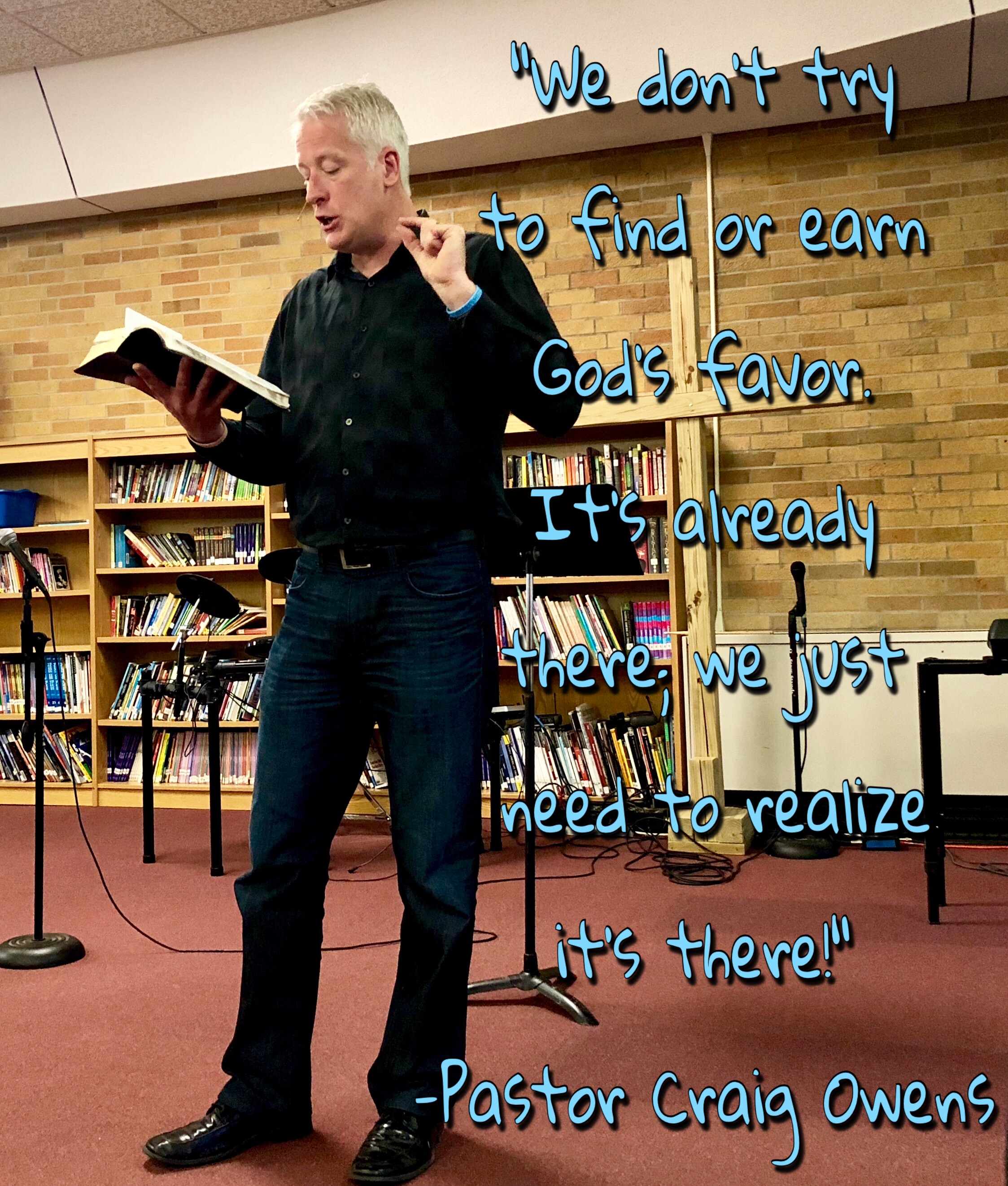
But please notice this truth—We don’t try to find or earn God’s favor. It’s already there; we just need to realize it’s there!
You see, we don’t grow in God’s favor, nor do we get more favor, but we progressively become more deeply and intimately acquainted with God’s favor that is already there. Check out what Moses said:
If I have found favor in Your sight, show me now Your way, that I may know You progressively become more deeply and intimately acquainted with You, perceiving and recognizing and understanding more strongly and clearly and that I may find favor in Your sight (Exodus 33:13)
The angel said to Mary, “You are HIGHLY FAVORED” (Luke 1:28). God uses the same word when He says to us: God made us ACCEPTED in the Beloved (Ephesians 1:6).
How can this be??Because on the Cross, Jesus switched places with us. He took all our sin and DISgrace, and gave us all of His righteousness. Now when God the Father looks at us, all He sees is the righteousness of His Son. Now all praise to God for His wonderful kindness to us and His favor that He has poured out upon us because we belong to His dearly loved Son(TLB).
God’s grace is undiminished. It is as full today as it ever has been. God could never love you more than He already does. God could never love you less because of anything you do. Keep your eyes on Him and you will find just how much favor He has for you!
Join me this Sunday either in person or on Facebook Live as we continue to learn more about God’s favor.
This is part 4 in my 5-part series, “I can know Jesus is A.L.I.V.E. because of ….” I have already addressed A—Apologetics, L—Lives changed, and I—It is finished. Today I want to consider the prophecies that the life, death, and resurrection of Jesus supposedly fulfilled.
We have all heard about “copycat” crimes. Could the life and death of Jesus fit that? Since Jesus was born from the family line of King David, and His family really wanted the promised Messiah to finally appear, perhaps He was pushed that way. Perhaps He lived in a certain way to make it look like He was fulfilling prophecy.
Detective J. Warner Wallace wrote, “Homicide detectives are perhaps the least trusting people in the world. My own experience investigating murders has taught me to consider everyone a liar—until, at least, I have good reason to believe otherwise.”
So was Jesus a liar? Was He following some copycat script to make it merely look like He was the Messiah? Or do we have good reasons to believe He was telling the truth? Consider three points—
How could David describe a crucifixion scene in 1000 BC, since the Persians didn’t invent it until around 400 BC (see Psalm 22:12-18)?
How could Jesus control others’ actions (i.e. Judas’ betrayal; being killed by crucifixion, not by stoning; soldiers gambling for His clothes)?
Even His own followers—whom He would need to perpetrate the hoax—didn’t understand what He was doing (John 12:16).
Prosecutors have to present enough evidence to convince a jury that they have arrested and brought to trial the right man. One of the key terms is beyond a reasonable doubt—“a part of jury instructions in all criminal trials, in which the jurors are told that they can only find the defendant guilty if they are convinced ‘beyond a reasonable doubt’ of his or her guilt.”
Let’s consider a hypothetical case that a prosecutor might present:
multiple eyewitnesses saw a man fleeing the scene, and all of them identified the suspect in a police line-up
the shoe prints at the crime scene were the same size and design that of the suspect was wearing when he was arrested
prosecutors presented text messages in which the suspect threatened to do to the victim exactly what was done to the victim
the wounds made by the weapon which was used on the victim correspond with the weapon the police found in the suspect’s car
the blood on that weapon matched the blood of the victim
the fingerprints on that weapon are the suspect’s fingerprints
That is the evidence. From that evidence, the jury is asked to draw inferences about the reasonableness of that suspect being the one who committed the crime.
I have listed just six pieces of evidence. How strong do you think the prosecutor’s case is? What if the jurors were presented with 50 pieces of evidence? What about 100? 200? How about 300 pieces of evidence?
Jesus fulfilled at least 300 prophecies—which were made before He was born!—in His life, death, and resurrection!
Math professor Peter Stoner calculated that the odds for just one man in history to fulfill only 8 prophecies is 1-in-1×10¹⁷. How amazing is that!? To give us a little perspective, Stoner says that 1×10¹⁷ silver dollars would cover the entire state of Texas in silver dollars two-feet thick. If just one of those silver dollars was marked, and a blindfolded man could select that one marked coin on his very first attempt, that would be about the same odds of Jesus fulfilling only 8 prophecies.
As a juror, if you weighed this evidence, do you find enough proof to “convict” Jesus?
But ultimately Jesus didn’t come just to fulfill prophecy; He came to rescue you and me from the penalty of our sin (Luke 4:16-21), and that is the best news of all!
Join me either in person or on Facebook Live this Sunday for the final message in this 5-part series.
Throughout history, lots of martyrs have died for what they believe. But only One had been resurrected from the dead to prove that what He believed and taught was true.
Jesus, however, is not a martyr. His life and His work weren’t cut short. Calvary didn’t happen to Jesus, but He came specifically to die on a Cross. He knew what was going to happen to Him. Check this out…
Jesus predicted not only His death but His resurrection too (John 10:7-18)
Jesus knew exactly how He would die, which was not by stoning at the hands of the Jews, but by crucifixion at the hands of the Romans (John 10:22-33; Mark 8:31; Matthew 26:2)
Later, knowing that everything had now been finished, and so that Scripture would be fulfilled, Jesus said, “I am thirsty.” … When He had received the drink, Jesus said,“It is finished.”
Actually His “It is finished” wasn’t just a statement, it was a yell that reverberated throughout the countryside. The Greek words Mark uses are megas phōnē, which sounds a lot like our word megaphone. Jesus wanted to make sure everyone heard Him, and then look at the result:
Then Jesus uttered another loud cry and breathed His last. And the curtain in the sanctuary of the Temple was torn in two, from top to bottom.
The curtain that separated God’s presence from mankind was torn in two. The writer of Hebrews notes, “Our High Priest offered Himself to God as a single sacrifice for sins, good for all time. Then He sat down in the place of honor at God’s right hand.”
What do you conclude from all this? C.S. Lewis offered this challenge:
“A man who was merely a man and said the sort of things Jesus said would not be a great man or a moral teacher. He would either be a lunatic—on the level with the man who says he is a poached egg—or else he would be the devil of hell. You must take your choice. Either this was, and is, the Son of God; or else a madman or something worse. You can shut Him up for a fool… or you can fall at His feet and call Him Lord and God. But let us not come with any patronizing nonsense about His being a great human teacher. He has not left that open to us.”
Jesus told us that He would die, how He would die, when He would die, why He would die, and that He would be resurrected. If you heard all of these claims before His crucifixion, you might think He was a lunatic or a braggart. But after His It Is Finished! declaration, we have only one logical conclusion: Jesus is exactly who He said He was. It was out of love for you that Jesus laid down His life and picked it up again. Will you put your faith in Him today?
We are working our way through 5-parts of this series: “I can know Jesus is A.L.I.V.E. because of….” We’ve already covered:
This is part 1 of a 5-part series with a simple premise: “I can know Jesus is A.L.I.V.E. because of…” and then I am presenting evidence for each of the five letters. This is a look at the letter “A” for Apologetics for the resurrection of Jesus.
For some of my evidence, I am going to use historical texts from the Bible. When I say “historical” I mean that in the scholarly definition: this Book is attested to by historians and literary critics to be an accurate record of actual historical facts. You can read more of the apologetics for the Bible’s authenticity in a post I previously published here.
I would ask you to weigh the evidence for three possibilities concerning the claims of Christians regarding the death and resurrection of Jesus.
(1) Jesus didn’t actually die.
The Romans didn’t invent crucifixion, but they perfected it to be one of the most gruesome forms of torturous death that history has ever known. This leads one to wonder how could anyone go through the torture Jesus did and survive?
A team of medical examiners, after examining the historical account of Jesus’ death concluded: “The difficulty surrounding exhalation leads to a slow form of suffocation. Carbon dioxide builds up in the blood, resulting in a high level of carbonic acid in the blood. The body responds instinctively, triggering the desire to breathe. At the same time, the heart beats faster to circulate available oxygen. The decreased oxygen (due to the difficulty in exhaling) causes damage to the tissues and the capillaries begin leaking watery fluid from the blood into the tissues. This results in a build-up of fluid around the heart (pericardial effusion) and lungs (pleural effusion). The collapsing lungs, failing heart, dehydration, and the inability to get sufficient oxygen to the tissues essentially suffocate the victim. The decreased oxygen also damages the heart itself (myocardial infarction) which leads to cardiac arrest. In severe cases of cardiac stress, the heart can even burst, a process known as cardiac rupture. Jesus most likely died of a heart attack.”
Besides that, the dead body of Jesus was also thoroughly examined by both the Romans who conducted the crucifixion (see Mark 15:43-45) and His friends who prepared His body for burial (John 19:38-40). In addition, two contemporary historians who aren’t friendly to the cause of Christianity (Tacitus and Josephus) both attested to Christ’s death by crucifixion.
(2) Jesus didn’t actually rise from the dead.
Some say the disciples were delusional from their intense grief. But Jesus was seen on more than one occasion, sometimes by one person, sometimes by twos, and several times by large groups (see 1 Corinthians 15:3-8). Some of Jesus’ closest friends weren’t convinced by second-hand testimony but had to see Jesus for themselves (John 20:19-20, 24-28). All four biblical accounts record women seeing the resurrected Jesus. This is significant because women were not allowed to serve as “legal witnesses,” so this wouldn’t have helped the “delusional” disciples at all.
Some say the disciples stole the body of Jesus. But this is problematic because of the armed guards at the tomb of Jesus (Matthew 27:62-66; 28:11-15).
(3) Jesus was crucified and resurrected.
Sir Arthur Conan Doyle’s Sherlock Holmes said, “When you have eliminated the impossible, whatever remains, however improbable, must be the truth.” So after looking at the shortcomings and difficulties of the first two options, let’s consider this third possibility: that it happened just as the historical records in the Bible indicate.
Cold-case detective J. Warner Wallace said of this third possibility, “The last explanation (although it is a miraculous, supernatural explanation) suffers from the least number of liabilities and deficiencies. If we simply enter into the investigation without a pre-existing bias against anything supernatural, the final explanation accounts for all of the evidence without any difficulty. The final explanation accounts for the evidence most simply and most exhaustively, and it is logically consistent…. The final explanation is also superior to all other accounts (given that it does not suffer from all the problems we see with the other explanations).”
Check out the video where I discuss all of these points in more detail, and join me either in person or on Facebook Live for the next four Sundays as we continue looking at the evidence supporting the resurrection of Jesus.
David hasn’t done anything wrong. He’s never tried to lead a rebellion against King Saul. In fact, he’s never even talked poorly about Saul. And yet Saul is out to kill David!
David tries to get as far away as he can, choosing to live in the desert so that he might get some relief from Saul. Still Saul comes after him with a force of 3000 men! Every time David moves, Saul’s men are hot on his trail. David described his situation like this—
My mortal enemies surround me. Their hearts are cold and calloused toward me, and they speak terrible things about me. They track me down and surround me. They are like hungry lions, crouching, waiting to pounce on me!
If you were in David’s sandals, how confident would you be that God could get you out of the situation? Remarkably, David’s confidence was as high as it could be!
David not only was confident that God would hear him, but that He would listen to him. More than that, David knew God would pay attention to him. And then David boldly said, “I call on You, O God, for you WILL answer me.”
How could David pray such a confident prayer? The answer is in this principle…
There is a direct correlation between intimacy and confidence.
David made two very intimate claims about his relationship with God:
You will keep me as the apple of Your eye
You hide me in the shadow of Your wings
The apple of the eye is the pupil. Our eyes are amazingly designed to not only take in information but to protect themselves. If something is getting too close to our eye, the eyelids blink in protection faster than we can consciously tell them to. So David was claiming that God would protect him by reflex!
The shadow of Your wings was a reference to the top of the Ark of the Covenant; a place called the mercy seat. Here is where the priest sprinkled the blood of a sacrificial lamb to atone for the people’s sin and to appeal to God’s mercy. The mercy seat was over-shadowed by two angels’ wings.
David was saying that God kept him in this intimate place—covered by God’s mercy and protection!
Jesus also told us about intimate confidence when He said, “If you remain in Me, and My words remain in you, ask whatever you wish, and it will be given you” (John 15:7).
Intimacy: remain IN Jesus, and let His words remain IN you
Confidence: ask whatever you wish, and it will be given you
Are your prayers this confident? If not, don’t work on raising your confidence, but work on increasing your intimacy. Check your intimacy level with questions like:
Am I abiding in Jesus?
Are His words abiding in me?
Do I have any unconfessed sin?
Is my prayer a “Your kingdom come, Your will be done” prayer?
Focus on intimacy, and then watch your confidence soar!
If you are interested in learning more about the prayers of David, I have also discussed his prayer for help, his prayer of crying out loud, and his prayer of praise.
“When such embers of contention begin to smoke among Christians, we can be sure satan planted the spark; he is the one great kindle-coal of all strife.
“Whenever there is a storm in the spirits of saints, and the winds of emotions are high and loud, it is easy to see who has stirred up the tempest. The devil practices his black art on unmortified lusts, that enable him to raise easily many storms of division among believers. …
“There is nothing, next to Christ and heaven, which satan begrudges believers more than their peace and mutual love. If he cannot separate them from Christ, and stop them from getting to heaven, he takes sinister pleasure in watching them get there in a storm. …
“Saints who live in strife and contention are sinning against the strong prayers which Christ Himself uttered on their behalf [John 17:11, 21].” —William Gurnall, The Christian In Complete Armor
(I have many more quotes from this classic book posted here, here, here, and here.)



 This is a weekly series with things I’m reading and pondering from Oswald Chambers. You can read the original seed thought here, or type “Thursdays With Oswald” in the search box to read more entries.





 Craig T. Owens