Devotional Ideas

BibleGateway

Are you looking for some ideas to stimulate your personal devotional time in the Bible? BibleGateway.com has some amazing resources! One that I use every day are the various devotionals/newsletters that can be emailed to me. Each morning I discover fresh insights into God’s Word from some of the most trusted spiritual giants.

For instance, I read this as a part of a message from Charles Spurgeon this morning—

How numerous are the tears of unbelief! We manufacture troubles for ourselves by anticipating future ills which may never come, or which, if they do come, may be like the clouds, all ‘big with mercy,’ and ‘break with blessings on our head.’ We get supposing what we should do if such-and-such a thing occurred, which thing God has determined never shall occur. We imagine ourselves in positions where providence never intends to place us, and so we feel a thousand trials in fearing one. That bottle, I say, ought never to carry within it a tear from a believer’s eyes, and yet it has had whole floods poured into it. O the wickedness of mistrust of God, and the bitterness with which that distrust is made to curse itself. Unbelief makes a rod for its own back; distrust of God is its own punishment….

Check out the devotionals by clicking here, or the list of available newsletters by clicking here.

Whatever it takes to get you more into God’s Word, just do it!

Links & Quotes

link quote

Some good reading & watching from today…

“The nearer our souls draw to God the larger our love will grow, and the greater our love the more unselfish we shall become and the greater our care for the souls of others. Hence increased spiritual experience, so far as it is genuine, brings with it a strong desire that others may know the same grace that we ourselves enjoy. This leads quite naturally to an increased effort to lead others to a closer and more satisfying fellowship with God.” —A.W. Tozer

[VIDEO] What a good sport! Assembly of God General Superintendent Dr. George O. Wood is “interviewed” by comedian Michael Jr.

“There is in the life and teachings of Jesus a relentless tendency toward simplicity. There is a steady impulse toward living at risk, and with a kind of abandon to the Father’s care that looks foolish to the well-off world. There is an unsettling otherworldliness that made Jesus and His first followers radically useful in this dead-end world. There is a freedom from things and for the Kingdom that thrills the heart of His disciples. Lord, give us this freedom.” —John Piper 

“Jesus asks you not to lead; He Himself has gone before; He calls you to no labor which He has not Himself already accomplished. … I know the proud flesh wants to serve Christ, by striking out new paths. Proud man has a desire to preach new doctrine, to set up a new Church, to be an original thinker, to judge, and consider, and do anything but obey. This is no service to Christ. He that would serve Christ must follow Him; he must be content to tread only in the old footsteps, and go only where Christ has led the way.” —Charles Spurgeon

“Preserve, then, my sons, that friendship ye have begun with your brethren, for nothing in the world is more beautiful than that. It is indeed a comfort in this life to have one to whom thou canst open thy heart, with whom thou canst share confidences, and to whom thou canst entrust the secrets of thy heart. It is a comfort to have a trusty man by thy side, who will rejoice with thee in prosperity, sympathize in troubles, encourage in persecution.” —Ambrose

Don’t be deceived: Fifty Shades Of Gray is pornography! Here’s how to fight it.

[VIDEO] The Bible Project has these helpful, artistic videos that give you a big-picture-view of a book of the Bible. Check out what they have already done with Genesis.

No Kindas

no kindasAmaziah could have been one of Judah’s great kings. His father had cleaned up the Temple and had begun a revival of worship of God. When he came to the throne, Amaziah quickly led his army to an impressive victory over the Edomites.

That’s when things started to unravel.

Actually, things were beginning to come apart right from the start of Amaziah’s reign, but no one seemed to notice.

We get the clues in the language the biblical writers use. Amaziah frequently had a “but” or a “however” attached to what he did. Notice—

  • Amaziah “did what was right in the eyes of the Lord, BUT not as his father David had done” (2 Kings 14:3).
  • He worshiped God “HOWEVER the high places [of pagan worship] were not removed” (14:4).
  • He rallied his fighting men for battle BUT “he also hired a hundred thousand [mercenary] fighting men from Israel” (2 Chronicles 25:6).
  • Amaziah led his army to victory over the Edomites with God’s help BUT “he brought back the gods of the people of [Edom] … bowed down to them and burned sacrifices to them” (25:14).
  • The king of Israel warned Amaziah not to attack Israel “HOWEVER Amaziah would not listen” (25:20).

Not only did these BUTS and HOWEVERS take Amaziah farther away from God, they took him farther away from his people too: “From the time Amaziah turned away from following the Lord, they conspired against him in Jerusalem (25:27).

There is no “kinda” following God. It’s all-in or nothing. My heart is either fully devoted to God with no BUTS or HOWEVERS, or am I moving away from God and from others around me.

It should be a huge warning sign when I hear myself say “but” or “however” in regard to anything involved with following my God.

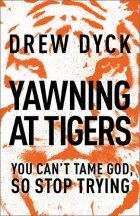
Yawning At Tigers (book review)

Yawning At TigersI’ve been longing for a book like Yawning At Tigers to be published! For years I have been concerned with the “taming” of God that I see among so many in our culture, so the subtitle of Drew Dyck’s book nails it: You Can’t Tame God, So Stop Trying!

Drew opens with a real-life story of exotic animals which were set loose in a small town in the midwest. Where people had viewed the animals behind bars and plexiglass before and found them tame, their attitude was completely changed when those same animals were walking down their street! Drew uses this story to draw an analogy to the way people view a “tame God” contained behind stained glass windows, as opposed to the true God set loose in their neighborhoods.

Drew writes, “Even when we see evidence of God in our midst, when we glimpse His holiness, we’re more likely to yawn than yell. Somehow we’ve succeeded in making the strange ordinary.” It’s sad, but true in far too many settings.

Yawning At Tigers is an impassioned call to open the Scriptures up and really see God. He is awesome, He is ferocious, He is a warrior, He is white-hot love! Until we really see God, others will yawn at the thought of Christians or church. Again Drew gets it right when he says, “Only when we gain a proper understanding of God’s identity can we begin to appreciate the implications of His love.”

If you are desirous to see God revealed in all His fullness in your life, in your church, in your community, then you will resonate with the message of Yawning At Tigers.

I am a Thomas Nelson book reviewer.

Eye Exam

EyechartProbably at one time or another everyone has gone through some sort of eye exam where you read an eyechart to get information about your vision. This simple exam gives your doctor a standard by which to measure the visual acuity of your eyes. After all, without an objective standard for your vision, who’s to say whether your eyesight really is good or bad?

After taking the exam, the doctor can determine whether you have…

  • emmetropia—normal vision where light from your eye’s lens is properly focused on the retina at the back of your eye; or
  • myopia—also called short-sightedness, where the light is focused in front of the retina; or
  • hyperopia—or far-sightedness, where the light is focused behind the retina.

Both myopia and hyperopia can be corrected by lenses. Glasses, contact lenses, or even corrective surgery can correct your focal point, restoring emmetropia again. But notice this:

Lenses don’t change what you see, but how you see it. 

By refocusing the light into the right place, you are now looking at the same object, but the focal point is corrected. You are able to see things that were there all along, but that your out-of-focus vision caused you to miss. For a Christian, the Bible works the same way—

Scripture doesn’t change the events or circumstances in your life, but it does change how you see them. 

The eye is the lamp of the body. If your eyes are good, your whole body will be full of light. But if your eyes are bad, your whole body will be full of darkness. (Matthew 6:22-23)

Vision problemsWhat’s true for an eye exam is also true for a spiritual exam: If you don’t read the eyechart, it’s hard to tell if your vision is out-of-focus.

Far too many people don’t read the Bible for themselves, so they never have given the Holy Spirit a chance to show them where their attitude or lifestyle is out of focus with God’s design. However, if you are reading the Bible, here are three warning signs that you may have blurry spiritual vision that needs to be corrected:

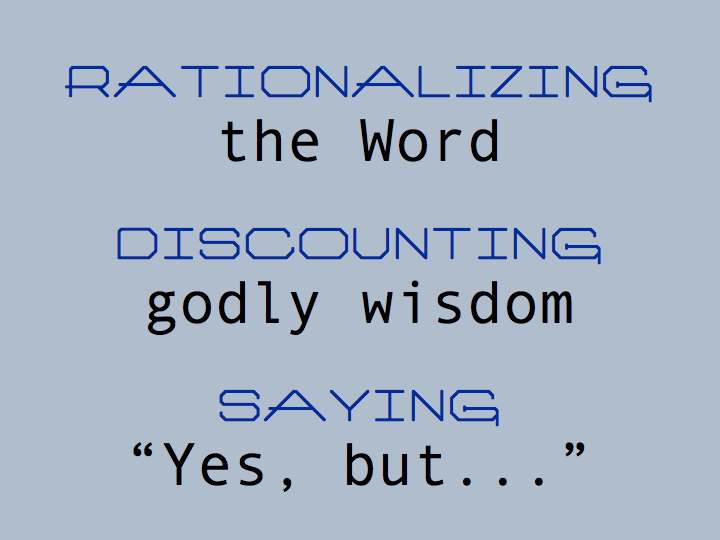
  1. You try to rationalize what the Holy Spirit is saying to you through the Bible, instead of simply obeying what He says.
  2. You discount the wisdom of other God-fearing people who are saying the same thing God’s Spirit is saying.
  3. You frequently find yourself saying, “I know that’s what the Bible says, but….”

You don’t have to live with blurry spiritual vision. Read the Bible for yourself, and let the Holy Spirit point out how your vision can be corrected.

If you have missed any of the messages in our P119 series, you can access them all by clicking here.

Both Testaments

BibleThis past week I’ve had two conversations that seemed like contradicting thoughts about the Bible, but they’re really exactly the same.

Conversation #1—Since Jesus Christ set us free from the law, there is no longer any need for us to read or study the Old Testament.

Conversation #2—The New Testament is a perversion of the Old Testament, so we should ignore it and stick with the “original” Scripture.

One thing that has helped me see the Scripture in a more correct light is a thought I picked up from Leonard Sweet and Frank Viola in their book Jesus: A Theography. Instead of the titles we’ve given the two divisions of the Bible, it will be better to call them the First and Second Testaments. “Old” and “New” have a tendency to make us think out-dated and updated; First and Second remind us that they go together.

Hosea is one of the first prophets in the First Testament whose words were put into writing. It’s interesting to note how many of the themes from the Pentateuch, Joshua and Judges are linked to Israel’s condition in the last few years before the northern tribes went into exile.

“Hosea’s allusions to Genesis through Judges are highly significant. First, they help to establish the fact that these books had already been written by the time of Hosea, in the eighth century B.C. (Many scholars consider these books to be from the sixth century B.C. and even later.) Second, Hosea’s construal of these books helps us to understand early Biblical interpretation, which in turn gives us a better understanding of how the [Second] Testament interprets the [First].” —Archeological Study Bible

When we move into the Second Testament, we see over 850 First Testament passages are quoted, sometimes entire paragraphs. In every instance, the Second Testament authors see the fulfillment of the First Testament in the life of Jesus Christ.

In fact, Jesus Himself quoted from 22 books of the First Testament, even on the day of His resurrection He explained to them what was said in all the Scriptures concerning Himself (Luke 24:27), and He said He would open our minds so that we too could understand all the Scriptures (Luke 24:45-47).

Finally there is the issue of fulfilled prophesy. Not only were First Testament prophesies fulfilled during the First Testament time, but even more were fulfilled during the Second Testament. In Jesus Christ alone about 200 such prophesies were fulfilled.

Both Testaments are equally important, and equally valuable. In fact, either Testament without the other robs God of His glory and robs us of seeing His fullness.

7 Bible Study Ideas From D.L. Moody

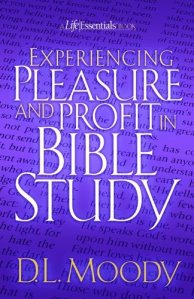
Pleasure & ProfitAs I read D.L. Moody’s book Pleasure & Profit In Bible Study, I made note of several ideas that could stimulate a great Bible study. Check out my review of this book by clicking here, then check out these great study-starters:

“If you are impatient, sit down quietly and commune with Job. If you are strong-headed, read of Moses and Peter. If you are weak-kneed, look at Elijah. If there is no song in your heart, listen to David. If you are a politician, read Daniel. If you are getting sordid, read Isaiah. If you are chilly, read of the beloved disciple. If your faith is low, read Paul. If you are getting lazy, watch James. If you are losing sight of the future, read in Revelation of the promised land.” —Richard Baxter 

“Every chapter [of Mark] but the first, seventh, eighth and fourteenth begins with ‘And,’ as if there was no pause in Christ’s ministry.”

“Matthew begins with Abraham; Mark with Malachi; Luke with John the Baptist; but John with God Himself. Matthew sets forth Christ as the Jew’s Messiah. Mark as the active worker. Luke as a man. John as a personal Savior.”

“[In John’s Gospel] the word repent does not occur once, but the word believe occurs ninety-eight times.”

“Dr. A. T. Pierson says: Let the introduction cover five P’s; place where written; person by whom written; people to whom written; purpose for which written; period at which written.” 

“Some time ago a man wanted to take my Bible home to get a few things out of it, and when it came back I found this noted in it:

  • Justification, a change of state, a new standing before God.
  • Repentance, a change of mind, a new mind about God.
  • Regeneration, a change of nature, a new heart from God.
  • Conversion, a change of life, a new life for God.
  • Adoption, a change of family, new relationship towards God.
  • Sanctification, a change of service, separation unto God.
  • Glorification, a new state, a new condition with God.”

“I was wonderfully blessed by taking the seven ‘Blesseds’ of the Revelation. … Or you may take the eight ‘overcomes’ in Revelation…. I have been greatly blessed by going through the ‘believings’ of John. Every chapter but two speaks of believing. … Take the six ‘precious’ things in Peter’s Epistles. And the seven ‘walks’ of the Epistle to the Ephesians. And the five ‘much mores’ of Romans 5. Or the two ‘receiveds’ of John 1. Or the seven ‘hearts’ in Proverbs 13, and especially an eighth. Or ‘the fear of the Lord’ in Proverbs.” 

“No scripture is exhausted by a single explanation. The flowers of God’s garden bloom, not only double, but seven-fold: they are continually pouring forth fresh fragrance.” —Charles Spurgeon

11 Quotes From “Pleasure & Profit In Bible Study”

Pleasure & ProfitD.L. Moody’s book Pleasure & Profit In Bible Study is a Bible study rejuvenator for both the novice and experienced reader of the Bible. You can read my full book review by clicking here. Below are some of the quotes I especially appreciated in this book.

“The more you love the Scriptures, the firmer will be your faith. There is little backsliding when people love the Scriptures.” 

“I believe we should know better how to pray if we knew our Bibles better. … And if we feed on the Word, it will be so easy then to speak to others; and not only that, but we shall be growing in grace all the while, and others will take notice of our walk and conversation.”

“It is a very interesting fact that of the thirty-nine books of the Old Testament, it is recorded that our Lord made quotations from no less than twenty-two. … About 850 passages in the Old Testament are quoted or alluded to in the New…. In the Gospel by Matthew there are over a hundred quotations from twenty of the books in the Old Testament. In the Gospel of Mark there are fifteen quotations taken from thirteen of the books. In the Gospel of Luke there are thirty-four quotations from thirteen books. In the Gospel of John there are eleven quotations from six books. In the four Gospels alone there are more than 160 quotations from the Old Testament. … In Paul’s letter to the Corinthians there are fifty-three quotations from the Old Testament; sometimes he takes whole paragraphs from it. In Hebrews there are eighty-five quotations, in that one book of thirteen chapters. In Galatians, sixteen quotations. In the book of Revelation alone, there are 245 quotations and allusions.”

“It is very important that every Christian should not only know what the Old Testament teaches, but he should accept its truths, because it is upon this that truth is based. Peter said the Scriptures are not given for any private interpretation, and in speaking of the Scriptures, referred to the Old Testament and not to the New. … If the Old Testament Scriptures are not true, do you think Christ would have so often referred to them, and said the Scriptures must be fulfilled? When told by the tempter that He might call down the angels from heaven to interpose in His behalf, he said: ‘Thus it is written.’ Christ gave Himself up as a sacrifice that the Scriptures might be fulfilled. Was it not said that He was numbered with the transgressors? And when He talked with two of His disciples by the way journeying to Emmaus, after His resurrection, did He not say: ‘Ought not these things to be? am I not to suffer?’ And beginning at Moses He explained unto them in all the Scriptures concerning Himself, for the one theme of the Old Testament is the Messiah. … Christ referred to the Scriptures and their fulfillment in Him, not only after He arose from the dead, but in the book of Revelation He used them in Heaven. He spoke to John of them on the Isle of Patmos, and used the very things in them that men are trying to cast out. He never found fault with or rejected them.”

“Prophecy is history unfulfilled, and history is prophecy fulfilled. … Between 500 and 600 hundred Old Testament prophecies have been remarkably and literally fulfilled, and 200 in regard to Jesus Christ alone. Not a thing happened to Jesus Christ that was not prophesied from 1700 to 400 years before He was born.”

“Someone has said that there are four things necessary in studying the Bible: Admit, submit, commit and transmit. First, admit its truth; second, submit to its teachings; third, commit it to memory; and fourth, transmit it. If the Christian life is a good thing for you, pass it on to some one else.”

“Application to the Word will tend to its growth within and its multiplication without.”

“We learn that Christ prayed when he was baptized, and nearly every great event in His ministry was preceded by prayer. If you want to hear from Heaven you must seek it on your knees.”

“If you want to reach people that do not agree with you, do not take a club to knock them down and then try to pick them up. When Jesus Christ dealt with the erring and the sinners, He was as tender with them as a mother is with her sick child.” 

“Let us go to the Bible and see what that old Book teaches. Let us believe it, and go and act as if we believed it, too.”

“But we can not be ready if we do not study the Bible. So whenever you hear a good thing, just put it down, because if it is good for you it will be good for somebody else; and we should pass the coin of heaven around just as we do the coin of the realm.”

D.L. Moody’s Word To Pastors About The Word

Pleasure & ProfitAs I read D.L. Moody’s book Pleasure & Profit In Bible Study, I noticed several of his comments were directed to pastors.

In my humble opinion, the pastor needs to be the “Bible Student In Chief” of his or her congregation. The pastor’s love for God’s Word will create a hunger in the congregation to study this amazing Book!

You can read my full book review of Pleasure & Profit by clicking here. Below are some of the words to us pastors from this book.

“Oh! let every minister tell the truth, though he preach himself out of his pulpit. … If the Bible only has a chance to speak for itself, it will interest the people.” 

“Give the people the Word of God. Some men only use the Bible as a text book. They get a text and away they go. They go up in a balloon and talk about astronomy, and then go down and give you a little geology, and next Sunday they go on in the same way, and then they wonder why it is people do not read their Bibles.”

“It a good thing for a minister to have the reputation of feeding his people. … People can get along without your theories and opinions, ‘Thus saith the Lord’—that is what we want.”

“Christ did not have a short-hand reporter to go around with Him to write out and print His sermons, and yet the people remembered them. Never mind about finished sentences and rounded periods, but give your attention to making your sermons clear so that they stick. Use bait that your hearers will like.”

“It is a thing to weep over that we have got thousands and thousands of church members who are good for nothing towards extending the Kingdom of God. They understand bazaars, and fairs, and sewing-circles; but when you ask them to sit down and show a man or woman the way into God’s kingdom, they say: ‘Oh, I am not able to do that. Let the deacons do it, or some one else.’ It is all wrong.” 

Pastor, how is your personal Bible study time? Is it invigorating, or humdrum? We’ve got to get immersed in the Word so that we can encourage our congregations to do likewise.

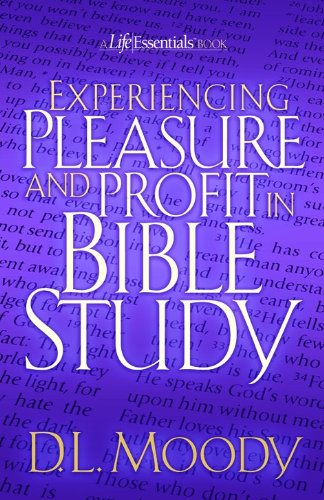
Pleasure & Profit In Bible Study (book review)

Pleasure & ProfitNear the beginning of Pleasure & Profit In Bible Study, Dwight Moody states the purpose of his book: “We cannot overestimate the importance of a thorough familiarity with the Bible. I try to lose no opportunity of urging people by every means in my power to the constant study of this wonderful Book. If through the pages that follow, I can reach still others and rouse them to read their Bibles, not at random but with a plan and purpose, I shall be indeed thankful.”

I am thankful that D.L. Moody took the time to pen this book for us. Though over a century old, his words are bringing a renewed excitement to studying my all-time favorite book: The Bible.

Moody devoured God’s Word, and had amazing recall of all he read. He reminds us that anything we are full of will be much easier to recall and apply. He then allows us a glimpse into his personal study time, showing us how he reads his Bible, what he looks for, how he marks certain passages, and other ways to engage Scripture.

If anyone ever felt like their Bible reading or studying was in a rut, this book will be a welcome rejuvenator. Even for those who already appreciate their time studying God’s Word, Pleasure & Profit will bring new insights for your study time.

I highly recommend this book!