Rewards For Faithfulness

NunI unabashedly tell anyone who asks me what my favorite book is … It’s the Bible. I have yet to find such a collection of writings that work every single time they’re applied.

Two summers ago we began a series of messages on the 119th Psalm. It appears that the psalmist shares my passion for God’s Word, as he writes time and time again the difference Scripture makes in his life.

The other thing that makes this psalm so cool to me is the organization of the 176 verses into twenty-two 8-verse segments, with each verse in a segment beginning with the the same Hebrew letter as its title. In the Hebrew language, the letters in the alphabet had their own meaning. In English an “n” is simply spelled “n.” It has no other definition or meaning. But in Hebrew the letter nun has both a spelling and a meaning. Nun is spelled nun-vav-nun (final), and it means both faithfulness and the reward for faithfulness.

Look at the three Hebrew characters that spell nun. Reading right to left it tells a story and gives the meaning of the letter/word—the one who is humbled in faithfulness will be the one who stands in righteousness. The perfect example of this is Jesus, Who humbled Himself when He came to earth and to the Cross, and then was exalted by the Heavenly Father to wear the crown of righteousness (see Philippians 2:5-11 and Revelation 14:14). Paul starts this passage by calling on us to “have the same attitude as that of Jesus” (v. 5), and concludes with the call to stick with it all the way to the end (see vv. 12-13).

RewardsThe psalmist calls us to this same thing in nun (Psalm 119:105-112). The “bookend” verses say, “Your Word is a lamp for me… so my heart is set on keeping Your Word” (vv. 105 and 112). In between the psalmist commits himself to a life of humbly persevering to God’s ways, and reaps the rewards of a changed heart, the joy of the Lord, and a heritage to pass on to others.

I have fought the good fight, I have finished the race, I have kept the faith. Now there is in store for me the crown of righteousness, which the Lord, the righteous Judge, will award me on that day—and not only to me, but also TO ALL who have longed for His appearing (2 Timothy 4:7-8).

Humble yourself before the Lord, and He will lift you up (James 4:10).

My heart is set on keeping Your decrees to the very end (Psalm 119:112).

Rewards here (new heart, joy, heritage) AND rewards in Heaven (a crown of righteousness). How awesome is that!!

If you have missed any of the messages in our P119 series, you can access them all by clicking here.

12 Quotes From “Tactics

TacticsIn Tactics Greg Koukl gives Christians more how than what/why in defending the Biblical faith. It is an outstanding read that I recommend to all Christians (young or old). You can read my full book review by clicking here. Below are just a few of the quotes I highlighted in this empowering book.

“First, Christ’s ambassadors need the basic knowledge necessary for the task. They must know the central message of God’s kingdom and something about how to respond to the obstacles they’ll encounter on their diplomatic mission. … However, it is not enough for followers of Jesus to have an accurately informed mind. Our knowledge must be tempered with the kind of wisdom that makes our message clear and persuasive. This requires the tools of a diplomat, not the weapons of a warrior, tactical skill rather than brute force. Finally, our character can make or break our mission. Knowledge and wisdom are packaged in a person, so to speak. If that person does not embody the virtues of the kingdom he serves, he will undermine his message and handicap his efforts.” 

“The tactical approach requires as much careful listening as thoughtful response.”

“It is not the Christian life to wound, embarrass, or play one-upmanship with colleagues, friends, or even opponents, but it’s a common vice that anyone can easily fall into.” — Hugh Hewitt 

“Always make it a goal to keep your conversations cordial. Sometimes that will not be possible. If a principled, charitable expression of your ideas makes someone mad, there’s little you can do about it. Jesus’ teaching made some people furious. Just make sure it’s your ideas that offend and not you, that your beliefs cause the dispute and not your behavior.”

“The ability to argue well is vital for clear thinking. That’s why arguments are good things. Arguing is a virtue because it helps us determine what is true and discard what is false. … Paul warns against wrangling about words and quarreling about foolish speculations (2 Timothy 2:14, 23). But he also commands us to be diligent workmen, handling the word of truth accurately (2 Timothy 2:15). And, because some disputes are vitally important, Paul solemnly charges us to reprove, rebuke, and exhort when necessary (2 Timothy 4:112). This cannot be done without some confrontation, but disagreement need not threaten genuine unity.”

“If you want skeptics to believe in the Bible, don’t get into a tug-of-war with them about inspiration. Instead, invite them to listen—to engage Jesus’ words firsthand—then let the Spirit do the heavy lifting for you.”

“You have to know why Jesus is the only way before it is helpful to tell people that He is the only way.” 

“There are three specific things you can do to ‘ready’ yourself to respond. You can anticipate beforehand what might come up. You can reflect afterward on what took place. And in both cases you can practice the responses you think of during these reflective moments so you will be prepared for the next opportunity.”

“Knowing when to step back requires the ability to separate the hogs and the dogs from the lost sheep looking for a shepherd. But how do you know when someone has crossed the line? When do we have an obligation to speak, and when should we save our pearls for another time? Part of the answer can be found in Jesus’ next words in Matthew 7:6: ‘…lest they trample [the pearls] under their feet, and turn and tear you to pieces.’ Be generous with the truth except with someone who shows utter contempt for the precious gift being offered him. He will simply trample it in the mud and then viciously turn on you. … There is an exception to this principle, however. I have learned from my radio show that sometimes my real audience is not the person I’m talking to, but the people who are listening in, eavesdropping on the conversation. … Lee Strobel calls this ‘ricochet evangelism.’” 

“When I face an aggressive challenger, I often give him the last word. Not only is this gracious, it’s also powerful, conveying a deep sense of confidence in one’s own view. Instead of fighting for the final say-so, give it away. Make your concluding point clearly and succinctly, and then say, “I’ll let you have the last word.” But don’t break this promise. Grant him his parting shot, and then let it rest.”

“Know the truth. Know your Bible well enough to give an accurate answer. Tactics are not a substitute for knowledge. Cleverness without truth is manipulation.”

“Culture is most profoundly changed not by the efforts of huge institutions, but by individual people.” —Chuck Colson


9 Requisites For Contented Living

Contented Living

“There are nine requisites for contented living:

  1. Health enough to make work a pleasure [Ecclesiastes 5:19*];
  2. Wealth enough to support your needs [Proverbs 30:8-9];
  3. Strength to battle with the difficulties and overcome them [1 Corinthians 15:57];
  4. Grace enough to confess your sins and forsake them [James 5:16];
  5. Patience enough to toil until some good is accomplished [Romans 5:3-5];
  6. Charity enough to see some good in your neighbor [Luke 10:25-37];
  7. Love enough to move you to be useful and helpful to others [Ephesians 4:2-3];
  8. Faith enough to make real the things of God [Psalm 91];
  9. Hope enough to remove all anxious fears concerning the future [Psalm 33:18].” —Goethe

* The quote is from Wolfgang Goethe, but I added the Scripture references.

Defeating satan

Spiritual warfare.1The Bible tells us that satan is a formidable foe. He steals, he kills, he destroys. When he speaks, lies are all that come out of his mouth. He slanders, he deceives, he coaxes, he bullies; he does whatever he can to trip up as many people as he can.

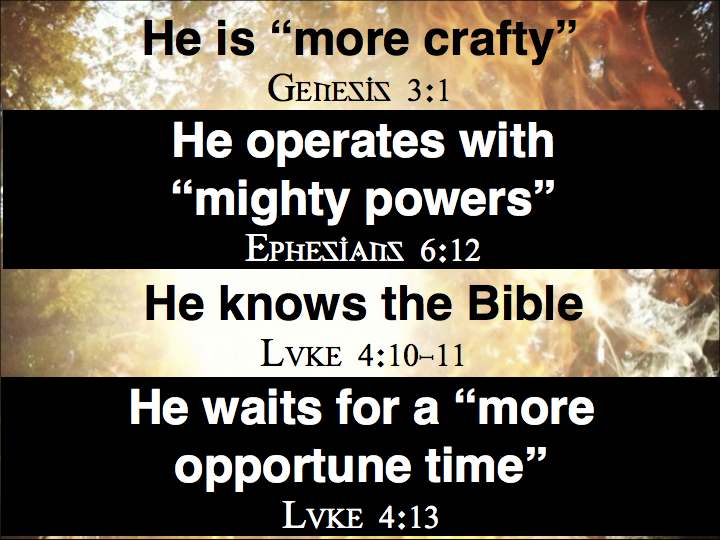
Remember this: “The prince of this world now stands condemned” (John 16:11). He wants to take as many victims down with him as he can! Look what the Bible says about his powers—

  • He is more crafty (Genesis 3:1). This means he is extremely subtle. He seldom throws a huge blatant sin right in your face, but he whispers subtle suggestions.
  • He operates with mighty powers (Ephesians 6:12). He knows how to match strength for strength.
  • He knows the Bible (Luke 4:9-11). The difference is he only knows the words, but the scriptural text is not illuminated by the Holy Spirit to him.
  • He waits for the most opportune time (Luke 4:13) to pounce.

But “…that satan might outwit us… we are not unaware of his schemes” (2 Corinthians 2:11). What are his schemes?

  • Pride—“You can do it yourself.” This was his original downfall, and now he will use it on you.
  • Second-guessing—“Did God really say…?” (Genesis 3:1). He will try to make you think that God’s Word is out-of-date or irrelevant to you.
  • Condemning. Notice that satan wasn’t around when God showed up in the Garden of Eden. Instead he leaves you feeling like you’re unacceptable to God and that you need to hide from Him.

The way we overcome satan is the same way Jesus did it: Jesus quoted Scripture to refute each of satan’s temptations (see Luke 4:1-13). We are victorious in the exact same manner!

Now have come the salvation and the power and the kingdom of our God, and the authority of his Messiah. For the accuser of our brothers and sisters, who accuses them before our God day and night, has been hurled down. They triumphed over him by the blood of the Lamb and by the word of their testimony(Revelation 12:10-11).

Don’t try to go toe-to-toe with the devil because he is too strong for you to handle on your own! But with God’s Word as your weapon and the Holy Spirit as your Counselor, you can hurl him down every time!

3 Steps To Better Bible Studies

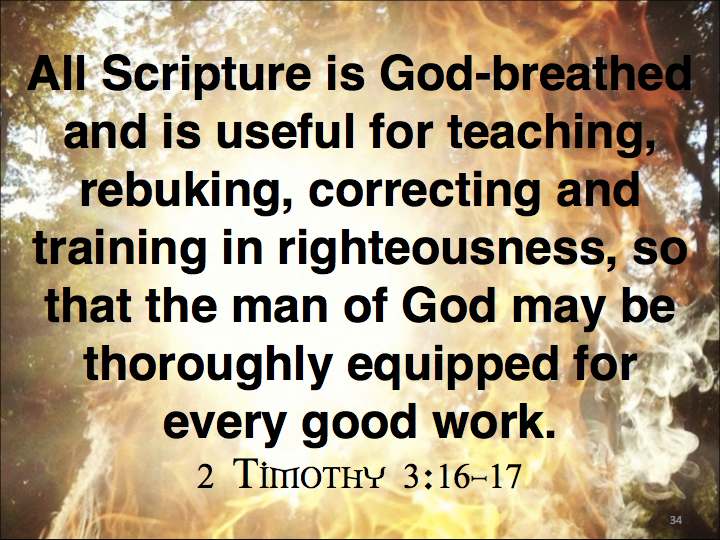
Inspired WordThe Bible is God’s inspired Word—literally, that means it is “God-breathed” (2 Timothy 3:16-17). If the Holy Spirit inspired the Word to the biblical writers, He can best illuminate the same Word to you as you read and study it.

This is how Jesus said the Holy Spirit would help us handle God’s Word:

Teach (John 14:26a). This word means to teach by holding a discourse with someone (or in this case, with Someone). Reading the Bible is meant to be a dialogue, not a monologue.

Remind (John 14:26b). The Holy Spirit is actively involved in us recalling and applying the Word to the situations in which we find ourselves. The Bible tells us to study to be prepared (1 Peter 3:15) and to handle God’s Word like a good worker (2 Timothy 2:15). We are also told not to pre-plan what to say if we are put on the spot, but that words would be given us (Matthew 10:19) as the Holy Spirit recalls to our memory which we have studied.

Convict (John 16:8). This word means both to refute and to confute. Confute simply means proving something is wrong. Refute means to show us we’ve reached a false or illogical conclusion, perhaps a conclusion we reached without giving it very much thought.

Guide (John 16:13). We get a good idea of the meaning of this word from the negative use of the same word—Can a blind man lead [the same word for “guide” in John 16:13] a blind man? Will they not both fall in a pit? (Luke 6:39). We can trust the Holy Spirit to lead us to the truth in the Scriptures that we can apply to our lives.

Quite simply better Bible studies come from:

  1. Praying for the Holy Spirit to illuminate Scripture to you as your read it.
  2. Reading the Bible.
  3. Obeying what the Holy Spirit illuminates to your heart and mind.

Try it and see what happens. I think you’ll like the results!

The Precursor Of A Blessing

R.A. TorreyPastor, please carefully read this words from R.A. Torrey…

“There are many ministers who are missing the fullness of power God has for them, simply because they are not willing to admit the lack there has been all these years in their ministry. It is indeed a humiliating thing to confess, but that humiliating confession would be the precursor of a marvelous blessing. But there are not a few who, in their unwillingness to make this wholesome confession, are casting about for some ingenious device or exegesis to get around the plain and simple meaning of God’s Word, and thus they are cheating themselves of the fullness of the Spirit’s power that God is so eager to bestow upon them. And furthermore, they are imperiling the eternal interests of the souls that are dependent upon their ministrations, that might be won for Christ if they had the power of the Holy Spirit which they might have.” —R.A. Torrey

It is indeed a humiliating thing to admit that we have fallen short in our ministry. But as Torrey says, this momentary humbling can lead to an extraordinary outpouring of God’s blessing.

We can lose our pride now, or we can lose our pride later when we stand before God.

The choice is up to you and me…

7 Final Quotes From “The Ministry Of God’s Word”

The Ministry Of God's WordI’ve been sharing some of the many quotes I highlighted in Watchman Nee’s book The Ministry Of God’s Word. You can read previous quotes by clicking here, here, here, here, and here. This is a book that I have called a must read for pastors, and you can read my full book review by clicking here.

“A minister of the Word ought to be attentive to how he speaks. The words he speaks must come through discipline, since God creates the words for us through His disciplining us. … How much you can speak depends upon how much you have learned inwardly. … It is more than your preaching His Word; you as a person must be so chiseled and tested by Him that the word which comes out of you is God’s Word.” 

“Let us realize that the minister of the Word must be tried first. Without any trial there can be no word. If other brothers and sisters should enter into trial before you, you have nothing to help them. Even if you should try to say something, it falls as an empty word. What use is an empty word? Word is formed in fire. … Hence the ministers of the Word are those who are chosen by God to be dealt with first, to be tried first, and to know the Lord first, so that they may minister Christ to God’s children. … If we expect to have a big ministry we should be ready to receive more dealings.”

“The Word of God is full of emotion. It should not be recited verbatim in a mechanical way. It ought to be pressed out through deep feeling. … One’s emotion must be so refined that he can rejoice when God’s Word is joyful and wail when the Word of God is sorrowful. His feeling follows the Word of God closely. This is not performance. Please never learn to perform. … The more spiritual a man is, the richer his feeling. … The more lessons one learns before God the more enriched his feeling will be.” 

“A minister of the Word should know that God is building up his ministry through each trial and difficulty. Do not be so foolish as to deem it best to flee from trial. If no thorn, then no grace, hence no power and little ministry. You may speak the Word but you do not possess the strength of the spirit to push it out. You need the Word; you also need a usable spirit.”

“In preaching the gospel, if you make men a little bigger, you make the gospel somewhat smaller. … Spiritual humility comes through our being enlightened by God to a real knowledge of our self, where as soulish self-abasement is the result of looking at man, comparing ourselves with others, and being afraid of men.” 

“We need to take good care of our mind that it may be usable when God wants it.”

“He who desires to minister the Word must learn how to speak simply. … Always remember that God’s Word is for men to understand, not for them to become confused about. … Hence a very important point in ministering the Word is to climb high before God. The higher we climb the more God’s Word is released. God rejects low thought, low-quality persuasion, cheap metaphors or words. Reach high and yet be clear.” 


Links & Quotes

link quote

“Accept these [euphoric] sensations with thankfulness as birthday cards from God, but remember that they are only greetings, not the real gift. I mean, it is not the sensations that are the real thing. The real thing is the gift of the Holy Spirit which can’t usually be—perhaps not ever—experienced as a sensation or emotion. The sensations are merely the response of your nervous system. Don’t depend on them. Otherwise when they go and you are once more emotionally flat (as you certainly will be quite soon), you might think that the real thing had gone too. But it won’t. It will be there when you can’t feel it. May even be most operative when you can feel it least.” —C.S. Lewis

Discipline motivates—Punishment mortifies.
Discipline is based on trust—Punishment is based on fear.
Discipline is time in—Punishment is time out.
Discipline is practice—Punishment is penalty.”  Read more from Ken Davis in his post The Power Of The D Word.

Before you go anywhere else with your disappointments, go to God. Maybe you don’t want to trouble Him with your hurts. ‘He’s got famines and wars; He won’t care about my little struggles,’ you think. Why don’t you let Him decide that? He cared enough about a wedding to provide the wine. He cared enough about Peter’s tax payment to give him a coin. He cared enough about the woman at the well to give her answers. He cares about you! Your first step is to go to the right person. Go to God.” —Max Lucado 

Brian Thomas asks, “Has evolutionary faith blinded biologists from seeing the forensic clues within the insect symbiosis they study?” in his post about the beauty and elegance of Creation shown in symbiosis.

[INFOGRAPHIC] How President Obama’s end-run around Congress is going to cost you money. A lot of money!

“Scripture will ultimately suffice for a saving knowledge of God only when its certainty is founded upon the inward persuasion of the Holy Spirit. Indeed, these human testimonies which exist to confirm it will not be vain if, as secondary aids to our feebleness, they follow that chief and highest testimony. But those who wish to prove to unbelievers that Scripture is the Word of God are acting foolishly, for only by faith can this be known. Augustine therefore justly warns that godliness and peace of mind ought to come first if a man is to understand anything of such great matters.” —John Calvin

10 More Quotes From “The Ministry Of God’s Word”

The Ministry Of God's WordPastor, if you haven’t read The Ministry Of God’s Word by Watchman Nee yet, you need to put this on your To Do list. It’s one of the very few books I have labeled a must read for pastors (you can read all about it in my book review by clicking here). Here are a few more quotes from this fascinating book.

“There is no assurance that the Word previously anointed by the Holy Spirit will again be anointed each time it is spoken. Let us remember that the Word of revelation we earlier received is not guaranteed to always be such a word whenever it is uttered. The Word remains, but revelation does not linger. You may repeat the Word, yet you cannot repeat the revelation or the anointing. Revelation and anointing are in God’s hand. You can only repeat the words, you cannot recall revelation.” 

“A minister is one in whom there is light, revelation, and the anointing of the Holy Spirit. When he arises and speaks on the Bible, God is willing to speak through the Bible. This is how a minister supplies the church with God’s Word.”

“One reason for the prevailing impotency of the church is that our Lord does not find a way through us.”

“Do not be a professional preacher. Once you turn professional you speak not because you have something to say from God but because you are obliged to utter something.”

“Serving the church with God’s Word is ministering the Son of God. … If the Bible is divorced from the Person of Christ it becomes a dead book.” 

“The task is not simply presenting a book to men, rather is it presenting the Son of God in the Book.”

“What you preach must be what you truly know.” 

“The Word of God is not something people hear by just being present. Physical presence does not insure the hearing of the Word.”

“You are sure that the Lord wants you to minister this Word and He will providentially arrange the time and opportunity for you to deliver it. And thus the Word you preach shall become Christ in others. This is the ministry of the Word in us.

“One cannot minister the Christ one does not know, nor can one serve with only a fragmentary knowledge of Christ. Ministry cannot be based on fragmentary knowledge. … For God to reveal His Son in us is not the result of research or searching; it is entirely a matter of mercy and revelation. It is an inward seeing, an inner knowing. And thereafter the Bible becomes a new and living Book.”

You can read other quotes from this book by clicking here, here, and here.

Faith’s Checkbook (book review)

Faith's CheckbookWhen you pull out your checkbook, it’s nice to have money in the account so your check will be honored. The same concept holds true for your “spiritual bank account.” Charles Spurgeon has a collection of daily biblical promises called Faith’s Checkbook which will help you realize how fully-funded God has made your spiritual account.

Each day the Spurgeon, called the Prince of Preachers, highlights a promise in God’s Word and unpacks all the riches that promise delivers. Each thought only takes a page, but Spurgeon gives you enough “cash” to provide for you for that day.

What a fantastic year-long journey of faith-building I had with Faith’s Checkbook!