Certainty In Uncertain Times

… Perhaps the Lord will act in our behalf … The God we serve is able to save us from the furnace…but even if God does not save us… (1 Samuel 14:6 and Daniel 3:17-18).

We often remember and even hold in high regard those leaders who rise up in times of crisis or uncertainty. But I think we might be shocked if we knew exactly how scared these seemingly unflappable leaders actually were! 

The Philistines really had the Israelites on the ropes. Israel’s army was slowing melting away, as soldiers one by one were deserting and heading home. The Philistines had captured all of the sword-makers, so that there were only two swords left—one for King Saul and one for his son Jonathan. 

And to make matters even more desperate, the Philistines occupied all the strategic high ground, so that even if the Israelites were going to attempt an attack, they would have to scale the cliffs in order to do so.

For Jonathan, this situation was unbearable. So he said to his armor-bearer (keep in mind that this armor-bearer didn’t really have any armor to bear!), “Let’s go attack the Philistines.” And then he adds this line that probably didn’t instill too much confidence in anyone, “Perhaps the Lord will give us victory.” 

Perhaps?!

Many years later, when the nation of Israel was in exile in Babylon, three Jewish young men found themselves in a literal hot spot. King Nebuchadnezzar had built an enormous statue of himself and commanded that everyone bow down and worship it. Shadrach, Meshach, and Abednego had been promoted into leadership positions in the capital city of Susa, so there was no hiding in the outreaches of the countryside for them. Their disobedience to the king’s command would make them stand out to everyone. The king had ordered that anyone who disobeyed his edict would be thrown into a fiery furnace. 

Shadrach, Meshach, and Abednego were God-fearing men and knew that they could not worship any other god except Yahweh. When the king confronted their disobedience, they also responded with words that didn’t sound very confident, “God can save us, but we’re not sure if He will save us. But even if He doesn’t, we’re not going to bend our knee.” 

If?!

“Perhaps” and “if” don’t sound like very confident words, do they? 

And yet these godly leaders were totally certain in their uncertain times. They weren’t certain of the outcome, but they were certain of God’s ability to bring the ultimate victory. Even in dark times of crisis, godly leaders are certain that God is greater than their uncertain circumstances. 

A mark of a godly leader is one who has a certain confidence in God even in an uncertain crisis.

Jonathan, and Shadrach, and Meshach, and Abednego would all tell us, “Whether God was going to give us victory in the moment of crisis or not, we will remain in God’s presence! We will not compromise. We will not give in to fear. We will not disobey God. We will continue to cling to Him—rescue or not—knowing that He will be glorified in whatever way He chooses to respond.” 

These young men teach an invaluable lesson for all of us even today: Trust God no matter how uncertain the times are. 

This is part 45 in my series on godly leadership. You can check out all of my posts in this series by clicking here.

On Living In A [COVID-19] Age

In 1948, World War II had come to a close and the nuclear age had dawned. The Cold War was beginning to ratchet up and the fear of nuclear annihilation was gripping people’s hearts. 

In this environment, C.S. Lewis wrote an essay entitled On Living In An Atomic Age. I have changed the word “atomic” for “COVID-19,” and I think you will see the relevance. 

In one way we think a great deal too much of the COVID-19 virus. “How are we to live in a COVID-19 age?” I am tempted to reply: “Why, as you would have lived in the sixteenth century when the plague visited London almost every year, or as you would have lived in a Viking age when raiders from Scandinavia might land and cut your throat any night; or indeed, as you are already living in an age of cancer, an age of syphilis, an age of paralysis, an age of air raids, an age of railway accidents, an age of motor accidents.”

In other words, do not let us begin by exaggerating the novelty of our situation. Believe me, dear sir or madam, you and all whom you love were already sentenced to death before the COVID-19 virus was invented: and quite a high percentage of us were going to die in unpleasant ways. We had, indeed, one very great advantage over our ancestors—anesthetics; but we have that still. It is perfectly ridiculous to go about whimpering and drawing long faces because the scientists have added one more chance of painful and premature death to a world which already bristled with such chances and in which death itself was not a chance at all, but a certainty.

This is the first point to be made: and the first action to be taken is to pull ourselves together. If we are all going to be destroyed by the COVID-19 virus, let that virus when it comes find us doing sensible and human things—praying, working, teaching, reading, listening to music, bathing the children, playing tennis, chatting to our friends over a pint and a game of darts—not huddled together like frightened sheep and thinking about viruses. They may break our bodies (a microbe can do that) but they need not dominate our minds.

For Christians, I would urge you to think in ways in which I am certain C.S. Lewis would agree: 

Set your minds on things above, not on earthly things. (Colossians 3:2) 

Finally, brothers and sisters, whatever is true, whatever is noble, whatever is right, whatever is pure, whatever is lovely, whatever is admirable—if anything is excellent or praiseworthy—think about such things. (Philippians 4:8) 

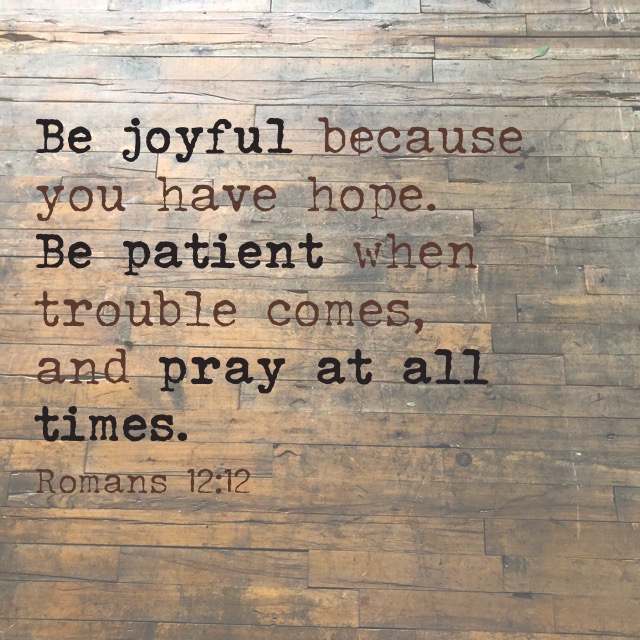
Be joyful because you have hope. Be patient when trouble comes, and pray at all times. (Romans 12:12)

Poetry Saturday—Give To The Winds Thy Fears

Give to the winds thy fears,
hope and be undismayed;
God hears thy sighs and counts thy tears;
God shall lift up thy head.

Through waves and clouds and storms,
He gently clears the way;
wait thou His time, so shall this night
soon end in joyous day.

Still heavy is thy heart,
still sink thy spirits down?
Cast off the weight, let fear depart,
and ev’ry care be gone.

What though thou rulest not,
yet heav’n, and earth, and hell
proclaim, God sitteth on the throne,
and ruleth all things well.

Leave to His sov’reign sway
to choose and to command.
so shalt thou wond’ring own His way,
how wise, how strong His hand!

Far, far above thy thought
His counsel shall appear,
when fully He the work hath wrought,
that caused thy needless fear.

Thou seest our weakness, Lord,
our hearts are known to Thee;
O lift Thou up the sinking heart,
confirm the feeble knee.

Let us in life, in death, 
Thy steadfast truth declare,
and publish with our latest breath
Thy love and guardian care. —Paul Gerhardt (translated by John Wesley)

Poetry Saturday—O My Soul What Means This Sadness

O my soul! what means this sadness?
Wherefore art thou thus cast down?
Let thy griefs be turned to gladness,
Bid thy restless fears be gone;
Look to Jesus, look to Jesus,
And rejoice in His dear name.

What though satan’s strong temptations
Vex and grieve thee day by day,
And thy sinful inclinations
Often fill thee with dismay;
Thou shalt conquer,
Through the Lamb’s redeeming blood.

Though ten thousand ills beset thee
From without and from within,
Jesus saith He’ll ne’er forget thee,
But will save from hell and sin.
He is faithful
To perform His gracious Word.

Though distresses now attend thee,
And thou tread’st the thorny road,
His right hand shall still defend thee;
Soon He’ll bring thee home to God.
Therefore praise Him,
Praise the great Redeemer’s name.

Oh that I could now adore Him
Like the heavenly host above,
Who forever bow before Him,
And unceasing sing His love.
Happy songsters!
When shall I your chorus join? —W.B. Bradbury

Sabbathing

On the Wednesday of Christ’s Passion Week, all of the Gospel writers are in perfect agreement. Between all four of them, they write not one word about what happened on that day. That silence actually speaks volumes to us!  

Jesus is almost surely in Bethany (since that has become is nightly retreat this week), and He is taking a Sabbath rest. “Wait,” you might be saying, “sabbathing on Wednesday?! I thought that was supposed to be Saturday or Sunday?” 

The Sabbath is not a day; it’s an attitude of the heart. 

Jesus followed the example His Father set right at the beginning. 

The Israelites are to observe the Sabbath, celebrating it for the generations to come as a lasting covenant. It will be a sign between Me and the Israelites forever, for in six days the Lord made the heavens and the earth, and on the seventh day He rested and was refreshed. (Exodus 31:16-17)

Notice that God rested and was refreshed. The word rested means to stop working and celebrate. It’s a time to reflect on the work completed and celebrate what has been done. Then the Bible says God was refreshed, which literally means “God refreshed Himself.” He took a deep, satisfying, rejuvenating breath! 

Resting and being refreshed—or sabbathing—is not a luxury; it’s a necessity! 

Jesus understood this principle of sabbathing. Remember that He had only a limited time to accomplish all that the Father had for Him: “We must work the works of Him Who sent Me and be busy with His business while it is daylight; night is coming on, when no man can work” (John 9:4 AMP). If anyone was a Man on a mission, it was Jesus, and yet rest was vital to Him…

  • …from the very beginning of His life, Jesus practiced healthy habits
  • …He started each day in prayer 
  • …He rested and refreshed after expending Himself in ministry, and encouraged His disciples to do so as well (see Luke 2:52; Mark 1:35; 6:30-32, 45-46) 

Now—just before the intense, horrific, inhumane experience He is about to go through—Jesus is sabbathing. He is resting and refreshing His body, soul, and spirit. 

So what keeps us from sabbathing? 

  1. Guilt—“I feel guilty taking time off.” Remember that if Jesus did it, we should too. 
  2. Misplaced priority—“If I don’t do it, it won’t get done.” But remember Who is in charge. The psalmist reminds us, “The Lord is king!” (Psalm 99:1). 
  3. Fear—“If I ‘tune out’ what might I be missing?” Remember: Your Father is watching over you every single moment (see Psalm 121).  

If you want to experience more productivity in your life, don’t try to go 24/7—take a sabbath break. Stop working and celebrate what God has done, then take a deep breath of worship in God’s presence. Jesus demonstrated that sabbathing was vital for ministry success. 

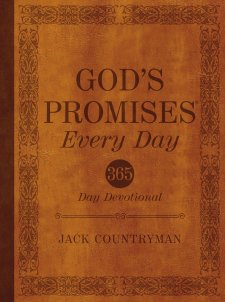
God’s Promises Every Day (book review)

Psychologists tell us that babies are only born with two innate fears, yet many people’s lives are constricted because of numerous fears that they have allowed to creep in. A great way to begin defeating those fears is by learning what God has to say about them, and a great place to begin that journey is with Jack Countryman’s book God’s Promises Every Day.

It’s not very effective to simply tell ourselves, “Don’t be afraid of that.” Instead, we need something with more authority—like God Himself. The Bible is jam-packed with promises that God has given us; promises that will counteract our limiting fears. 

Jack Countryman has put together a marvelous resource to bolster your fight against crippling fears every single day. Each day’s reading begins with a short portion of Scripture, followed by just a couple of short paragraphs unpacking the truth in that Scripture, and then concluding with a one-sentence-long prayer based on that biblical truth. 

Short, but very powerful and effective! The Bible itself says that faith is built by hearing and applying God’s Word, and that’s exactly what God’s Promises Every Day makes so accessible to us.

It’s interesting to note that Jesus refuted every one of satan’s attack by quoting a portion of Scripture. Reading this book every day will similarly arm you to attack the temptations and fears that the enemy wants to throw at you as well. 

I am a Thomas Nelson book reviewer. 

Saturday In The Proverbs—The Perils Of Breaking God’s Laws (Proverbs 28)

[Each chapter in the Book of Proverbs contains thoughts that fit into a theme; they are not just random thoughts gathered together. In this “Saturday In The Proverbs” series, I will share a theme that I see in each chapter. But the cool thing about God’s Word is that you may see an entirely different theme. That’s great! If you do, I would love for you to share it in the comments below.]

Those who forsake the law praise the wicked, but such as keep the law contend with them (Proverbs 28:4).

I could jump off a tall building, but the law of gravity demands I will pay a painful—perhaps even a deadly—price in the end. 

Violating God’s laws are no less painful and deadly. Break them at your own peril.

If you do violate God’s laws, the consequences include:

  • fear (v. 1)
  • more rulers and more rules being imposed on you (vv. 2, 15, 16)
  • justice is perverted (vv. 3, 5, 6)
  • shame (vv. 7, 18, 22-24)
  • insecurity (vv. 8, 19, 26)
  • your prayers are unheard by God (v. 9)
  • retribution coming back to bite you (vv. 10, 13, 14, 17, 20, 21, 27)
  • embarrassment (v. 11)
  • a backlash from others (vv. 12, 25, 28)

Thursdays With Oswald—Jeremiah 22

Oswald ChambersThis is a weekly series with things I’m reading and pondering from Oswald Chambers. You can read the original seed thought here, or type “Thursdays With Oswald” in the search box to read more entries.

Jeremiah 22

[These are notes from Oswald Chambers’ lecture on Jeremiah 22.] 

     “Perfect love drives out fear” [1 John 4:18]—but not love in its beginning. To say “Therefore will we not fear, though…” [Psalm 46:2] is only possible when the love of God is having its way. … 

     Every power of human government that can be used by the devil and self-interest can be reclaimed and used by God. On the other hand, everything that is usable by God is abusable by the devil. … 

     As in the Book of Isaiah, so in Jeremiah, God is revealed as the Controller behind every power of evil; when evil strikes His people it strikes not only by God’s permission but under His direct control (cf. Isaiah 37:29; John 19:11). … 

     Divine fire as opposed to natural fire, burns the fiercer the farther you get away from it; when you get nearer to God, His burning becomes a comfort.

From Notes On Jeremiah

These are good thoughts from Chambers—and good passages of Scripture as well—to keep in mind when we are staring down evil or being persecuted for our faith in Christ. 

Remember:

  • God’s love drives out our fear, but focusing on our fears can drive out God’s love. 
  • God uses; the devil abuses. 
  • No evil can touch you unless God has allowed it, and He only allows it to accomplish something that will bring Him glory. 
  • If the fires seem to be burning hotter, run to God not away from Him!

Abundant Bravery

“I am grabbing all you fears by the jugular because I know you are my everyday enemy. You fears are too often my cancer, my addiction, my hidden habit. You’re my jailer, my poison, my daily blade of self-harm. You’ve been my anesthetic, the thing I’ve let come freeze me every day, lock me up, and suck away my life. You’ve snuffed out my soul while you kept on breathing for years. You’re the most common brain tumor, always beginning in our minds.

“You fears may think you can divide us and conquer us and imprison us in small places, in small lives, with high fences that keep out hope and possibility and each other and the lives we really want. But you don’t know how we’re seeing things.

“You may think you can make us cynical about dreams and apathetic about hope and dubious about possibility and people and prospects. But we’re all over you: you aren’t meant to drive our lives; you’re meant to teach us something about life. You’re a chameleon that wears a thousand different masks, and there are ways to see the realest, truest, surest things.

“You can sound loud or you can strut about and rant like pride. You can grow deathly quiet and look like numbness or apathy or indifference or a dream running in the wrong direction.

“But the thing is: When I find my fears, I find my idols. When I find where you lurk, I will look you in the eye until I know your realest name. And I will say your name out loud. …

“So I will go on crushing all of your life-absorbing fears to a fine powder because this is the deal: I want to be better at letting go of you than letting go of joy. I don’t have to worry about what’s up ahead because Christ is the head of everything. And I don’t have to fear what’s around the next corner because Christ is already there too. 

“We don’t have to abide in our fears because we can abide in our Father.

“There’s believing it and then there’s abundantly living it: Fear is a liar, and love hands out keys. Love is infinite and love can’t ever end, and if love doesn’t run out, what is there ever to fear? There will still be love when the worst happens and when the hope doesn’t happen. There will still be love when everything is crumbling, and there will be enough love to rebuild. There will still be enough love to keep breathing, to keep believing, to keep being and being brave.

“For this I know: Fear can be what we feel, but brave is what we do.” —Ann Voskamp, The Way Of Abundance

Check out some other quotes from Ann’s amazing book here, here, and here.

Thursdays With Oswald—Isaiah 8-11

Oswald ChambersThis is a weekly series with things I’m reading and pondering from Oswald Chambers. You can read the original seed thought here, or type “Thursdays With Oswald” in the search box to read more entries.

Isaiah 8-11

[These are notes from Oswald Chambers’ lecture on Isaiah 8-11.]

     God did not give a progressive revelation of Himself through the Old Testament: the people progressively grasped the revelation, which is very different. …

     The remarkable thing is that when Jesus Christ comes, every one of the things the prophets have been saying fit in with one Personality, the Being whom we know as the Lord Jesus Christ. Isaiah never saw Jesus Christ, he could not have imagined Him, then what inspired him? The very Mind of God (see 2 Peter 1:20). … 

     Fear is apt to make us atheistic and in our outlook we enthrone the devil, not God. God is behind it all, not a thing happens but He knows all about it. …

     If we try to draw our breath from any other source we instantly get diseased. By prayer and communion with God we live out in God’s moral open air, consequently we can live in the cities and amongst the places of men and maintain the life which is in accordance with the Messiah’s life…. The enemy of our souls goes for all he is worth against our praying, against our solitudes with God, he tries to prevent us drawing our breath in the fear of the Lord. The great need is to bring every thought and imagination into captivity to the obedience of Christ until every bit of our nature is reconstructed. 

From Notes On Isaiah

In these four chapters of Isaiah, the kings of Judah are facing enemies closing in from all sides and fear is mounting. Isaiah keeps speaking a word from the Lord that amounts to God saying this: Stop focusing on your troubles and focus on Me instead!

It’s a good reminder for us still today. God is in control. Let me say that again: God is in control! Let His perfect love and His perfect power drive out fear from your heart. Keep your eyes on Him, not on the problems coming against you. Let your thoughts be captivated by Jesus, and you will be reconstructed from the inside out with the nature of Christ.