In the month of Kislev in the 20th year of the Israelites’ exile in Babylon, Nehemiah began to pray for favor when he spoke with King Artaxerxes. In the month of Nisan—four months later—Nehemiah was finally given the opportunity to speak with the king about his heart’s desire to travel to Jerusalem (Nehemiah 1:1–2:6).
Jeremiah dictated all of God’s words to Baruch in the 4th year of King Jehoiakim’s reign. Presumably, Baruch begin sharing these words immediately, but it wasn’t until the 9th month of the 5th year that these words appeared to hit home (Jeremiah 36:1-6, 8-9).
In the 3rd year of King Cyrus’ reign, Daniel was shown a vision from God and he began to pray for God to give him the meaning of the vision. Twenty-one days later and angel arrived with the answer (Daniel 10:1-12)
Zechariah and Elizabeth prayed and tried to get pregnant until Elizabeth became post-menopausal. Even after they stopped praying and stopped trying, Gabriel told them their prayer had been heard and Elizabeth became pregnant (Luke 1:5-25).
God’s timing is perfect!
What has God promised you? Are you still praying for it? Still believing for it? Are you still doing what you need to do to see it happen? If God spoke it to you, He has not forgotten you! Don’t believe the lie that the window of opportunity has closed!
If it seems slow in coming, wait patiently, for it will surely take place. It will not be delayed. (Habakkuk 2:3)
Listen to the podcast of this post by clicking on the player below, and you can also subscribe on Apple, Spotify, or Audible.
I have been so grateful for the insights of Dr. Gary Chapman in his book The Five Love Languages. I have found this book to be of immense value in helping couple prepares for marriage, and in helping married couples get beyond a place where intimacy has become stuck.
In short, the five love languages are words of affirmation, quality time, gifts, acts of service, and physical touch. The goal of learning the other person’s love language—and learning to speak it consistently and fluently—is an increased level of intimacy. In the book of Amos, God asks, “Can two people walk together without agreeing on the direction?” (Amos 3:3 NLT), and speaking the right love language definitely helps people agree!
The whole reason we come to God in prayer as a Father, as a Brother, and as a Counselor is so that we can hear Him speaking our love language and we can continue to walk in deeper intimacy with Him.
When my then-girlfriend Betsy and I first met, we spent hours and hours getting to know each other. We would ask questions, share stories, and tell things we did and didn’t enjoy. This is the epitome of intimate conversation: getting to know the other person’s heart as you open up your heart to them as well.
I’ve shared this analogy before, but intimacy grows stale and can eventually disappear altogether if those in a relationship are no longer walking together. It doesn’t work if I say, “Betsy, I’m looking forward to spending an hour with you each week,” or even if I say, “I’ll give you 15 minutes each morning.” Instead, our relationship needs to be one of continual walking.
It’s the same thing for us as Christians: we cannot only give God an hour at a church service on Sunday mornings, nor is intimacy going to increase if I only walk and talk with my Savior for a few minutes in my morning devotions.
Walking closely with Him is what God has desired right from the beginning. He walked with Adam and Eve each evening. This phrase “walking with God” is used consistently throughout the Bible of those who had an intimate relationship with their Father, Brother, and Counselor—Noah, Abraham, Isaac, the people of Israel (Genesis 3:8, 6:9, 17:1, 48:15; Leviticus 26:12). And even as the New Testament era dawns, we read, “And they [Zechariah and Elizabeth] were both righteous before God, walking in all the commandments and ordinances of the Lord blameless” (Luke 1:6 NKJV).
But I’m especially intrigued by the story of Enoch in Genesis 5:21-24. Twice in four short verses, we read “Enoch walked with God.” Remember that verse in Amos—“Can two people walk together without agreeing on the direction?”—so Enoch and God had to be in agreement. In fact, that’s exactly what we read about Enoch in the Book of Hebrews:
By faith Enoch was taken from this life, so that he did not experience death: “He could not be found, because God had taken him away.” For before he was taken, he was commended as one who pleased God. And without faith it is impossible to please God, because anyone who comes to Him must believe that He exists and that He rewards those who earnestly seek Him. (Hebrews 11:5-6)
If you’ve taken Dr. Chapman’s love language assessment, you probably found that you were pretty lopsided: maybe you scored very highly in one love language and then barely registered in another. We may be lopsided in our love language skill, but God speaks every language perfectly!
Dr. Chapman noted that when our love language is being spoken to us sincerely and consistently, our love tank is filled, and all of the love languages begin to become more meaningful.
Just as God walked with Enoch until the day He brought him Home, so He wants to walk with us.
Walk in obedience to all that the Lord your God has commanded you, so that you may live and prosper. (Deuteronomy 5:33)
The Lord will establish you as His holy people, as He promised you on oath, if you keep the commands of the Lord your God and walk in obedience to Him. (Deuteronomy 28:9)
May He turn our hearts to Him, to walk in obedience to Him and keep the commands. (1 Kings 8:58)
Blessed are all who fear the Lord, who walk in obedience to Him. (Psalm 128:1)
And this is love: that we walk in obedience to His commands. As you have heard from the beginning, His command is that you walk in love. (2 John 6)
When we walk in loving intimacy with Him, our intimacy grows deeper and more mature. Sometimes they will say of couples who have been married for a long time and walk in increasingly deeper intimacy with each other, “They seem to know each other’s thoughts.” That’s because they know each other’s hearts—and that’s what God wants to do with us. He did it with Enoch, and He will do that with us too (Jude 14; Jeremiah 33:3; Habakkuk 3:19).
Enoch walked intimately with God for 365 years. Let us walk intimately with God for 365 days a year, for as many years as He gives us until God takes us away with Him forever!
If you’ve missed any of the messages in our prayer series called Intimate Conversation, you can find all of the messages by clicking here.
Listen to the podcast of this post by clicking on the player below, and you can also subscribe on Apple, Spotify, or Audible.
“Highly esteemed” is how two different angels addressed Daniel (Daniel 9:23, 10:11). This was a title they obviously heard from God Himself. At both instances, Daniel was in a time of intense and sustained prayer and fasting.
While I was speaking and praying, confessing my sin and the sin of my people Israel and making request to the Lord my God for His holy hill … Gabriel, the man I had seen in the earlier vision, came to me…. (Daniel 9:20-21)
At that time I, Daniel, mourned for three weeks. I ate no choice food; no meat or wine touched my lips; and I used no lotions at all. (Daniel 10:2-3)
Prayer was a regular habit for Daniel and prayer was also what Daniel turned to immediately in times of trouble (Daniel 2:18, 6:10).
We see the same thing in the lives of two notable women in the New Testament. Elizabeth is described as an upright woman who observed all of God’s commandments blamelessly. She continuously prayed that she might get pregnant, and then Gabriel came to bring the good news of her upcoming pregnancy. Elizabeth responded by saying, “The Lord has done this for me.… He has shown me His favor” (see Luke 1:5-25).
Mary was also a righteous woman who was steeped in Scripture (as we can see in her song of praise). When Gabriel appeared to her, he called her “highly favored” (see Luke 1:26-55).
A righteous, prayer-filled lifestyle also brings favor and esteem with earthly kings. Daniel and his friends fasted and prayed, which led to King Nebuchadnezzar’s favor directed to them (Daniel 1:11-20, 2:48-49). After three days of prayer and fasting, Queen Esther found favor in the eyes of King Xerxes, which led to the salvation of all the Jewish people (Esther 4:15—5:3). And Nehemiah’s sustained prayer over four months won the favorable reply from King Artaxerxes (see Nehemiah 1:1—2:8).
If you want to hear deep things from God, if you want to be called “highly esteemed” by the Most High, if you want to gain favor with earthly kings, you must be committed to the sustained work of prayer and righteous living. If you would like to dig into this deeper, check out 4 Thoughts To Help Prayer Become A Daily Habit.
Have you ever had a really good scare? Maybe in the dark or when you were young? Then in the light or as you got older you thought, “Why was I afraid of that?” Our relief came from the fact that we think we know more. But here’s the problem: there is a difference between a healthy fear and an unhealthy fear, so not every fear is something we should try to alleviate.
Sometimes we treat too lightly the things that are really quite powerful. Consider the arrival of Jesus in Bethlehem. There are more angels sent by God surrounding this one event than anywhere else in all the Bible. Yet all four angelic appearances have the same message: “Do not be afraid.”
Why would people fear what we now celebrate as such a joyous event? I think it’s because God Himself—the All-Holy Creator of the Universe—is coming near to sinful man (see John 1:9; 1 Timothy 6:15-16).
God is holy, and His holiness is unapproachable by sin. At the exact same moment, God is love, and His love desires for us to approach Him. We cannot make this happen on our own, which leads to more fear.
In the Greek language of the New Testament phobeō is the main word for “fear.” This word can be defined as either fleeing from a terrible thing or clinging in obedience to an awesomely reverent thing. Jesus said the same things when He told us, “I tell you, my friends, do not be afraid of those who kill the body and after that can do no more. But I will show you whom you should fear: Fear Him who, after your body has been killed, has authority to throw you into hell. Yes, I tell you, fear Him” (Luke 12:4-5).
In the Advent story, the first appearance of “Do not be afraid” is when an angel appears to Zechariah. Why would Zechariah be so afraid at the approach of God? I think there may have been three reasons:
Herod was king—making the society Zechariah lived in politicized and irreligious
Zechariah was without a priestly heir to carry on his family name
his wife Elizabeth may have sinned—at least that’s what people would have whispered about her barrenness
All of this added up to Zechariah feeling like God was displeased with them and that He was only coming close to bring fiery judgment.
The angel told Zechariah not to fear because “your prayer has been heard.” In other words, “I am inviting you to trust in what God HASalreadydone versus trusting in what you might or might not be able to do on your own.” Phobeō was an invitation to choose reverential obedience (holy fear) of the eternal over the terror of the temporal.
Sadly, Zechariah initially clung to the negative phobeō. Yet after Elizabeth did conceive and John was born, this was transformed into holy, reverential fear, as heard in the Spirit-inspired song he sang. Notice in Luke 1:67-75 Zechariah’s emphasis on all that God has done: He has come, He has redeemed, He has raised, He said, He has kept His covenant, He has rescued, He has enabled.
Have you put yourself in the category of “unworthy of God’s favor”? Has fear crippled you—like it had done with Zechariah—from continuing to pray, believe, and try?
Fear is an invitation to evaluate in who or in what I have placed my trust.
I invite you to accept the invitation to take your eyes off the temporary and put them on the Eternal One. “…The time is coming quickly, and what I show you will come true. It may seem slow in coming, but wait for it; it will certainly take place, and it will not be delayed.”(Habakkuk 2:3 GNT)
Check out the other messages in this Do Not Be Afraid series by clicking here.
If you’ve been reading my series of posts on God’s favor, I hope you are becoming more aware of how strongly I want you to know this: God is for you! He’s not looking for opportunities to blast you, but to bless you. (If you want to read some of these previous posts, check out the link at the bottom of this post.)
In writing his account of the birth of Jesus, Luke is captured with the idea of God’s favor. Luke uses the word favor more than any of the other gospel writers, and he uses the word quite frequently as he relates the events leading up to the birth of Jesus. During his narrative we meet two women—Elizabeth and Mary. Here are five lessons we can learn from these two mothers.
(1) “Favor” is not the same thing as “favorite.” To say, “I am the one on whom God’s favor rests” is not the same as saying, “I am God’s favorite.” Elizabeth recognized God’s favor on both herself and on Mary (Luke 1:25 & 43), and Mary also recognized God’s favor on herself (Luke 1:28, 30, 48-49). But nowhere did these women think they were God’s favorites. God has no favorites, but instead He showers His abundant, never-ending favor on everyone!
(2) “Favor” probably didn’t look like what they would have planned for themselves. Elizabeth didn’t get pregnant until the age when she should have been a grandmother, and Mary got pregnant before she was even married. I’m sure neither of them thought their lives would go this way! But God knew what He was doing all along (see Isaiah 45:7-9; Psalm 139:16).
(3) They needed humility, obedience, and perseverance to remain in the place where they could recognize God’s favor. No one can stop God’s favor, but the devil would love to keep you from recognizing God’s favor. One way satan does this is by trying to get us to appeal to our pride (“I think I can do this better”) because then obedience to God and perseverance through the trying times is very difficult to maintain.
(4) God’s favor is for God’s glory (not necessarily for our comfort). God is accomplishing HIS plan through us. His favor toward us places us where He needs us, when He needs us there, and with the talents we need to respond correctly when we get to that moment. Mary spoke the words that I’m sure were also in Elizabeth’s heart: “I am the Lord’s servant. May it be to me just as you have said.”
(5) God’s favor doesn’t necessarily answer all our questions. Even though God’s favor places us in the right place, at the right time, with the right skills, we will still undoubtedly have questions about why God is doing what He’s doing. If you feel that way, you’re not alone—Hebrews 11 is full of people who felt the same way. But hang in there and keep trusting God: He knows what He’s doing! In the meantime remember this: God is able to make ALL grace abound toward you, that you, ALWAYS having ALL sufficiency in ALL things, may have an abundance for EVERY good work (2 Corinthians 9:8).
Check out this video of the full message I shared on these lessons from the life of Elizabeth and Mary.
Join me this Sunday as we continue looking at God’s favor. You can join me either in person or on Facebook Live.
If you’ve missed any of my previous posts on God’s favor, check out:
I’ve been thinking, writing, and speaking about God’s favor quite a bit lately. You can check out some thoughts here, here, and here.
This topic isn’t complete without considering God’s grace. After all, grace literally means God’s unmerited favor.
So what do you think disgrace means?
The prefix dis- means separation. When something is disassembled, it’s not whole as it used to be. If someone is feeling discouraged, they are separated from what used to give them courage. So disgrace could mean that we are separated from God’s grace.
But are we really?
Listen carefully to this, and then take a look at this 4-minute video—satan cannot stop God’s grace, but he can stop you from recognizing God’s grace. In other words, disgrace doesn’t mean that God’s grace has been withdrawn from you, but rather disgrace is when you are having difficulty seeing, hearing, or feeling God’s grace.
Elizabeth was feeling disgrace, but then check out what God did for her…
You can read the story for yourself in Luke 1:5-25. This video clip is a small snippet from a longer message. If you would like to listen to the whole message, please click here.
“It was because of His grace that God the Father sent His only Son to die in our place. To say it another way, Christ’s death was the result of God’s grace; grace is not the result of Christ’s death.” —Jerry Bridges
God had been showing us His love throughout the Old Testament period, but the Advent of Jesus made it abundantly and unmistakably clear that God is for us!
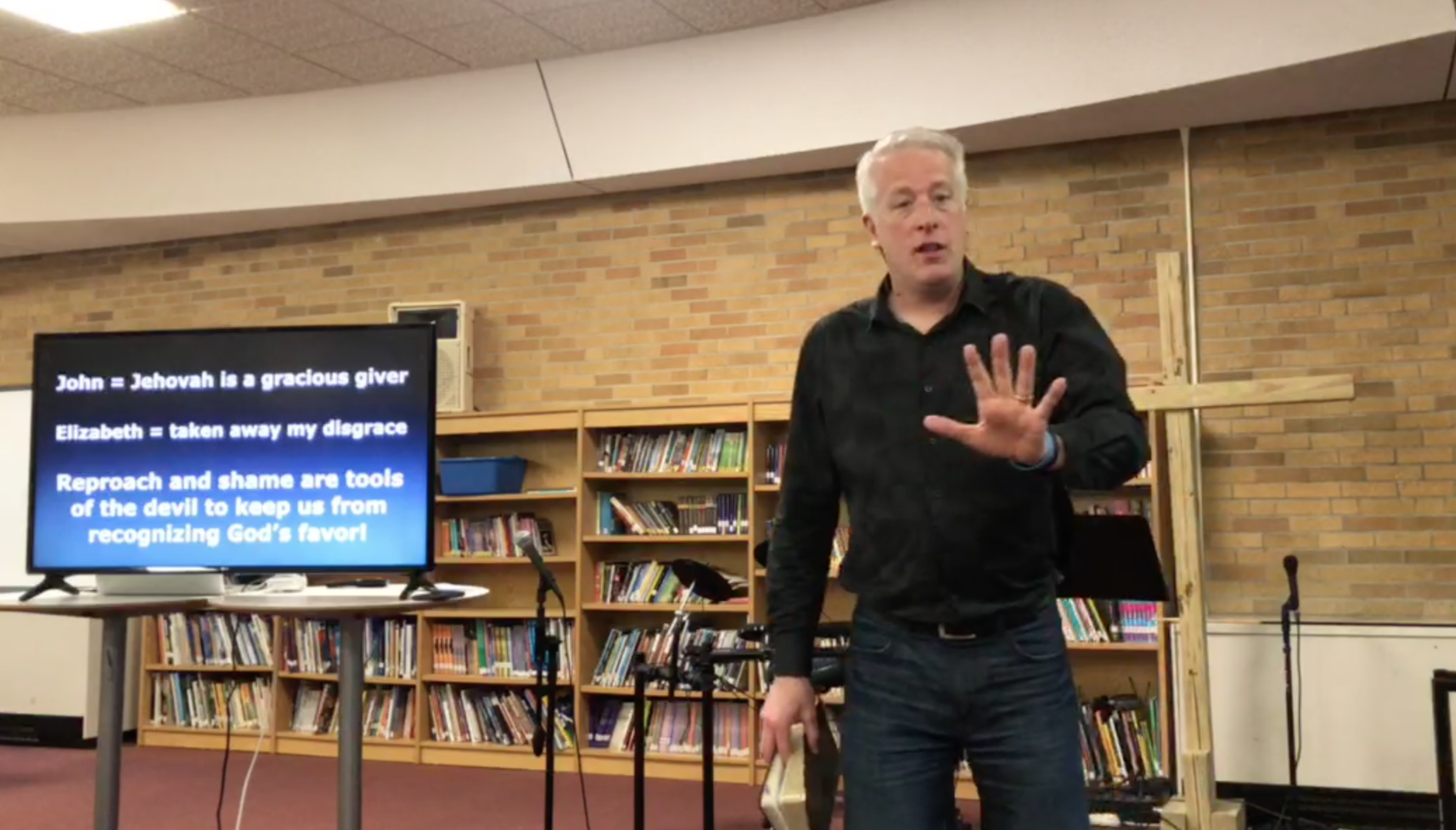
John (the one who would announce the arrival of Jesus) means Jehovah is a gracious Giver.
Elizabeth (John’s mother) said that God had not only shown His favor to her by making her pregnant, but she also said God had removed her disgrace.
Mary (the mother of Jesus) was greeted by the angel with the phrases “You are highly favored” and “You have found favor with God.”
On the night of Christ’s birth, the angels sang, “Glory to God in the highest heaven, and on earth peace to those on whom His favor rests.”
Jesus, in His first public sermon, quoted Isaiah’s words, saying He had come to proclaim God’s favor.
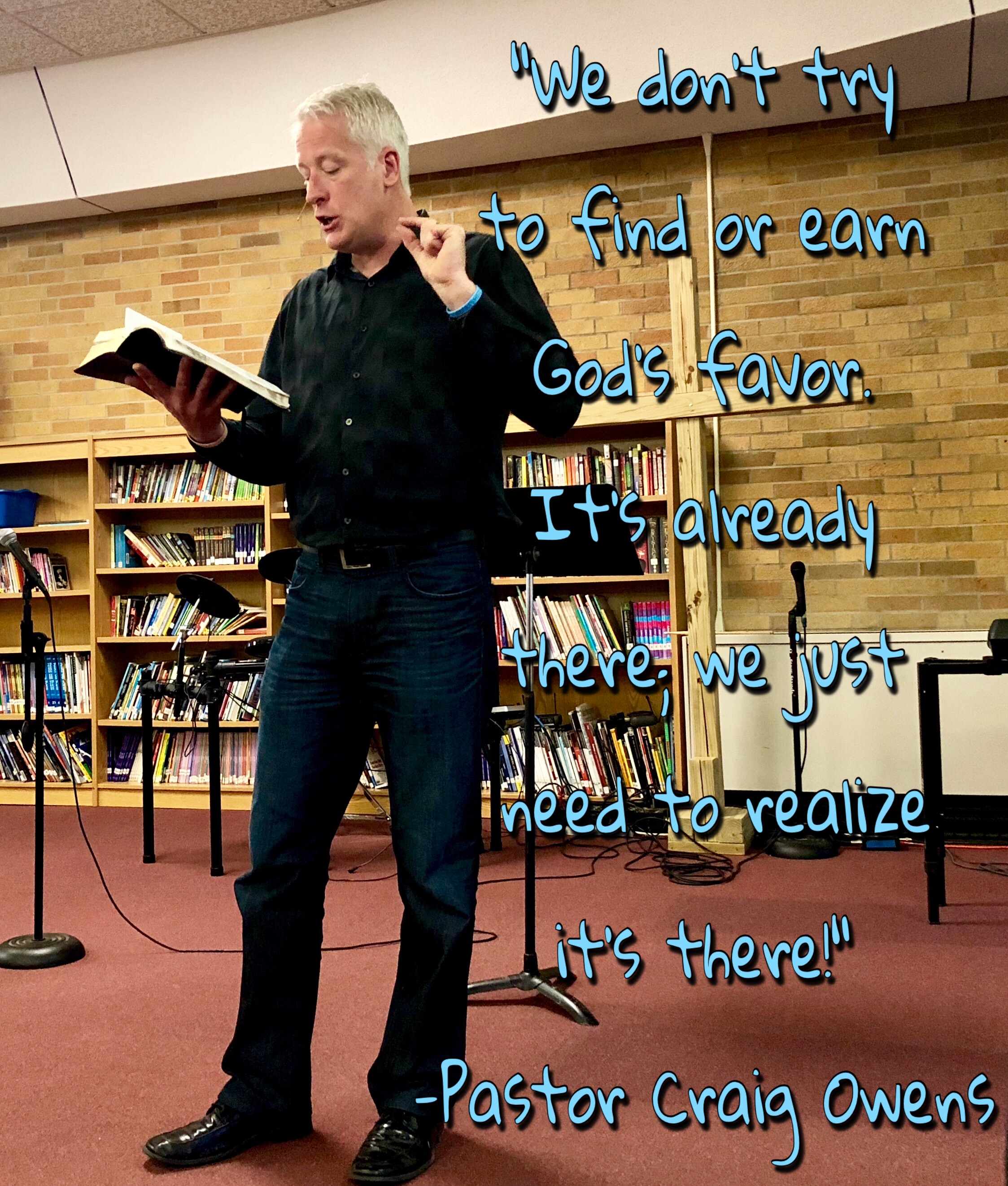
But please notice this truth—We don’t try to find or earn God’s favor. It’s already there; we just need to realize it’s there!
You see, we don’t grow in God’s favor, nor do we get more favor, but we progressively become more deeply and intimately acquainted with God’s favor that is already there. Check out what Moses said:
If I have found favor in Your sight, show me now Your way, that I may know You progressively become more deeply and intimately acquainted with You, perceiving and recognizing and understanding more strongly and clearly and that I may find favor in Your sight (Exodus 33:13)
The angel said to Mary, “You are HIGHLY FAVORED” (Luke 1:28). God uses the same word when He says to us: God made us ACCEPTED in the Beloved (Ephesians 1:6).
How can this be??Because on the Cross, Jesus switched places with us. He took all our sin and DISgrace, and gave us all of His righteousness. Now when God the Father looks at us, all He sees is the righteousness of His Son. Now all praise to God for His wonderful kindness to us and His favor that He has poured out upon us because we belong to His dearly loved Son(TLB).
God’s grace is undiminished. It is as full today as it ever has been. God could never love you more than He already does. God could never love you less because of anything you do. Keep your eyes on Him and you will find just how much favor He has for you!
Join me this Sunday either in person or on Facebook Live as we continue to learn more about God’s favor.
“Build God-centered anticipation and expectancy and excitement into your home—especially for the children. If you are excited about Christ, they will be too. If you can only make Christmas exciting with material things, how will the children get a thirst for God? Bend the efforts of your imagination to make the wonder of the King’s arrival visible for the children.” —John Piper
“The only people whose soul can truly magnify the Lord are people like Elizabeth and Mary—people who acknowledge their lowly estate [Luke 1:43, 48] and are overwhelmed by the condescension of the magnificent God.” —John Piper
“I try to read every book—Christian and secular—touted as ground-breaking. None of them are. We are driven by a reality placed in us by the Creator God with legitimate ways, context, and relationship to express our sexuality. If we don’t find those legitimate outlets, we will spend our lives searching for fulfillment in self-destructive ways to fill that God-given need for community, intimacy, relationship, and meaning. We cannot live without intimacy, and here I don’t mean sex. Sex is simply one of the most powerful forms of intimacy. We are not asexual beings. Being Christ-followers, striving for integrity in all things, doesn’t neuter us.” —Becky McDonald, founder and president of Women At Risk (WAR) International
“We must discipline our minds in all things to submit to the Word of God. We have the mind of Christ (1 Corinthians 2:16), and we are commanded to let His mind hold sway in all our thinking (Philippians 2:5). What the Scripture teaches concerning the disciplined life may not always seem the reasonable thing to do—because we cannot square its teaching with our experience or logic—but it is always the Word of God. Our duty is to get behind it and order all our steps accordingly.” —T.M. Moore
“Life is better when we act like we might see someone again soon, isn’t it?” —Seth Godin
















 Craig T. Owens