Listen to the audio-only version of this podcast by clicking on the player below, or scroll down to watch the video.
When you are in a leadership role it is unavoidable that you will occasionally have to talk about people. Perhaps it’s gathering more information or discussing an incident with a fellow leader. However, we have to be very careful that these discussions don’t cross the line into gossip. Gossip is toxic for your organization, and left unchecked can lead to disastrous results. Check out this episode where Greg and I discuss how to make your conversations about goals instead of gossip.
[0:31] Leaders have to have lots of conversations on different levels—how do they do this without gossiping about their teammates?
[1:32] Leaders need to have a goal for each of their conversations.
[3:39] What holds leaders back from having the productive (but difficult) conversations?
[6:02] Leaders need to be careful of the diabolic nature of gossip.
[8:58] We need to try to make all of our conversations constructive for us, our teammates, and the entire organization.
[11:01] Productive, healthy conversations must become a part of your organization’s culture.
[13:09] Do your teammates totally trust that you, as their leader, have their best in mind?
[16:51] Leaders need to prioritize transparency at all levels of the organization.
[18:36] Leaders can empower their teammates to make healthy changes.
Check out this episode and subscribe on YouTube so you can watch all of the upcoming episodes. You can also listen to our podcast on Spotify and Apple.
Axis reported this in their weekly Cultural Translator newsletter. “Gallup polling data has found a huge spike in the percentage of Americans who say they get less sleep than they need. Survey results also indicate an increase in Americans’ daily stress. Why it’s news you can use: This data indicates that when you interact with anyone—in a store, on the road, at work, or in church—there’s a decent chance that particular human is feeling both exhausted and stressed out. The odds of this stress/exhaustion matrix are even higher if you are conversing with a young woman aged 18 to 29. In 2001, 42% of young women in that bracket said they get enough sleep, but that number has dropped to 27%. Younger women are also the most likely to say they experience daily stress. Stress and sleep have a symbiotic relationship, and parents should understand how both factors play a role in teens’ mental health.” I have written quite a few posts about getting enough sleep, and about taking some time for self-care.
“The world and its culture will not improve unless we play an active role in trying to improve it. Beginning with ourselves, we must make sure the culture we choose honors God and spreads His grace to the people around us. From there we must become informed about the state of culture, especially that which is most potent in conveying ideas and establishing practices—law, education, entertainment, social media, and pop culture in all its forms. That’s not to say we have to participate in all these; but at the least, we need to understand the times and how they shape and are shaped by various forms of culture so that we can know what we ought to do in pursuing a culture of love (1 Chronicles 12:32).” —T.M. Moore
“A man gives little if he gives much with a frown; he gives much if he gives little with a smile.” —Talmud, Ketubot
This is a very helpful interactive map of Paul’s missionary journeys. While you are on the viz.bible website, be sure to check out all of the other amazing infographics they have. I use these quite often to help me grasp the message of Scripture visually.
My courage and my success are directly tied to my obedience of God’s Word. The life of Joshua is just one example. Check out this full message here. I have lots of new content every week, which you can check out on my YouTube channel.
“Christ is more of an Artist than the artists. He works in the living spirit and the living flesh; He makes men instead of statues.” —Vincent van Gogh
Bryan Windel echoes something I’ve frequently said on this blog, “The Bible is rooted in real history. This is why archaeology is such a valuable tool; it helps us uncover the biblical world and provides us with important background knowledge about the people, places, and events described in the text.” Bryan was a part of a dig at Shiloh (where Joshua and Samuel play key roles) and he shares some of his observations and discoveries.
“I trained four years to run nine seconds, and people give up when they don’t see results in two months.” —Usain Bolt
“Those who have turned the tide of history have turned it by means of prayer. This should be the motto of every follower of Jesus Christ. Never stop praying, no matter how dark and hopeless it may seem.” —Billy Graham
I love these stories of hope from To Write Love On Her Arms. They have lots of great words of encouragement for you to share with others.
Listen to the podcast of this post by clicking on the player below, and you can also subscribe on Apple, Spotify, or Audible.
Every organization has a culture and has some sacred cows.
I define culture as the unwritten rules that everyone who’s been around for a while knows, but seldom thinks to share with any newcomers. Those newcomers usually don’t know they have broken one of those unwritten rules until they actually break one of those rules!
Sacred cows are the untouchable things in every organization. Those things that have always been in place and can never be changed or removed.
But what if you’re the new leader coming into an organization? How do you navigate the new culture? How do you keep from messing with those sacred cows? Greg and I discussed this on a recent episode of our leadership podcast.
Check out the full episode this clip came from by clicking here.
[1:27] what leaders do that will undermine their leadership
[2:48] why it’s more fun to be around grateful people
[4:12] Craig shared about the impact grateful teammates have had on him
[4:52] why is it so easy to complain?
[6:28] leaders need to speak positive things into this around them
[7:42] leaders need to shut down complaining teammates quickly
[8:39] Greg challenges leaders to confront their own negative attitude
[10:00] leaders need to create a place of safety to help others to develop to their full potential
[12:08] Greg reminds leaders that busyness can restrict gratitude
[13:29] criticism is both a mindset and a “heartset”
[13:59] how many of our criticism come from our assumptions about others?
[15:06] poor leaders have a misunderstanding of what gratitude does
[15:55] some ways leaders can express gratitude to their teammates
[17:57] another look at the problem of assumptions
[19:08] a grateful person attracts others to them
[21:00] Craig gives leaders a challenge to help bolster their attitude of gratitude
Check out this episode and subscribe on YouTube so you can watch all of the upcoming episodes. You can also listen to our podcast on Spotify and Apple.
Listen to the podcast of this post by clicking on the player below, and you can also subscribe on Apple, Spotify, or Audible.
For any students of American history or of the role the Bible has played in affecting world affairs, Reading The Bible With The Founding Fathers is an eye-opening book. You can check out my full book review by clicking here. Unless otherwise noted, quotes are from author Daniel Dreisbach.
“Following an extensive survey of American political literature from 1760 to 1805, political scientist Donald S. Lutz reported that the Bible was referenced more frequently than any European writer or even any European school of thought, such as the Enlightenment or Whig intellectual traditions. Indeed, the Bible accounted for about one-third of all citations in his sample. According to Lutz, ‘Deuteronomy is the most frequently cited book, followed by Montesquieu’s The Spirit of the Laws.’ … Saint Paul is cited about as frequently as Montesquieu and [William] Blackstone, the two most-cited secular authors, and Deuteronomy is cited almost twice as often as all of [John] Locke’s writings put together.”
“The founders often quoted the Bible without the use of quotation marks or citations, which were not necessary for a biblically literate society but the absence of which fail to alert a biblically illiterate modern audience to the Bible’s invocation.”
“Increasing unfamiliarity with the Bible makes it harder and harder for Americans to understand their origins and their mores, or to put words to their experiences. … Lacking knowledge of the Bible, Americans are likely to be literally inarticulate, unable to relate themselves to American life and culture as a whole.” —Wilson Carey McWilliams
“Knowledge of the Bible and its place in the American experience, in short, helps Americans better understand themselves and their history.”
“In regard to this Great Book [the Bible], I have but to say, it is the best gift God has given to man. All the good the Saviour gave to the world was communicated through this book. But for it we could not know right from wrong. All things most desirable for man’s welfare, here and hereafter, are to be found portrayed in it.” —Abraham Lincoln
“[T]he Bible has had a literary influence not because it has been considered as literature, but because it has been considered as the report of the Word of God.” —T.S. Eliot
“[William] Tyndale, who was the first to translate the Bible into English from the original Hebrew and Greek, can be rightly called the father of the King James Bible. Approximately ‘eighty percent of his Old Testament and ninety percent of his New Testament’ were adopted by the King James translators. …
“There is much truth in the remark that ‘without Tyndale, no Shakespeare.’ It is also true that ‘without Tyndale, no King James Bible.’ ‘Without the King James Bible,’ Alister McGrath observed, ‘there would have been no Paradise Lost, no Pilgrim’s Progress, no Handel’s Messiah, no Negro spirituals, and no Gettysburg Address. … Without this Bible, the culture of the English-speaking world would have been immeasurably impoverished.’”
“The size of the vocabulary found in the King James Bible is not extensive. [William] Shakespeare, it is estimated, used between fifteen and twenty thousand different words. Milton’s verse draws on a lexicon of about thirteen thousand words. The Old Testament, in the Hebrew and Aramaic, has approximately fifty-six hundred words. The New Testament, in the Greek, has around forty-eight hundred words. In the entire King James Bible, by contrast, there are only about six thousand different words, according to one accounting.”
“The opinion that human reason, left without the constant control of divine laws and commands, will preserve a just administration, secure freedom and other rights, restrain men from violations of laws and constitutions, and give duration to a popular government, is as chimerical as the most extravagant ideas that enter the head of a maniac. … Where will you find any code of laws, among civilized men, in which the commands and prohibitions are not founded on Christian principles? I need not specify the prohibition of murder, robbery, theft, [and] trespass. … Every wise code of laws must embrace the main principles of the religion of Christ.” —John Adams
“Moral principles and precepts contained in the Scriptures ought to form the basis of all our civil constitutions and laws. These principles and precepts have truth, immutable truth, for their foundation; and they are adapted to the wants of men in every condition of life. They are the best principles and precepts, because they are exactly adapted to secure the practice of universal justice and kindness among men; and of course to prevent crimes, war and disorders in society. No human laws dictated by different principles from those in the gospel, can ever secure these objects. All the miseries and evils which men suffer from vice, crime, ambition, injustice, oppression, slavery and war, proceed from their despising or neglecting the precepts contained in the Bible. … For instruction then in social, religious and civil duties resort to the scriptures for the best precepts and most excellent examples of imitation.” —Noah Webster
the difference between patriotism and nationalism both in our country and in your organization [1:35]
Greg explains how leaders need to lead inside out [2:42]
I share one sure-fire way for leaders to evaluate potential new leaders, and how this relates to citizenship [3:27]
leaders can change the culture without having an office or a title [4:25]
the value of team building and how it relates to patriotism [5:10]
Chuck Colson said politics are downstream from culture, so what happens in your backyard will ultimately affect Washington, D.C. [5:45]
how my grandfather changed his business culture [6:43]
Greg explains how gratefulness and patriotism are directly related [8:13]
wherever you are, you can make a difference—your daily actions have a cumulative effect [12:43]
Check out this episode and subscribe on YouTube so you can watch all of the upcoming episodes. You can also listen to our podcast on Spotify and Apple.
Listen to the podcast of this post by clicking on the player below, and you can also subscribe on Apple or Spotify.
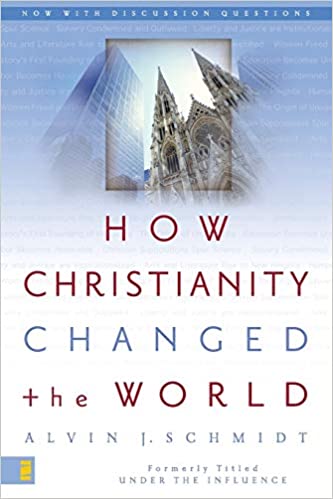
Alvin Schmidt claims, “No other religion, philosophy, teaching, nation, movement—whatever—has so changed the world for the better as Christianity has done.” And I quite believe him. He lays out the evidence to back up this bold claim in his book How Christianity Changed The World.
A few years ago I presented a series of messages to make the case for the resurrection of Jesus. One of the pieces of evidence I presented was the cultural engagement of Christians whose lives had been transformed by a personal relationship with the resurrected Jesus Christ. Alvin Schmidt’s book is like taking this single point of mine and putting it on steroids!
Using the reports of first-person observers from the first century all the way through present day, Mr. Schmidt shows how there is not a single part of the culture that hasn’t benefitted from the involvement of those who live out the Christian principles they have discovered in the Bible. From the care of the sick and elderly, to the elevation of women and marriage, to art, and architecture, and music, and medicine, and science, and education—every sphere of life has been improved by practicing Christians.
I would highly recommend reading this book and then keeping it close at hand to share with those ignorant or skeptical of the claims of Christianity. As William Barclay noted, “Anyone who asks the question, ‘What has Christianity done for the world?’ has delivered himself into a Christian debater’s hands. There is nothing in history so unanswerably demonstrable as the transforming power of Christianity and of Christ on the individual life and on the life of society.” To that, I add a hearty Amen!
Please get a copy of How Christianity Changed The World for your library.
The foundations are being destroyed, what can the righteous do?
The faithful have vanished from among men
Everyone lies to his neighbor
The boastful say, “We will triumph with our tongues”
The wicked freely strut about when what is vile is honored among men
This could be said today in my neighborhood. And 20 years ago in Washington DC. And 500 years ago in Europe. But it was said over 3000 years ago!
In times like these it’s important to remember that there have always been times like these!
In the United States, elections bring regular changes in leadership. Around the world and throughout history violent dictators are toppled, benevolent monarchies fall, dominate personalities shine brightly and fade from the scene, even people who called themselves “Great” or “the king of kings” have disappeared. What should our perspective be in changing cultures—whether they are good or evil?
In Psalms 9-12, David shares some timeless reminders.
In Psalm 9, he contrasts the temporary track record of mortals with the transcendency of Yahweh. His Selah pauses in this psalm invite us to consider the question: Who benefits me ultimately and affects me eternally: mortals or God?
In the Septuagint, Psalms 9 and 10 make up one psalm. In our English Bible, Psalm 9 closes with the phrase “they are but men” and Psalm 10 closes by calling mankind “mere earthly mortals.” Contrast that with Yahweh who is described as “the LORD reigns forever” and “the LORD is King for ever and ever.”
In between these eternal affirmations of God, mere earthly mortals are described as:
arrogant
boastful—literally saying “hallelujah” to themselves
blessing all who are like them in their wicked thoughts
having no room in their thoughts for God
evenpraying to themselves—which is the literal meaning of “he says to himself” that David repeats three times
Literally this mere earthly mortal thinks of himself as god! But even as he says “nothing will ever hurt me while I’m alive” he acknowledges his mortality, admitting that he is indeed finite.
In Psalms 11 and 12, David gives the righteous the proper perspective to handle all of this. In a word, David wants the godly to remember:
Remember God sees everything
Remember God punishes the wicked and rewards the righteous
Remember God gets the final word
Christians can only live exemplary, anxiety-free, and God-honoring lives when we stay focused on the Infinite, on the Eternal God. With this perspective we can live out our roles as “aliens and strangers”—as the apostle Peter calls us—while we live in this evil culture.
I grew up reading the King James Version of the Bible. So naturally, this was the version I also memorized. Even to this day (all these many, many[!] years later), many of the verses I memorized still come back to my mind in that Olde English slant.
A few years ago we celebrated the 400th anniversary of the King James authorized translation of the Bible into English. It’s astounding to realize how many words, phrases, and concepts from this version have become mainstays in the English language. From Shakespeare’s plays right down to current writings, this “Book of books” infiltrates our thoughts and our vocabulary.
Here is an outstanding poem Glen Scrivener put together to honor the 400th anniversary of the KJV, where he attempts to share 100 phrases from this translation in 3 minutes. Enjoy!



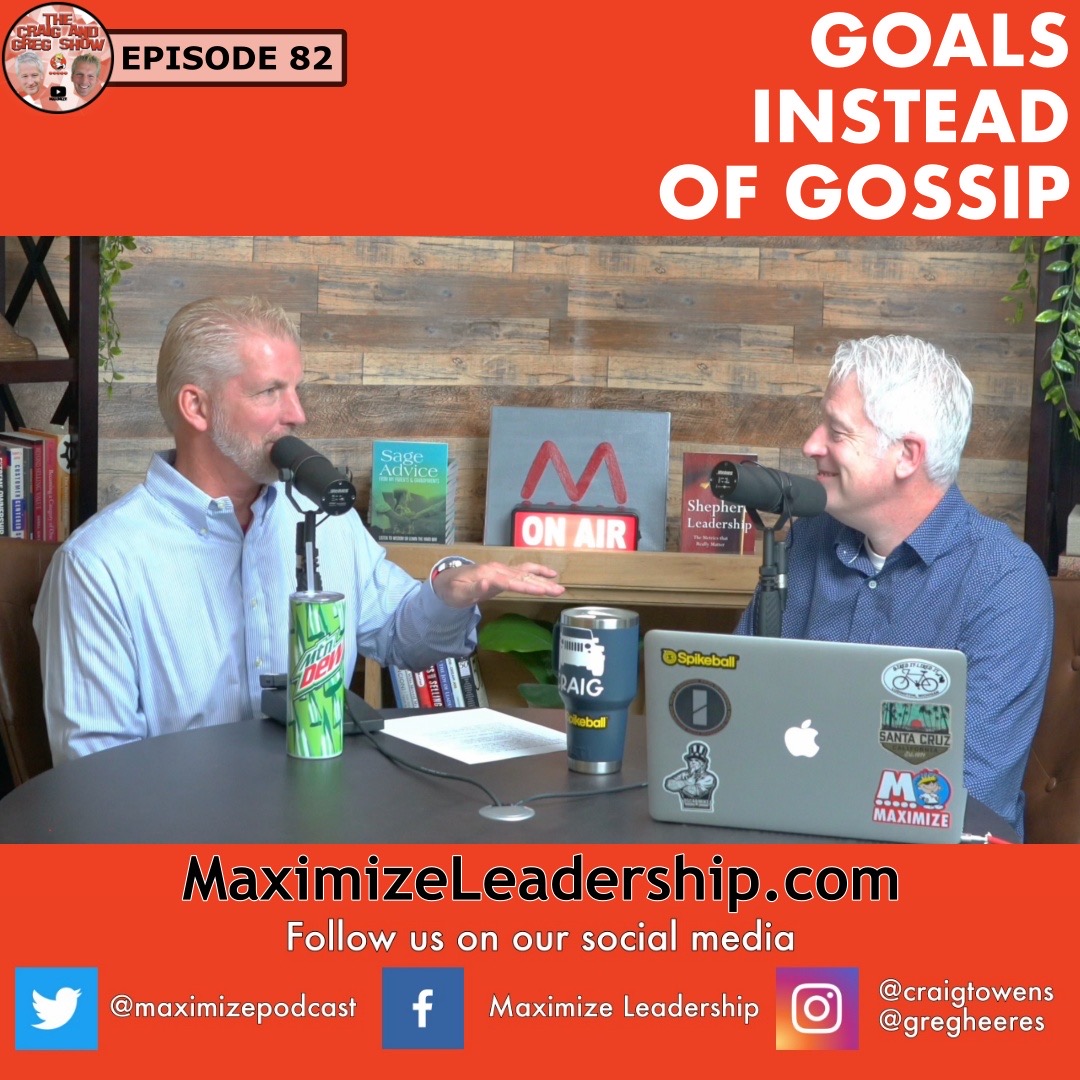 When you are in a leadership role it is unavoidable that you will occasionally have to talk about people. Perhaps it’s gathering more information or discussing an incident with a fellow leader. However, we have to be very careful that these discussions don’t cross the line into gossip. Gossip is toxic for your organization, and left unchecked can lead to disastrous results. Check out this episode where Greg and I discuss how to make your conversations about goals instead of gossip.








 Craig T. Owens