Ruth + Boaz—The Mother’s Day Version

Listen to the podcast of this post by clicking on the player below, and you can also subscribe on Apple or Spotify.

John Maxwell said, “We overestimate what we can do in a day; we underestimate what we can do in a year.” In the case of parents, I think we do the same thing: we lose sight of the big picture when we get bogged down in the details and the pressures of each day. As a result, many times we are unaware of the long-lasting rewards that come from our daily obedience and God’s eternal faithfulness. This was never more true than in the fantastic love story of Ruth + Boaz. 

Last week we looked at the history of Pentecost and what took place 50 days after the Passover, we saw a picture in the Old Testament that was fulfilled in the New Testament. The Jews saw this too. In the Hagiographa (Holy Writings), they picked one of the books of the Old Testament to read at each of the annual Jewish feasts, and the Book of Ruth was selected for Pentecost. I think this was because Ruth herself is in essence a “harvest” of God’s blessing. She is the firstfruits of the non-Jewish people whom God has engrafted into His holy family. 

The story of Ruth’s coming into God’s family is birthed out of heartache. Elimelech and Naomi live in Bethlehem, which means “house of bread,” but it was a time of famine; Elimelech’s name means “God is King,” but Israel had no king and everyone lived for themselves; Naomi’s name means “pleasant,” but her days were bitter (see Judges 21:25; Ruth 1:1-5). 

After Elimelech and his two sons die, Naomi changes her name to Mara (which means bitterness), and yet she hears “that the LORD had come to the aid of His people by providing food for them” (1:6) and she decides to return to Bethlehem. She counsels her daughters-in-law to remain with their families in Moab, but Ruth decides to cling to Naomi. 

In the face of utter hopelessness, Ruth could have chosen what was familiar—her family, her homeland, her gods—but instead she chose to cling to Jehovah. 

Perhaps when she heard that Jehovah had come to the aid of His people she realized, “I’ve never heard of Chemosh coming to the aid of his people. We sacrifice to him but he doesn’t do anything for us. This Jehovah cares for His people. I will put my faith in Him.” 

Ruth’s first step of obedience triggers a whole series of events, starting with one that the writer of this story introduces by saying, “As it turned out, Ruth found herself working in a field belonging to Boaz.” 

But this is no accident—God oversees and directs all of the details. All of history is His story. God is in charge of the tiniest of details: even down to directing Ruth to the right barley field. Ruth’s trust in Jehovah, her obedience in following Him, set things in motion that God had planned, just as Paul explained in Romans 8:28. 

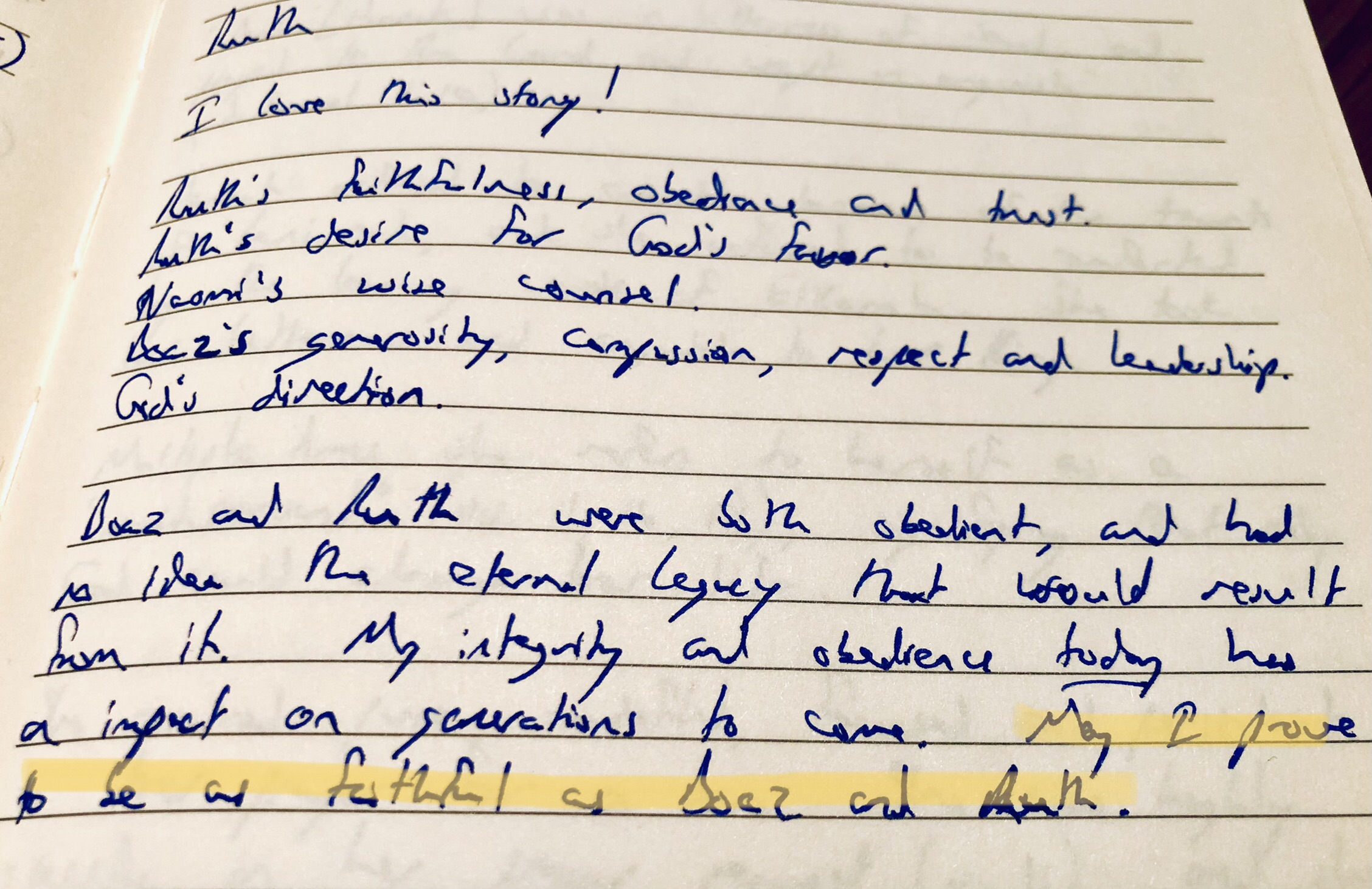
Moms, at the end of the story of your life, you will look back and see so many as-it-turned-out moments. But that means you are living in an as-it-turned-out moment right now. If you believe God is overseeing the details of your life, then every moment is divinely orchestrated by Jehovah, every moment is strategic, every moment is God-directed. You must remain daily obedient to God. 

Don’t underestimate the legacy of God’s provision that is being established every single day that you remain obedient in following Him. Look at the amazing way God used Ruth and Boaz in the family tree of Jesus Christ (Ruth 4:16-22; Matthew 1:1-6).

Moms, your obedience today is preparing your children—and their future generations—for them to experience God’s provision in a coming famine (see Amos 8:11; Psalm 91).

Of course, Ruth can’t give birth to Obed without there being a father, which is why the story is called Ruth + Boaz. On Father’s Day we’ll look at the integrity of Boaz that made this possible too, so please make plans to join me then.

►► Would you please prayerfully consider supporting this ministry? ◀︎◀︎

Confirmation Of The Baptism In The Holy Spirit

Listen to the podcast of this post by clicking on the player below, and you can also subscribe on Apple or Spotify.

The baptism in the Holy Spirit is what Pentecostal Christians frequently refer to as our distinctive doctrine. Notice I said distinctive, not better. Can someone go to heaven without being baptized in the Spirit? Yes! But I’ve found that living in this distinctive empowerment makes the journey to heaven so much more productive and joyful.   

After the resurrection of Jesus, everything took on a whole new meaning, because the “light” had been turned on in the Old Testament palace. All of the practices that Jews had been observing for thousands of years suddenly had a new illumination in the New Testament.  

Pentecost had always been a celebration 50 days following the Passover. In the Old Testament, the law was given from Sinai on the fiftieth day after the deliverance from Egypt, so in a sense, the appearance of God on Sinai was the birthday of the Jewish nation. In the New Testament, the first outpouring of the Holy Spirit on the first Pentecost after Jesus ascended to heaven was the birthday of the Christian nation for all people. 

One of our foundational truths says: “All believers are entitled to and should ardently expect and earnestly seek the promise of the Father, the baptism in the Holy Spirit and fire, according to the command of our Lord Jesus Christ. This was the normal experience of all in the early Christian Church.” 

And another foundational truth is a corollary: “The baptism of believers in the Holy Spirit is witnessed by the initial physical sign of speaking with other tongues as the Spirit of God gives them utterance.” 

God has always confirmed His presence with signs and wonders. From the signs in Egypt to convince Pharaoh that Jehovah was greater than the Egyptian gods to the ministry of Jesus. In fact, Peter said that the signs and wonders done by Jesus were God’s authentication of His ministry (see Luke 5:17-26; Acts 2:22; Acts 10:38). 

Jesus said this should characterize our ministry too (see Mark 16:15-20; Acts 1:5, 8).  

R.A. Torrey noted, “The baptism of the Holy Spirit always imparts power for service…. The baptism of the Holy Spirit is the Spirit of God falling upon the believer, taking possession of his faculties, imparting to him gifts not naturally his own, but which qualify him for the service to which God has called him.” 

Check out this chart that walks us through the book of Acts to see how God authenticated the ministry of those who were baptized in the Holy Spirit by performing signs and wonders through them:

You may download this chart in a PDF format by clicking here Chart of signs in Acts ←

When a Christian is baptized in the Holy Spirit there are two types of evidence:

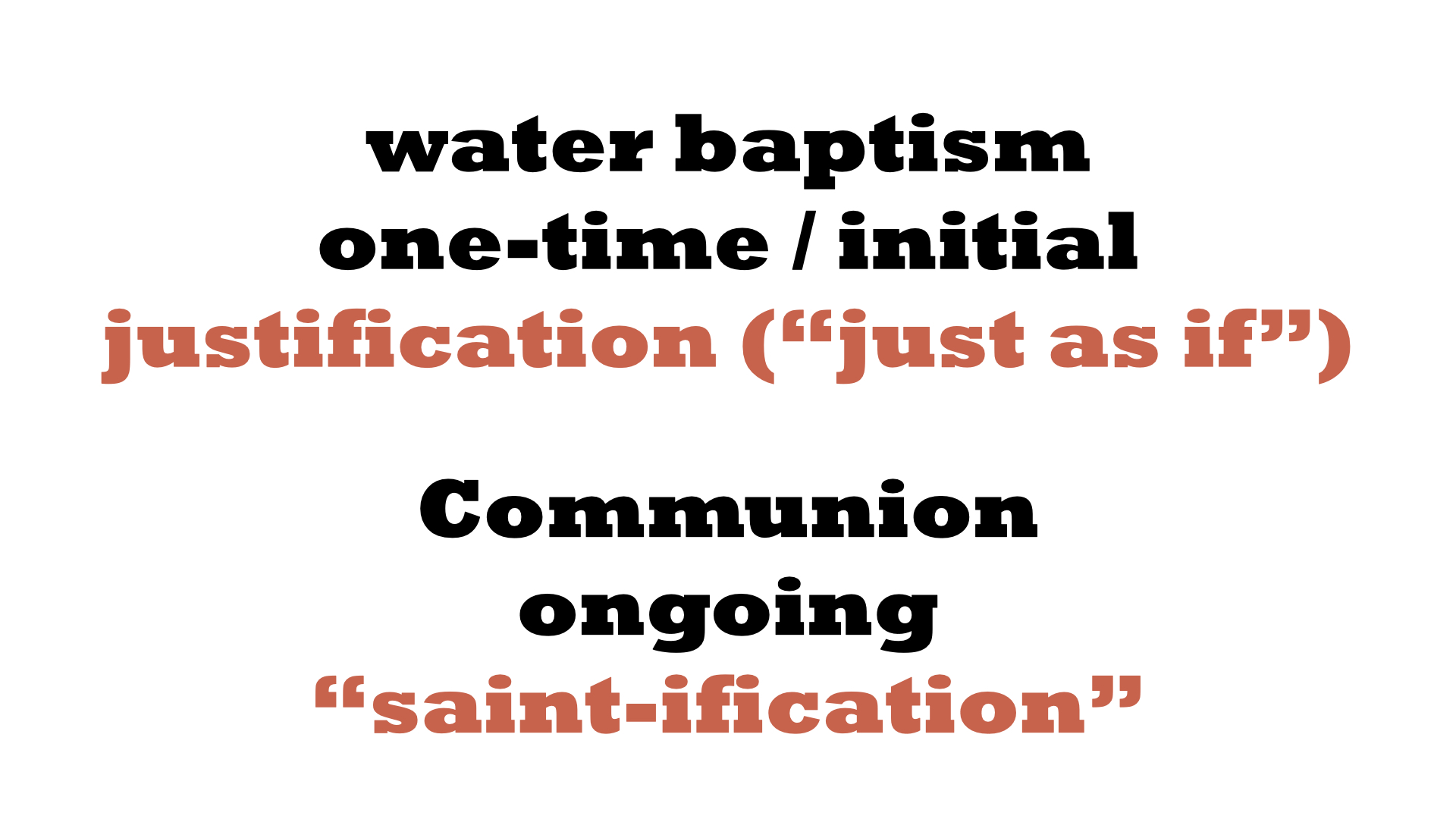
  1. Initial evidence—typically speaking in a language that hasn’t been studied but has been supernaturally given by God. 
  2. Ongoing evidence—I would sum this up in the word sanctification (or as I like to remember it by saying “saint-ification”). This is the lifestyle change, the empowered living, and even the miraculous that cannot be counterfeited by man’s efforts alone. 

Let’s not try to put God in a box—telling Him when, where, how, and through whom He can work. Instead, let’s yield ourselves entirely to Him by letting the Holy Spirit empower us to be effective, unmistakable witnesses for Jesus Christ. 

►► Would you please prayerfully consider supporting this ministry? ◀︎◀︎

I will be relaunching our series called We Are: Pentecostal in two weeks. Please follow along with all of the messages in this series by clicking here for the details.

And if you would like to check out the other messages in our series looking at our foundational belief statements, you can find the full list by clicking here.

“Father, Into Your Hands I Commit My Spirit”

Listen to the podcast of this post by clicking on the player below, and you can also subscribe on Apple or Spotify.

I have some sobering news for you: You are going to die. 

Death is the great equalizer. It comes for the rich and poor, the scholar and the illiterate, all races, all ages, the healthy as well as the sick. Unless you’re still alive when Jesus comes back again, your odds of dying are 1-in-1. 

What happens “on the other side”? What happens after this life is over? Since it seems dark and mysterious to most people, they tend to ignore it until it’s thrust upon them. That’s why I find the dying words of people interesting. Like P.T. Barnum asking, “How were the receipts today at Madison Square Garden?” or W.C. Fields reading a Bible on his deathbed and telling a friend, “I’m looking for a loophole.” 

Or the very last words of Jesus: “Father, into Your hands I commit My spirit.” 

Jesus is steeped in Scripture, so nearly everything He says in His final four declarations come directly from the Psalms, including His final phrase which comes from Psalm 31:5. 

When Jesus broke a three-hour silence with His cry, “My God, My God, why have You forsaken Me,” both Matthew and Mark use the Greek words megas phoné to describe how loudly Jesus spoke. And now with His final words, Luke uses the same megas phoné description. 

Notice in the first megaphone cry Jesus calls on God the All-Powerful Creator. And with His last megaphone declaration, He calls on His Father who is All-Loving. How comforting it is to know that God is both All-Powerful and All-Loving! Not only can He answer our cries, but He delights to answer them! 

The word Jesus uses for “commit” is in the future tense and it means “to entrust as a deposit.” Jesus believed that God was going to do more than just give Him life again, but that He would give life to all who would believe in Him. 

Unlike atheist Bertrand Russell who said, “I would never die for my beliefs because I might be wrong,” Jesus DID die for His beliefs, and by rising from the dead proved He was right in trusting God. 

Job saw an inescapable death for all mankind, but he also foresaw the forgiveness of God (Job 14:5, 16-17). Jesus died once for all mankind and was then resurrected, bringing about the death of death by making forgiveness accessible to anyone (Hebrews 9:27-28; 1 Corinthians 15:19-22). 

We can now have the peace that comes from trusting the only One to Whom we can safely entrust our souls. Because Jesus brought death to death, we can have the same peace when we die that Jesus had when He died. 

With faith in Jesus, you can…

…live today knowing you’re invincible until God calls you home 

…live today full of joy because your home in heaven is secure

…live your very last day in peace because you know to Whom your soul is entrusted 

Because Jesus died at peace with God, we can face death triumphantly! 

If you’ve missed any of the messages in our series on the dying declarations of Jesus, you can access the full list by clicking here.

►► Would you please prayerfully consider supporting this ministry? ◀︎◀︎
“It Is Finished”

Listen to the podcast of this post by clicking on the player below, and you can also subscribe on Apple or Spotify.

Just before Jesus said, “I am thirsty,” John tells us that Jesus knew everything written about Him in the law had been completed and all of the prophecies about Him had been fulfilled. Jesus knew this to be true but no one else standing there would have said “Aha!” because of that statement. But Jesus left no doubt for any of us when He next said, “It is finished!

These three English words are just one word in Greek: tetelestai. It’s in the perfect tense, telling us that nothing more needs to be added to Christ’s work. It not only shares the same root word that John uses for completed and fulfilled, but it closes the circle of another dying declaration of Jesus when He quoted Psalm 22:1: “My God, My God, why have You forsaken Me?” His “It is finished” statement is also the last verse of Psalm 22.

The root word telos translated as completed, fulfilled, and finished has a very rich meaning. Here are three definitions we should consider: 

(1) To complete or bring to a conclusion

Jesus told His Father that He had finished (telos) His mission (John 17:4). Q: How do we know His mission was completed? A: Jesus sat down! Think about this: There were no chairs in the Old Testament temple because a priest never rested, there was always more work to do. But when Jesus finished His work, He sat down (see Hebrews 10:1-4, 11-12). 

(2) To discharge a debt

Since Jesus was the only One who could make the final “once for all” payment, that means that we were hopeless debtors prior to that. God foretold of His forgiveness using the picturesque language of a debt being “doubled up” when it was paid in full (see this video where I explain this concept more fully). Here’s what Jesus did: 

Having cancelled and blotted out and wiped away the handwriting of the note with its legal decrees and demands which was in force and stood against us. This note with its regulations, decrees, and demands He set aside and cleared completely out of our way by nailing it to His cross. (Colossians 2:14 AMP) 

Q: How do we know the debt was paid in full? A: The curtain that had separated us from God’s presence was torn in two.

(3) To fill up what’s missing

In this case, Jesus took what was missing by switching cups with us. He drank the cup of God’s righteous wrath—which was justly ours—and gave us His cup of righteousness in its place! (see Isaiah 51:17-22; Matthew 26:39).  

Q: How do we know we have a cup of righteousness in place of a cup of wrath? A: Dead saints of God were resurrected when Jesus died. “It is finished” was not Jesus giving up, but death giving up … it was not Jesus defeated, but death defeated! 

Jesus paid it all! There is nothing I can do to add to His completed—tetelestai—work, so I can now do what formerly was impossible: I can live a holy life for God’s glory. I can now finish (telos) my race on earth and receive the rewards God has stored up for me (see 2 Timothy 4:7-8). 

Christ’s tetelestai confession is our empowerment to live holy! 

If you’ve missed any of the messages in our series looking at the dying declarations of Jesus, you may access the full list by clicking here.

►► Would you please prayerfully consider supporting this ministry? ◀︎◀︎

“I Am Thirsty”

Listen to the podcast of this post by clicking on the player below, and you can also subscribe on Apple or Spotify.

Jesus has just broken a 3-hour silence with His megaphone-voice cry: “My God, My God, why have You forsaken Me?” Now His final three statements will follow in rather short order, beginning with, “I am thirsty.”

It might seem trivial that Jesus expressed His desire for a drink, especially since He also knew that there was no thirst-quenching water nearby. Far from being trivial, however, this was eternally important because it completed His mission. 

Before saying, “I am thirsty,” John tells us that Jesus knew “that all was now completed.” The Greek word for know is sometimes translated as “see” and sometimes “know.” When it’s “see” it’s always in the past tense—“saw” or “have seen.” Perhaps in His 3-hour silence, Jesus was reviewing His earthly life, looking back to see what He had accomplished. Make no mistake about it, Jesus was on-mission for all 30+ years of His life in Israel. 

But now that He has seen His life, He “knows.” This word is in the perfect tense. He’s seen it all and He knows He has accomplished all He set out to complete. As He had told His audience earlier in His life, “For assuredly, I say to you, till heaven and earth pass away, one jot or one tittle will by no means pass from the law till ALL is fulfilled” (Matthew 5:18). 

In looking back on His life, Jesus saw one final thing: He needed to be given vinegar to drink just as David prophesied (Psalm 69:13-21). With that sour sip, ALL the Ts are crossed and ALL the Is are dotted! 

When John writes, “Knowing all was now completed, and so the Scripture would be fulfilled,” he uses the Greek word which means mission accomplished! 

Why did Jesus need to fulfill ALL the prophecies and complete ALL the law? Check out His earlier statement from the Amplified Bible: “For truly I tell you, until the sky and earth pass away and perish, not one smallest letter nor one little hook identifying certain Hebrew letters will pass from the Law until all things it FORESHADOWS are accomplished.” 

The law was just our temporary guardian and the temple practices were just a shadow of the realities of Heaven (see Galatians 3:23-25; Hebrews 10:1-10). ALL of them were merely pointing to Jesus, so Jesus made sure ALL of them were completed. 

His “I am thirsty” statement was really His “Amen” to His completed mission. 

Jesus fulfilled every Scripture so that we could stand on every promise! 

Check this out: “For no matter how many promises God has made, they are ‘Yes’ in Christ. And so through Him the ‘Amen’ is spoken by us to God” (2 Corinthians 1:20). 

The shadows of the law were turned into the substance on which we can come boldly before the throne of God’s grace! In just three words—“I am thirsty”—Jesus completed His mission for God’s glory and for our eternal help! 

If you’ve missed any of the messages in our series on the dying confessions of Jesus from the Cross, you can access the full list by clicking here.

►► Would you please prayerfully consider supporting this ministry? ◀︎◀︎

The Sin Of Man, The Salvation Of Jesus

Listen to the podcast of this post by clicking on the player below, and you can also subscribe on Apple or Spotify.

“Jesus is risen indeed!” This is the glorious good news that Christians around the world celebrate. 

But good news is really only good news when you fully realize how bad the bad news was. Like when the doctor comes in to tell you, “You’re going to be fine,” and you breathe a sigh of relief. And then the doctor goes on to explain what your condition was and all of the heroic efforts that were undertaken on your behalf, and you realize how close to death you actually were that your sigh of relief turns into a shout of joy! 

The resurrection of Jesus is the good news that brings us eternal life. But instead of merely breathing a sigh of relief thinking, “I shall not perish but have everlasting life,” let’s take a look at how close we were to everlasting death. 

Our fourth foundational belief says: “Man was created good and upright…. However, man by voluntary transgression fell and thereby incurred not only physical death but also spiritual death, which is separation from God.” 

Adam and Eve were given a choice: they were able not to sin and they were able to sin. God gave them dominion over everything in His creation but themselves, and He made them to be personally and intimately connected with Himself. But satan tempted them to take dominion over themselves, saying that they would become like God.

They sinned. “And sure enough, they then had knowledge of good and evil, but it was from the standpoint of becoming evil and remembering how good they once were,” said Nancy Guthrie. Because they sinned, now all of us are unable not to sin. Why? Because no one has been able to demonstrate to us how to be able not to sin. 

Their sin had consequences for them that have extended to us:

  • they felt shame at their vulnerability before God
  • they were fearful to be in God’s presence 
  • they were separated from God  
  • and they doomed all of us to live an utterly meaningless existence forever! 

But Adam and Eve’s sin didn’t send God scrambling for a remedy. Our fifth foundational truth says: “Man’s only hope of redemption is through the shed blood of Jesus Christ the Son of God.” 

Jesus turned the absolutely worst news into the most eternally, overwhelmingly good news ever! 

Jesus was made the cure for sin from before the foundation of the world. God made Jesus to be our sin (not just to carry our sins). In order for this to happen, Jesus had to become human like us. That means that Jesus, like Adam and Eve, had the same choice to sin or to not sin but He did not sin. This allowed Him to be our perfect sacrifice on the Cross. 

When He died on the Cross, Jesus removed the uncrossable abyss between us and God. Jesus made it possible once again for us to be able not to sin. Not only that, but Jesus covers the shame that would linger even after our sin is forgiven by clothing us in His own righteousness! 

(check out all of the biblical references for the above points by clicking here)

Sin had us doomed to not only a meaningless existence on earth, but also to an utterly meaningless existence for the eternity following death. Jesus became our sin to allow us to be reunited with God and reclothed in Christ’s righteousness. This is not just good news, it’s eternally, overwhelmingly good news! 

If you’ve missed the discussion of any of our other foundational truths, you may access the full list by clicking here.

►► Would you please prayerfully consider supporting this ministry? ◀︎◀︎

“My God, My God”

Listen to the podcast of this post by clicking on the player below, and you can also subscribe on Apple or Spotify.

Jesus has been hanging on the Cross silently for three hours. And now He gathers His strength for four final statements that all come in pretty close proximity. His first three dying declarations have been declarations of love:

But now comes a word of sheer, unparalleled agony. A word from a heart that is experiencing the depths of betrayal and pain that has never been known—or even approached—in all of human history: Eloi, Eloi, lama sabachthani! (Matthew 27:45-46; Mark 15:33-34)

Does this sound like a good Friday message: My God, My God, why have You forsaken Me? 

This is the only one of the seven dying declarations of Jesus that Matthew and Mark record, and they do it nearly identically: 

  • It’s spoken in the everyday language of the people: Aramaic 
  • It’s translated into the worldwide language of business and literature: Greek 
  • It’s a direct quotation of Hebrew Scripture 

This is a word for everyone: Jews and Greek, nobles and commoners, religious people and pagans. 

This dying declaration comes from words taken directly from Psalm 22. David wrote this psalm 1000 years before the crucifixion of Jesus, but note the amazing accuracy in the despicable treatment of Jesus, gambling for Christ’s clothes, even the crucifixion itself (which was unknown in David’s time), and then there’s the heart-wrenching cry My God, My God, why have You forsaken Me?  

Matthew and Mark say Jesus “cried out.” This can mean a cry of joy or a cry of pain. They also record that He cried out with “a loud voice.” The Greek words here will sound very familiar even to English ears—“loud” is the word megas, and “voice” is the word phoné. Literally: Jesus raised a megaphone voice to make sure everyone heard His cry! 

Remember that cried out can either be a cry of joy or of pain? Which one was it? You could make the case that it is both of these meanings. But there is a third way of using this word: a cry for help. 

Jesus is about to take a plunge. He is about to descend deeper than anyone else ever has. He is about to voluntarily go into Hell itself. This megaphone cry is His battlecry before storming the gates of Hell! 

Christ’s megaphone battlecry was heard in Hell and in Heaven as Jesus descended to decisively defeat hell, death, and the grave! Make no mistake, Jesus undoubtedly won that battle! That same descriptive word megas is also used for… 

  • …the stone in front of His grave is a megas stone 
  • …the earthquake that rolled away that stone on Resurrection morning was a megas earthquake 
  • …the joy of Christ’s friends at seeing the tomb empty was a megas joy 
  • …the trumpet sound at Christ’s Second Coming when He returns to earth as the Conquering King will be a megas blast, and His shout a megaphone cry (Matthew 24:31; 1 Thessalonians 4:16)! 

Jesus went to the deepest depths to take us to the highest heights! 

His megaphone declaration from the Cross on Good Friday was a cry of pain over our sin, a battlecry as He stormed the gates of Hell, and a cry of joy over His coming victory! 

So now we can say, “Where, O Death, is your victory? Oh yeah, you don’t have one because my Savior has totally defeated you!” 

If you’ve missed any of the other dying declarations of Jesus from the Cross, you may access the full list by clicking here.

►► Would you please prayerfully consider supporting this ministry? ◀︎◀︎
“Dear Woman”

Listen to the podcast of this post by clicking on the player below, and you can also subscribe on Apple or Spotify.

The crucifixion of Jesus lasted about six hours. This was mercifully short compared to what typically happened to crucifixion victims. It was hard enough for Jesus to get enough air just to breathe, let alone enough air to talk, so His words are few but precious! From 9:00 until about noon, He speaks three times; from noon until about 3:00, He has no recorded words; at 3:00 there are four final statements that come pretty close together. 

As Jesus speaks His final declaration before wordlessly suffering for the next three hours, let’s take a look at who was there. They were people who deeply cared about Jesus, and people about whom Jesus deeply cared: His mother, His aunt, the mother of one of His disciples, Mary Magdalene, and His beloved disciple John. 

Also notable was who wasn’t present on Golgotha: none of Christ’s siblings or other close relatives. 

This last word from Jesus before His long silence was an incredibly loving word. As the oldest of His siblings, and with His earthly father Joseph dead, Jesus had head-of-the-household responsibilities, especially the care of His mother Mary. 

When Jesus speaks to her, He says, “Dear woman.” This is a term of kindness, respect, and endearment. To both His mother and to John, there is a Greek word that is omitted in some English translations of the Bible: Behold. Since Christ’s words were at a premium, this word was Jesus saying, “Listen very closely. Pay careful attention to this important word I’m about to speak.” 

To His mother, Jesus says, “Dear woman, behold your son.” Jesus was saying, here is one on whom you can depend. And to His dear friend Jesus says, “Behold your mother.” Literally, Jesus was asking John to care for Mary as though she were his own biological mother. 

Think about the dying declarations we’ve already heard. To those who treated Him so horribly, Jesus said, Father, forgive them.” This was a word of forgiveness that required agape love. To the hardened criminal crucified next to Him, Jesus said, “Today you will be with Me in paradise.” This was a word of salvation that also required agape love. 

Agape love is only possible in a regenerated heart. It’s an utterly selfless love that Jesus described this way: “Greater love has no one than this: to lay down one’s life for one’s friends” (John 15:13). To forgive the unforgivable, to grant salvation to a lifelong criminal, takes the other-worldly agape love. We expect this from Jesus. 

But there are two other loves in this scene. When Jesus says, “Dear woman,” He is expressing this natural love of son to mother. This Greek love is labeled storgé. C.S. Lewis calls this “the most natural, emotive, and widely diffused of loves.” To His dear friend John, Jesus speaks a word of philos love. C.S. Lewis says philos is “the love between friends as close as siblings in strength and duration [and] the least natural of loves.” 

Jesus cared deeply for His mother and He deeply trusted His friend John. This tells me an important truth: Jesus doesn’t just care about spiritual things. 

In fact, there isn’t anything that you care about that Jesus doesn’t feel too: “He had to be made like [us] fully human in every way” (Hebrews 2:17). 

Sadly, I think we frequently hold on to some cares because we think they are too small or too insignificant—or maybe “unspiritual”—so we think they are unworthy of Christ’s attention. Let me say it again: There isn’t anything that you care about that Jesus doesn’t feel too! 

Jesus intercedes before the Father’s throne of grace on our behalf. He knows exactly what to ask for because He experienced all of our earthly pains Himself. Then the Father and Son send the Holy Spirit into our hearts to give us the love and strength we need (see Hebrews 4:14-16; Romans 5:5). 

When Jesus showed us His full love—storgé, philos, and agape—He made it possible for us to fulfill His command: “A new command I give you: Love one another. As I have loved you, so you must love one another. By this everyone will know that you are My disciples, if you love one another” (John 13:34-35). 

Jesus showed every kind of love so that we can live every kind of love! As we live as love-filled people, we show others the path to Christ’s love for their own love-starved hearts. 

Jesus spoke this loving declaration from the Cross to show us that His love covers any need that we have to encounter. Let me repeat it again so that you don’t forget it: There isn’t anything that you care about that Jesus doesn’t feel too!

If you’ve missed any of the other messages in our series on the dying declarations of Jesus from the Cross, you can access the full list by clicking here.

►► Would you please prayerfully consider supporting this ministry? ◀︎◀︎

“Today You Will Be With Me In Paradise”

Listen to the podcast of this post by clicking on the player below, and you can also subscribe on Apple or Spotify.

Dying declarations are powerful statements!

As Jesus was nailed to the Cross, His first dying declaration prompted such a change of heart in a hardened criminal that the criminal’s own dying declaration caused Jesus to say, “Amen!” The story is found in Luke 23:32-43.

But first, we need to ask, why were criminals crucified alongside Jesus? An obvious answer is that it fulfilled a First Testament prophecy—He poured out His life unto death, and He let Himself be regarded as a criminal and be numbered with the transgressors (Isaiah 53:12). 

How did this come about? Maybe…

  • Pilate was trying to justify his actions? 
  • the Sanhedrin had used these criminals as “evidence” that Jesus was stirring up a rebellion against the crown? 
  • a Roman centurion suggested, “Let’s kill three birds with one stone”? 

Whatever the case, they couldn’t have been very happy about this, especially since Barabbas (a fellow criminal) had just been released. They probably blamed Jesus for their awful predicament, so they naturally joined in the mockery. 

And what cruel mockery it was! 

  • the people stood watching these crucifixions and, since Luke uses the word for a sports spectator, it appears they were cheering the bloodshed they were observing
  • the Pharisees and Sadducees derided Jesus
  • the Roman soldiers continued the inhuman mockery and abuse that they had begun hours before 
  • the criminals crucified on either side of Jesus blasphemed Him 

Luke kindly records that only one criminal was hurling insults at Jesus, but Matthew and Mark make it clear that both criminals were blaspheming Jesus (Matthew 27:44; Mark 15:32). 

It appears that one criminal, although at first a blasphemer, had a change of heart. 

Perhaps it was because He heard this Jesus, who was being so horribly mistreated, ask His Father to forgive His tormentors instead of asking for retribution. The apostle Peter says that when we follow Christ’s example in this it can actually make people become ashamed of their slander against us (1 Peter 2:23; 3:14, 16). 

Or perhaps this criminal had been in the crowd earlier that week on Monday when Jesus taught about the Kingdom of God all day. If he was, he would have heard Jesus talk about the rewards for the righteous and the punishment for the wicked, and he would have heard Jesus talk about how even criminals like himself could be allowed into God’s Kingdom (Matthew 21:28-32). 

All of this was working on him until his own slander against Jesus stuck in his throat and he rebuked his companion for his blasphemy. He said, “We are guilty and deserve this death sentence. But this Man is totally innocent!” 

Then turning to Jesus, he delivers his faith-filled declaration, “LORD Jesus, remember me when You come into Your kingdom.” He called Him Lord, asked for a reward, and acknowledged that Christ’s Kingdom was not of this earth. This dying declaration was more faith-filled than even the disciples of Jesus could make, since all but one of them had fled in fear!

Jesus is so moved by this man’s declaration that His first word to him is Amen: “I tell you the truth [literally: Amen!], today you will be with Me in paradise. 

King David taught us that the sacrifice that God accepts is a broken heart, and the apostle Paul agrees by saying that it is the heart change and the confession of our mouth that brings our salvation (Psalm 51:16-17; Romans 10:4-11). 

My friend, Jesus has opened the way to Paradise for you by His death on the Cross. When our humbled hearts speak the truth about God’s Kingdom, Jesus says, “Amen!” and God welcomes us into His presence for ever and ever! Don’t wait another day, but cry out to Jesus today: tell Him that you are guilty, but you believe He has paid for your sins. He will then say the same word to your heart: “Amen! You will spend eternity in Paradise with Me!” 

If you would like to follow along as we look at all seven of the dying declarations Jesus made from the Cross, please click here. 

►► Would you please prayerfully consider supporting this ministry? ◀︎◀︎
“Father, Forgive Them”

Listen to the podcast of this post by clicking on the player below, and you can also subscribe on Apple or Spotify.

In our system of law, special attention is given to someone’s dying declaration. If our legal system gives such weight to the last words of an imperfect man, it seems to me that we should take special note of the dying declarations of the only truly innocent Man who ever walked this earth: Jesus Christ. 

After being nailed to the Cross, the first dying declaration from Jesus was: Father, forgive them, for they do not know what they are doing (Luke 23:34). 

Let’s say that Billy is dying on a hospital bed after being fatally shot, and all he can muster the strength to do is point at Johnny and whisper, “He… shot… me….” We would know who the “he” was in that situation, but who exactly is the “them” in this declaration of Jesus? 

Who offended Jesus? Who mortally wounded Him? Who caused Him such anguish? Maybe it was…

  • His disciples who couldn’t stay awake to pray with Him 
  • Judas who betrayed Him with a kiss 
  • the nine disciples who ran away 
  • Peter who denied three times that he knew Jesus 
  • the false witnesses in Caiaphas’ house
  • the members of the Sanhedrin who hit Him and spit on Him 
  • the members of the Sanhedrin who were silent 
  • the temple guards who mocked Him 
  • those who spewed lies when Jesus stood before Pilate
  • those who lied about Jesus when He stood before Herod 
  • Herod and his soldiers who mocked Him 
  • the Roman soldiers who abused Him 
  • the Roman soldiers who stripped Him naked and crucified Him 

To all of the above, Jesus said, “Father, forgive them”!  

Listen to how Peter described the response of Jesus to all of this: When they hurled their insults at Him, He did not retaliate; when He suffered, He made no threats… (1 Peter 2:23). That word for insults means to heap abuse on Him or to pile on. This was a fulfillment of a 700-year-old prophecy: He was oppressed and afflicted… (Isaiah 53:7). Isaiah uses similar words, where oppressed means tyrannized, and afflicted means a humiliating, painful loss of dignity. 

Christ’s own disciples afflicted Him, and so did the temple guards, and Pilate, and King Herod, and the Roman soldiers… and you and me. All of this mistreatment and humiliation and tyrannizing was handed out by us too (see Isaiah 53:6; 1 Peter 2:24-25). That’s why His arms were spread so wide when He said, “Father, forgive them,” because there were so many that needed forgiveness! 

When Jesus said forgive, He was asking His Father to take away our guilt that kept us out of God’s presence. Think of a courtroom scene where God the Father is the Judge, satan is the prosecutor, Jesus is the victim, and I am the defendant. The evidence is overwhelming and incontrovertible, and I am pronounced guilty. My punishment is a death sentence. When Jesus says, “Father, forgive him,” He is taking the death penalty in my place! 

In another beautiful fulfillment of an Old Testament practice, Jesus became both our sin offering and our scapegoat, making atonement for us at the mercyseat in the Most Holy Place, and allowing us to be welcomed into God’s holy presence (Leviticus 16:15-16, 20-22; Hebrews 9:12-14). 

When Jesus said, “Father, forgive them,” He was saying, “Father, bring them into Your presence!” 

You and I need to accept by faith the atoning work done on the Cross, the forgiveness of sins that was purchased for us. Jesus didn’t come to condemn us, but to lovingly restore us, and for that we are eternally and humbly grateful. 

Please don’t miss out on any of these dying declarations from Jesus. You can find my thoughts on all of the confessions of this dying Man by clicking here.

►► Would you please prayerfully consider supporting this ministry? ◀︎◀︎