A Mother’s Thunderous Prayer

Hannah only appears in the first two chapters of 1 Samuel, but her legacy thunders through her son, and its rumblings continue to reverberate today. At first glance, it seems somewhat ironic that Hannah’s name means grace (undeserved favor) because we tend to think of a grace-filled person as quiet and unassuming. We don’t typically think of grace as thundering, but indeed it does! 

Notice 3 P’s from Hannah’s life—

  1. Hannah is grace personified. She didn’t crumble because of Peninnah’s taunts, nor did she compromise on her heart’s prayer because of Elkanah’s compliments. She never responded verbally to either Peninnah or Elkanah, but she took all her anguish to God in prayer. 
  1. Hannah is persistent in prayer. Hannah lives out the definition of importunity—unswerving, unabated, persistent prayer. The Bible tells us, “year after year…in bitterness of soul Hannah wept much and prayed to the Lord … she kept on praying to the Lord.” Notice an important contrast: Peninnah means jewels (from earth), while Hannah means grace (from God). God wants to give us answers that are eternal.  
  1. Hannah is piously reverent. Three times Hannah called herself a servant. She is respectful to the high priest Eli even when he falsely accuses her of being drunk. After Eli assures Hannah that God is going to grant her prayer request, notice her reverent actions—she broke her fast, her face was no longer downcast, she worshipped before the Lord, and she and Elkanah tried again to get pregnant.  

Hannah’s anguish drove her to God. Year after year her bitterness of soul kept her in God’s presence. And after God answered her prayer, her rejoicing continued to keep her in God’s presence. She was importunate in prayer.

But also notice that God was silent while Hannah prayed year after year. Oswald Chambers says, “God’s silences are His answers. … Some prayers are followed by silence because they are wrong [this wasn’t Hannah’s case], others because they are bigger than we can understand.” 

God was going to give Hannah a son, but the time wasn’t right yet. God needed a strong man in a dark time, and it wasn’t dark enough yet. 

Israel had to sink into even deeper darkness. While Samuel was still a young man, the Israelite army was defeated, Eli and his two sons all died, and the ark of the covenant of the Lord was captured. This prompted Eli’s daughter-in-law to name her son Ichabod—God’s glory has departed. 

This darkness allows Samuel to lead the people into a revival and then on to victory (1 Samuel 7:3-10). But notice how God responded to Samuel’s revival prayer—the Lord thundered with a loud thunder against the Philistines and threw them into such a panic that they were routed before the Israelites. 

God’s response was a fulfillment of Hannah’s prayer. After God answered her and gave her a son, Hannah’s song of rejoicing foretold God’s response that was coming years later in Samuel’s revival—“It is not by strength that one prevails; those who oppose the Lord will be broken. The Most High WILL thunder from heaven…. 

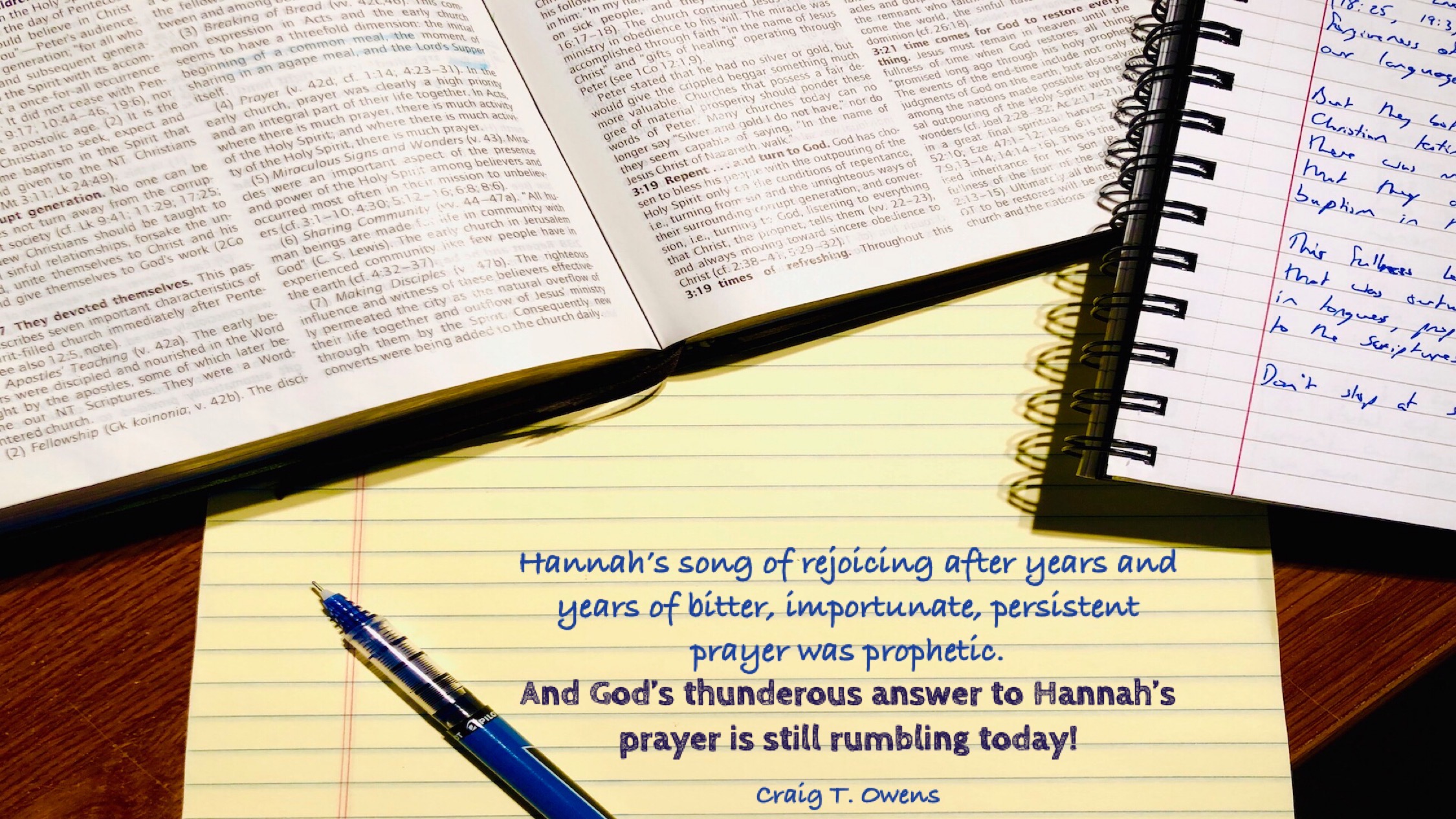
Hannah’s song of rejoicing after years and years of bitter, importunate, persistent prayer was prophetic—and God’s thunderous answer to Hannah’s prayer is still rumbling today! 

Moms, don’t stop praying! God wants to answer your prayer. The Holy Spirit will help you pray (Romans 8:26). God’s timing IS coming. He will thunder His thunder in answer to your persistent prayer! 

If you have missed any of the posts in our We Are: Pentecostal series, please click here to access them.

A Graphical Look At Ephesians 2

Ephesians 2:11-21

11 Therefore, remember that formerly you who are Gentiles by birth and called “uncircumcised” by those who call themselves “the circumcision” (which is done in the body by human hands)—12 remember that at that time you were separate from Christ, excluded from citizenship in Israel and foreigners to the covenants of the promise, without hope and without God in the world. 13 But now in Christ Jesus you who once were far away have been brought near by the blood of Christ.

14 For He Himself is our peace, who has made the two groups one and has destroyed the barrier, the dividing wall of hostility, 15 by setting aside in His flesh the law with its commands and regulations. His purpose was to create in Himself one new humanity out of the two, thus making peace, 16 and in one body to reconcile both of them to God through the Cross, by which He put to death their hostility. 17 He came and preached peace to you who were far away and peace to those who were near. 18 For through Him we both have access to the Father by one Spirit.

19 Consequently, you are no longer foreigners and strangers, but fellow citizens with God’s people and also members of His household, 20 built on the foundation of the apostles and prophets, with Christ Jesus Himself as the chief cornerstone.21 In Him the whole building is joined together and rises to become a holy temple in the Lord.


Bible Gateway’s Bible Audio App (review)

Typically, I post book reviews. So what’s a review of an audio app doing here? Quite simply, the Bible Gateway Bible Audio App is a wonderful companion piece to the Book of books—the Bible. 

I am a voracious reader, but my all-time, hands-down, nothing-else-is-even-close book is my Bible. I enjoy finding new ways to interact with God’s Word, so I am always on the lookout for study aids or companion pieces. This audio Bible meets this desire very nicely! 

I enjoy how streamlined this app is. Not a lot of options or distractions on the screen. Just pick your passage, select which version you would like to listen to, and tap the big play button. It’s that simple! If you would like to look at the screen while you listen, the verses appear one-by-one at the top of the screen as they are being read. Other options include playback speed, repeat options, and a sleep timer. 

I recently recommended this app to a friend of mine and he wrote, “I have two learning disabilities: dyslexia and ADD. I found the audio easy to listen to and appreciate the large print text. This app is now the first thing and last thing I do every day!” 

The free version of this app is more than adequate, but for a small fee, you can upgrade to add even more versions to your library, which you may then listen to even when you’re not on a WiFi. 

Bible Gateway is owned by Zondervan. Some of the other Zondervan Bible study tools I have reviewed in the past (and I am still using today) include:

I downloaded this audio app for free, and you can too by clicking here. 

In > On

When it comes to the Holy Spirit’s involvement in a Christian’s life: In > On.

Sometimes, instead of referring to the two major divisions of the Bible as Old Testament and New Testament, I prefer to use First Testament and Second Testament. This helps me remember that “Old” doesn’t mean outdated, and “New” doesn’t mean forgetting what came before it.

B.B. Warfield had a great analogy. He imagined the First Testament to be a perfectly-constructed mansion. Only the finest materials had been used, and the mansion had been constructed by the best craftsmen being overseen by the world’s premier Architect. The only problem was this mansion had no lights. With the appearing of Jesus in the Second Testament, finally the lights are turned on. Jesus reveals the beauty that was already there! 

In the First Testament, we frequently read that the Holy Spirit comes ON people, usually for leadership functions. We see this phrase with Moses and his co-leaders, several of the judges, Israel’s first two kings, and many of the prophets (see Numbers 11:25; Judges 3:10, 6:34, 11:29, 15:14; 1 Samuel 11:6, 16:13; 2 Kings 2:15). 

However, there is one leader in the First Testament about which we notice the Spirit came IN him. Twice Ezekiel says this (2:2, 3:24). This was hinting at a to-be-fulfilled promise in the Second Testament (36:25-27). 

The Holy Spirit being IN God’s people—which makes them God’s leaders—is described by Jesus in Acts 1:5. Many translations render this verse, “You will be baptized with the Holy Spirit.” But the NIV footnote and The Message both say “in the Holy Spirit.” Indeed, the Greek word means “by, with, or in.” But in context to being baptized (which means immersed, submerged, cleansed, overwhelmed), I think the best word is: baptized IN the Holy Spirit.  

Let me say it again: When it comes to the Holy Spirit’s involvement in a Christian’s life: In > On. 

“You hardly need to pray to have the Spirit poured out, for that has been done. What you need is a baptism of the Holy Spirit; to go down personally into that glorious flood that has been poured forth. Oh, to be immersed in the Holy Spirit and into fire—covered with His holy influence—plunged into the Godhead’s deepest sea and lost in His immensity! Here is our life and power.” —Charles Spurgeon 

Jesus wants all of His followers to be baptized IN the Holy Spirit. So He told us to keep on asking, keep on seeking, keep on knocking, keep on waiting for God’s promised infilling (Luke 11:9-13; Acts 1:4-8). 

Don’t stop at salvation—with just the Holy Spirit deposited in you—press on to be submerged deep into the Holy Spirit. 

If you missed the first couple of posts in this series, check out Where’s God Today? and The Holy Spirit Keeps Christians “Oscar Mike.” 

Coronavirus And Christ (book review)

Coronavirus And Christ is a quintessential example of how the Bible’s message is applicable to any situation we face. This book could have been written as “The Bubonic Plague And Christ” or “The Great War And Christ” or even “The Spanish Flu And Christ” and the message would have been the same. 

John Piper himself states, “What John Piper has to say on this topic isn’t nearly as important as what God has to say on this topic.” God’s Word is timeless, always applicable, and always authoritative. Coronavirus And Christ is steeped in biblical principles. 

The first half of this book reminds us of God’s sovereignty even in times that we may see as unexpected or chaotic. Pastor John writes, “The secret of ‘sorrowful, yet always rejoicing’ [2 Corinthians 6:10] is this: knowing that the same sovereignty that could stop the coronavirus, yet doesn’t, is the very sovereignty that sustains the soul in it. Indeed, more than sustains—sweetens. Sweetens with hope that God’s purposes are kind, even in death—for those who trust Him.” 

In the second half of this book, Pastor John elaborates on six possible answers to the question, “What is God doing through the coronavirus?” I am confident that you will be encouraged to see how God is in control of events that seem out of our hands. 

Coronavirus And Christ is a short book, but one that will arm you with faith-building insights that will help you throughout not just this time, but any others that will inevitably come along. Desiring God has made the ebook version of this book available for free (click here to access the link). 

Certainty In Uncertain Times

… Perhaps the Lord will act in our behalf … The God we serve is able to save us from the furnace…but even if God does not save us… (1 Samuel 14:6 and Daniel 3:17-18).

We often remember and even hold in high regard those leaders who rise up in times of crisis or uncertainty. But I think we might be shocked if we knew exactly how scared these seemingly unflappable leaders actually were! 

The Philistines really had the Israelites on the ropes. Israel’s army was slowing melting away, as soldiers one by one were deserting and heading home. The Philistines had captured all of the sword-makers, so that there were only two swords left—one for King Saul and one for his son Jonathan. 

And to make matters even more desperate, the Philistines occupied all the strategic high ground, so that even if the Israelites were going to attempt an attack, they would have to scale the cliffs in order to do so.

For Jonathan, this situation was unbearable. So he said to his armor-bearer (keep in mind that this armor-bearer didn’t really have any armor to bear!), “Let’s go attack the Philistines.” And then he adds this line that probably didn’t instill too much confidence in anyone, “Perhaps the Lord will give us victory.” 

Perhaps?!

Many years later, when the nation of Israel was in exile in Babylon, three Jewish young men found themselves in a literal hot spot. King Nebuchadnezzar had built an enormous statue of himself and commanded that everyone bow down and worship it. Shadrach, Meshach, and Abednego had been promoted into leadership positions in the capital city of Susa, so there was no hiding in the outreaches of the countryside for them. Their disobedience to the king’s command would make them stand out to everyone. The king had ordered that anyone who disobeyed his edict would be thrown into a fiery furnace. 

Shadrach, Meshach, and Abednego were God-fearing men and knew that they could not worship any other god except Yahweh. When the king confronted their disobedience, they also responded with words that didn’t sound very confident, “God can save us, but we’re not sure if He will save us. But even if He doesn’t, we’re not going to bend our knee.” 

If?!

“Perhaps” and “if” don’t sound like very confident words, do they? 

And yet these godly leaders were totally certain in their uncertain times. They weren’t certain of the outcome, but they were certain of God’s ability to bring the ultimate victory. Even in dark times of crisis, godly leaders are certain that God is greater than their uncertain circumstances. 

A mark of a godly leader is one who has a certain confidence in God even in an uncertain crisis.

Jonathan, and Shadrach, and Meshach, and Abednego would all tell us, “Whether God was going to give us victory in the moment of crisis or not, we will remain in God’s presence! We will not compromise. We will not give in to fear. We will not disobey God. We will continue to cling to Him—rescue or not—knowing that He will be glorified in whatever way He chooses to respond.” 

These young men teach an invaluable lesson for all of us even today: Trust God no matter how uncertain the times are. 

This is part 45 in my series on godly leadership. You can check out all of my posts in this series by clicking here.

Remember … Reorient … Rejoice … Repeat …

…remember… (Deuteronomy 16).

As Moses called the Israelites to keep three main feasts each year—Passover, Weeks (or Pentecost), and Tabernacles—he said the purpose was to remember.

Closely linked to all three of these feasts was another important word: celebrate (vv. 10, 13, 15). 

This remembering and rejoicing on a regular schedule was to keep God’s people aligned with God’s intimate and ongoing involvement in their lives. As a result, an attitude and an action should become just as ongoing in the lives of God’s people—

  • The attitude: joyful gratitude (vv. 11, 14)
  • The action: joyful giving (vv. 10, 15, 17)

These three set times were to be a time of reorientation. They were not supposed to be the only three times God’s people remembered what God had done, celebrated His goodness, let joy overflow their hearts, and let giving overflow to others. These reorientation times should excite us to live like this every single day! 

That’s why Paul wrote, “Rejoice in the Lord always. I will say it again: Rejoice!” (Philippians 4:4). 

What celebrations can you build into your life that will help you 

Remember … Reorient … Rejoice … Repeat …

Where’s God When I Feel Abandoned?

Have you ever felt abandoned by someone? 

You stood up for someone, but when you needed someone to stand up for you they disappeared Or you did what was right, but no one recognized you for it? Or you were the encourager, but when you needed encouragement no one was around for you? Or maybe even you obeyed God down to the very last detail, and yet it seemed God abandoned you when you needed Him most? 

Jesus knows what every single one of these scenarios feel like! He stood up for the downtrodden, but they screamed, “Crucify Him!” He poured His life into teaching and encouraging His friends, but they all ran when the heat was on, leaving Jesus all by Himself. He obeyed God down to the very last detail, and yet it seemed like God abandoned Him when He needed Him most. 

Have you ever felt abandoned by God? 

Jesus did. 

Hanging from the Cross He cried out, “My God, My God, why have You forsaken Me?!” 

I cannot help but notice two things about the state of mind Jesus was in heading to the horrific treatment He would face (see Matthew 26:31-44; 27:27-46). 

  1. Jesus knew all of this was going to happen to Him. Notice the phrases “for it is written” and “so that the Scriptures would be fulfilled” and “so that the writings of the prophets might be fulfilled. Even His cry from the Cross was a literal quotation of Old Testament Scripture (Psalm 22:1).
  2. God was silent. Even though Jesus called out to His Father three times in prayer, “My Father!” there was no heavenly response. 

Why would God remain silent during this trial? God didn’t need to speak to His Son during the trial because He had already spoken to Him before the trial! 

It’s the same in our trials—

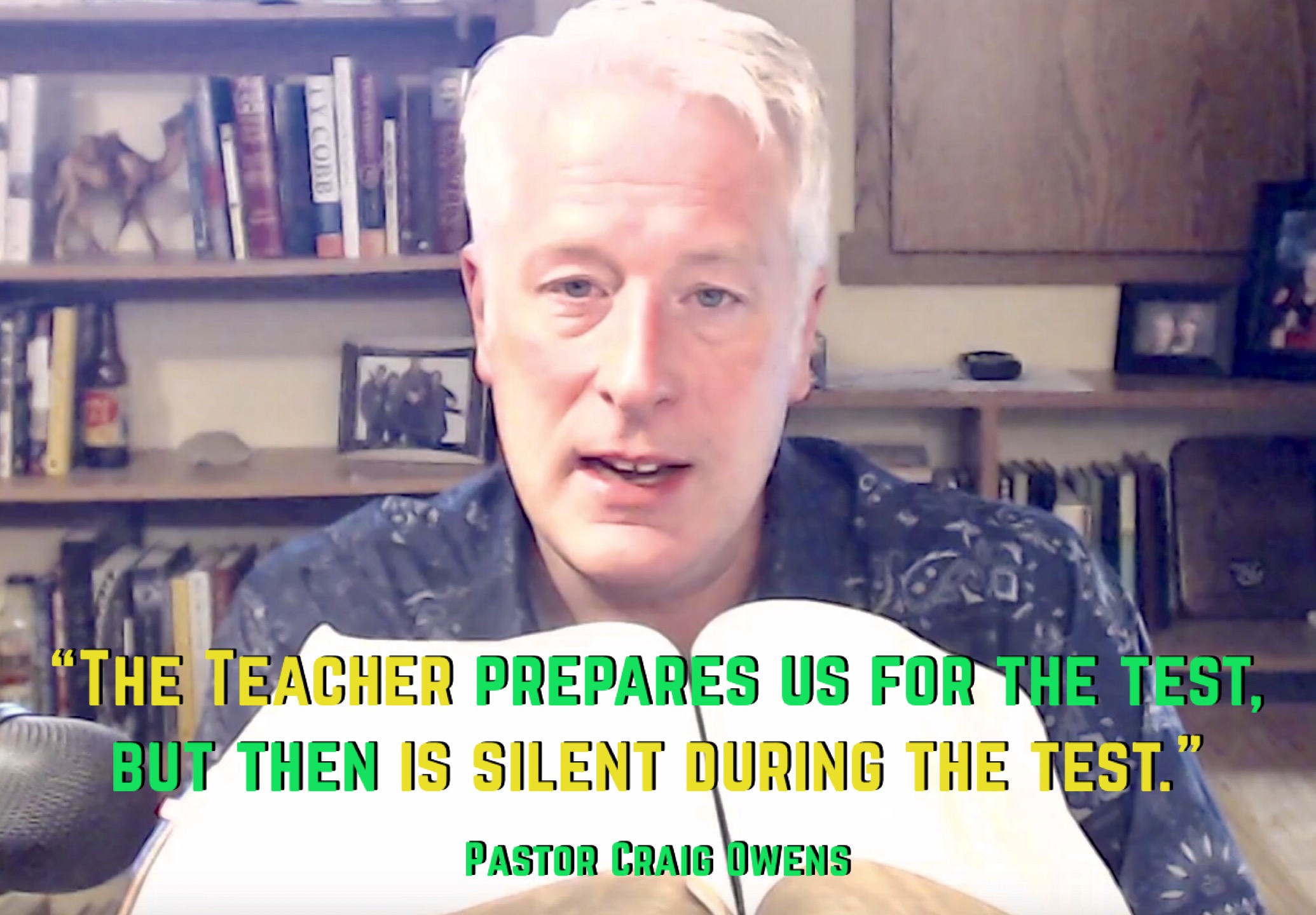
The Teacher prepares us for the test, but then is silent during the test. 

God’s silence is not His rejection or abandonment. Just as God provided for Jesus in His moment of trial, God has provided for us in our trials too—For no temptation (no trial regarded as enticing to sin), [no matter how it comes or where it leads] has overtaken you and laid hold on you that is not common to man [that is, no temptation or trial has come to you that is beyond human resistance and that is not adjusted and adapted and belonging to human experience, and such as man can bear]. But God is faithful [to His Word and to His compassionate nature], and He [can be trusted] not to let you be tempted and tried and assayed beyond your ability and strength of resistance and power to endure, but with the temptation He will [always] also provide the way out (the means of escape to a landing place), that you may be capable and strong and powerful to bear up under it patiently. (1 Corinthians 10:13 AMP) 

So let’s learn three invaluable lessons we can learn from Christ’s time of supreme suffering. 

1. Be honest in God’s presence 

Jesus didn’t hide His feelings, nor did He try to couch His vocabulary in “churchy” sounding words. God already knows what’s in your heart, so pour it out raw and honestly! Go to the Psalms and see raw emotions on full display in prayer. 

2. Lean all your weight on Jesus

Jesus prayed, “My Father!” and He cried out from the Cross, “My God!” His death on the Cross took away the barriers that kept up from coming into God’s presence (see 2 Corinthians 5:21). After His resurrection, Jesus sent this message to His friends: “Go instead to my brothers and tell them, ‘I am ascending to MY Father and YOUR Father, to MY God and YOUR God’” (John 20:17). 

3. Go to the Word of God

This is what Jesus did. In His moment of abandonment, He quoted Psalm 22 from the Cross. Jesus fulfilled ALL of the Scriptures, so now we can pray with greater assurance—For no matter how many promises God has made, they are “Yes” in Christ. And so through Him the “Amen” is spoken by us to the glory of God (2 Corinthians 1:20). 

God’s silence is NOT God’s abandonment. God’s silence is His invitation for us to be honest, to lean on Jesus, and to trust every promise in His Word. Every single promise that is Yes! and Amen! 

If you’ve missed any of the other messages in our Where’s God? series, please check out: 

And join me this Sunday as we take a look at how Jesus has conquered humanity’s ultimate enemy. 

The Artisan Collection Bible (book review)

How do “Bible” and “artisan” belong in the same title? They’re more connected than you may have previously thought, and The Artisan Collection Bible is the perfect place to explore this connection. 

If you were to ask someone what occupation Jesus had while He was on earth, it would be a safe bet that most people would say He was a carpenter. Indeed, the Greek word tekton is translated as “carpenter” for both Joseph and Jesus (see Matthew 13:54-56 and Mark 6:2-3). However, the consensus among Greek scholars today is that the word tekton is more likely to mean an artisan than just merely a wood-working carpenter. 

That makes sense, doesn’t it? After all, you would expect boundless creativity from the Creator. The One who fashioned our beautiful universe would certainly still be interested in expressing Himself in creative and beautiful ways. 

For myself, reading the Bible sparks in me a desire to be creative with words, and images, and colors, and designs. This is exactly what The Artisan Collection Bible gives you the space to do. And I literally mean “space.” 

One of the most attractive features to me about this Bible is the extra-wide margins along every single page. As you read God’s Word and the beauty of the Creator is illuminated in your heart and mind, you have readily available space to express your own creativity as worship to the Creator. Try crafting a poem, or turning the passage into a personal prayer, or drawing a picture that captures the vibrancy of God’s love letter written to you. The design of this Bible helps you to do more than just read the Word of God, it invites you to interact with the God of the Word. 

The Artisan Collection Bible would make an excellent gift for your creative friend or loved one. 

I am a Zondervan book reviewer and a member of the Bible Gateway Blogger Grid. As a book reviewer I received a free copy of this book from the book publisher. I am not compensated for my review. Although I may have received the book free of charge, I am under no obligation to write a favorable review. I am free to express my honest opinion about the book’s content. If I say it’s a good book, it’s because I think it’s a good book! 

Refined By The Fire

Where is God in our trials? When we call, Jesus runs to our cry. He is able to help us because He knows exactly what our cries sound like. Aren’t you glad He does?! 

While we are in these difficult times, you might find yourself asking a question I have asked, “Okay, God, I believe You are doing something, but what exactly are You doing?” 

I can’t tell you specifically what God is doing in your life, because your story is unique and special. But I can tell you that during the hard, painful chapters of our lives, God is accomplishing at least five things in all of us.

  1. God is opening our eyes to new paradigms

We will learn lessons in these fiery trials that we couldn’t possibly learn any other way. 

  1. God is building empathy in us which we didn’t have before

One dictionary defines empathy as “the power of understanding and imaginatively entering into another person’s feelings.” It’s only because of our trials that we no longer have to imagine what someone else is feeling, but instead we know exactly what they’re feeling and how we can help. 

  1. God is growing our patience 

It’s been said that patience is the “mother of all other virtues.” Paul said that “these troubles produce patience” (Romans 5:3). As God grows your patience, He will also help you to grow all of the other Christlike virtues. 

  1. God is refining His character in us 

Paul went on to add that not only does trouble produce patience, but “patience produces character” (Romans 5:4). During the times of difficulty and uncertainty, we become more aware of deficiencies in our character. 

  1. God is building in us an unshakable hope in His future grace 

Hope is not wishful thinking; it’s well-founded believing! 

I want to circle back to that word refining because I think that best sums up what God is doing in our painful times. Romans 8 tells us—The Spirit Himself thus testifies together with our own spirit, assuring us that we are children of God. And if we are His children, then we are His heirs also: heirs of God and fellow heirs with Christ—sharing His inheritance with Him; only we must share His suffering if we are to share His glory. But what of that? For I consider that the sufferings of this present time—this present life—are not worth being compared with the glory that is about to be revealed to us and in us and for us and conferred on us! (Romans 8:15-18) 

So where’s God in this time of fire? He is overseeing our trial as a Perfect Refiner. Do you know how the silversmith knows he has purified the impurities from the silver ore? The silver is pure when he can see his own reflection in the silver! 

In the heat of your trial, God is close to you. He knows the perfect temperature and the precise time that it will take to allow His face to be seen in you! 

Sometimes you will see what God is doing through your furnace time, sometimes you won’t. But don’t ever bail out! God IS working! He is giving you a new perspective, a deeper empathy, more patience, an unshakable hope, and most of all—He is removing the impurities that will allow His face to be seen more clearly in you! 

Join me this Sunday as we continue to learn where God is in our darkest times. And if you didn’t catch the previous messages in this series, please check out The God That Runs To You and How Long Will This Last?