Good Grief From A Friend

Listen to the podcast of this post by clicking on the player below, and you can also subscribe on AppleSpotify, or Audible. 

After God created Adam, He said, “It’s not good for you to be alone.” That’s just as true today: God didn’t intend for us to journey on our own, but He gives us companions along the way. 

Last week we saw that God has to sometimes cause us grief to get our attention when we are straying from His path. He sometimes puts people in our lives to do the same thing. 

There’s a reason God puts the people in our lives that He does. We are called to speak the truth in love (Ephesians 4:15). But that sometimes means people will get upset with us (Galatians 4:16). “Real friends hurt each other. … Truth is the primary way faithful friends should wound each other—it is the help that hurts.” —Dick Brogden 

(Check out all of the verses in this post by clicking here.) 

The Corinthians thought they were super-spiritual, but Paul had to call them out on their foolishness (1 Corinthians 3:3; 5:1-2). Before Pauls’ letter, the Corinthians seemed happy. His letter caused them grief, but it was good grief that led to repentance and true joy (2 Corinthians 7:8-10). 

To keep silent when a brother or sister is straying is not God-honoring. We are not to be the sin police, but we are to address sinful issues (James 5:19-20). 

As King David flirted with the idea of how he could get something that he thought would make him happy, an anonymous attendant tried to get his attention. David ignored this and then tried to sweep it under the rug. In fact, he thought he got away with his sin (2 Samuel 11:1–12:7). 

But God sent Nathan to speak a hard word to David. We don’t know when Psalm 141 was written, but we know that David did write it. Perhaps it was penned at the time of Nathan’s loving confrontation. He said, “Let a righteous man strike me—that is a kindness; let him rebuke me—that is oil on my head” (Psalm 141:5). 

We do know that David wrote Psalm 51 after Nathan’s loving hard word, and in this prayer we see David’s confession, repentance, and a request for God’s joy to replace David’s grief. 

So how do New Testament-era Christians use good grief to help fellow saints? 

  1. Examine yourself first (Matthew 7:1-5). Make sure you aren’t plagued by the same sin you have noticed in a brother or sister. 
  2. Cry before you confront, just as the prophet Samuel did before he had to deliver a hard word to King Saul (1 Samuel 15:10-11). 
  3. Confront in love with the goal of restoration, but make sure you are confronting someone who know you love them and who will receive your loving word  (Proverbs 27:5; 9:8). 
  4. Pray that their grief will be turned to joy (Luke 22:31-32; Galatians 6:1; Psalm 51:12). 

Friendships with fellow saints are precious and they are vital. We need iron to sharpen iron (Proverbs 27:17) so that we will all stand before the throne together for eternity. 

This is the final message in our series Grief Into Joy. If you missed any of the messages, you can check them all out by clicking here. 

►► Would you please prayerfully consider supporting this ministry? My Patreon supporters get behind-the-scenes access to exclusive materials. ◀︎◀︎
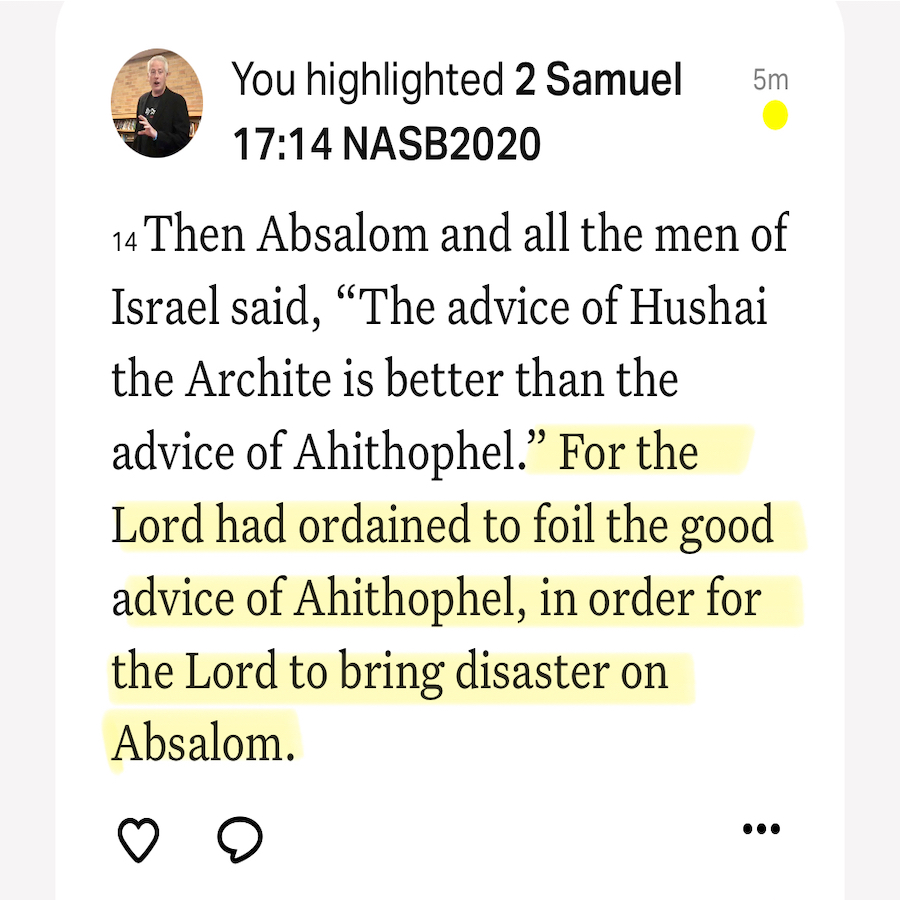
The Bias Of Human Agendas

Absalom said to Ahithophel, “Give us your advice. What should we do?” … Ahithophel said to Absalom, “I would choose twelve thousand men and set out tonight in pursuit of David. I would attack him while he is weary and weak. I would strike him with terror, and then all the people with him will flee. I would strike down only the king and bring all the people back to you….” This plan seemed good to Absalom and to all the elders of Israel. 

But Absalom said, “Summon also Hushai the Arkite, so we can hear what he has to say as well.” When Hushai came to him, Absalom said, “Ahithophel has given this advice. Should we do what he says? If not, give us your opinion.”

Hushai replied to Absalom, “The advice Ahithophel has given is not good this time….” 

Absalom and all the men of Israel said, “The advice of Hushai the Arkite is better than that of Ahithophel.” For the Lord had determined to frustrate the good advice of Ahithophel in order to bring disaster on Absalom. (2 Samuel 16:20; 17:1-7, 14). 

Absalom (unlike his father) didn’t consult God, but consulted men. 

Ahithophel had a personal agenda. All he wanted to do is get revenge on David for what he had done to Uriah and Bathsheba. Notice Ahtihophel’s wording: “I will kill only the king” (v. 2). 

What was Ahithophel’s beef with David? Uriah—the man whose wife David stole, the man whom David had killed to cover up his affair—was Ahithophel’s son (2 Samuel 23:34, 11:3)! 

Hushai, the the other man who gave Absalom counsel, also had an agenda. Hushai is repeatedly given one description: Friend of David (2 Samuel 15:37, 16:16-17; 1 Chronicles 27:33). So Hushai’s sole focus is saving his friend’s life. 

Humans always give their advice with their own bias or agenda. 

It’s okay to talk to men and get their counsel, but always allow God to confirm or reject their advice.

The Promise Of The King

Listen to the podcast of this post by clicking on the player below, and you can also subscribe on AppleSpotify, or Audible.

My podcast partner Greg and I just recorded an episode of our leadership podcast about Christmas traditions. I think there more traditions associated with this time of year than with any other event on our calendars. Traditions keep us connected to our roots, but they also help us feel like we can be in control of things. 

There has been a tradition in countries with monarchies that whenever a king died, the people would say something like, “The king is dead. Long live the king!” They would say this because the next king ascended to the throne immediately after his predecessor died. Except when a nation had been defeated, the traditional cry of, “The king is dead” was unanswered by, “Long live the king!” 

It appears at this moment that a new tradition has to be started—one where we take leadership over our own fates. 

The apostle Peter noted that people awaiting the Second Coming of Jesus would question if that event was ever going to happen. And the prophet Malachi closed the Old Testament with people saying much the same thing: “There doesn’t seem to be any advantage to following God’s laws, so maybe we should just do things our own way” (2 Peter 3:3-4; Malachi 3:13-15).

But then we turn the page to the dawn of the New Testament, and Matthew writes his Gospel about the First Advent of Jesus. He wants to show us that although the line of earthly kings in Israel may have been broken, the promised King of kings had now come to earth. 

I’m intrigued by the exceptions Matthew lists in his opening genealogy to illustrate this truth. First, as you might expect, the phrase “the father of” appears 39 times. This tells us a biological fact of life. These men didn’t know if they had fathered a son or a daughter, what their child’s contribution to the world might be, or even if their child would live faithfully to God. 

Matthew opens his genealogy by saying “the son of” twice. First, Matthew lists Jesus as the son of David—the king to whom God gave a very special promise of an eternal King coming from David’s family line. Then Matthew traces the genealogy back further to say “the son of Abraham”—the one through whom God said He would bless all nations (2 Samuel 7:11-16; Genesis 12:1-3). 

And what about the exceptional women Matthew records in this male-dominated genealogy? We have Tamar, Judah’s daughter-in-law, who tricked him into fathering a child by her; Rahab, a Canaanite prostitute who put her faith in God; Ruth, a Moabitess who left her homeland because she trusted God; Bathsheba, an adulteress who became David’s wife; and then Mary, the mother of Jesus, who was called “highly favored” of God (Luke 1:28). 

The phrase “son of” appears one more time when the angel calls Joseph by this title (Matthew 1:20). Jospeh is also called “the husband of Mary” (Matthew 1:16). 

Whereas Abraham and David were rewarded for their faithfulness to God and were told of future blessings, Joseph’s act was different. Joseph had a choice. He was told that the Child in Mary’s womb would be the Messiah. Now Jospeh had to decide: Would he choose to believe this? Would he choose to bear the shame and reproach to accept his role as father? 

We have the a similar choice today: Will we choose to believe that God has announced His plan and that He is fulfilling His plan? 

Here’s the simple truth. It appears as two statements, but it is really the same thought—

The Advent of Jesus has come. The Advent of Jesus will come. 

The First Advent of Jesus should build our anticipation for the Second Advent. His First Advent should be proof that God keeps His promise. 

Jesus told us that believing God’s promise would bring us into God’s family. Jesus said, “For My Father’s will is that everyone who looks to the Son and believes in Him shall have eternal life, and I will raise them up at the last day” (John 6:40). 

The apostle Paul also assures us, “So in Christ Jesus you are all children of God through faith” (Galatians 3:26). 

Let’s not blindly follow the traditions of previous generations, but let us chose for ourselves to believe in God’s promised Messiah, to trust that He alone can give us eternal life, and then let us live in both celebration of His First Advent and expectation of His Second Advent. 

If you’ve missed any of the messages in our Christmas series called Long Live The King Of Kings, you can find them all by clicking here. 

►► Would you please prayerfully consider supporting this ministry? My Patreon supporters get behind-the-scenes access to exclusive materials. ◀︎◀︎

Beware Of “I’m Owed This”

Listen to the podcast of this post by clicking on the player below, and you can also subscribe on AppleSpotify, or Audible. 

On Mother’s Day, I shared a word of encouragement from a woman who interacted with the prophet Elisha. As I was studying for this message, I paused to consider an example—actually a warning—that comes from Elisha’s servant Gehazi. 

Because of the miraculous things that God had done through Elisha, word began to spread about God’s power that was on display through this godly prophet. In fact, word even spread to other countries, including the land of Aram where was a highly decorated military commander named Naaman lived. This revered leader was afflicted by leprosy. The king of Aram sent Naaman to Elisha to be cured of this disease (see 2 Kings 5). 

When Naaman came to Elisha, he was given instructions to bathe himself seven times in the Jordan River. Initially, Naaman balked at this, but eventually, he humbled himself in obedience and was miraculously healed of his leprosy! 

Naaman had come to Israel and Elisha with the intention of buying a miracle (just take a look at the treasures that he brought with him). Elisha would not accept money or gifts from Naaman. Not that there’s anything wrong with a prophet receiving gifts, but not when the intention of the giver is to give a bribe. 

This is where Gehazi makes a fatal mistake. Gehazi has a conversation with himself (notice the phrase “he said to himself”) that he should have had with Elisha. He determined that he and Elisha were owed something for their ministry work. Gehazi then compounded this unhealthy conversation by telling one lie after another lie to justify the conclusion he had reached. 

Elisha knew that God keeps track, that God keeps perfect records, that God will reward far better than any man ever could. He said, “Is this the time to take money or to accept clothes?” No! We need to let God determine the timing and the gift. 

As a result, the leprosy that had left Naaman now attacked Gehazi. In reality, it was a leprosy of his heart that merely appeared on his skin. Gehazi was then dismissed from his ministry position with Elisha. 

Sadly, I’ve witnessed many ministry leaders who have derailed their leadership with an “I deserve this” attitude. Thinking “I’m owed this” took their eyes off God and put them on the rewards they thought they should have received. How sad this is! 

We all need to be on guard. The “I’m owed this” lie didn’t just derail Gehazi, it’s also what turned Lucifer into satan. Is it any wonder, then, that satan uses this lying attitude as an effective weapon—from Adam and Eve, to King David, to Gehazi, to Ananias and Sapphira, all the way down to us. 

Our constant prayer should be, “Holy Spirit, guard my heart against the leprosy of entitlement. Help me keep the ‘I’m owed this’ attitude far, far away from my heart’s door.” 

►► Would you please prayerfully consider supporting this ministry? My Patreon supporters get behind-the-scenes access to exclusive materials. ◀︎◀︎

God Delights In Me

It’s been said that the bookends of success are starting well and finishing well. I believe that! 

David started well when he lifted up a prayer of thankfulness to God when he became king over the united nation of Israel. Prayer at the the beginning puts us on a path toward success. 

Have you ever begun to assemble a child’s toy or a piece of furniture, gotten completely stumped, and only then read the instruction manual? We’ve all been there! There are many things in life that we start on our own and then hit our knees in prayer only after we’ve exhausted all of our human resources. Fortunately, after we pray and God answers, we often end up finishing well with a prayer of praise and thanksgiving. The question is: what do we do when we again get ready to start something else? Do we pause to start well with prayer, or do we dive in on our own again? 

I think one of the biggest reasons we don’t go to prayer quickly is because we feel unworthy to go into the presence of a holy, righteous God. 

One commentator said about Psalm 18 that David probably prayed this “before he committed his terrible sin” with Bathsheba and Uriah. That may be, but with very few minor changes, David prayed this exact same prayer (2 Samuel 22) at the very end of his reign. His reign as king was bookended with the same prayer. 

Between the bookend prayers of Psalm 18 and 2 Samuel 22, David prayed another prayer—this one was after he had sinned against God, Bathsheba, and Uriah. David truly believed that God forgave that sin and wiped the slate clean, so much so that he noted this great blessing on his life: “He brought me out into a spacious place; He rescued me because He delighted in me. 

He rescued me because He delighted in me?! Yes! 

David knew that God had told us that He delights in those who obey Him. The example of God’s delight was seen in Jesus. Because Jesus paid the price for the forgiveness of my sins, I can be completely cleansed. Then Jesus comes in me, and takes me into Him, and takes both of us into the Father. So now when our Heavenly Father looks at a forgiven sinner, He sees only the righteousness of Jesus—something He utterly delights to see! (Check out all of the biblical passages I’m referencing by clicking here.)  

David said his sin had been washed “whiter than snow” (Psalm 51:7), So now look at what he could claim—

The Lord has dealt with me according to my righteousness; according to the cleanness of my hands He has rewarded me. For I have kept the ways of the Lord; I am not guilty of turning from my God. All His laws are before me; I have not turned away from His decrees. I have been blameless before Him and have kept myself from sin. The Lord has rewarded me according to my righteousness, according to my cleanness in His sight” (2 Samuel 22:21-25). 

…according to my cleanness in His sight. 

In GOD’S sight! The devil wants to accuse me. He wants my sight to dominate. The devil doesn’t want me to see myself as God sees me. But I declare it out loud: I am clean IN HIS SIGHT! 

This cleanness allows me full, bold, confident access to Almighty God! I can take everything to God in prayer because I am clean in His sight! 

If you would like to read more of the posts in our prayer series called Be A First Responder, please click here. 

The Blessing Of Quiet Humility

“When you’re full of yourself, God can’t fill you. But when you empty yourself, God has a useful vessel. Your Bible overflows with examples of those who did.

“In his gospel, Matthew mentions his own name only twice. Both times he calls himself a tax collector. In his list of apostles, he assigns himself the eighth spot.

John doesn’t even mention his name in his gospel. The twenty appearances of ‘John’ all refer to the Baptist. John the apostle simply calls himself ‘the other disciple’ or the ‘disciple whom Jesus loved.’

Luke wrote two of the most important books in the Bible but never once penned his own name.

Paul, the Bible’s most prolific author, referred to himself as ‘a fool’ (2 Corinthians 12:11).

King David wrote no psalm celebrating his victory over Goliath. But he wrote a public poem of penitence confessing his sin with Bathsheba (see Psalm 51).

“And then there is Joseph. The quiet father of Jesus. Rather than make a name for himself, he made a home for Christ. And because he did, a great reward came his way. ‘He called His name Jesus’ (Matthew 1:25).” —Max Lucado, in You!

Check out my book review of You! by clicking here, and you can read some other quotes from this book here.

The Wonder Of God’s Forgiveness

King David was intimately confident that God would hear his prayers. No matter what—even if David had sinned.

The prophet Nathan confronted David after David had committed adultery with another man’s wife, gotten her pregnant, and then had her husband killed to try to cover up their affair. David assumed he had gotten away with it, but God sent Nathan to tell David that He knew all about it.

David immediately went to prayer.

His prayer is instructive for us when we sin too. David’s appeal to God for forgiveness is based solely on God’s ability and willingness to forgive, not on any merits David brings.

In this prayer, David presents a tally sheet. On his side of the ledger, he lists my transgressions, my iniquity, my sin, my bloodguilt. He sums it up with, “Against You, You only, have I sinned and done what is evil in Your sight.

David also tallies up God’s side of the ledger: You are right, You are just, You are righteous.

We might be tricked into thinking that a Perfect Being like this wants nothing to do with a sinful creature like you and me. But this is completely wrong! David appeals to God’s unfailing love, and Your great compassion. He lists God’s desire to cleanse, wash, blot out sins, restore, and release from blood-guiltiness.

David said, “I have sinned against the Lord.” And immediately Nathan responded, “The Lord has taken away your sin.”

Sin is all on me! Restoration is all on God!

With this in mind, we learn that the mark of a maturing Christian is not one who never sins, but one who…

  1. …feels a broken heart because of their sin (see Psalm 51:10)
  2. …confesses my sin
  3. …confidently asks for His forgiveness
  4. …helps others who have sinned (v. 13)
  5. …continues to abide in Jesus (vv. 10-12)

God is quick to forgive. Are we equally as quick to ask for His forgiveness?

You can study more of the lessons from the prayers of David:

Five Women; One Amazing Story!

For some of you, it’s hard to put the word “happy” in front of Mother’s Day.

One definition of happy is “favored by fortune; lucky.” In other words, we’re happy IF things happen to be going our way. But we don’t know how things are going to turn out?

In the last Super Bowl, the New England Patriots were down by 25 points early in the 3rd quarter. It didn’t appear that things were going the Patriots’ way … except they won!

So don’t judge “happy” or “not happy” by how things are going in the middle of the story! 

To God, all of History is His Story. He knows every move, every hurt, every fumble, every betrayal, every noble deed, every evil deed … nothing escapes His notice. And it all fits into His Story—We are assured and know that God being a partner in their labor ALL THINGS work together and are fitting into a plan for good… (Romans 8:28).

Check out the stories of these five women—

Tamar had to pretend to be a prostitute in order to get her father-in-law to followthrough on his commitment. As a result, she became pregnant by him and was almost burned at the stake.

Rahab didn’t pretend to be a prostitute; she was a prostitute. She lived in an important city that was about to be defeated by the Israelites. Instead of trying to make things easier on herself, she trusted God and put herself in a very dangerous position.

Ruth was a non-Israelite married to an Israelite man. But when her husband, her brother-in-law, and her father-in-law all died, she took a huge risk in staying with her mother-in-law. She could have moved in with her family in a country she knew, but she went where she was an alien, a widow, and dirt poor.

Bathsheba was married to Uriah, who was a member of the king’s inner circle. But the king took advantage of her when Uriah was away at war, impregnated her, killed her husband, and then married her. Their son from that union died shortly after being born, but Bathsheba trusted God to make something good of her tragedy.

Mary was engaged to be married when she was found to be pregnant. Society could have shunned her, her fiancé could have had her killed for her unfaithfulness, but she trusted God to keep His word.

These five mothers are the ONLY women mentioned in the genealogy of Jesus (Matthew 1:1-6, 16)

God used all of these women. Despite the way they were treated or mistreated; despite their own mistakes; despite the injustices committed against them. God used all of them as irreplaceable parts of His Story.

To God, all of History is His Story! He’s doing things through your life that you can’t possibly imagine. Trust Him—if you do, your name will also be recorded in the best “His Story” ever recorded! 

Whenever you don’t know what’s going on, lean into Him, cry out to Him. But then say with Mary, “I am the Lord’s servant. May it be to me as you have said.” And what does God say? “I am working ALL THINGS together to tell My Story through your life!”

Don’t Get Left Behind

This post is especially for the men (but, ladies, feel free to read along too).

No, I’m not talking here about the series of Left Behind books that tell a story about people who may miss out on the rapture of the Church. I’m talking about you leaving the protection of your friends and being exposed to a serious defeat.

Most times when I am counseling men who have given in to a temptation, or those who are battling the same old perplexing problems, I find a common theme. It’s not something new—it’s been around a long, long time.

Take this for example:

In the spring of the year, when kings normally go out to war, David sent Joab and the Israelite army to fight the Ammonites.

You probably know the rest of this sad story: David cannot contain his lust for Bathsheba (another man’s wife) so he seduces her, sleeps with her, gets her pregnant, and then kills her husband to try to cover it up. But look where it all started: David was alone. When he normally would have been with his brothers-in-arms, he stayed behind.

I’m a big believer in accountability, so I’ve written before about a brother who makes sure I stay on the straight-and-narrow. What about you? Are you trying to stay pure all by yourself? Are you battling temptations on your own?

Two people are better off than one, for they can help each other succeed. If one person falls, the other can reach out and help. But someone who falls alone is in real trouble. Likewise, two people lying close together can keep each other warm. But how can one be warm alone? A person standing alone can be attacked and defeated, but two can stand back-to-back and conquer. (Ecclesiastes 4:9-12)

Don’t try to go into battle all by yourself. If David—a man after God’s own heart—couldn’t win on his own, what makes you think you can?

Loyalty

Listen to the podcast of this post by clicking on the player below, and you can also subscribe on AppleSpotify, or Audible.

How would you define loyalty? All of the dictionary definitions have to do with faithfulness. It’s almost implied that there is a blindness (at worst), or a dogged persistence (at best), to remain loyal to a person or to an idea. The thinking goes, “If I’m loyal to someone, like it or not, I become their Yes-man.”

But I think…

Loyalty is not telling people what they want to hear, but what they need to hear.

For an example, take the prophet Nathan in the Bible. We don’t know how old he is when he steps on the scene, or even where he came from. There isn’t a clue as to his tribal ancestry or even his father’s name.

King David wanted to build a temple for the ark of the covenant of the Lord, and he asked Nathan about this. Nathan immediately said, “Yes!” (kinda reinforces that idea of loyalty = Yes-man, doesn’t it?) But wait! That night, God speaks to Nathan and says, “Tell David he’s not the one to build the temple for Me.” So Nathan returns to David and loyally tells him no.

Later on, David steals another man’s wife and contrives a plan to have that man murdered on the battlefield. David thinks he’s gotten away with it until Nathan, the loyal friend, shows up to confront David with his sin. Nathan didn’t want to see David fail, but he wanted to give him a chance to confess and repent.

Near the end of David’s life, one of David’s sons, Adonijah, wanted to take the throne for himself. Many of the officials in David’s palace jumped on the bandwagon, but loyal Nathan did not. In fact, Nathan even got word to the King about Adonijah’s plans. As a result, David asked Nathan to anoint his son Solomon as king.

During David’s life, Nathan wrote David’s biography. If Nathan was just a mindless Yes-man, he could have easily left out the messy parts of David’s life. But the loyal friend wanted to show future readers that we all mess up, but God forgives and restores us when we repent.

Nathan’s name means the gift God gave or a giver. Both meanings fit this loyal man.

David was so blessed by Nathan’s loyalty that he named one of his own sons after the prophet.

Loyal friends give their friends the gift of life. They don’t let friends go down a destructive path. They don’t join with others when they attack. They remain constant, always-there, friends.

What a blessing to be called a loyal friend! And what an even greater blessing to have “Nathans” in our own lives!

►► Would you please prayerfully consider supporting this ministry? My Patreon supporters get behind-the-scenes access to exclusive materials. ◀︎◀︎