Listen to the podcast of this post by clicking on the player below, and you can also subscribe on Apple, Spotify, or Audible.
The apostle Paul shows us how simply sharing the good news about Jesus opened a door for him to speak to a very influential group in Athens. I experienced something similar that I think will be helpful for you to hear.
The Scripture I reference in this video is Acts 17:16-34.
You can watch the full sermon this clip came from by clicking here.
Listen to the podcast of this post by clicking on the player below, and you can also subscribe on Apple, Spotify, or Audible.
Jesus has sent us on-mission (which means we are missionaries) to every street. We don’t go in our power, but we are empowered by the baptism of the Holy Spirit (see Luke 24:46-49).
Jesus said our missionary work would take us to every street, starting with Jerusalem—which we have called Main Street. These are people very similar to us. Then our mission will expand into all Judea (Acts 1:8). These are people that have less in common with us. Last week we talked about taking the message of Jesus to Lombard Street: Talking with people who have knowledge of the Bible, but tend to twist and turn with the popular traditions of the day.
Remember that our mission is to be witnesses—share the Scripture and our personal story. It’s not our responsibility to try to open people’s minds so they can repent, but the Holy Spirit opens minds and calls people to repentance.
The apostle Paul reminded us that, “The god of this age has blinded the minds of unbelievers” (2 Corinthians 4:4). The Holy Spirit uses our witness as the catalyst to open minds. This clash of light and darkness creates acceptance and anger. Notice these contrasts in one short segment of Paul and Silas’ missionary journey in Acts 16:13-24 and 17:1-13:
Acceptance—Acts 16:13-15
Anger—16:16-24
Acceptance—17:1-4
Anger—17:5-6
Acceptance—17:10-12
Anger—17:13
The opposition in Philippi brought Paul and Silas to Thessalonica, and the opposition in Thessalonica brought them to Athens.
Athens was named for the goddess Athena, and it has been called “the university city of the Roman world.” Philo (a Jewish historian) called the Athenians “keenest in intellect.” It was the center of art, literature, and philosophy
I’m going to call Athens “Rodeo Drive.”
Rodeo Drive is called “the intersection of luxury, fashion and entertainment.” Kay Monica Rose, the Rodeo Drive Committee President, said, “There is nothing in the world comparable to Rodeo Drive. The legendary street’s magic continues thanks to the exemplary craftsmanship from today’s greatest fashion houses and brands, the architect-designed boutique spaces, the spectacular window displays, artist collaborations and pop ups, and our unrivaled customer service. At the heart of my vision for Rodeo Drive is the preservation and advancement of an unmatched legacy.”
A marketing professor once told me, “When advertising, you have to remember that everyone has radio station WIFM playing in their head—What’s in it for me?” The people on Rodeo Drive are self-focused and self-assured.
How do we take the message of Jesus to those Judeans on Rodeo Drive? Let’s learn from Paul’s time there (Acts 17:16-34).
Control your anger. Even though Paul was “greatly distressed,” he didn’t let his anger control him, but he kept his distress under control.
Use measured words. Paul “reasoned” with the people there, which means he engaged in meaningful dialogue with them.
Don’t argue. Some to the Athenians “disputed with him [Paul]” but he didn’t dispute back. Instead he was preaching the good news about Jesus and the resurrection.
Start where they are. Paul noted that the Athenians were “very religious.”He doesn’t condone their idolatry, but he simply uses it as a conversation starter.
Move to the eternal issue. He then proceeds to point them to Jesus as the “unknown god” that they are worshiping, bringing everything back to His resurrection from the dead.
Be ready for acceptance and anger. As in Philippi and Thessalonica, there were some who accepted the Gospel message and some who got angry when they heard it.
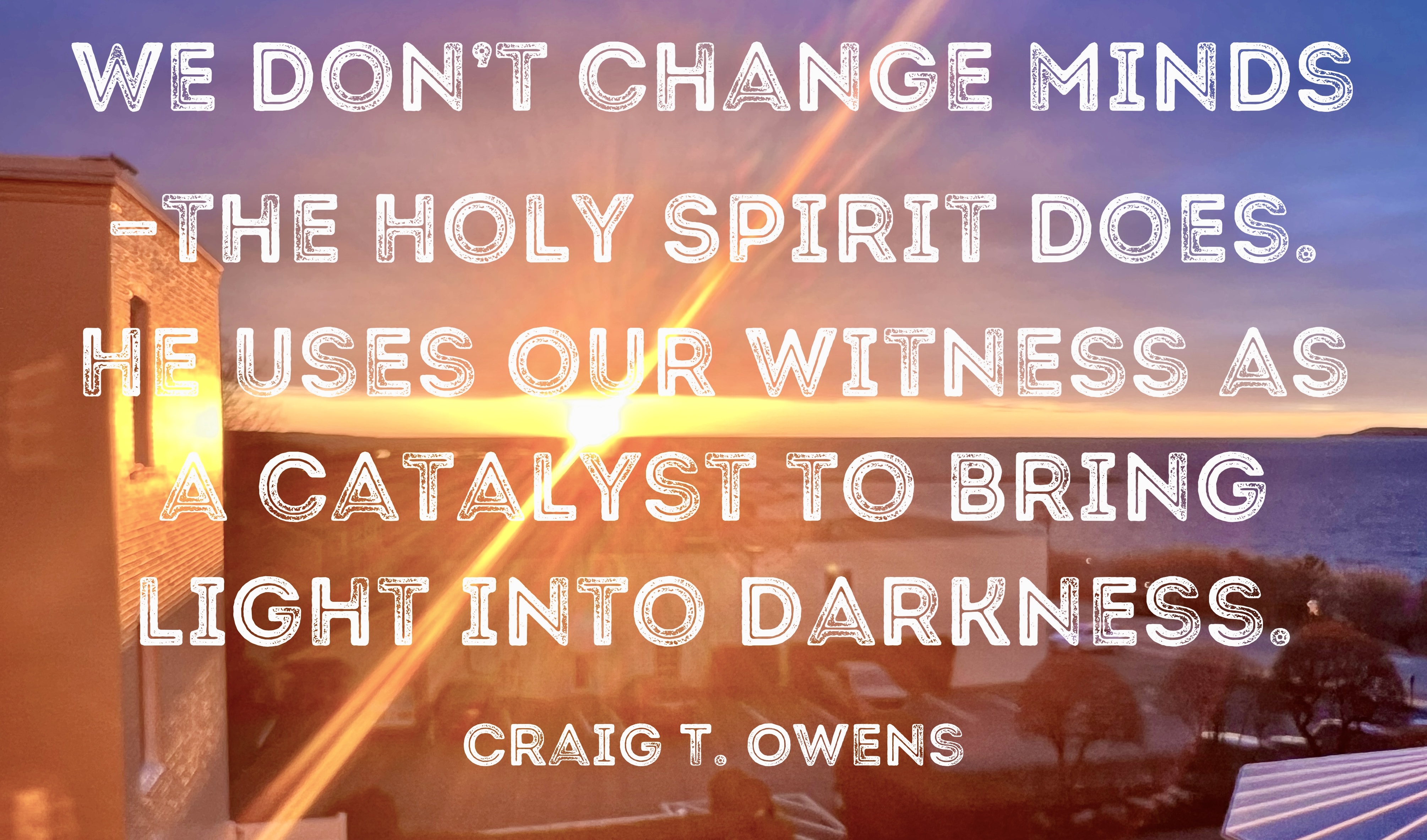
Remember: We don’t change minds—the Holy Spirit does by using our words as a catalyst.
Axis reported this in their weekly Cultural Translator newsletter. “Gallup polling data has found a huge spike in the percentage of Americans who say they get less sleep than they need. Survey results also indicate an increase in Americans’ daily stress. Why it’s news you can use: This data indicates that when you interact with anyone—in a store, on the road, at work, or in church—there’s a decent chance that particular human is feeling both exhausted and stressed out. The odds of this stress/exhaustion matrix are even higher if you are conversing with a young woman aged 18 to 29. In 2001, 42% of young women in that bracket said they get enough sleep, but that number has dropped to 27%. Younger women are also the most likely to say they experience daily stress. Stress and sleep have a symbiotic relationship, and parents should understand how both factors play a role in teens’ mental health.” I have written quite a few posts about getting enough sleep, and about taking some time for self-care.
“The world and its culture will not improve unless we play an active role in trying to improve it. Beginning with ourselves, we must make sure the culture we choose honors God and spreads His grace to the people around us. From there we must become informed about the state of culture, especially that which is most potent in conveying ideas and establishing practices—law, education, entertainment, social media, and pop culture in all its forms. That’s not to say we have to participate in all these; but at the least, we need to understand the times and how they shape and are shaped by various forms of culture so that we can know what we ought to do in pursuing a culture of love (1 Chronicles 12:32).” —T.M. Moore
“A man gives little if he gives much with a frown; he gives much if he gives little with a smile.” —Talmud, Ketubot
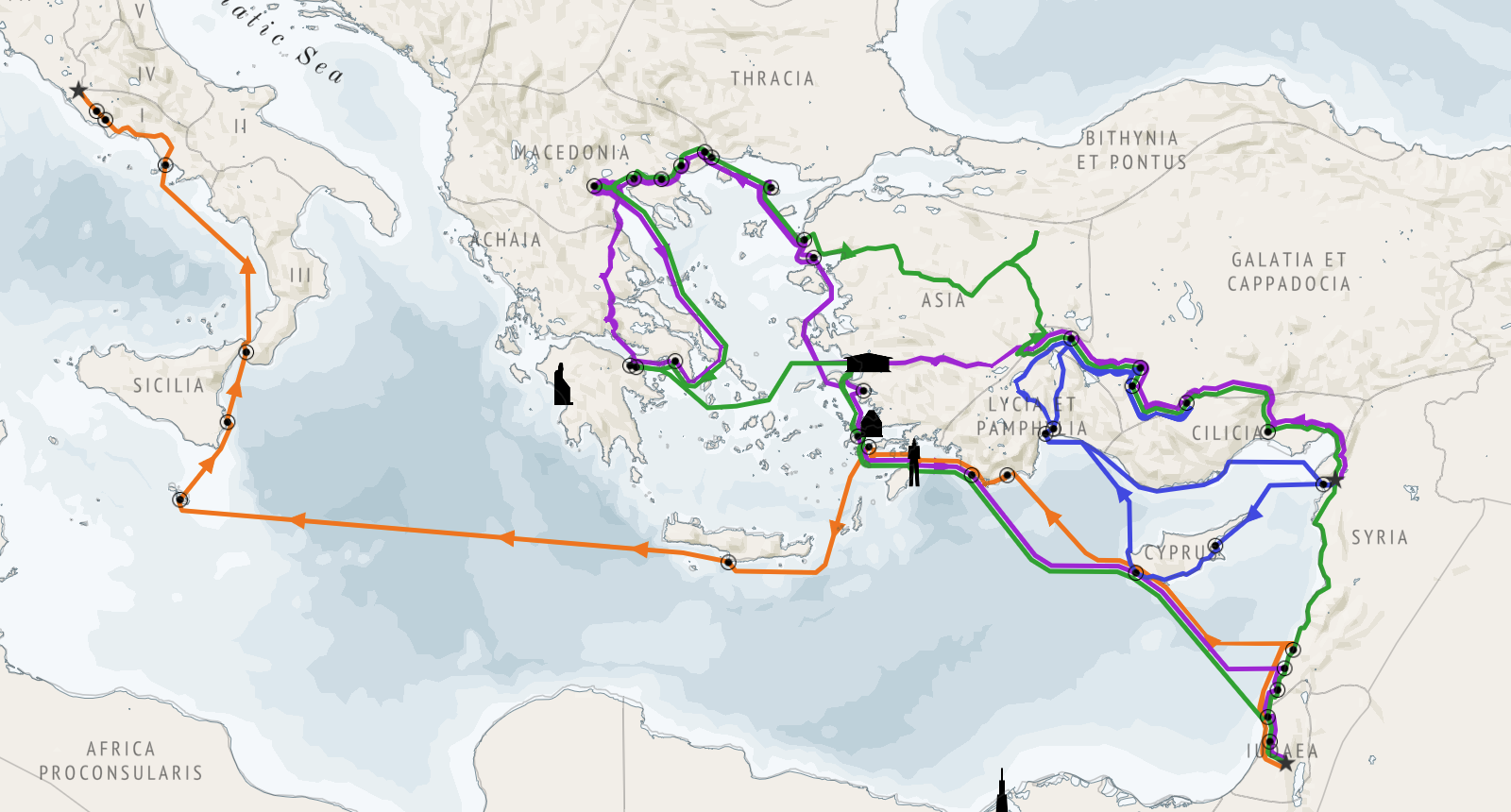
This is a very helpful interactive map of Paul’s missionary journeys. While you are on the viz.bible website, be sure to check out all of the other amazing infographics they have. I use these quite often to help me grasp the message of Scripture visually.
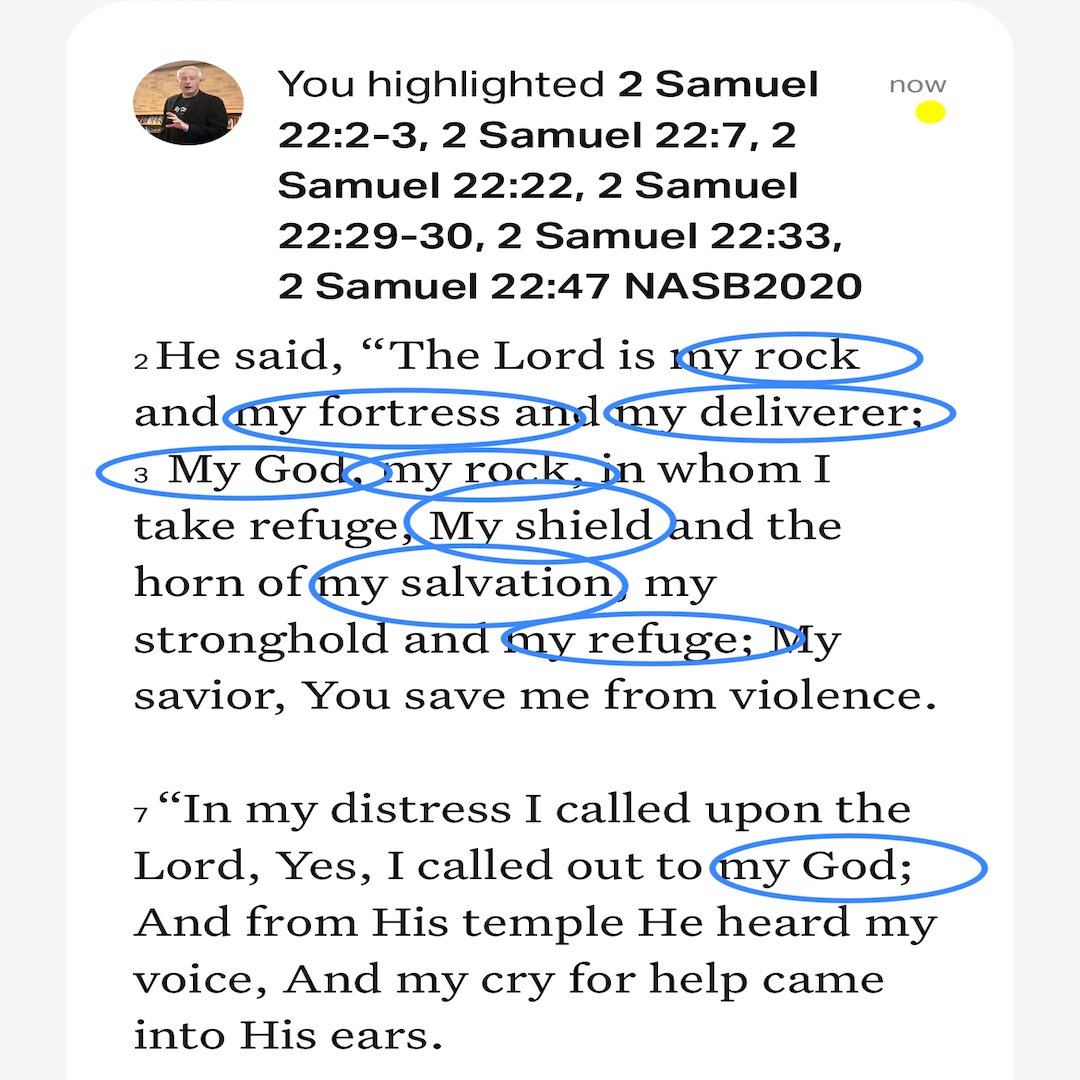
The Holy Spirit who inspired the words of the Bible is the same Holy Spirit in you. He can illuminate the biblical promises for your prayer time, and He can help you apply the biblical principles to your everyday circumstances. I have lots of new content every week, which you can check out on my YouTube channel.
“Carl M. ‘Daddy” Hanson (1865-1954), a spiritual father to many early Pentecostals on the northern Great Plains, earned his Pentecostal stripes on both sides of Azusa Street. He experienced the Pentecostal distinctive of speaking in tongues in the 19th century, and he became an early leader in the Assemblies of God in the first half of the 20th century.” Check out this mini-biography of this Pentecostal pioneer.
Absolutely astounding! The silk of spider webs has unique properties that medical science is beginning to use in humans. What an amazing Creator we serve!
In my sermon about parenting, I quoted from Proverbs 22:6. Commenting on this verse, Dick Brogden, in Proverbs: Amplified and Applied, wrote, “The principle regarding our children is that the things they are taught early on will give them every opportunity for stability later in life. This reality does not guarantee that they will make right choices (including whether or not to follow Jesus); it does guarantee that they have the resource of wisdom to draw on should they choose. … Whatever their choice, we can rest in the peace that we laid up for them every resource for good. Our peace (regarding our children) comes from what we have done with our heart and resources, not what they have done with theirs.”
Listen to the podcast of this post by clicking on the player below, and you can also subscribe on Apple, Spotify, or Audible.
I am sure everyone has heard the comical philosophical question, “Which came first: the chicken or the egg?” At Creation, the chicken clearly came first. But in other instances, sometimes the correct answer is not either-or but both-and.
The apostle Paul warned his protege Timothy, “For the time will come when men will not put up with sound doctrine. Instead, to suit their own desires, they will gather around them a great number of teachers to say what their itching ears want to hear” (2 Timothy 4:3). In other words, the people are saying, “The truth makes us uncomfortable, so tell us something that makes us feel good. If you do, you will be rewarded by our popular support.”
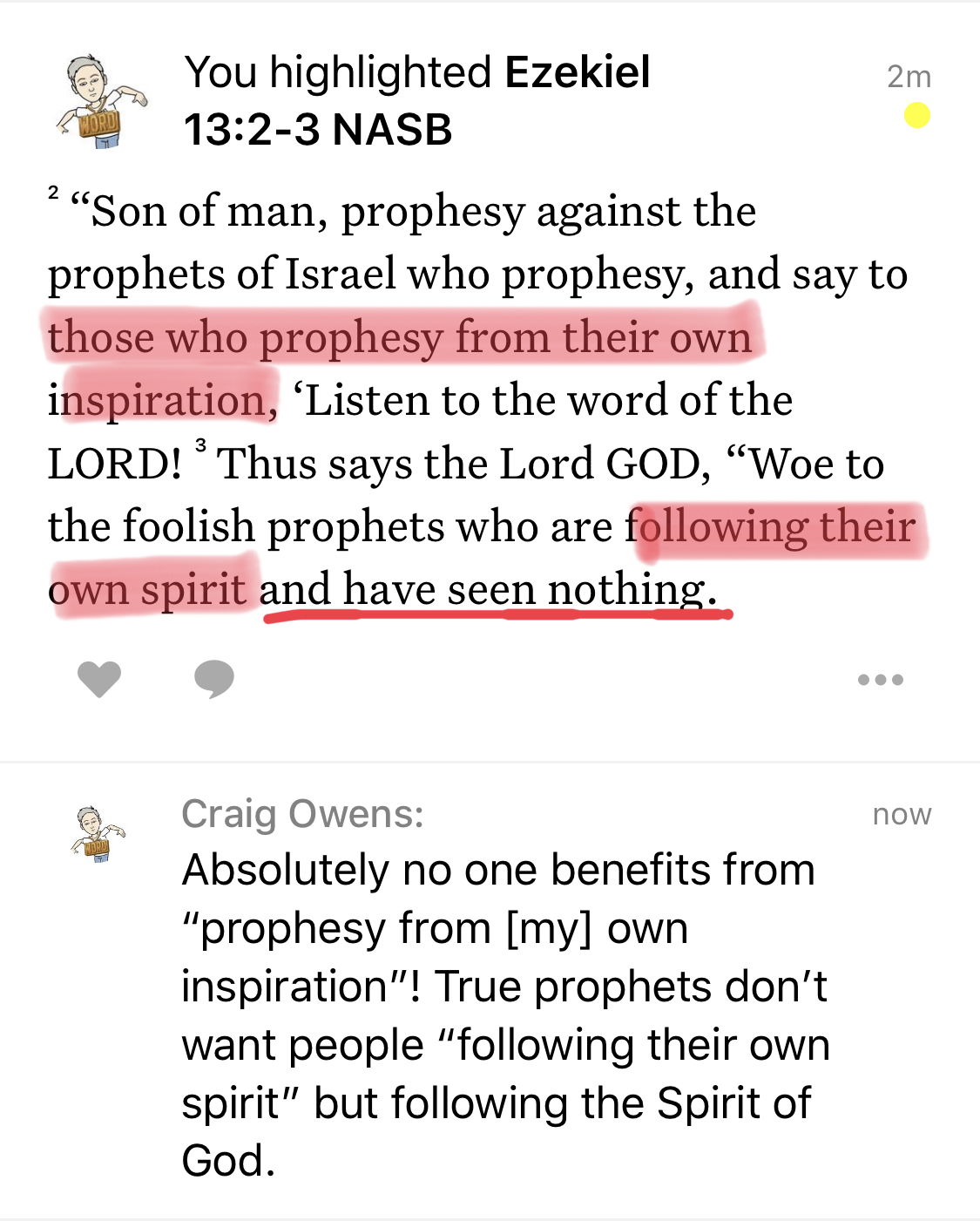
Nearly 600 years earlier, God had something to say to those popular teachers, “Woe to the foolish prophets who follow their own spirit and have seen nothing!” (Ezekiel 13:3). The New King James Version says they “prophesy out of their own heart” and the New American Standard Bible says they “prophesy from their own inspiration…following their own spirit.” In other words, they are speaking a popular message, not a truthful message.
So which came first: the chicken of people with itching ears or the egg of false prophets with a popular message intended for itching ears? I think this is a true both-and. It’s both people looking for a feel-good message, and false prophets realizing they can be rewarded for sharing a popular feel-good message.
Absolutely no one benefits from a prophecy from my own inspiration. True prophets of God don’t want people following their own spirit but following the Spirit of God.
A mark of anungodlyleader is one who uses God’s name only as his platform for personal gain.
To those false prophets, God says, “Woe are you, for My judgment will fall on you.” To those with itching ears who trade popularity for truth, Paul says to Timothy, “Have nothing to do with them” (2 Timothy 3:1-5).
This is part 72 in my series on godly leadership. You can check out all of my posts in this series by clicking here.
If you were one of Christ’s disciples, wouldn’t you think it would be time for Jesus to take a victory lap? Maybe He could show up at the next meeting of the Sanhedrin, or in Pontius Pilate’s courtroom, or King Herod Antipas’ throne room. You can almost hear their longing for this when they asked Jesus, “Lord, are You at this time going to restore the kingdom to Israel?” (Acts 1:6).
Jesus answered that question by saying, “Your race is just now beginning!” You see, Christ’s resurrection wasn’t the end of the race, but an important—absolutely indispensable—part of our ongoing race. “I will be raised back to life again” was a bold claim, but it wasn’t the final bold claim. There is one more for us to consider.
The resurrection of Jesus is our assurance that what Jesus says He will do, He will do. One of the things He promised is, “I am going to prepare a place for you and I will come back to get you” (John 14:1-3). The place Jesus has prepared for us is the end of our race—the finish line for which every Christian should be longing.
The disciples asked Jesus how they could know when His return was getting closer. He gave them a lot of things to watch for, but He concluded by saying, “And this gospel of the kingdom will be preached in the whole world as a testimony to all nations, and THEN the end will come” (Matthew 24:14).
In order for us to go Home, the whole world—people in all nations—have to hear the Good News of the Kingdom of God.
In one of the boldest claims of all, Jesus says He has ultimate authority, and that He is commissioning us to use His authority for the express purpose of our missionary work to all nations. Notice the “therefore” which indicates what we are to do with His authority—
All authority in heaven and on earth has been given to Me. Therefore go andmake disciples of all nations, baptizing them in the name of the Father and of the Son and of the Holy Spirit, and teaching them to obey everything I have commanded you. And surely I am with you always, to the very end of the age. … But you will receive power when the Holy Spirit comes on you; and you will beMy witnesses in Jerusalem, and in all Judea and Samaria, and to the ends of the earth. (Matthew 28:18-20; Acts 1:8)
The apostle Paul appreciated this analogy of running a race. Just before it was time for Paul to go Home, he told his friend Timothy, “I have fought the good fight, I have finished the race, I have kept the faith” (2 Timothy 4:7).
Earlier in his life, Paul used a running example when he wrote to the Christians at Corinth—
Do you not know that in a race all the runners run, but only one gets the prize? Run in such a way as to get the prize. Everyone who competes in the games goes into strict training. They do it to get a crown that will not last, but we do it to get a crown that will last forever. Therefore I do not run like someone running aimlessly; I do not fight like a boxer beating the air. No, I strike a blow to my body and make it my slave so that after I have preached to others, I myself will not be disqualified for the prize. (1 Corinthians 9:24-27)
Paul gives us three don’ts and three dos in this passage:
Don’t fail to train, don’t run aimlessly, don’t get disqualified by focusing on the temporal
Do go into strict training, do stay focused on the eternal, do run for the prize of hearing Jesus say, “Well done!”
Do you want to go Home? Do you want Jesus to come again to take all of His children Home? Then finish the race of telling everyone in the whole world the Good News about Jesus.
This is a weekly series with things I’m reading and pondering from Charles Spurgeon. You can read the original seed thought here, or type “Thursdays With Spurgeon” in the search box to read more entries.
Listen to the podcast of this post by clicking on the player below, and you can also subscribe on Apple, Spotify, or Audible.
Don’t Let Your ‘Well Begun’ Be Only ‘Half Done’
But our citizenship is in heaven. And we eagerly await a Savior from there, the Lord Jesus Christ, Who, by the power that enables Him to bring everything under His control, will transform our lowly bodies so that they will be like His glorious body. Therefore, my brothers and sisters, you whom I love and long for, my joy and crown, stand firm in the Lord in this way, dear friends! (Philippians 3:20—4:1).
The start is not everything, but it is a great deal. It has been said by the old proverb that ‘well begun is half done,’ and it is certainly so in the things of God. … See to it that you lay a good foundation. It is better to have no repentance than a repentance that needs to be repented of! It is better to have no faith than a false faith! It is better to make no profession of religion than to make an untruthful one! … We should learn early on the difference between grace and merit, between the purpose of God and the will of man, between trust in God and confidence in the flesh. If we do not start aright, the further we go, the further we will be from our desired end and the more thoroughly in the wrong we will find ourselves.
In the biblical passage Spurgeon used as his text, we read some important words. First of all, we need to live as citizens of Heaven, not as citizens of Earth. That means we need to always follow God’s laws, not the passing fads of culture.
Second, the apostle Paul calls Jesus both Savior and Lord. We don’t get to choose one and ignore the other. We cannot say, “Thank You, Jesus, for saving me, but I’ll take it from here.”
Finally, we need to not only stand firm, but as Paul also says in another letter, “So, if you think you are standing firm, be careful that you don’t fall!” (1 Corinthians 10:12). No assumptions. No coasting. No merely going through the motions of Christianity, but keeping a humble heart that responds to the correcting word from the Holy Spirit.
Let’s make sure that our walk with Jesus is never described as only “half done.” But instead, let’s begin well, walk well, and rejoice to hear our Savior say, “Well done, good and faithful servant!”
Listen to the podcast of this post by clicking on the player below, and you can also subscribe on Apple, Spotify, or Audible.
And they were not able to resist the wisdom and the Spirit by which [Stephen] spoke. (Acts 6:10)
Luke the historian doesn’t give us very many details about Stephen, but one common thread is the obvious help the Holy Spirit gave him:
Stephen, full of faith and power, did great wonders and signs among the people
they were not able to resist the wisdom and the Spirit by which he spoke
all who sat in the council…saw his face as the face of an angel
when they heard these things they were cut to the heart
being full of the Holy Spirit, [Stephen] gazed into heaven and saw the glory of God, and Jesus standing at the right hand of God
Jesus lived this way too. Near the end of His public ministry He said,
“I have never spoken on My own authority or of My own accord or as self-appointed, but the Father Who sent Me has Himself given Me orders concerning what to say and what to tell. And I know that His commandment means eternal life. So whatever I speak, I am saying exactly what My Father has told Me to say and in accordance with His instructions.” (John 12:49-50 AMP)
Jesus said this same Holy Spirit who directed His vocabulary, and Who gave Stephen his irresistible words, would do the same thing for us too. The apostle Paul asked for the Ephesian Christians to pray for him like this, “Pray also for me, that whenever I speak, words may be given me so that I will fearlessly make known the mystery of the gospel” (Ephesians 6:19).
When we are yielded to the Holy Spirit we can say with assurance…
A mark of a godly leader is his irresistible, Spirit-led vocabulary.
This is part 60 in my series on godly leadership. You can check out all of my posts in this series by clicking here.








 Craig T. Owens