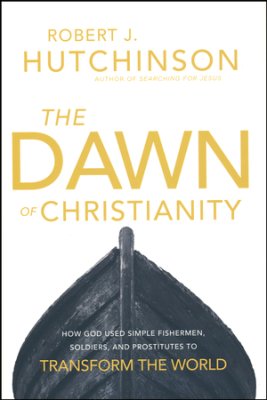
The Dawn Of Christianity (book review)

Sometimes when people are reading the Gospels and the Book of Acts in the New Testament of the Bible they forget what an accurate history is presented at a pivotal time in world events. In The Dawn Of Christianity, Robert J. Hutchinson makes the history behind, surrounding, and after the biblical accounts come to life in a fresh way.

The Dawn Of Christianity tells the history surrounding Jesus of Nazareth and His followers almost in a novel-like format. Hutchinson masterfully puts together the four Gospel accounts and Luke’s history of the early church in chronological order, and then brings in archaeological, geographic, and anthropological resources like a supporting cast to the biblical account. Along the way, we are introduced to extra-biblical characters, places, and customs that add a new depth of understanding to the history presented in Scripture.

Hutchinson notes, “Recent archaeological discoveries are showing that the New Testament in general, and the Gospels in particular, are far more reliable historical sources than previous generations of New Testament experts realized.” Indeed, he makes good use of as many pertinent finds as possible to enhance his storytelling.

The Dawn Of Christianity spans the time from just before the birth of Jesus Christ of Nazareth and then tracks the spread of Christianity for about 20 years following Christ’s ascension into heaven. It’s a fascinating and enlightening story for both Bible aficionados and skeptics alike.

I am a Thomas Nelson book reviewer.

Thursdays With Oswald—Out Of The Wreck I Rise

Oswald ChambersThis is a weekly series with things I’m reading and pondering from Oswald Chambers. You can read the original seed thought here, or type “Thursdays With Oswald” in the search box to read more entries.

Out Of The Wreck I Rise 

No, in all these things we are more than conquerors through Him who loved us. For I am convinced that neither death nor life, neither angels nor demons, neither the present nor the future, nor any powers, neither height nor depth, nor anything else in all creation, will be able to separate us from the love of God that is in Christ Jesus our Lord. (Romans 8:37-39

     The Apostle Paul is not talking of imaginary sentimental things, but of desperately actual things, and he says we are “more than conquerors” in the midst of them all, super-conquerors, not by our wits or ingenuity, our courage or pluck, or anything other than the fact that not one of them can separate a man from the love of God in Christ Jesus. … 

     The word “tribulation” has its roots in the Latin tribulum—a sledge for rubbing out corn; literally, a thing with teeth that tears. … 

     “Anguish” comes from a word meaning to press tightly, to strangle, and the idea is not a bit too strong for the things people are going through. … Can the love of God in Christ hold there, when everything says that God is cruel to allow it, and that there is no such thing as justice and goodness? Shall anguish separates us from the love of God? No, we are more than conquerors in it, not by our own effort but by the fact that the love of God in Christ holds. … 

     In every one of “these things” logic is shut up. … A man can go through tribulations which make you hold your breath as you watch him; he goes through times that would knock the wits out of us and make us give way to blasphemy and whimperings. He is not blind or insensitive, yet he goes through in marvelous triumph—what accounts for it? One thing only, the fact that behind it all is the love of God which is in Christ Jesus our Lord. Spiritually, morally, and physically the saint is brought clean through, triumphant, out of the wreck wrought by tribulation, anguish, persecution, famine, nakedness, peril and sword. Whatever maybe the experiences of life, whether terrible and devastating or monotonous, it makes no difference, they are all rendered impotent, because they cannot separate us from the love of God which is in Christ Jesus our Lord. “Out of the wreck I rise” every time. 

From The Saints In A Disaster Of Worldliness

Thank You, Jesus, that because of Your love “out of the wreck I rise” every time.

10 Quotes From “Legacy Leadership”

I just finished an outstanding reading plan on YouVersion called Legacy Leadership by Dr. J. Lee Whittington. For anyone interested in the biblical concept of servant-leadership, I highly recommend you check out this reading plan.

Here are a few quotes I especially liked…

“Legacy Leadership is a process of intentional influence that takes place in the context of a relationship.”

“There is a recurring pattern of affirmation and exhortation in Paul’s leadership. He provided a dynamic balance between challenging his followers to grow and acknowledging their progress. He was affirming, but never content.”

“There is a growing trend to attack, criticize, and resent anyone who has talent or achievements that sets them apart from others. This tendency extends to those who resent the efforts of leaders who challenge the status quo. Opponents of change initiatives often attempt to marginalize leaders by attacking their character and questioning their motives. If the messenger is flawed, then the message and vision they offer cannot be trusted. As disappointing as it is, these challenges come with the territory of leadership.

“If I am to lead with integrity, I must always confront my own lack of integrity. This demands a willingness to constantly reflect on my motives and the courage to confront my own hypocrisy. It also requires me to allow myself the discomfort of inviting the scrutiny of both the Lord and others who care enough to confront me about my motives, my attitudes, and my behavior.”

“The most effective leaders are able to exert influence without asserting their formal authority. … Paul deliberately chose to forego the legitimate, reward, and coercive power inherent in his position. Instead, he leaned into another base of power: referent power. Referent power is based on respect and admiration. When this is present, the followers identify with and want to emulate their leader. This power base does not come from the leader’s position or control of resources. Rather, it is based on the leader’s character and integrity. Referent power is based on who the leader is.”

“Legacy Leaders do not lead from a distance. They imitate Jesus who said, ‘I am among you as one who serves’ (Luke 22:27). They are comfortable sharing their lives with their followers.”

“The best relationships between a leader and their followers are those that are characterized by a great deal of mutual trust and shared information. The responsibility for creating this type of relationship rests squarely on the shoulders of the leader.”

“Authentic leaders have a seamless link between their values and their actions. But the congruence between values and attitudes is just the starting point for authentic leadership.  From the perspective of scripture, a leader’s attitudes and actions must be anchored to God’s standards. When a leader’s enacted values are in congruence with their espoused values, and those espoused values are in turn anchored to God’s principles, the leader had moral authority.”

“It’s easy to critique the authenticity of others.  But, if we are really serious about developing our own authenticity, we must focus on ourselves. I read this statement several years ago: ‘If we are to be people of integrity, we must constantly confront our lack of integrity.’”

“Legacy Leaders embrace the principles of servant-leadership and understand that the conscious choice to lead comes after the desire to serve. This inclination is not natural. It must be energized by continuous reliance on the empowering presence of God’s Spirit.”

Thursdays With Oswald—Popular Christianity?

Oswald ChambersThis is a weekly series with things I’m reading and pondering from Oswald Chambers. You can read the original seed thought here, or type “Thursdays With Oswald” in the search box to read more entries.

Popular Christianity? 

     Take the popular idea of Christianity and compare it with the patience of the saints, and you will see where we are. Popular Christianity says, “We must succeed.” … We are determined to be successful, but the Apostle Paul says we are called upon to be faithful (1 Corinthians 4:1-2). …  

     The way worldly sagacity argues is—Pay men back in their own coin, if you have been deceived, deceive in order to get your rights—“an eye for an eye and a tooth for a tooth.” You cannot do that if you are a saint. We must practice the expressed love of God and behave among the unseemly as the children of God. There is no test on earth to equal it. There is unseemly laughter at the saint—“Where is your success? what have you done? what is the good of missionary enterprise?” … 

     We do not need Jesus Christ and the Bible for the ordinary common-sense standpoint, and if in a crisis we act according to common sense we do not express the love of God. … 

     The test for the saint is not common sense, but “Is this is what Jesus Christ stood for?” 

From The Saints In A Disaster Of Worldliness

Standing true to Jesus Christ and the Bible is never popular.

So the question is—Do I want praise from men, or “Well done” from my Savior?

Thursdays With Oswald—Your Peace Vs. True Peace

Oswald ChambersThis is a weekly series with things I’m reading and pondering from Oswald Chambers. You can read the original seed thought here, or type “Thursdays With Oswald” in the search box to read more entries.

Your Peace Vs. True Peace

     Conviction of sin is the realization that my natural life is based on a disposition that will not have Jesus Christ. The Gospel does not present what the natural man wants but what he needs, and the Gospel awakens an intense resentment as well as an intense craving. … 

     If I am peaceful and happy and contented and living my life with my morality well within my own grasp, why does the Holy Spirit need to come in and upset the balance and make me miserable and unfit for anything? It is time we asked ourselves these questions. God’s Book gives us the answer. Thank God, we are coming to the end of the shallow presentation of Christianity that makes out that Jesus Christ came only to give us peace. Thousands of people are happy without God in this world, but that kind of happiness and peace is on a wrong level. Jesus Christ came to send a sword through every peace that is not based on a personal relationship to Himself. He came to put us right with God that His own peace might reign. …

     If once we have allowed Jesus Christ to upset the equilibrium, holiness is the inevitable result, or no peace forever. …

     Before the Spirit of God can bring peace of mind He has to clear out the rubbish, and before He can do that He has to give us an idea of what rubbish there is.

From The Soul Of A Christian

Jesus said, “Do not suppose that I have come to bring peace to the earth. I did not come to bring peace, but a sword” (Matthew 10:34).

The Apostle Paul also noted that he was perfectly happy living his life as he was, until he read in the Scripture that the way he was happily living was actually sinful. And once he realized that, the sin actually became harder to break (see Romans 7:7-20).

Oswald Chambers reminds us of the same fact: God wants to upset anything on which we have based our peace that is not rooted in Him. He wants to make us aware of our trust in other sources, our wrong beliefs, our human-based equilibrium. In short, He wants to show us the rubbish in our life so that He can help us clear out that rubbish and know true peace!

Will you let Him disturb your peace so you can know true peace?

The Profit Of Persecution

“Jesus Christ not only warned that persecution would come, He went further and said that it was profitable to go through persecution [Matthew 5:11-12; 2 Corinthians 12:10]. …

“No one understands your circumstances but God, and He has given you the fighting chance to prove you can be more than conqueror in all these things. Let God lift you out of the broken place, out of the the bedraggled place. Let Him put within you the Holy Spirit so that you can face the music of life and become more than conqueror in every place where you have been defeated. …

“The Apostle Paul seems to be never tired of comparing the Christian life to a fight, and a fight against tremendous odds, but always a winning fight. …

“We cannot be more than conquerors if there is nothing to fight! Our Lord Himself and the Spirit of God in the Epistles make it very clear that everything that is not of God will try its best to kill His life out of us; yet instead of doing that it makes us all the stronger. …

“The grace of God will make us marvelously impervious to all the onslaughts of tribulation and persecution and destitution because we are seated in heavenly places in Christ Jesus and cannot be awakened up to self-pity. God sends His rough weather and His smooth weather, but we pay no attention to either because we are taken up only with the one central thing—the love of God in Christ Jesus.” —Oswald Chambers, in The Fighting Chance

Thursdays With Oswald—Teach Them While They’re Young

Oswald ChambersThis is a weekly series with things I’m reading and pondering from Oswald Chambers. You can read the original seed thought here, or type “Thursdays With Oswald” in the search box to read more entries.

Teach Them While They’re Young

      We need a personal knowledge of God through all our life. The time to discover Him for ourselves is in life’s earliest morning—“that from a child thou hast known the holy Scriptures, which are able to make thee wise unto salvation,” wrote Paul to Timothy (2 Timothy 3:15). “And ye fathers, provoke not your children to wrath: but nurture them in the chastening and admonition of the Lord” (Ephesians 6:4).

     We are so built that in childhood we can more easily come to a knowledge of God in simplicity than in later years. And in those formative years the personal life can be shaped and fitted to God’s standard more surely than later on.

From Shade Of His Hand

At the end of Ecclesiastes, Solomon wrote, “Remember your Creator in the days of your youth, before the days of trouble come” (Ecclesiastes 12:1).

Oswald Chambers notes that parents lay a much stronger foundation for their children’s future spiritual attainment by talking often of the love of God while those children are still young.

Parents—start early, keep at it often, and don’t ever quit telling your children about God’s love. 

These commandments that I give you today are to be on your hearts. Impress them on your children. Talk about them when you sit at home and when you walk along the road, when you lie down and when you get up. Tie them as symbols on your hands and bind them on your foreheads. Write them on the doorframes of your houses and on your gates. (Deuteronomy 6:6-9)

Train up a child in the way he should go: and when he is old, he will not depart from it. (Proverbs 22:6)

[Mom and Dad, be sure to check out Andrew Murray’s exceptional book Raising Your Child To Love God. You can read some quotes from Murray’s book here, and some of his prayers for children here.]

Thinking Christianly

“If you read history you will find that the Christians who did most for the present world were just those who thought most of the next. The Apostles themselves, who set on foot the conversion of the Roman Empire, the great men who built up the Middle Ages, the English Evangelicals who abolished the Slave Trade, all left their mark on Earth, precisely because their minds were occupied with heaven. It is since Christians have largely ceased to think of the other world that they have become so ineffective in this.” —C.S. Lewis

“To think secularly is to think within a frame of reference bounded by the limits of our life on earth: it is to keep one’s calculations within this-worldly criteria. To think christianly is to accept all things with the mind as related, directly or indirectly, to man’s eternal destiny as the redeemed and chosen child of God…. There is nothing in our experience, however trivial, worldly, or even evil, which cannot be thought about christianly.” —Harry Blamires

Most of us do not think; we live healthy ordinary lives and don’t bother about thinking at all; but when an upheaval comes from underneath proving that the basis of things is not rational, we find the value of the Bible attitude, which is that the basis of things is tragic and not rational…. We have to live based on our relationship to God in the actual condition of things as they are.” —Oswald Chambers

God wants a child’s heart, but a grownup’s head. He wants us to be simple, single-minded, affectionate, and teachable, as a good children are; but He also wants every bit of intelligence we have to be alert at its job, and in first-class fighting trim.” —C.S. Lewis

“Don’t let anyone capture you with empty philosophies and high-sounding nonsense that come from human thinking and from the spiritual powers of this world, rather than from Christ.” —Apostle Paul (Colossians 2:8)

“We do not think on the basis of Christianity at all. We are taught to think like pagans for six days a week and to reverse the order for one day, consequently in critical moments we think as pagans and our religion is left in the limbo of the inarticulate.” —Oswald Chambers

[Emphasis in these quotes added by me]

To read thought-provoking quotes like this every day, please follow me on Twitter and Tumblr.

Are You Wretched?

absolute-surrender“You will find that in this passage (Romans 7:6-25) the name of the Holy Spirit does not occur once, nor does the name of Christ occur. The man is wrestling and struggling to fulfill God’s law. Instead of the Holy Spirit and of Christ, the law is mentioned nearly twenty times. In this chapter, it shows a believer doing his very best to obey the law of God with his regenerate will. Not only this; but you will find the little words, I, me, my, occur more than forty times. This is the regenerate I in its impotence seeking to obey the law without being filled with the Spirit. This is the experience of almost every saint. …

“Blessed be God when a man learns to say: ‘O wretched man that I am!’ from the depth of his heart. He is on the way to the eighth chapter of Romans [Romans 8:1]. …

“God does not work by His spirit as He works by a blind force in nature. He leads His people as reasonable, intelligent beings, and therefore when He wants to give us that Holy Spirit Whom He has promised, He brings us first to the end of self, to the conviction that though we have been striving to obey the law, we have failed. When we come to the end of that, then He shows us that in the Holy Spirit we have the power of obedience, the power of victory, and the power of real holiness.” —Andrew Murray, in Absolute Surrender

7 Quotes From “The Dawning Of Indestructible Joy”

the-dawning-of-indestructible-joyThe Dawning Of Indestructible Joy is a wonderful book from John Piper to prepare your heart for celebrating Christ’s First Advent! It’s arranged as a 25-day countdown until Christmas morning. Check out my review of this book here, and then enjoy a few quotes that caught my attention.

“The coming of Jesus was a search-and-save mission. ‘The Son of Man came to seek and save the lost’ [Luke 19:10]. So Advent is a season for thinking about the mission of God to seek and to save lost people from the wrath to come. … ‘As the Father has sent Me, even so I am sending you’ (John 20:21). It’s the story of how the vertical advent of God in the mission of Jesus bends out and becomes the horizontal advent of Jesus in the mission of the church. In us.”

“If there is a longing in your heart this Advent for something that the world has not been able to satisfy, might not this longing be God’s Christmas gift preparing you to see Christ as consolation and redemption and to receive Him for who He really is?”

“Christmas is about the coming of the Son of Man who ‘came not to be served but to serve, and to give His life as a ransom for many.’ These words in Mark 10:45, as a brief expression of Christmas, are what I hope God will fix in your mind and heart this Advent. Open your heart to receive the best present imaginable: Jesus giving Himself to die for you and to serve you all the rest of eternity.”

“Take the very personal words of the Apostle Paul and make them your own. ‘The life I now live in the flesh I live by faith in the Son of God, who loved me and gave Himself for me’ (Galatians 2:20). This is how Jesus destroyed the works of the devil and rescued us from our sin. Don’t leave Christmas in the abstract. Your sin. Your conflict with the devil. Your victory. He came for this.”

“The point is that when Jesus comes, He confirms the truth of all God’s promises. He shows that God is trustworthy; He keeps His word. … Christ came to prove that God tells the truth, that God keeps His promises. Christmas means that God can be trusted.” 

“It is God’s message of hope this Advent that what is good need never be lost and what is bad can be changed. The devil works to take the good and bring the bad. And Jesus came to destroy the works of the devil [1 John 3:8].”

“This is what God does again and again. He may be doing it for you this Advent season—graciously and tenderly frustrating you with life that is not centered on Christ and filling you with longings and desires that can’t find their satisfaction in what this world offers, but only in the God-man. What a Christmas gift that might be! Let all your frustrations with this world throw you onto the Word of God. It will become sweet—like walking into paradise.”