Links & Quotes

link quote

Some good reading from today…

[PHOTOS] Today is the birthday of the United States Marine Corps. Here are some great pictures of our Marines in action.

“Your hope for the future is not in what you did yesterday, but improving today so that you can meet the future head-on.” —John Maxwell

Did you know that 90% of babies diagnosed with Down syndrome are aborted?! Here are 9 people with Down syndrome who live highly successful lives.

“‘Circumstances over which I have no control’ is a perfectly true phrase, but it must never be made to mean that we cannot control ourselves in those circumstances.” —Oswald Chambers

“The whole Bible and all past history unite to teach that battles are always won before the armies take the field. The critical moment for any army is not the day it engages the foe in actual combat; it is the day before or the month before or the year before. … Preparation is vital. Let this be noted by everyone. We can seek God today and get prepared to meet temptation tomorrow; but if we meet the enemy without first having met God, the outcome is not conjectural; the issue is already decided. We can only lose.” —A.W. Tozer

“We must open our Bibles every morning with this prayer—‘Give us this day our daily bread.’” —Charles Spurgeon

Good advice on how to respond to people who are antagonistic toward your Christian faith.

Hmm, Pope Francis demotes (again!) a U.S. cardinal who is doctrinally conservative.

A Murderer’s Checklist

Murderer's checklistYou shall not murder (Exodus 20:13) sounds pretty straightforward. This verse is actually just one word in the Hebrew language: ratsach. The idea is a human killing another human in an animalistic way.

Think of a predatory animal like a lion. The lion attacks as an angry response when it is provoked. There is no thought about consequences or possible alternatives, but it simply lashes out in anger. A lion will also lie in wait to ambush its prey. Humans who kill in this animalistic way are regarded in the Bible as murderers (see Exodus 21:14; Numbers 35:20-21, and Deuteronomy 19:11, 13).

The legal definition of homicide today says it is “the killing of a human being by a sane person, with intent, malice aforethought (prior intention to kill the particular victim or anyone who gets in the way) and with no legal excuse or authority.”

God determines our day of conception (Psalm 139:16), the value and purpose of our life  while we are alive (Ephesians 2:10), and the day of our death (Job 14:5). Taking any of these things out of God’s hand, and putting them into our own hands, not only constitutes murder but dishonors God.

Some things are obviously homicide: Abortion is murder, suicide is murder, euthanasia is murder. Because these things put man in the place of God, they are unlawful.

But think of this: Slander is also murder. According to rabbinical scholars, publicly humiliating someone is murder, because it is character assassination. Jewish law also forbids the sharing of true but harmful information about someone else. Both of these things devalue a human being’s God-given value and purpose. Jesus echoed these teachings in Matthew 5:21-22 and Matthew 15:19.

J.I. Packer wrote, “We all have in us capacities for fury, fear, envy, greed, conceit, callousness, and hate that, given the right provocation, could make killers out of us all. … When the fathomless wells of rage and hatred in the normal human heart are tapped, the results are fearful.”

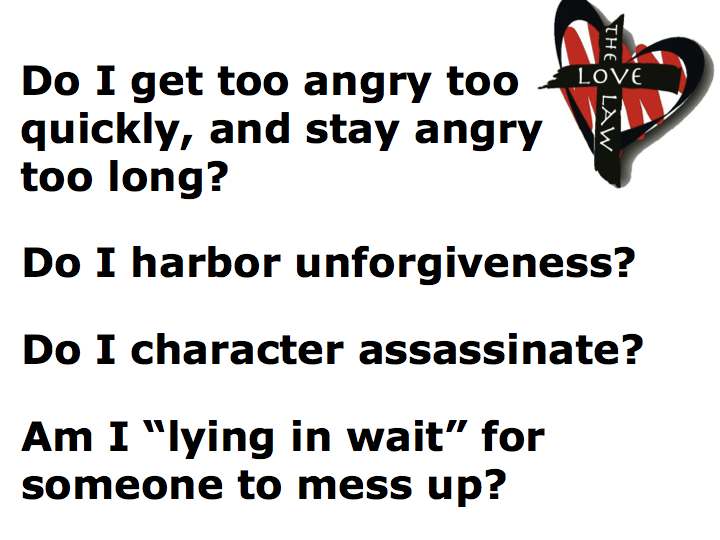
Here’s a quick checklist to make sure we aren’t getting close to becoming murderers:

  • Do I get too angry too quickly, and stay angry too long?
  • Do I harbor unforgiveness against anyone?
  • Have assassinated someone’s character?
  • Am I “lying in wait” for anyone to catch them doing wrong?

To stay clear of these murderous ways:

If you have missed any of the messages in our series The Love In The Law, you can find them all by clicking here.

Links & Quotes

link quote

“A spirit of thankfulness is so at odds with a spirit of coarse jesting that when one rises, the other falls [Ephesians 5:4]. And a spirit that yearns to edify is so at odds with foul talk that when one rises, the other falls [Ephesians 4:29].” —John Piper
“Love for others is the overflow of God-given security for the good of others. It signifies that we have the resources to care about others because God cares for us.” —John Piper


British prime minister David Cameron said recently that “our religion is now the most persecuted religion around the world.” Read this post about The War On Christians.

The Assemblies of God has now shown membership growth for 24 consecutive years, and its attendance grew more in 2013 than the US population did! Check out these God-glorifying stats.

“Let anger be guarded against. If it cannot, however, be averted, let it be kept within bounds. For indignation is a terrible incentive to sin. It disorders the mind to such an extent as to leave no room for reason. The first thing, therefore, to aim at, if possible, is to make tranquility of character our natural disposition by constant practice, by desire for better things, by fixed determination.” —Ambrose of Milan

“There is no true comfort for anyone on this earth except that of the Holy Spirit. This is why you need Him abiding in you. He alone can lay you down at night, as in a warm bed, and fill your heart with perfect peace. He alone can truly comfort you in times of pain and sorrow. He is the one who will assure you, ‘This comfort is not just temporary—it is eternal!’” —David Wilkerson

Guess what? Being popular in high school may hurt you in the long run.

Surprise (or not)! The biggest tax delinquents are US government employees.

13 Quotes From “Dear Abba”

Dear AbbaDear Abba is an intimate book of prayer and personal reflection; it’s thought-provoking and emotionally-moving. You can read my full book review by clicking here. Below are some of the quotes and prayers I found especially meaningful.

“Dear Abba, I’ve come to the place where I’m letting You love me more each day, but I still struggle with letting You like me.” 

“It would be comical if it wasn’t so sad: all of our desires to make ourselves worthy of this world but unfit for the world to come.”

“Peace and joy go a-begging when the heart of a Christian pants for one sign after another of God’s merciful love. Nothing is taken for granted, and nothing is received with gratitude.”

“I feel like the psalmist tonight—downcast. I was upcast, bright, enjoying the warmth of the day and then suddenly my joy was pickpocketed. It was a small thing, a minor misunderstanding that I could have let roll off like water, but I held on to it and nursed it awhile, and like sin always does, it grew. Now I find my mind completely disturbed, anxious, angry, and my imagination is conjuring up all sorts of somebody-done-me-wrong songs. Why do I not trust You? After so many demonstrations of Your infinitely tender hand, why do I not trust You?”

“Sin does not magnify the suffering of man’s plight; instead, it mitigates it. When I sin, I seek an escape from my humanity. I used to say to myself, ‘Well, you’re only human!’ But sin does not make me human; it compromises my humanity. The philandering husband with his mistress on business trips, the chemically addicted, the thieves who build ivory towers out of stolen money, the sensation-seekers and power brokers who seek substitutes. They do not drink the poverty of the human situation down to the last drop. They dare not stare it full in the face.” 

Yet. Those three letters stop me in my rutted tracks of besetting sins. For You were tempted as I am, yet You did not sin. The humbling point is that on a scale from 1 to 10, I usually give in when the heat reaches 3 or 4, yet You experienced the 10—the full-in-the-face of temptation—and did not give in. You are the friend of sinners, yet You are also the Great High Priest who invites us to come with confidence to Your throne and receive both our daily bread and extra rations for emergencies.”

“To practice poverty of spirit calls us not to take offense or be supersensitive to criticism.

“When the gift of a humble heart is granted, we are more accepting of ourselves and less critical of others. … For the humble person there is a constant awareness of his or her own weakness, insufficiency, and desperate need for God.”

“My friends in Christ, the simple truth is that the Christian Church in America is divided by doctrine, history, and day-to-day living. We have come a long sad journey from the first century, when pagans exclaimed with awe and wonder, ‘See how these Christians love one another!’” 

“Christ’s breakthrough into new life on Easter morning unfettered Him from the space-time limitations of existence in the flesh and empowered Him to touch not only Nepal, but New Orleans, not only Matthew and Magdalene, but me. The Lion of Judah in His present risenness pursues, tracks, and stalks us here and now.”

“I realized today that there is a third character who goes up to the temple to pray: the pharisaic tax collector—a ragamuffin who knows she’s a ragamuffin and wants to make sure everyone else knows she’s a ragamuffin. So she ends up using her sinner status not to cry out for mercy to You, but rather to seek out the attention of others as one who is real and authentic, when in reality she is nothing more than hubris in thrift-shop fashions. I realized this today because I looked in the mirror. God, be merciful to me.” 

“The tendency to continually berate ourselves for real or imaginary failures, to belittle ourselves and underestimate our worth, to dwell exclusively on our dishonesty, self-centeredness, and lack of personal discipline, is the influence of our negative self-esteem. Reinforced by the critical feedback of our peers and the reproofs and humiliations of our community, we seem radically incapable of accepting, forgiving, or loving ourselves.”

“If nobody remembers my name or the works of my hands, if everything that I’ve worked so hard to build over the years crumbles into insignificance, if I lose my health and my wits and even, heaven forbid, my memory, You are still my refuge and strength.” 

Thursdays With Oswald—Venting In Prayer

This is a weekly series with things I’m reading and pondering from Oswald Chambers. You can read the original seed thought here, or type “Thursdays With Oswald” in the search box to read more entries.

Venting In Prayer 

     When you are worked up to a pitch emotionally, read some of the Psalms, and the Spirit of God will gradually teach you how to form a spiritual nous*, a mind whereby you will not only understand but will slowly and surely get to the place where you can express your spirit, you will have a totally new language. 

* To read what Chambers means by the Greek word nous, click here. 

From Biblical Psychology 

Sometimes we’re too timid in our prayers. We think we need to hold back, or not really say what’s on our mind. We probably think that some of the language we use might be too offensive for God’s ears.

Have you ever read some of the Psalms? As Oswald Chambers suggests, this is a great place to form your prayer vocabulary. David really “lets loose” in some of his prayers, calling his enemies all sorts of names, and basically saying, “Get ‘em, God!”

So you don’t want to say those kinds of things to God? Don’t you think He already knows what you’re thinking? Wouldn’t it be much more effective to “vent” in prayer—in the safe presence of your loving Heavenly Father? It’s really only after you “get it out” that the Holy Spirit can help you work it out.

Express yourself—vent in God’s presence instead of the presence of those who are troubling you—and then listen to how God’s Spirit will help you slowly and surely get a brand new perspective on your situation.

UPDATE: I have a whole chapter called ‘Your Emergency Release Valve’ about these types of prayers in my book When Sheep Bite.

Love Is… (part 2)

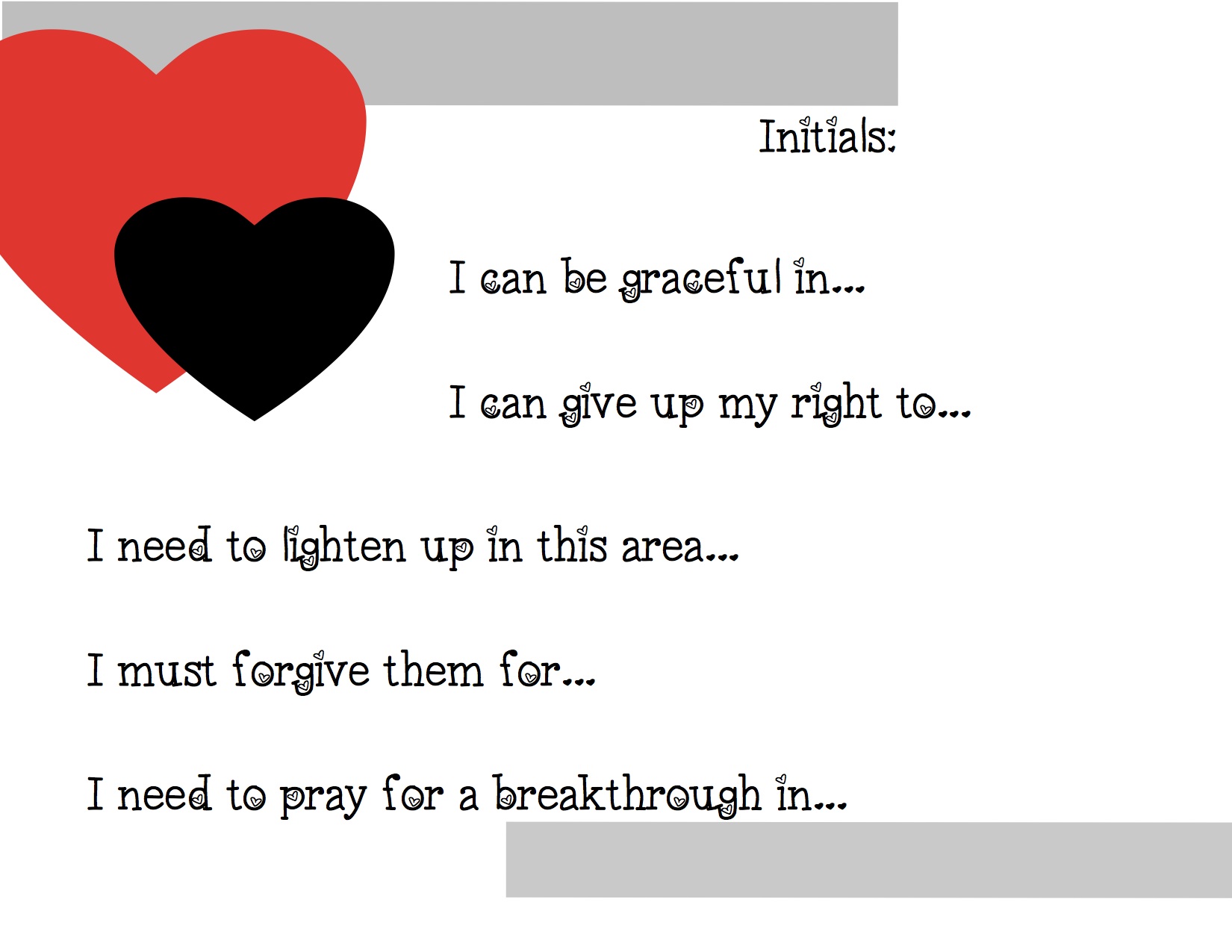
Love is… worksheet 2We are taking a practical look at the incredible definition of love in 1 Corinthians 13. We’re doing this in the context of learning how to love the “unloveable”—or maybe I should say, loving those who are the most resistant to real love. If we can show them love, how much more will the love of Jesus be seen!

All of these verbs are present tense verbs. That means they aren’t exhausted in the past, and they aren’t waiting for future conditions to improve—they are in operation NOW.

Far too many people know Christians more by what we’re against than by what we’re for. So where the biblical text say “love does not” or “love isn’t,” I’ve changed it into the positive “love is.”

You can read about the first five attributes love love by clicking here.

The next five attributes are:

Love is graceful

  • The root word means something that should be covered up, or something we’re ashamed of. Because our words and actions are graceful, they are things we wouldn’t have to defend, or explain, or apologize for later. They are words and actions that wouldn’t embarrass us.
  • Agape will do nothing that misbecomes it.” —Matthew Henry

Love knows our relationship > my rights

  • True love “does not demand its own way” (New Living Translation) nor does it “insist on its own rights” (Amplified Bible). Instead it always seeks ways that the relationship can be repaired or enhanced, even if that means giving up something I consider to be “my right.”
  • NOTE: I’m not saying that you become a doormat. This is not a license for someone to abuse you, but it is a call for us to balance our responses. Romans 12:18 says as far as it depends on you, live at peace with everyone.
  • Here are some great balancing verses. Balance Proverbs 26:4-5 (here is a video where I expand on this idea), and then balance Philippians 2:3-4.

Love is even-tempered

  • The Amplified Bible says it well: love is not touchy or fretful or resentful.
  • This Greek word means not getting stirred up or exasperated. So we need to lighten up!
  • There are some places where we’ve become too sensitive, too touchy, too short-fused. The fire of hurt has replaced the fire of love. So Matthew Henry advises us: “Where the fire of love is kept in, the flames of wrath will not easily kindle, nor long keep burning.”

Love is forgiving

  • The New International Version says love keeps no record of wrongs.
  • This Greek phrase speaks of an accountant tallying up the hurts (where there is an overdrawn account), seeing there is a debt to be paid back, and then appointing himself as the bill collector. True love cancels those IOUs.
  • We don’t forgive others because they deserve forgiveness, but we forgive others because we received forgiveness from God that we did not deserve!
  • For if you forgive people their trespasses [their reckless and willful sins, leaving them, letting them go, and giving up resentment], your heavenly Father will also forgive you. (Matthew 6:14 AMP)

Love is God-honoring

  • Agape loves what God loves and hates what God hates.
  • Agape loves when people find God’s truth, and hates anything that blocks that pursuit.
  • Agape loves the sinner and hates the sin.
  • “The sins of others are the grief of an agape spirit [not] its sport or delight; they will touch it to the quick….” —Matthew Henry

Here’s where the real test comes in: How will you apply these attributes of love to someone in your life? More specifically: to someone you think is “unloveable”?

I know you have someone in your life that you think is unloveable. With that person’s face clearly in mind, how will you fill in the blanks:

  1. I can be graceful in…
  2. I can give up my right to…
  3. I need to lighten up in this area…
  4. I must forgive them for…
  5. I need to pray for a breakthrough in…

If you would like a downloadable PDF of this worksheet, click here –> Love is… worksheet 2

If you missed any of the messages in our Loving the Unlovable series, you can check them all our here.

Don’t Unchristianize Your World

This morning I shared this quote from Henry Drummond. He absolutely nails it when he says our temper can unchristianize the societies in which we live and work.

“The peculiarity of ill temper is that it is the vice of the virtuous. … No form of vice, not worldliness, not greed of gold, not drunkenness itself, does more to unchristianize society than evil temper. For embittering life, for breaking up communities, for destroying the most sacred relationships, for devastating homes, for withering up men and women, for taking the bloom of childhood, in short, for sheer gratuitous misery-producing power this influence stands alone.” —Henry Drummond

May God help us eliminate our unchristianized tempers!

Preying Or Praying

Listen to the podcast of this post by clicking on the player below, and you can also subscribe on AppleSpotify, or Audible.

I wrapped up our Ticked Off! series yesterday with a sad story. It appears right in the opening pages of the Bible, and it’s a story where one man’s anger preys on him, like a lion on a wounded animal.

Now Able kept flocks, and Cain worked the soil. In the course of time Cain brought some of the fruits of the soil as an offering to the Lord. But Able brought fat portions from some of the firstborn of his flock. The Lord looked with favor on Able and his offering, but on Cain and his offering He did not look with favor. So Cain was very angry, and his face was downcast. 

Then the Lord said to Cain, “Why are you angry? Why is your face downcast?” If you do what is right, will you not be accepted? But if you do not do what is right, sin is crouching at your door; it desires to have you, but YOU MUST MASTER IT.” (Genesis 4:2-7, emphasis added)

We’re not sure exactly why “the Lord looked with favor on Able and his offering, but not on Cain and his offering.” Except we know that the Bible says obedience is better than sacrifice. In other words, it’s not what they brought as a sacrifice, but how they brought their sacrifice. Apparently, Able’s heart was worshipful and Cain’s was begrudging.

Able’s heart was focused on God; Cain’s heart was focused on himself. That’s why Cain became so selfishly angry, because he wasn’t getting what he thought he deserved!

This anger was setting up Cain for disaster. Anger itself is not a sin, but unaddressed anger can put us on a slippery slope toward sin!

Notice God told Cain, “YOU must master it.” God can’t help us until we stop trying to help ourselves. God wants to help us defeat the crouching lion of sin, but we have to ask him to help us.

Sadly, there is no biblical record of Cain asking God for His help. Instead in the next verses Cain—so consumed by his anger that he cannot think straight—murders his own brother. Cain was preyed upon by anger because Cain didn’t pray about his anger.

The devil is looking for any opening at all where he can pounce on you. And Ephesians 4:26-27 says that unaddressed anger is just such an opening. Don’t let your anger defeat you as it did Cain. Confess your anger to God (Psalm 32:1-5) and let God help you defeat the crouching lion of anger.

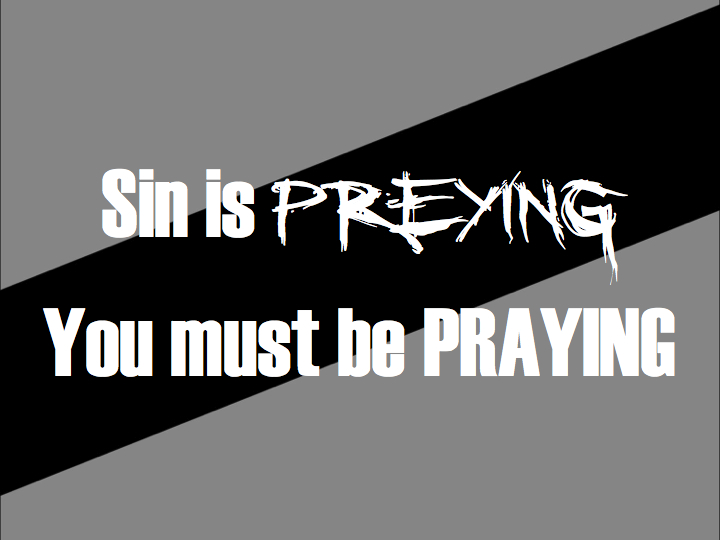
Sin is PREYing. You must be PRAYing.

If you want to check out the other messages in our series called Ticked Off! you may click here.

►► Would you please prayerfully consider supporting this ministry? My Patreon supporters get behind-the-scenes access to exclusive materials. ◀︎◀︎

Don’t Play The Fool

Listen to the podcast of this post by clicking on the player below, and you can also subscribe on AppleSpotify, or Audible.

You probably know this already: Once you get boiling mad, it’s hard to see things objectively anymore. You get steamed up—ticked off!—and you are on a no-detours course to “make things right.”

You might say things like…

  • “They need to know what they did wrong!”
  • “He’s got this coming to him!”
  • “She needs to get a taste of her own medicine!”

The unspoken completion of all of those phrases is the dangerous part. What we’re really saying is, “He needs to know what he did wrong, and I’m just the one to tell him!” Or, “She needs to get a taste of her own medicine, and I’m just the one to dispense that prescription to her!

It’s been said that action has killed its thousands; reaction its tens of thousands.

Did he hurt you? Yes!

Is he a jerk for doing so? Absolutely!

Should he get punished for it? Probably!

Are you the one to do it? No. No! NO!

He played the fool… Don’t sink to his level and play the fool yourself! 

Wise King Solomon said:

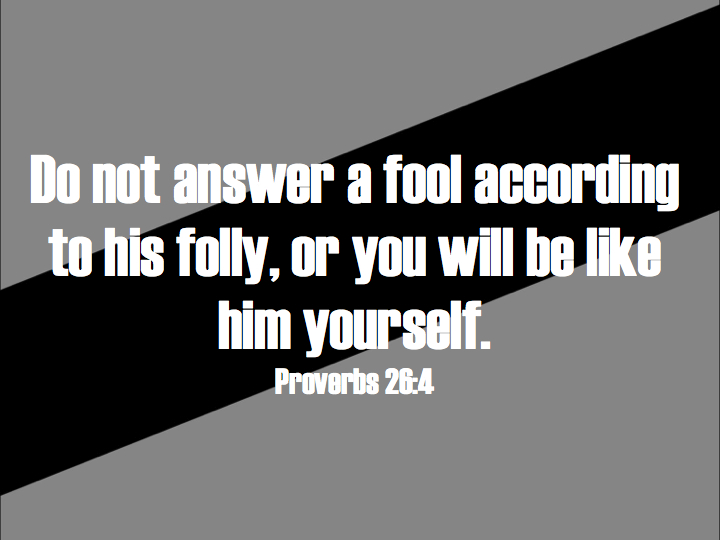
Do not answer a fool according to his folly, or you will be like him yourself. (Proverbs 26:4)

A fool gives full vent to his anger, but a wise man keeps himself under control. (Proverbs 29:11)

So what can you do to the one who injured you?

The best thing you can do is to FORGIVE HIM!

That’s right: leave him in God’s hands. Let the All-Righteous Judge deal with him. Don’t stay wounded, because you are continuing to allow your injurer to keep you trapped, to keep you wounded. Leave him in God’s hands by taking your hands off of him!

Never pay back evil with more evil. Do things in such a way that everyone can see you are honorable. Do all that you can to live in peace with everyone. Dear friends, never take revenge. Leave that to the righteous anger of God. (Romans 12:17-19)

Don’t play the fool! Forgive him and let God take it from there.

If you want to check out the other messages in our series called Ticked Off! you may click here.

►► Would you please prayerfully consider supporting this ministry? My Patreon supporters get behind-the-scenes access to exclusive materials. ◀︎◀︎

It’s Not Anger Management

Listen to the podcast of this post by clicking on the player below, and you can also subscribe on AppleSpotify, or Audible.

Aristotle had an insightful quote that was almost accurate—

“Anybody can become angry—that is easy; but to be angry with the right person, and to the right degree, and at the right time, and for the right purpose, and in the right way—that is not within everybody’s power and is not easy.”

I agree with most of this, but I would argue that it’s not within anybody’s power to express their anger in the right way.

The Bible says that our challenge is to not sin when we are angry (Ephesians 4:26). But most anger is selfishly provoked. That means, I’m angry because I have been offended, or my “rights” have been violated, or someone injured me.

If my anger has been selfishly provoked, how can I be expected to express my anger in any other fashion but selfishly?!

Instead of me trying to manage my anger, I need to listen to the Holy Spirit’s voice. There is one important question the Spirit asks us (which comes from Jonah 4:9)—

Do you do well to be angry?

  • Is it good for me to be angry with this? or should I let this go?
  • Is my anger righteously provoked? or is it selfishly provoked?
  • Does this grieve the Holy Spirit (Isaiah 63:10)?

God’s Spirit within you is never silent. He will either confirm that your anger is righteously provoked (as it was with Jesus in John 2:13-17), or it’s selfishly provoked (as it was with Jonah). That’s why you must ask yourself that question and allow the Holy Spirit to help you answer it: Do I do well to be angry?

If you answer “yes,” and the Holy Spirit confirms this in your heart, then He will help you to be angry with the right person, and to the right degree, and at the right time, and for the right purpose, and in the right way (as Aristotle said).

And if you answer “no,” the Holy Spirit is the only one who can help put out the flames of your anger in a healthy way.

So don’t try to manage your temper. Listen to the Holy Spirit asking you, “Do you do well to be angry?” And let Him guide you from there.

If you want to check out the other messages in our series called Ticked Off! you may click here.

►► Would you please prayerfully consider supporting this ministry? My Patreon supporters get behind-the-scenes access to exclusive materials. ◀︎◀︎