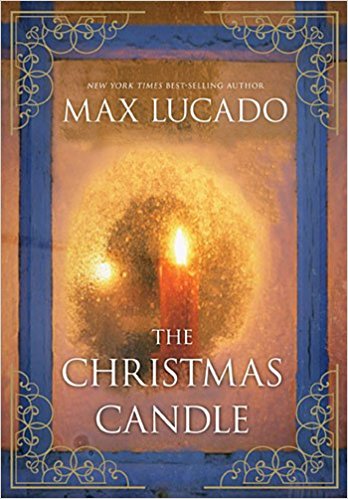
Max Lucado is a storyteller par excellent! His craft is on full display in the engaging short story The Christmas Candle.
Lucado takes us back to Victorian-era England, to the small village of Cotswolds. Nothing much seems to happen in this little village, except for a visit from an angel every 25 years to one specific family. The Haddington family have been candle-makers for as far back as anyone can remember. Every quarter-century, just before Christmas, an angel appears in the Haddington’s shop and points out one special candle. When this unique candle is given away by the Haddingtons to an individual, they can pray for a miracle and expect that God will answer that prayer.
Lucado’s story centers on a time when the angel should be appearing soon. But Mr. and Mrs. Haddington are older now, and worried that they don’t have an heir to which the candle-making trade can be passed on, the townspeople are in more desperate need than ever before, and the village’s new pastor is highly skeptical about the so-called “miracle qualities” of an ordinary looking candle. And all the while, the time of the angel’s appearing is getting closer and closer.
The message Lucado is able to drive home through this story is truly a God-given gift that will encourage your faith. Whether you read this book at Christmas time or not, you will be uplifted in your faith in God’s power to do the miraculous!
A little boy wanted to do something special for his family, so he thought he would do something he had seen his mother do dozens of times: bake a cake. Quickly he looked through a cookbook and got to work.
Dad was the first one to come home and heard an unusual clatter in the kitchen. Peeking around the corner he saw his son wearing his wife’s apron, slightly dusted in flour, and vigorously stirring a big bowl of batter.
“What are you doing, son” Dad asked.
Without looking up from his work the boy proudly answered, “I’m making a cake, Dad!”
Dad looked around the kitchen and saw all the proper ingredients out, so he was somewhat assured when he asked, “So how’s it going?”
The little boy paused and looked up at him, “Pretty good I think. I’m just having a little trouble with the ‘tbls” and ‘tsps.’”
For those of you who have done any baking, you know that “tbls” are tablespoons and “tsps” are teaspoons. If you get those mixed up, the cake might not turn out very well. For instance, adding a teaspoon of baking powder when the recipe calls for a tablespoon might result in a flat cake. Or adding a tablespoon of salt when the recipe asks for a teaspoon might making a rather salty cake.
Abbreviations only work if everyone is on the same page with you. If they’re not, it could be rather unsavory or maybe even dangerous.
In 1816, Joseph Mohr penned the words to what some have called the best-known Christmas carol in the world: Silent Night! Holy Night!
I’m not really sure how “silent” the night Jesus was born really was: a village so filled with people that no bedrooms were available, a mother in labor, a crying newborn, animals in a stable disturbed by the mother and child, singing angels, and curious shepherds. But let’s leave that part alone for a while.
Although it may not have been a silent night, it most assuredly was a Holy Night! That full title gives us the full impact of what happened at Christ’s First Advent.
Holy means something unlike anything else; someone or something devoted to God; something divine; something with God’s fingerprints all of it. I see at least three divinely holy things in this carol.
Not only was the birth of Jesus a fulfillment of prophesy (see Isaiah 7:14 and Matthew 1:18-25), but it was also an indication of God’s miracle-working power. The fact the Luke gives so many specific details about that birth night (see Luke 2:1-2) also lets us know that this isn’t a “once upon a time” myth.
Angels bring messages to key people before the birth of Jesus (Luke 1:11, 26; Matthew 1:20) and on the night of His birth (Luke 2:9-14). John also gives us a peek behind the scenes of the massive spiritual warfare taking place the night of Christ’s birth (see Revelation 12:1-5). Paul tells us that we, too, are involved in this spiritual battle, but that because of Christ’s Advent we’re more than conquerors through Jesus (Ephesians 6:12; Romans 8:37).
Jesus was fully Man and fully God (see Philippians 2:5-7; Matthew 26:63-64; John 8:54-58). This is so important, because without this we would be lost. If Jesus wasn’t fully Man, He wouldn’t know how to help us; if He wasn’t fully God, He couldn’t help us.
So when you hear this carol playing, ask someone if they know the title. More than likely they will say, “Silent Night.” To which you can easily reply, “Actually it’s Silent Night! Holy Night! and I’d like to tell you three amazing, holy things that took place!”
Let’s never abbreviate away the miracles. It may or may not have been a Silent Night, but it most certainly was a Holy Night! These supernatural miracles surrounding Christ’s First Advent provided us freedom from sin, and a rock-solid hope of our eternal reward in Heaven at Christ’s Second Advent.
If you’ve missed any of the other Christmas carols we have already looked at, you can check them out by clicking here.
O Christmas, merry Christmas,
Most of us who have nicknames didn’t receive them at birth, but they were given to us later on. It might have been because of a memorable incident, or even a character trait that we are known for.
But think about Jesus. Even before His first Advent, He was given numerous “nicknames” or titles that foretold what He was going to do. In the Christmas carol “O Come O Come Emmanuel” four of Christ’s nicknames/titles are key for us today.
It’s so important for us to look back at these First Advent titles because they give us perspective for today and hope for Christ’s Second Advent.
Paul makes it clear that we are living in a time of both already and not yet. We have redemption (Ephesians 1:7), and we are waiting for the day of redemption (Ephesians 4:30). Jesus has already paid for our freedom (First Advent), but we are still awaiting the rewards that will come with His Second Advent.
O come, O come…
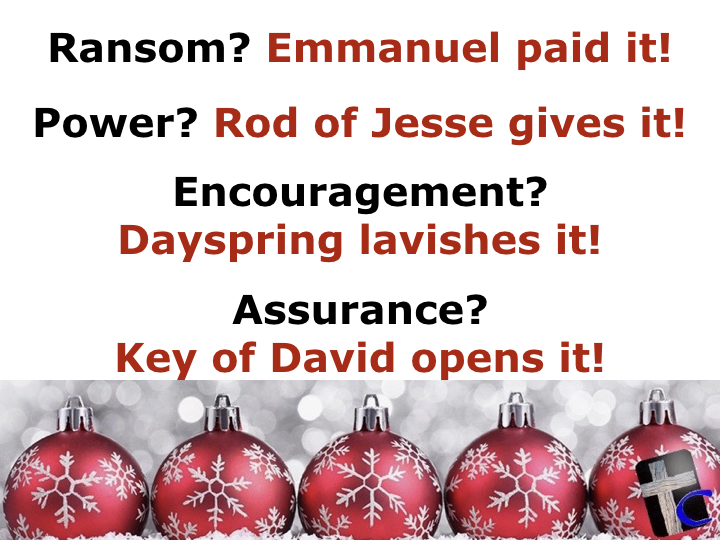
Literally, this means “God is with His people.” The prophesy was originally given to the prophet Isaiah (see 7:14 and 8:6-10), but it was repeated when Jesus was born (Matthew 1:23). Only One Who was fully God and fully Man could pay the price for our ransom from sin.
David, the son of Jesse, prayed, “Who am I, Sovereign Lord, and what is my family, that You have brought me this far?” (2 Samuel 7:18). Yet God was going to continue to keep David’s family line alive (although at times it looked like the dead stump of a long-forgotten tree) to give a throne to Jesus as the King of kings that would once and for all crush satan’s tyranny.
When I think of Dayspring, I think of light exploding immediately into the darkness (Isaiah 9:2 and Luke 1:77-78). Jesus Himself told us of His victory over the darkness: I have told you these things, so that in Me you may have [perfect] peace and confidence. In the world you have tribulation and trials and distress and frustration; but be of good cheer [take courage; be confident, certain, undaunted]! For I have overcome the world. [I have deprived it of power to harm you and have conquered it for you] (John 16:33, AMP).
Only Jesus holds the key to open wide our heavenly home (Isaiah 22:22; Revelation 1:8)!
What do you need?
All our longings—all our O come! O come!—are satisfied in Jesus. His First Advent is the already, and His Second Advent gives us hope for the not yet.
If you’ve missed any of the other Christmas carols we have already looked at, you can check them out by clicking here.
I heard the bells on Christmas Day
How many “old familiar carols” have you heard Christmas after Christmas, until the words have almost lost their meaning? If we’re not careful, any song repeated too often can lose the richness of its original intent.
There are some amazing messages in many of our old familiar Christmas carols, because many of those messages are saturated with the old familiar story of Redemption that the Bible tells over and over again.
Please join me this Sunday as we take a new look at the old familiar messages in our Christmas carols. These messages will bring a new appreciation of God’s love that was sung at Christ’s Advent, and reawaken the sweetness of meaning for this Christmas Day.
This has been an ongoing series, so if you would like to catch up with us you can see the Christmas carols we already discussed here, here, and here. Then the carols we have looked at this Advent season are:
Celebrating Advent means both looking back at Christ’s First Advent in Bethlehem and looking ahead to His Second Advent at the end of time. Faith in the First Advent fuels hope in the Second Advent. Let’s take a look at the events leading up to and surrounding Christ’s Second Advent to help us appreciate what was begun at His First Advent.
Overarching all of the end times events is a Christian’s blessed hope: “The resurrection of those who have fallen asleep in Christ and their translation together with those who are alive and remain unto the coming of the Lord is the imminent and blessed hope of the church.”
The word “rapture” doesn’t appear in Scripture, but we get this word from the Latin word raptu, which comes from the Greek word harpazo. We first see it when Philip is “caught away” from the Ethiopian’s presence in the desert (Acts 8:39). This is the same word Paul uses when he says that Christians will be “caught up” to meet Christ in the air (see 1 Thessalonians 4:13-17).
Note that the rapture of the Church is not the Second Coming of Christ. His Second Coming takes place at the end of the period known as the Tribulation when Jesus returns to earth as a conquering King and establishes His Millennial Reign on earth (Revelation 19:11-16; 20:1-4).
During Christ’s Millennial Reign, the devil and his cohorts are locked up until the end of the 1000-year reign and are allowed to tempt people one final time. The devil will succeed in tempting quite a few people, as he will once again muster a sizable army to attack Christ and His followers. This decisive battle will culminate in the final judgment.
“There will be a final judgment in which the wicked dead will be raised and judged according to their works. Whosoever is not found written in the Book of Life, together with the devil and his angels, the beast and the false prophet, will be consigned to the everlasting punishment in the lake of fire” (Revelation 20:11-15).
After this will come the New Heavens and New Earth where Christians will commune with God for ever and ever (Revelation 21:1-5, 22-27; 22:1-5, 12-21).
In light of Christ’s First Advent in Bethlehem, and His soon return (His Second Advent), how are Christians to live? In a word: HOPEFUL!
In all of these passages discussing the end times, hope-filled words are used—
Jesus also pointed out that Heaven is a place “prepared for you since the creation of the world,” while Hell is “prepared for the devil and his angels.” GOD WANTS YOU WITH HIM IN HEAVEN!
As you rejoice in the First Advent, remember that Christ’s First Coming was to provide a way for you to have your sins forgiven and be able to spend eternity with Him. So as we look forward in hope to Christ’s Second Advent we say with the Apostle John, “Amen. Come, Lord Jesus!”
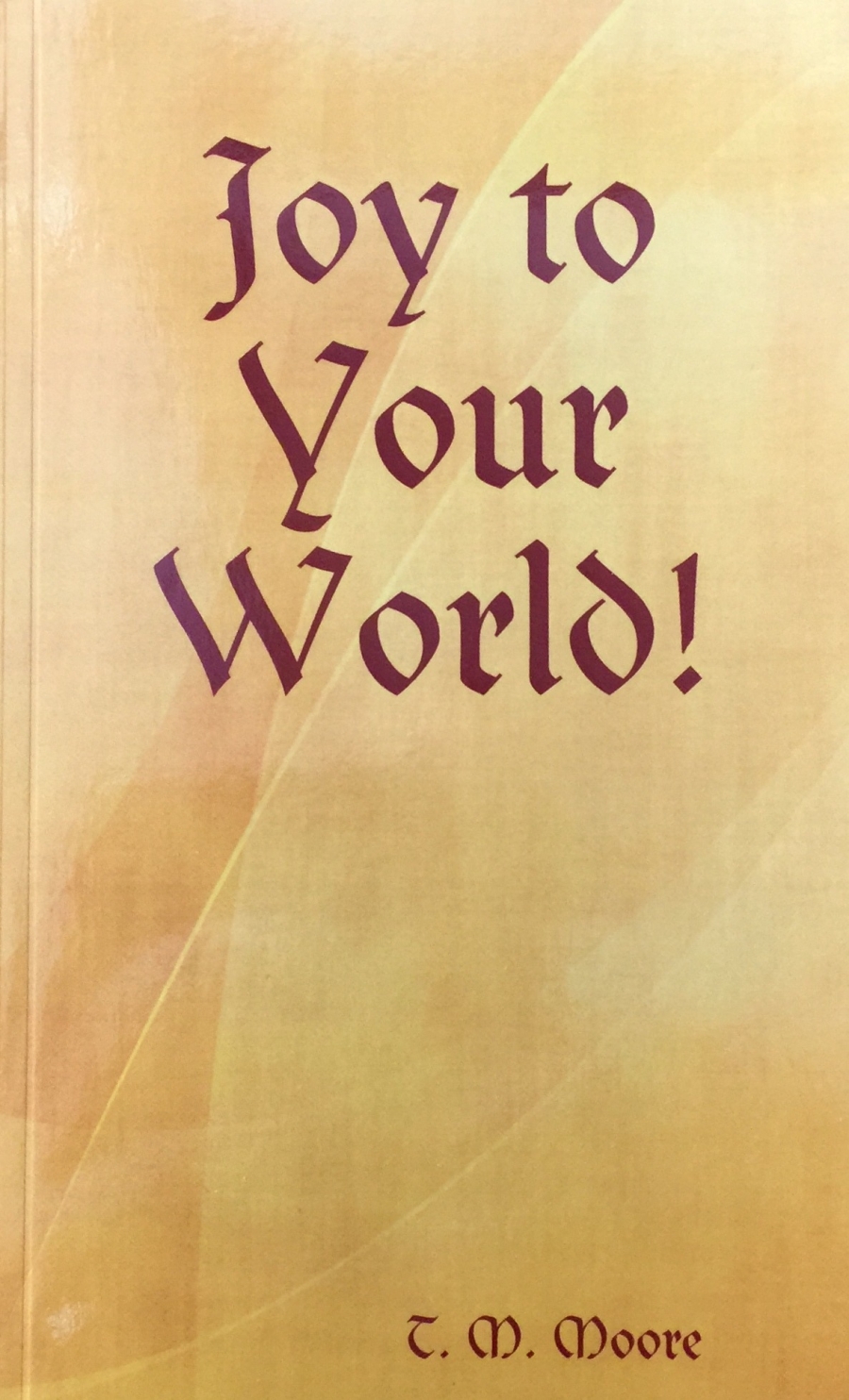
“Joy To The World” is a Christmas song, right? Well, we do often sing it during the Advent season, but T.M. Moore persuasively makes the case in his book Joy To Your World that this message is a year-round blessing.
Quite simply, Moore reminds us that “the Christian life is joy.” Joy is what distinguishes the Christians from others, and joy is what attracts others to the Christian faith more than anything else.
Jesus sent His followers out to make disciples, and the empowering force behind the Christian’s testimony is the joy that Jesus is the One who has conquered hell, death, and the grave. So of all people, Christians should be brimming over with joy.
T.M. Moore writes: “When, because of our knowledge of God, the joy that fills our souls comes to expression as joy lived, then our lives will make sense, our salvation will be visible to the watching world, and we can offer any who may ask, sound reasons for how that joy can be theirs as well.”
This is an excellent message to be read at anytime, not just at Christmas.
That first Christmas was supposedly a silent night and a holy night. Maybe there was some singing angels involved, but at least their message was about “peace on earth.”
Sometimes that idea of “peace” at Christmas time can make us feel like hypocrites. Sometimes it seems as if there is more turmoil than peace, and more ill-will than goodwill.
Even Henry Wadsworth Longfellow’s poem called I Heard The Bells On Christmas Day starts out in celebration, but then shifts to the dark words, “And in despair I bowed my head: ‘There is no peace on earth,’ I said, ‘for hate is strong and mocks the song of peace on earth, goodwill to men.’”
If you have had a hard time finding peace this Christmas, this short message will bring you hope and encouragement, so that you can truly say, “Merry Christmas!”
If you’ve missed any of the messages in our series The Carols Of Christmas, you can find the full list here.