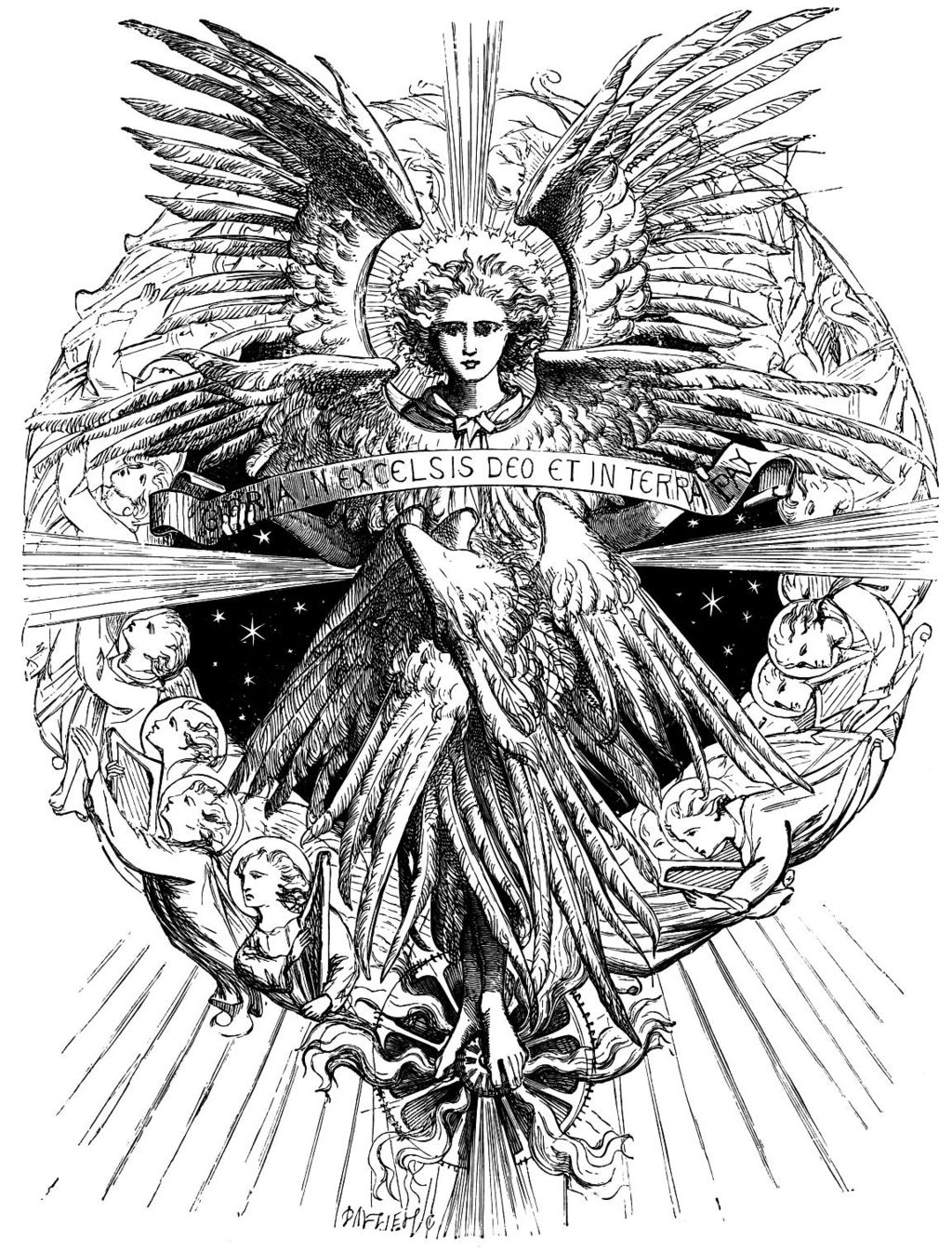
Glory to God in the highest and on earth peace, goodwill to all people.
We praise You, we bless You, we worship You, we glorify You, we give thanks to You for Your great glory.
Lord, King, heavenly God, Father, Almighty; Lord, the only-begotten Son, Jesus Christ, and Holy Spirit.
Lord God, Lamb of God, Son of the Father who takes away the sin of the world, have mercy on us, You who take away the sins of the world. —Angel Hymn / Doxology(~300 AD)
Glory to God in the highest
and peace to His people on earth.
Lord God, heavenly King,
Almighty God and Father,
we worship You, we give You thanks,
we praise You for Your glory.
Lord Jesus Christ, only Son of the Father,
Lord God, Lamb of God,
You take away the sin of the world:
have mercy on us;
You are seated at the right hand of the Father:
receive our prayer.
For You alone are the Holy One,
You alone are the Lord,
You alone are the Most High,
Jesus Christ,
with the Holy Spirit,
in the glory of God the Father. Amen. —updated in the Book of Common Prayer (~1975)
I think all of you can finish this poem: ’Twas the night before Christmas and all through the house not a creature was stirring, not even a mouse.
Haddon Sundblom’s painting for Coca-Cola
This poem was written in 1837 by Clement Moore. Most people assume the title of the poem is the first line of the poem, but Moore’s original title is actually “A Visit From St. Nicholas.” And we all know what St. Nicholas (aka Santa Claus) looks like, right? Actually, this well-known painting of Santa Claus is the creation of Haddon Sundblom for Coca-Cola in 1930, but it’s not too far off from the original St. Nicholas.
Nicholas of Myra
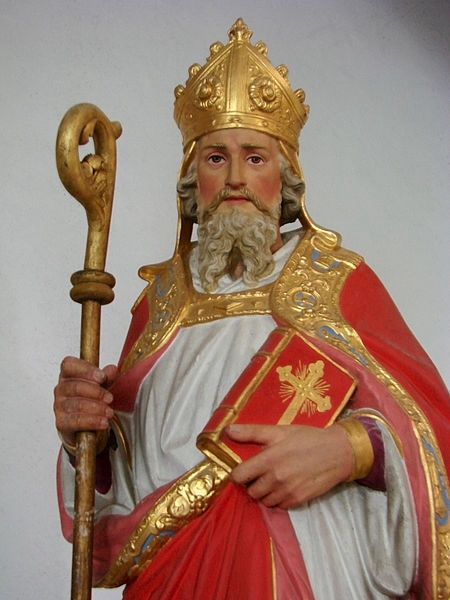
Nicholas of Myra was a Christian bishop who lived in the 3rd century AD. It was discovered by some of his peers that he would anonymously throw bags of money through the open windows of the poor people in his town. Some of the coins landed in these poor families’ shoes and socks as they were drying by the fireplace. The myth grew that without your stockings hung by the fireplace you wouldn’t receive any gifts. After Nicholas died in 342 AD he was declared a saint, so his popular practice of blessing the poor spread and took on a life of its own.
I’m struck by a contrast from the line in Moore’s poem that “the stockings were all hung by the chimney with care.” This tells us how well people prepare for the “arrival” of St. Nicholas each Christmas, but let’s contrast that with how ill-prepared—if they even know they need to prepare!—people are for the absolutely certain fact of the arrival of King Jesus!
Just as the vast majority of Israelites weren’t prepared for the Messiah’s first Advent in Bethlehem in the 1st century, how many people are still unprepared for His second Advent which could occur at any moment?
Think about the contrasts between the legend of St. Nicholas (i.e. Santa Claus) and the certainty of Jesus Christ:
St. Nicholas was a poor monk who has now become richer than imaginable. Jesus is the King of kings who left all His riches and kingly rights to become poor.
St. Nicholas was a servant who has now been elevated to royalty status. Jesus is Absolute Royalty who became a servant.
St. Nicholas lives in a castle at the North Pole; there wasn’t even a room for Jesus at His birth, or even later in His adult life.
St. Nicholas is a fable that people venerate; Jesus is the Truth that people mock.
There was no room in any inn, although Joseph knocked and knocked. Jesus is still knocking today, except today it’s on the door of your heart (Revelation 3:20). Will you let Him in? Or will you continue to allow your heart and mind to be dominated by myths and legends?
Advent is a time for reflection. I don’t think we could ask a more heart-searching question than this—
Am I more prepared for St. Nicholas than I am for King Jesus?
Some things are fascinating by what isn’t said. For instance, in the Christmas carol It Came Upon A Midnight Clear there is something conspicuously missing.
One thing that isn’t missing is singing. Every one of the stanzas ends with a phrase about the angels singing. But can you spot what IS missing? I didn’t see it at first until I read this quote from respected music professor Dr. C. Michael Hawn: “This may be the only commonly sung Christmas carol in our hymnals that does not mention the birth of Christ!”
This carol just sort of assumes that we know why the angels are singing. But do we know?
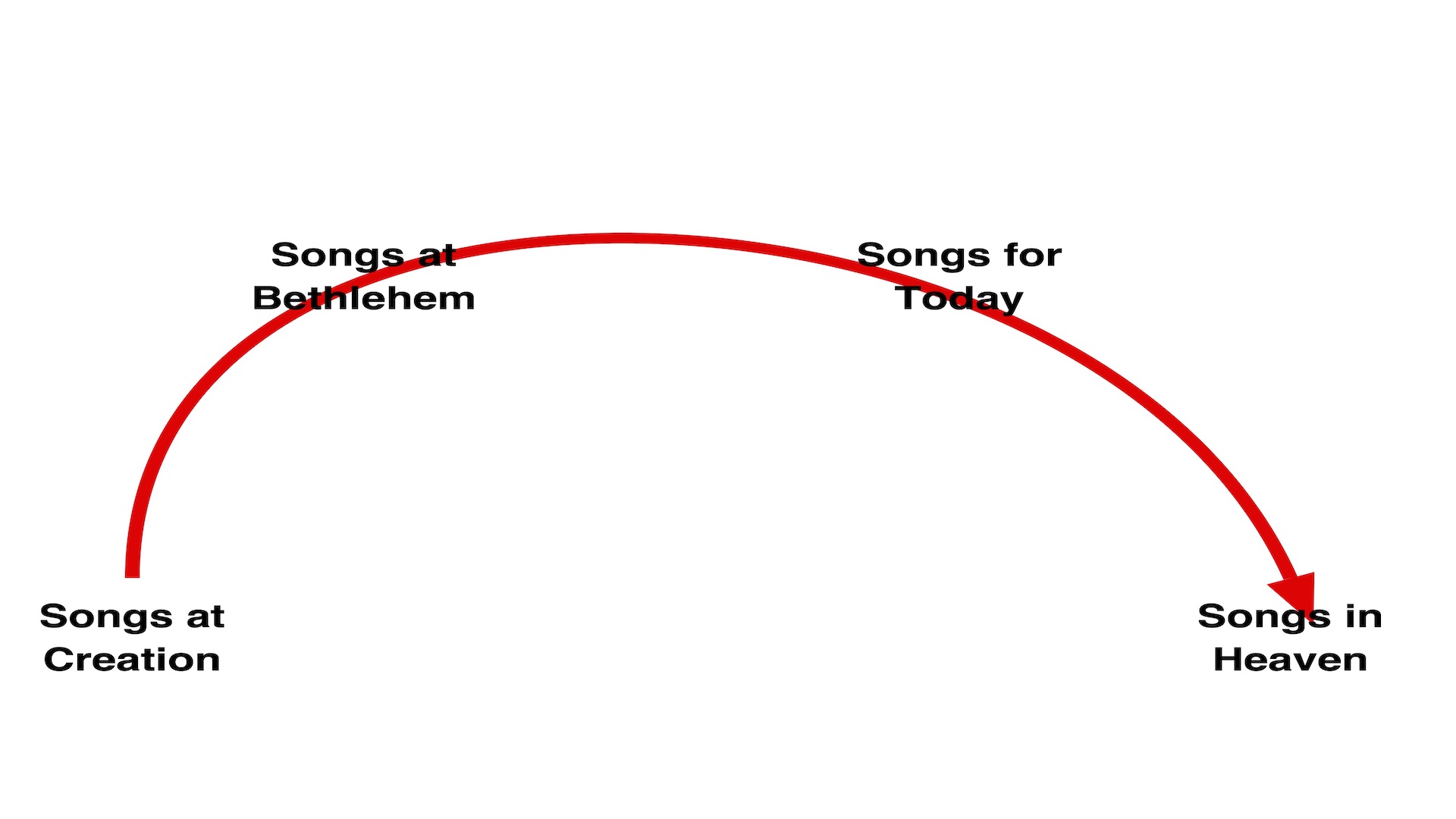
The Bible tells us that the angels were singing at Creation and that they are still singing in Heaven for all of eternity (Job 38:4-7; Revelation 5:9-13; 7:9-12; 15:2-4). Then we have this glimpse of the angels singing when Jesus was incarnated as a human baby in Bethlehem (Luke 2:14). Where did they get their song and their inspiration to sing it?
Their song comes from the Choir Leader who is the King of kings. Jesus is singing in Heaven, before the throne of His Father, about the salvation that He brought to mankind through His incarnation, sinless life, death on Calvary, and resurrection from the grave (see Hebrews 2:9-12).
The song that Jesus sings tells the story of how He came to earth just like us—made a little lower than the angels—so that He might taste sin and death and conquer them for us. Now as our victorious Savior, He is not ashamedto call those who put their faith in Him His brothers and sisters.
Now perhaps you see why angels are also singing all the time!
Even today there is a lot of singing around the Christmas season, but there is something missing in most of the songs: a focus on what Christmas really means. The world’s songs are about trees, and gifts, and Santa, and falling in love, but it’s a song that is out of tune with the angelic song.
As Christians, we have a choice we can look around at this out-of-tune singing and lament what’s happening in our world, we can join in these meaningless songs, or we can look up at our Savior and sing the song He is singing.
Christian, will you join with the angelic choir to let the world hear the unmistakable love song that Jesus is still singing today?
In Longfellow’s classic I Heard The Bells On Christmas Day every stanza ends with the phrase “peace on earth, goodwill to men.” Unless you’ve been living someplace that doesn’t get the daily news, you might be saying, “Peace on earth? Really? I just don’t see it….” Or as Ebenezer Scrooge might say, “Peace on earth? Bah! Humbug!”
A humbug is an imposter, or something empty of meaning.
The third stanza of I Heard The Bells seems almost to slide into that Christmas humbug note: “And in despair I bowed my head: ‘There is no peace on earth,’ I said. ‘For hate is strong and mocks the song of peace on earth, goodwill to men.’”
Indeed, even for those who call themselves a Christian, Christmas could become a humbug if…
… it’s all about busyness or just trying to “survive the holidays”
… we get more excited about Santa Claus coming down the chimney to fill stockings than we do about Jesus coming down to Earth to be born in a manger
… our main focus is on gifts—both what you’re giving and what you’re getting—and then we regret putting ourselves into debt
Between Malachi (the last book of the Old Testament) and Matthew (the first book of the New Testament) is a time span of about 400 years that is called “the dark period.” God had promised through Jeremiah that He would restore the Israelites and rebuild Jerusalem. There were promises of the Messiah coming to set things right, but after 400 years of darkness, the mindset of most Israelites was probably, “Messiah? Peace? Bah! Humbug!!”
What God really promised through Jeremiah was a peace that came about as a result of two things: (1) forgiveness of sins and (2) restoration of a perfect relationship with God. The Hebrew word for “peace” is shalom, which means one’s personal sense of wholeness and well-being, free from anxiety and fear, knowing that all is well between my soul and God.
This is what God promises—I will cleanse them from ALL the sin they have committed against Me and will forgive ALL their sins of rebellion against Me (Jeremiah 33:8).
This shalom is what comes through the First Advent of Jesus! As Longfellow observed, “Then pealed the bells more loud and deep: God is not dead nor doth He sleep; the wrong shall fail, the right prevail, with peace on earth, goodwill to men.”
And this is what Jesus brought—
She will give birth to a Son, and you are to give Him the name Jesus,because He will save His people from their sins (Matthew 1:21 NIV).
Now you have been united with Christ Jesus. Once you were far away from God, but now you have been brought near to Him through the blood of Christ. For Christ Himself has brought peace to us… (Ephesians 2:13-14 NLT)
Therefore, since we are justified (acquitted, declared righteous, and given a right standing with God) through faith, let us grasp the fact that we have…peace with God through our Lord Jesus Christ (the Messiah, the Anointed One) (Romans 5:1 AMP).
The bells and carols and remembrances of Christ’s First Advent should send our hearts soaring in anticipation of Christ’s Second Advent—when Christ shall return to take all of His own to be with Him forever, where He will wipe away every tear and where we live forever with Him in the New Jerusalem (see Jeremiah 33:9; John 14:3; Revelation 21:1-4).
Let us guard against Christmas ever becoming a humbug—an imposter, something empty of meaning—but let’s make sure the rich meaning of Christ’s peace dwells richly in us!
Of peace on earth, goodwill to men. (Henry Wadsworth Longfellow)
How many “old familiar carols” have you heard Christmas after Christmas until the words have almost lost their meaning? If we’re not careful, any song repeated too often can lose the richness of its original intent.
There are some amazing messages in many of our old familiar Christmas carols because many of those messages are saturated with the old familiar story of Redemption that the Bible tells over and over again.
Please join me this Sunday as we take a new look at the old familiar messages in our Christmas carols. These messages will bring a new appreciation of God’s love that was sung at Christ’s Advent, and reawaken the sweetness of meaning for this Christmas Day.
This has been an ongoing series for us. To take a look at the Christmas carols we’ve already talked about, check them out here, here, here, and here, and here. The Advent songs we looked at this year are:
When C.S. Lewis first introduces us to the land of Narnia in The Lion, The Witch and The Wardrobe, we discover that the White Witch has Narnia seemingly under her iron fist, and has made it so that it’s always winter but never Christmas.
“Come on!” cried Mr. Beaver, who was almost dancing with delight. “Come and see! This is a nasty knock for the Witch! It looks as if her power is already crumbling. … Didn’t I tell you, that she’d made it always winter and never Christmas? Didn’t I tell you? Well, just come and see!”
And then they were all at the top and did see.
It was a sledge, and it was reindeer with bells on their harness. But they were far bigger than the Witch’s reindeer, and they were not white but brown. And on the sledge set a person whom everyone knew the moment they set eyes on him. He was a huge man in a bright red robe (bright as holly-berries) with a hood that had fur inside it and a great white beard that fell like a foamy waterfall over his chest. … Some of the pictures of Father Christmas in our world make him look only funny and jolly. But now that the children actually stood looking at him they didn’t find it quite like that. He was so big, and so glad, and so real, that they all became quite still. They felt very glad, but also solemn.
“I’ve come at last,” said he. “She has kept me out for a long time, but I have got in at last. Aslan is on the move. The Witch’s magic is weakening.”
I think the Israelites waiting for their Messiah must have felt a little like the Narnians: always winter, but never Christmas; trapped under the iron-fisted rule of Babylon, and Persia, and Rome.
But as they approached what we now call the year 1 AD, winter is about to end and the Advent of CHRISTmas is about to occur at long last!
You might think that the birth of Jesus brought us the King of Kings. But actually, there were three other “king of kings” that preceded Jesus, who all helped to fulfill God’s ultimate plan.
Nebuchadnezzar was the king of Babylon. God called him “My servant” and also gave him the title “king of kings” (Jeremiah 27:6; Ezekiel 26:7). It was he who defeated Judah and took captives with him to Babylon. Among those captives was a young man named Daniel.
God gave Daniel the ability to interpret Nebuchadnezzar’s dream which foretold of three other kingdoms which would follow Babylon, with the fourth kingdom being called a kingdom of iron. History shows us that Babylon was defeated by the Medes, who were in turn defeated by the Persians, who were themselves defeated by the Greco-Romans.
Artaxerxes was king of the Persians, and he called himself “king of kings” (Ezra 7:12). He helps to facilitate the Jews’ return back to Jerusalem, and even helped fund their efforts to rebuild the temple of Solomon and reestablish worship there.
In 44 BC, Julius Caesar was assassinated, and Octavius was named in Caesar’s will as his adopted son and heir. Eventually, Octavius quelled a 20-year-long civil war and established himself as the unquestioned ruler of the Roman Empire. He changed his name to Caesar Augustus, which means the exalted one. But all throughout the Mediterranean world archeologists have discovered numerous other titles for Caesar Augustus—Divine, Son of God, God Incarnate, God from God, Lord, Redeemer, Liberator, Savior of the World, and King of Kings.
Historian Luke records these words, “In those days Caesar Augustus issued a decree” (Luke 2:1). This decree called everyone to return to his hometown to be registered in Rome’s census. This decree meant that Joseph was obligated to return to Bethlehem. He took his pregnant wife with him to arrive just in time for Jesus to be born.
Jesus—THE eternal and ultimate King of Kings—was born in Bethlehem just as had been prophesied 700 years earlier in the winter of Israel’s captivity:
But you, Bethlehem Ephratah, you are little to be among the clans of Judah; yet out of you shall One come forth for Me Who is to be Ruler in Israel, Whose goings forth have been from of old, from ancient days (eternity). (Micah 5:2)
The coming of THE King of Kings is proof that God sees you too. God brought the king of kings named Nebuchadnezzar, and Artaxerxes, and Caesar Augustus to power just to move two “average Joes” 70 miles from Nazareth to Bethlehem so that THE King of Kings could be born there to fulfill the prophesy.
God has a plan for your life. His plan for you was in place before you were even conceived in your mother’s womb. And—even this very moment—He is watching over world events to make sure that every detail of His plan is fulfilled (see Ephesians 2:10; Psalm 139:16; Jeremiah 1:12)!
If you ever feel like you are in a “winter” season of your life—always winter and never Christmas—just remember that God sees you, He has a plan for you, and He will bring an end to your winter just in time to bring you CHRISTmas!
We live in an amazing time—the First Advent of Jesus has already happened in Bethlehem, and yet we are eagerly anticipating Christ’s Second Advent at any moment!
The fourth stanza of Charles Wesley’s classic Christmas carol Hark! The Herald Angels Sing is a wonderful between-the-Advents look at what happened at the First Advent, and what we have to look forward to in the Second Advent. The key thing to note in this stanza is the verbs: come, fix, rise, bruise, efface, stamp, and reinstate.
COME, Desire of nations—What is the “desire of nations”? It’s the restoration of God’s glory on earth, so it’s not really a what but a Who. The prophet Haggai informs us that our Desire is realized in the Advent of Jesus (2:1-9).
FIX in us Thy humble home—At His First Advent, Jesus came and humbly made His home among us, even dying to pay the penalty for our sins (Hebrews 2:14, 17; Philippians 2:7-8).
RISE, the woman’s conquering seed—Although Jesus was obedient to death—even death on a Cross, He didn’t stay dead but was resurrected (Philippians 2:8-9; Revelation 1:18)!
BRUISE in us the serpent’s head—With His death and resurrection, Jesus took away the sting of death from satan, fulfilling one of God’s first prophesies (Genesis 3:15; 1 Corinthians 15:19-26, 54-57).
Adam’s likeness now EFFACE—That means to wipe out, do away with, expunge. That’s exactly what God does with our forgiven sins (Psalm 103:1-4, 10-12)!
STAMP Thine image in its place—Although our sin has been effaced, God doesn’t leave us as blank slates, but instead He allows the image of His Son Jesus to be stamped onto our lives (2 Corinthians 1:21-22; 2 Corinthians 3:18).
REINSTATE us in Thy love—The relationship we longed for is now reborn in us (1 Corinthians 15:49)!
The Desire of Nations HAS come, and yet He WILL come again! We’re living between the Advents now, so a good question for Christians to ask is: “How are we to live?” I think there are three key things—
In celebration that Jesus came at His First Advent to be our Savior
In anticipation of the Second Advent
In obedience to God’s Word (Revelation 22:7)
To take a look at the other stanzas of this Christmas carol, please click here.
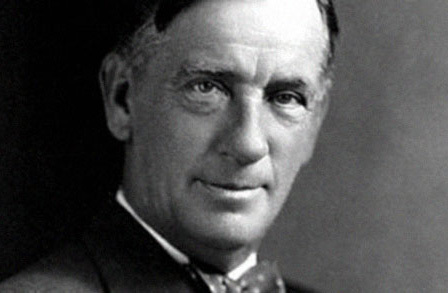
A man is at his finest towards the finish of the year; He is almost what he should be when the Christmas season is here; Then he’s thinking more of others than he’s thought the months before, And the laughter of his children is a joy worth toiling for. He is less a selfish creature than at any other time; When the Christmas spirit rules him he comes close to the sublime.
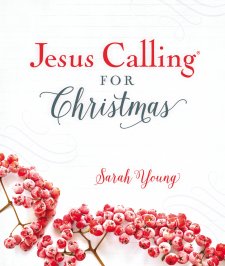
“I am Immanuel—God with you—and I am enough! When things in your life are flowing smoothly, it is easy to trust in My sufficiency. However, when you encounter rough patches—one after another after another—you may sometimes feel that My provision is inadequate. This is when your mind tends to go into high gear: obsessing about ways to make things better. There is nothing wrong with seeking solutions, but problem-solving can turn into an addiction: your mind spinning with so many plans and possibilities that you become confused and exhausted.
“To protect yourself from this mental exhaustion, you need to remind yourself that I am with you always, taking care of you. It is possible to rejoice in Me—to proclaim My sufficiency—even during the most difficult times. This is a supernatural work, empowered by My Spirit who lives in you. It is also a decision that you make—day by day and moment by moment. Choose to be joyful in Me, your Savior, for I am indeed enough!” —Jesus Christ (in Sarah Young’s Jesus Calling For Christmas)
(You can check out some more quotes from Sarah Young’s book by clicking here.)



 Glory to You who have shown us the light.



 Craig T. Owens