Links & Quotes

Christian saints have the joyful privilege of being able to step up for fellow saints. It’s hard work at times, but if we remember who those saints really are, it’s never heavy work! 

I have a lot of new video content on my YouTube channel every week. Please check it out and subscribe so you don’t miss anything.

“A people that values its privileges above its principles soon loses both.” —Dwight D. Eisenhower 

“[Jesus] draws us to Himself daily, to seek His beauty in Scripture, dwell before the beauty of His glorious face, bask in the beauty of His heavenly throne room, and become, increasingly, His beauty in and to the world. No matter how long we’ve known Him or how careful and earnest our study of Him has been, His fresh beauty remains fresher still.” —T.M. Moore

“Christianity is always out of fashion because it is always sane; and all fashions are mild insanities.” —G.K. Chesterton 

Replace the “sandwich method” of feedback with this: (1) Tell the person why you are giving them feedback, (2) Give them the feedback, and (3) End with a belief statement.

Never Self-Sufficient

Listen to the podcast of this post by clicking on the player below, and you can also subscribe on AppleSpotify, or Audible. 

There is a cliche people love to quote: “Give a man a fish and you feed him for a day. Teach a man to fish and you feed him for a lifetime.” 

Is this how Christians should live? 

It sounds like the experienced fisherman may be annoyed at having to catch a fish every day just to give it to someone else. If you want to put a noble spin on the cliche, you could say that the wise and patient fisherman invested his time to teach someone else to provide for themselves, never needing to return to their teacher. 

This certainly wouldn’t be the example of Jesus. 

As He was teaching the large crowd of people, whom He thought of as sheep without a shepherd, they became hungry. Jesus directed His disciples to feed them. He didn’t tell them to teach the crowd to provide for themselves. 

As Jesus miraculously fed thousands of people, notice that He kept on giving until they were all satisfied—

     And taking the five loaves and two fish, He looked up to heaven and, praising God, gave thanks and broke the loaves and kept on giving them to the disciples to set before the people; and He also divided the two fish among them all. And they all ate and were satisfied. (Mark 6:41-42 AMPC)

The example in the Old Testament was to look to God for a supply of manna every single day. In the New Testament, Jesus taught us to pray for our daily supply of bread every single day (Exodus 16:14-17; Matthew 6:11; John 6:35).

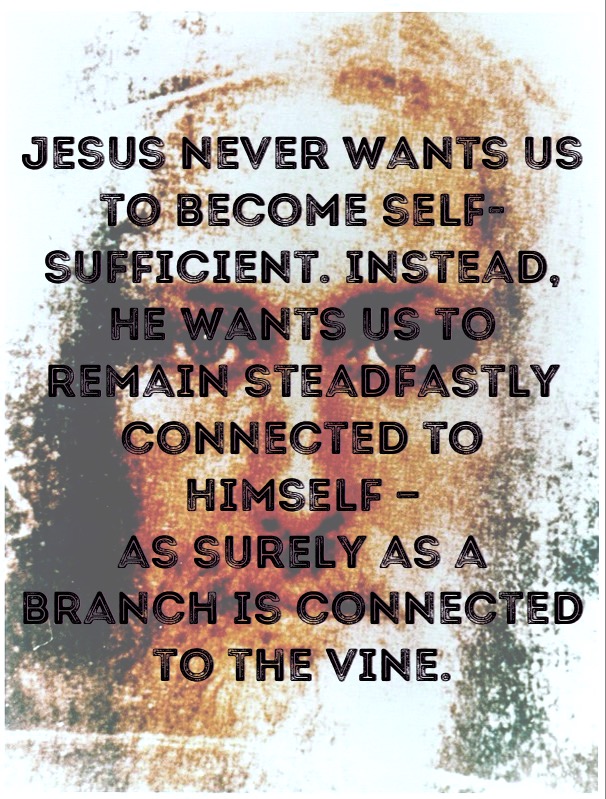
Jesus never wants us to become self-sufficient. Instead, He wants us to remain steadfastly connected to Himself—as surely as a branch is connected to the vine. 

Far from teaching us to provide for ourselves, Jesus says, “If you remain in Me and I in you, you will bear much fruit; apart from Me you can do nothing” (John 15:5). 

Jesus is never wearied by our continually coming to Him; rather, He is delighted when we do! He wants to be our supply each and every day for all of eternity! 

►► Would you please prayerfully consider supporting this ministry? My Patreon supporters get behind-the-scenes access to exclusive materials. ◀︎◀︎

Reading, Confessing, Worshiping

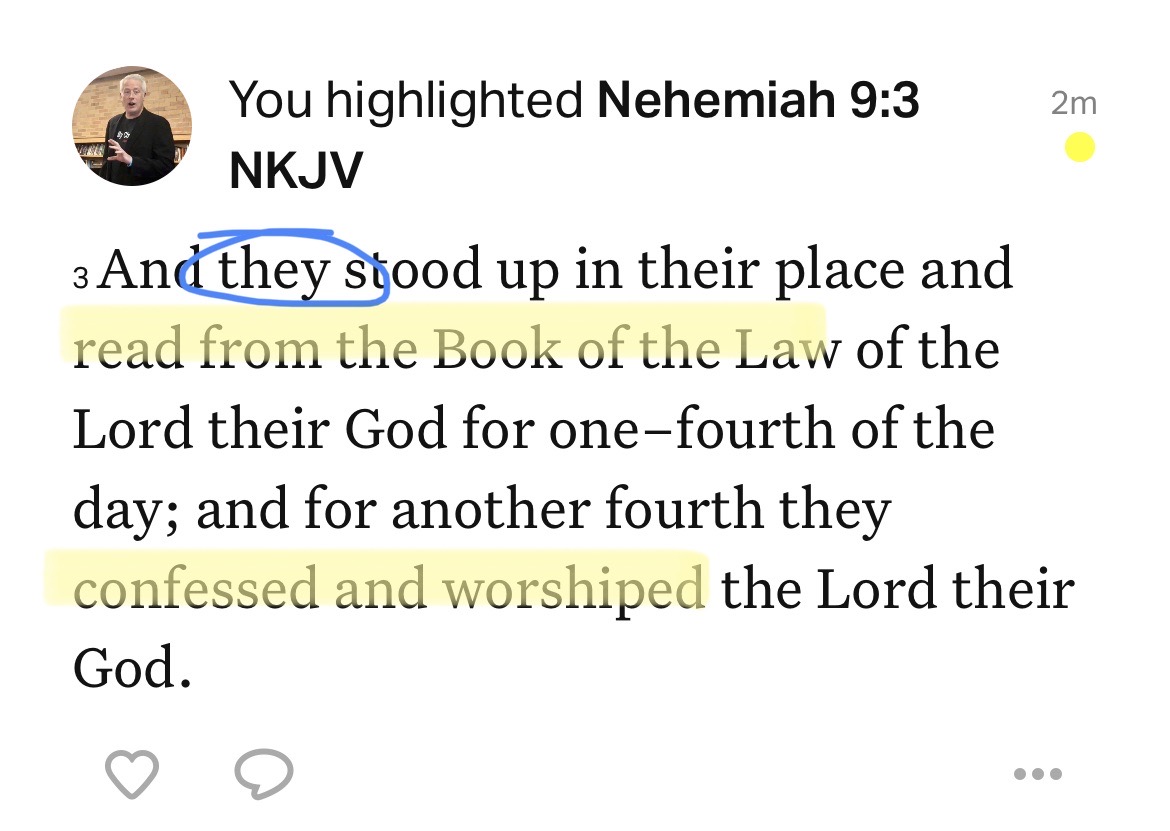
And they stood up in their place and read from the Book of the Law of the Lord their God for one-fourth of the day; and for another fourth they confessed and worshiped the Lord their God. (Nehemiah 9:3)

I have three takeaways from this verse—

(1) When we read God’s Word, the Holy Spirit illuminates it to us. Confession and worship should be normal responses to the Word and the Spirit.

(2) There is something special when saints come together to learn what God is speaking to them.

(3) Don’t put God on the clock, but bask in His presence.

When Shepherds And Sheep Talk

Listen to the podcast of this post by clicking on the player below, and you can also subscribe on AppleSpotify, or Audible. 

In John 10:1-18, Jesus calls Himself the Good Shepherd, and He refers to those who follow Him as His sheep. 

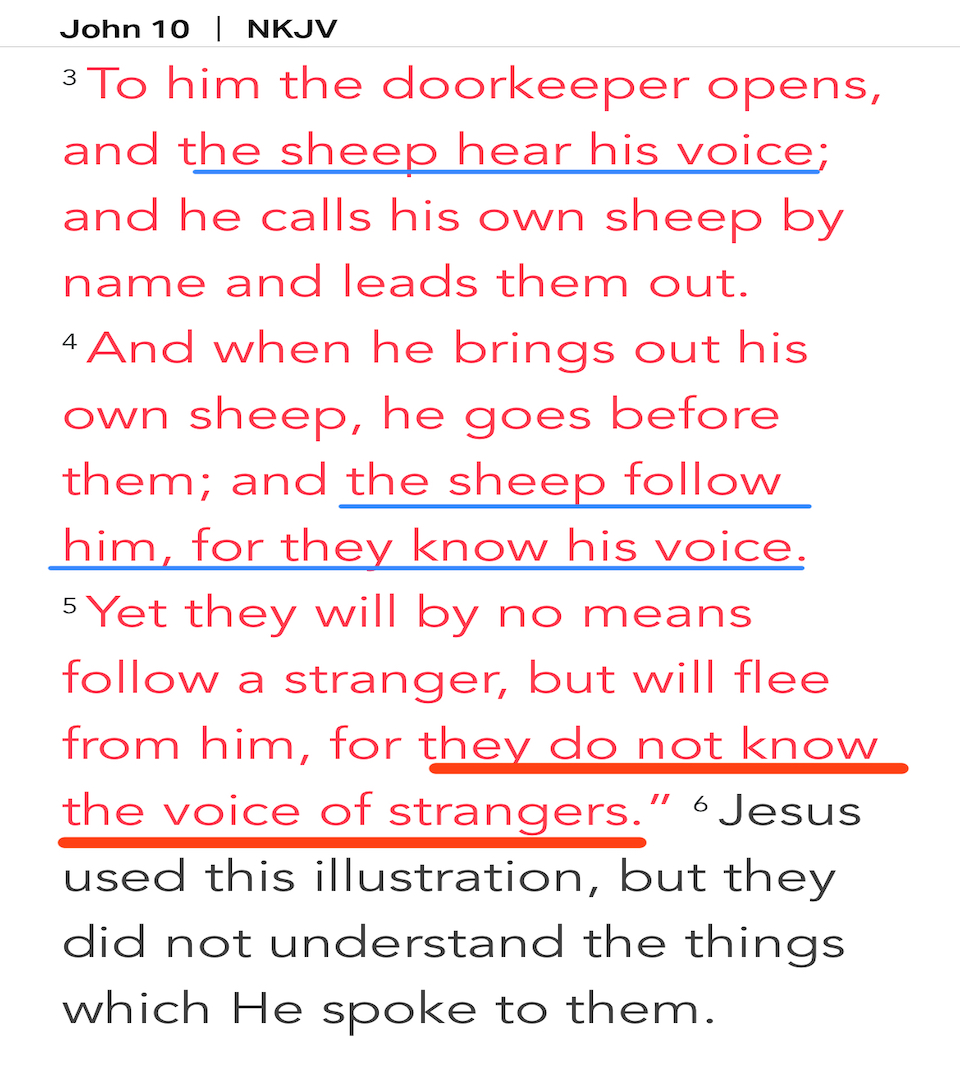
Anyone who has ever seen a shepherd interact with his sheep knows that the sheep are listening for their shepherd’s voice to give them direction, but they will ignore or run away from a stranger’s voice. 

(You may want to check out this video clip where I talk about how shepherds individualize their care for their sheep.)

This requires two-way communication. The shepherd must speak tenderly and convincingly, and the sheep must remain tuned in to their shepherd’s voice with an ear to follow. 

This requires proximity. The shepherd cannot speak from a distance without raising his voice, and sheep will never be attracted to someone who yells at them. 

This requires consistency. The shepherd needs to continually speak life-giving words, and the sheep need to consistently obey the shepherd’s words in order to reap the benefits. 

This requires discernment. The sheep have to be able to know the difference between their shepherd’s voice and a stranger’s voice. The shepherd needs to speak “words of eternal life” (see John 6:68-69). 

This requires patience. A shepherd’s directions really “get through” the first time, so the message needs to be patiently, lovingly, and creatively repeated. 

This requires abiding. The shepherd needs to show himself trustworthy, and the sheep need to show themselves faithful in their abiding with their shepherd. 

Jesus is the good and perfect Shepherd. There is no one else to whom I should be trusting, abiding with, listening to, and obeying. 

The Good Shepherd will call some of His sheep to serve as His under-shepherds for other sheep. Those under-shepherds bring the Good Shepherd glory by shepherding just as Jesus models for them. 

When shepherds and sheep remain in constant communication, there is a vitality and maturity that is readily apparent. And when the communication breaks down, the health of the sheep quickly deteriorates. 

If you have been called to be an under-shepherd, please check out my books Shepherd Leadership and When Sheep Bite that will give you practical, biblical guidelines for you to thrive in this beautiful ministry. 

►► Would you please prayerfully consider supporting this ministry? My Patreon supporters get behind-the-scenes access to exclusive materials. ◀︎◀︎

Links & Quotes

There’s no secret formula to fruitfulness as a Christian. We just stay connected to Jesus and the fruit will grow. This clip is from this sermon.

I have lots of new content every week, which you can check out on my YouTube channel.

The “Ten Commandments” are not explicitly listed or reiterated in the New Testament. Does that mean they are obsolete? No, says David Mathis, it means they are fulfilled. “Jesus Himself says He did not come to destroy the Law and Prophets, but to do something even more striking: fulfill them (Matthew 5:17). That is, fulfill like prophecy. Not simply keep the Ten in place, or remain under them, or leave them untouched, but fulfill them—first in His own person, and then by His Spirit in His church. He came not to cast off Moses, but to fulfill Jeremiah, and in doing so, He accomplished what is even more radical: establishing Himself as the supreme authority, putting God’s law within His people (rather than on tablets), writing it on their hearts (rather than stone), and making all His people to know Him (Jeremiah 31:31–34).” Check out my post The 10 Commandments in the New Testament.

More archeological evidence supporting to the historicity of the Bible. You can check out the full article, but this paragraph is a good summation: “One of the surprising findings was that, according to the results of their tests, the Broad Wall in Jerusalem, also known as Hezekiah’s Wall, was likely built during the reign of Uzziah, who Scripture says built fortifications in Jerusalem (2 Chronicles 26:9). Another finding was that Jerusalem was much more heavily populated and urbanized in the 12th through 10th centuries BC than some scholars previously thought. This would align with the biblical description of Jerusalem, particularly during the days of David and Solomon.”

“There is much of beauty, goodness, and truth to be discovered in the city of man, as Augustine pointed out toward the end of his great treatise, City of God. But all the culture and best intentions of men turn to corruption apart from the power of God to redeem and renew them. We who live also in the heavenly city now possess the mind of Christ (1 Corinthians 2:16); we are able to see the ways that culture can be ‘taken captive’ from the clutches of sin and unbelief and made to serve the purposes of Christ in all things. Thus, for the honor and glory of God, we commit ourselves daily to using all our time, activities, relationships, roles, responsibilities, and culture to furthering His rule on earth as it is in heaven.” —T.M. Moore

“Have movies and most conventional paleontologists got it all wrong? T. rex and other theropod dinosaurs (the meat-eaters) are often portrayed as intelligent predators that can outmuscle and outsmart their opponents. But is that really supported by science?” A very interesting compilation of research can be found here. The conclusion is exactly right: “God designed dinosaur brains that were perfectly suited for their lifestyles and body size when He created dinosaurs on Day 6 of the creation week (Genesis 1:25).” 

Always Ready

Listen to the podcast of this post by clicking on the player below, and you can also subscribe on AppleSpotify, or Audible. 

A large crowd surrounded Jesus. “He welcomed them and spoke to them about the kingdom of God, and healed those who needed healing. Late in the afternoon the Twelve came to Him and said, ‘Send the crowd away so they can go to the surrounding villages and countryside and find food and lodging, because we are in a remote place here.’ He replied, ‘You give them something to eat’” (Luke 9:11-13). 

Why did the crowds seek out Jesus? They came to Him because they knew He had wisdom, healing, and food for them. As disciples of Jesus, we never know when people will be around us that are in need. In fact, the closer we walk with Jesus, the more needy people will begin to gravitate toward us.

Jesus never intends that we simply give them a verbal blessing like, “Go, be filled and be warm” (James 2:16).

Jesus wants us to give them something substantial.

This means we need to both prepare and stock up ahead of time (be proactive) and we need to be sensitive to the prompting of the Holy Spirit in each encounter we have with a needy person (be reactive).

Jesus told us that the Holy Spirit would remind us of His words (John 14:26), but that means we have to study His words ahead of time. The Holy Spirit can then give us those words to share in the heat of the moment (Matthew 10:19–20). 

Jesus also instructed us to have available both old and new treasures to share with people around us (Matthew 13:52). The old speaks to being proactive, and the new is reactive to each thing that we are learning and experiencing.

One of my life’s mottos is: Leave every place better than I found it.

That means I also want to leave every person better than they were before we crossed paths. 

In order to do this, I have to have something substantial—something eternally significant—to give to them. When needy people show up, it is too late for me to prepare.

I want to be always ready. That means I need to be always abiding with my Savior. I need to be learning at the feet of Jesus, filled with the power of the Holy Spirit, and saturated in the love of God, so that I always have something good to give. 

Jesus, when you tell me, “Give them something to eat,” I want to give them You. Help me to proactively prepare so that I am ready to react in a way that glorifies You every single time.

►► Would you please prayerfully consider supporting this ministry? My Patreon supporters get behind-the-scenes access to exclusive materials. ◀︎◀︎

Links & Quotes

Many of the examples Jesus used to tell us about the Kingdom of God seem like such small things. But those small beginnings have irresistible growth potential! Check out more thoughts in my series of posts called Kingdom Praying. I have lots of new content every week, which you can check out on my YouTube channel.

My wife is a school teacher and I also work quite a bit in our local schools. I think T.M. Moore is spot-on in his analysis of the breakdown in our current educational system: “This commitment to the Law and Word of God as foundational to the education of the young was everywhere practiced throughout the pre-revolutionary period in colonial America. It was unthinkable in the colonies that young people should be submitted to any instruction for any length of time without being taught the commandments and statutes of God, including the Gospel of Jesus Christ. Parents insisted on it, colonial and local statutes required it, and local school boards dutifully saw to it in all their schools.Since the middle of the previous century, assailed by specious invocations of ‘the separation of Church and State,’ educational policy in America has increasingly denied a place to God, His commandments, and His Word in the public-school curriculum. Generations of American children have grown up in a ‘disenchanted’ world (Charles Taylor), a world in which God, spiritual things, and the Law of God are deemed to be irrelevant if not oppressive, or at least a nuisance. The present crisis of morality, culture, and social upheaval is only the most visible consequence of that policy.”

David Mathis shared some thoughts about the healthy pace of ministry Jesus demonstrates for us. He said, “Let’s sit together at the feet of Jesus, and consider the pace and patterns of His life and ministry. He was not idle. Nor was He frenzied. From all we can tell from the Gospels, Jesus’s days were full. I think it would be fair to say He was busy, but He was not frantic. He lived to the full, and yet He did not seem to be in a hurry. In Jesus, we observe a human life with holy habits and patterns: rhythms of retreating from society and then reentering to do the work of ministry. Even as God Himself in human flesh, Jesus prioritized time away with His Father. He chose again and again, in His perfect wisdom and love, to give His first and best moments to seeking His Father’s face.“ These words resonate with me, because they are thoughts that I considered quite extensively for my book Shepherd Leadership.

I love reading stories like these that show how a relationship with Jesus utterly transforms a person’s life! “Opal W. Eubanks joined the Mississippi Highway Patrol during the race riots of 1964. A large, broad-shouldered white man, he relished the opportunity to strike fear in the hearts of African-Americans who were in trouble with the law. By his own admission, he was a foul-mouthed sinner who liked ‘rough stuff.’ A radical conversion to Christ in the early 1970s altered the course of Eubanks’ life, and his hardened heart became tender toward African-Americans in his rural community. He and his wife, Thelma, ultimately pioneered an Assemblies of God congregation consisting mostly of African-Americans, which they pastored for 21 years.”

The Greek word for “teaching” in Mark 9:31 means an ongoing dialogue. It’s an imperfect verb here because it is an activity that is never fully completed. Jesus wants us to abide with Him—to dialogue with Him—to continually learn from Him. The New Living Translation says it this way, ”For He wanted to spend more time with His disciples and teach them.” This is just as true for us today! 

J. Warner Wallace addresses the claims that the Old Testament prophets actually foretold that Jesus would be the Messiah. I love considering the apologetics for the death and resurrection of Jesus Christ, and this video will become an added resource for me in the future.

Andrew Murray On Preaching

“When the Lord chose His twelve disciples, it was ‘that they might be with Him and that He might send them out to preach’ (Mark 3:14). A life in fellowship with Him prepared them for the work of preaching. … 

“The law of their first calling remained unchanged: their unbroken fellowship with Him was the secret of their power to preach and to testify of Him. … 

“The same principle stands for all His servants, for all time: without the experience of His presence with us, our preaching has no power. The secret of our strength is the living testimony that Jesus Christ is every moment with us, inspiring, directing and strengthening us. … 

“But remember that this power is never meant to be experienced as if it were our own. It is only as Jesus Christ as a living Person dwells and works with His divine energy in our own hearts and lives that there can be power in our preaching as a personal testimony. … 

“For it’s only when His servants show in their lives that they obey Him in all His commands can they expect the fullness of His power and His presence to be with them. Only when they themselves are living witnesses to the reality of His power to save and to keep from sin can they expect to experience His abiding presence, and the power to train others to the life of obedience that He asks.

“The living experience of the presence of Jesus is an essential element in preaching the gospel. If this becomes clouded, work becomes a human effort, without the freshness and power of the heavenly life. Nothing can bring back the power and blessing but a return to the Master’s feet so that He may breathe into the heart, in divine power, His blessed word, ‘I am with you always!’” —Andrew Murray

Links & Quotes

Healthy leaders look in the mirror first before they confront a teammate on something that needs to change. Check out the full conversation Greg and I had on The Craig and Greg Show about defeating the two-headed leadership killer of ignorance and arroganceI have lots of new content every week, which you can check out on my YouTube channel.

“I am often, I believe, praying for others when I should be doing things for them. It’s so much easier to pray for a bore than to go and see him.” —C.S. Lewis, Letters to Malcolm: Chiefly on Prayer

“The greatest weapon against stress is our ability to choose one thought over another.” —William James

The most empowered and empowering person is the one who remains in Jesus.

“Whereas three or more incidents of intense stress within a year (say, serious financial trouble, being fired, or a divorce) triple the death rate in socially isolated middle-aged men, they have no impact whatsoever on the death rate of men who cultivate many close relationships.” —Daniel Goleman, Richard Boyatzis & Annie McKee, Primal Leadership

T.M. Moore has an outstanding series of posts on how Christians should interact with the governments in the lands in which they live. I highly recommend this series to you. T.M. wrote, “We have seen that justice is a jewel of many facets. In its obligatory facet, justice requires that we love our neighbors simply because they are made in the image of God. We must regard them, and do with them, as we wish to be regarded and done with ourselves. In its preventive facet, justice demands that we use forethought in all our actions to make sure, as far as possible, that our neighbor or his property is not injured by what we do. Distributive justice encourages us to share generously with our neighbors and others in need. Restorative justice comes into play when the balance of neighbor love has become disturbed and the one guilty of disturbing it is required to set things right again. Each of these forms of justice, grounded in the Law of God, is very much a part of life in our society today. It is simply mindless or prejudicial to insist that we should have no input from Scripture or the Law of God, either in the public square or in the making of public policy. Our nation was founded on Biblical principles of justice, and to deny this is to rewrite history past and to put in jeopardy history to come.”

The Greek word translated as “consider” in Hebrews 3:1 means to observe closely, to consider attentively, to fix your eyes or mind upon it. In its context, this verb is usually directing us to the end result of being in awe, kindling a renewed faith, and being rejuvenated with a new resolve to move forward. This is what happens especially when we consider Jesus❣️

In, On, And Through

Listen to the podcast of this post by clicking on the player below, and you can also subscribe on AppleSpotify, or Audible. 

I’ve talked before about the benefits of calling the Old and New Testaments the First and Second Testaments. This helps me not to subconsciously slip into the thought that “old” means outdated or that “new” means a replacement of what came before it. When I say First and Second I remember that there cannot be a Second without a First, that the First anticipates the Second and the Second fulfills the First. 

The people of the First Testament experienced the Spirit of God in an often-repeated phrase: “the Spirit of the Lord came on” someone. It usually came on them for a specific task or season. For instance…

  • 70 leaders to help Moses (Numbers 11:25)
  • the judges that delivered Israel from their enemies (Judges 3:10, 6:34, 11:29, 14:6, 15:14)
  • the anointing for Israel’s king (1 Samuel 16:13)
  • empowerment for prophets to prophesy (Ezekiel 11:5)

(Check out all of the above references by clicking here.)

When the Holy Spirit came on these men, there was a noticeable supernatural anointing and empowerment, but more times than not these men also had visible and sometimes crippling stumbles. 

What happens on the outside often stays on the outside. Sort of like the little boy whose mom brought him to church one Sunday. The little boy was constantly standing up on his chair and disturbing everyone around him. Finally, the exasperated mother whispered, “If you don’t sit down I’m going to take you to the restroom and spank you.” The little boy immediately sat down with his arms tightly crossed. He looked at his mom and said, “Outside I may be sitting down but inside I’m standing up!” 

God looks at the heart. He told the Israelites that their inward defiance didn’t outweigh their outward religious practices. And Jesus said that people who prophesied, cast out demons, and performed miracles, but still had an unrepentant heart, would hear Him say, “I never knew you” (Isaiah 1:12-13; Matthew 7:21-23). 

In the First Testament, we see a desire for the Holy Spirit to be more than on—a desire for Him to come in. David prayed, “Create in me a pure heart, O God, and renew a steadfast spirit within me” (Psalm 51:10). And God promised His people, “I will give them an undivided heart and put a new spirit in them … And I will put My Spirit in you and move you to follow my decrees and be careful to keep My laws” (Ezekiel 11:19, 36:27). 

That is exactly what happened on that Pentecost Sunday immediately following Christ’s resurrection and ascension. The Christians were baptized in the Holy Spirit. He came in them and brought them into the Godhead (John 14:20). 

Jesus described this “in-ness” in the picturesque language of a branch joined to the vine. The branch cannot produce any fruit on its own, but it abides in the vine so that the fruit-producing power can flow into the branch (see John 15:1-5). 

Paul identified this fruit of the Spirit as “love, joy, peace, forbearance, kindness, goodness, faithfulness, gentleness and self-control,” and he concluded with the phrase, “against such things there is no law” (Galatians 5:22-23). The law always sets limits, but when the Holy Spirit abides in us, the production of fruit is limitless! 

Being baptized in the Holy Spirit means that we allow Him to come in us and then to work on us. It’s only when the Holy Spirit has worked in us that can He flow through us to others. Jesus said that we would receive the Spirit’s empowerment to be witnesses—that’s an inward change that produces an outward fruit.

The Holy Spirit works in us to work on us so that He can work through us. So don’t stop at just salvation, but be baptized in the Holy Spirit! 

If you’ve missed any of the messages in our series on the Pentecostal experience, you can find all of those messages by clicking here. 

►► Would you please prayerfully consider supporting this ministry? My Patreon supporters get behind-the-scenes access to exclusive materials. ◀︎◀︎