6 Ways To Make Sure Everything You Do Is Sacred

It's all sacredAround 1300 AD, the Church began propagating a myth. It showed up in two words that were created around that time: clergy and laity.

Simply stated, clergy is from a root word that means “the learned men … the ones enlighten for ministry.” And laity is anyone not in that inner circle.

Insecure leaders did this to maintain control. They continued to read the Scriptures in Latin, which few could read, so they made sure that the clergy alone had a Bible, and they alone became the expounders of how the Bible told us to live.

In the clergy-laity divide, they also created a sacred-secular divide.

When Paul addresses the Colossians he does so with anything but a clergy-laity divide in mind. He calls them the holy and faithful brothers in Christ (Colossians 1:2). The KJV translates holy as saints, for that’s how Paul indeed sees them. And he sees them as his very own faith-filled brothers.

Paul also has anything but a sacred-secular divide in mind as he instructs then—whatever you do, whether in word or deed.

He makes it clear that everything we do as faith-filled, holy saints is to be sacred and God-honoring.

How do we do whatever we do in a sacred, God-honoring way? We ask these six questions:

[1] Can it be done with a clear conscience? (Acts 23:1; 24:16)

  • “It is not WHAT a man does that determines whether his work is sacred or secular, it is WHY he does it.” —A.W. Tozer

[2] Will it promote the Gospel? (Philippians 1:27)

[3] Is it a good deed? (Acts 10:38; James 3:13)

[4] Does it point people to God? (1 Peter 2:12; 1 Corinthians 10:31)

[5] Can I do it in the name of Jesus? (Colossians 3:17do it ALL in the name of Jesus)

[6] Does it cause others to be thank-full? (Colossians 3:17giving THANKS to God the Father).

Live according to your high calling, for all you do is sacred!

(To check out more thoughts on Colossians 3:15-17, click here and here.)

Try Reverse Thinking

Listen to the podcast of this post by clicking on the player below, and you can also subscribe on Apple or Spotify.

Today was the absolute worst day ever
And don’t try to convince me that
There’s something good in every day
Because, when you take a closer look,
This world is a pretty evil place.
Even if
Some goodness does shine through once in a while
Satisfaction and happiness don’t last.
And it’s not true that
It’s all in the mind and heart
Because
True happiness can be obtained
Only if one’s surroundings are good
It’s not true that good exists
I’m sure you can agree that
The reality
Creates
My attitude
It’s all beyond my control
And you’ll never in a million years hear me say that
Today was a good day
(now read from the bottom to the top)

Psychologists call it metacognition when we think about what we’re thinking about. The Bible calls it capturing every thought (2 Corinthians 10:5).

Sometimes it takes reversing our thinking.

The devil has a singular agenda: He wants to steal joy from your life, he wants to kill any hope you have for the future, and he wants your end to be utter destruction.

Jesus has a singular agenda for you too: I have come that you might have abundant life.

Try reversing your thinking. Try thinking about your thinking a different way.

The devil says, “Life has no purpose.” God says, “I created you on purpose.”

The devil says, “You’re nothing special.” God says, “You’re one-of-a-kind.”

The devil says, “God remembers you blew it.” God says, “I’ve forgotten everything I’ve forgiven.”

The devil says, “This life is all there is.” God says, “You can’t even imagine what’s coming next!”

The devil says, “You’ll never find true love.” God says, “I love you so much that I died for you.”

Reverse your thinking to listen to what God says. Then you will be able to reverse today was the absolute worst day ever to today was a good day!

►► Would you please prayerfully consider supporting this ministry? My Patreon supporters get behind-the-scenes access to exclusive materials. ◀︎◀︎

Misbehaving Government

Misbehaving governmentChristians are to have an “alien” response to earthly governments. Simply stated: the Bible says we should not rail against governing authorities the way Earthlings do. Christians should respond with proper submission (check this out).

But what if those earthly governors are misbehaving? What then?

We can still be in God-honoring submission to them in the way we call out their misbehavior. 

Look at some examples—

  • Daniel asked permission to go against the king’s wishes (Daniel 1:8), proposed an alternative plan (v. 12), but ultimately agreed to submit to the authority’s decision (v. 13).
  • Shadrach, Meshach and Abednego didn’t argue with King Nebuchadnezzar (Daniel 3:16-18), but respectfully took their stance for God (notice the use of the phrase “O king” as a title of respect).
  • Peter and John simply stated, “We must obey God rather than human authority” (Acts 5:29).

This is exactly what Jesus told us to do when He said, “Give to Caesar what is Caesar’s, and to God what is God’s” (Luke 20:25). Jesus said something very similar to Pilate, when that governor said, “Don’t you realize I have the power to set You free?” Jesus said, “You would have no authority over Me if it were not given to you from above” (John 19:10-11).

So how do we respond to misbehaving governors?

[1] With respect to their office.

[2] With reverent fear of God (see 1 Peter 2:17). “Because we reverence God as the Lord of history, we see beyond the fear and intimidation of the moment.” —James W. Thompson

[3] Leaving the results to GodDaniel 3:26-29, 6:16-27; Acts 5:40-42.

[4] With lots of prayer1 Timothy 2:1-4.

Throughout history, Christians have always had the opportunity to confront ungodly governors. HOW they did it is what set them apart from the Earthling response, and what brought glory to God.

Here’s the video of my full message on this topic—

Next Sunday, November 8, is a day of prayer for those facing persecution for their Christian faith around the world. Join us in a time of prayer for them. If you’ve missed any messages in this series, you may find the complete list by clicking here.

Alien Government

Are we submittingPerhaps you can relate to one or more of these quotes about our government:

  • “Government is like a baby: …a big appetite at one end and no sense of responsibility at the other.” —Ronald Reagan
  • “If you ever injected truth into politics you have no politics.” —Will Rogers
  • “The word ‘politics’ is derived from the word ‘poly,’ meaning ‘many,’ and the word ‘ticks,’ meaning ‘blood sucking parasites.’” —Larry Hardiman
  • “Politics have no relation to morals.” —Nicolo Machiavelli

But if you are a Christian, the Bible calls you to not give in to the cynicism that many feel toward our government. As aliens and strangers on Earth, we are called to to interact with government officials in a peculiar way.

In a single word, the Bible calls us to submit. The Greek word that both Peter (1 Peter 2:13) and Paul use (Romans 13:1, 5) has a couple of definitions. On the one hand it carries a military meaning to arrange troops under the command of a leader. On the other hand, it’s also a voluntary attitude of cooperating, assuming responsibility, and carrying a burden for the common good.

No where does submission imply letting leaders abuse us, or remaining silent and uninvolved if their activities are immoral or unbiblical. Instead submission recognizes that government officials have been placed in their positions by God (Daniel 4:25, 32the Most High is sovereign over all the kingdoms of men, and gives them to anyone He wishes), and that they are God’s servants (Romans 13:4, 6) who have to give an accounting to God for their actions.

Our alien response of properly submitting is our way of supporting them in their God-given responsibilities. How do we do this?

  1. Treat them with respect (Romans 13:7; 1 Peter 2:17).
  2. Separate the person [loved by God] from the policy [may or may not line up biblically], then disagree with the policy, not with the person.
  3. Pray for them (1 Timothy 2:1-4).

This way of interacting with them will bring glory to God (1 Timothy 2:3; 1 Peter 2:15).

Here’s a good question to ask ourselves: Are we submitting like servants of the King of kings?

If you’ve missed any messages in this series, you may find the complete list by clicking here.

You may also be interested in my video The Church should be pre-political.

5 Ways To Live As A Free Servant

Peculiar not popularWe Americans love our freedom! But “freedom” is often misused and even abused—

  • We have sexual freedom … but not the “freedom” to say no.
  • We have freedom of expression … unless it’s “offensive” to me.
  • We have freedom of speech … unless I think it’s “hate speech.”

Freedom usually means: I am free to do what I want when I want to do it, but you are free to only do what I agree to. In other words, “freedom” has become subjective and selfish. For Christians, citizens of Heaven who are passing through Earth, the Bible calls us to use our freedom in a different way.

[1] Make sure your freedom is based in reverence for God (1 Peter 1:17). God is the One who will judge our actions. The Amplified Bible adds, “conduct yourselves in reverent fear of Him and with profound respect for God.”

[2] Live good lives, shown by your good deeds (1 Peter 2:12). The word good here means beautiful, useful, beneficial. In other words, the emphasis is more on action than on talk. George MacDonald wrote, “The time for speaking seldom arrives, the time for being never departs.”

[3] Do good to silence foolish talk (1 Peter 2:15). Notice the contrast between doing (the citizens of Heaven) and merely talking (the citizens of Earth). Good doing always trumps good talking.

[4] Live as free servants (1 Peter 2:16). That sounds like an oxymoron, doesn’t it? A free servant?! But this is the same word used to describe Jesus in Philippians 2:7. It’s also how Jesus lived. In fact, the only time Jesus said, “I have set you an example” is when He was being the lowest of servants.

[5] Never forget the Cross (1 Peter 2:21-24; 4:1-6). Because of what Jesus did on the Cross for us, we die to sins and live for righteousness. Because of the Cross, we are to live differently from Earthlings.

When we live in this peculiar way, it gets noticed:

Simple question: If you are a Christian, are you living the way Peter instructs you to live?

If you’ve missed any messages in this series, you may find the complete list by clicking here.

Christians As Priests

Priesthood of ChristiansThere are some extraordinary pictures in the Old Testament that take on new life when viewed through the lens of Jesus Christ. One picture is how God chose the Jewish people out of all the people on earth, how He then chose the tribe of Levi to serve as His priests, and then how He chose Aaron from the Levites to be the high priest.

The Jewish people, the Levites, and then Aaron became God’s special possession because He chose them; it’s not that He chose them because they were special. God did this to give us a picture of what He wants to do with all of us.

Although the Levites were chosen as priests, God tells all of Israel—

You will be for Me a kingdom of priests and a holy nation. (Exodus 19:6)

For you are a people holy to the Lord your God. That the Lord your God has chosen you out of all the peoples on the face of the earth to be His people, His treasured possession. (Deuteronomy 7:6)

When the Apostle Peter is speaking to New Testament Christians, he uses the same type of language. He calls all Christians:

Christians are ‘a kingdom of priests and a holy nation’ that are to carry out their priestly roles while on Earth. 

Peter also talks about where Christian priests are to minister. In the Old Testament, the priests had a set location where ministry was done. But Peter says we are living stones built on the Living Stone (2:4). That means that the place of worship today is not brick and mortar, but flesh and blood.

Christian priesthood is mobile, adaptable, empathetic, and responsive to the the needs of the people.

If you are a Christian, here are some good questions to ask yourself:

We will be continuing our series about how citizens of Heaven should live on Earth this Sunday. If you don’t have a home church in the Cedar Springs area, please come join us. If you’ve missed any messages in this series, you may find the complete list by clicking here.

A Perspective On Problems

False ideas on problemsWe were blessed to have a special guest speaker yesterday morning: Jeff Hlavin. Wow, what a great word he shared with us! He continued in our series called Aliens and Strangers, on how Christians are to live in this world as citizens of Heaven. Below are a few notes I jotted down.

Dear friends, do not be surprised at the fiery ordeal that has come on you to test you, as though something strange were happening to you. (1 Peter 4:12)

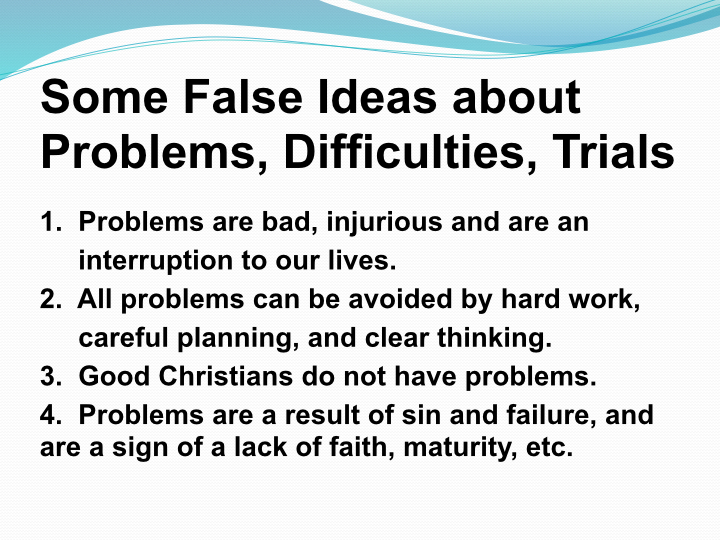
Using this verse as his introduction, Pastor Jeff shared four false ideas about problems:

  1. Problems are bad and are an interruption to our lives.
  2. All problems can be avoided by hard work, careful planning and clear thinking.
  3. Good Christians don’t have problems.
  4. My problems are a result of sin or are a sign of a lack of faith/maturity.

Instead I should see from a biblical perspective that…

“The Holy Spirit is the greatest Change Agent in a Christian’s life. I can only resolve this tension by obedience. … The devil tries to invoke turmoil in my life, but I can overcome this turmoil by submitting to God (James 4:7).” —Jeff Hlavin

“Trials develop spiritual/emotional/mental muscles that we need to have to soar into the place God has for us.” —Jeff Hlavin

If you would like to download a copy of the outline Pastor Jeff handed out to us, click here → Perspective on Problems Outline ←

We will be continuing in our Aliens and Strangers series this Sunday, and I’d love to have you join us. If you’ve missed any messages in this series, you may find the complete list by clicking here.

One Word

RedemptionWhen it comes right down to it, there is really just one word that makes Christians peculiar. Just one word changes our citizenship from Earth to Heaven. One word took us from a path where our sins had us headed toward an eternity in Hell.

Jesus stepped in where He didn’t have to go. Jesus became our sin to pay-off our sin debt. Jesus took us back from satan’s possession, and made us a part of His Father’s family.

Jesus redeemed us! 

I wonder if we truly understand that word redemption?

Peter is speaking to us as “strangers here in reverent fear” on Earth, and he calls us to live up to God’s call—Be holy, because I am holy (1 Peter 1:16; Leviticus 11:44-45). He asks us to obediently follow God’s Word (1:22), to get rid of Earth-bound things (2:1), and instead taste that the Lord is good (2:3).

Why? Because we’ve been “redeemed from the empty way of life…by the precious blood of Christ” (1:18-19) We don’t live holy lives to try to earn redemption, but because we have been redeemed we are now capable of living holy lives!

To help illustrate his point, Peter quotes a couple of verses from Isaiah 40. In this chapter, we are invited to weigh the greatness and love and knowledge and power of God against the things we can provide for ourselves on Earth. Please check out the video below, where I go through this 40th chapter of Isaiah.

If you’ve missed any messages in this series, you may find the complete list by clicking here.

A Whole New Revelation

The Word and the SpiritHow would you like to have better insight than prophets like David, Isaiah, Jeremiah, Ezekiel or Daniel? How would you like to have a greater revelation of who Jesus is than even in the angels in Heaven? You can!

Peter tells us aliens and strangers how we should live on Earth as citizens of Heaven (1 Peter 1:13-16):

  • Our minds prepared for action
  • Self-controlled (another translation says sober)
  • Fully hopeful of God’s promises
  • Obedient children
  • Not conformed to the world’s standards
  • As holy as God is

If that sounds like a challenging list, it’s because it is a challenging list! But notice an important word that starts verse 13: Therefore. This tells us we must look at what came before the therefore to know how to respond to what comes after the therefore.

In the verses preceding (vv. 10-12) we read about Old Testament prophets and New Testament preachers. But notice the similarities between these two—They both spoke about grace and salvation, and they both spoke with the Holy Spirit’s guidance. The Word of God was inspired by the Holy Spirit, and it is the same Holy Spirit that wants to give you a full revelation of what is in the Word.

The prophets searched carefully, but they never got to see Jesus come to Earth and fulfill the prophesies. The angels in Heaven have seen the story played out, but they don’t know what it is to have received a complete pardon for their sins that would have damned their souls to Hell.

That’s why Spirit-filled Christians who regularly study the Word of God have better insight than the prophets, and greater revelation than the angels!

What about you?

  1. Have you invited Jesus into your heart?
  2. If you have, are you regularly reading your Bible?
  3. If you are, have you allowed God to baptize you in His Holy Spirit?

This combination not only makes you peculiar to Earthlings, it makes you peculiar to prophets and angels too!

If you’ve missed any messages in this series, you may find the complete list by clicking here.

The Joy Of Trials

Drawing othersA quick show of hands: How many of you would consider your difficult situations a blessing from God?

Probably not a lot of hands went up, but it’s true.

Peter lists six blessings of God for which we can bless Him (see 1 Peter 1:3-3-9):

  1. God’s great mercy
  2. New birth
  3. Living hope
  4. An inheritance that can never perish
  5. God’s shielding power
  6. Trials

Trials?! Yep!

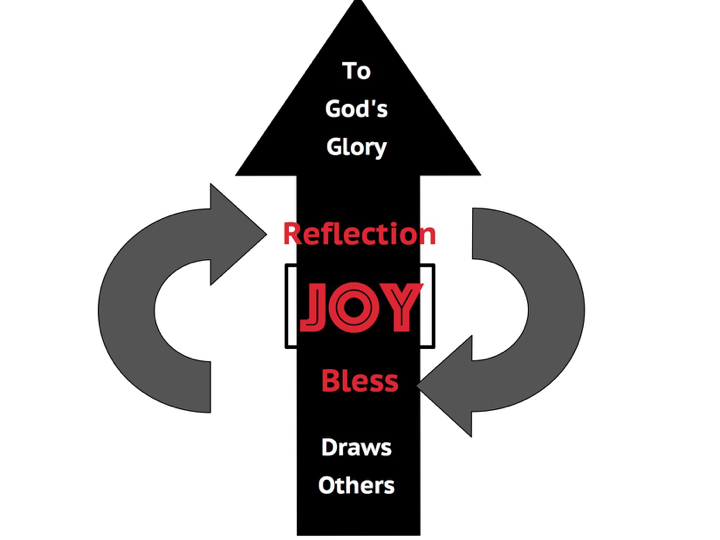
Peter is quick to tell us that trials only last for a little while, but they are sent our way to prove that our faith is genuine. He says that trials result in praise, glory and honor from God to us, and that successfully going through our trials lead to “an inexpressible and glorious joy.”

In trials you probably don’t feel like praising God, but our God-breathed soul is made up of more than just emotions. We also have been given a mind and a will. So here’s what I would suggest—in your trials, use your mind to reflect on the blessings of God. Then use your will to open your mouth. When you you do this, you will experience the emotion of an inexpressible and glorious joy.

In other words: you are more likely to act yourself into feeling than you are you feel yourself into action!

Look at how David did this in Psalm 34. In a huge trial…

  • …he used his mind and will: I will extol the Lord at all times.
  • …then his emotions kicked in: My soul will boast in the Lord.
  • …his worship helped others: let the afflicted hear and rejoice.
  • …and this pointed everyone to God: Glorify the Lord with me; let us exalt His name together.

Seeing your trials as a way to bless God not only benefits you, but it draws others to God’s sustaining power as well.

If you’ve missed any messages in this series, you may find the complete list by clicking here.