O Lord, Forgive

A friend of mine gave me some solid counsel a number of years ago that has always stuck with me: The mark of a maturing Christian is one who is closing the gap between sin and repentance.

Sin is open treason against God. Why would I want to overlook it or excuse it?! Once I recognize it as sin, why would I want to hold on to it?!

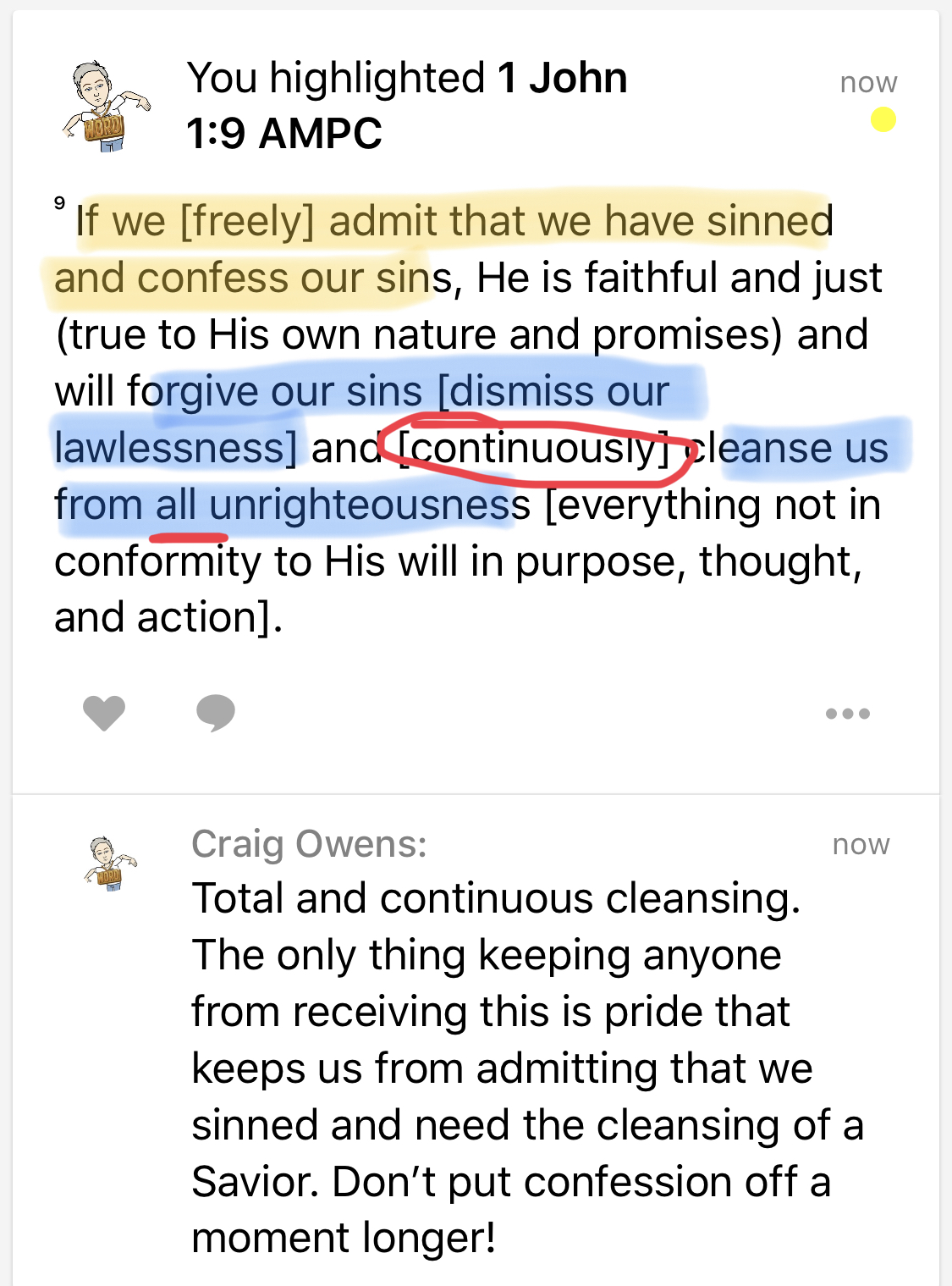
If we freely admit that we have sinned and confess our sins, He is faithful and just (true to His own nature and promises) and will forgive our sins—dismiss our lawlessness—and continuously cleanse us from all unrighteousness—everything not in conformity to His will in purpose, thought, and action. (1 John 1:9 AMPC) 

“Come now, let’s settle this,” says the Lord. “Though your sins are like scarlet, I will make them as white as snow. Though they are red like crimson, I will make them as white as wool.” (Isaiah 1:18) 

May we all take the time to reflect on our words and actions to see if we have sinned, and then to quickly confess that sin and ask for our loving God’s forgiveness.

“If my soul has turned perversely to the dark;

If I have left some brother wounded by the way;

If I have preferred my aims to Yours;

If I have been impatient and would not wait;

If I have marred the pattern drawn out for my life;

If I have cost tears to those I loved;

If my heart has murmured against Your will,

O Lord, forgive.” —F. B. Meyer

10 Quotes From “Grace”

Max Lucado’s newest book Grace is a wonderful reminder of how extravagant God is toward us (you can read my full review by clicking here). Here are 10 of my favorite quotes from Grace

“God’s guilt brings enough regret to change us. satan’s guilt, on the other hand, brings enough to enslave us. … It boils down to this choice: Do you trust your Advocate or your accuser?”

“Sin is not a regrettable lapse or an occasional stumble. Sin stages a coup against God’s regime. Sin storms the castle, lays claim to God’s throne, and defies His authority. Sin shouts, ‘I want to run my own life, thank you very much!’ Sin tells God to get out, get lost, and not come back. Sin is insurrection of the highest order, and you are an insurrectionist. So am I. So is every single person who has taken a breath. … God didn’t overlook your sins, lest He endorse them. He didn’t punish you, lest He destroy you. He instead found a way to punish the sin and preserve the sinner. Jesus took your punishment, and God gave you the credit for Jesus’ perfection.”

“Grace-a-lots believe in grace, a lot. Jesus almost finished the work of salvation, they argue. In a rowboat named Heaven Bound, Jesus paddles most of the time. But every so often He needs our help. So we give it. We accumulate good works the way Boy Scouts accumulate merit badges on a sash. … We find it easier to trust the miracle of resurrection than the miracle of grace. We so fear failure that we create the image of perfection, lest Heaven be even more disappointed in us than we are. The result? The weariest people on earth. Attempts at self-salvation guarantee nothing but exhaustion. We scamper and scurry, trying to please God, collecting merit badges and brownie points, and scowling at anyone who questions our accomplishments. Call us the church of hound-dog faces and slumped shoulders. Stop it! Once and for all, enough of this frenzy. ‘Your hearts should be strengthened by God’s grace, not by obeying rules’ (Hebrews 13:9 NCV). Jesus does not say, ‘Come to Me, all you who are perfect and sinless.’ Just the opposite. ‘Come to Me, all who are weary and heavy-laden, and I will give you rest’ (Matthew 11:28 NASB).”

“Give the grace you’ve been given. You don’t endorse the deeds of your offender when you do. Jesus didn’t endorse your sins by forgiving you. Grace doesn’t tell the daughter to like the father who molested her. It doesn’t tell the oppressed to wink at injustice. The grace-defined person still sends thieves to jail and expects and ex to pay child support. Grace is not blind. It sees the hurt full well. But grace chooses to see God’s forgiveness even more. It refuses to let hurts poison the heart. ‘See to it that no one misses the grace of God and that no bitter root grows up to cause trouble and defile many’ (Hebrews 12:15 NIV). Where grace is lacking, bitterness abounds. Where grace abounds, forgiveness grows.

“Find a congregation that believes in confession. Avoid a fellowship of perfect people (you won’t fit in), but seek one where members confess their sins and show humility, where the price of admission is simply the admission of guilt. Healing happens in a church like this.”

“Plunge a sponge into Lake Erie. Did you absorb every drop? Take a deep breath. Did you suck the oxygen out of the atmosphere? Pluck a needle from a tree in Yosemite. Did you deplete the forest of foliage? Watch an ocean wave crash against the beach. Will there never be another one? Of course there will. No sooner will one wave crash into the sand than another appears. Then another, then another. This is a picture of God’s sufficient grace. Grace is simply another word for God’s tumbling, rumbling reservoir of strength and protection. It comes at us not occasionally or miserly but constantly and aggressively, wave upon wave. We’ve barely regained our balance from one breaker, and then, bam, here comes another. ‘Grace upon grace’ (John 1:16 NASB). We dare to hang our hat and stake our hope on the gladdest news of all: if God permits the challenge, He will provide the grace to meet it. We never exhaust His supply. ‘Stop asking so much! My grace reservoir is running dry.’ Heaven knows no such words. God has enough grace to solve every dilemma you face, wipe every tear you cry, and answer every question you ask.”

“How long has it been since your generosity stunned someone? Since someone objected, ‘No, really, this is too generous’? If it has been awhile, reconsider God’s extravagant grace. ‘Forget not all His benefits, who forgives all your iniquity’ (Psalm 103:2-3 RSV).”

“Your identity is not in your possessions, talents, tattoos, kudos, or accomplishments. Nor are you defined by your divorce, deficiencies, debt, or dumb choices. You are God’s child. You get to call Him ‘Papa.’ You ‘may approach God with freedom and confidence’ (Ephesians 3:12 NIV). You receive the blessings of His special love (1 John 4:9-11) and provision (Luke 11:11-13). And you will inherit the riches of Christ and reign with Him forever (Romans 8:17).”

“To live as God’s child is to know, at this very instant, that you are loved by your Maker not because you try to please Him and succeed, or fail to please Him and apologize, but because He wants to be your Father. Nothing more. All your efforts to win His affections are unnecessary. All your fears of losing His affection are needless. You can no more make Him want you than you can convince Him to abandon you. The adoption is irreversible. You have a place at His table.”

“Where there is no assurance of salvation, there is no peace. No peace means no joy. No joy results in fear-based lives. Is this the life God creates? No. Grace creates a confident soul who declares, ‘I know Whom I have believed, and am convinced that He is able to guard what I have entrusted to Him for that day’ (2 Timothy 1:12 NIV). … Trust God’s hold on you more than your hold on God. His faithfulness does not depend on Yours. His performance is not predicated on yours. His love is not contingent on your own.”

Just Passin’ Through

This world is not my home. I’m just a traveler passing through. At times this world sure is beautiful! I love the sunsets, and the thunderstorms, and the oceans, and the forests. I love the animals, and the art, and the music.

But this is not my home. C.S. Lewis wrote—

“The books or the music in which we thought the beauty was located will betray us if we trust to them; it was not in them, it only came through them, and what came through them was longing. These things—the beauty, the memory of our own past—are good images of what we really desire; but if they are mistaken for the thing itself they turn into dumb idols, breaking the hearts of their worshipers. For they are not the thing itself; they are only the scent of a flower we have not found, the echo of a tune we have not heard, news from a country we have never yet visited.

And the Apostle John gave me this warning—

Do not love this world nor the things it offers you, for when you love the world, you do not have the love of the Father in you. For the world offers only a craving for physical pleasure, a craving for everything we see, and pride in our achievements and possessions. These are not from the Father, but are from this world. (1 John 2:15-16 NLT)

This is not my home. I’m just passin’ through, and enjoying the scents and echoes of my Heavenly Homeland!

Temptation

Have you ever thought, “Well, of course Jesus could say ‘no’ to temptation! After all, He is God.”

Yes, Jesus is fully God. But He is also fully Man. And it was as a Man that He defeated temptation.

“As a Man, without using any of His divine powers, Jesus defeated temptation in the same areas where Eve failed and where we fail. … By this He condemned sin in sinful man, that is, He showed we sin, not because we have to sin, but because we choose to sin and because we ignore the help available through the Word and the Spirit.” —Stanley Horton

We don’t have to sin, but we choose to sin.

Ouch!

“In His temptation, Jesus did not use His divine power to defeat the devil. Still identifying Himself with us as Spirit-filled human, He defeated satan by the same means that are available to us — the Word, anointed by the Spirit. Eve, tempted in exactly the same areas—the lust of the flesh (appetite), the lust of the eyes (desire), and the pride of life—failed (Genesis 3:6; 1 John 2:16). In these areas, which John says together comprise the things of the world or worldliness (1 John 2:15). Jesus won a complete victory for us. He has truly overcome the world (John 16:33). We can do the same by our faith (1 John 5:4).” —Stanley Horton

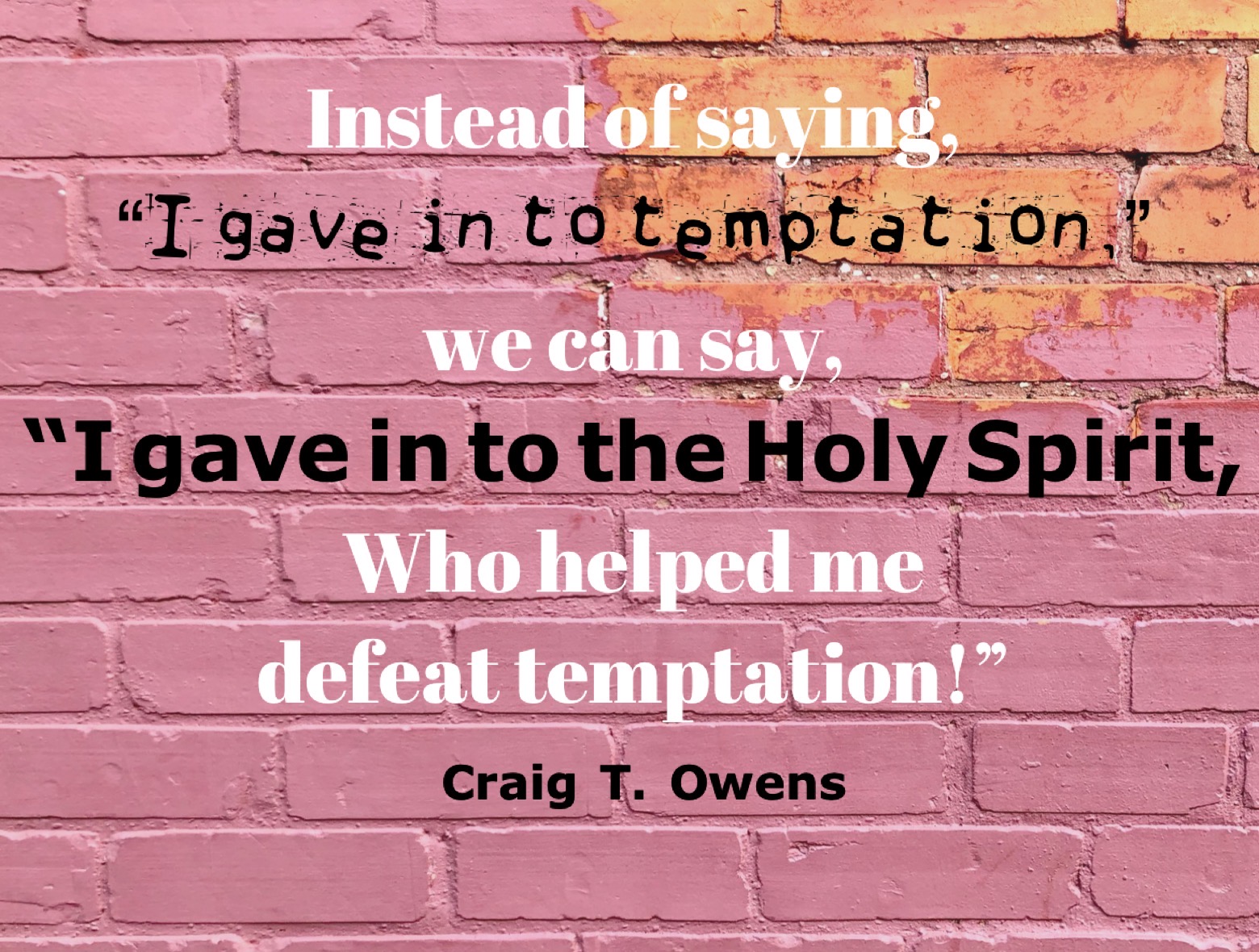
We can do the same thing. Instead of saying, “I gave in to temptation,” we can say, “I gave in to the Holy Spirit, Who helped me defeat temptation!”

Thursdays With Oswald—Instantly Detecting Compromise

This is a weekly series with things I’m reading and pondering from Oswald Chambers. You can read the original seed thought here, or type “Thursdays With Oswald” in the search box to read more entries.

Instantly Detecting Compromise

     We must be continually renewed in the spirit of our mind so that the slightest beginning of compromise with the spirit of the world is detected. “Well, what’s the harm; there’s nothing wrong in it,” when you hear that you know you have the spirit of the world, because the Spirit that comes from Jesus says, “Does this glorify God?”

From Biblical Ethics

There’s a HUGE difference between a Christian being in the world and of the world. A Christian who is compromising, is slowly becoming of the world. They say, “This isn’t wrong.”

A Christian who is uncompromising, is slowly becoming in the world but of Heaven. They judge everything by whether or not it brings glory to God.

Compromise is the slow erosion. Seldom does one go from a passionate follower of God to a worldly person suddenly. It is the small compromises day after day that are the most dangerous.

So one of my frequent prayers must be—

Search me, O God, and know my heart; test me and know my anxious thoughts. Point out ANYTHING in me that offends You. (Psalm 139:23-24, NLT)

A-to-Z Love

You probably have heard that Psalm 119 is the longest chapter in the Bible (176 verses). The anonymous author clearly loved God’s Word—everything about it from aleph to taw (that’s Hebrew for “from A to Z”).

The psalm’s 176 verses are divided into 22 sections, with eight verses in each section (the Hebrew alphabet has 22 letters). All of the verses except three mention God’s Word in some way (law, statutes, commands, etc.). In other words, this author loved God’s Word from start to finish, and everything in-between!

How about if we continue the A-to-Z love?

I love that God’s Word is…

A—An attitude adjustor

B—Bright hope

C—Comforting

D—Direction for life

E—Educational

F—Fulfilling my deepest longings

G—Good and good for me

H—Historically accurate

I—Illuminating

J—Just what I need, when I need it

K—Keeping me from sin’s grip

L—Liberating me from anxiety

M—Making me the God-fearing man I should be

N—Never condemning, always encouraging

O—Opening my understanding

P—Purifying my motives

Q—Quality time

R—Revealing God’s love for me

S—Strength for today

T—Temptation defeater

U—Unfailing truth

V—Visionary

W—Worth more than all my other books

X—Xenografted into my heart (James 1:21)

Y—Yahweh’s love letter to me

Z—Zoe (1 John 1:1)

Go ahead and add your A-to-Z love of God’s Word in the comments…

I also shared a series of 22 messages looking at each of the sections of Psalm 119. You can find the complete list of those messages by clicking here.

Tiger Woods & I Have Something In Common

One part of Tiger Woods’ statement stood out to me this morning:

“I knew my actions were wrong, but I had convinced myself that normal rules did not apply … I thought only about myself…  I thought I could get away with anything I wanted to. … I thought I was entitled….”

This hits me right between the eyes. Because that sounds like… me.

And probably you, too.

I think the biggest stumbling points into sin are:

  • “This won’t hurt me.”
  • “I can handle it.”
  • “I deserve it.”

Tiger’s fame magnified what he did, but only in the eyes of our media and culture. In God’s eyes, my sins are just as painful as Tiger’s. In God’s eyes, my sins hurt my relationships with Him and with others as much as Tiger’s. But here’s the great truth for Tiger Woods, for me, and for you:

But if we confess our sins to Him, He is faithful and just to forgive us our sins and to cleanse us from ALL wickedness.

I’m glad that I can be forgiven!

Naked Before God

Imagine: You and your wife are the only people on the face of the earth. No bills, no employer, no economic downturn, no kids, no school, no traffic. Just you and God. That was Adam and Eve in the Garden of Eden. The Bible gives this commentary, “Now the man and his wife were both naked, but they felt no shame.”

Nothing to hide from God. Nothing to hide from each other. A perfect relationship with God. A perfect relationship with each other.

Then the temptation, and the bite of the forbidden fruit. Sin enters. Now, something changes when God comes to talk with His favorite couple: “Then the man and his wife heard the sound of God as He was walking in the garden in the cool of the day, and they hid from God among the trees.”

“Why are you hiding from Me?” God asks.

“Uh,” Adam stammers, “because we’re naked.”

Sin made mankind uncomfortable in God’s presence. Sin made them want to hide from God. They knew He was there, but they tried to pretend He wasn’t. This is why I think many of us don’t come into God’s presence in prayer: we’re uncomfortable because of our sin.

We should not run away from God, instead, we should run to Him. “If we confess our sins to Him, He is faithful and just to forgive us our sins and to cleanse us from all wickedness” (1 John 1:9).

What happens when we’re forgiven? We’re re-clothed. God Himself clothes us. He made clothes for Adam and Eve, and He clothes us, too, in the righteous robes of Jesus. “And all who have been united with Christ in baptism have put on Christ, like putting on new clothes” (Galatians 3:27).

And when we’re clothed in Christ, we no longer have to hide from God, nor feel uncomfortable in His presence. Instead, we can “come boldly to the throne of our gracious God. There we will receive His mercy, and we will find grace to help us when we need it most” (see Ephesians 3:12 and Hebrews 4:16).

Perhaps the reason we don’t spend enough time in prayer is that we feel self-conscious, sinful, uncomfortable… naked.

You don’t have to be naked. You can be clothed in Christ. You can enter into God’s presence without shame and find the mercy and grace and help that you need.

Still Learning

I live by the axiom, “If you’re through learning, you’re through.” So I try to learn something new every day.

I just finished a class called New Testament Survey: a quick overview of the 27 books that compromise the New Testament of the Bible. Here’s a couple of interesting factoids I picked up from my studies:

  • The earliest-written book was James. Interesting, because at one point James thought Jesus (his half-brother) was nuts.
  • Only Matthew uses the term kingdom of heaven; all of the other writers use kingdom of God.
  • Mark uses the word immediately more times than anyone else. Perhaps because his source (Peter) was always doing things so quickly… sort of a ready, FIRE!, aim kinda guy.
  • Luke wrote what is called “the global gospel” for everyone, so he included 45 teachings/events that no one else records.
  • John doesn’t record any of Jesus’ parables.
  • John uses the word believe nearly 100 times— way more than any other writer.
  • Luke talks about the Holy Spirit nearly 60 times in the 28 chapters of Acts.
  • Romans is the longest of Paul’s epistles with 7101 words; Philemon is the shortest with just 355 words.
  • With the exception of the pastoral epistles (1 Timothy, 2 Timothy, Titus) Paul’s letters are arranged in the Bible from longest to shortest.
  • In 1 & 2 Thessalonians (only 136 verses) Paul refers to God, Christ, the Holy Spirit, or a combination thereof more than 150 times.
  • Paul gives Timothy seven word pictures to describe the kind of pastor he should be: son, soldier, athlete, farmer, workman, instrument, and servant.
  • Hebrews is called “the book of better things” so better is used 13 times. This word is used only six times in the remaining 26 books of the New Testament.
  • James wrote 108 verses but issues 50+ direct commands.
  • In John’s three short epistles he uses the word know 33 times, and the word dear ten times.

Keep on learning! There’s a lot of good stuff out there. What have you learned lately?

Cheap Trade-Off

During the reign of King Rehoboam in Judah, God’s judgment fell on the land. Because of their sin against Him, God allowed Shishak, the king of Egypt, to plunder Jerusalem. Shishak carried off all of the valuable furnishings of the temple in Jerusalem.

To replace what had been plundered Rehoboam commissioned the casting of shields made of bronze (1 Kings 14:27). Whenever the king went to the temple, all the guards would carry these shiny shields with them, but then immediately after the king left the temple the guards returned their shields to the armory.

It looked good, but it was all a cheat … an imitation … a cheap trade-off.

Looking back a few chapters we read that not only did Rehoboam’s father, King Solomon, make the original shields out of gold, but he made almost everything out of gold. In fact, the Bible says, “Nothing was made of silver, because silver was considered of little value in Solomon’s days.” If silver was of little value, can you imagine how cheap bronze was?!

The temple is plundered. The gold shields—along with anything else of value—are gone, but there is no outcry from Rehoboam or the people, no repentance for their crimes against God, no anger at their sin that allowed Shishak’s raid.

Instead, Rehoboam wanted to try to keep up appearances.

He made bronze shields to look like the stolen gold shields.
He made his trip to the temple a spectacle of pomp and circumstance.
He hid the bronze shields away after he left the temple.

Isn’t this how many people deal with the plundering of their lives? I know I have at times. It seemed so much easier to try to cover up what was lost because of my sin, than to simply admit I sinned, repent of that sin, and ask for God’s merciful forgiveness.

Sure, Rehoboam still looked like he had his act together. But he knew—every time he was on this way to the temple and saw those bronze shields—that he was living a lie. He accepted a cheap trade-off for the real deal.

I am so grateful that, “If we confess our sins, He is faithful and just and will forgive us our sins and purify us from all unrighteousness” (1 John 1:9).

I’m not going to settle for cheap trade-offs anymore. How about you?