Listen to the podcast of this post by clicking on the player below, and you can also subscribe on Apple, Spotify, or Audible.
Both physically and psychologically, our natural response to an attack, a surprise, or pain is to fight or flight.
Although this is a natural response, it’s not the best response for shepherd leaders. Think about it: when a sheep is biting you or misbehaving, although you would like to smack them on the fuzzy nose or run away from them, those are not healthy responses.
Jesus said that those who ran away in the face of attacks—either from sheep within or wolves without—aren’t worthy of the title “shepherd” (John 10:12-13). And Paul told Timothy that shepherd leaders “must not be quarrelsome but must be kind to everyone” (2 Timothy 2:24).
As I said, fight-or-flight is natural, but Jesus is calling His under-shepherds to a supernatural response. This will require God’s help, which He frequently provides for us in the timely counsel of wise friends who have experienced the same pain you are experiencing.
Check out this short video where I talked to a group of pastors about this topic.
I would like to invite you to join a cohort of pastors that will be dealing with the same painful sheep bites you have experienced. We’ll meet together online every other week for 10 sessions to discuss the biblical principles that will help us all respond in the supernatural ways that strengthen our leadership, heal our flocks, and bring glory to the Chief Shepherd.
This cohort is limited to just 10 pastors so that we can develop some solid friendships that will last well beyond the cohort, so please sign up today.
Check out more information on my book When Sheep Bitehere.
Listen to the podcast of this post by clicking on the player below, and you can also subscribe on Apple, Spotify, or Audible.
Before you recruit someone to fill that next opening in your organization, I’ve got a resource that you should definitely check out. The resource I am referring to comes from the book Recruiting to Releasing by Jim Wiegand. I had a chance to sit down with Jim to talk about this eye-opening book.
Purchase your copy of Recruiting to Releasing on Amazon here, or on Apple Books here.
If you would like to check out when Jim interviewed me about my book When Sheep Bite, check out that video here.
Listen to the podcast of this post by clicking on the player below, and you can also subscribe on Apple, Spotify, or Audible.
Let’s review the historical background for the Psalms of Ascent. The Jewish people made four pilgrimages to Jerusalem each year, which sit about 2500 fee above sea level, so this was a physical climb. But this also has a spiritual lesson for us today: We are to continue progressing in our walk with God—upward and onward!
The songs of ascent that these pilgrims sang give us life-changing lessons that we can still apply today.
I’m sure there were some pilgrims who thought, “We have to go to Jerusalem.” Just as there are some people today who may something like, “I have to tithe.” But when you have experienced the blessing that comes from obedience, your “have to” turns to “get to” really quickly!
There is a longing in Psalm 128 for God’s blessing. In fact, we see it in nearly every verse: blessed (v. 1), blessing and prosperity (v. 2), blessed (v. 4), bless and prosperity (v. 5), and peace (v. 6).
We have to remember that our obedience doesn’t earn God’s blessing, but rather our obedience keeps us in the place where we can receive God’s ever-flowing blessings. When I have experienced the blessing that followed even my “have to” attitude, I now joyfully “get to” obey because I know that keeps me in a blessed place.
But even knowing that these blessings are flowing for us, sometimes we still get weary. Sometimes it seems as if we are being faithful but we aren’t seeing the results that perhaps we saw before.
Think about these pilgrims ascending 2500 feet year after year after year. It was challenging enough during the golden days of King David and King Solomon, but can you imagine the feelings of futility during the dark days? Perhaps during the exile when the temple was in ruins, or after the exile when the temple didn’t look as it did before and there were overlords ruling Israel? And then it was unquestionably true that the older a pilgrim got, the harder the climb became for them.
But the struggle keeps us reliant on God. Like Solomon said, “The way of life winds upward for the wise, that he may turn away from hell below” (Proverbs 15:24). The longer I walk, the more I get to rely on God’s help, and the sweeter He becomes to me!
I love the line in the hymn Great is Thy Faithfulness, “Strength for today and bright hope for tomorrow—blessings all mine with ten thousand beside.” Because of God’s blessings that I’ve already experienced, I can trust Him for more, even in the struggle of the climb.
Look at some of these promises that come out in other biblical translations.
Blessedare those who fear God (NIV) = “How joyful are those who fear the Lord” (NLT)
Blessing and prosperity will be yours (NIV) = “You will enjoy the fruit of your labor” (NLT) and “You will eat what you worked so hard to grow” (NET)
The middle of this psalm is in verses 3-4. Remember above when I said nearly every verse contains a word of blessing? I didn’t list verse 3, but there is language in this verse that makes it pregnant with blessing—Your wife will be like a fruitful vine within your house; your sons will be like olive shoots around your table.
You may ask, “How is this a blessing?”
The phrase “under their own vine and under their own fig tree” appears throughout the Old Testament. It described a blessed, prosperous, happy, and peaceful home. It was a home at peace within because there was also peace without.
This described the golden era of King Solomon—During Solomon’s lifetime Judah and Israel, from Dan to Beersheba, lived in safety, everyone under their own vine and under their own fig tree (1 Kings 4:25).
After the northern kingdom of Israel fell and the southern kingdom of Judah was surrounded by the Assyrian forces of King Sennacherib, the king’s field commander tried to entice them the people with similar words—
Do not listen to Hezekiah. This is what the king of Assyria says: “Make peace with me and come out to me. Then each of you will eat fruit from your own vine and fig tree and drink water from your own cistern until I come and take you to a land like your own—a land of grain and new wine, a land of bread and vineyards, a land of olive trees and honey. Choose life and not death! Do not listen to Hezekiah, for he is misleading you when he says, ‘The LORD will deliver us.’” (2 Kings 18:31-32)
Notice that he said the land would be “a land like your own.” He was trying to get them to compromise, to no longer listen to God’s voice, to no longer climb up into God’s presence. Much like satan tempted Adam and Eve to eat the forbidden fruit with the promise, “You will be like God.”
But these blessings in Psalm 128 don’t come from fearful “have to” obedience to man, but from reverencing God above all else. So the longing of verses 1-4 become the prayer of verses 5-6 (notice the word may used three times in these verse).
The focus of our longing—where we need to keep our eyes—is on God’s heavenly throne: Zion, Jerusalem, Israel (vv. 5-6; Micah 4:1-5).
In an earlier story, Caleb may have gotten tired while he waited for God to fulfill His promise to him, but he always trusted God as he walked on (see Joshua 14:9-12).
What promises of God are you still praying for?
What are you longing to see accomplished?
What has God already done that you can look back on?
The Hill, though high, I covet to ascend, The Difficulty will not me offend; For I perceive the Way to life lies here. Come, pluck up Heart, let’s neither faint nor fear;
Better, though difficult, the Right Way to go,
Than wrong, though easy, where the End is Woe. (John Bunyan)
Don’t give in.
Don’t give up.
Keep climbing.
Like Caleb say, “It may have been 85 years of walking and climbing, but I’ll keep climbing. GOD, GIVE ME THIS HILL!”
If you would like to check out the other songs of ascent that we’ve already studied, please click here.
Fellas, the godly superwomen in our lives have unlocked our leadership potential. What are you going to do with that? You have only two choices: steward it or squander it. We only honor these godly women when we steward that potential well. Watch the full Father’s Day sermon here.
I have lots of new content every week, which you can check out on my YouTube channel.
Dan Reiland addresses an important topic for busy leaders: busy work vs. real work. “Doing the easy stuff makes us feel good, doing the hard stuff helps other people live better. When we focus on our real work over busywork, we see intentional progress toward a focused vision or goal, rather than just checking things off a list.” Check out the four things Dan calls leaders to focus on.
“Because of what Jesus did for us through His life, death, and resurrection, we are no longer the worst things we have ever done. We are now the best thing God has ever done for us! That’s what God saved us from.That is our history. Now the question is, what has God saved us for? That is our destiny!“ —Jim Wiegand, in the Everything Begins With Purpose reading plan on YouVersion
A good reminder for pastors. “Call your own soul often to account; examine the temper, the frame, and the motions of your heart with all holy severity, so that the evidences of your faith in Jesus, and your repentance for sin, and your conversion to God, be many and fair, be strong and unquestionable; that you may walk on with courage and joyful hope toward heaven, and lead on the flock of Christ thither with holy assurance and joy.” —Isaac Watts
“The fellow who never makes a mistake takes his orders from one who does.” —Herbert Brocknow
“‘The fear the Lord.’ This refers to an awesome respect for God, which is a good thing. Without it, people are presumptuous before God. Those who do not fear God fail to respect His awesome power and righteousness, and they do not recognize the infinite distance between their sins and His holiness.“ —Quest Study Bible commentary on Psalm 128:1
“Our Lord did not ask us to give up the things of earth, but to exchange them for better things.” —Fulton J. Sheen
“Abortion advocates have long labeled humans in the earliest stages of development as ‘nothing but’ clumps of cells. This description is like calling Michelangelo’s David ‘a clump of marble.’ The only difference is that while art historians know every detail of this statuary masterpiece, scientists are still unlocking the secrets of the embryo.” John Stonestreet shares some astounding new research about the ways that the cells of a baby develop in a way that can only be attributed to an All-Wise Creator.
The unrighteous always seek to pull down those who hold to God’s righteous standard. How sad that they think it easier to pull the righteous down than to repent of their own evil. God sees this: He rewards the righteous who do not compromise and He punishes the unrepentant unrighteous who try to force the righteous to compromise.
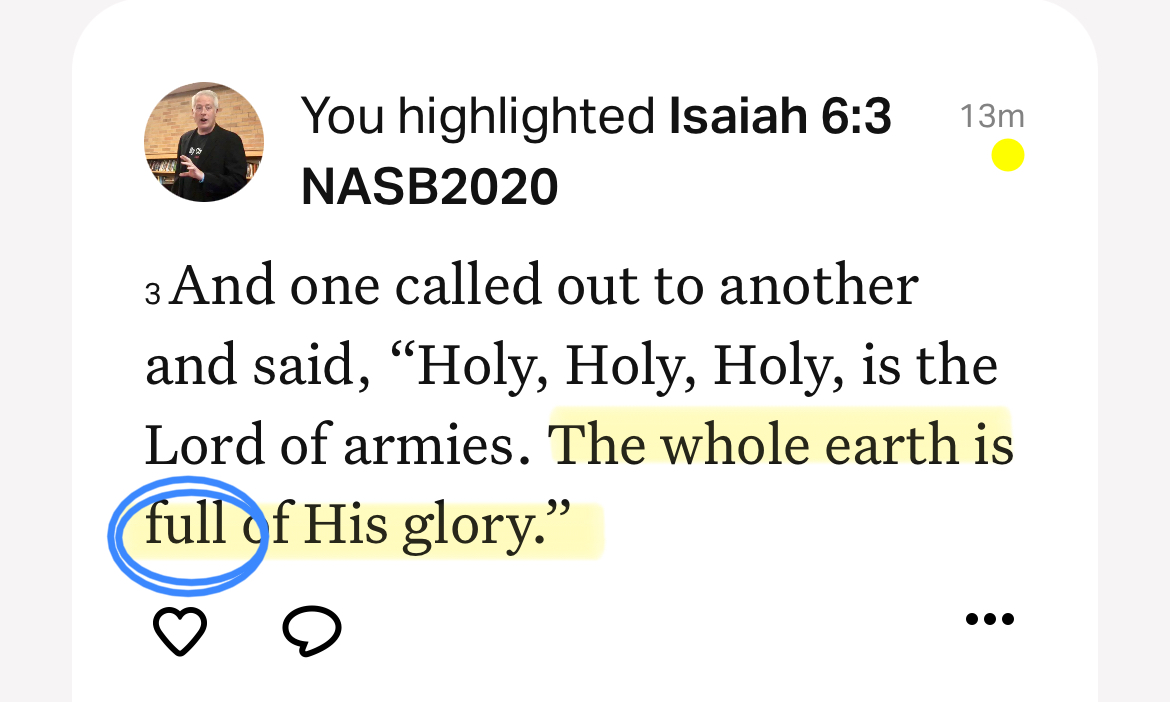
And one [angel] called out to another and said, “Holy, Holy, Holy, is the Lord of armies. The whole earth is full of His glory.” And the foundations of the thresholds trembled at the voice of him who called out, while the temple was filling with smoke. Then I said, “Woe to me, for I am ruined! Because I am a man of unclean lips, and I live among a people of unclean lips; for my eyes have seen the King, the Lord of armies.” (Isaiah 6:3-5)
The literal translation of the phrase “the whole part is full of His glory” is, “The fullness of the whole earth IS His glory.”
Paul says it this way, “All things have been created through Him [Jesus] and for Him. He is before all things, and in Him all things hold together” (Colossians 1:16-17). God spoke all things into existence—we literally live today in His breath, we breathe His breath, we eat His breath. All that exists is the fullness of His glory.
Isaiah got a small glimpse of this glory, and the weightiness of God’s awesome glory brought him to his knees (Isaiah 6:4-5).
How many trivial things would fall to the side when we realize how unimportant they are in comparison to the eternal importance of God’s glory!
How differently we would live each day if we were aware of God’s presence in and around us!
How fearful we would be to even contemplate sinning in His presence!
How quick we would be to repent of sin when we are aware of just how present He is!
How unafraid we would be to boldly stand for God and proclaim His love and power if we were aware of His ever-present Spirit equipping and supporting us!
Oh, that “the Father of glory may give you a spirit of wisdom and revelation in the knowledge of Him” (Ephesians 1:17)!
Every year, Jews from around the world made four pilgrimages up to Jerusalem for various feasts and sacrifices. These journeys reminded them of God’s goodness as they went to the Temple to worship, and they helped refocus on God’s ways as they returned to their regular routines.
Jerusalem is over 2500 feet above sea level, so the pilgrimage there was a physical workout as well as a spiritual workout. These workouts were beneficial for God’s people, preparing them to minister in their cities in the following months.
The Book of Psalms contains 15 songs that these pilgrims would sing to and with each other as they traveled up to Jerusalem. These Psalms of Ascent are still instructive for Christians today.
As we resume this series this summer, I hope you can join me for this look at the life-changing truths these pilgrimage songs can still teach today to all of God’s people. We would love to have you join us in person, but if you are unable to do so you can watch the videos of these messages on my YouTube channel.
You can check out the messages we shared last summer from Psalms 120-127 here. And the current series of messages include:
Listen to the podcast of this post by clicking on the player below, and you can also subscribe on Apple, Spotify, or Audible.
“…the Jews there tried to stone You, and yet You are going back?” (John 11:8).
The disciples were sitting around Jesus contemplating the next steps when they heard the news that Jesus’ friend Lazarus was sick and on death’s doorstep.
This statement seems to be a very logical thought. At least it is logical from a human perspective. But God sees wider, farther, and deeper than we ever will, so His logic is both perfect and limitless.
Yes, the Jews had tried to stone Jesus (8:59; 10:31, 39), and for mere men operating and thinking as men, staying away from danger is a logical conclusion.
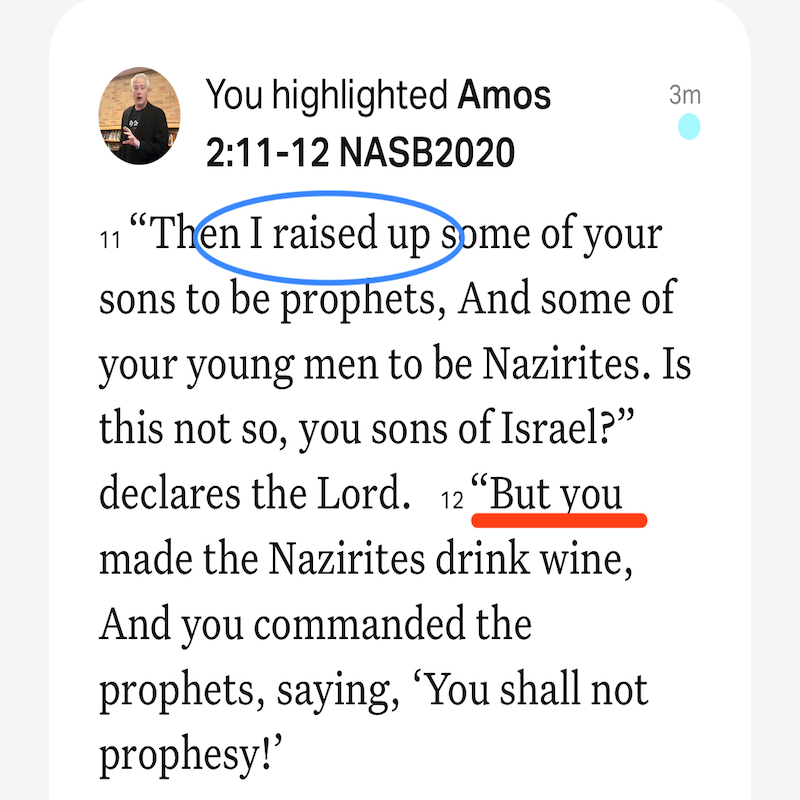
But Jesus was on-mission from His Father (5:19). He had to go to Bethany because the sickness of Lazarus “will not end in death. No, it is for God’s glory so that God’s Son may be glorified through it” (11:4). Later, at the tomb of Lazarus, Jesus prayed, “This is for the benefit of the people standing here, that they may believe that You sent Me” (v. 42). When the dead Lazarus was returned to life and came out of the grave, God indeed was glorified!
Jesus declares that when we walk with Him, we always walk in the light (v. 9). This is because He IS the light of the world (8:12; 9:5). And as we walk with Him, we too bear the light wherever He calls us to walk (Matthew 5:14).
To walk in our own logic is to stumble in the darkness (John 11:10). We calculate and plan from a place of scarcity and fear. As a result, we stumble right past—or we sit still out of fear—and miss the opportunities for God’s glory to be displayed.
My logic always has a dark edge that I cannot see past. But the logic of God has no dark places because He can see from beginning to end perfectly.
I must daily walk in His light, even into those places where my limited logic would tell me to avoid. It is there that I will be able to witness God’s glory that I wouldn’t have seen had I sat still in my “safe” place.
Listen to the podcast of this post by clicking on the player below, and you can also subscribe on Apple, Spotify, or Audible.
The word sounds as painful physically as it is emotionally. I am talking about the word “fester.”
Check out this episode of The Podcast.
I truly believe that When Sheep Bite will be a healing resource for shepherd leaders who are still feeling the pain of their latest sheep bite. Please pick up a copy today!
If you would like to check out the full conversation Greg and I had on our leadership podcast called The Craig and Greg Show, you can find that episode here.
Listen to the podcast of this post by clicking on the player below, and you can also subscribe on Apple, Spotify, or Audible.
On Mother’s Day, I mentioned that Proverbs 31 might be an intimidating description for Moms, but it doesn’t need to be that way. This chapter lists what is possible when a woman is fully committed to God, her husband, and her children.
Her faithfulness is her superpower which unleashes so many good things for those around her. Or as we said it: Her nobility helps her be a king maker.
I concluded by saying that men have an important role to play in order to honor the king-making power which the godly women in his life have unlocked. This is a man’s superpower! Together, God-fearing men and women can create a legacy of king makers. But separated or self-focused men and women can create a legacy of king breakers.
The Hebrew word for noble is used five times in Proverbs: three times for the godly superwoman (Proverbs 12:4, 31:10, 31:29), and twice for the godly superman (13:22, 31:3).
Remember that this word is also translated in different versions of the Bible as excellent, virtuous, and strong in character.
In Proverbs 31:3 the word vigor for men is attached to that same Hebrew word. In this context, the word can be defined as strength, efficiency, ability, or wealth.
On Mother’s Day, we said that Eve is the “help meet” (as the old King James Version says), which means that she is the key that unlocks Adam’s potential. The teaching throughout Proverbs says that men can squander this unlocked potential by…
…forgetting God’s laws—Proverbs 31:4-5
…not stewarding the unlocked leadership opportunities in our marriage, parenting, work, or community involvement (Proverbs 5:15-20; 2:1-5, 12-17; 22:29; 31:23).
In essence, we cancel the definition of vigor that we saw above, changing strength to weakness, efficiency to inefficiency, ability to inability, and wealth to poverty.
On Mother’s Day we looked at virtuous Ruth who used her godly superpower to unlock the potential for Boaz, the man who would become her husband. Let’s look at his example:
he was called a man of standing because his righteousness was well known in Bethlehem—Ruth 2:1
he was obedient to the smallest details of the law—Ruth 2:3; Leviticus 19:9-10
he honored his father by following his example—Matthew 1:5; Joshua 2:1-24, 6:23
he was an honored employer—Ruth 2:4
he was also (just like Ruth) called a man of noble character—Ruth 3:7-11, 14
A Dad’s superpower looks very similar to a Mom’s superpower. The godly woman unlocks the potential, and when the godly man carefully stewards that potential, he is also using his godly superpower (Luke 12:42-43, 48)!
Guys, when we use our God-given superpower, we honor Him and the godly women in our lives who have made this possible for us. We do this by…
…faithfully loving God with all our heart, soul, mind, and strength—Proverbs 31:4-5; Mark 12:28-31
…caring for our bride like Jesus cares for His bride—Ephesians 5:25
…honoring the legacy of our parents—Ephesians 6:2-3
…passing on a godly heritage to our children—Ruth 4:21-22
This is God’s design. And it is God’s delight when we live this way. So we must make the choice to either carry on the godly heritage that was handed down to us, or reverse the ungodly heritage that we may have inherited.
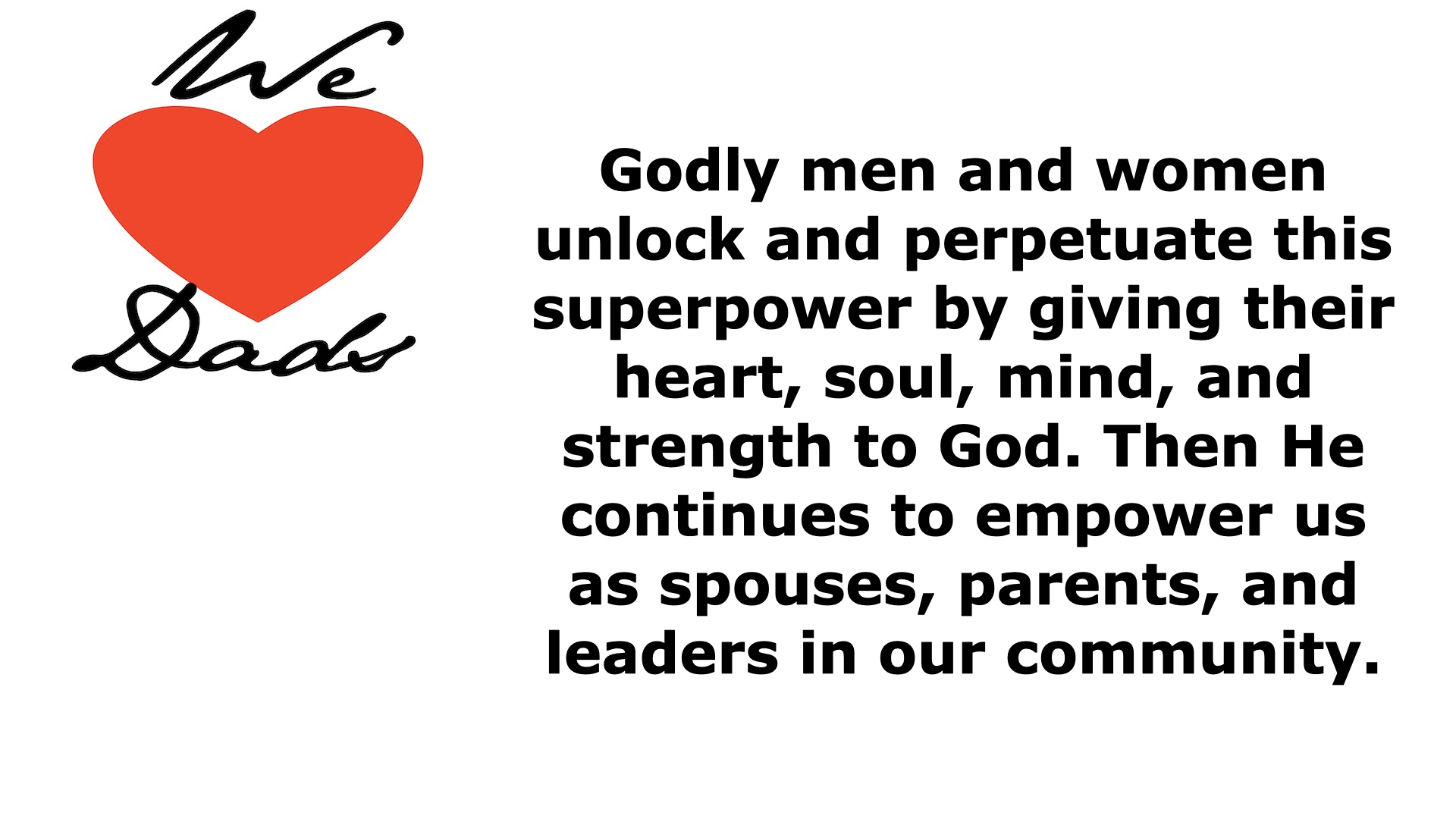
Godly men and women unlock and perpetuate their God-given superpower by giving their heart, soul, mind, and strength to God. And then God will continue to empower us as the spouses, parents, and leaders in our community that He desires for us to be!
There’s no secret formula to fruitfulness as a Christian. We just stay connected to Jesus and the fruit will grow. This clip is from this sermon.
I have lots of new content every week, which you can check out on my YouTube channel.
The “Ten Commandments” are not explicitly listed or reiterated in the New Testament. Does that mean they are obsolete? No, says David Mathis, it means they are fulfilled. “Jesus Himself says He did not come to destroy the Law and Prophets, but to do something even more striking: fulfill them (Matthew 5:17). That is, fulfill like prophecy. Not simply keep the Ten in place, or remain under them, or leave them untouched, but fulfill them—first in His own person, and then by His Spirit in His church. He came not to cast off Moses, but to fulfill Jeremiah, and in doing so, He accomplished what is even more radical: establishing Himself as the supreme authority, putting God’s law within His people (rather than on tablets), writing it on their hearts (rather than stone), and making all His people to know Him (Jeremiah 31:31–34).” Check out my post The 10 Commandments in the New Testament.
More archeological evidence supporting to the historicity of the Bible. You can check out the full article, but this paragraph is a good summation: “One of the surprising findings was that, according to the results of their tests, the Broad Wall in Jerusalem, also known as Hezekiah’s Wall, was likely built during the reign of Uzziah, who Scripture says built fortifications in Jerusalem (2 Chronicles 26:9). Another finding was that Jerusalem was much more heavily populated and urbanized in the 12th through 10th centuries BC than some scholars previously thought. This would align with the biblical description of Jerusalem, particularly during the days of David and Solomon.”
“There is much of beauty, goodness, and truth to be discovered in the city of man, as Augustine pointed out toward the end of his great treatise, City of God. But all the culture and best intentions of men turn to corruption apart from the power of God to redeem and renew them. We who live also in the heavenly city now possess the mind of Christ (1 Corinthians 2:16); we are able to see the ways that culture can be ‘taken captive’ from the clutches of sin and unbelief and made to serve the purposes of Christ in all things. Thus, for the honor and glory of God, we commit ourselves daily to using all our time, activities, relationships, roles, responsibilities, and culture to furthering His rule on earth as it is in heaven.” —T.M. Moore
“Have movies and most conventional paleontologists got it all wrong? T. rex and other theropod dinosaurs (the meat-eaters) are often portrayed as intelligent predators that can outmuscle and outsmart their opponents. But is that really supported by science?” A very interesting compilation of research can be found here. The conclusion is exactly right: “God designed dinosaur brains that were perfectly suited for their lifestyles and body size when He created dinosaurs on Day 6 of the creation week (Genesis 1:25).”



 Both physically and psychologically, our natural response to an attack, a surprise, or pain is to fight or flight.