In the morning, Lord, You will hear my voice; in the morning I will present my prayer to You and be on the watch. (Psalm 5:3)
The phrase “be on the watch” is just one word in Hebrew. It means to lean forward, to peer into the distance, to be the best of watchmen trying to see something the moment it appears on the horizon.
This is the posture David encourages us to take with each and every prayer request we present to our Heavenly Father. Our attitude should be, “I am so excited to see how God is going to answer me!”
“wait expectantly” (NIV)
“look up” (NKJV)
“wait for You to speak to my heart” (AMPC)
I shared a video on this idea on an episode of The Podcast—Faith Starts Walking.
I have lots of new content every week, which you can check out on my YouTube channel.
I’m proud to be a part of the Assembly of God fellowship that has its roots in missions. Alice Luce is a great example of a missions pioneer whose work in the 1920s is still bearing fruit today.
“Our nation’s founding document declared independence from Britain, but, with equal fervor, declared dependence upon God. Expressing ‘firm reliance on the Protection of divine Providence,’ the signers committed the American experiment to their Maker. The Spirit of 1776 was reverence and trust. So, as we mark this solemn occasion, let us seek a rebirth of true liberty, which is possible only when governed by divine law. For, without God, we can never have ‘liberty and justice for all.’” —Chuck Colson
“It is impossible to describe the abundance of peace and heavenly joy that often flows into my soul by means of the fresh answers which I have obtained from God, after waiting upon him for help and blessing; and the longer I have had to wait upon him, or the greater my need, the greater the enjoyment when at last the answer comes, which has often been in a very remarkable way, in order to make the hand of God the more manifest.” —George Mueller
The Institute for Creation Research reports on a study: “Physicists at Roskilde University in Denmark have shown that a single equation correctly describes the frequency of wing and fin strokes for a wide array of flying and swimming creatures, including birds, insects, bats, and whales.” Wow, it’s almost as if an all-wise Creator knew what He was doing!
T.M. Moore uses the understanding of wireless internet access to help Christians with a picture of prayer. “When we bend our increasingly Christ-filled minds, hearts, and consciences to the spiritual code-writing of prayer, we craft messages which shape the spiritual air as they course their way toward the Source of all living-water spiritual power, Who is filling all things with Himself. The more we pray with Christ-overflowing souls, the more we flood the spiritual airspace with the Lord, crowding out and sidelining those forces of wickedness which seek to jam those airwaves or fill them with spiritual disinformation. And the less spiritual ‘airspace’ the devil can command, the better for all of us.” —T.M. Moore
Listen to the podcast of this post by clicking on the player below, and you can also subscribe on Apple, Spotify, or Audible.
The phrase “Jesus knew” specifically appears twice in John chapter 13 (vv. 1, 3), but the idea appears in multiple places. Jesus was continually and intimately aware of His Father’s plan and the Holy Spirit’s empowerment to help Him live out that plan.
Check out some of the things Jesus knew:
He knew His mission—I have come into the world as a light, so that no one who believes in Me should stay in darkness (John 12:46)
He knew His role in fulfilling that mission—For I did not come to judge the world, but to save the world (12:47)
He knew His Father’s voice directing Him in His mission—For I did not speak on My own, but the Father who sent Me commanded Me to say all that I have spoken.I know that His command leads to eternal life. So whatever I say is just what the Father has told Me to say(12:49–50)
He knew His Father’s timing for His mission—Jesus knew that the hour had come for Him to leave this world and go to the Father (13:1)
He knew His Father’s empowerment to complete the mission—Jesus knew that the Father had put all things under His power (13:3)
He knew what He must do to bring glory to His Father as He fulfilled His mission—Having loved His own who were in the world, He loved them to the end. … So He got up from the meal, took off His outer clothing, and wrapped a towel around His waist. After that, He poured water into a basin and began to wash His disciples’ feet, drying them with the towel that was wrapped around Him(13:1, 4-5)
Jesus said that He was in His believer’s lives, just as He was in the Father (John 14:20). That means He takes us into His Father, and He also told us that He would impart His Holy Spirit to us.
That means you and I have all that we need to know all that Jesus knew and to live like Jesus lived.
My question is: Why don’t I live this way?
Why am I not living up to this potential every day?
The simple conclusion must be that I am not operating in the full resources that are mine as a child of God.
I must make sure that I am abiding more and more intimately with my Savior, that I am tuning into the prompting of the Holy Spirit more and more consistently, and that I am increasingly aware of my Father’s will for my life.
If we strive for this, we can know what Jesus knew and we can live like Jesus lived. This is how we bring glory to God, just as Jesus did!
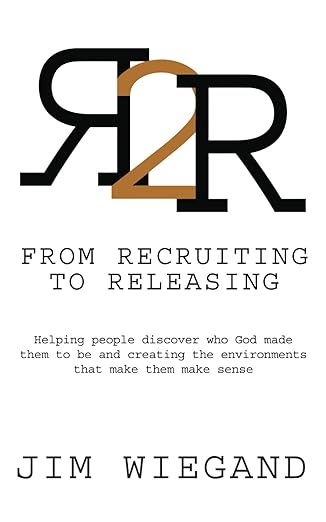
Jim’s book centers on the intersection of three circles. This is the “sweet spot” where people are doing what God created them to do. In order to find your sweet spot (or help others find theirs), Jim gives us three questions. Here are those questions with a couple of supporting quotes.
Question #1—What is your passion?
“The easiest question is the first one I always ask and sounds something like this: What are you passionate about? What thrills you when you get to do it? What makes your heart come alive when you see it? What do you love to do when you’re done doing what you have to do? If all jobs paid the same and you couldn’t fail, what would you do starting tomorrow?”
“Paul said he was ‘compelled’ to preach the gospel and that it was a ‘pleasure’ to do so. His passion for the God of the lost and the lost themselves caused him to travel the world. Everywhere he went, he saw revival or a riot, or at times, both in the same day. Then he’d be mistaken for a Greek god, stoned and left for dead or at times beaten, imprisoned, and slated for execution. And then the next day, he got up and did it all over again. That’s not fear of failure! That’s a God-given passion to tell people the good news of Jesus Christ!”
Question #2—What is your pain?
“What bothers you? What is it you see in the world that you would change? What breaks your heart? What do you find yourself praying about more than any other thing? What subjects do people no longer want to talk to you about because you’re always talking about those things?”
“The way I figure it, if it was bothering me the way it was, I was probably the one God wanted to do something about it. You see, I’ve learned that if I do something about what bothers me, and you do something about what bothers you, and the folks around here all do something about what bothers them, well, eventually there may come a day when there won’t be anything left to bother anyone.”
Question #3—What is your proficiency?
“What are you good at? What comes naturally to you? What did you pick up quickly and easily compared to others around you? What do you do with little effort that takes others much effort?”
I like the bridge in the song I Keep Falling In Love With Him—
When I first fell in love with Jesus, I gave Him all my heart And I thought I couldn’t love him more than I did right at the start. But now I look back over the mountains, and the valleys where I’ve been And It makes me know I love Him so much more than I did then
Out of the depths—Think how far we’ve come on this climb. In the first Song of Ascent, we were experiencing the woes of being in the valley (Psalm 120:5-7). But now in this song, the feelings of being in the depths are not from someone else’s sinful activity.
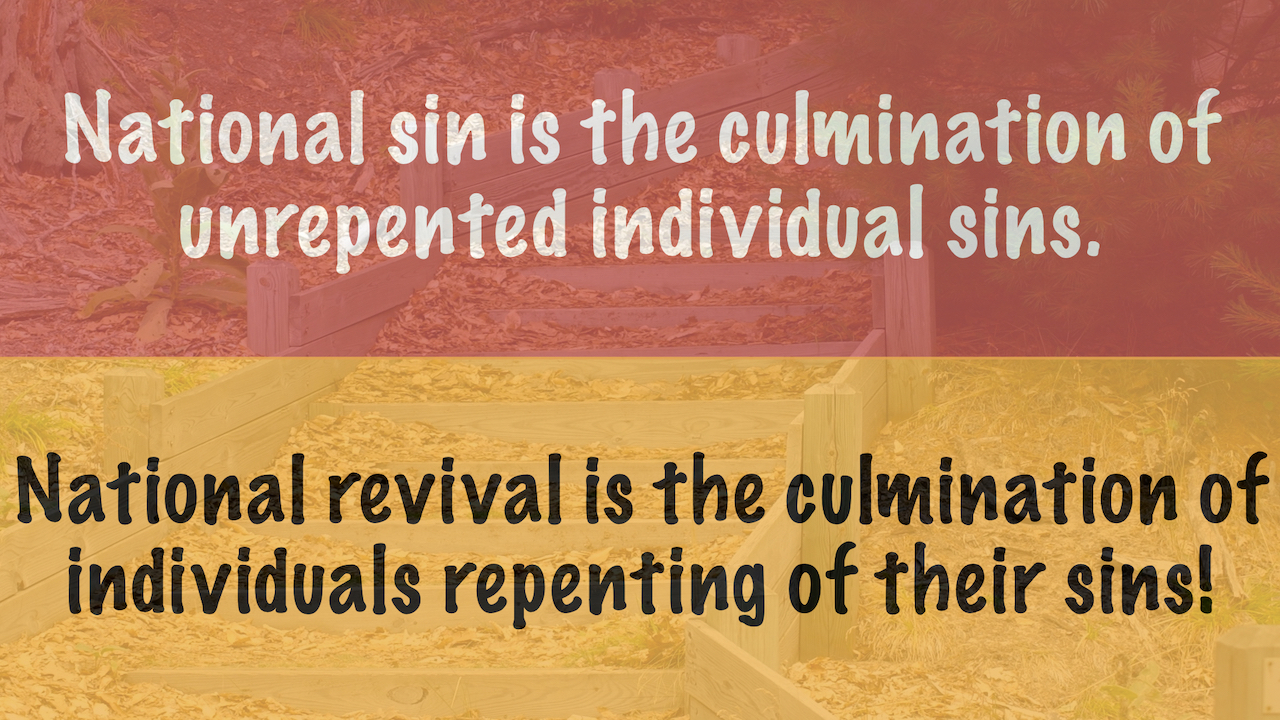
The psalmist is pointing out that national sin is the culmination of unrepented individual sins. God addressed this in Leviticus 20:22—Keep all My decrees and laws and follow them, so that the land where I am bringing you to live may not vomit you out.
Even in these depths, the psalmist is confident that God will hear—let Your ears be attentive (v. 2). Nehemiah was confident too. Look how he joins his personal sin to the national sin after Israel had be vomited out of the land (Nehemiah 1:1-7).
Our confidence comes from the rock-solid assurance that God completely forgives our sins and then forgets all that He forgives (vv. 2-3; Psalm 103:10-12).
The middle verses (vv. 5-6) have the key words wait, watch, and hope. This middle part comes down to: (1) What I’m going to pay attention to, and (2) What God pays attention to.
God is attentive to our cries for mercy, and He is watchful for our care, not for our punishment!
We are called to wait and watch in hope because God has proven that He is all in for us. Look at this completeness:
full forgiveness (v. 3)
unfailing love (v. 7a)
full redemption (v. 7b)
all their sins (v. 8)
Notice in v. 7 the phrase “all THEIR sins” is now corporate (not singular, personal as in the opening verses).
We’ve gone FROMmy voice, my cryTOyour hope, O Israel and redemption of their sins.
If national sin is the culmination of unrepented individual sins, then national revival is the culmination of individuals repenting of their sins!
In what may be the best-known parable that Jesus told, what’s the difference between the hard path where the seeds failed to produce anything and the fertile soil where the seeds produced an abundant harvest? The fertile soil had a plow applied to it. In the same way, God wants to “plow” the hard places in our life so that there can be an abundant harvest! Check out this full sermon here.
I have lots of new content every week, which you can check out on my YouTube channel.
“The greatest reason for a loss of reality is that while we say we believe one thing, we allow the spirit of the naturalism of the age to creep into our thinking, unrecognized.” —Francis Schaeffer, in True Spirituality
“The glory of God is a silver thread, which must run through all our actions.” —Thomas Watson
“Christianity is not the removal of weakness, nor is it merely the manifestation of divine power. Rather, it is the manifestation of divine power through human weakness.” —Dr. Donald Stamps, Life In The Spirit Study Bible,commenting on 2 Corinthians 4:7-9, 12:9-10
“In our media-rich, secular age, we must be especially vigilant against unbelief finding its way into our hearts [Hebrews 3:12]. The heavenly calling of God is really real, and we can really partake of it. But we’ll need to be continuously on guard against ideas and messages that can undermine our confidence, stifle our boasting, rob us of the reality of our experience of Christ, set us adrift from the Lord, and end up proving us to be someone other than we thought.” —T.M. Moore
“If you don’t want responsibility, don’t sit in the big chair. To be successful, you must accept full responsibility.” —Pat Summitt
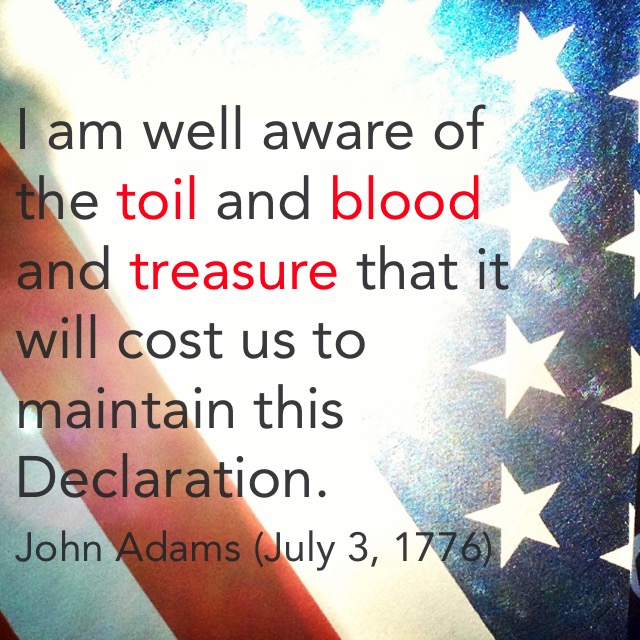
From the 1440 Daily Digest: Congratulations, America—July 4, 2024, marks the 248th commemoration of the day the Declaration of Independence was adopted by the Second Continental Congress. Through the centuries, the US has grown from 13 colonies with about 2.5 million people to 50 states and 14 territories with a population of more than 330 million. The economy has swelled to over $27T. Advances in public health have cut the child mortality rate from over 45% to under 1%, while our citizens live over 35 years longer on average. Scientific achievements in the US have delivered everything from the light bulb, modern flight, and the internet to air conditioning, movies, and the polio vaccine. More than 2.7 million miles of power lines electrify the country across over 4 million miles of paved roads, with over 90% of households accessing broadband internet. The US has also been responsible for more than 800 human visits to space—the most of any country.
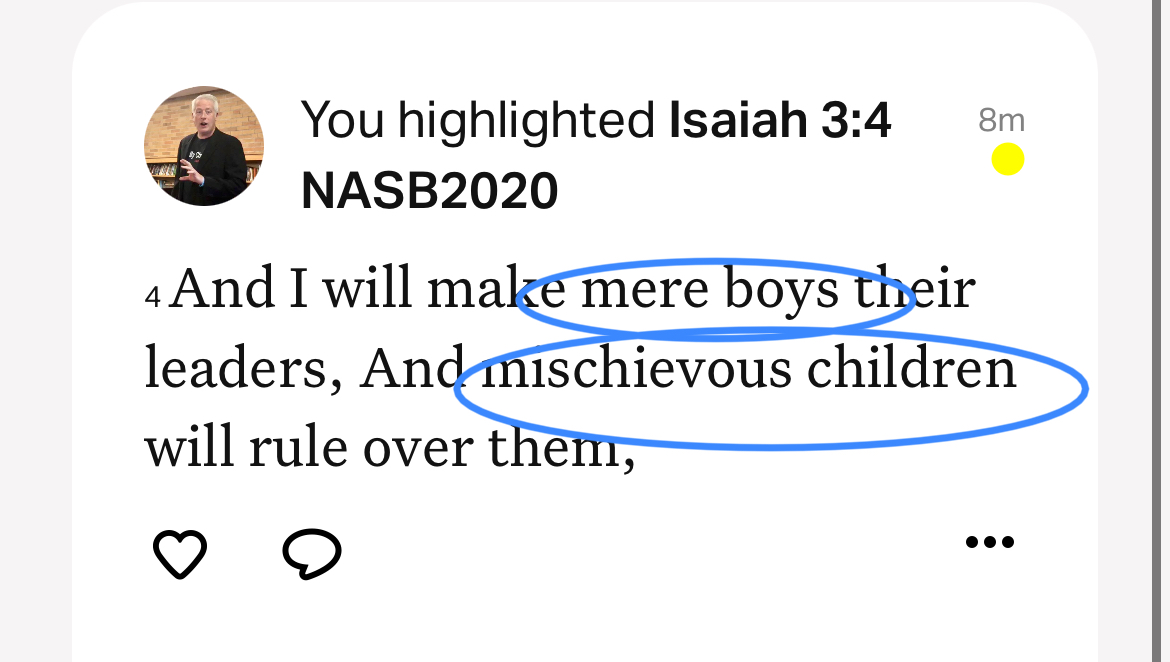
“And I will make mere boys their leaders, and mischievous children will rule over them, and the people will be oppressed, each one by another, and each one by his neighbor; the youth will assault the elder, and the contemptible person will assault the one honored.” (Isaiah 3:4-5)
God gives nations the “leaders” they deserve. They are leaders in that they occupy an office, but they don’t lead people nor care for the citizens—they don’t have wisdom to lead nor do they care about anyone but themselves. This is the inevitable result for a nation that turns its back on God!
In Hebrew, “mere boys” and “mischievous children” are defined as arbitrary, unprepared, unskilled, immature people. The AMPC translation says, “And I will make boys their princes, and with childishness shall they rule over them with outrage instead of justice” (Isaiah 3:4).
If we think our political and civic leaders are self-focused, unskilled, and childish, we should look in the mirror. We must be the leaders in confession and repentance if we want to see a change “downstream” in our governmental leaders. It’s not “them,” it’s us. We have to change—turning wholeheartedly to God—and only then God can change our leadership.
Listen to the podcast of this post by clicking on the player below, and you can also subscribe on Apple, Spotify, or Audible.
Have you ever said to yourself…
…I should have known better?
…why I am going through this again?
…I thought I was over this hurdle?
…you would think I would have matured enough by now to not have to deal with this?
Maybe the author of Psalm 129 felt this way: “Here I am on the 10th step and I’m still having to deal with this! When will I finally arrive at the top and be done with these issues?” (compare Psalm 129:1-2 with 124:1-5).
I think those statements—“I should have known better” or “I thought I was over this”—pre-suppose that we will reach a point in our life where we “arrive.” If nothing else, this psalm is a reminder that we are still on the journey, that we are still a work-in-progress, that the saint-ification process is still ongoing. It’s clear from Scripture that we never “arrive” until we arrive in Heaven and hear our Master say, “Well done, good and faithful servant.”
While we are ascending up toward our heavenly home, these great oppressions and plowings remind us that there is still work to be done in us and through us to bring glory to God (Romans 5:3-4; James 1:2-4, 12).
Of his Soviet prison, Alexander Solzhenitsyn said, “I bless you, prison—I bless you for being in my life—for there lying on rotting prison straw, I learned the object of life is not prospering as I had grown up believing, but the maturing of the soul.”
The reality is God is using all of those things for my good and for His glory (Romans 8:28).
What happens as I am oppressed and plowed?
(1) I am refined—Psalm 66:8-12, 16-20. God is removing the impurities from my life.
(2) My prayers are matured. Psalm 129:5-8 is an imprecatory prayer, a prayer that says, “Get ‘em, God!” These have their place, but for us they are to be our emergency release valve (which I discuss in more depth in my book When Sheep Bite). But Jesus calls for our prayers to mature from imprecatory to intercessory (Matthew 5:43-45). In my book I write, “This is the highest level of Christian maturity: To pray like Jesus did for those who insulted Him, slandered Him, and crucified Him, ‘Father, forgive them for they don’t understand what they are doing’ (Luke 23:34)”
(3) I develop more intimate God-dependence—2 Corinthians 1:8-10.
(4) I am better equipped to help others—2 Corinthians 1:3-6.
(5) Others feel more inclined to pray for me—2 Corinthians 1:7, 11.
“God uses broken things. It takes broken soil to produce a crop, broken clouds to give rain, broken grain to give bread, broken bread to give strength.” —Vance Havner
Oppressed? Yes! Defeated? No!
Plowed? Yes! Enslaved by the plow’s cords? No!
God uses this to bring us closer and closer to Him until He can eventually say to us face-to-face, “Well done, good and faithful servant!” That’s when we truly arrive! Until then, we keep on ascending.
Godly men honor their wives by having eyes only for them. Fellas, if you find your eyes wandering you need to tell yourself, “That’s not mine!” and then quickly put your eyes back where they belong. Check out my full message to men on Father’s Day.
I have lots of new content every week, which you can check out on my YouTube channel.
From a recent article at The Institute for Creation Research: “Astronomers using the James Webb Space Telescope have recently confirmed that two galaxies are extremely distant, with one becoming the new record holder as the most distant galaxy from Earth. … By uniformitarian reckoning, this galaxy existed just 290 million years after the supposed Big Bang, yet it looks too mature for its age. … This new record-breaker is just the latest example of the ‘distant mature galaxy problem’ that has long plagued the Big Bang model.” These galaxies are all the masterpiece of one Creator! Here is another resource from a biblical perspective that outlines what the “in the beginning” moment (Genesis 1:1) may have looked like.
“Give me the preacher who opens the folds of my heart; who accuses me, convicts me, and condemns me before God; who loves my soul too well to suffer me to go on in sin, unreproved, through fear of giving me offence; who draws the line with accuracy, between the delusions of fancy, and the impressions of grace; who pursues me from one hiding place to another, until I am driven from every refuge of lies; who gives me no rest until he sees me, with unfeigned penitence, trembling at the feet of Jesus; and then, and not till then, soothes my anguish, wipes away my tears, and comforts me with the cordials of grace.” —Samuel Pearce
Matthew Emadi writes, “The New Testament quotes Psalm 110 more than any other Old Testament passage. The apostles and the early church loved Psalm 110 for its majestic depiction of the Lord Jesus Christ and His reign over all nations.” Here’s how to read Psalm 110 in light of the words and works of Jesus.
J. Warner Wallace, at a Q&A session, answers questions about why some Bible translators have marked a couple of passages as unreliable, and why some books that claim to be authentic accounts aren’t included in the canon of Scripture.
“So the writer [of the Book of Hebrews] urges his readers, as part of being faithful to Him Who called them, to consider Jesus, to strive for the glory of Jesus, and to fix their minds on Jesus as the key to knowing daily strength for faithfulness (Hebrews 12:1-2). What does this entail? … The writer of Hebrews admits that he learned to look to Jesus by paying attention to those who had known Him, listening carefully to their words, and laying hold on them with faith (Hebrews 2:1-4). As he heard the apostles and studied the Scriptures of the Old Testament, the picture of Jesus presented there began to become increasingly clear. … The lesson is plain: Jesus is being revealed in the Scriptures of the Old and New Testament. Wherever we read or study in the Scripture, Jesus is present, making Himself known. We can see Jesus throughout the Bible, and consider Him as He is presented to us, in all His majesty, beauty, and power. Our responsibility is to read the Bible in such a way as to recognize what God is revealing about His Apostle and our High Priest, Jesus Christ.” —T.M. Moore



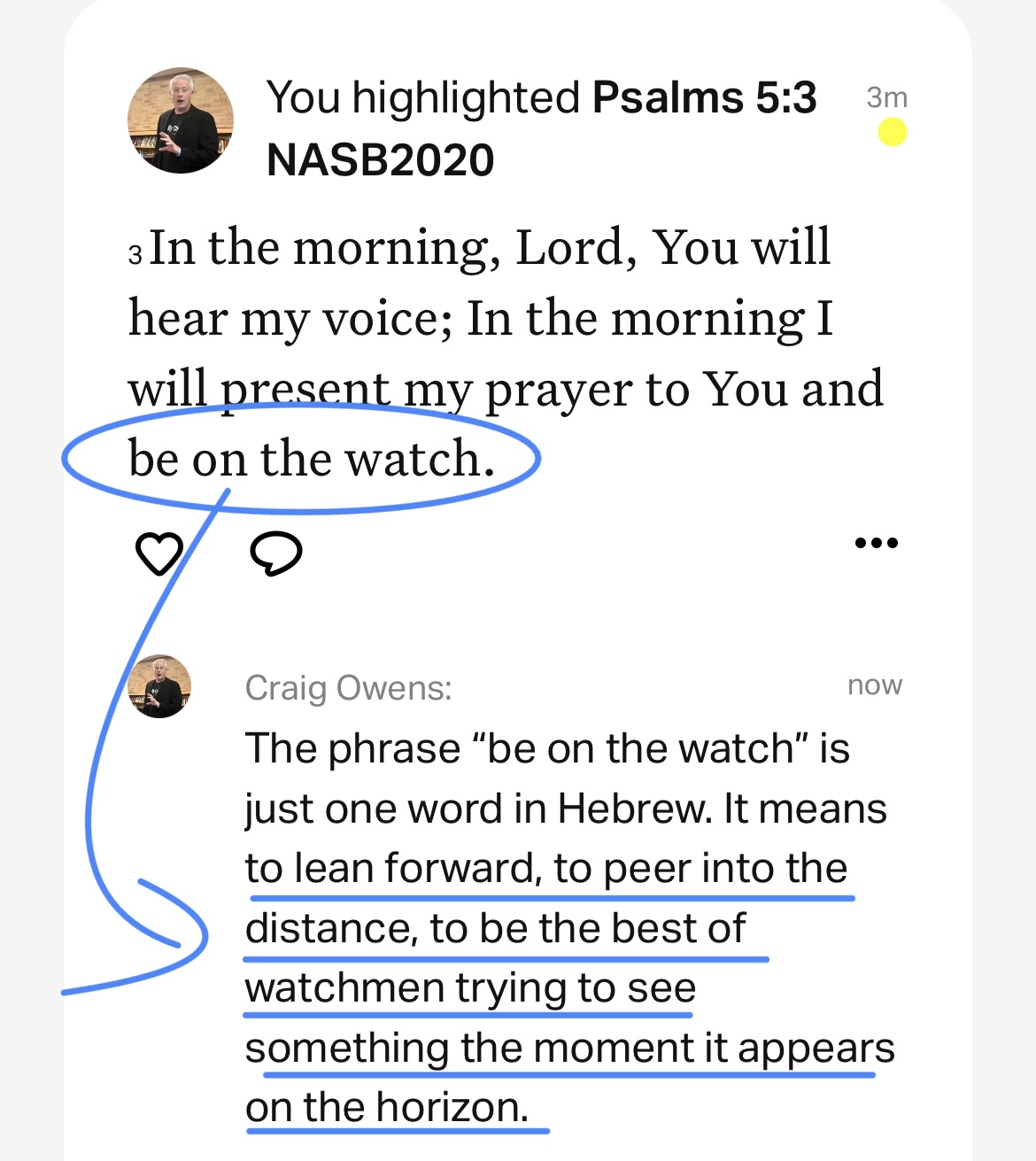 In the morning, Lord, You will hear my voice; in the morning I will present my prayer to You and be on the watch. (Psalm 5:3)




 Craig T. Owens