8 Ways Pastors Can Minister Like The Apostle Paul

PreachingThe Apostle Paul reminded the Thessalonians of how he ministered among them (“You know…” [1 Thessalonians 2:1]). This gives all of us pastors now an example of how to minister.

(1) “With the help of God we dared to tell you His gospel” (v. 2). I cannot minister out of my own strength; everything must flow from God’s strength.

(2) The message “does not spring from error or impure motives, nor are we trying to trick you” (v. 3). I must constantly allow the Holy Spirit to check my motives and check my theology.

(3) “We speak as men approved by God to be entrusted with the gospel”( v. 4a). I am merely a vessel that God chooses to use to share His gospel. This must keep me humble.

(4) “We are not trying to please men but God, Who tests our hearts” (v. 4b). I minister only for God’s approval, only for the applause of Nail-Scarred hands. “We were not looking for praise from men” (v. 6).

(5) “We were gentle among you, like a mother caring for her little children … We dealt with each of you as a father deals with his own children, encouraging, comforting and urging you to live lives worthy of God” (vv. 7, 11, 12).

(6) “We loved you so much that we were delighted to share with you not only the gospel of God but our lives as well” (v. 8). Paul didn’t just show up to preach, but he was in day-to-day interaction with the saints.

(7) “We worked night and day in order not to be a burden to anyone while we preached the gospel of God to you” (v. 9). My salary should not be too much of a burden for my congregation.

(8) “Holy, righteous and blameless we were among you” (v. 10). My life of integrity adds weight to the message that I preach (v. 5).

May all of us who are pastors live and minister like this!

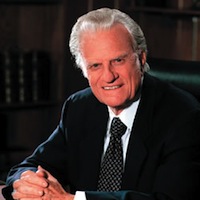
Billy Graham’s Humility

BillyGraham

This story was shared by Max Lucado—

I witnessed an example of this humility last October. I partnered with Michael W. Smith for a ministry weekend near Charlotte, NC. The retreat was held at “The Cove,” a beautiful facility that is owned and maintained by the Billy Graham Association.

A few hours before the event, Michael and I met to go over the weekend schedule. But Michael could hardly discuss the retreat. He was so moved by what he had just experienced. He had just met with Billy Graham for the purpose of planning Rev. Graham’s funeral. The famous evangelist was, at the time, 94 years old. He was confined to a wheelchair, on oxygen. His mind was sharp and spirits were high. But his body was seeing its final days. So he called for Michael. And he called for his pastor. He wanted to discuss his funeral. He told them that he had a request.

“Of course,” they said. “Anything you want. What is it?”

“Would you not mention my name?”

“What?”

“Can you not mention my name? Just mention the name of Jesus.”

4 Ways To Share The Good News With Everyone

Everybody EveryoneJesus told His followers that their ministry assignment was to take His message of salvation throughout the entire world. One requirement to do this, is to be able to communicate with lots of people. Actually to be able to communicate with everyone.

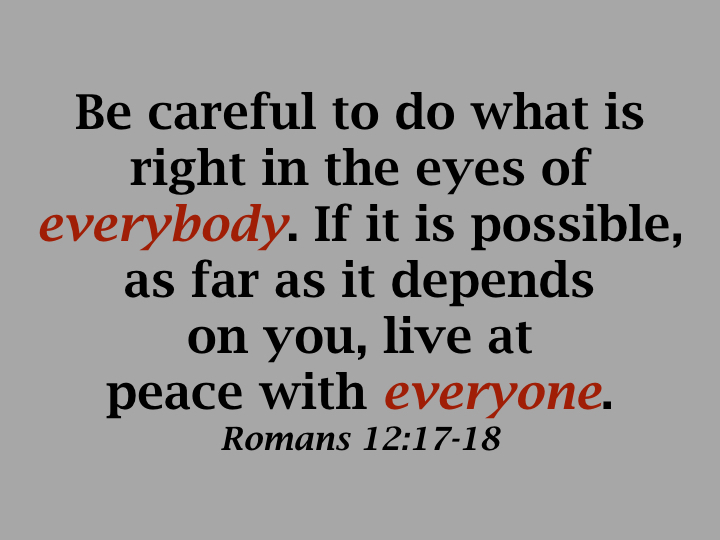
Be careful to do what is right in the eyes of everybody. If it is possible, as far as it depends on you, live at peace with everyone. (Romans 12:17-18)

Really? Everybody and everyone?!

Yes!

Jesus said our Helper would be the Holy Spirit. He would come to empower us to be witnesses to everyone, everybody, everywhere (Acts 1:8).

We have been learning how to communicate with others better, but noticing their communication style “accent.” Check out this post to get some more insight into this. In a nutshell…

  • Doers are action-oriented
  • Planners like to work out all the details
  • People want to make sure everyone is connected
  • Visions are imagining a better future

So if you are a Doer, and you’re trying to share the Good News about Jesus with a Planner, you can probably see a potential problem. The Doer is speaking in bullet points, but the Planner is wanting a lot more facts and figures.

This is where the Holy Spirit can help us. He has the insight that we don’t, and He can direct our words, just as He directed Christ’s words (see John 12:49-50).

Here’s how to talk their talk when you’re sharing the Good News:

(1) Doer

  • Keep it brief
  • Share more facts than stories
  • Stress now/today
  • Rely on the Gospel of Mark (action oriented)

(2) Planner

  • Tell them the who, what, where, when, why, and how
  • Be ready for lots of questions
  • Give them time to process your information
  • Rely on the Gospel of Matthew (lots of background, lots of Old Testament references to answer the who, what, where, when, why and how)

(3) People

  • Develop a friendship first
  • Share more stories than facts
  • Don’t tell them, show them your personal life
  • Rely on the Gospel of Luke (lots of personal stories about changed lives)

(4) Vision

  • Share both the facts and the stories
  • Encourage them to “Imagine what would happen …”
  • Give them time to ask questions
  • Rely on the Gospel of John (very poetic and image-rich)

You can connect with everyone, everybody, everywhere and share the Gospel with them in an effective way. Allow the Holy Spirit to give you the insight you need.

Check out how I describe this in more detail here…

Pentecost Sunday

For Pentecost Sunday, I think these words from Charles Spurgeon are vital for us to hear again…

“The Holy Spirit’sC.H. Spurgeon power was gloriously manifested in and after Pentecost. He remains at this hour the present Immanuel—God with us, dwelling in and with His people, quickening, guiding, and ruling in their midst. Is His presence recognized as it ought to be? We cannot control His working; He is most sovereign in all His operations, but are we sufficiently anxious to obtain His help, or sufficiently watchful lest we provoke Him to withdraw His aid? Without Him we can do nothing, but by His almighty energy the most extraordinary results can be produced…. The Holy Ghost is no temporary gift, He abides with the saints. We have but to seek Him aright, and He will be found of us.” —Charles Spurgeon

Poetry Saturday—Garden Of Trust

FullSizeRenderBuild a little fence of trust
Around today;
Fill the space with loving work,
And therein stay;
Look not through the sheltering bars
Upon tomorrow;
God will help thee bear what comes
Of joy or sorrow. —Mary Frances Butts

Bono & Eugene Peterson Discuss The Psalms

Thursdays With Oswald—The Right Ingredients For Spiritual Growth

Oswald ChambersThis is a weekly series with things I’m reading and pondering from Oswald Chambers. You can read the original seed thought here, or type “Thursdays With Oswald” in the search box to read more entries.

The Right Ingredients For Spiritual Growth 

     God engineers the circumstances that are best fitted for the development of the life of His Son in us. … 

     We hear it asked, “What is the good of all this study and reading of the Bible? We get no ‘change’ out of it.” Most of us want something to show for what we do. We are not interested in God’s life in us, but only in our life in God. We are not after the development of the unconscious life of the Son of God in us, but after the “small change” which enables us to say, “I did this and that.” The life of the Son of God grows feeble in a life of that order.

     Every mind has two stories, the conscious and the unconscious. Most of what we hear passes out of our conscious mind into our unconscious mind and we think we have forgotten it, but we have not, we never forget anything; we cannot always recall it when we want to, but that is a different matter. We forget nothing; it is there, although not in the conscious mind, and when certain circumstances arise, suddenly the thing we thought we had forgotten is there to our amazement right enough. 

     This is exactly what Jesus said the Holy Ghost would do, “He shall…bring all things to your remembrance whatsoever I have said unto you” [John 14:26]. The Holy Spirit is forming the unconscious mind all the time, and as we “mop up” His teaching—simply take it in, not try to estimate it as we would a mathematical study—we shall find God is putting in the right soil for His life to grow in.

From The Psychology Of Redemption

God knows the soil, and the circumstances that will best make His life grow in us. Will I let Him have His way?

The best “fertilizer” for this growth is the Holy Spirit bringing out the Word of God in the circumstances in which God places us. Notice Jesus said the Spirit would remind us the Word. Which means it is my responsibility to put the Word into my mind as regularly as I can. Am I daily in His Word?

The Importance Of Good Theology

Brandon D. Smith“Theology is about love—of God and neighbor. We worship rightly so we can share the gospel rightly. We want to know God rightly, and we want to tell others about him rightly. … It’s not loving to lead people into a false relationship with a false god, so we shouldn’t take our theology lightly.

“Good theology is the system of roots that keeps our tree of faith vibrant and alive. It keeps us grounded and centered, yet growing. When we are rooted, we won’t remain stagnant. And neither will those around us.

“Forging and sharpening a good theology is valuable, for the worship of God and the mission to others.” —Brandon D. Smith

10 More Quotes From “Answering Jihad”

Answering JihadNabeel Qureshi has given us a very timely book in Answering Jihad. He cuts through the confusion and misinformation to give us an informed, clear look at the teachings of Islam in regard to jihad.

I already shared one set of quotes from this book (which you can read here). Here is the next set of quotes I found eye-opening.

“At the risk of over-generalizing, this common understanding of Islam boils down to this: True obedience to Allah will result in Muslim dominance.”

“I have heard many people, frustrated by the increasing frequency and scale of Islamist terrorism, suggest that Islam needs a reformation. What they may not realize is that radical Islam is the Islamic reformation. This might sound shocking, but consider: Just as the Protestant Reformation was an attempt to raze centuries of Catholic tradition and return to the canonical texts, so radical Islam is an attempt to raze centuries of traditions of various schools of Islamic thought and return to the canonical texts of the Quran and Muhammad’s life.”

“Violent expressions of Islam adhere more consistently and more literally to the foundational texts of the Islamic faith, the Quran and the hadith. Peaceful versions of Islam must reinvent traditions from Muhammad’s life in order to be internally consistent, or they must ignore them outright.”

“Instead of fearing Muslim immigrants, we should embrace them and be the element of change we wish to see. … I suggest friendship rather than fear has a better way forward.”

“Christians believe Jesus is God, but the Quran is so opposed to this belief that it condemns Jesus worshipers to hell (5:72).”

“According to Jesus, God is our Father, yet the Quran very specifically denies that God is a father (112:1-4).”

“Islam roundly condemns worship of the Trinity (5:73), establishing in contrast its own core principle of Tawhid, the absolute oneness of God. Tawhid emphatically denies the Trinity, so much so that it is safe to say the doctrine of God in Islam is antithetical to the doctrine of God and Christianity. … The Trinity teaches that God is not a person, but three Persons: Father, Son, and Spirit. To assert that the God of Islam is the same person as the God of Christianity becomes almost nonsensical at this point, as the Christian God is tripersonal, two persons of Islam specifically denies in the Quran.”

“One can both love Muslims and insist that the God they worship is not the same as the Christian God.”

“In the Christian worldview, the exemplar for followers of God is no mere man but God Himself. Since God cares for those who are His enemies, even blessing them with rain, Christians ought to love their enemies and pray for those who persecute them, so that they can follow God’s example. This contrasts with the teaching of the Quran, where Allah tells Muslims, ‘O you who believe! Do not take my enemies or your enemies as allies, offering them your friendship when they do not believe’ (60:1). Of course, that is not to condemn the Quran, as it is counterintuitive to love one’s enemy. The Christian command may make little earthly sense, but it is the explicit teaching of Jesus.” 

“Even though Muslims are often raised with the teaching that ‘Islam is the religion of peace,’ when they study the texts for themselves, they are faced with the reality that Muhammad in the Quran calls for jihad. They will stand at the crossroads for only so long before they choose what path they will take—apostasy, apathy, or radicalization. As Muslims make that choice, it would benefit the whole world if they did not make it alone, or worse, with radical recruiters. We need to show compassion for Muslims and befriend them.”

Be sure to check out my review of Answering Jihad, and then pick up a copy for yourself.

The Safe Walk Of Faith

David Wilkerson“We sometimes think that when God commands us to do something and we obey, everything will be smooth sailing. We think He’ll be grateful for our obedience so He will place us on a four-lane freeway to blessing. Abraham obeyed God’s Word, but the fact is, one act of obedience doesn’t add up to a walk of obedience.

“Abraham had a promise from God, but along the way he had to go through the Negev desert, over snow-covered mountains, through another desert, and past the warring people of Canaan. Then he ended up in the midst of a famine in Egypt. I’m glad God didn’t tell Abraham about the path he would be walking!

“This particular path was like no other Abraham had walked. Yet, through it all, he was never in any danger. Nobody could touch him. God was his shield and protector every day. And because of his faith, Abraham was becoming a friend to God.” —David Wilkerson