There are some long-lasting benefits in keeping a journal. Here’s one benefit I shared with some ministry interns. If you haven’t already done so, please check out my YouTube channel for more great content.
The James Webb Space Telescope (JWST) is causing problems for Big Bang proponents. In a recent post from the Institute for Creation Research, some of these problematic areas were laid out. “As noted in a previous Creation Science Update and Impact article, data from the JWST show that distant galaxies look more ‘mature’ and ‘developed’ than predicted by Big Bang theorists. Big Bang astronomers assume light from the most distant galaxies took almost 14 billion years to reach Earth. Although this may sound reasonable, creation scientists think this assumption is open to challenge. But in any case, by Big Bang reckoning, we should be seeing these very distant galaxies—not as they are now, but as they were almost 14 billion years ago. Hence, these galaxies should appear very “unevolved” and ‘immature.’ Yet, this expectation is routinely contradicted, and data from the JWST are making the disagreement even worse.” One thing the JWST has definitely done: It has shown the beauty and the power of our Creator!
John Piper said, “One of the greatest hope-killers is that you have tried for so long to change, and have not succeeded.” This is an encouraging word for anyone who has prayed, and prayed, and prayed for a breakthrough. “Take heart, struggler. Keep asking, seeking, knocking. Keep looking to Christ. If God gets glory by saving robbers in the eleventh hour, he surely has his purposes why he has waited till now to give you the breakthrough you have sought for years.”
This is pretty compelling evidence for the global Flood that is described in the Book of Genesis—
Listen to the audio-only version of this podcast by clicking on the player below, or scroll down to watch the video.
When we think about leadership, we often envision the people in organizationally designated leadership roles “leading down” to the people on their team. In this episode of The Craig And Greg Show, we flip the script, discussing how you can “lead up” to those above you and help your team achieve greater levels of success.
[0:30] This is part 1 of a new series of periodic episodes of how to lead at all levels of your organization.
[1:07] What is the real definition of a leader?
[1:55] You need different skills to lead up based on how receptive your leader is.
[3:31] Do you have the right tools to lead up, or do you need to fill your toolbox first?
[5:30] What happens when the leadership above you changes?
[6:35] There are two really important words when leading up: stewardship and accountability.
[7:59] “I told you so” doesn’t help you lead up, nor does withholding information from your up-leader.
[11:55] What are the best ways to talk to your up-leader?
[14:35] Everyone in the organization already knows when you have the good ideas, so you don’t have to announce it.
[15:05] How do you balance being proactive with being too aggressive?
[16:05] What lessons can you learn from working with your difficult up-leader?
[17:42] You shouldn’t try to “fix” your up-leader, but help your up-leader.
[19:34] I share how I kept my attitude in check with my difficult up-leader.
[22:00] Coaches can help you do what you’re already doing better than you’re currently doing it
Check out this episode and subscribe on YouTube so you can watch all of the upcoming episodes. You can also listen to our podcast on Spotify and Apple.
“That’s a pretty bold claim. Are you prepared to back that up?”
I’ll bet you have heard something like that said to you, and maybe you have even said that yourself to someone else who made a big, audacious statement.
After Jesus is arrested by the religious leaders—an arrest that will ultimately lead to Jesus being crucified on the Cross—there are some incredibly bold claims spoken by key people in this part of the Story. For the most part, these are claims that we don’t read earlier in any of the Gospels, but as this story is heading toward its most crucial moment, we have these audacious statements pronounced.
But here’s the most important part: These bold claims weren’t just made, but they were backed up with proof as well.
As we head toward the remembrance of Christ’s death on the Cross and His resurrection three days later, please join us for this look at these eye-opening bold claims. I would love to have you join us in person, but if you are unable to do that, we will make all of the messages available on Facebook and YouTube. If you’ve missed any of the messages, or simply want to review what we’ve already learned, you can find all of these messages here:
Listen to the podcast of this post by clicking on the player below, and you can also subscribe on Apple, Spotify, or Audible.
When I was younger—and so much more immature—I thought it would diminish my leadership if I ever answered, “I don’t know” to any question. As a result, I fired off very self-assured answers that probably weren’t well thought-out.
They probably weren’t very God-honoring answers either.
Once a leader is “on the record” with an answer, they will usually defend their stance even if it appears to be wrong. After all, they must save face at all costs.
A downward slide continues when a leader then uses their position of authority to say something like, “Because I’m the leader and I said so!” With this stance, people are often repelled from that leader.
How much better to to wait before giving an answer—to give up the need to always be “The Answer Man”!
And better yet, let’s not give anyone our answer, but let’s seek God for HIS answer! Not only will this be the best answer, but God will defend Himself without us having to step in to “help” Him.
With this stance, the people are not only drawn to this godly leader but they are drawn to God as well.
Consider these examples from Moses:
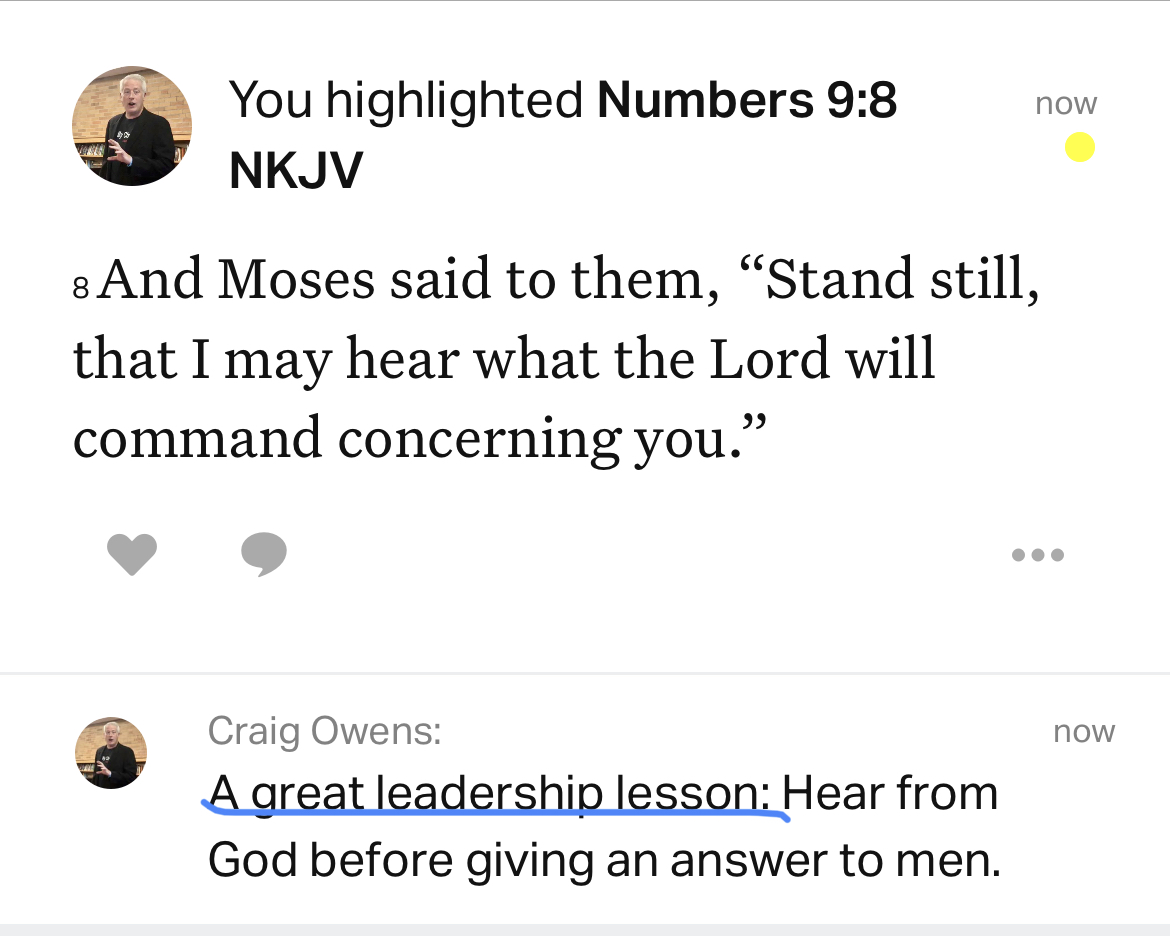
Stand still, that I may hear what the Lord will command concerning you. (Numbers 9:8)
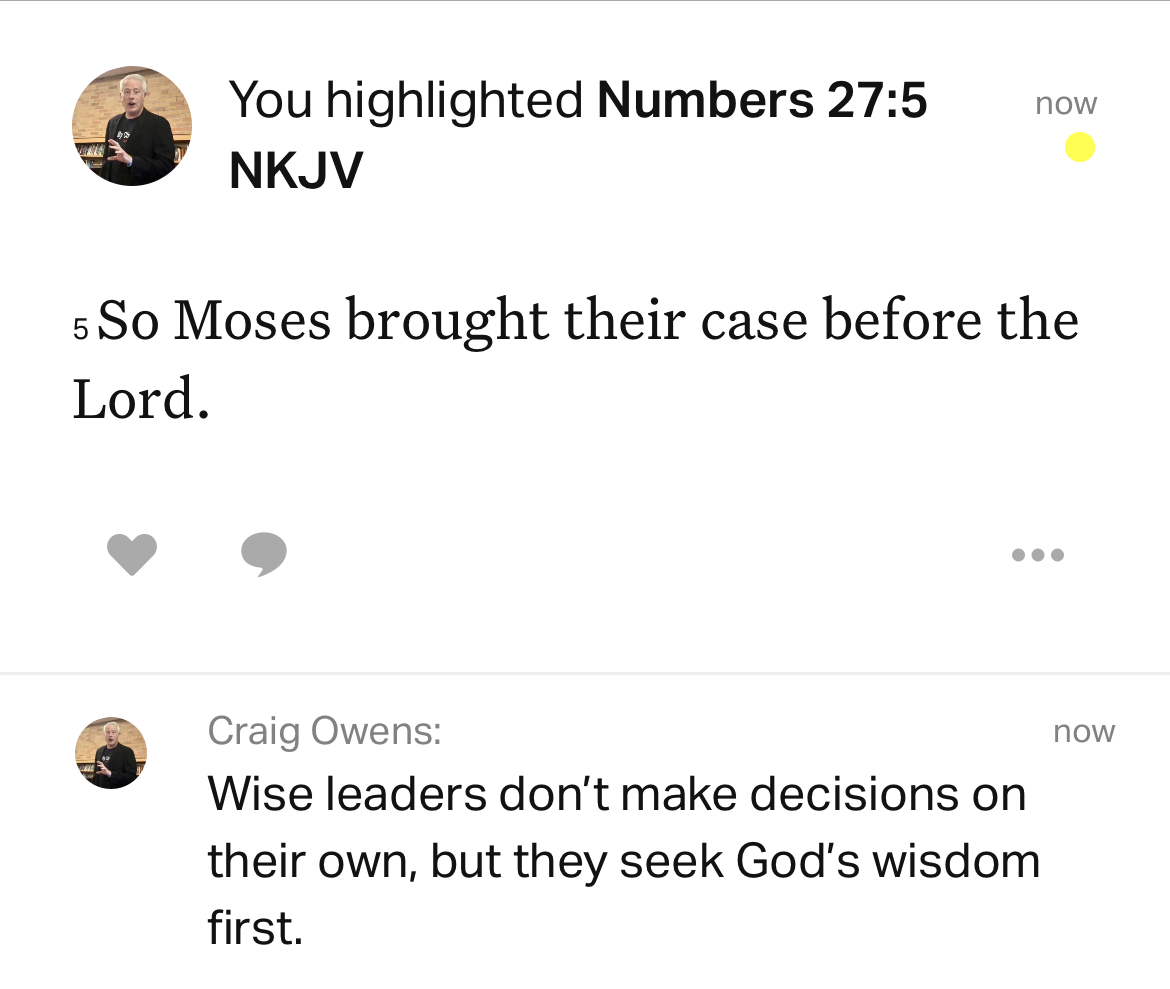
So Moses brought their case before the Lord. (Numbers 27:5)
A mark of a godly leader is one who hears from God before answering men.
So the next time someone asks your opinion, pause. Remember that it’s okay to say, “I’m not sure how to answer you on that one. I need to hear what God has to say about this.” Let’s give up the desire to be “The Answer Man” for everything. Instead we can simply announce the answer that God has given.
This is part 69 in my series on godly leadership. You can check out all of my posts in this series by clicking here.
If you are a pastor (or if you really want to encourage your pastor), I’ve got a super-special deal on my book Shepherd Leadership. Check it out by clicking here.
Listen to the podcast of this post by clicking on the player below, and you can also subscribe on Apple, Spotify, or Audible.
I don’t think there’s any arguing that Jesus must have been the healthiest Person to ever live. Dr. Luke records His growth in just one succinct verse: “And Jesus grew in wisdom and stature, and in favor with God and man” (Luke 2:52). Every word of Scripture is inspired, right down to the order the words are penned. So when Luke says first that “Jesus grew in wisdom,” that is our indication that a healthy mind is the foundation for every other aspect of health.
I recently received an email from a Christian brother asking for prayer and counseling in overcoming lust and pornography. I naturally agreed to pray with him, but I also said, “Before I offer you any strategies to try, let me ask you a quick question: What have you already tried to get victory over this?”
He replied, “I’ve tried praying, watching videos on it, and basically saying no to the devil. But the temptation comes when I am weak and I think, ‘I can just try again tomorrow!’ And then I fall into it. I am just tempted at times throughout the day, and sometimes I fight it with prayer, but other times I just fall right into it basically without even trying.”
What my friend is dealing with here is a natural, unconscious response. Our brains like well-worn paths because it’s very easy and comfortable for our minds to automatically respond as they have responded before. As in the case of my friend, it may be heading down a path of lust that leads to pornography. For others, it may be unhealthy choices made in response to certain triggers, or it may be the anger that flares up into biting words when a certain someone pushes your buttons.
We head down that well-worn path unconsciously and automatically. Our immediate response might bring some temporary relief, but usually, we’re not very happy with where we’ve ended up once again.
If we are going to make a new path—or a new, healthier response—we first need to become aware of the well-worn path we automatically go to. So my counsel to my friend who emailed me for help was to start keeping a journal. I wrote back:
Your willpower alone isn’t going to cut it (as you’ve probably realized). Here’s the first step I would suggest: keep a journal of every time you are tempted to lust or porn. Write down what you were feeling, was it day or evening, what was happening just before that, did you have time in prayer and Bible reading that day or not, how did you fight the temptation, were you successful or not? I think as you keep track of these things you will begin to see some triggers and some patterns. Maybe you were physically tired, or lonely, or hungry. Maybe it was a certain person you talked with or a show you watched. Maybe it was after checking your social medias or after a super-hard day at work. When you start to see patterns of what is causing you to go to porn for relief, you can recognize them earlier and head them off before they grip your mind so strongly.
Psychologists call it metacognition when we think about what we’re thinking about—when we think about why we are taking a certain well-worn path again.
We don’t think about our thinking very frequently. We keep thinking along those well-worn paths out of habit, not because we want to go down those paths. This is where the Holy Spirit is invaluable: He helps us see those well-worn paths, identify which paths are unhealthy or unproductive, and then help us begin to carve out a new path.
It’s not just thinking about right things, but thinking rightly about all things—even the painful things or the triggering things.
In Ephesians 4:22-25, Paul counsels us to take off the “old self” and “put on the new self, created to be like God in true righteousness and holiness. Therefore” (and this is an important conclusion) “each of you must put off falsehood and speak truthfully to his neighbor.”
Do you remember that Jesus taught us to love our neighbor as ourselves (Mark 12:28-31)? Paul says we are to speak truthfully to our neighbor, so doesn’t that mean that we have to first speak truthfully to ourselves? Yes, we do! If we are going to make new paths for our mind, we are going to have to talk to ourselves differently.
My cousin Dick Brogden wrote, “A primary theater of spiritual warfare is in our heads and thoughts. The primary weapon of the enemy is deceit. He starts with attractive little lies and half-truths, and works his way up to blatant, ridiculous, perverted nonsense. Winning the battle for truth in the mind is critical to winning the war. If we lose enough of the little skirmishes, we can believe and do any wicked thing. If we daily combat lies with light and truth, we will stand firm.”
The “little lies and half-truths” will keep us trapped on our old, well-worn paths. But identifying those lies, and speaking the truth to them, will help us travel down new paths that lead to health and freedom.
Let the Holy Spirit be your Counselor. Let the Holy Spirit help you think about what you’re thinking about when you’re triggered to unconsciously head down the unhealthy well-worn path. Let the Holy Spirit help you see a new path. And then let the Holy Spirit empower you to stick with it—to keep doing the hard work of blazing a new path.
I am going to build on this series of messages about a Christian’s mental health, but let’s start with this simple prayer:
Holy Spirit, help me make new paths.
As you pray this, listen to how the Holy Spirit will guide you away from the unhealthy, unconscious, well-worn paths, and will then lead you into the new, healthy path that brings you freedom.
I am really looking forward to a new series of sermons that I am launching this Sunday. This will be a once-per-month series for the remainder of the year and it’s simply called A Christian’s Mental Health. If you don’t have a home church in the west Michigan area, I would love for you to join me in person, but the sermons will also be posted on my YouTube channel.
T.M. Moore has an outstanding post called The Essence of the Lie. In one part, Moore writes, “Thus the lie claims to be the truth, but, at the same time, it insists that truth is personal, relative, pragmatic, and utilitarian. Truth, from this perspective, is not absolute, but dynamic, changeable rather than fixed. It is conditioned by circumstances of time and place. At the end of the day, people are the final arbiters of truth, and truth is whatever they find to be useful for their purposes. Ultimate truth is that which people impose on others by one or another kind of force, whether intellectual, political, or physical.” Check this one out!
Harvard University has been studying a group of individuals since 1938 to try to determine the main factors that contribute to a long and healthy life. The director and assistant director of this study just published an article that sums up what they have learned over all these years—“[If] we had to take all 85 years of the Harvard Study and boil it down to a single principle for living, one life investment that is supported by similar findings across a variety of other studies, it would be this: Good relationships keep us healthier and happier. Period. If you want to make one decision to ensure your own health and happiness, it should be to cultivate warm relationships of all kinds.”
“The battle for control and leadership of the world has always been waged most effectively at the idea level. An idea, whether right or wrong, that captures the minds of a nation’s youth will soon work its way into every area of society, especially in our multimedia age. Ideas determine consequences.” — The American Covenant
“The storms of life are no longer our point of reference when [Jesus] is our focal point.” —Dutch Sheets
John Stonestreet was intrigued by a street reporter asking, “What are men good for?” There were a lot of soft, ambiguous answers given, but John quipped, “Men are good for fathering, protecting, loving, providing, leading, fighting for what’s right with their lives if need be, and obeying, in a masculine way, the creation mandate of the God who made us male and female and declared both ‘very good.’ Was that so hard?” Amen!
Peter’s mother-in-law was sick with a fever. “They immediately told Jesus about her. So He went to her…” (Mark 1:30-31).
They didn’t call a doctor first, or try a home remedy first, or consult a friend about how they treated a fever first. They immediately went to Jesus. And as soon as they did, Jesus went to the sick woman and healed her.
The old hymn What A Friend We Have In Jesus has a powerful reminder: “Oh, what peace we often forfeit—Oh, what needless pain we bear—all because we do not carry everything to God in prayer.”
What are we waiting for? Why do we try to help ourselves first when Jesus is standing right there waiting to help us?
Let’s respond differently. Let’s make going to Jesus our first—our immediate—response so that Jesus can come to our aid right away.
Listen to the podcast of this post by clicking on the player below, and you can also subscribe on Apple, Spotify, or Audible.
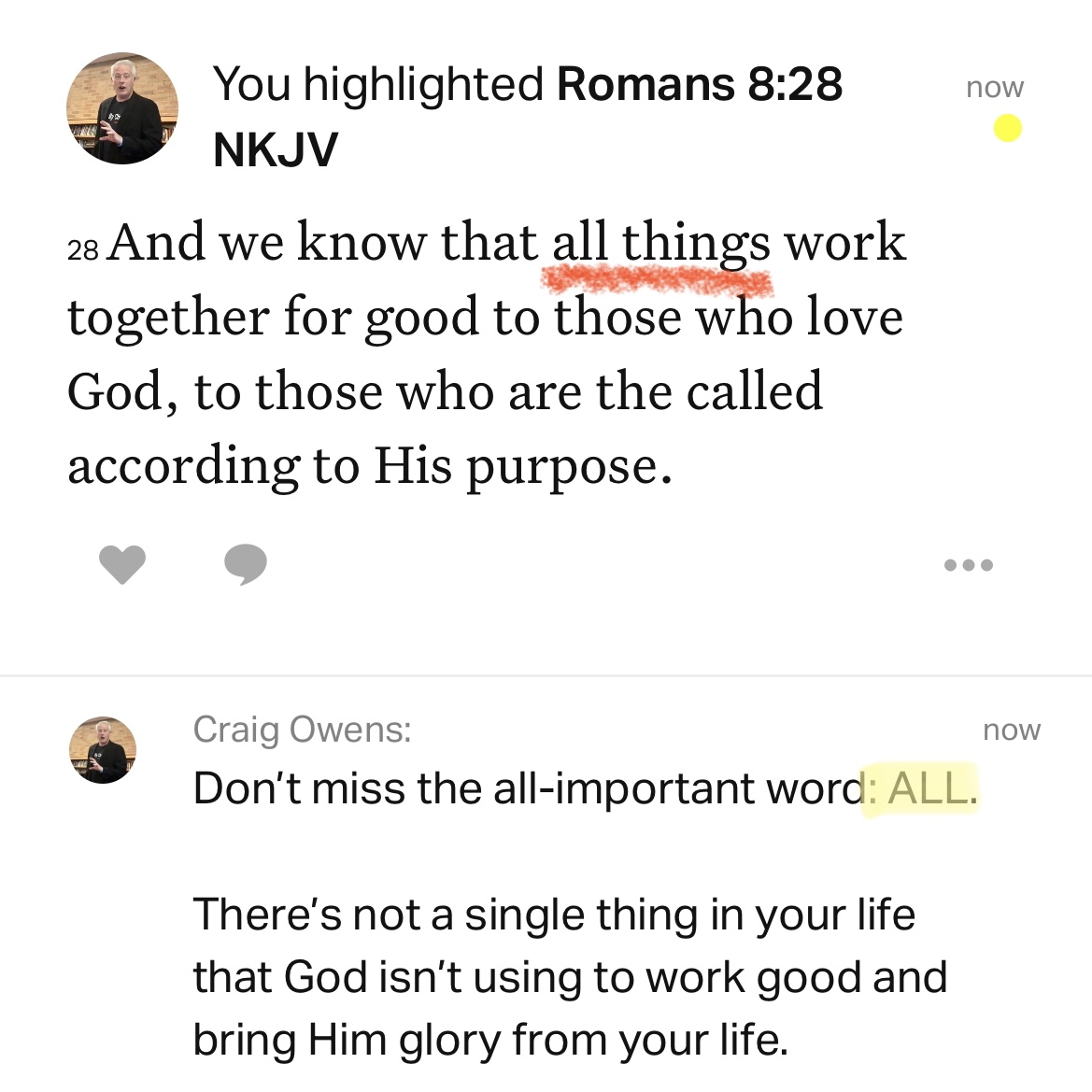
Romans 8:28 has a small but extremely powerful word in it: ALL.
“And we know that ALL things work together for good to those who love God, to those who are called according to His purpose.”
The verb tense here would probably be more accurate to say “are working.” God never wastes an experience, but He is using ALL those things to prepare you for the next assignment He has for you.
Check out this brief clip from a training time I was able to share with some young ministry interns.
Don’t dwell on the “what ifs” but let’s remind ourselves that God is sovereignly in control. Let’s learn to take God at His word—He ISWORKINGALLOFTHOSEEXPERIENCES together for your good and for His glory.
I don’t think there is any arguing that Jesus was the healthiest individual who ever walked planet Earth. Some may want to push back with, “Of course He was because He didn’t have any problems to deal with!”
But the writer of Hebrews tells us that Jesus experienced everything you and I will ever experience (Hebrews 2:17), so His deity didn’t exclude Him from the stressors that His humanity would have to face. And yet, He handled all of these things successfully.
Luke the physician observed the growth of Jesus and tells us that it all began with Jesus having a robust mental health. From that foundation, everything else—physical, spiritual, relational—all could develop properly. We must learn from this example and pay careful attention to our own mental health.
This Sunday we will begin a series that we will be returning to once each month throughout this whole year called A Christian’s Mental Health. I would love to have you join us in person, but if you are unable to do that, we will make all of the messages available on Facebook and YouTube. If you’ve missed any of the messages, or simply want to review what we’ve already learned, you can find them all here:













 Craig T. Owens