9 More Quotes From “Live Dead Life”

Joy Hawthorne is a 16-year-old living with her parents in a radically Islamic Middle East country. Live Dead Life started out as her personal journal, but then became a book that I found highly compelling. Here are some additional quotes from this book.

“How do we do all for the glory of God? Well, ‘for the glory of God’ means that the purpose ends with God, not with me. What I do is not about me, but about God.”

“Not everyone will be a pioneer missionary, but everyone needs a vision to see beyond the borders of her country and have the courage to send others, and the pioneers are the ones who scout the land and report back home to those future missionaries and intercessors.”

“If I know the cure, if I know the truth, if I know the life, if I know the love—and I do—then I am compelled to share it with everyone everywhere—wherever Jesus is not yet worshiped.”

“This is not a race to see how far I can go alone, but to see how far we can relay together, working as a giant team.”

“If the unreached are going to hear about Jesus, we’ll have to step out of comfort zones and go to hard places.”

“Rather than wish for a home with less risk and more comforts, I accept and follow God’s plan for my life and find myself happy where He has placed my family. I willingly follow Him rather than draw lines in the sand of where I won’t go and what I won’t do. We go because, despite the risks, we know our God has a plan. We go because Jesus is worthy. He is worthy of my praise and the praise of the unreached I live among. No matter the cost, Jesus deserves all glory.”

“I feel safe today, but in case something should happen to me tomorrow, I want to take every opportunity today. God knows what I need, and until my work here is done, I am untouchably covered by Jesus’ blood. … I don’t think satan wants me to go to the dangerous, difficult, unreached places. He would rather I stay home. Believing this, will I be afraid or will I be bold?”

“My teen years are the perfect opportunity. I have more time and energy now than I might have in a few years. I want to take responsibility for the message of Jesus and for the people around me. The time is now. There is no good reason to wait. My door is open, and Jesus calls me to follow Him through it.”

“God, help us to abandon everything to You because You are worthy of it all. You are worthy of our lives. You are worthy of the praise and love of every tribe and nation on earth. Give us Your heart. Make our hearts overflow for every people. Give us Your eyes to see the world.”

Please be sure to read my review of Live Dead Life by clicking here, and check out the first set of quotes I shared from this amazing book by clicking here.
The Transparency That God Loves

Have mercy … heal me … deliver me … save me … (Psalm 6:2, 4).

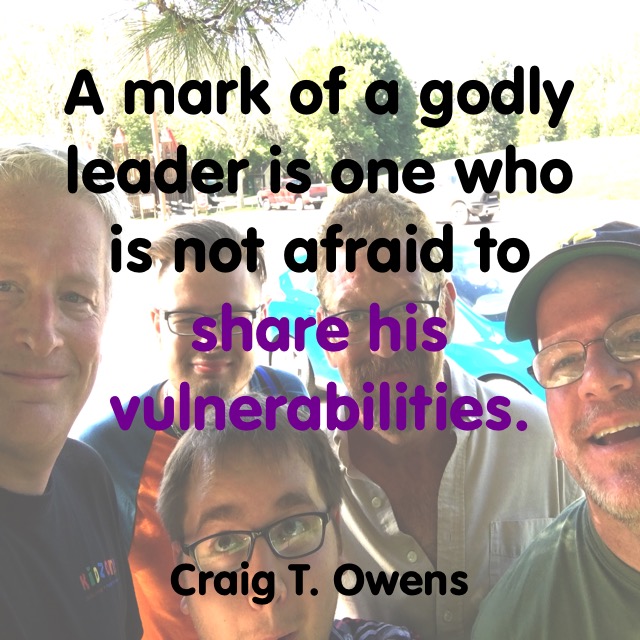
A mark of a godly leader is one who is not afraid to share his vulnerabilities.

David freely admits his fear of punishment, his need for God’s help, and his grief that robbed him of sleep.

But he also admitted just as freely his rock-solid assurance of God’s help:

  • The Lord has heard my weeping
  • The Lord has heard my supplication
  • The Lord will receive my prayer

Godly leaders are confidently transparent before God and before those around them. God delights in that transparency, and He delights to answer vulnerable prayers.

This is Part 17 in my series on godly leadership. You can check out all of my posts on this topic by clicking here.

11 Quotes For Pastors From “Interpretation Of The Scriptures”

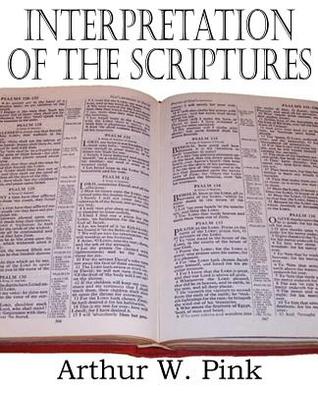
You don’t have to be a pastor to benefit from reading Interpretation Of The Scriptures by A.W. Pink, rather I think all students of the Bible will benefit from reading this classic book. However, the Apostle James did warn that “not many of you should presume to be teachers” because “we who teach will be judged more strictly” (James 3:1). In that light, A.W. Pink directs several of this comments in this book exclusively to those who teach/preach from the Bible. Here are a few of those quotes.

“The preacher’s task is both the most honorable and the most solemn of any calling, the most privileged and at the same time the most responsible one.”

“The ministry is no place for trifiers and idlers, but for those who are prepared to spend and be spent in the cause of Christ. The preacher ought to work harder than the miner, and to spend more hours per week in his study than does the man of business in his office.”

“Particularly does the minister need to attend unto this injunction ‘take heed unto thyself’ in his study of the Scriptures, reading them devotionally ere he does so professionally; that is, seeking their application and blessing to his own soul before searching for sermonic materials.”

“To ‘open’ the Scriptures helpfully to the saints requires something more than a few months’ training in a Bible institute, or a year or two in a seminary. None but those who have been personally taught of God in the hard school of experience are qualified so to ‘open’ the Word that Divine light is cast upon the spiritual problems of the believer, for while Scripture interprets experience, experience is often the best interpreter of Scripture.”

“The preacher should be with his time as the miser is with his gold—saving it with care, and spending it with caution.”

“Great care needs ever to be taken that we do not expound our own minds instead of God’s.”

“The preacher should be, above everything else, a man of the Book, thoroughly versed in the contents of God’s Word, one who is able to bring forth out of his treasure ‘things new and old’ (Matthew 13:52). The Bible is to be his sole text-book, and from its living waters he is to drink deeply and daily.”

“Commentaries we consult only after we have made a first-hand and exhaustive study of a passage.”

“It is at the feet of God that the preacher must take his place, learning from Him the meaning of His Word, waiting upon Him to open its mysteries, looking to Him for his message.” 

“To discourse upon the chemical properties of food will not feed a starving man, neither will tracing out the roots of the Hebrew and Greek words (necessary though that be in its proper place) the better enable Christ’s followers to fight the good fight of faith.”

“Scripture must be allowed to speak for itself, and it does so only so far as the preacher sets forth its genuine import. Not only is he to explain its terms, but also the nature of the ideas they express, otherwise he is apt to make use of scriptural terms and yet give them an unscriptural sense.”

To read the other quotes I shared from Interpretation Of The Scriptures, click here. You may also check out my full book review by clicking here.

The Advent “Nicknames” Of Jesus

Most of us who have nicknames didn’t receive them at birth, but they were given to us later on. It might have been because of a memorable incident, or even a character trait that we are known for.

But think about Jesus. Even before His first Advent, He was given numerous “nicknames” or titles that foretold what He was going to do. In the Christmas carol “O Come O Come Emmanuel” four of Christ’s nicknames/titles are key for us today.

It’s so important for us to look back at these First Advent titles because they give us perspective for today and hope for Christ’s Second Advent.

Paul makes it clear that we are living in a time of both already and not yet. We have redemption (Ephesians 1:7), and we are waiting for the day of redemption (Ephesians 4:30). Jesus has already paid for our freedom (First Advent), but we are still awaiting the rewards that will come with His Second Advent.

O come, O come…

  1. …Emmanuel

Literally, this means “God is with His people.” The prophesy was originally given to the prophet Isaiah (see 7:14 and 8:6-10), but it was repeated when Jesus was born (Matthew 1:23). Only One Who was fully God and fully Man could pay the price for our ransom from sin.

  1. …Rod of Jesse 

David, the son of Jesse, prayed, “Who am I, Sovereign Lord, and what is my family, that You have brought me this far?” (2 Samuel 7:18). Yet God was going to continue to keep David’s family line alive (although at times it looked like the dead stump of a long-forgotten tree) to give a throne to Jesus as the King of kings that would once and for all crush satan’s tyranny.

  1. …Dayspring 

When I think of Dayspring, I think of light exploding immediately into the darkness (Isaiah 9:2 and Luke 1:77-78). Jesus Himself told us of His victory over the darkness: I have told you these things, so that in Me you may have [perfect] peace and confidence. In the world you have tribulation and trials and distress and frustration; but be of good cheer [take courage; be confident, certain, undaunted]! For I have overcome the world. [I have deprived it of power to harm you and have conquered it for you] (John 16:33, AMP).

  1. …Key of David

Only Jesus holds the key to open wide our heavenly home (Isaiah 22:22; Revelation 1:8)!

What do you need? 

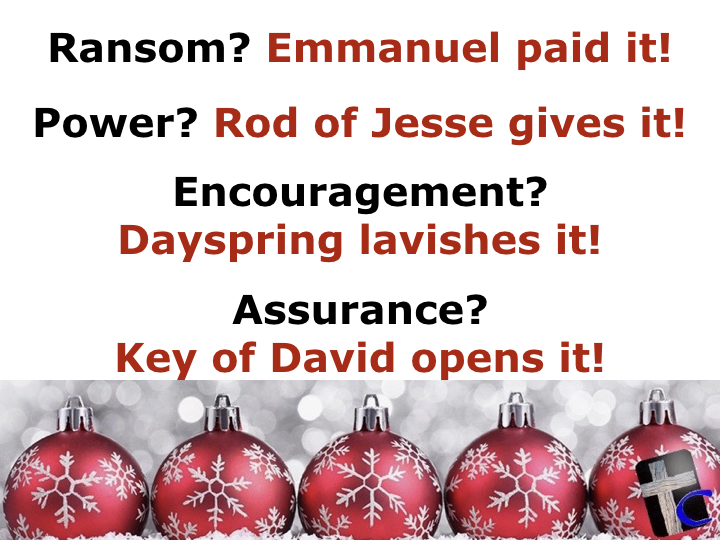
  • Ransom? Emmanuel paid it! 
  • Power to defeat satan? The Rod of Jesse gives it! 
  • Encouragement to press on? The Dayspring lavishes it! 
  • Assurance of your eternal home in Heaven? The Key of David opens it! 

All our longings—all our O come! O come!—are satisfied in Jesus. His First Advent is the already, and His Second Advent gives us hope for the not yet.

If you’ve missed any of the other Christmas carols we have already looked at, you can check them out by clicking here.

Poetry Saturday—Hark the Glad Sound

Hark the glad sound! The Savior comes,
The Savior promised long;
Let ev’ry heart prepare a throne,
And ev’ry voice a song.

He comes the pris’ners to release,
In satan’s bondage held.
The gates of brass before Him burst,
The iron fetters yield.

He comes the broken heart to bind,
The bleeding soul to cure,
And with the treasures of His grace
To enrich the humble poor.

Our glad hosannas, Prince of Peace,
Thy welcome shall proclaim,
And heav’ns eternal arches ring
With Thy beloved name. —Philip Doddridge

Thursdays With Oswald—Prayer Is The Work

Oswald ChambersThis is a weekly series with things I’m reading and pondering from Oswald Chambers. You can read the original seed thought here, or type “Thursdays With Oswald” in the search box to read more entries.

Prayer Is The Work 

     The key to the missionary problem is in the hand of God, not of man, and according to Our Lord, the key is prayer, not work, as that word is popularly understood, because work may mean evading spiritual concentration. Our Lord says—“Pray therefore…” [Matthew 9:38]. … 

     We are apt to think of prayer as a common-sense exercise of our higher powers in order to prepare us for work; whereas in the teaching of Jesus, prayer is not to fit us for the “greater works,” prayer is the work. Prayer is the outcome of our apprehension of the nature of God, the means whereby we assimilate more and more of His mind, and the means whereby He unveils His purposes to us. …  

     God is not impressed by our earnestness, He nowhere promises to answer prayer because of our agony in intercession, but only on the ground of Redemption. We have “boldness to enter into the holiest by the blood of Jesus,” and in no other way. … 

     The armor is for the battle of prayer [see Ephesians 6:11-20]. “Take up the whole armor of God … stand therefore …” and then pray. The armor is not to fight in, but to shield us while we pray. Prayer is the battle. … 

     We have to live depending on Jesus Christ’s wisdom, not on our own. He is the Master, and the problem is His, not ours. We have to use the key He gives us, the key of prayer. Our Lord puts the key into our hands, and we have to learn to pray under His direction. That is the simplicity which He says His Father will bless.

From So Send I You

In light of these thoughts from Oswald Chambers, how does this change your view of prayer?

The Carols Of Christmas

I heard the bells on Christmas Day

Their old familiar carols play,
And wild and sweet the words repeat
Of peace on earth, goodwill to men. (Henry Wadsworth Longfellow)

How many “old familiar carols” have you heard Christmas after Christmas, until the words have almost lost their meaning? If we’re not careful, any song repeated too often can lose the richness of its original intent.

There are some amazing messages in many of our old familiar Christmas carols, because many of those messages are saturated with the old familiar story of Redemption that the Bible tells over and over again.

Please join me this Sunday as we take a new look at the old familiar messages in our Christmas carols. These messages will bring a new appreciation of God’s love that was sung at Christ’s Advent, and reawaken the sweetness of meaning for this Christmas Day.

This has been an ongoing series, so if you would like to catch up with us you can see the Christmas carols we already discussed here, here, and here. Then the carols we have looked at this Advent season are:

11 Quotes From “Interpretation Of The Scriptures”

In my review of A.W. Pink’s book Interpretation Of The Scriptures, I noted that any student of the Bible will benefit from reading this exceptional book. The quotes I want to share today are for that universal audience, but I will also be sharing some additional quotes soon that are specifically aimed at those who are Bible teachers or pastors.

“God does not ask for blind credence from us, but an intelligent faith, and for that three things are indispensable: that His Word should be read (or heard), understood, and personally appropriated.”

“Moreover, the obscurity is not in them [the Scripture], but in the depravity of our nature which resists the holy requirements of God, and the pride of our hearts which disdains seeking enlightenment from Him.”

“It has pleased God to furnish His people with gifted instructors, and instead of haughtily ignoring them we ought (while testing their teaching—Acts 17:11) to accept thankfully whatever help they can afford us.”

“Methods of Bible study are only of relative importance; but the spirit in which it is studied is all-important. It calls for no argument to prove that a spiritual book calls for a spiritually minded reader. … Only where there is honesty of soul and spirituality of heart will there be clearness of vision to perceive the Truth; only then will the mind be capable of discerning the full import of what is read. … None but the Spirit of Truth can write God’s Law on my heart. Here, then, is the first and most essential qualification for understanding and interpreting the Scriptures, namely a mind illumined by the Holy Spirit.”

“That which conflicts with what is taught, plainly and uniformly, in the Scriptures as a whole, and which whole is set before us as the alone rule of our faith and obedience. This requires from the expositor not only a knowledge of the general sense of the Bible, but also that he takes the trouble to collect and compare all the passages which treat of or have a definite bearing upon the immediate point before him, so that he may obtain the full mind of the Spirit thereon. Having done that, any passage which is still obscure or doubtful to him must be interpreted by those which are clear. No doctrine is to be founded on a single passage.”

“By divorcing a verse from its setting or singling out a single clause, one may ‘prove’ not only absurdities but real falsities by the very words of Scripture.”

“The word for ‘search the Scriptures’ (John 5:39) signifies diligently to track out, as the hunter does the spoor of animals. The interpreter’s job is to bring out the sense and not merely the sound of the Word.”

“To a very large extent, and far more so than any uninspired book, the Bible is a self-explaining volume: not only because it records the performance of its promises and the fulfillment of its prophecies, not only because its types and antitypes mutually unfold each other, but because all its fundamental truths may be discovered by means of its own contents, without reference to anything extra or outside itself.”

“Assuredly God has not subordinated His Word to our reason for us to accept only what commends itself to our judgment. Nevertheless, He has furnished His people with this faculty, and though insufficient of itself it is a valuable aid in the understanding of Truth. While reason is not to be made the measurer of our belief, yet it is to be used as the handmaid of faith, by comparing passage with passage, deducing inferences and drawing consequences according to the legitimate laws of logic.”

“The concordance will stand [the Bible reader] in far better stead than the best dictionary.”

“There is a middle ground between hastily condemning or accepting, namely to weigh carefully and prayerfully what is presented, testing it by other passages and by our own experience.”

Interpretation Of The Scriptures (book review)

Bible reading and Bible study will be of immeasurable benefit to the reader if the Scriptures are interpreted correctly. Fortunately for us, A.W. Pink gives us some timeless principles for doing just this in his book Interpretation Of The Scriptures.

Pink acknowledges something that the Apostle Peter also acknowledged: sometimes the passages we read in the Bible can be challenging to understand. But Pink quickly adds, “God does not ask for blind credence from us, but an intelligent faith, and for that three things are indispensable: that His Word should be read (or heard), understood, and personally appropriated.”

In this book, Pink systematically gives us guidelines for the proper and effective interpretation of the the Scriptures. He does so by using many of the age-old maxims of logic and hermeneutics, but he also emphasizes the invaluable role the Holy Spirit plays in our Bible reading times. After all, the Holy Spirit was the One who inspired the writing of the Scriptures, so He is best able to illuminate the true meaning to our hearts and minds.

This is NOT a book exclusively for pastors and Bible teachers (although both will be greatly benefitted by studying this text), but it is for anyone who wants to read the Bible accurately, with an eye toward correctly applying the principles that God gives us.

I’m not sure how many times I have read through the Bible in my life, but while reading Interpretation Of The Scriptures I noticed a new attention to concepts and insights that I had previously overlooked. I highly recommend that all serious readers of the Bible read this book as well.

Looking Ahead To The Second Advent

Celebrating Advent means both looking back at Christ’s First Advent in Bethlehem and looking ahead to His Second Advent at the end of time. Faith in the First Advent fuels hope in the Second Advent. Let’s take a look at the events leading up to and surrounding Christ’s Second Advent to help us appreciate what was begun at His First Advent.

Overarching all of the end times events is a Christian’s blessed hope: “The resurrection of those who have fallen asleep in Christ and their translation together with those who are alive and remain unto the coming of the Lord is the imminent and blessed hope of the church.”

The word “rapture” doesn’t appear in Scripture, but we get this word from the Latin word raptu, which comes from the Greek word harpazo. We first see it when Philip is “caught away” from the Ethiopian’s presence in the desert (Acts 8:39). This is the same word Paul uses when he says that Christians will be “caught up” to meet Christ in the air (see 1 Thessalonians 4:13-17).

Note that the rapture of the Church is not the Second Coming of Christ. His Second Coming takes place at the end of the period known as the Tribulation when Jesus returns to earth as a conquering King and establishes His Millennial Reign on earth (Revelation 19:11-16; 20:1-4).

During Christ’s Millennial Reign, the devil and his cohorts are locked up until the end of the 1000-year reign and are allowed to tempt people one final time. The devil will succeed in tempting quite a few people, as he will once again muster a sizable army to attack Christ and His followers. This decisive battle will culminate in the final judgment.

“There will be a final judgment in which the wicked dead will be raised and judged according to their works. Whosoever is not found written in the Book of Life, together with the devil and his angels, the beast and the false prophet, will be consigned to the everlasting punishment in the lake of fire” (Revelation 20:11-15).

After this will come the New Heavens and New Earth where Christians will commune with God for ever and ever (Revelation 21:1-5, 22-27; 22:1-5, 12-21).

In light of Christ’s First Advent in Bethlehem, and His soon return (His Second Advent), how are Christians to live? In a word: HOPEFUL!

In all of these passages discussing the end times, hope-filled words are used—

  • therefore encourage each other with these words
  • wait for the blessed hope—the glorious appearing of our great God and Savior 
  • stand firm … let nothing move you
  • Jesus says, I am coming soon! My reward is with Me

Jesus also pointed out that Heaven is a place “prepared for you since the creation of the world,” while Hell is “prepared for the devil and his angels.” GOD WANTS YOU WITH HIM IN HEAVEN!

As you rejoice in the First Advent, remember that Christ’s First Coming was to provide a way for you to have your sins forgiven and be able to spend eternity with Him. So as we look forward in hope to Christ’s Second Advent we say with the Apostle John, “Amen. Come, Lord Jesus!”