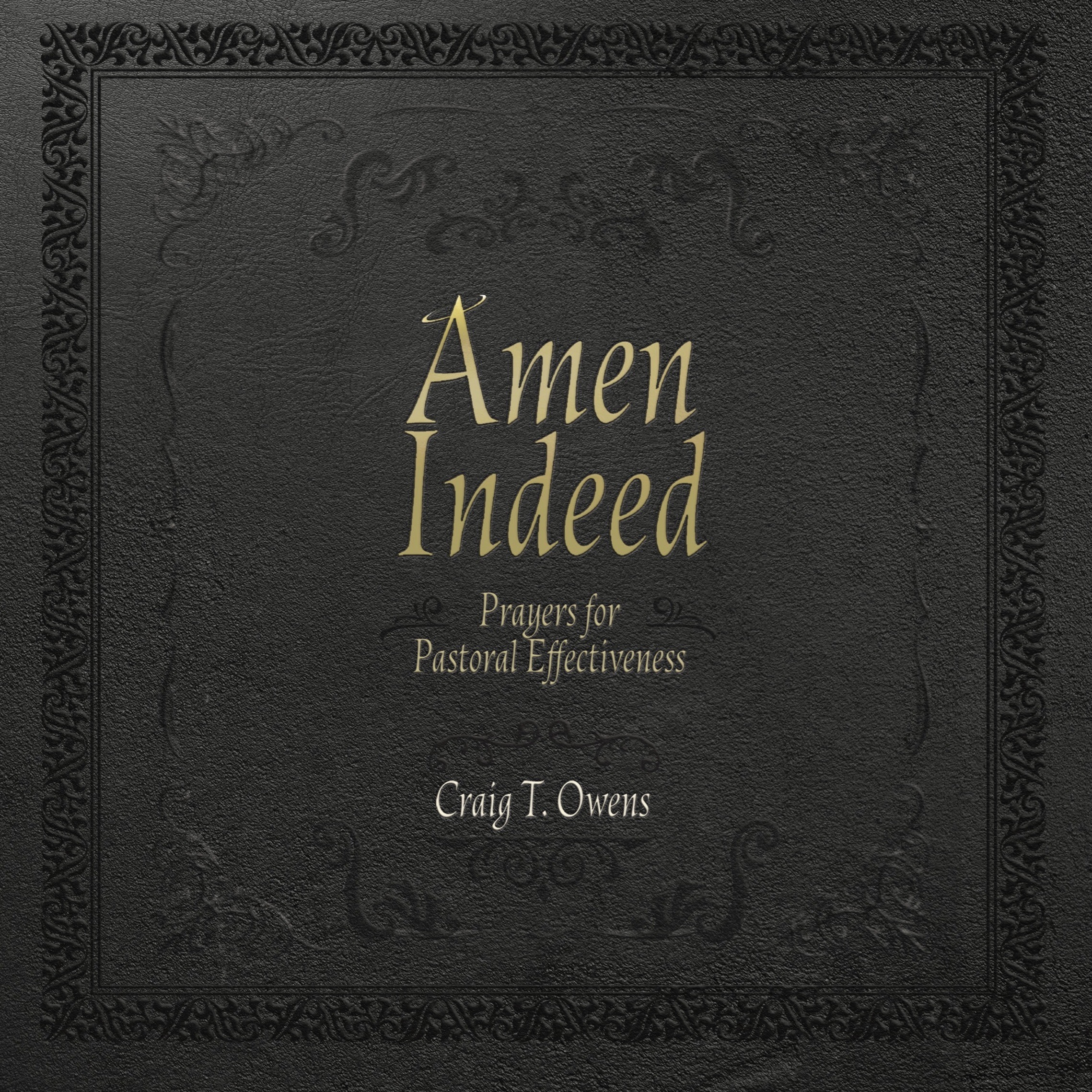
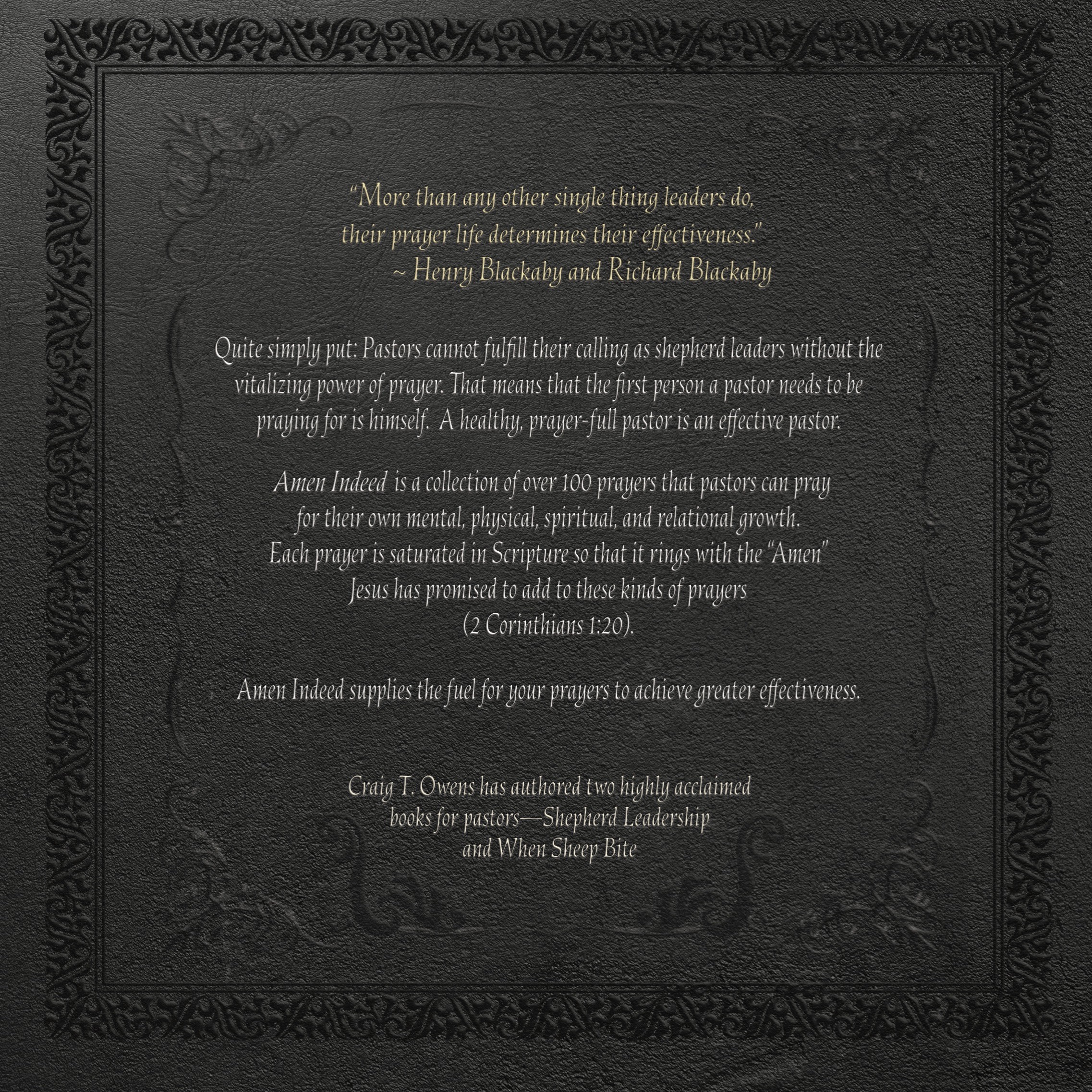
Pastors can only fulfill their calling as shepherd leaders with the vitalizing power of prayer, and must pray for themselves first. A healthy, prayer-full pastor is an effective pastor. My newest book is to help pastors in this vital discipline of prayer.
Amen Indeed fuels growth by providing more than 100 prayers for pastors to pray for their own mental, physical, spiritual, and relational growth. Each is sourced from Scripture and rings with the “Amen” that Jesus promised to add (2 Corinthians 1:20).
“There is one assured way for our prayers to be answered: It is to pray the will of God.
“There is one assured way to pray the will of God: It is to pray Scripture.
“As ministers of the Gospel we would be wise then to primarily pray Scripture, for ‘the word of our God stands forever’ (Isaiah 40:8).” —Dick Brogden, Founder of the Live Dead Movement
“When it comes to prayer, we need some help. And in Amen Indeed, help is at hand. Whatever is keeping us from prayer, Craig Owens can help us push through to a more consistent and more consistently joyful and fruitful life of prayer.” —T.M. Moore, Principal of The Fellowship of Ailbe
Andrew Murray wrote The Inner Life, which has become a timeless classic. There is so much richness of thought and so much for Christians to ponder about their own walk with Jesus.
“Many people are so occupied with how much or how little they have to say in their prayers that the voice of One speaking is never heard, because it is not expected or waited for. … The greatest blessing in prayer will be our ceasing to pray and to let God speak. … Prayer and the Word are inseparably linked together: power in the use of either depends upon the presence of the other. … It is clear why this is so. Prayer and the Word have one common center—God. Prayer seeks God; the Word reveals God. In prayer, man asks God; in the Word, God answers man. In prayer, man rises to heaven to dwell with God; in the Word, God comes to dwell with man. In prayer, man gives himself to God; in the Word, God gives Himself to man.”
“Heaven is filled with the life and power and blessing that earth needs, and the prayer of earth is the power to bring that blessing down. … God is looking for people through whom He can bless the world. Say definitely: Here am I; I will give my life to this calling. Cultivate your faith in the simple truth: God hears prayer; God will do what I ask. Give yourself to others as completely as you give yourself to God. Open your eyes to sense the needs of a perishing world. Take up your position in Christ and in the power which His name and life and Spirit give you. And go on practicing definite prayer and intercession.”
“We can be so full of God’s holy presence that, when men see us or think of us, this name will come to mind—the man of God. … Let your life be devoted to one thing—to bring men to God, and God to men.”
“The Word of God is true because God Himself will make it true in us. We have much to learn about what hinders that power, much to overcome to be freed from these hindrances in order to receive that power. But all will be right if we study our Bibles with the determination to believe that God’s Word has omnipotent power in our hearts to accomplish every blessing of which it speaks.”
“Our one aim must be perfect harmony between conscience and conduct. Every conviction must be carried out into action. Christ’s commands were meant to be obeyed. If this is not done, the accumulation of scriptural knowledge only hardens us and makes us unable to learn from the Spirit.” [see 1 John 3:21-24]
“The two trees in the garden are God’s revelation of the same truth. If Adam had eaten of the tree of life, he would have received and known all the good God had for him in living power as an experience. And he would have known evil only by being absolutely free from it. Eve was led astray by the desire for knowledge—‘…a tree to be desired to make one wise…’ (Genesis 3:6). In this way, man got a knowledge of good without possessing it. He had a knowledge of good only from the evil that was its opposite. And since that day, man has searched for truth more in knowledge than in life.”
“The true aim of education, study, and reading is not what is brought into us, but what is brought out of ourselves when we actually put into practice what we have learned. This is as true of the study of the Bible as of any other study.”
My Patreon supporters have access to another two dozen quotes from this book. Join them and get exclusive content not shared anywhere else and early access to content that will be shared publicly in the future.
Listen to the podcast of this post by clicking on the player below, and you can also subscribe on Apple, Spotify, or Audible. Check out the video content in this post by clicking here.
Remember that Peter’s first letter was to instruct Christians how to interact with non-Christians, but his second letter is about Christians interacting within the community of faith. It’s a precious faith that we share with precious friends. Our dear friends encourage us to think wholesomely, have informed perseverance, remain pure, and stay on guard until the very end.
You can sense Peter’s longing for his dear friends of the faith to grasp this. He even says in this letter that it is his second letter to keep reminding the saints about the richness in Jesus, and he says as long as he has breath in his lungs he will keep on reminding us (2 Peter 1:12-15).
Peter uses an almost identical greeting in both letters: “Grace and peace be yours in abundance” (1 Peter 1:2; 2 Peter 1:2). This sentiment of linking grace and peace was almost universal, with all but five New Testament books greeting their audiences with the dual blessing of grace and peace.
Let’s talk about these dual blessings.
James Thayer defines this Greek word for peace: “According to a conception distinctly peculiar to Christianity, the tranquil state of a soul assured of its salvation through Christ, and so fearing nothing from God and content with its earthly lot, of whatsoever sort that is.”
This means that Christians who have put their faith in Jesus as their Savior have peace with God (Romans 5:1), and that peace guards our hearts against all fear (Philippians 4:7).
The other blessing in Peter’s greeting is grace (see also Romans 5:2). This is—quite simply and quite profoundly—God’s favor toward us. God’s grace is unearned by our efforts, undeserved despite our sins, and unending for all eternity. And it comes coming in wave after wave (see John 1:16; I especially like it in the AMPC).
Peter’s greeting in his second letter adds a phrase from his first letter: “…through the knowledge of God and of Jesus our Lord.” It’s fitting that this is in his second letter, showing he is still growing in his knowledge of Jesus.
We don’t get more grace and peace through knowledge, but we realize and can apply more grace and peace through this growing knowledge. The tap of God’s blessing is already open full—no more can come out. As we grow in the knowledge of this, we find it increasingly precious and valuable.
The Greek word for knowledge here is epignosis. This is knowledge through personal experience.
I once worked with a man who was a retired Air Force officer. Before flying one mission, he walked into the flight control building—a huge hanger-like structure—where dozens and dozens of personnel sat staring at screens to forecast the weather.
Lou asked a private for the forecast: “Sir, you have clear skies and excellent visibility for your mission,” he dutifully reported.
“Private,” Lou shouted, “on your feet!” The young man snapped to attention. “Follow me,” Lou ordered and began marching toward the door of the hanger. When they got there, Lou ordered the private to open the door, step outside, close the door behind him, and not to re-enter the hanger for 60 seconds.
One minute later that private stepped back inside and stood before Lou dripping wet. “Now, private,” Lou demanded, “what is my weather forecast.”
“It looks like rain, sir,” the young private reported.
Epignosis is not book knowledge about Jesus, but personal, intimate, experiential knowledge of Jesus. That Air Force meteorologist only knew about weather from his radar screen, but once he got drenched outside, he knew of the weather conditions from personal experience.
Peter says this epignosis is ours (2 Peter 1:3-5).
There’s only one thing that keeps us from growing in our knowledge of God’s abundant grace and peace: Complacency. In v. 5, Peter says we are to “make every effort.”
It’s not our effort that brings God’s grace, but it is our effort that allows us to know His grace—to know Jesus personally. Notice the progression:
(v. 3) Christ’s divine power has give us everything we need by His own glory and goodness
(v. 4a) Through these gracious gifts He has given us His great and precious promises
(v. 4b) Through His promises we can participate in His divine nature
(v. 5) For this very reason, we are to bring our best effort, our diligent interest, and our total attention
Peter concludes his letter exactly as he starts it: Keep growing in your epignosis (3:18).
The more you grow in epignosis, the more intimate knowledge you will have to encourage your dear friends of the faith—
And we know that the Son of God has come, and He has given us understanding so that we can know the true God. And now we live in fellowship with the true God because we live in fellowship with His Son, Jesus Christ. He is the only true God, and He is eternal life. (1 John 5:20 NLT)
Then like Paul, we can pray for ourselves and for our dear friends for a continual growing in this intimate knowledge of Jesus (see Ephesians 1:15-19).
Check out the other messages in this series from 2 Peter called Friends of the Faith.
The terms used in the New Testament for followers of Jesus aren’t typically the same terms we use today. As Christians, we need to ask ourselves, “Is my life showing the biblical definition of what it means to know Jesus as my Lord and Savior?”
“The trouble is that what we call ‘asking God’s forgiveness’ very often really consists in asking God to accept our excuses. What leads us into this mistake is the fact that there usually is some amount of excuse, some ‘extenuating circumstances.’ We are so very anxious to point these out to God (and to ourselves) that we are apt to forget the really important thing; that is, the bit left over, the bit which the excuses don’t cover, the bit which is inexcusable but not, thank God, unforgivable. And if we forget this, we shall go away imagining that we have repented and been forgiven when all that has really happened is that we have satisfied ourselves with our own excuses.” —C.S. Lewis in The Weight of Glory
“There is a place for anger. Without it, we would become passive against injustice. Anger helps us turn away from accepting blame that does not belong to us. It allows us to gain needed emotional distance from the one who hurt us. But anger requires safeguards. In this psalm, David had two: (1) He told his anger to God. … (2) He let God handle the execution of anger.” —Dr. George O. Wood, in A Psalm in my Heart
T.M. Moore speaks to the church in this post called Equipped For Good Works. A couple of comments that especially caught my attention: “A local church grows as it increases in the likeness of Jesus Christ” and “Churches grow as individual church members grow in zeal for good works, and do good to others at every opportunity, beginning within the household of faith.”
“I believe that the prophesies in the Revelation, and in the books of Daniel and Ezekiel are very much of this character, and that, while it is quite right to watch for and expect the coming of the Lord, we shall spend our time more profitably in preaching the doctrines of the gospel than in meditating upon the mysterious prophecies of the Word. They will be understood when they are fulfilled, but we do not think they will be fully understood before that time.” —Charles Spurgeon
The name of God is an important topic. Dr. Kaspars Ozolins writes, “What, then, is the actual name of Israel’s God? In biblical Hebrew it is represented by a sequence of four consonants, the famous tetragrammaton: YHWH. This name occurs a total of 6,828 times in the Old Testament.” Learn more about this name in this post.
This year marks the 500th anniversary of the printing of the Tyndale Bible. This is an important event in Christian and world history. Check out this short overview of how this Bible came to be, and its impact that is still being felt today.
Many people claiming to be a savior of the Jewish people had come on the scene earlier.
We see the Jewish leadership asking John the Baptizer if he was “the one” they had been expecting (John 1:19-23). In the Book of Acts, Gamaliel reminds the Sanhedrin of all of the previous men who had claimed to be the deliverer and had utterly failed in their attempts (see Acts 5:34-37).
Undoubtedly, the shepherds had heard many stories as they sat around their campfires at night. So notice that the angel clarifies that this is not just another story, but the fulfillment of the promises of the advent of THE Messiah. Jesus wasn’t just another so-called savior, but He was “THE Messiah, THE Lord.”
Jesus Himself would say of Himself, “I am THE way, THEtruth, and THE life” (John 14:6).
He is THE ONE AND ONLY!
Only Jesus is the Alpha and Omega (Revelation 1:8).
Only Jesus holds the keys of death and Hell (Revelation 1:18).
Only Jesus fulfills every prophetic promise (Hebrews 1:1-2; 2 Peter 1:19-20).
All confusion is removed when we look to Jesus.
All doubts are satisfied in Him.
All uncertainty is made certain by Who He is, what He did, what He is still doing, and what He will soon complete!
God has given each of you a gift from His great variety of spiritual gifts. Use them well to serve one another. (1 Peter 4:10 NLT)
In Greek, the root word for “gift” is grace. We all have received a grace gift from God and we are to employ that gift graciously.
My gift is not for showing off but for building up—“to serve one another.”
My gift is not for my benefit but to benefit others—“so that in all things God may be praised through Jesus Christ” (v. 11 NIV).
My gift is given to me so that I may help others see Jesus and praise God. If people only see my gift—and nothing more—I am misusing my gift and I am robbing God of His glory.
To HIM be the glory and the power for ever and ever. Amen. (1 Peter 4:11 NIV)
Father, thank You for the grace gift You have given me. Holy Spirit, help me graciously steward this gift to serve others so that they can better glorify God.
Listen to the podcast of this post by clicking on the player below, and you can also subscribe on Apple, Spotify, or Audible. Check out the video content in this post by clicking here.
How do most people finish this phrase: “With friends like these…”? You probably said, “…who needs any enemies!”
But isn’t that rather sad? If this cliche is so well-known, it must be because so many people have experienced false or fickle friends. Maybe a lot of people have experienced what Christian Bovee noted: “False friends are like our shadow, keeping close to us while we walk in the sunshine, but leaving us the instant we cross into the shade.”
I much prefer the words of Ralph Waldo Emerson: “The glory of friendship is not the outstretched hand, not the kindly smile, nor the joy of companionship; it is the spiritual inspiration that comes to one when you discover that someone else believes in you and is willing to trust you with a friendship.”
I think the apostle Peter would agree with Emerson.
Peter wrote his first general epistle to Christians who are interacting with worldlings. Peter calls Christians “aliens and strangers” because of citizenship is heavenly—we are simply sojourners on earth as we make our way to our home in Heaven. Along this journey, 1 Peter gives us invaluable wisdom on how to behave ourselves as citizens of Heaven.
Peter probably has this journey in mind when he addresses his second epistle: “To those who through the righteousness of our God and Savior Jesus Christ have received a faith as precious as ours” (2 Peter 1:1).
“Precious” is defined here as highly esteemed. And when he says, “as ours” he is saying the saints in the Kingdom of God have equal honor with anyone who may have a title or a position of leadership in the Church. Paul would agree with Peter (see 1 Corinthians 3:5, 21-23; 12:27).
Peter emphasizes this point by using the phrase “dear friends” four times in this letter (2 Peter 3:1, 8, 14, 17). Let me give you another quote from Emerson: “God evidently does not intend us all to be rich, or powerful or great, but He does intend us all to be friends.”
Peter uses the Greek word agapetos—with the root word for servant-hearted love at the root. This makes me think about our precious faith that we defined as highly esteemed, because agapetos also means esteemed, highly valued, beloved.
Precious friends encourage us in our precious faith on our long journey as we travel toward Heaven.
(1) They encourage us to think wholesomely (3:1).
They pray for our minds, as Paul did for his friends at Philippi (Philippians 1:9-10), and they practice—or live out—what they preach (Philippians 4:8-9).
(2) They encourage us to have informed perseverance (vv. 8-11).
They help us look backward see how faithful God has been in past times and how trustworthy God is now, and then ask us, “What kind of man or woman ought you to be in this moment? How can you continue to persevere in holiness and godliness until the very end?”
(3) They encourage us to remain pure (vv. 11-14).
They prompt us to be looking forward in hopeful expectation, and they encourage us to make every effort to be pure. These things require the development of habits. Andrew Murray said the habits that keep us pure are formed over the long haul: “The entrance of divine truth into the mind and heart, the formation of habits and the training of character—these are not attained by sudden and isolated efforts, but by regular and unceasing repetition.”
Sometimes our precious friends have to speak a lovingly hard word to us (see Proverbs 27:6).
(4) They encourage us to remain on guard (v. 17)
They don’t want us to be disqualified in our race (1 Corinthians 9:24-27), so they come to our rescue if we do stumble (James 5:19-20).
Let’s make this something new:
With friends like these I can live a victorious, God-honoring, Christ-glorifying life!
Let’s be those precious friends to others who share in the same precious faith.
Check out all of the message in this series from the book of 2 Peter by clicking here.
“Our prayers can go where we cannot. There are no borders, no prison walls, no doors that are closed to us when we pray.” —Brother Andrew
The historicity of the Bible is well documented. Here is another archeological biography from The Bible Archeology Report, this one of Ben-Hadad III.
“I do not want the walls of separation between different orders of Christians to be destroyed, but only lowered, that we may shake hands a little easier over them.” —Rowland Hill (1744-1833)
“Those who are seriously attempting chastity are more conscious, and soon know a great deal more about their own sexuality than anyone else. They come to know their desires as Wellington knew Napoleon, or as Sherlock Holmes knew Moriarty; as a rat-catcher knows rats or a plumber knows about leaky pipes. Virtue—even attempted virtue—brings light; indulgence brings fog.” —C.S. Lewis, in Mere Christianity
Marvin Olasky begins this informative article, “The war against abortion did not begin with the now-overturned 1973 Roe v. Wade decision.” He then gives us a comprehensive history of women of science who have stood on the front lines of the pro-life movement. Check out The Women Who Guarded the Womb.
J. Warner Wallace debunks that myth that Christianity is anti-science. Wallace actually makes that case the Christianity is the reason behind science’s remarkable growth.
Listen to the podcast of this post by clicking on the player below, and you can also subscribe on Apple, Spotify, or Audible. Check out the video content in this post by clicking here.
It seems like many people put business and faith in two separate boxes, considering them entirely different topics of discussion. Greg and I completely disagree—the Bible is a resource for all areas of our lives, from the board room to the living room. That’s why we wrote our Business By The Book series. This is a guide to help you apply biblical principles to the corporate world. In today’s episode we preview the first book in this series: Business by the Book: What the Bible says about a CEO’s vision-casting.
[0:00] Introduction
[2:10] What does it mean for the leader to cast vision for his or her organization?
[3:07] Here’s what you can expect from Business by the Book—What the Bible says about a CEO’s vision-casting
[4:13] After a leader has cast a vision, that leader then needs to empower his or her entire team to help them achieve the vision.
[6:46] Leaders must be self-aware of their strengths and weaknesses, and help their teammates learn about themselves as well.
[9:06] Organization chart maneuvering can help empower teammates to accomplish great things. And I also share a teaser about a new project on which Greg is working.
[10:26] Greg talks about two vastly different roles: Commander and Includer.
[12:27] I share an excerpt from a chapter that Greg wrote in this book, and then Greg elaborates on how this helps a team pursue the vision.
[16:37] Leaders can move from doing to facilitating, which will help others set up into new roles.
[18:21] Some counsel for leaders who are first time vision-casters.
[19:26] Greg shares a tip for facilitating meetings to get more people involved.
[21:44] “Leaders become great not because of their power, but because of their ability to empower others.”
[24:18] HERE’S HOW TO WIN A FREE COPY OF OUR NEW BOOK!
Listen to the podcast of this post by clicking on the player below, and you can also subscribe on Apple, Spotify, or Audible.
Then one of the synagogue leaders, named Jairus, came, and when he saw Jesus, he fell at His feet. He pleaded earnestly with Him, “My little daughter is dying. Please come and put Your hands on her so that she will be healed.” (Mark 5:22-23)
The fact that we know Jairus’ name leads me to believe that he became both a follower of Jesus as Messiah and a part of the Church after Christ’s ascension.
Some might say, “Of course he was a ‘believer’—Jesus raised his little girl from the dead!”
True. But let’s not overlook some the events leading up to this miracle, including the role of an unnamed woman whose apparent interruption may have led to Jairus’ little girl’s death in the first place.
This woman “had been subject to bleeding for twelve years. She had suffered a great deal under the care of many doctors and had spent all she had, yet instead of getting better she grew worse” (vv. 25-26). Luke, a trained physician himself, adds that she had tried many remedies in her desperation “but no one could heal her” (Luke 8:43).
This desperate woman’s goal was just to touch the fringe of Jesus’ robe. She had no hopes of talking directly to Jesus because in her unclean status, her touch could make Jesus unclean too (Leviticus 15:25-27). This almost assuredly made people treat her as an untouchable leper.
Her touch did indeed provide a miracle for her! The words “immediately” and “at once” (Mark 5:29, 30) are the same Greek word. Jesus and the woman felt it simultaneously—she was healed!
Jesus—who was on His way to heal a dying little girl—stopped in His tracks.
The woman probably tried to melt into the crowd. “But Jesus kept looking around to see who had done it” (v. 32). Fearfully, probably still kneeling on the ground, this healed woman told Jesus her full story. Jesus spoke lovingly to her, calling her “daughter” to assure her that it was her faith, and not His clothing, that had healed her.
Meanwhile, as Jairus waited (im)patiently, the news arrives: “There is no need to bother Jesus any longer. Your daughter has died. It’s hopeless. Please come back home.”
Jesus, knowing what the messengers had just shared with Jairus, looked at him and said, “Don’t be afraid; just believe.”
Maybe the words of Jesus were even something like, “Don’t be afraid, but just like this healed woman did, believe. Your faith can bring about the same kind of miracle for your daughter.”
As a synagogue leader, perhaps Jairus knew this woman. She would have come to a priest after every treatment and every doctor’s visit to see if she could be pronounced clean. Time after time the verdict was, “Unclean.” It seemed hopeless. And yet just a single faith-filled touch—right before the eyes of Jairus—had brought about a miracle that no one else could accomplish.
I think Jairus could turn his fear into faith because of what he had just witnessed. Without that miracle happening right before his eyes, perhaps his fear would have overwhelmed his faith, just like those who were mourning at Jairus’ house would later laugh at Jesus when He said, “The little girl is not dead but only sleeping” (vv. 39-40).
The faith and boldness of this woman unleashed faith in Jairus!
We can see Jarius’ fear turn to faith in the simple act of allowing Jesus to continue walking with him back to his home. As they approached his home, perhaps Jairus’ wife was angry and distraught that Jairus and Jesus had been so delayed in arriving. But as Jairus took his wife by the hand and said, “I believe Jesus can do something miraculous for our daughter,” his faith also unleashed her faith.
They walked into that bedroom with Jesus and saw their faith rewarded as they received their daughter back from the dead!
Are you facing a situation that seems impossible? Perhaps you have been to doctors and experts but no one can find an answer for you. Maybe you started to approach Jesus, only to be confronted by the cruel facts that what you had hoped for was dead. Or maybe it seems that the arrival of Jesus has been delayed for so long that there is no longer any need to seek His help.
If your fear is greater than your faith at this time, you can look to these examples recorded for us in the Scripture. Perhaps you can even look back in your own history, or the history of your family, to see a miraculous example.
There’s another great reason for you to continue to trust in Jesus. Just as the unclean woman sought an answer for years, the moment of her miracle was the moment faith was renewed in those who saw her healing. As you continue to seek your miracle, know that God’s timing is perfect. Your answer will come at the perfect moment to unleash faith in another wavering heart.
Keep believing in faith. Keep trusting in Jesus. Keep expecting your miracle.
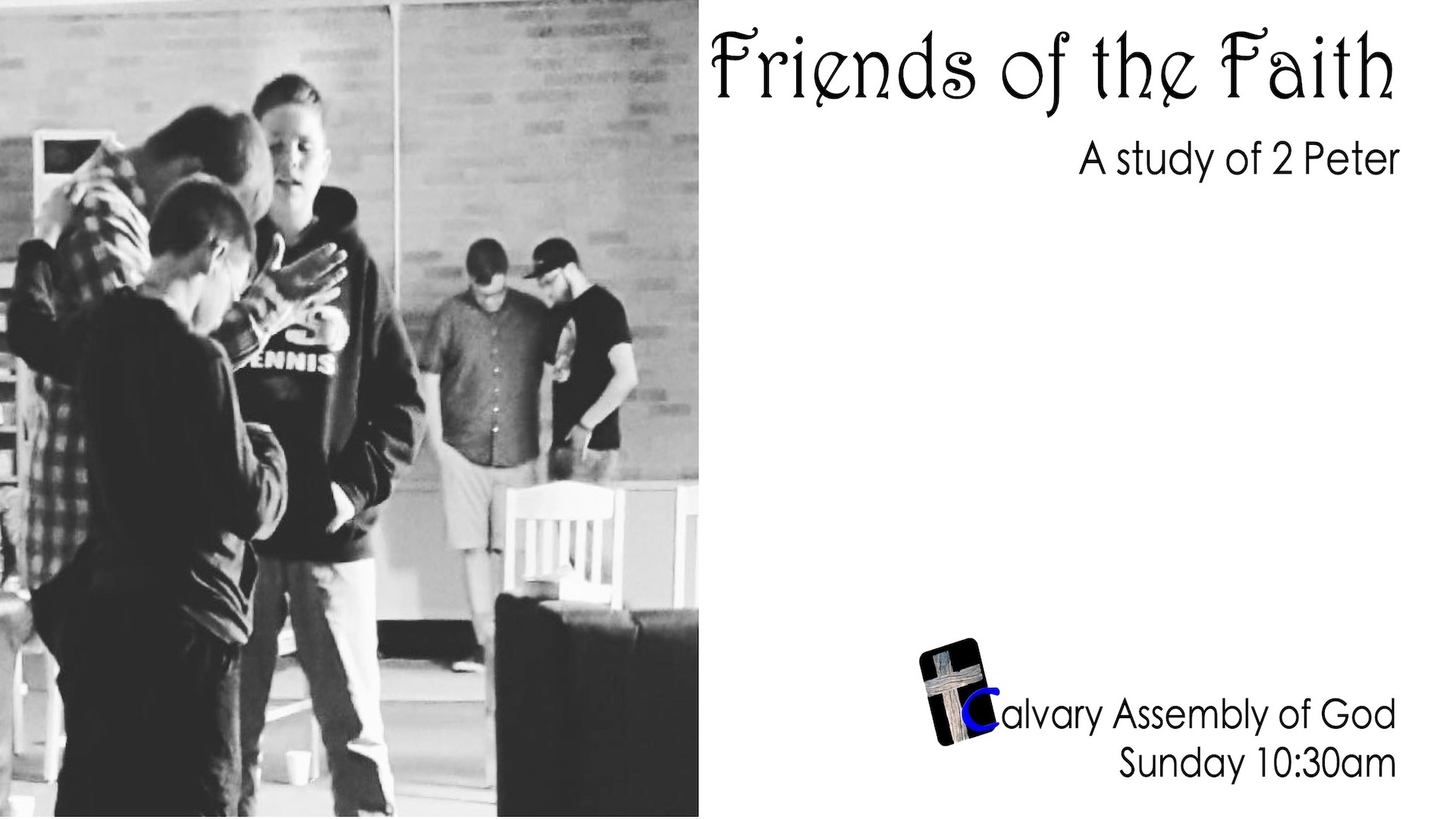
In Peter’s first letter to the saints, he teaches saints how to interact with the world. He calls Christians “aliens and strangers” as they sojourn on Earth on their way to Heaven.
In Peter’s second letter, he instructs saints on how to interact with other saints. He addresses this letter to those of us “who share the same precious faith.”
Join us at Calvary Assembly of God for this study of 2 Peter, as we delve into Peter’s inspired instruction on how saints in community with other saints naturally grow in deeper intimacy with their Savior Jesus. This increasing intimacy not only serves as an encouragement to other saints but it presents an attractive testimony to those still in the world to know Jesus for themselves.
We meet at 10:30 every Sunday morning. Here’s what we have covered so far:



 Pastors can only fulfill their calling as shepherd leaders with the vitalizing power of prayer, and must pray for themselves first. A healthy, prayer-full pastor is an effective pastor. My newest book is to help pastors in this vital discipline of prayer.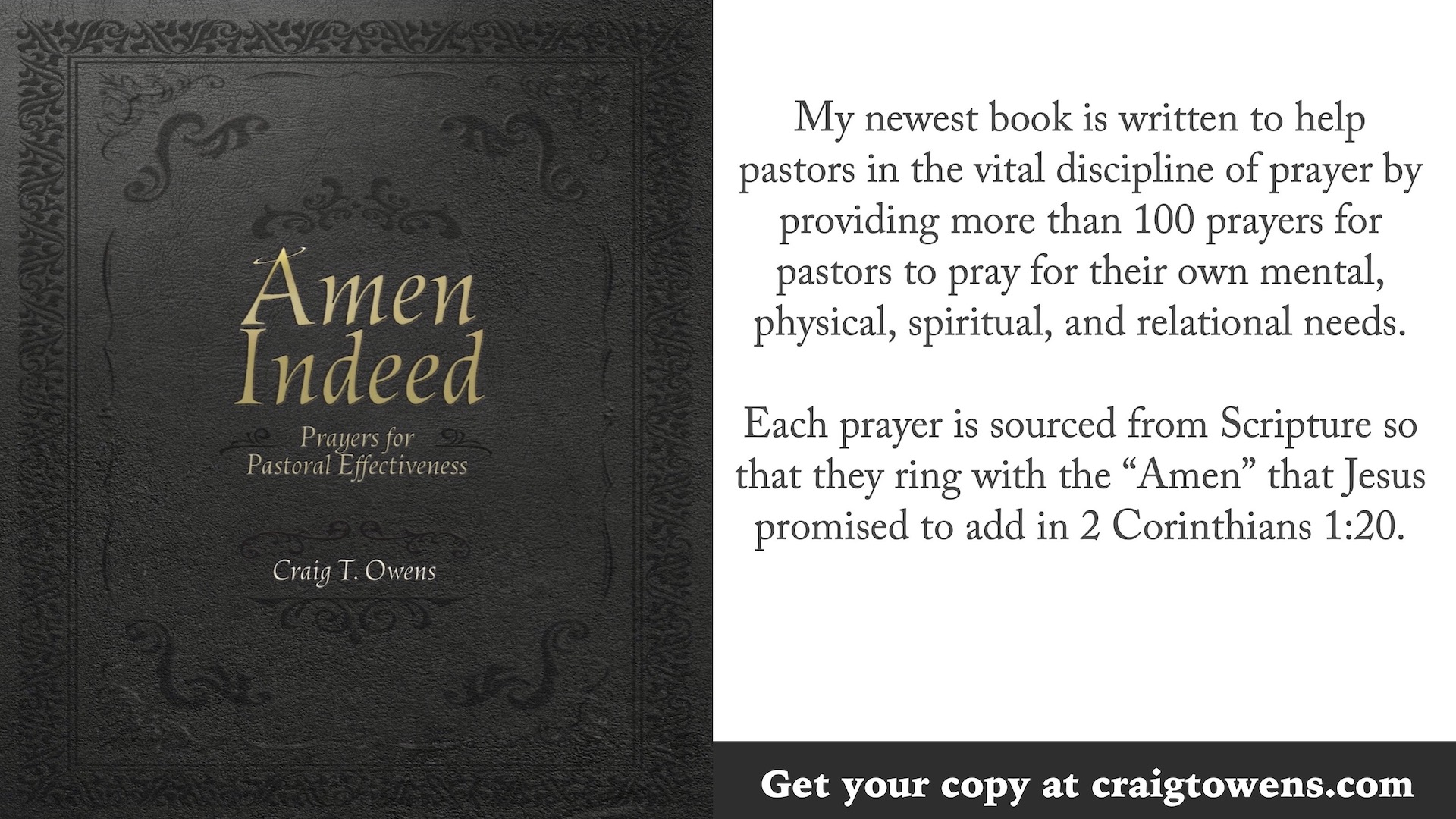



















 Craig T. Owens