Listen to the podcast of this post by clicking on the player below, and you can also subscribe on Apple, Spotify, or Audible.
When people attack their leader—or when sheep bite—it hurts!
Our first best response is to acknowledge, “That hurt!” but then we need to pause. Our natural response to an attack is fight-or-flight, but healthy leaders take time to learn why that bite occurred.
This is an excerpt from an episode of The Craig and Greg Show where Greg interviewed me about my new book When Sheep Bite.
If you would like to watch the full episode of our leadership podcast, you can find that here.
I am getting ready to facilitate a cohort for pastors who have gone through painful sheep bites—or perhaps they are feeling them right now! If you are a pastor, or if you know of a pastor who has been bitten, please check out this cohort here.
And if you would like to pick up a copy of When Sheep Bite for yourself, you can get that here.
Listen to the podcast of this post by clicking on the player below, and you can also subscribe on Apple, Spotify, or Audible.
Have you ever said to yourself…
…I should have known better?
…why I am going through this again?
…I thought I was over this hurdle?
…you would think I would have matured enough by now to not have to deal with this?
Maybe the author of Psalm 129 felt this way: “Here I am on the 10th step and I’m still having to deal with this! When will I finally arrive at the top and be done with these issues?” (compare Psalm 129:1-2 with 124:1-5).
I think those statements—“I should have known better” or “I thought I was over this”—pre-suppose that we will reach a point in our life where we “arrive.” If nothing else, this psalm is a reminder that we are still on the journey, that we are still a work-in-progress, that the saint-ification process is still ongoing. It’s clear from Scripture that we never “arrive” until we arrive in Heaven and hear our Master say, “Well done, good and faithful servant.”
While we are ascending up toward our heavenly home, these great oppressions and plowings remind us that there is still work to be done in us and through us to bring glory to God (Romans 5:3-4; James 1:2-4, 12).
Of his Soviet prison, Alexander Solzhenitsyn said, “I bless you, prison—I bless you for being in my life—for there lying on rotting prison straw, I learned the object of life is not prospering as I had grown up believing, but the maturing of the soul.”
The reality is God is using all of those things for my good and for His glory (Romans 8:28).
What happens as I am oppressed and plowed?
(1) I am refined—Psalm 66:8-12, 16-20. God is removing the impurities from my life.
(2) My prayers are matured. Psalm 129:5-8 is an imprecatory prayer, a prayer that says, “Get ‘em, God!” These have their place, but for us they are to be our emergency release valve (which I discuss in more depth in my book When Sheep Bite). But Jesus calls for our prayers to mature from imprecatory to intercessory (Matthew 5:43-45). In my book I write, “This is the highest level of Christian maturity: To pray like Jesus did for those who insulted Him, slandered Him, and crucified Him, ‘Father, forgive them for they don’t understand what they are doing’ (Luke 23:34)”
(3) I develop more intimate God-dependence—2 Corinthians 1:8-10.
(4) I am better equipped to help others—2 Corinthians 1:3-6.
(5) Others feel more inclined to pray for me—2 Corinthians 1:7, 11.
“God uses broken things. It takes broken soil to produce a crop, broken clouds to give rain, broken grain to give bread, broken bread to give strength.” —Vance Havner
Oppressed? Yes! Defeated? No!
Plowed? Yes! Enslaved by the plow’s cords? No!
God uses this to bring us closer and closer to Him until He can eventually say to us face-to-face, “Well done, good and faithful servant!” That’s when we truly arrive! Until then, we keep on ascending.
Listen to the podcast of this post by clicking on the player below, and you can also subscribe on Apple, Spotify, or Audible.
Both physically and psychologically, our natural response to an attack, a surprise, or pain is to fight or flight.
Although this is a natural response, it’s not the best response for shepherd leaders. Think about it: when a sheep is biting you or misbehaving, although you would like to smack them on the fuzzy nose or run away from them, those are not healthy responses.
Jesus said that those who ran away in the face of attacks—either from sheep within or wolves without—aren’t worthy of the title “shepherd” (John 10:12-13). And Paul told Timothy that shepherd leaders “must not be quarrelsome but must be kind to everyone” (2 Timothy 2:24).
As I said, fight-or-flight is natural, but Jesus is calling His under-shepherds to a supernatural response. This will require God’s help, which He frequently provides for us in the timely counsel of wise friends who have experienced the same pain you are experiencing.
Check out this short video where I talked to a group of pastors about this topic.
I would like to invite you to join a cohort of pastors that will be dealing with the same painful sheep bites you have experienced. We’ll meet together online every other week for 10 sessions to discuss the biblical principles that will help us all respond in the supernatural ways that strengthen our leadership, heal our flocks, and bring glory to the Chief Shepherd.
This cohort is limited to just 10 pastors so that we can develop some solid friendships that will last well beyond the cohort, so please sign up today.
Check out more information on my book When Sheep Bitehere.
Listen to the podcast of this post by clicking on the player below, and you can also subscribe on Apple, Spotify, or Audible.
The word sounds as painful physically as it is emotionally. I am talking about the word “fester.”
Check out this episode of The Podcast.
I truly believe that When Sheep Bite will be a healing resource for shepherd leaders who are still feeling the pain of their latest sheep bite. Please pick up a copy today!
If you would like to check out the full conversation Greg and I had on our leadership podcast called The Craig and Greg Show, you can find that episode here.
Listen to the audio-only version of this podcast by clicking on the player below, or scroll down to watch the video.
As you may have heard, I have written a new book! In this episode Greg and I sit down and chat about When Sheep Bite, and discuss how the valuable lessons it provides are critical for leaders of any organization.
[0:21] I have a confession to make…
[1:43] This book is for both business leaders and church leaders.
[3:07] Attacks usually lead to to fight-or-flight, but When Sheep Bite offers a new response.
[5:21] It’s healthy to validate our feelings when we’ve been hurt, but then good leaders go deeper.
[8:39] Empathy is health, but making excuses is not healthy.
[10:37] Watch out for the sneaky bite of flattery.
[11:26] Leaders who have been hurt have to guard against harboring that hurt.
[13:23] Leaders need to learn how to confront misbehavior correctly.
[14:46] In order for sheep to bite, and in order for the shepherd to lead, they have to be close to each other. How do both sheep and shepherds set boundaries?
[17:46] We can disagree but we cannot disrespect!
[19:49] Bitterness can rob a leader of vitality, so we have to find effective ways to heal.
[22:46] Fight-or-flight is natural, but we need to strive for the supernatural response of faithfulness to our calling.
[23:40] In many ways WSB points to what a good coach does. Contact Maximize Leadership about how our coaching huddles can help your leadership soar—get in touch with us!
Check out this episode and subscribe on YouTube so you can watch all of the upcoming episodes. You can also listen to our podcast on Spotify and Apple.
Listen to the podcast of this post by clicking on the player below, and you can also subscribe on Apple, Spotify, or Audible.
How exactly should we pray for those who have so badly mistreated us? There’s a natural response, and then there’s a supernatural response that Jesus calls us to.
In the New Testament, the Greek word for “bless” is eulogeo. The prefix eu- means “good” and the root logos is “word.” So, in the New Testament context in which we now live, to bless someone literally means to say good words both to them and about them. So when Jesus tells us, “Bless those who curse you and pray for those who mistreat you,” He is telling us to say good words to them, and to say good words about them in prayer to our Heavenly Father. …
Commenting on Psalm 109:4, my friend Kevin Berry said, “While they accuse me like satan, I will pray for them like Jesus.” This is the highest level of Christian maturity: To pray like Jesus did for those who insulted Him, slandered Him, and crucified Him, “Father, forgive them for they don’t understand what they are doing” (Luke 23:34).
I truly believe that When Sheep Bite will be a healing resource for shepherd leaders who are still feeling the pain of their latest sheep bite. Please pick up a copy today!
Listen to the podcast of this post by clicking on the player below, and you can also subscribe on Apple, Spotify, or Audible.
I’m going to guess that I’m not alone in this: I don’t like when people criticize me.
Especially when I’m in a leadership position, trying my best to make good decision for the entire organization, and someone comes up to me to criticize my decision-making abilities or my skill at carrying out my decisions.
The easiest thing to do is simply dismiss their biting remarks. We can so easily say, “They have no idea what they’re talking about so I can ignore everything they’ve said to me.”
Criticism is one of the most common bites that sheep dispense to those who are trying to shepherd them.
But before we simply dismiss them, let me ask you to consider this:
Is it possible that God is using these critics to get your attention?
Is it possible that you have a flaw in a blind spot, and this critic is showing you something that you’ve been missing?
If you can answer, “Yes” to even one of those questions, then you can also say that your critic is a God-sent gift for you to improve your leadership capacity.
I discussed this recently on the Fellowship of Ailbe podcast.
The full quote from Dick Brogden’s book Proverbs: Amplified and Applied says: “Critics and skeptics are gifts to us, for in their aspersions they often bring to light a brokenness or a liability early on in its development in us. If we are secure enough to ferret out the truth through the condemnation of others, we remain healthy in the long term as our malady is exposed and dealt with before it becomes too serious.”
This means that criticism should lead us to a time of honest introspection.
In the chapter “Is God Trying to Get My Attention?” in my book When Sheep Bite, I wrote—
Remember that we are naturally self-protective, so this time of introspection will need to be supernaturally empowered by the Holy Spirit if we are going to see the true prompter of the attack. A prayer I have prayed more times than I can count is, “Search me thoroughly, O God, and know my heart! Try me and know my thoughts! And see if there is any wicked or hurtful way in me, and lead me in the way everlasting” (Psalm 139:23-24 AMPC).
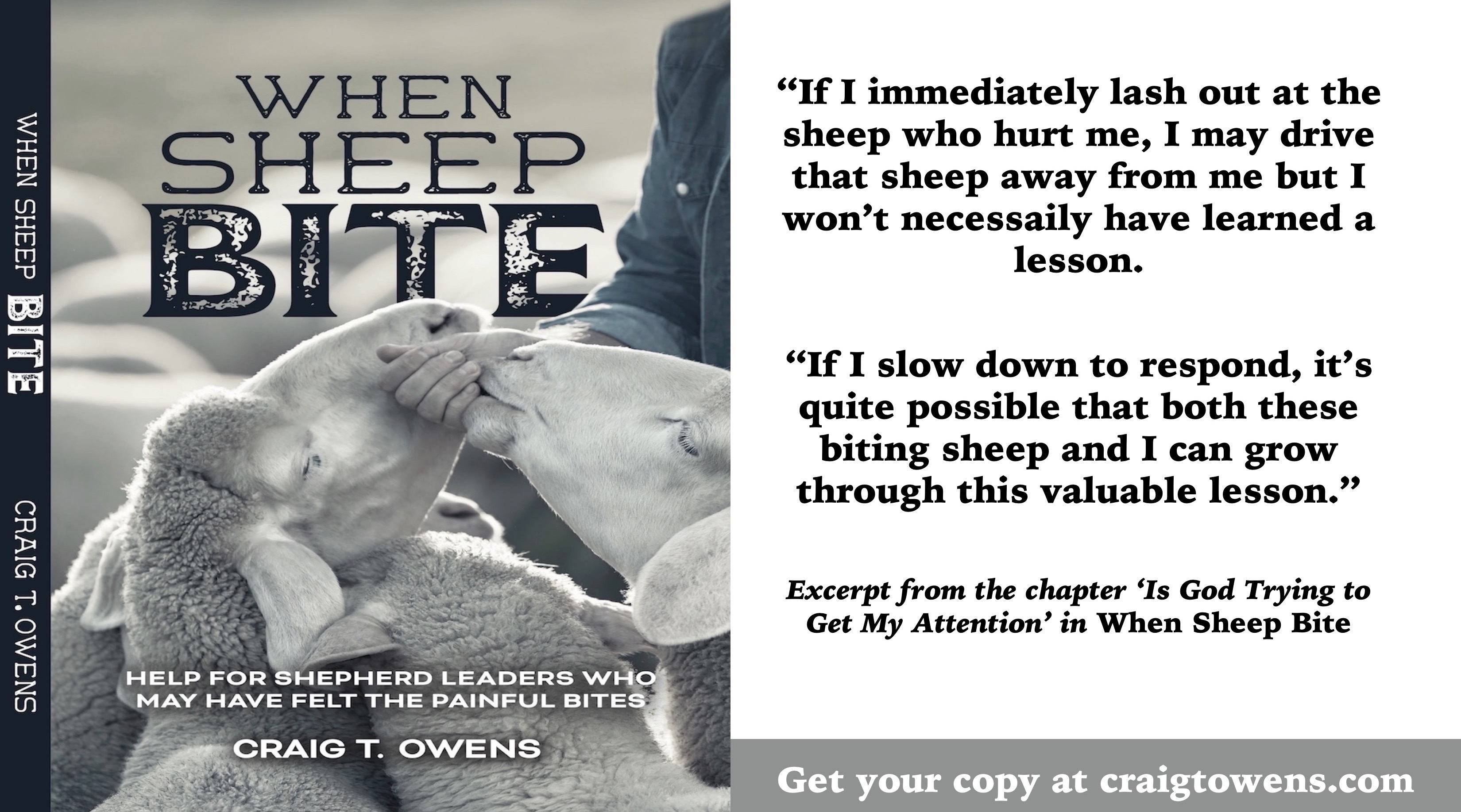
It is only this humble reflection that can turn an experience into a lesson. If I immediately lash out at the sheep who hurt me, I may drive that sheep away from me but I won’t necessarily have learned a lesson. The one who bit me may have left my pasture, but perhaps they will never join any other pasture but may wander in the wilderness for the rest of their life. If I slow down to respond, it’s quite possible that both these biting sheep and I can grow through this valuable lesson.
Let’e reframe the way we think about critics and their criticism. Before we simply dismiss it, let’s prayerfully consider if there is a lesson that God is trying to teach to us through this critic.
Listen to the podcast of this post by clicking on the player below, and you can also subscribe on Apple, Spotify, or Audible.
People get into fights for lots of silly reasons. But one thing that causes many hurt feelings and harsh responses is gossip. This is one of the “sheep bites” I discuss in great detail in my book When Sheep Bite.
In the chapter “When Sheep Gossip About You,” I wrote—
The first part of the antidote when you have heard gossip spoken about you is to remember that God has also heard the gossip spoken about you. This is what Jesus demonstrated for us. Peter, who was there to hear all of the gossip spoken about Jesus, wrote, “He did not retaliate when He was insulted, nor threaten revenge when He suffered. He left His case in the hands of God, who always judges fairly” (1 Peter 2:23 NLT). …
There was no need for Moses to respond to these gossipers because the One “who always judges fairly” said to these gossipers, “Why then were you not afraid to speak against My servant Moses?” (Numbers 12:8). When God takes up our cause, let’s not try to take it out of His perfectly just hands. …
Just because God has called you to be His under-shepherd, and just because you may have been innocent of wrongdoing, you don’t have license to “lord it over” those who have gossiped about you. Moses described himself as humble—more humble than anyone else. He wasn’t bragging, but he wrote those words under the inspiration of the Holy Spirit. An insecure leader feels the need to defend himself against any slight against his character, whether it is a real or perceived attack. But the humble leader knows that God’s calling comes with God’s protection.
Solomon wrote, “Avoiding strife is an honor for a person, but any fool will quarrel” (Proverbs 20:3).
Anyone can start a fight—it’s not hard at all! Especially when someone has spoken foolishly, ignorantly, or even maliciously against you in their gossip.
Butonly strong people can walk away from a fight.
Only wise people can remain quiet when a fool tries to provoke them into an argument.
Only God-fearing people can entrust themselves to the One who keeps perfect records of the insults and slander thrown at them—just as Jesus did.
Be that kind of leader!
If you are a pastor, you know the painful bites of gossip. This is just one of several sheep bites I diagnose to help shepherd leaders find a healing, biblical response. Please check out my book When Sheep Bite.
Listen to the podcast of this post by clicking on the player below, and you can also subscribe on Apple, Spotify, or Audible.
I would like to take you behind the scenes to the origin of my second book. In this video, you will hear how I first came up with the idea for When Sheep Bite, and how the Holy Spirit redirected my original book design.
Check out this episode of The Podcast.
I wrote this in the Introduction to Section One of When Sheep Bite—
I know that when you are in distress you are looking for immediate relief. You may be tempted to jump right to Section 2 of this book where I outline specific thoughts and strategies for handling the ways your sheep are biting and kicking, but I invite you to hold off. … It may appear from your perspective that the fault lies entirely with the attacking sheep—and that you feel that you haven’t done anything to provoke them. But these attacks can open our eyes to things we haven’t noticed before and teach us invaluable lessons, if we are willing to quiet ourselves before the Holy Spirit’s counsel. …
If we don’t have the heart of a shepherd leader, we will not only treat every bite and kick as if it is completely their fault, but we will never be looking for ways to bring healthy correction and restoration to that wayward sheep. Let me remind you that all of us were those wayward sheep—biting God’s hand, running away from Him—when Jesus put His very life on the line to bring us into the sheepfold (Romans 5:6-8). This kind of shepherding doesn’t come just because we outwardly try to do the right thing, but because we have a right heart attitude (Philippians 2:5).
I truly believe that When Sheep Bite will be a healing resource for shepherd leaders who are still feeling the pain of their latest sheep bite. If you are a pastor—or if you love your pastor—please pick up a copy today!
Listen to the podcast of this post by clicking on the player below, and you can also subscribe on Apple, Spotify, or Audible.
When we are going through something difficult or painful, we want to get counsel from someone who has some understanding of what we’re facing. In a word, we want someone empathetic.
Webster’s Dictionary defines empathy as the action of understanding, being aware of, and being sensitive to the feelings, thoughts, and experience of another. If you were telling me about your painful situation, to let you know that I “get you”—that I empathize with you—I might say something like, “I’ve been there, done that, and have the scars to prove it.”
But as I tell you my story, I need to really guard against one-upmanship. Webster’s defines that as the art or practice of outdoing or keeping one jump ahead of a friend or competitor. Saying something like, “Oh, feel your pain, but let me tell you how I had it so much worse” is one-upping and unhelpful!
In my book When Sheep Bite, I wrote this in the Introduction—
When you share a tale of real pain with a trusted friend, you don’t want them to try to one-up your story. Instead, you would want them to comfort you in your pain, to give you some helpful insight, or to even just cry along with you. On the other hand, you probably aren’t going to share your story of pain with someone who has no understanding of your situation. We want someone who “gets us,” someone who can relate, someone who can truly empathize with what we are feeling. …
I want to give you what I wanted when this happened to me: empathy, insight, a helpful perspective, and a manual of help that God has provided in the Bible. I don’t want to try to one-up your story of pain, because I’m confident that no one could truly know how deeply you’ve been hurt. But I do want to give you some assurance that I know what I’m talking about.
As I was discussing some of the ideas in my book with a group of pastors, I reminded them of the value of an iron-sharpening-iron friend (as Solomon describes in Proverbs 27:17) who is empathetic without crossing the line into one-upmanship.
I truly believe that When Sheep Bite will be a healing resource for shepherd leaders who have been there, done that, and have the sheep bite marks to prove it. If you are a pastor—or if you love your pastor—please pick up a copy today!







 Craig T. Owens