Listen to the podcast of this post by clicking on the player below, and you can also subscribe on Apple, Spotify, or Audible.
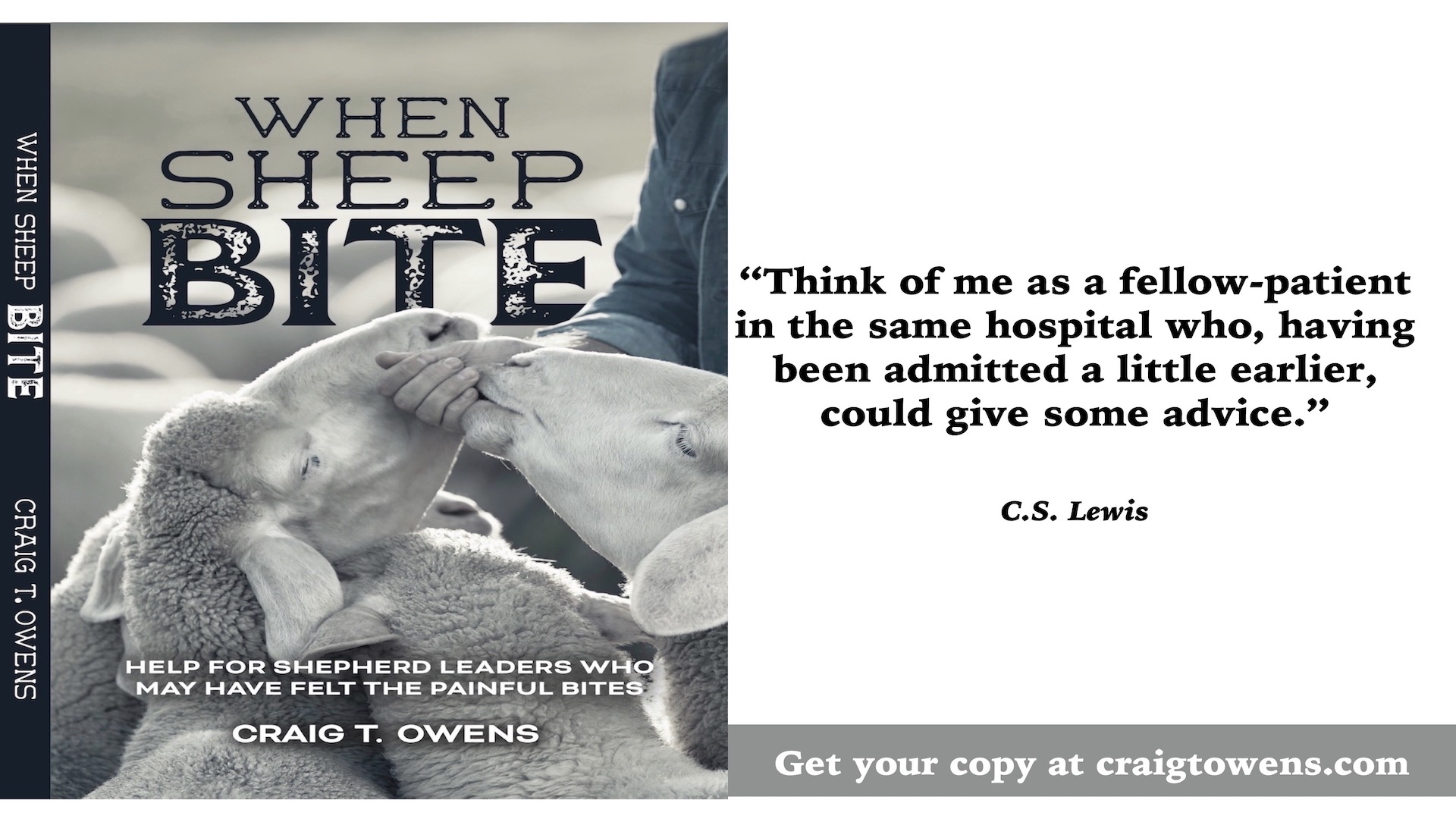
I would like to take you behind the scenes to the origin of my second book. In this video, you will hear how I first came up with the idea for When Sheep Bite, and how the Holy Spirit redirected my original book design.
Check out this episode of The Podcast.
I wrote this in the Introduction to Section One of When Sheep Bite—
I know that when you are in distress you are looking for immediate relief. You may be tempted to jump right to Section 2 of this book where I outline specific thoughts and strategies for handling the ways your sheep are biting and kicking, but I invite you to hold off. … It may appear from your perspective that the fault lies entirely with the attacking sheep—and that you feel that you haven’t done anything to provoke them. But these attacks can open our eyes to things we haven’t noticed before and teach us invaluable lessons, if we are willing to quiet ourselves before the Holy Spirit’s counsel. …
If we don’t have the heart of a shepherd leader, we will not only treat every bite and kick as if it is completely their fault, but we will never be looking for ways to bring healthy correction and restoration to that wayward sheep. Let me remind you that all of us were those wayward sheep—biting God’s hand, running away from Him—when Jesus put His very life on the line to bring us into the sheepfold (Romans 5:6-8). This kind of shepherding doesn’t come just because we outwardly try to do the right thing, but because we have a right heart attitude (Philippians 2:5).
I truly believe that When Sheep Bite will be a healing resource for shepherd leaders who are still feeling the pain of their latest sheep bite. If you are a pastor—or if you love your pastor—please pick up a copy today!
Listen to the podcast of this post by clicking on the player below, and you can also subscribe on Apple, Spotify, or Audible.
When we are going through something difficult or painful, we want to get counsel from someone who has some understanding of what we’re facing. In a word, we want someone empathetic.
Webster’s Dictionary defines empathy as the action of understanding, being aware of, and being sensitive to the feelings, thoughts, and experience of another. If you were telling me about your painful situation, to let you know that I “get you”—that I empathize with you—I might say something like, “I’ve been there, done that, and have the scars to prove it.”
But as I tell you my story, I need to really guard against one-upmanship. Webster’s defines that as the art or practice of outdoing or keeping one jump ahead of a friend or competitor. Saying something like, “Oh, feel your pain, but let me tell you how I had it so much worse” is one-upping and unhelpful!
In my book When Sheep Bite, I wrote this in the Introduction—
When you share a tale of real pain with a trusted friend, you don’t want them to try to one-up your story. Instead, you would want them to comfort you in your pain, to give you some helpful insight, or to even just cry along with you. On the other hand, you probably aren’t going to share your story of pain with someone who has no understanding of your situation. We want someone who “gets us,” someone who can relate, someone who can truly empathize with what we are feeling. …
I want to give you what I wanted when this happened to me: empathy, insight, a helpful perspective, and a manual of help that God has provided in the Bible. I don’t want to try to one-up your story of pain, because I’m confident that no one could truly know how deeply you’ve been hurt. But I do want to give you some assurance that I know what I’m talking about.
As I was discussing some of the ideas in my book with a group of pastors, I reminded them of the value of an iron-sharpening-iron friend (as Solomon describes in Proverbs 27:17) who is empathetic without crossing the line into one-upmanship.
I truly believe that When Sheep Bite will be a healing resource for shepherd leaders who have been there, done that, and have the sheep bite marks to prove it. If you are a pastor—or if you love your pastor—please pick up a copy today!
This is a book I wish I didn’t have to write, but far too many pastors are leaving their ministries too early because of the attacks they have had to endure. When Sheep Bite is help for hurting shepherds.
One pastor has called this book “a must-read for every pastor and ministry leader,” and another pastor said, “This is more than a good book. This is the difference between finishing your race and dropping out.”
Listen to the podcast of this post by clicking on the player below, and you can also subscribe on Apple, Spotify, or Audible.
I want to make sure there are no misunderstandings on this, so please stay with me! I realize that the title of my newest book—When Sheep Bite—may bring a picture to your mind that I never intended.
Check out this episode of The Podcast.
Here are some helpful resources from this episode:
If you would like to watch the full interview I did on the Converge Coaching podcast, check that out here.
Listen to the podcast of this post by clicking on the player below, and you can also subscribe on Apple, Spotify, or Audible.
“Who gave You this authority,” the chief priests twice demanded of Jesus in Luke 20:1-8.
Worldly minded people are always looking for a résumé of accomplishments or the stamp of approval from a superior, so they can demand the unquestioned loyalty from those who report to them. In other words, they are looking for authority from their position that allows them to prove to others that they are in charge.
The “chief priests and the teachers of the law, together with the elders” (v. 1) had earned their positions, or so they thought. They are, therefore, asking Jesus to, “Prove it!” They want to know why Jesus gets to say and do the things He says and does.
Jesus had every right to flex on them! But He knew that His words and deeds spoke for themselves. He “knew that the Father had put all things under His power” (John 13:3) so there was nothing for Him to prove to anyone.
In my book When Sheep Bite, I have a chapter about sheep questioning the authority of their shepherd. In that chapter I wrote—
When our conversation with criticizing sheep hasn’t gone well, and when those unhealthy sheep begin to gossip and then slander, it’s inevitable that they will eventually began to question your authority as a shepherd. Perhaps they think you’re too young and naive, or too old and out of touch. They may question your motives, or the vision you’ve imparted for the church, or your ability to follow through on what you have already shared. Whatever the case, these biting sheep seem to be implying that they know better than you do how this pasture should be run. During times like these, it is tempting to want to “prove” that we are qualified, that we do know what we’re doing, and that we can indeed successfully pursue the vision we’ve articulated for them. Once again, it’s natural to want to say, “I’ll show you just how qualified I am!”
Before we respond, we need to recognize the source of our authority. … Far greater than positional authority is moral authority. This is authority that comes not merely from a title or position, but from who conferred that title or position on the leader. If God has called us and appointed us to this pasture, that is all the authority we need.
Jesus didn’t answer the “Prove it!” demand, but went right on teaching and serving. We need to remember that there is only One to whom we must give an answer. There is only One who can say to us either, “Depart for Me,” or “Well done, good and faithful servant!”
A mark of a godly leader is one who is quietly confident of his moral authority.
As a result, that leader no longer feels the need to prove anything.
This is part 78 in my series on godly leadership. You can check out all of my posts in this series by clicking here.
In January 1647, Oliver Cromwell captured King Charles I during the British Revolution. Within just a few months, Charles escaped and was able to raise another army. A year later, in August 1648, Cromwell’s forces once again defeated the army Charles had raised, and once again Charles was taken prisoner.
Oliver Cromwell put Charles on trial for his crimes, and after the guilty verdict was pronounced, Charles I was executed. A total of 59 people signed the former king’s death warrant.
Fast forward eleven years and Oliver Cromwell had died and his son Richard had taken his place as Lord Protector of England. Unlike his father, there was great discontent with Richard’s leadership. As a result, the Loyalists were able to sweep Charles II into power.
After assuming the throne of England, Charles II wanted the 59 death warrant signers put on trial, but fifteen of them had already died. That little fact didn’t stop King Charles II. He ordered that their bodies be exhumed, placed on trial, convicted of their crimes, and then hung.
I’m no psychologist, but I think it’s safe to say that Charles II might have had a slight problem with unforgiveness!
This is from a chapter I entitled “The ties that no longer bind.” The insidious nature of unforgiveness is that it ties us to the one who injured or offended us.
Jesus taught us to pray, “Forgive us our debts, as we also have forgiven our debtors” (Matthew 6:12). The word He uses for “debts” means something justly or legally due, or an offense or sin that has been committed. So a debtor is one who morally or legally owes another for the wrong committed.
So for these debts, we are taught to ask for forgiveness of God and to give that same forgiveness to others. Jesus uses the same root word for both “forgive” and “forgiven,” but there are nuances that make the picture quite clear.
When we ask God to forgive our debts, it is the active voice (I have to ask for it) and it is stated in the second person (I have to receive it). When I ask my Heavenly Father for this, my offense has been paid-in-full because the legal and moral requirements aren’t due any longer. I couldn’t pay this debt on my own, but Jesus paid it for me (2 Corinthians 5:21).
When I forgive someone who has wronged me, it is again the active voice (I have to give it), but it is now in the first person (I don’t wait around for the other person to ask for forgiveness). I let it go. I don’t hinder the other person or myself with waiting for the penalty to be paid any longer.
This is the only part of this model prayer for which Jesus gives a commentary afterwards (in Matthew 6:14-15). With this, Jesus is teaching us that to say, “I’m forgiven” is also to say, “I’m forgiving.”
Unlike Charles II, when we are forgiven and forgiving, the inevitable result is freedom for both ourselves and our offenders.
If we practice this relentlessly, we are both freed ourselves and freeing others!
When we pray, “Forgive as we also have forgiven,” we are both acknowledging His power to forgive us and requesting the faith need to be forgiving people. As C.S. Lewis noted, “To be a Christian means to forgive the inexcusable, because God has forgiven the inexcusable in you.”
The Bible describes satan’s activity as stealing, killing, and destroying. He’s called the father of lies, so he uses slander to try to steal, kill, and destroy. His slander is: “God can’t forgive that” and “You shouldn’t let them off the hook for what they did to you.”
These two thoughts are linked, just as “I’m forgiven” and “I’m forgiving” are linked. If I begin tothink that what someone did to me was too big for me to forgive, then I can also believe that there is a sin I have committed that is too big for God to forgive. But when I live both receiving and giving forgiveness, I can tune out this lie from hell.
After I wrote the best-selling book Shepherd Leadership, I started naturally gravitating toward anything shepherd related. A Shepherd Looks at Psalm 23 was the perfect fit for me! But I think anyone will enjoy these beautiful insights on Psalm 23. Check out my full book review here.
Here are some quotes that especially caught my eye—
“Sheep do not ‘just take care of themselves’ as some might suppose. They require, more than any other class of livestock, endless attention and meticulous care. … From early dawn until late at night this utterly selfless Shepherd is alert to the welfare of His flock. … Above all, He is very jealous of His name and high reputation as the Good Shepherd. He is the Owner who delights in His flock. For Him there is no greater reward, no deeper satisfaction, than that of seeing His sheep contented, well fed, safe, and flourishing under His care. This is indeed His very ‘life.’ He gives all He has to it. He literally lays Himself out for those who are His. He will go to no end of trouble and labor to supply them with the finest grazing, the richest pasturage, ample winter feed, and clean water. He will spare Himself no pains to provide shelter from storms, protection from ruthless enemies and the diseases and parasites to which sheep are so susceptible.”
“A flock that is restless, discontented, always agitated and disturbed never does well. … When one startled sheep runs in fright, a dozen others will bolt with it in blind fear, not waiting to see what frightened them.”
“In the course of time I came to realize that nothing so quieted and reassured the sheep as to see me in the field. The presence of their master and owner and protector put them at ease as nothing else could do, and this applied day and night. … When my eyes are on my Master they are not on those around me. This is the place of peace.”
“Only those intimately acquainted with sheep and their habits understand the significance of a ‘cast’ sheep or a ‘cast down’ sheep. This is an old English shepherd’s term for a sheep that has turned over on its back and cannot get up again by itself.”
“Sheep are notorious creatures of habit. If left to themselves, they will follow the same trails until they become ruts; graze the same hills until they turn to desert wastes; pollute their own ground until it is corrupt with disease and parasites. … No other class of livestock requires more careful handling, more detail direction, than do sheep.”
My Patreon supporters had early access to these quotes, plus I have shared many more quotes from this book with these friends.
My newest book When Sheep Bite is releasing soon. You can pre-order a copy for yourself here.
Writing Shepherd Leadership opened the door for me to have a lot of conversations with pastors, and I discovered just how beat up so many of them feel. As a result, I am working on a new book called When Sheep Bite as a way to help these pastors not just survive, but thrive in their ministry. I am self-publishing this book, and I could really use your financial investment in this project. I’ve got some special offers for you. Please check out this link and prayerfully consider helping me help these hurting pastors.
I love learning more about the historicity of the Bible! If you do too, check out this archeological biography of King Jehoram. And if you would like to keep the history of the kings and prophets straight, this side-by-side chart is one of the most downloaded resources I have ever produced.
“I can accept failure. Everyone fails at something. But I can’t accept not trying.” —Michael Jordan